


This article explores the Best Secondary Market Platforms for Private Shares in 2026 and the ways they provide liquidity, compliance, and access for investors and employees. The global market leaders (Forge Global, EquityZen) and regional experts (Ledgy, Qapita) have created unique models such as reverse auctions, SPVs, and continuous trading models.
- What Is a Secondary Market for Private Shares?
- How We Selected the Best Platforms
- Key Points
- 1. Forge Global
- Forge Global Key Characteristics
- 2. EquityZen
- EquityZen Key Characteristics
- 3. Nasdaq Private Market
- Nasdaq Private Market Key Characteristics
- 4. Hiive
- Hiive Key Characteristics
- 5. Carta Liquidity
- Carta Liquidity Key Characteristics
- 6. ShareForce
- ShareForce Key Characteristics
- 7. Pulley
- Pulley Key Characteristics
- 8. Ledgy
- Ledgy Key Characteristics
- 9. Qapita
- Qapita Key Characteristics
- 10. Global Shares
- Global Shares Key Characteristics
- Conclusion
- FAQ
With their offerings, they are redefining the private equity industry and creating a balance between transparency and access, while retaining sufficient control.
What Is a Secondary Market for Private Shares?
A secondary market for private shares is a stock exchange aimed at providing an avenue for employees and investors to buy or sell shares of private companies before they go public or get acquired. Unlike public stock exchanges, these markets implement more regulations and usually need accredited investors.
Some of the services that operate in these spaces provide liquidity through SPVs, auctions, and bid/ask exchange. They allow employees to cash out ESOPs and investors to invest before an IPO, but require the approval of the company, as well as a certain minimum investment and a fee for each trade.
How We Selected the Best Platforms
| Criteria | What to Check | Suggested Weight |
|---|---|---|
| Founding & Credibility | Year founded, track record, regulatory licensing, institutional backing | 20% |
| Market Focus & Liquidity Model | Target companies (early-stage, late-stage, unicorns), liquidity type (SPV, auction, bid/ask) | 25% |
| Company Access & Investor Eligibility | Number of issuers listed, employee participation, accredited investor requirements | 20% |
| Minimum Investment & Fees | Entry thresholds ($10K–$100K), transaction fees (2–5%), SPV costs | 20% |
| Regional Strengths & Compliance | Geographic coverage (US, EU, APAC), regulatory expertise, governance standards | 15% |
Key Points
| Platform | Key Strengths | Best For |
|---|---|---|
| Forge Global | Largest marketplace, live bid/ask pricing, “Forge Price™” valuation | Institutional investors, accredited buyers |
| EquityZen | SPV structures, lower minimums ($10K–$20K), pre-IPO focus | Mid-sized investors, employees selling ESOPs |
| Nasdaq Private Market | Company-sponsored tender offers, structured liquidity programs | Employees in firms organizing liquidity events |
| Hiive | Real-time anonymous bid/ask, competitive fees, Hiive50 Index | Accredited investors seeking transparent pricing |
| Carta Liquidity | Integrated with Carta cap tables, employee liquidity programs | Startups using Carta for equity management |
| ShareForce | Multi-jurisdiction compliance, cap table accuracy, IFRS/ASC reporting | Global private firms with complex structures |
| Pulley | Fast onboarding, simple cap table + option management | Early-stage startups |
| Ledgy | Scenario modeling, strong European presence | EU-based growth companies |
| Qapita | APAC-focused, ESOP administration + liquidity events | Asia-Pacific startups |
| Global Shares | Equity plan management, liquidity event support | Mid-market firms scaling internationally |
1. Forge Global
Founded in 2014, Forge Global, based in San Francisco, is the largest secondary marketplace for private shares. Forge Global targets late-stage unicorns and pre-IPO companies.
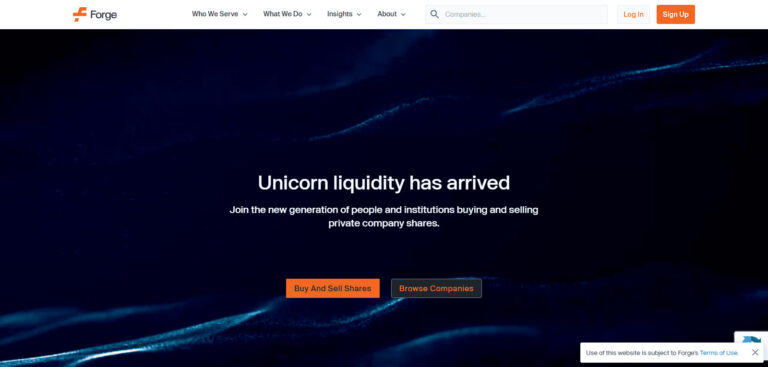
Forge Global’s liquidity model establishes a live bid/ask market with Forge Price™ benchmarks to provide market participants with transparent valuations. Forge Global operates as a regulated broker-dealer and, as a result, is able to provide coverage to a broad range of customers comprising thousands of issuers.
Investors who are accredited and are institutional dominate clientele. The minimum investment of $100,000 reflects the institutional focus. Pricing is around 5% of the transaction value per side. Forge Global provides the most liquidity of any service for secondary trades of private equity, providing customers market depth and employees a reliable exit.
Forge Global Key Characteristics
- Founded: 2014, San Francisco
- Market Focus: Late-stage unicorns & pre-IPO firms
- Liquidity Model: Live bid/ask exchange with Forge Price™ benchmarks
- Investor Type: Accredited & institutional investors
- Minimum Investment: ~$100K, fees ~5% per side
| Advantages | Disadvantages |
|---|---|
| Largest marketplace with deep liquidity | High minimum investment (~$100K) |
| Transparent pricing via Forge Price™ | Fees around 5% per side |
| Strong institutional investor base | Limited access for smaller investors |
| Wide company coverage (thousands of issuers) | Complex compliance requirements |
| Real-time bid/ask market depth | ROFR clauses may block trades |
2. EquityZen
Started in 2013, EquityZen was founded in New York to provide access to private shares for all investors. The companies it generally works with are in the growth phase and are preparing to go public. The SPV (special purpose vehicle) structure is how EquityZen offers liquidity.
EquityZen’s model is a marketplace and broker-dealer combined. There are hundreds of pre-IPO tech companies that investors can choose from. Accredited individuals and family offices are the types of investors that EquityZen works with, as well as smaller institutions.
EquityZen has an edge in the marketplace because employees are able to sell their shares of ESOPs, and investors are able to gain access to opportunities to invest in shares before an IPO is complete, with low capital.
EquityZen Key Characteristics
- Founded: 2013, New York
- Market Focus: Mid-stage growth companies nearing IPO
- Liquidity Model: SPV structures pooling investors
- Investor Type: Accredited individuals, family offices
- Minimum Investment: $10K–$20K, fees ~5% + SPV costs
| Advantages | Disadvantages |
|---|---|
| Lower minimums ($10K–$20K) | SPV structures add extra costs |
| Accessible to mid-sized accredited investors | Limited liquidity compared to Forge |
| Focus on pre-IPO opportunities | Fees ~5% + SPV expenses |
| Employee ESOP selling made easy | Valuations less transparent |
| Strong tech company coverage | Smaller deal sizes |
3. Nasdaq Private Market
Established in 2013 as a subsidiary of Nasdaq, Nasdaq Private Market focuses on structured liquidity. It mainly serves company-initiated tender and/or repurchase offers. Its liquidity model is centralized auction ensuring primary control over price. It is an institutional exchange provided by Nasdaq.

Access is restricted to firms running liquidity programs, mainly (but not limited to) unicorns and growth companies. Investors are employees, executives, and approved institutional buyers. Investment levels for most transactions are set at $50K.
Each transaction is priced individually, and fees are split between the issuers and the investors.Private Market is a dedicated liquidity solution for firms seeking control over the amount of liquidity while in possession of governance, and therefore, is the preferred solution for firms looking to transact through secondary sales.
Nasdaq Private Market Key Characteristics
- Founded: 2013, Nasdaq spin-off
- Market Focus: Company-sponsored tender offers & buybacks
- Liquidity Model: Centralized auctions, issuer-approved events
- Investor Type: Employees, executives, institutions
- Minimum Investment: ~$50K, fees negotiated per event
| Advantages | Disadvantages |
|---|---|
| Backed by Nasdaq credibility | Only company-sponsored events |
| Structured tender offers ensure compliance | Limited investor flexibility |
| Strong governance and transparency | Minimums often ~$50K |
| Ideal for employee liquidity programs | Pricing not always market-driven |
| Trusted by unicorns & growth firms | Access restricted to approved buyers |
4. Hiive
Hiive launched in Canada in 2021 as a platform supporting liquidity in late stage, unicorn and pre IPO companies via a reserve-based trading model similar to trading on a public exchange, with a marketplace and broker dealer license.
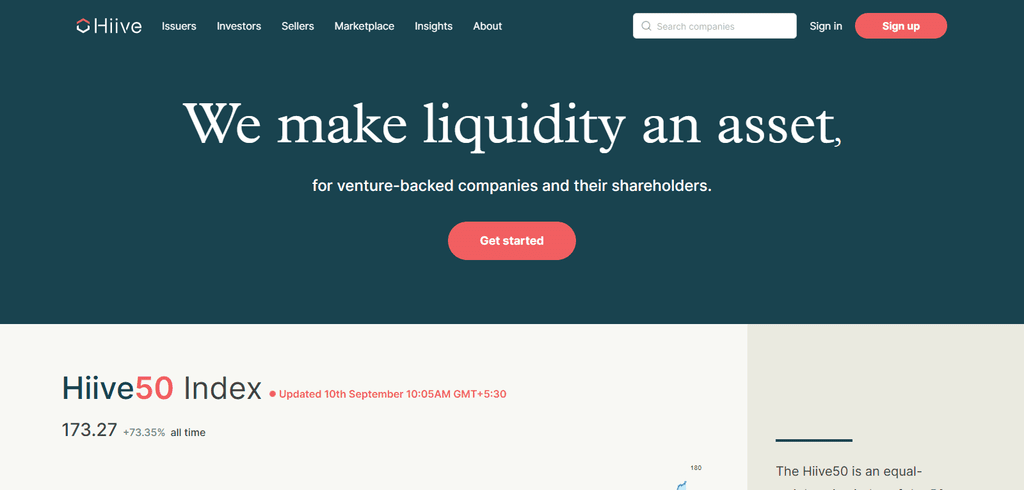
Hiive gives companies access to hundreds of potential investors with a Hiive50 Index of select companies. Hiive’s clients are accredited investors wanting to invest in private companies, with capital requirements starting at $25,000 to $50,000 compared to Equity Zen’s $10,000 minimum.
Hiive charges low pricing at 2% to 3% per side, competing with Equity Zen and below Forge Global’s pricing. Hiive trades on the speed and transparency of its execution at slow Forge trades in 2026.
Hiive Key Characteristics
- Founded: 2021, Canada
- Market Focus: Late-stage startups & unicorns
- Liquidity Model: Real-time anonymous bid/ask matching
- Investor Type: Accredited investors seeking transparency
- Minimum Investment: $25K–$50K, fees ~2–3% per side
| Advantages | Disadvantages |
|---|---|
| Real-time anonymous bid/ask | Newer platform, less proven |
| Lower fees (~2–3%) | Minimums $25K–$50K |
| Transparent pricing model | Smaller company coverage than Forge |
| Hiive50 Index tracks top issuers | Limited institutional participation |
| Fast-growing marketplace | Dependent on accredited investors only |
5. Carta Liquidity
Carta Liquidity was launched in 2021 after Carta Inc. launched in 2012 as a primary cap table management solution. Its secondary market focuses on startups using Carta for equity administration. Liquidity is offered through company-approved liquidity events and bilateral trades.

Carta Liquidity has a SaaS+broker-dealer model and has strong company access as it manages equity for 30,000+ startups. Investors are employees, executives, and accredited investors. The minimum investment is $25,000 although it varies. Fees are around 3-5%, and issuers sometimes pay the fees.
Carta Liquidity has an advantage of integrated secondary market trading with cap table management. It offers compliance as well as ease of execution. Startups organizing liquidity events prefer Carta Liquidity over competitors.
Carta Liquidity Key Characteristics
- Founded: Carta (2012), Liquidity arm launched 2021
- Market Focus: Startups using Carta cap table management
- Liquidity Model: Company-approved events & bilateral trades
- Investor Type: Employees, founders, accredited investors
- Minimum Investment: ~$25K, fees ~3–5% per side
| Advantages | Disadvantages |
|---|---|
| Integrated with Carta cap tables | Only available to Carta-managed firms |
| Seamless compliance & reporting | Fees ~3–5% per side |
| Strong employee liquidity programs | Minimums ~$25K |
| Trusted by 30K+ startups | Limited open-market trading |
| Hybrid SaaS + broker-dealer model | Company approval required for trades |
6. ShareForce
ShareForce, started in 2018, has a compliance-first approach to creating a global secondary market. Focused mostly on multi-jurisdictional firms with complex structures in the private markets, ShareForce’s liquidity model is structured transactions with IFRS/ASC reporting.
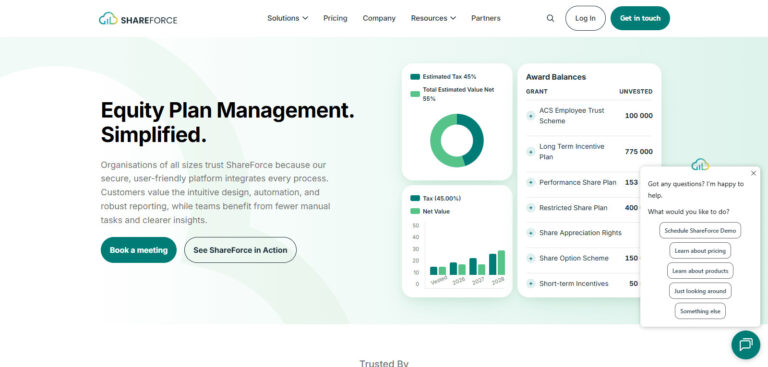
The model is enterprise SaaS + broker dealer and the company access is throughout Europe, Asia, and Africa. The type of investors are Institutional Investors and PE funds as well as accredited buyers. Typically they have a minimum investment of $50K-$100K. Pricing is typically 4-5% on either side with additional compliance costs.
One of ShareForce’s biggest selling points is their focus on accuracy of cap tables as well as regulatory compliance. Which makes ShareForce a great partner for firms that need cross border liquidity and still maintain accounting and governance standards.
ShareForce Key Characteristics
- Founded: 2018, global compliance-first platform
- Market Focus: Multi-jurisdictional firms with complex structures
- Liquidity Model: Structured transactions with IFRS/ASC reporting
- Investor Type: Institutions, PE funds, accredited buyers
- Minimum Investment: $50K-100K, fees ~ 4-5% per side
| Advantages | Disadvantages |
|---|---|
| Multi-jurisdiction compliance expertise | Higher fees (~4–5%) |
| IFRS/ASC reporting for governance | Minimums $50K–$100K |
| Ideal for complex structures | Less accessible for small investors |
| Strong institutional investor base | Slower transaction speed |
| Global coverage across regions | Focused on enterprise-level firms |
7. Pulley
Pulley, which launched in the US in 2019, includes an equity management tool and a SaaS platform for providing liquidity in 2025, focusing on early-stage startups. The liquidity model includes trades and company-approved events. Basic company access is early-stage companies that use Pulley.

The model mainly reaches employee-investors, founders, and accredited fund investors. The minimum investment is about $10K–$25K. The pricing is approximately 3–4% per side. Pulley’s competitive edge focuses on simplicity and speed.
For early-stage startups, investor fund liquidity solutions can quickly drive revenue with light compliance. The complexity of the compliance is not worth the overhead cost to the company.
Pulley Key Characteristics
- Founded: 2019, USA
- Focused market: Early-stage startups
- Company liquidity: Approved events and bilateral trades
- Type of investors: Employees, founding members and accredited investors
- Minimum investment: $10K-25K, fees ~3-4% per side
| Advantages | Disadvantages |
|---|---|
| Simple cap table + liquidity integration | Smaller company coverage |
| Accessible minimums ($10K–$25K) | Fees ~3–4% |
| Fast onboarding for startups | Limited institutional participation |
| Ideal for early-stage firms | Liquidity depends on company approval |
| Lightweight compliance overhead | Less transparent pricing |
8. Ledgy
Founded in 2017 in Switzerland, Ledgy is Europe’s leading equity management platform. Its target market consists of growing companies within the European region. Their liquidity model consists of scenario modeling and structured liquidity events. Their model is Saas with secondary trading integration.

Company access consists of hundreds of EU startups and scale-ups. Investors include employees, founders, and accredited investors. The minimum investment is commonly between €20K-€50K. Pricing consists of a 3-5% commission on either side, and subsidies are available on the issuer’s side.
Ledgy’s regulatory expertise in Europe and it’s modeling of complex scenarios makes it the leading platform for EU companies looking to design custom liquidity programs.
Ledgy Key Characteristics
- Founded: 2017, Switzerland
- Focused market: European growth stage companies
- Company liquidity: Structured events and scenario modeling
- Type of investors: Employees, founding members and accredited investors
- Minimum investment: €20K-50K, fees ~3-5% per side
| Advantages | Disadvantages |
|---|---|
| Strong European regulatory expertise | Fees ~3–5% |
| Scenario modeling for liquidity events | Minimums €20K–€50K |
| Trusted by EU startups & scale-ups | Limited outside Europe |
| Employee & founder participation | Smaller liquidity pool |
| SaaS integration with equity management | Company approval required |
9. Qapita
Founded in 2019, Qapita is Asia Pacific’s leading equity management and liquidity platform, with a focus on startups and unicorns in the APAC region. Qapita’s liquidity model pertains to company-approved liquidity events and bilateral trading. Qapita’s model operates as a SaaS and broker-dealer hybrid.
The firm has access to over 500 companies in India, Singapore, and Indonesia. Qapita’s clients are employees, founders, and accredited investors. Typically, investments range from $20,000 to $50,000. Pricing is approximately 3% to 5% per side.
By 2026, Qapita projects itself to be the most trusted secondary platform in Asia-Pacific due to its regional expertise, administration of ESOPs, and integration of regional compliance frameworks.
Qapita Key Characteristics
- Founded: 2019, Singapore
- Focused market: APAC startups and unicorns
- Company liquidity: Bilateral trades and company-approved events
- Type of investors: Employees, founding members and accredited investors
- Minimum investment: $20K-50K,fees ~3-5% per side
| Advantages | Disadvantages |
|---|---|
| APAC regional expertise | Fees ~3–5% |
| ESOP administration + liquidity | Minimums $20K–$50K |
| Trusted by India & SE Asia startups | Limited global coverage |
| Company-approved events ensure compliance | Smaller investor base |
| Hybrid SaaS + broker-dealer | Dependent on local regulations |
10. Global Shares
Based in Ireland and founded in 2005, Global Shares helped grow JPMorgan’s equity plan management when acquired in 2022. Global Shares services mid-market firms as they scale internationally. Their liquidity model combines liquidity events with equity plans. Their platform is enterprise SaaS and broker-dealer.

Global Shares has access to thousands of firms globally. Investors are employees, executives, and accredited investors. Their minimum investment is around $25 K to $50 K. Cost is around 4-5% price issued, with issuers covering some of the cost.
Global Shares has a competitive advantage with JPMorgan’s ownership and the associated institutional equities network. Global Shares helps firms meet their needs for liquidity globally.
Global Shares Key Characteristics
- Founded: 2005, Ireland (sold to JPMorgan in 2022)
- Focused market: Mid-sized companies scaling internationally
- Company liquidity: Equity plan-integrated structured events
- Type of investors: Employees, executives and accredited investors
- Minimum investment: $25K-50K, fees ~4-5% per side
| Advantages | Disadvantages |
|---|---|
| Backed by JPMorgan network | Fees ~4–5% |
| Strong equity plan integration | Minimums $25K–$50K |
| Global coverage across firms | Access limited to accredited investors |
| Ideal for mid-market scaling firms | Company approval required |
| Trusted enterprise SaaS platform | Slower liquidity compared to Hiive |
Conclusion
In 2026, private share secondary market offerings have differentiated themselves to appeal to more diverse types of investors and companies. Forge Global and EquityZen are large players known for big market coverage and ease of participation.
Nasdaq Private Market and Carta Liquidity provide orderly corporate sanctioned liquidity events. Hiive is one of the challenger platforms and provides lower costs and increased transparency. Ledgy and Qapita are regional champions, respectively in Europe and APAC, offering local market compliance.
ShareForce and Global Shares focus on enterprise and governance, while Pulley is built for governance flexibility. This array of options is intended to increase access to compliant markets while adding more transparent routes for equity holders to increase their realized value.
FAQ
What is a secondary market for private shares?
A secondary market allows investors and employees to buy or sell shares of private companies before they go public. Platforms like Forge Global and EquityZen provide liquidity by matching buyers and sellers of pre-IPO stock.
Which platform has the lowest minimum investment?
EquityZen and Pulley offer minimums as low as $10K–$20K, making them accessible to smaller accredited investors. In contrast, Forge Global often requires $100K+, targeting institutions.
Do I need to be an accredited investor?
Yes. Platforms like Forge Global, Hiive, and EquityZen require SEC-accredited investor status. Company-sponsored events on Nasdaq Private Market or Carta Liquidity may allow employees to participate directly.
Which platform is best for employees selling ESOPs?
EquityZen, Carta Liquidity, and Nasdaq Private Market are designed for employee liquidity programs, offering structured tender offers or SPVs to simplify selling ESOPs.
What fees do these platforms charge?
Fees typically range from 2–5% per side. Hiive is competitive at ~2–3%, while Forge Global and EquityZen average ~5%. Company-sponsored events may have issuer-subsidized fees.