

In this article, I will talk about Best Avalanche Node Providers for developers, validators, and Web3 applications. I will go through the best providers in terms of Avalanche support, price, API access, supported networks, infrastructure, backup options, scalability, reliability and technical support. This comparison will help you select the right Avalanche node provider according to your specific performance, deployment and infrastructure needs.
What Are Avalanche Node Providers?
Avalanche node providers are infrastructure companies offering managed access to Avalanche blockchain nodes, RPC endpoints, APIs, and other services. These providers can be used by developers and businesses to connect applications to Avalanche networks without having to build, configure and maintain node infrastructure independently.
Their services could include node deployment, API access, monitoring, backups, security, scaling and technical support. Depending on the provider, users can query Avalanche C-Chain, P-Chain, and X-Chain data as well as dedicated or shared infrastructure.
These services are valuable for dApps, validators, wallets, exchanges, analytics platforms and other applications that require reliable Avalanche connectivity.
Benefits Of Avalanche Node Providers
Faster Node Deployment: Providers hide the complexity of deploying Avalanche nodes, so developers are able to deploy infrastructure without the need to manually set up servers, networking, software, and blockchain clients.
Less infrastructure management: Managed services help to remove the need to manage routine maintenance, software upgrades, monitoring, server configuration and troubleshooting of nodes internally.
Reliable access to the blockchain: Professional infrastructure can provide stable RPC and API connectivity, giving dApps, wallets, exchanges and other applications consistent access to Avalanche data.
Easy Scalability: Users can scale up computing resources, API capacity, storage or dedicated infrastructure as application traffic and blockchain workloads expand.
API Access: Avalanche node providers offer RPC, REST, WebSocket or other API interfaces that facilitate communication between applications and Avalanche networks.
Improved Monitoring: Many providers offer dashboards, health checks, alerts and performance monitoring to help teams quickly identify node or connectivity problems.
Security Features: Managed infrastructure might provide access control, firewalls, DDoS protection, private endpoints and more security features for production blockchain applications.
Multi-Chain Infrastructure: Developers may often obtain access to many supported networks through one infrastructure provider, including Ethereum, Polygon, Solana, Avalanche, Arbitrum and others.
Backup and recovery: Backup, failover, snapshots or recovery features can help reduce the impact of infrastructure failures, depending on the provider and plan.
Supporto Tecnico: Dedicated infrastructure teams can help with deployment, configuration, API connectivity, performance issues and other technical node related issues.
Key Points
| Provider | Key Point |
|---|---|
| Chainstack | Offers enterprise-grade Avalanche RPC and node infrastructure with global low-latency routing, dedicated nodes, subnet support, and high uptime guarantees for production Web3 applications. |
| Alchemy | One of the largest blockchain infrastructure platforms, providing Avalanche RPC endpoints, developer tooling, analytics, and scalable enterprise infrastructure trusted by major Web3 projects. |
| QuickNode | Delivers high-performance Avalanche nodes with fast response times, extensive APIs, analytics tools, and global infrastructure designed for developers and enterprises. |
| Ankr | Provides Avalanche RPC endpoints through a globally distributed infrastructure network, featuring high throughput, archive access, and scalable pay-as-you-go pricing. |
| Infura | A leading blockchain infrastructure provider offering managed Avalanche RPC services, developer-friendly APIs, and integration with the broader Consensys ecosystem. |
| Lava Network | Uses a decentralized RPC network model that connects Avalanche applications to multiple node operators for enhanced reliability, privacy, and redundancy. |
| GetBlock | Offers instant access to Avalanche shared and dedicated nodes with support for multiple blockchain networks, making it suitable for developers and startups. |
| NOWNodes | Provides Avalanche full-node and explorer API access through a Blockchain-as-a-Service platform supporting more than 100 blockchain networks. |
| OnFinality | Delivers scalable Avalanche API endpoints, archive node access, analytics, and enterprise infrastructure for high-volume blockchain applications. |
| BlockPI Network | Focuses on high-performance, low-latency, and cost-efficient RPC infrastructure for Avalanche and other blockchain ecosystems. |
1. Chainstack
Chainstack was founded in 2018 and is headquartered in Singapore. It offers managed blockchain infrastructure for developers and enterprises. It supports Avalanche with managed node and RPC infrastructure, including deployment, monitoring, automated updates, failover and resource scaling. **Pricing Free Developer plan.

Paid plans: Growth ($49/month), Pro ($199/month), Business ($499/month), Enterprise (from $990/month) Chainstack has multiple blockchain networks, API and WebSocket access, operational alerts, archive data, dedicated nodes and scaling options. Its self-healing infrastructure and failover capabilities enhance the reliability of production applications.
| Feature | Details |
|---|---|
| Avalanche Infrastructure | Managed Avalanche node and RPC infrastructure |
| Node Access | Managed nodes and dedicated infrastructure options |
| API Access | HTTP and WebSocket connectivity |
| Deployment | Managed cloud-based blockchain infrastructure |
| Monitoring | Node health and infrastructure monitoring |
| Scaling | Resources and infrastructure can be scaled for growing workloads |
| Reliability | Managed infrastructure with redundancy and failover capabilities |
| Developer Tools | APIs, node management and blockchain infrastructure tooling |
| Multi-Chain | Supports Avalanche and numerous other blockchain networks |
| Best For | Developers, Web3 applications, enterprises and production workloads |
2. Alchemy
Alchemy, a provider of blockchain development infrastructure and APIs for Web3 apps, launched in 2017 and is based in San Francisco, California. It supports Avalanche (among others like Ethereum, Solana, Polygon, Arbitrum, Optimism, Base, BNB Smart Chain).
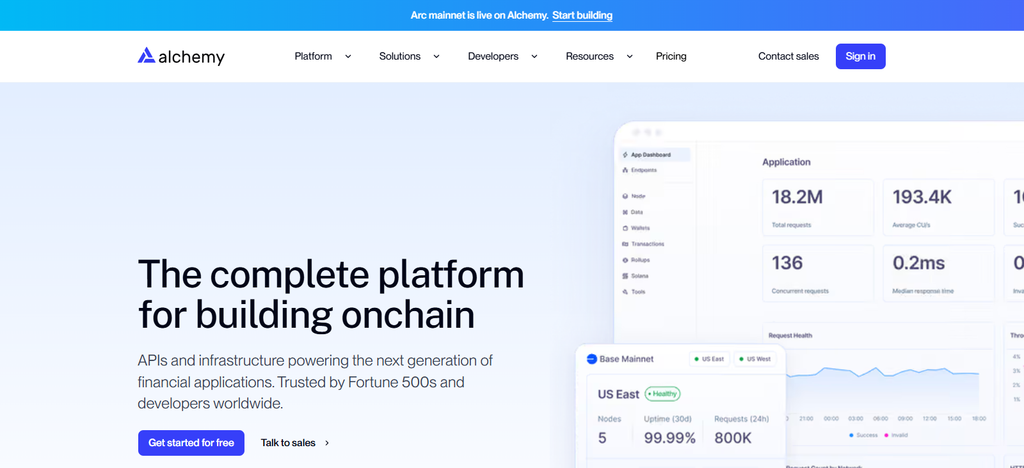
Pricing includes a Free plan that gives you 30 million Compute Units per month, Pay As You Go pricing at $0.525 per million CUs, and custom Enterprise plans. Alchemy provides RPC and API access, webhooks, higher throughput, premium endpoints, enterprise security and scalable capacity.
Alchemy does not prominently publish policies specific to backups, so users should consult their recovery requirements directly with Alchemy.
| Feature | Details |
|---|---|
| Avalanche APIs | Supports Avalanche C-Chain and P-Chain APIs |
| API Access | JSON-RPC access through authenticated API keys |
| P-Chain Support | Validator, staking, delegation and subnet-related API methods |
| C-Chain Support | EVM-compatible smart-contract and blockchain interactions |
| Data Access | Blockchain data retrieval and transaction interaction |
| Scalability | Higher-throughput API access available through paid configurations |
| Developer Tools | SDKs, APIs, dashboards and development tooling |
| Multi-Chain | Supports 100+ blockchain networks across its platform |
| Monitoring | Application and API usage visibility |
| Best For | dApp developers, Web3 applications and teams needing multi-chain APIs |
3. QuickNode
Founded in 2017 and based in Hallandale, Florida, QuickNode builds blockchain infrastructure for developers, enterprises and Web3 apps. Its Avalanche infrastructure has C-Chain, X-Chain and P-Chain APIs supporting smart-contract, asset-transfer, validator, staking, subscription, proposer and debugging.
Pricing is based on endpoint configuration and usage and offers scalable plans for growing workloads. QuickNode provides ** HTTPS and WebSocket API access**, developer tools, monitoring, and infrastructure designed for high availability.
It also supports multiple chains for many other blockchain networks and specific backup setups can depend on the node configuration you choose.
| Feature | Details |
|---|---|
| Avalanche Support | Mainnet and Fuji Testnet |
| C-Chain | EVM-compatible smart-contract APIs |
| P-Chain | Validator, staking and subnet-related APIs |
| X-Chain | Asset creation and transfer APIs |
| API Access | HTTP and WebSocket endpoints |
| Archive Data | Archive access available for Avalanche endpoints |
| Real-Time Data | WebSockets, Streams and Webhooks |
| Global Infrastructure | Requests can be routed toward available locations |
| Security | Endpoint authentication and whitelisting |
| Best For | dApps, DeFi, analytics, developers and production applications |
4. Ankr
Ankr was founded in 2017 and is based in San Francisco, California and provides decentralized Web3 infrastructure and blockchain APIs. Avalanche is powered by Ankr’s Node API which gives RPC, REST and premium gRPC access. **Pricing Free tier Premium Pay-As-You-Go starting at $10/100 million API Credits.
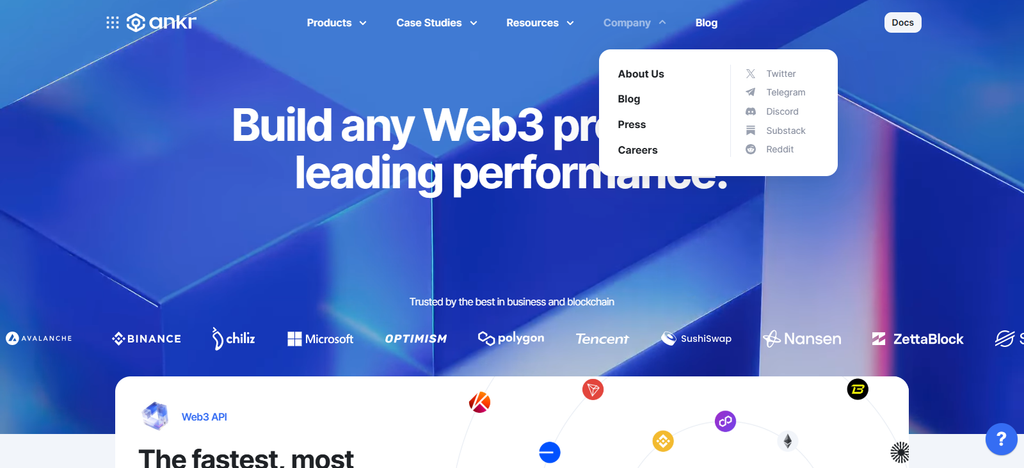
Higher tiers include more throughput and infrastructure capabilities. Ankr connects to many blockchain networks and offers features like HTTPS and WebSocket connectivity, API statistics, whitelisting, dynamic regions, and dedicated infrastructure options.
It scales according to the API usage and throughput. For dedicated deployments, ensure you confirm the backup policies you want.
| Feature | Details |
|---|---|
| Avalanche APIs | C-Chain, P-Chain and X-Chain support |
| EVM API | Standard EVM API for Avalanche |
| API Access | RPC, REST and gRPC options |
| Free Tier | Free monthly API quota |
| Premium Access | Higher request rates and additional API capabilities |
| Scaling | Up to high request throughput on premium infrastructure |
| Regions | Fixed regions on free access and dynamic regions on premium plans |
| WebSocket | WSS available on premium access |
| Analytics | Statistics and API usage visibility |
| Best For | Developers requiring flexible Avalanche API connectivity |
5. Infura
Founded in 2016 and part of ConsenSys since 2019, Infura provides blockchain infrastructure and developer APIs to Web3 applications. It is focused on reliable blockchain connectivity, API access and scalable infrastructure across supported networks.
Availability of avalanche and the precise set of avalanche endpoints should be verified with infura current network documentation prior to deployment. Pricing and limits differ by plan and usage, and API access is meant for applications that need scalable blockchain connectivity.
Infura provides developer tools and enterprise-grade infrastructure across multiple blockchain ecosystems. Backup, dedicated Avalanche configurations and recovery arrangements may depend on the service level chosen.
| Feature | Details |
|---|---|
| Blockchain APIs | Managed blockchain connectivity for application developers |
| Avalanche Access | Avalanche connectivity through supported API infrastructure |
| API Access | RPC/API-based blockchain interaction |
| Developer Access | API keys and developer-oriented infrastructure |
| Multi-Chain | Supports multiple major blockchain ecosystems |
| Scalability | Designed for applications requiring scalable blockchain access |
| Infrastructure | Managed blockchain infrastructure |
| Reliability | Production-focused infrastructure and network access |
| Development | Suitable for smart-contract and dApp connectivity |
| Best For | Developers and enterprises requiring managed blockchain APIs |
6. Lava Network
Lava Network is a decentralized RPC and data-access network that is meant to connect blockchain apps to infrastructure providers. Its Avalanche offering is centered on RPC access for applications to get blockchain data through a distributed provider marketplace instead of a single node operator.
The price will depend on the service chosen and the provider set-up and may not be a single traditional monthly node fee. Built for scalable Web3 applications, Lava provides API access to multiple blockchain networks.
Its distributed architecture is designed to improve provider availability and redundancy. Providers participating in the network may offer different backup, dedicated-node configurations, and direct infrastructure support.
| Feature | Details |
|---|---|
| Infrastructure Model | Decentralized RPC and blockchain data-access network |
| Avalanche | Provides Avalanche RPC/data access through its provider network |
| API Access | RPC-based blockchain connectivity |
| Provider Network | Uses multiple infrastructure providers |
| Redundancy | Distributed provider architecture can reduce dependency on one node |
| Multi-Chain | Designed to support multiple blockchain networks |
| Scalability | Distributed infrastructure is designed for growing RPC demand |
| Availability | Provider-based architecture supports resilient access |
| Developer Use | Blockchain data retrieval and application connectivity |
| Best For | Applications seeking decentralized RPC infrastructure |
7. GetBlock
GetBlock was founded in 2019 and is based in Singapore. It offers shared and dedicated blockchain infrastructure via API access.
It supports 130+ blockchain networks including Avalanche. Pricing Free Starter $39/month Advanced $159/month Pro $399/month Enterprise Starting at $799/month with different compute-unit and throughput limits. GetBlock offers RPC/API access, WebSockets, archive data, geographic routing, monitoring, dedicated nodes.
It has purpose-built infrastructure that can scale for high-volume production workloads. The backup arrangement will depend on the infrastructure configuration and should be confirmed when choosing dedicated services.
| Feature | Details |
|---|---|
| Avalanche Support | Avalanche RPC and node infrastructure |
| Node Types | Shared and dedicated infrastructure |
| API Access | RPC APIs and WebSocket connectivity |
| Archive Access | Archive-node infrastructure available |
| Multi-Chain | Supports a large range of blockchain networks |
| Monitoring | Infrastructure and node monitoring |
| Geographic Routing | Infrastructure designed for optimized connectivity |
| Scaling | Dedicated infrastructure for larger workloads |
| Developer Access | API-based blockchain data access |
| Best For | dApps, developers, RPC-heavy applications and enterprises |
8. NOWNodes
NOWNodes was founded in 2019 as a ChangeNOW department and provides blockchain-as-a-service infrastructure via full-node and Blockbook API. Avalanche is embedded into its supported blockchain infrastructure, allowing developers to access blockchain data via API endpoints.
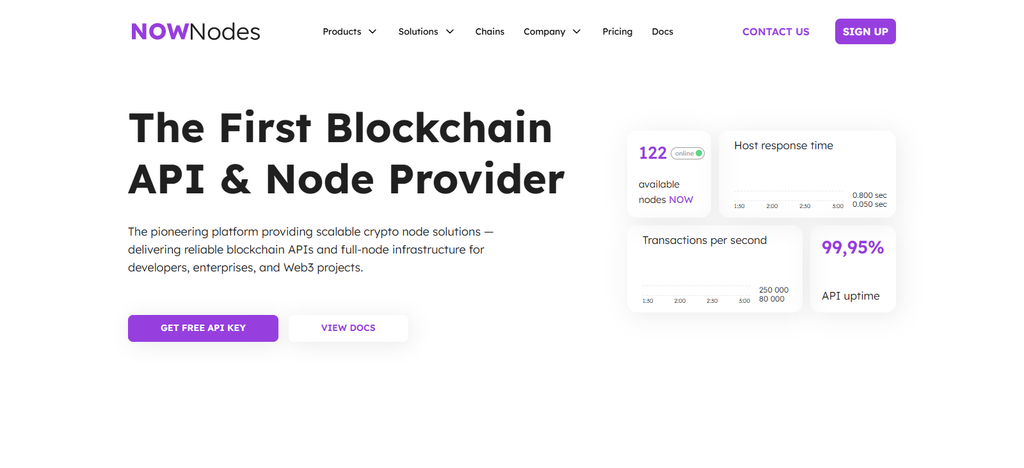
Pricing is not one single Avalanche hosting price, but rather depends on the node and service configuration you need. NOWNodes offers API access, 24/7 node monitoring, availability monitoring, GEO-balancing, scalable infrastructure and support for multiple blockchain networks.
It is built with infrastructure to support higher workloads and API response times. Verify specific backup and recovery options for individual node deployments.
| Feature | Details |
|---|---|
| Avalanche Infrastructure | Avalanche blockchain node/API access |
| Node Service | Blockchain-as-a-Service infrastructure |
| API Access | Blockchain APIs and Blockbook-style data access |
| Monitoring | 24/7 node surveillance |
| Availability | Infrastructure monitoring and operational management |
| Geographic Routing | GEO-balancing capabilities |
| Multi-Chain | Supports numerous blockchain networks |
| Scaling | Infrastructure designed for increasing API requirements |
| Support | Technical assistance and infrastructure support |
| Best For | Developers needing managed blockchain node access |
9. OnFinality
OnFinality was founded in 2019 and operates out of Auckland, New Zealand, offering blockchain APIs, dedicated nodes and infrastructure services. It supports **Avalanche ** along with Ethereum, Cosmos, Polkadot, Solana and many other networks.
Pricing Developer, Growth ($49/month), Accelerate ($249/month) and custom Ultimate plans, plus node and API usage can be added separately.
OnFinality provides RPC API access, dedicated nodes, archive infrastructure, scaling and production ready services Its platform also provides recovery-oriented infrastructure features, such as Lightning Restore, for supported archive nodes. The amount of support and the capacity are different depending on the plan.
| Feature | Details |
|---|---|
| Avalanche Support | Managed Avalanche infrastructure and API access |
| Node Options | Shared and dedicated infrastructure |
| API Access | RPC/API connectivity |
| Archive Infrastructure | Archive-node capabilities for supported networks |
| Scaling | Infrastructure designed for production workloads |
| Monitoring | Node and infrastructure monitoring |
| Recovery | Recovery-oriented infrastructure features for supported services |
| Multi-Chain | Supports numerous blockchain ecosystems |
| Enterprise | Custom infrastructure and higher-capacity configurations |
| Best For | Production applications, enterprises and developers |
10. BlockPI Network
BlockPI Network launched its Alpha-net in October 2022. The network operates a distributed RPC infrastructure which aims to eliminate single points of failure and increase scalability.
It supports Avalanche and over 60 blockchain networks and offers HTTPS and WebSocket API access. Pricing starts with a free package consisting of 50 million request units per month and paid options such as Pay As You Go and Elementary plans starting at $49.
BlockPI’s architecture scales using gateways, load balancing and expandable working nodes. It offers full-node and archive-node options, RPC APIs, and tiered technical support. There is no clear public disclosure of specific backup policies and headquarter information.
| Feature | Details |
|---|---|
| Avalanche Access | Avalanche Mainnet and Testnet |
| API Types | JSON-RPC, HTTPS and WebSocket |
| Archive Mode | Archive-node access available |
| Private RPC | Private RPC infrastructure |
| Public RPC | Public Avalanche endpoints |
| Uptime | BlockPI currently displays 99.99% 90-day uptime for Avalanche |
| Scaling | Higher rate limits and dedicated infrastructure options |
| Developer Tools | Bundler service and additional RPC functionality |
| Security | MEV protection and private RPC options |
| Best For | High-volume applications, dApps and teams needing scalable RPC |
Comparison Table: Best Avalanche Node Providers
| Provider | Founded | Avalanche Support | Pricing | API Access | Backup | Scaling | Best For |
|---|---|---|---|---|---|---|---|
| Chainstack | 2018 | Managed Avalanche nodes and RPC | Free + paid plans | HTTP, WebSocket | Failover/recovery features | High | Developers & enterprises |
| Alchemy | 2017 | Avalanche C-Chain & P-Chain APIs | Free + usage-based | JSON-RPC, APIs | Provider-managed infrastructure | High | dApps & developers |
| QuickNode | 2017 | C-Chain, P-Chain, X-Chain | Usage-based plans | HTTP, WebSocket | Infrastructure-dependent | High | High-volume dApps |
| Ankr | 2017 | C-Chain, P-Chain, X-Chain | Free + paid | RPC, REST, gRPC | Infrastructure-dependent | High | Multi-chain developers |
| Infura | 2016 | Avalanche connectivity | Plan/usage-based | RPC/API | Managed infrastructure | High | Enterprise applications |
| Lava Network | — | Avalanche RPC/data access | Provider/service dependent | RPC | Distributed provider model | High | Decentralized RPC |
| GetBlock | 2019 | Avalanche nodes & RPC | Free + paid | RPC, WebSocket | Configuration dependent | High | Developers & enterprises |
| NOWNodes | 2019 | Avalanche node/API access | Plan-dependent | API | Provider-dependent | High | Blockchain API users |
| OnFinality | 2019 | Managed Avalanche infrastructure | Free + paid/custom | RPC/API | Recovery features available | High | Production workloads |
| BlockPI Network | 2022 | Avalanche Mainnet/Testnet | Free + paid | HTTPS, JSON-RPC, WebSocket | Distributed infrastructure | High | Scalable RPC users |
Conclusion
The right Avalanche node provider for you will depend on your infrastructure requirements, budget, scalability needs and the level of technical support you expect. Chainstack,
Alchemy, QuickNode, Ankr, Infura, Lava Network, GetBlock, NOWNodes, OnFinality, and BlockPI Network each provide different ways to access Avalanche, API connectivity, network coverage, reliability, and scaling.
Compare Avalanche support, pricing, supported networks, API availability, backup options, customer support and deployment flexibility before choosing a provider.
Developers may want quick access to APIs, while validators and enterprises may want better infrastructure, monitoring and scalability. By considering these, you can select the best provider for you.
FAQ
What is an Avalanche node provider?
An Avalanche node provider offers managed infrastructure that lets developers, validators, businesses, and Web3 applications connect to the Avalanche network without building and maintaining their own node hardware.
Which Avalanche node provider is best in 2026?
The best provider depends on your requirements. Chainstack, QuickNode, Alchemy, Ankr, Infura, Lava Network, GetBlock, NOWNodes, OnFinality, and BlockPI Network offer different combinations of Avalanche access, API performance, pricing, scalability, and support.
How much does an Avalanche node cost?
Avalanche node costs vary by provider, infrastructure type, API usage, compute resources, storage, and traffic. Some providers offer free tiers, while dedicated and enterprise infrastructure generally requires paid or custom plans.
Can these providers support Avalanche APIs?
Yes. Providers such as Chainstack, Alchemy, QuickNode, Ankr, GetBlock, NOWNodes, OnFinality, and BlockPI provide API or RPC-based access for applications that need to interact with Avalanche blockchain data.
Do Avalanche node providers support validators?
Some providers offer infrastructure suitable for Avalanche validators, while others primarily focus on RPC and API access. Users should check validator-specific hardware, staking, monitoring, and operational requirements before selecting a provider.