
This article analyzes the best alternatives to Wealthfront for automated investing for the year 2026. Investors have come to expect automated investing to be affordable and offer 24/7 support.
- What is Wealthfront Alternatives for Robo-Investing?
- Key Points
- 1. Betterment
- Betterment Attributes
- 2. Fidelity Go
- Fidelity Go Attributes
- 3. Vanguard Digital Advisor
- Vanguard Digital Advisor Attributes
- 4. Schwab Intelligent Portfolios
- Schwab Intelligent Portfolios Attributes
- 5. M1 Finance
- M1 Finance Attributes
- 6. SoFi Automated Investing
- SoFi Automated Investing Attributes
- 7. Acorns
- Acorns: Attributes
- 8. Empower
- Empower Attributes
- 9. E*TRADE
- E*TRADE Core Portfolios Attributes
- 10. Axos Managed Portfolios
- Axos Managed Portfolios Attributes
- Conclusion
- FAQ
Wealthfront’s first-mover advantage means many competitors lack features like automation, but Betterment and others have made strong showings in the industry. This article identifies and compares the best automatable investing services. Each service’s mobile service and features are evaluated, in addition to the service’s fees.
What is Wealthfront Alternatives for Robo-Investing?
Wealthfront alternatives are electronic investment advisors that offer similar services and features as Wealthfront, but with distinctive offerings. Some of these alternatives include Betterment, Fidelity Go, and Vanguard Digital Advisor.
One alternative, Betterment, focuses on ultra-low fees, while others, like Personal Capital and Wealthfront, offer differentiated investing approaches. Still other robo-advisors, like Charles Schwab and E-Trade, incorporate traditional financial advisory services.
Alternative services and features provided by Wealthfront competitors may include tax-loss harvesting, mobile apps, and other automated investing features. Ultimately, the array of Wealthfront alternatives provides a variety of investment services to choosing, align, and personalize digital investment portfolio to personal preferences and objectives.
Key Points
| Robo-Advisor | Fees | Best For | Key Strengths |
|---|---|---|---|
| Betterment | 0.25% annual | Tax-efficient investors | Advanced tax-loss harvesting, goal-based investing |
| Fidelity Go | $0 under $25k, 0.35% above | Cost-conscious beginners | Backed by Fidelity, simple pricing |
| Vanguard Digital Advisor | ~0.15% | Long-term index investors | Ultra-low fees, retirement-focused |
| Schwab Intelligent Portfolios | $0 advisory fee | Fee-sensitive investors | No advisory fees, automatic rebalancing |
| M1 Finance | $0 | DIY investors | Customizable portfolios, fractional shares |
| SoFi Automated Investing | $0 | Beginners | Free management, career coaching perks |
| Acorns | $3–$9/month | Micro-investors | Round-up investing, simple savings automation |
| Empower | 0.89% (wealth mgmt) | High-net-worth clients | Hybrid robo + human advisors |
| E*TRADE Core Portfolios | 0.30% | E*TRADE users | Seamless integration with brokerage |
| Axos Managed Portfolios | 0.25% | Banking ecosystem users | Automated investing tied to Axos Bank |
1. Betterment
Launched in 2008, Betterment was the first large-scale, full-service automated advisor. It pioneered tax-loss harvesting and offers socially responsible investing. Though Betterment does not offer direct indexing, its ETF-based offerings provide ample diversification. Phone and electronic customer support is available to all customers, and unlimited CFP support is available to Premium customers.
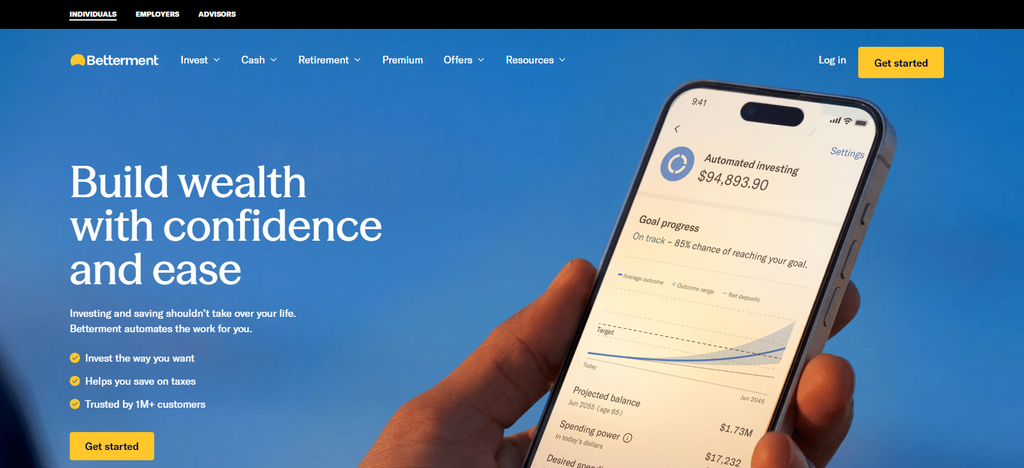
The mobile app allows customers to manage their investments to achieve financial goals, automatically rebalance their portfolios, and manage cash. Cash management accounts allow customers to earn interest while keeping cash in their Betterment accounts. Cash and equity investment accounts are free to all customers. Betterment remains the leading robo-advisor.
Betterment Attributes
- Founded: 2008
- Advisory Fee: 0.25% Digital, 0.65% Premium
- Direct Indexing: Not offered
- Customer Support: Phone and chat, Premium tier gives access to CFPs
- App: User-friendly to vividly symbolize goal-based investing
| Advantages | Disadvantages |
|---|---|
| Low fees (0.25% Digital) | No direct indexing |
| Advanced tax-loss harvesting | Premium plan is costly (0.65%) |
| Goal-based investing tools | Limited customization |
| Strong customer support with CFPs | Requires higher balance for Premium |
| Intuitive mobile app | No self-directed trading |
2. Fidelity Go
Launched in 2016 by Fidelity Investments, Fidelity Go is a low-cost robo-advisor. They charge no fees on accounts less than $25,000 and charge 0.35% on accounts greater than $25,000. Fidelity Go uses Fidelity Flex mutual funds to create portfolios and, therefore, has expense ratios of 0%.

Like most robo-advisors, Fidelity Go does not offer direct indexing. Customer support is provided to accounts greater than $25,000 in the form of financial coaching.
The support is unlimited. Account holders are allowed integration to other Fidelity services. Fidelity Go is most suitable to investors who want a simple and low-cost option with a moderately large sum of money to invest.
Fidelity Go Attributes
- Founded: 2016 (Original Fidelity Founding: 1946)
- Advisory Fee: 0% on balances less than $25,000; 0.35% on balances greater than $25,000
- Direct Indexing: Not offered
- Customer Support: Financial coaching provided on investments above $25,000
- App: Clutter-free, transitional, and integrated with other Fidelity applications
| Advantages | Disadvantages |
|---|---|
| $0 fee under $25K | Limited portfolio customization |
| Backed by Fidelity’s reputation | No direct indexing |
| Simple pricing structure | Digital-only support for small accounts |
| Access to financial coaching | Higher fee (0.35%) above $25K |
| Integrated mobile app | Fewer advanced tax features |
3. Vanguard Digital Advisor
Vanguard Digital Advisor launched its services in 2020 and charges around 0.15% per year. The account has a 100 dollar minimum. Portfolios consist of Vanguard ETFs. There are options of all-index and ESG portfolios. Active/Index portfolios are also available. Digitally, customers can find support and resources.
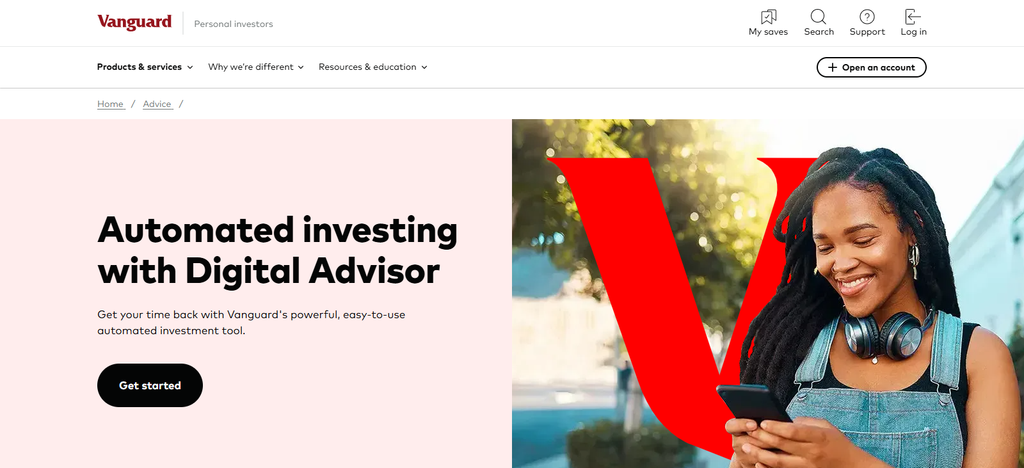
For an added cost, customers can gain access to human advisors. The Vanguard Digital Advisor mobile app allows users to do tax-loss harvesting, and place tax efficient funds. The app provides tools and resources for debt management and retirement planning. Overall, Vanguard Digital Advisor is best for users interested in long-term, low cost investments.
Vanguard Digital Advisor Attributes
- Founded: 2020
- Advisory Fee: ~0.15%
- Direct Indexing: Not offered
- Customer Support: Digital-based
- App: Resources for debt and retirement
| Advantages | Disadvantages |
|---|---|
| Ultra-low fees (~0.15%) | No direct indexing |
| Retirement-focused portfolios | Limited human advisor access |
| Tax-efficient strategies | Requires upgrade for CFP support |
| Strong brand trust | Less flexibility in customization |
| Helpful retirement calculators | Digital-only customer service |
4. Schwab Intelligent Portfolios
Charles Schwab launched the first no-advisory-fee portfolio in 2019 with its acquisition of Charles Schwab’s brokerage account. Like other brokers, it charges no advisory fees, but portfolios require at least $5,000. Unlike its competitors, it does not limit its portfolios to ETFs that it sponsors.
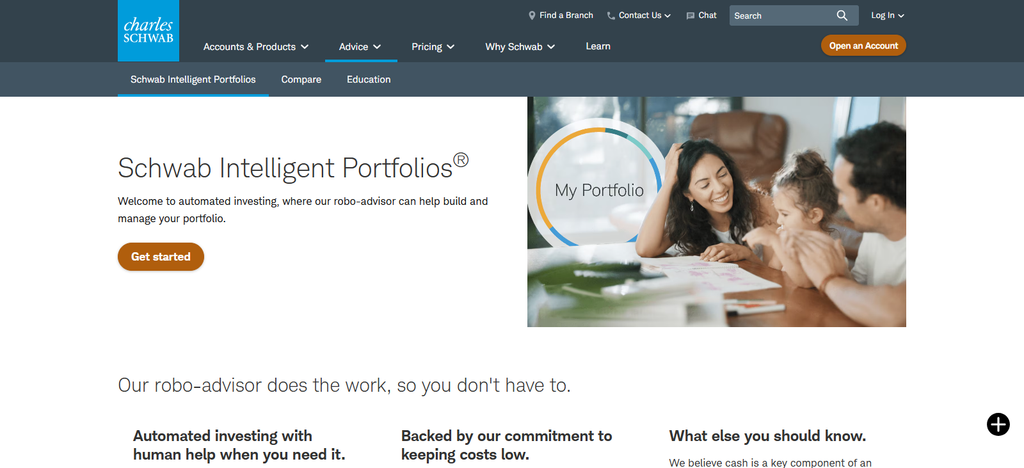
Instead, it has the potential to include tax-loss harvested ETFs for portfolios above $50,000. Cash allocations that range from 6% to 30% and may include a significant drag on the portfolio’s return potential.
It is the only brokerage firm that offers 24/7 phone and live chat support. Its mobile app gets positive reviews for its integration with the Schwab brokerage account, which includes goal tracking and rebalancing.
Schwab Intelligent Portfolios Attributes
- Founded: 2014 (Original Schwab Founding: 1971)
- Advisory Fee: 0%
- Direct Indexing: Not offered
- Customer Support: Phone and chat 24/7
- App: Integrated brokerage with daily rebalancing
| Advantages | Disadvantages |
|---|---|
| No advisory fees | $5K minimum deposit |
| Daily rebalancing | High cash allocation (6–30%) |
| Tax-loss harvesting at $50K+ | No direct indexing |
| 24/7 customer support | Cash drag reduces returns |
| Strong mobile integration | Limited customization options |
5. M1 Finance
Launched in 2015, M1 Finance is an automated investment service and brokerage that provides investment advice for free. However, a fee of three dollars per month is charged for accounts that have less than 10,000 dollars.

M1 Finance allows customers to create customizable portfolios by breaking up their investments into different sections, which they call “pies”. Similar to other robo-brokers, M1 Finance automatically rebalances investors’ portfolios.
The main difference from other investment services is that M1 Finance attempts to minimize the number of taxable events by selling the worst performing investments. M1 Finance offers relatively poor customer service. Email and phone customer service is only available for customers who have a premium membership.
The mobile app allows customers to manage their investments as well as access banking services. Investors who prefer a more passive approach to investing and do not require customer service should consider using M1 Finance.
M1 Finance Attributes
- Founded: 2015
- Advisory Fee: 0%
- Direct Indexing: Not offered
- Customer Support: Limited support
- App: User-friendly, bidirectional, customizable “Pie” portfolios
| Advantages | Disadvantages |
|---|---|
| $0 advisory fees | No direct indexing |
| Customizable “Pie” portfolios | Limited customer support |
| Fractional shares | Premium features require Plus membership |
| Tax-efficient rebalancing | Less beginner-friendly |
| Highly rated mobile app | No human advisor access |
6. SoFi Automated Investing
SoFi was founded in 2011 and offers robo-investing with a fee of 0.25% and a minimum investment of $50. SoFi and BlackRock work together to create ETFs for SoFi’s investments. SoFi’s portfolios offer automatic rebalancing and dividend reinvesting. Direct Indexing is not available.
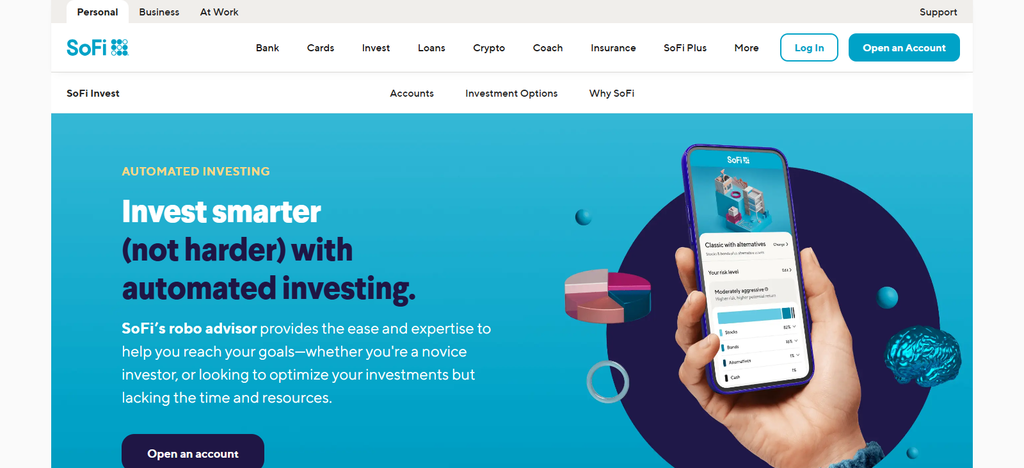
SoFi provides CFP sessions to their customers and allows sessions with unlimited benefit to members of SoFi Plus. The mobile app provides access to banking, investments, and loans. SoFi is best for first time investors.
SoFi Automated Investing Attributes
- Founded: 2011
- Advisory Fee: 0.25%
- Direct Indexing: Not offered
- Customer Support: CFPs, beginner investor support
- App: Integrated banking and loans, investment portal
| Advantages | Disadvantages |
|---|---|
| Free management for members | No direct indexing |
| Access to CFPs | Limited portfolio customization |
| Beginner-friendly platform | Higher fees compared to Acorns |
| Integrated financial ecosystem | Smaller ETF selection |
| Strong mobile app | Digital-first support |
7. Acorns
Launched in 2012, Acorns was the first company to offer micro-investing as a service rounded up by its signature ‘Acorns’ feature. Its cost varies from $3 to $12, charged monthly with no additional fees based on investment performance. Similar to competitors, Acorns limits portfolios to ETFs and does not provide direct indexing.
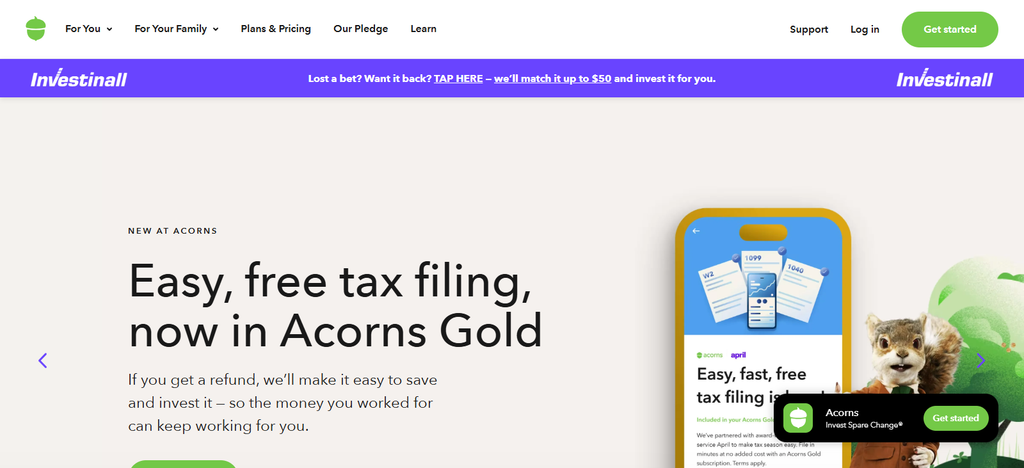
Acorns utilizes customer service automation to provide educational resources. Most features are automated to encourage user financial wellness. Along with automated round-up investment, users can set up automated monthly investments and custodial investment accounts. Like competitors, its greatest opportunity is with beginner, student, and payroll-linked investors.
Acorns: Attributes
- Founded: 2012
- Advisory Fee: $3-$12/month
- Direct Indexing: Not offered
- Customer Support: On-site support, education
- App: Easily transferred, user-generated investment portfolios, custodial accounts
| Advantages | Disadvantages |
|---|---|
| Micro-investing via round-ups | Flat monthly fees can be high |
| Easy automation | No direct indexing |
| Custodial accounts for kids | Limited customization |
| Beginner-friendly | Higher effective cost for small balances |
| Simple mobile app | No advanced tax features |
8. Empower
With fees of 0.89% for the first $1 million (becoming lower for larger balances), Empower charges somewhat less than other digital wealth management services. However, unlike many rivals, Empower does not offer direct indexing, and charges a 1.29% fee for balances less than $1 million.
Portfolios with Empower are algorithmically balanced with Smart Weighting. The service includes human financial planners for clients with a balance of at least $250,000, and has a strong mobile app with features to help clients analyze their taxable and after-tax investment accounts. Overall, Empower is best for higher net worth clients.
Empower Attributes
- Founded: 2009 (as Personal Capital)
- Advisory Fee: 0.89% first $1M, tiered lower above
- Direct Indexing: Not offered, Smart Weighting portfolios
- Customer Support: CFPs, dedicated advisors for $250K+
- Mobile/App: Robust dashboards, retirement & tax planning
| Advantages | Disadvantages |
|---|---|
| Hybrid robo + human advisors | High fees (0.89%) |
| Smart Weighting portfolios | Not beginner-friendly |
| Access to CFPs | High minimum balance for advisors |
| Strong retirement planning tools | No direct indexing |
| Robust mobile dashboards | Best suited for high-net-worth clients |
9. E*TRADE
ETRADE was founded in 1982 and purchased by Morgan Stanley in 2020. Its Core Portfolios charge a 0.30% annual fee, with a $500 minimum. Portfolios consist of ETFs. ETRADE offers tax loss harvesting with socially responsible ETFs, but does not offer direct indexing.

Customer support is available via phone or through an online support center. ETRADE’s mobile app supports both automated and fully-managed investment portfolios. ETRADE may be of interest to those who already use Morgan Stanley for their investing needs.
E*TRADE Core Portfolios Attributes
- Founded: 1982 (Morgan Stanley acquired 2020)
- Advisory Fee: 0.30% annually
- Direct Indexing: Not available
- Customer Support: Phone, online, brokerage integration
- Mobile/App: Comprehensive, supports robo + self-directed trading
| Advantages | Disadvantages |
|---|---|
| Backed by Morgan Stanley | 0.30% fee higher than Vanguard |
| Tax-loss harvesting at $25K+ | No direct indexing |
| Socially responsible options | $500 minimum deposit |
| Strong customer support | Limited customization |
| Comprehensive mobile app | Less competitive fees |
10. Axos Managed Portfolios
Launched in 2013 (as WiseBanyan, rebranded Axos in 2019) and with recent regulatory changes forcing them to raise their management fee, Axos Managed Portfolios currently charges between 0.24% to 0.50% per year with a 100$ minimum. Tax-loss harvesting is offered for an additional 0.20% for portfolios of 250k or more.
Direct indexing is not available. Customer support is moderate, and financial planning is not offered. Goal-based investing is available, and the account is automatically rebalanced. Their app also offers banking services. Investors who utilize other services offered by Axos Bank may find this Robo-advisor an attractive option.
Axos Managed Portfolios Attributes
- Founded: 2013 (WiseBanyan, rebranded 2019)
- Advisory Fee: 0.24–0.50% annually
- Direct Indexing: Not supported
- Customer Support: Online and phone, limited planning
- Mobile/App: Banking + investing integration, goal-based automation
| Advantages | Disadvantages |
|---|---|
| Low fees (0.24–0.50%) | No direct indexing |
| Banking + investing integration | Limited financial planning |
| Tax-loss harvesting optional | Extra fee for tax features |
| Goal-based automation | Smaller brand presence |
| Mobile app with banking tools | Less robust customer support |
Conclusion
In 2026, the robo-advisor market will provide more options than Wealthfront, and services will vary in terms of pricing, experience levels required of users, and the types of goals users wish to achieve. Betterment and Fidelity Go will allow users to direct their money towards specific types of investments, and to do so in a tax efficient manner.
Vanguard and Schwab will charge lower fees and offer investment options and advice related to retirement. Investors wishing to utilize a service offering a higher degree of flexibility in investment and portfolio decisions can use M1 Finance and SoFi.
Users wishing to invest small amounts can use Acorns, and clients with larger account balances can use the hybrid offering of Empower. Investors wishing to utilize the full range of financial services offered by E*TRADE can do so, along with clients of Axos Managed Portfolios.
FAQ
What is a robo-advisor?
A robo-advisor is an automated investment platform that builds and manages portfolios using algorithms, offering low-cost, hands-off investing.
Which robo-advisor is cheapest in 2026?
Platforms like Fidelity Go (free under $25K) and Schwab Intelligent Portfolios (no advisory fee) are among the lowest-cost options.
Does Betterment offer direct indexing?
No, Betterment does not provide direct indexing. It focuses on ETF-based portfolios with advanced tax-loss harvesting.
Which robo-advisor has the best mobile app?
M1 Finance and SoFi Automated Investing are praised for intuitive, feature-rich apps that integrate investing with banking and borrowing.
Is Empower suitable for beginners?
No, Empower is designed for high-net-worth clients, offering hybrid robo + human advisory services with higher fees.