

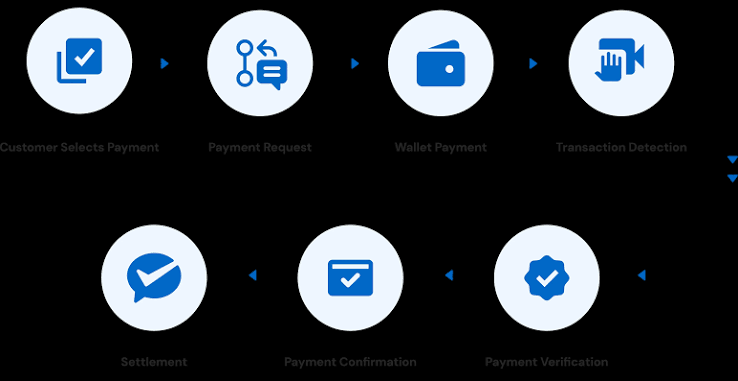

In this article, I will talk about the Best Stablecoin Payment Gateways for Subscriptions in 2026. I will compare platforms based on recurring payment support, supported stablecoins, blockchain networks, transaction fees, subscription automation, refund management, and security. I will also explore their key features, benefits, limitations, and business use cases to help you choose the right payment gateway for your subscription business.
- What Are Stablecoin Payment Gateways for Subscriptions?
- Key Points
- 1. Stripe Stablecoin Payments
- Best Use Cases of Stripe Stablecoin Payments
- Stripe Stablecoin Payments Pros & Cons
- 2. Coinbase Commerce (Enterprise)
- Best Use Cases of Coinbase Commerce (Coinbase Business)
- Coinbase Commerce (Coinbase Business) Pros & Cons
- 3. NOWPayments
- Best Use Cases of NOWPayments
- NOWPayments Pros & Cons
- 4. BitPay
- Best Use Cases of BitPay
- BitPay Pros & Cons
- 5. Coingate
- Best Use Cases of CoinGate
- CoinGate Pros & Cons
- 6. Triple A
- Best Use Cases of Triple-A
- Triple-A Pros & Cons
- 7. BVNK
- Best Use Cases of BVNK
- BVNK Pros & Cons
- 8. Sphere
- Best Use Cases of Sphere
- Sphere Pros & Cons
- 9. Request Finance
- Best Use Cases of Request Finance
- Request Finance Pros & Cons
- 10. MoonPay Trade
- Best Use Cases of MoonPay Trade
- MoonPay Commerce Pros & Cons
- Comparison table
- Conclusion
- FAQ
What Are Stablecoin Payment Gateways for Subscriptions?
Stablecoin payment gateways for subscriptions are payment solutions that allow companies to accept recurring payments in stablecoins like USDC and USDT. These gateways help SaaS companies, membership platforms, online service providers and digital businesses to manage subscription billing over blockchain networks.
Depending on the platform, they may support payment authorization, scheduled renewals, transaction tracking, and merchant settlements. Some solutions even provide API integration, automated billing tools and fiat conversion options.
Stablecoins provide businesses with the ability to mitigate their currency risk, and also to make faster and more flexible digital payments to their global customers.
Key Points
| Stablecoin Payment Gateway | Key Point |
|---|---|
| Stripe Stablecoin Payments | Ideal for SaaS and subscription businesses that want recurring billing while accepting stablecoin payments and settling within Stripe’s payment ecosystem. |
| Coinbase Commerce (Coinbase Business) | Supports USDC-focused payments with simple checkout tools, making it a strong choice for subscription platforms serving crypto-native customers. |
| NOWPayments | Offers recurring payment tools, subscription billing support, automatic coin conversion, and extensive stablecoin coverage across multiple blockchains. |
| BitPay | Provides merchant billing, invoicing, and flexible settlement options, allowing subscription businesses to accept stablecoins while receiving crypto or fiat. |
| CoinGate | Delivers subscription-friendly payment processing with e-commerce integrations and support for stablecoin payments globally. |
| Triple-A | A regulated payment gateway offering stablecoin acceptance and global merchant settlement, making it suitable for recurring payment services. |
| BVNK | Enterprise-grade stablecoin payment infrastructure that supports global payment flows, recurring billing operations, and treasury management. |
| Sphere | API-first stablecoin payment platform built for SaaS companies and online businesses needing programmable recurring payment experiences. |
| Request Finance | Combines stablecoin invoicing, recurring payment workflows, and subscription management capabilities for Web3 and digital businesses. |
| MoonPay Commerce | Supports recurring crypto subscriptions, Web3 commerce, and stablecoin payments through merchant-friendly integrations. |
1. Stripe Stablecoin Payments
Founded in 2010, Stripe provides payment infrastructure to businesses and accepts stablecoin payments. It supports USDC on Ethereum, Solana, Base and Polygon, USDP on Ethereum, Solana and Base, and USDG on Ethereum.
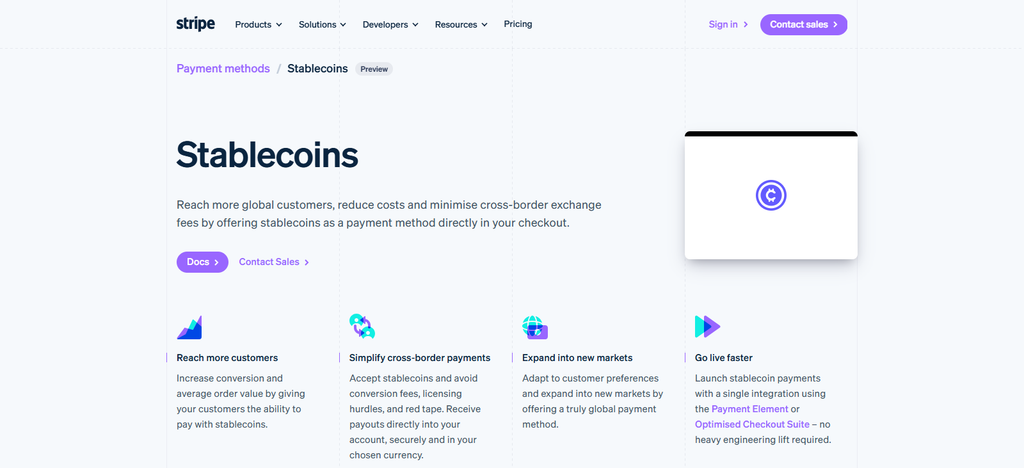
Merchants get USD settlement with Stripe Stablecoin Payments. Subscription billing must be validated separately and cannot be assumed to be part of every stablecoin checkout. With Stripe’s billing and API ecosystem, businesses can manage subscription plans, renewals, and cancelations (as long as the payment method is supported).
Refunds can return stablecoins to the customer’s original wallet. Availability is currently limited to qualified U.S. merchants.The text includes a reference to a specific version of the text, which is not included in the output.
Best Use Cases of Stripe Stablecoin Payments
- SaaS Subscription Businesses: Collect payments in stablecoins from global customers buying software subscriptions.
- Global Digital Services: Accept payments from customers in supported markets with stablecoin checkout.
- Online Marketplaces: Receive payments in stablecoin and disburse to sellers using integrated payment infrastructure.
- Fintech Applications: Integrate the acceptance of stablecoin payments and digital asset capabilities into financial applications.
- Cross-Border Businesses: Accept stablecoin payments and convert to fiat currency using Stripe’s payment infrastructure.
Stripe Stablecoin Payments Pros & Cons
| Pros | Cons |
|---|---|
| Supports stablecoin payments through established payment infrastructure. | Availability is limited to eligible merchants and regions. |
| Offers USD settlement for eligible transactions. | Not every stablecoin checkout supports recurring billing. |
| Provides API and developer integration capabilities. | Requires technical setup for advanced subscription workflows. |
| Supports multiple blockchain networks. | Stablecoin support varies by network and asset. |
2. Coinbase Commerce (Enterprise)
Coinbase, founded in 2012, launched Coinbase Commerce, a platform for businesses to accept payments in cryptocurrency. It’s moving its business payments infrastructure to Coinbase Business, and the legacy Commerce portal will be sunset and unavailable after March 31, 2026.
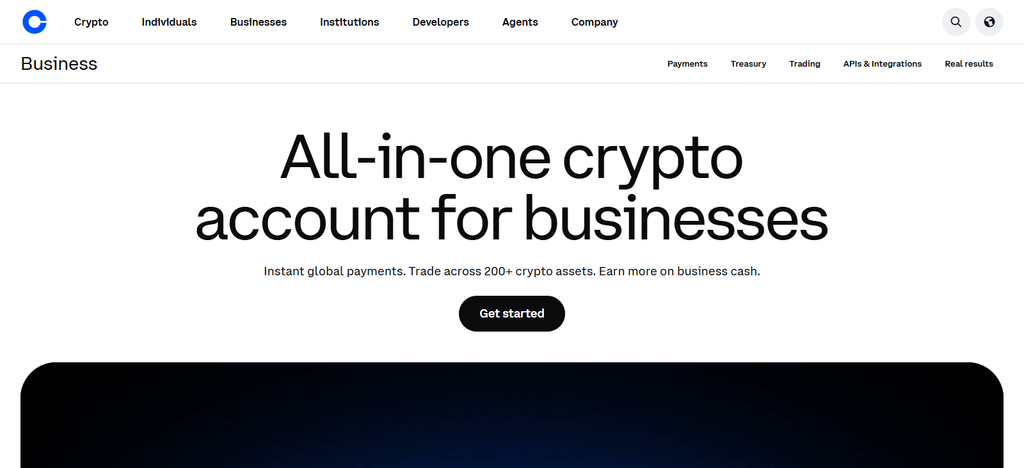
Coinbase Business supports USDC payments and has USDT on its roadmap for 2026 rollout. Business custody, bank offramps and accounting integrations. Do not assume its recurring subscription functionality is native automatic billing without a separate integration.
Legacy Commerce took a 1% cut of transactions, and Coinbase Business has different eligibility and pricing structures. Separate consideration is needed for refunds, cancelation of payment and subscription authorization.
Best Use Cases of Coinbase Commerce (Coinbase Business)
- E-commerce Businesses: Take cryptocurrency and stablecoin payments from customers who are buying products online.
- Digital Product Platforms: Accept payments for software, downloadable products and digital services.
- Crypto-Native Businesses: Accept payments from customers who want to pay with cryptocurrency wallets.
- International Merchants: Receive payment from customers in eligible digital currency in supported markets.
- Web3 Platforms: Incorporate crypto payment acceptance into blockchain applications and digital ecosystems.
Coinbase Commerce (Coinbase Business) Pros & Cons
| Pros | Cons |
|---|---|
| Provides established cryptocurrency payment infrastructure. | Legacy Commerce and Coinbase Business have different capabilities. |
| Supports stablecoin payment acceptance. | Recurring billing may require external integrations. |
| Offers business payment and financial management tools. | Availability and eligibility vary by region. |
| Provides cryptocurrency-to-fiat payment infrastructure. | Some services may have additional conversion costs. |
3. NOWPayments
NOWPayments, which was founded in 2019, offers cryptocurrency payment processing for online stores, digital services and subscription-based businesses. It supports more than 50 cryptocurrencies including stablecoin payment options.
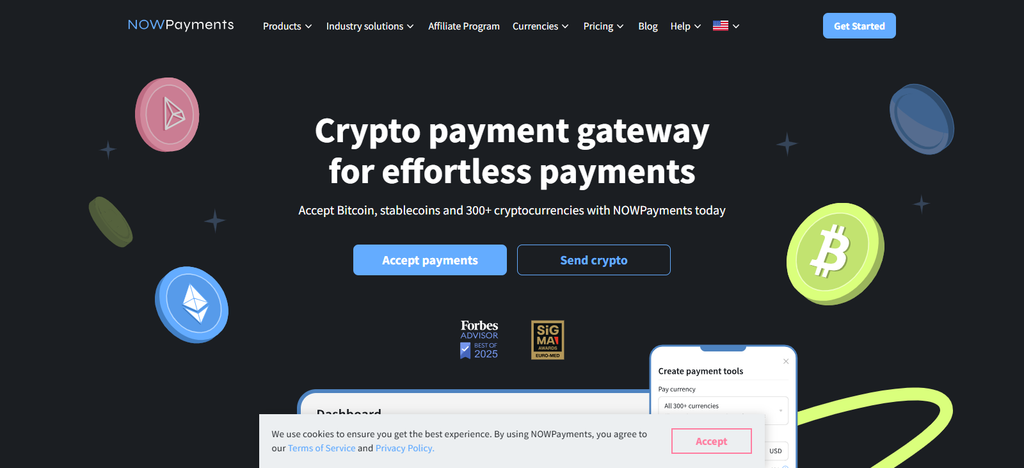
Networks are available as per the token selected. Its API, payment links, invoices and integrations allow businesses to link payment collection to their own subscription systems. Recurring billing isn’t a feature that should be assumed to be automatic for every payment, and should be set up using the appropriate API or external billing automation.
NOWPayments fees are 1% for same-currency transactions and 1.5% for multi-currency payments plus additional blockchain network costs. Refunds and cancelations are processed at the transaction level.
Best Use Cases of NOWPayments
- Subscription-Based Websites: Accept cryptocurrency for recurring memberships through integrated billing solutions.
- Online Stores: Get stablecoins and other cryptocurrencies via website checkout integrations.
- Digital Content Platforms: Get paid for premium content, online courses and downloadable products.
- Gaming Businesses: Accept cryptocurrencies as payment for gaming services, digital purchases and virtual goods.
- International Service Providers: Receive payments in digital currency from customers across the globe through payment links and invoices.
NOWPayments Pros & Cons
| Pros | Cons |
|---|---|
| Supports a wide range of cryptocurrencies and stablecoins. | Processing costs can increase with currency conversion. |
| Provides API and payment link integrations. | Advanced subscription automation may require development. |
| Offers payment buttons and e-commerce integrations. | Supported assets and networks vary. |
| Provides cryptocurrency payment management tools. | Refunds require separate blockchain transactions. |
4. BitPay
BitPay, founded in 2011, helps merchants accept payments, receive stablecoins and set up recurring billing. With the subscription billing feature, businesses can set up weekly, monthly and yearly payment schedules via the merchant dashboard. Custom billing intervals can be configured via its API.
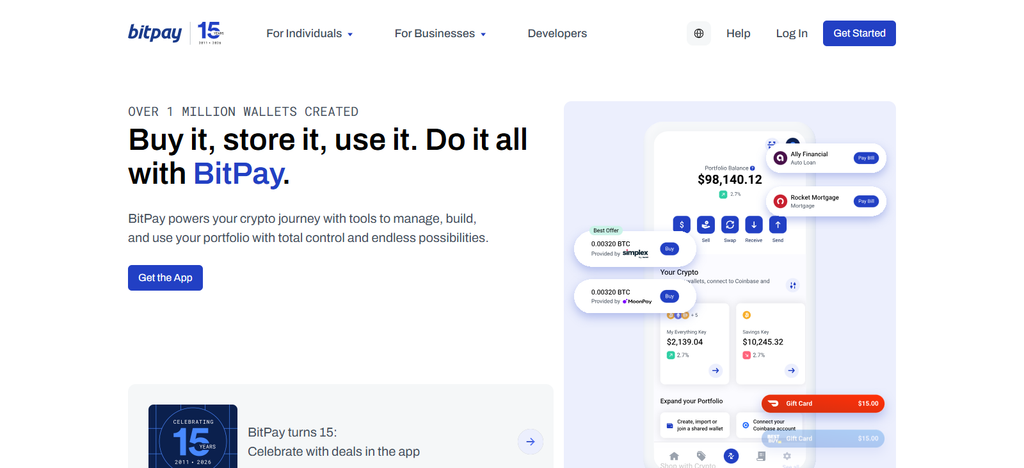
Customers are billed on a schedule via email and pay through the BitPay checkout. Other cryptos, including USDC, are also among supported stablecoins. Merchants may receive payout in local currency, bank payouts are usually processed on the next business day.
Businesses can cancel recurring bills from the dashboard. Refunds have to be done separately and you can’t just reverse blockchain transactions.
Best Use Cases of BitPay
- SaaS Subscription Services: Its recurring billing functionality helps you manage scheduled customer billing.
- Online Retail Businesses: Accept stablecoin payments via e-commerce integrations and online checkout.
- Professional Service Providers: Accept stablecoin payments for consulting, legal and other professional services.
- Global Contractor Payments: Pay international employees and independent contractors in stablecoins.
- Business Payment Processing: Process business transactions, customer invoices and merchant settlements
BitPay Pros & Cons
| Pros | Cons |
|---|---|
| Offers recurring billing functionality. | Supported stablecoin options are more limited than its overall cryptocurrency coverage. |
| Supports scheduled weekly, monthly and yearly billing. | Customer payment completion may still be required for invoice-based billing. |
| Provides merchant settlement options. | Merchant availability depends on location and eligibility. |
| Offers e-commerce and business integrations. | Processing and conversion fees affect total costs. |
5. Coingate
CoinGate, established in 2014, provides services such as cryptocurrency payment processing, merchant invoicing, and payment management. The infrastructure allows for stablecoin payments and a number of blockchain-based digital currencies, where network availability depends on the asset chosen.
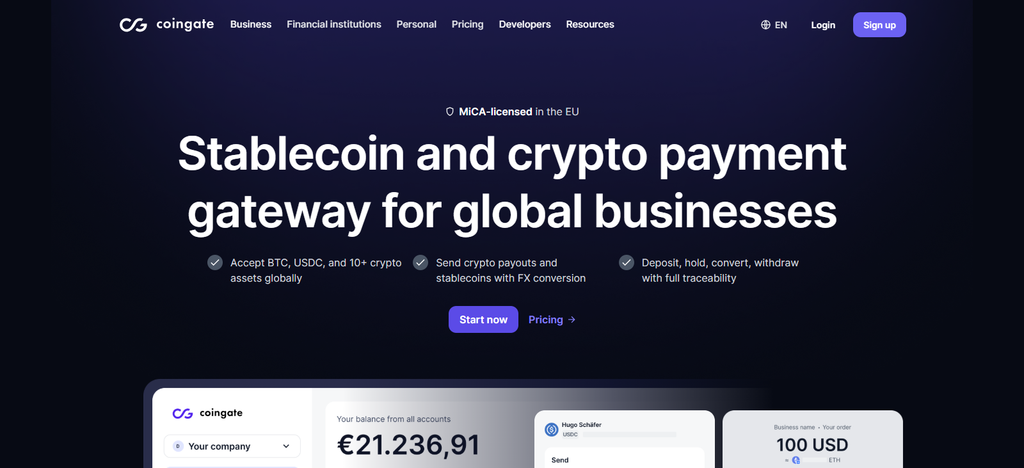
In 2026, CoinGate launched recurring invoicing and enhanced its product to handle payments, bringing its billing capabilities to businesses that want to experiment with subscription billing.
Its standard merchant processing fee is 1% and there are no setup or monthly account fees, but fees for conversion and withdrawal may be applicable. Its platform allows merchants to manage incoming payments, settlements and refunds. You should separately check automatic wallet authorization and uninterrupted recurring charges before you select it for subscription automation.
Best Use Cases of CoinGate
- E-commerce Platforms: Allow payments with stablecoins and cryptocurrencies to purchase products online.
- Digital Subscription Services: process payments from subscribers using compliant billing and invoicing workflows
- Online Service Businesses: Accept crypto payments for consulting, software and other digital services.
- International Merchants: Accept digital currency payments from customers in the countries that support it.
- Freelance Business: Generate invoices and payment requests to clients in international markets.
CoinGate Pros & Cons
| Pros | Cons |
|---|---|
| Supports multiple cryptocurrencies and stablecoins. | Not every asset is available across all networks. |
| Offers payment links and merchant invoicing. | Advanced recurring billing may require additional integration. |
| Provides e-commerce payment integrations. | Conversion and withdrawal charges may apply. |
| Offers merchant settlement options. | Automatic wallet authorization is not a universal feature. |
6. Triple A
Triple-A, founded in 2020, offers stablecoin payment acceptance and settlement services to international businesses. This includes major stablecoins like USDC and USDT, plus a variety of other digital currencies on supported blockchain networks. Businesses can accept payments from customers and settle in their preferred fiat currency, without needing to directly manage cryptocurrency volatility.
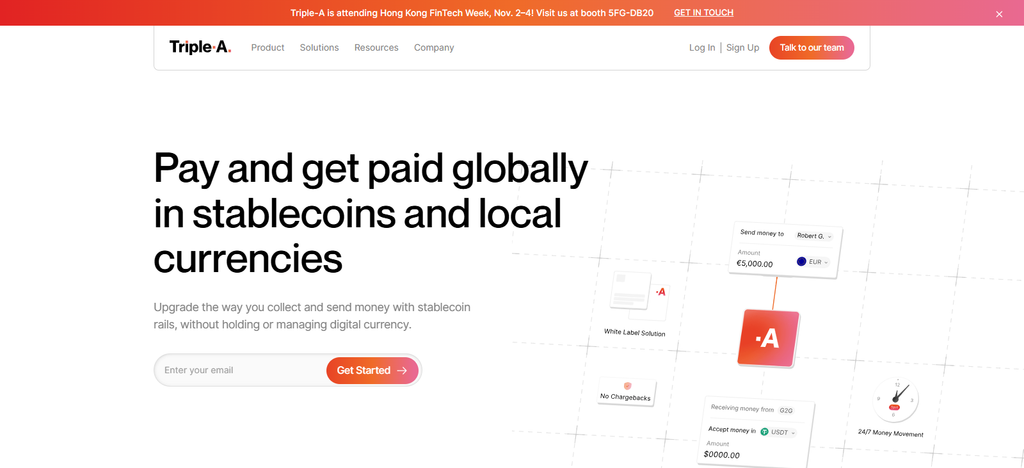
Its invoicing tools, payment requests, and merchant dashboard help manage incoming transactions. However, businesses should check for recurring subscription billing and automatic renewal options separately, as standard payment acceptance does not automatically mean that the wallet is authorized for recurring transactions. Triple-A also offers refund handling, withdrawal services and next-business-day bank settlement options.;
Best Use Cases of Triple-A
- International Professional Services: Get stablecoin payments from international clients for consulting and business services.
- E-commerce Businesses: Integrate digital currency payment options into online checkout systems.
- Online Marketplaces: accept payments from buyers and settle merchants or sellers.
- Gaming Platforms: Enable gamers to pay for games, virtual purchases and digital services with stablecoins.
- Cross-Border Businesses: Accept stablecoin payments and settle in supported local currencies.
Triple-A Pros & Cons
| Pros | Cons |
|---|---|
| Supports stablecoin payment acceptance. | Subscription automation may require external billing software. |
| Offers fiat settlement options. | Supported currencies depend on payment corridors. |
| Provides international payment infrastructure. | Pricing may depend on business requirements. |
| Offers business-focused payment processing. | Not designed primarily as a self-service subscription billing platform. |
7. BVNK
BVNK, which was founded in 2021, provides stablecoin payment infrastructure for businesses involved in international transactions, merchant collections and payouts. Its stablecoins are USDC, EURC and USDG, which are available on Ethereum, Polygon, Solana, Base, Arbitrum, Stellar and other networks, depending on jurisdiction.
BVNK offers payment APIs, wallet infrastructure, fiat conversion, settlement management and transaction monitoring. Its automation capabilities include payment handling, error management and gas optimization.
That said, it’s more of an enterprise payment infrastructure provider than a turnkey subscription billing platform. Businesses usually need to build their own recurring billing system for handling renewals, cancelations, and refund workflows.
Best Use Cases of BVNK
- SaaS subscription platforms: Embed stablecoin payment infrastructure into third-party recurring billing platforms.
- Global Marketplaces: Collect payments and pay out sellers cross-border in stablecoins.
- Fintech apps: Embed stablecoin payment and settlement capabilities in financial services.
- International B2B businesses: Facilitate cross-border business payments and supplier settlements.
- Enterprise Treasury Management: Manage stablecoin collections, conversions and business liquidity through payment infrastructure.
BVNK Pros & Cons
| Pros | Cons |
|---|---|
| Provides enterprise-grade stablecoin payment infrastructure. | May require technical integration and development resources. |
| Supports multiple stablecoins and blockchain networks. | Not a ready-made subscription checkout solution. |
| Offers fiat conversion and settlement capabilities. | Pricing may require a customized business agreement. |
| Provides APIs and transaction management tools. | Availability depends on jurisdiction and compliance requirements. |
8. Sphere
Founded in 2022, Sphere builds payment infrastructure for businesses and financial institutions needing to move money internationally, across stablecoin and traditional banking networks.

Its SpherePay solution is a B2B cross-border payments API that allows businesses to integrate payment processing and settlement into their existing systems. Its infrastructure is focused on stablecoin payment routing, bank connectivity, compliance screening and transaction management.
The payment corridor and integration setup you select will determine the assets and networks that are supported. Sphere doesn’t appear to be a standard subscription checkout platform with automatic renewals built-in, meaning businesses may need external billing software to manage subscription schedules, cancelations, refunds and recurring customer authorization.
Best Use Cases of Sphere
- Cross-Border Payment Platforms: Incorporate international money transfers using stablecoins into financial applications.
- Fintech Startups: Develop digital payment and settlement services using payment APIs.
- International Businesses: Manage payment workflows and cross-border transactions in supported markets.
- B2B Payment Services: Facilitate business to business payments and global supplier settlements.
- Financial Technology Platforms: Connect stablecoin payment infrastructure to existing financial and banking systems.
Sphere Pros & Cons
| Pros | Cons |
|---|---|
| Provides stablecoin-based cross-border payment infrastructure. | Not primarily designed for consumer subscription checkout. |
| Offers API-based payment integration. | Requires technical implementation. |
| Supports business payment and settlement workflows. | Recurring billing may require external systems. |
| Focuses on international payment infrastructure. | Supported payment corridors and assets may vary. |
9. Request Finance
Founded in 2017, Request Finance is a provider of business payments management, invoicing, accounts payable and stablecoin transaction services. Assets such as USDC, USDT, and other digital currencies are supported on networks including Ethereum, Polygon, Avalanche, BNB Chain, Arbitrum, and Solana, depending on the asset and product.
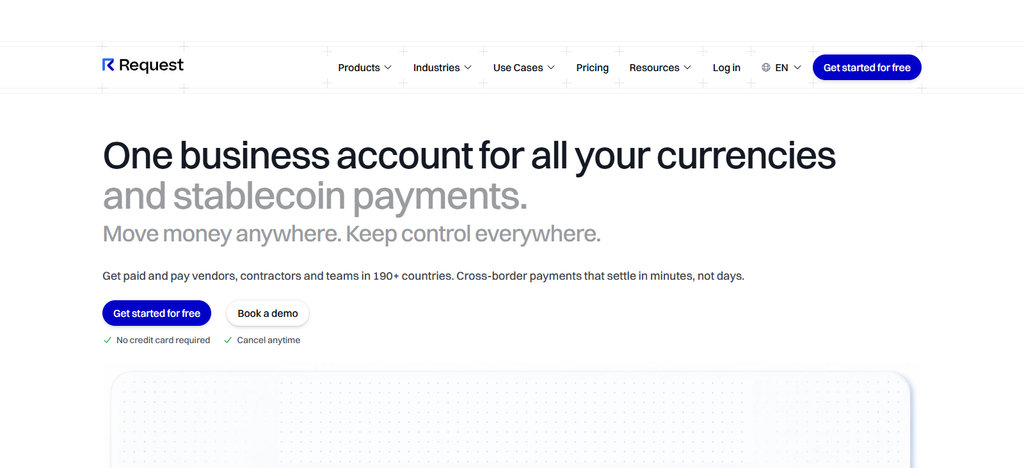
Its invoicing, payment tracking, accounting integrations and automated reconciliation help businesses run their financial operations. Request offers subscription-based software plans to its business customers, but this should not be confused with a merchant-facing automatic stablecoin subscription billing engine.
Paid plans on platforms are included in the pricing, but separate fees may apply for offramps to banks and other transfers. Refunds and cancelations depend on the payment workflow and the status of the transaction.I’ve been trying to get to the bottom of why our guys are so bad at this and it’s been a real struggle.
Best Use Cases of Request Finance
- DAO Treasury Management: Manage stablecoin payments, financial records, and organizational expenses.
- Freelance Businesses: Send invoices and receive stablecoin payments from overseas customers.
- SaaS Companies: manage business invoices and recurring financial expenses for software
- International Agencies: Handles payments to contractors and cross-border business transactions.
- Web3 Organizations: Simplify accounts payable, monitor payments and handle crypto accounting workflows.
Request Finance Pros & Cons
| Pros | Cons |
|---|---|
| Offers stablecoin invoicing and payment management. | Not a dedicated automatic subscription billing gateway. |
| Supports business expense and payment tracking. | Advanced features may require paid plans. |
| Provides accounting and financial workflow integrations. | Some integrations require additional configuration. |
| Useful for DAO and Web3 financial operations. | Less suitable for consumer-facing recurring checkout. |
10. MoonPay Trade
Founded in 2019, MoonPay offers MoonPay Commerce to businesses, creators and digital platforms that want to accept payments in cryptocurrency. It supports creation of subscription payment, billing periods and renewal reminders through its dashboard. Supported payment assets include USDC, SOL, ETH, BTC and hundreds of other tokens.
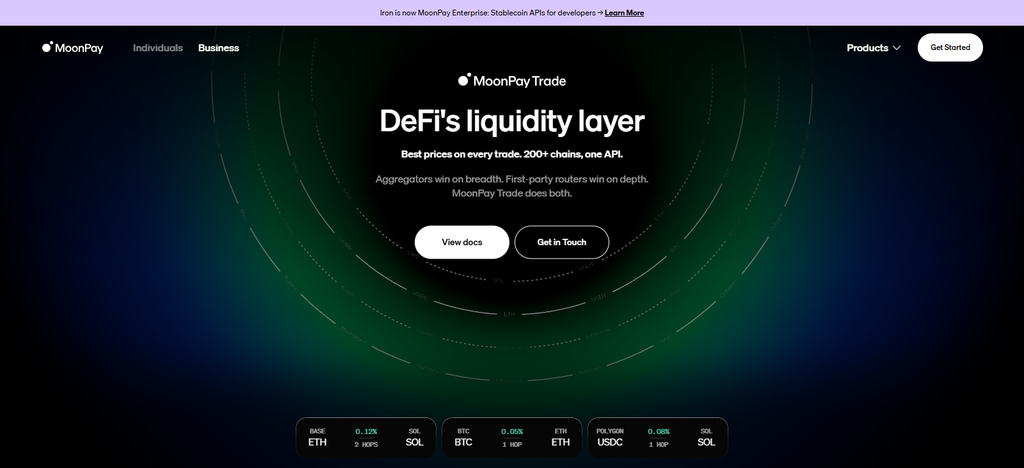
Blockchain coverage includes Ethereum, Solana, Base, BNB Chain, Arbitrum and Polygon. Its payment links, checkout widgets, webhooks and transaction dashboard help businesses manage collections and track subscription payments.
The standard transaction price is 2%, its HelioX Pass rate is 1%. Additional fees apply for swaps and automatic offramps . Refunds must be dealt with directly with the merchant, as blockchain payments are irreversible.
Best Use Cases of MoonPay Trade
- Creator Membership Platforms: Accept crypto payments for premium content and digital memberships.
- Digital Product Businesses: Take stablecoin payments for online products, subscriptions and digital services.
- Web3 Platforms: Integrate cryptocurrency checkout within blockchain apps and marketplaces.
- Online Marketplaces: Enable payments for digital goods & payment experiences for international customers.
MoonPay Commerce Pros & Cons
| Pros | Cons |
|---|---|
| Supports cryptocurrency payments for digital businesses. | Transaction fees can be higher than some alternatives. |
| Offers subscription-related payment functionality. | Supported payment methods vary by region. |
| Provides payment links and checkout integrations. | Blockchain transactions cannot be reversed directly. |
| Supports multiple cryptocurrencies and blockchain networks. | Additional swap and off-ramp charges may apply. |
Comparison table
| Payment Gateway | Best For | Stablecoin Support | Recurring Payments | API Integration | Fiat Settlement |
|---|---|---|---|---|---|
| Stripe Stablecoin Payments | Online businesses and SaaS | USDC, USDP, USDG | Through compatible billing integrations | Yes | Yes |
| Coinbase Commerce (Coinbase Business) | Crypto-native businesses | USDC and supported stablecoins | External integration may be required | Yes | Yes |
| NOWPayments | E-commerce and digital services | USDT, USDC and others | API-based workflows | Yes | Available |
| BitPay | Subscription billing and merchants | USDC and other supported assets | Yes, scheduled billing | Yes | Yes |
| CoinGate | Online stores and merchants | USDT, USDC and others | Recurring invoicing options | Yes | Yes |
| Triple-A | International businesses | USDC, USDT and others | Requires verification | Yes | Yes |
| BVNK | Enterprise payment infrastructure | USDC, EURC, USDG and others | External billing integration | Yes | Yes |
| Sphere | Cross-border payments | Supported stablecoins vary | External billing integration | Yes | Supported corridors |
| Request Finance | Web3 businesses and DAOs | USDC, USDT and others | Recurring invoicing workflows | Yes | Available options vary |
| MoonPay Commerce | Creators and digital platforms | USDC and other supported tokens | Subscription-related billing | Yes | Available options vary |
Conclusion
The best stablecoin payment gateway for subscriptions in 2026 will depend on recurring billing capabilities, supported stablecoins, transaction fees, blockchain coverage and payment automation. Payment features for subscriptions are provided by platforms like Stripe, BitPay and MoonPay Commerce.
Other platforms, such as BVNK, Sphere, Triple-A and Request Finance, focus more on business payment infrastructure and settlement. Businesses should also consider automatic renewals, customer authorizations, failed payment recoveries, cancelation options, refund management and fiat conversion when selecting a gateway. The right solution can streamline international subscription collections, offer more flexible payment options and support long-term business growth.
FAQ
What Is a Stablecoin Payment Gateway for Subscription Businesses?
A stablecoin payment gateway allows businesses to accept recurring digital currency payments using assets such as USDC and USDT. It helps manage subscription collections, payment processing, billing schedules and merchant settlements through blockchain networks.
Which Stablecoin Payment Gateways Support Recurring Payments?
NOWPayments, BitPay and MoonPay Commerce offer subscription-related payment features. Stripe also supports stablecoin payments, but businesses should verify recurring billing availability for their specific integration and account configuration.
Can Businesses Accept USDC and USDT for Monthly Subscriptions?
Yes, businesses can accept USDC and USDT for subscription payments through compatible payment gateways. However, supported stablecoins and blockchain networks vary by provider, so merchants should verify token availability before integrating a payment solution.
Do Stablecoin Payment Gateways Support Automatic Subscription Renewals?
Some gateways support automated recurring collections through scheduled billing, customer balance deductions or wallet authorization. Others generate recurring invoices that customers must pay manually. Businesses should check the payment authorization model before choosing a provider.