


MiCA compliant crypto platforms will be the most popular crypto platforms in 2026. This article covers the most popular MiCA licensed crypto companies in Europe. This includes exchanges like Coinbase, Kraken, Bitstamp, and Bitpanda, among others.
- What is MiCA Licensed Crypto Companies?
- Key Point & Best MiCA Licensed Crypto Companies in Europe
- 1. Coinbase
- Coinbase Features, Pros & Cons
- 2. Kraken
- Kraken Features, Pros & Cons
- 3. Bitstamp
- Bitstamp Features, Pros & Cons
- 4. Bitpanda
- Bitpanda Features, Pros & Cons
- 5. Crypto.com
- Crypto.com Features, Pros & Cons
- 6. KuCoin
- KuCoin Features, Pros & Cons
- 7. OKX
- OKX Features, Pros & Cons
- 8. Revolut
- Revolut Features, Pros & Cons
- 9. Bit2Me
- Bit2Me Features, Pros & Cons
- 10. Gate.io
- Gate.io Features, Pros & Cons
- Conclusion
- FAQ
Considering their founding history, fees, available crypto and the company’s regulatory status, will help you select a licensed and regulated EU crypto trading platform with confidence.
What is MiCA Licensed Crypto Companies?
MiCA licensed crypto companies refer to crypto companies licensed to conduct business under the Markets in Crypto-Assets (MiCA) regulation launched by the EU.
The MiCA crypto companies have met stringent regulatory requirements that cover the domains of security and transparency, consumer protection, financial stability, AML, among others.
A MiCA license for crypto organizations, exchanges, wallet providers, brokers, and any other Crypto Asset Service Provider gives the right to extend their services to all the member states of the EU.
For both the consumer and the business, engaging a MiCA licensed crypto company means that the regulatory practice and oversight are advanced, and the crypto trading, investing, and custody solutions are more secure.
Key Point & Best MiCA Licensed Crypto Companies in Europe
| MiCA Licensed Crypto Company | Key Point |
|---|---|
| Coinbase | Trusted global crypto exchange offering secure trading, institutional services, and strong regulatory compliance. |
| Kraken | Well-established platform known for advanced trading tools, robust security, and transparent operations. |
| Bitstamp | One of Europe’s oldest exchanges providing reliable crypto trading with institutional-grade infrastructure. |
| Bitpanda | European investment platform offering cryptocurrencies, stocks, ETFs, and precious metals in one app. |
| Crypto.com | Comprehensive digital asset ecosystem featuring trading, payments, staking, and crypto debit card services. |
| KuCoin | Popular exchange supporting a wide range of cryptocurrencies, trading products, and earning opportunities. |
| OKX | Advanced crypto platform providing spot, futures, options, Web3 wallet, and DeFi integration. |
| Revolut | Digital banking platform enabling users to buy, sell, and manage cryptocurrencies alongside traditional finances. |
| Bit2Me | Spain-based cryptocurrency platform offering secure trading, wallets, educational resources, and business solutions. |
| Gate.io | Global crypto exchange featuring extensive token listings, derivatives, staking, and Web3 ecosystem services. |
1. Coinbase
Established in 2012 by Brian Armstrong and Fred Ehrsam, with the intention of helping more people gain access to cryptocurrencies, started as a platform for buying and selling only Bitcoin, and is now one of the largest and most heavily regulated exchanges in the world.
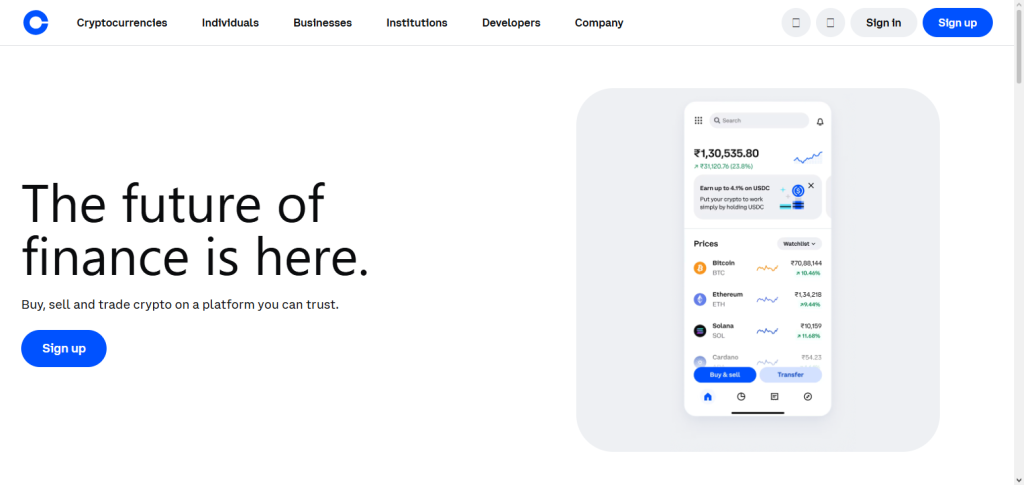
In June of 2026, Coinbase confirmed Luxembourg as its MiCA home, with authorization from the CSSF. With over 260 cryptocurrencies and pairs spanning multiple markets, the platform offers brokerage fees that range from 1.5% to 4%, with FDIC insurance on uninvested cash.
Coinbase Features, Pros & Cons
Features
- Licensed under MiCA via Luxembourg’s CSSF (confirmed June 2026)
- Supports 260+ cryptocurrencies and multiple trading pairs
- USD deposits (cash, uninvested) are FDIC insured
- Coinbase Advanced for pro-level trading with lower fees
- Coinbase One for lower fees and added benefits
Pros
- High transparency being publicly listed (NASDAQ)
- Exceptional reputation for security, has never been hacked
- Easy to use platform
- Wide international regulation
Cons
- Expensive fees, 1.5% to 4% for each transaction
- Poor reputation for customer support
- Less cryptocurrencies than competitors
2. Kraken
Founded in 2011 by Jesse Powell, Thanh Luu, and Michael Gronager, Kraken was launched to the public in 2013 and grew out of Powell’s concerns surrounding the security failures of Mt.
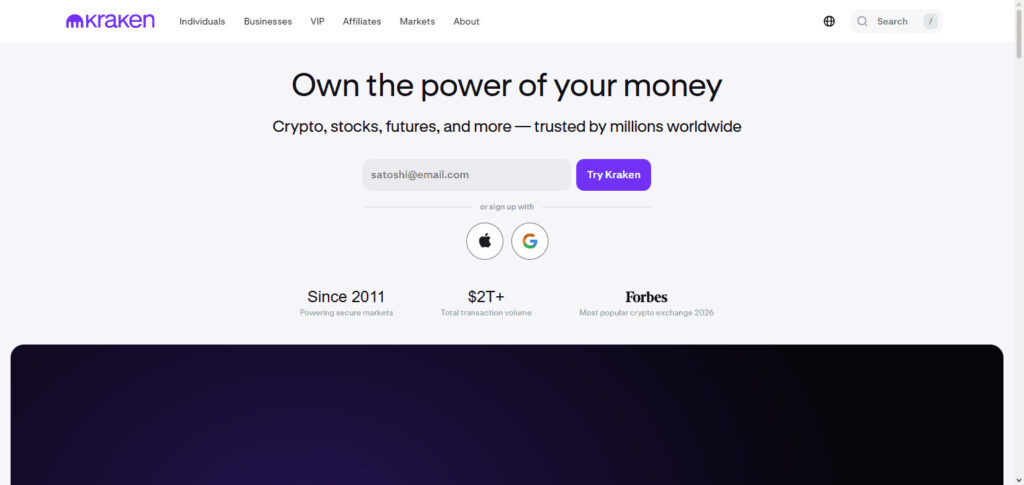
Gox. For this reason and many others, Kraken is also one of the top MiCA-licensed crypto companies. It is also one of the few crypto exchanges to have secured its EU authorization through the Luxembourg Regulator.
It is one of the most versatile exchanges, supporting over more than 100 crypto assets, and 7 fiat currencies, in addition to offering trading for tokenized equities and over 11,000 different stocks and ETFs.
Kraken Features, Pros & Cons
Features
- Licensed under MiCA via Luxembourg’s regulator
- 100+ cryptocurrencies and 7 fiat currencies (USD, EUR, GBP, JPY, CHF, AUD, CAD)
- 11,000+ stocks, ETFs, xStocks with crypto
- Kraken Pro for advanced order types and margin trading
- Kraken Wallet, self-custody crypto option
Pros
- One of the oldest and most trusted exchanges (2011)
- Strong security culture (Kraken Security Labs)
- Competitive institutional volume and deep liquidity
Cons
- Newer competitors (OKX, Revolut) have lower fees for beginners
- No FDIC coverage and no crypto insurance
- Moderate learning curve for trading with advanced tools
3. Bitstamp
Established in 2011 by Nejc Kodric and Damijan Merlak in Slovenia and with a newer base in Luxembourg after the acquisition from Robinhood, Bitstamp is the oldest crypto exchange.
For security-focused users, Bitstamp is among the best MiCA crypto companies due to its reasonable security record and holds MiCA authorization and other licenses.
Bitstamp supports over 85 digital assets and uses a volume-based fee structure with a range between 0.30% maker/0.40% taker fees to almost 0% for high-volume trades.
Bitstamp Features, Pros & Cons
Features
- MiCA license in Luxembourg (CSSF) (now under Robinhood)
- 85+ digital assets (2026)
- Volume-tiered fees with 0.30%/0.40% fees
- Bitstamp’s institutional brokerage service is for family offices/hedge funds
- Staking yield available through Bitstamp Earn
Pros
- The first continuously operated crypto exchange (launched 2011)
- Strong compliance with 50+ global licenses/registrations
- Customer funds fully backed.
Cons
- Deposit fees on card/PayPal hit 4%.
- Less coins.
- No discounts for traders.
4. Bitpanda
From its initial launch in Vienna on December 15, 2014, by founders Eric Demuth, Paul Klanschek, and Christian Trummer, Bitpanda expanded its services beyond crypto to other asset classes including Stocks, ETFs, and precious metals.
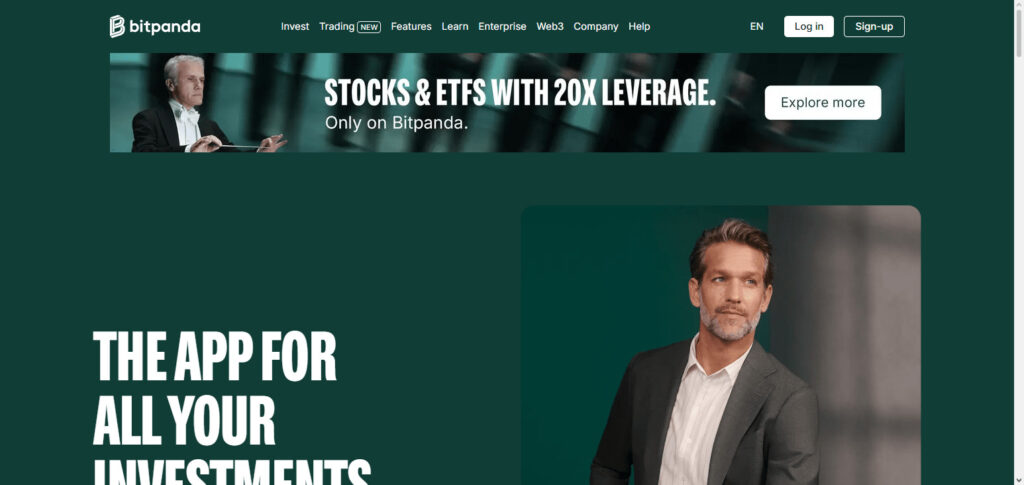
This earned Bitpanda a spot as one of the best MiCA crypto companies for Multi-Asset investing.
By early 2025, Bitpanda had procured three separate MiCA licenses allowing it a passport of all 27 EU states and enabling it to operate easily and freely in other states. With a trading fee of 1.49% for most transactions, Bitpanda is one of the most accessible exchanges with over 650 cryptocurrencies.
Bitpanda Features, Pros & Cons
Features
- Triple MiCA licensing from Germany, Austria, and Malta.
- 650+ cryptos plus stocks, ETFs, and metals.
- Flat 1.49% fee for most transactions.
- Bitpanda Earn for staking.
- Savings plans for automated investing.
Pros
- No hacks since established.
- Combined account for all assets.
- Plus, 16+ licenses across Europe.
Cons
- Not available to U.S. residents.
- Higher spreads/fees (1.49%–1.99%) vs. pro exchanges.
- Some users can’t stake based on country.
5. Crypto.com
Established in June 2016 by founders Kris Marszalek, Bobby Bao, Gary Or, and Rafael Melo, Crypto.com is one of the best MiCA Crypto companies as a card-linked Crypto rewards exchange. Crypto.com converted their card payment service from its initial form into a trading ecosystem.

The company received its MiCA license in 2025 as did other exchanges, including Coinbase, Kraken, and Bitpanda. Crypto.com offers over 400 Cryptocurrencies, spot trading of 480+ pairs, and a Visa card with perks and rewards.
Crypto.com Features, Pros & Cons
Features
- MiCA licensed (2025, alongside Coinbase, Kraken, Bitpanda)
- 400+ cryptocurrencies and ~480 spot trading pairs.
- Visa card with perks for Spotify and Netflix.
- Crypto.com Pay for merchant payments.
- DeFi wallet and NFTs.
Pros
- Great all in one (card + exchange + DeFi).
- Perks for staking CRO with generous rewards.
Cons
- High fees for Bitcoin withdrawals.
- Support slow to respond.
- Mid-range fees unless using CRO for discount.
6. KuCoin
Founded in mainland China in 2017, KuCoin was established bu Chun Gan, Ke Tang, and Johnny Lyu. KuCoin was relocating in 2018 to the Seychelle islands, after regulatory changes and earned the nickname, “the people’s exchange” for its listings of altcoins.
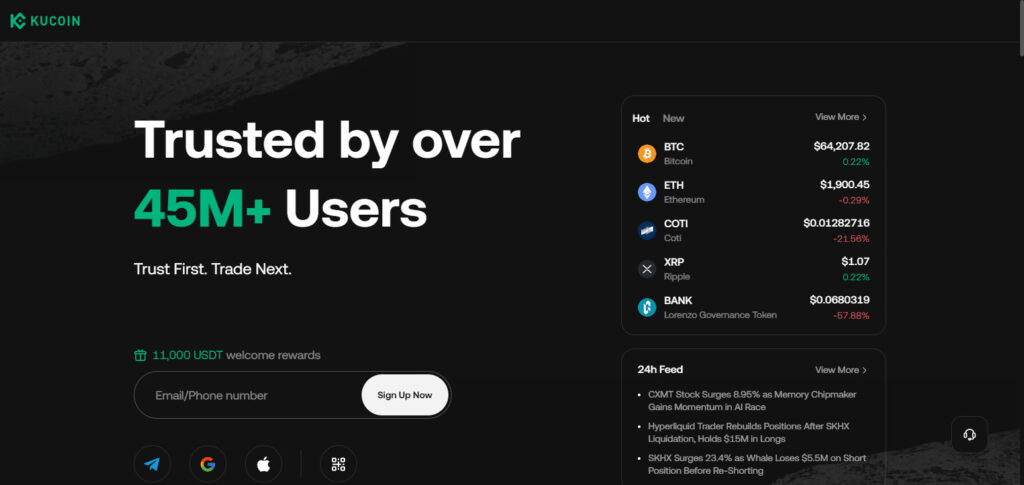
KuCoin has positioned itself high among MiCA-licensed crypto companies by creating a separate EU entity in Austria to serve European clients using MiCA. KuCoin shows off its altcoin listings and variety, boasting over 1,000 digital assets with a standard spot trading fee of 0.10% for both makers and takers.
KuCoin Features, Pros & Cons
Features
- EU presence through a dedicated Austria-based entity
- 1,000+ cryptocurrencies and 1,300+ trading pairs
- Spot fees around 0.10% maker/taker are standard
- Accepts crypto payment via KuCoin Pay at points of sale
- Comes with a trading bot (grid, DCA, AI-assisted) builder
Pros
- Early listing for new and niche altcoins
- Proved Reserves with Merkle Tree
- No deposit fees for fiat or crypto (most cases)
Cons
- Received CFTC enforcement action (2024) in the US
- Total features need KYC, which ends the anonymous-trading
- Regulatory presence in the EU is still smaller than exchanges like OKX or Bitpanda
7. OKX
Founded in 2017 by Star Xu, OKX operates a full ecosystem of spot and derivatives trading, options, and a web 3 wallet. This has led OKX to be one of the top five exchanges globally by trading volume.
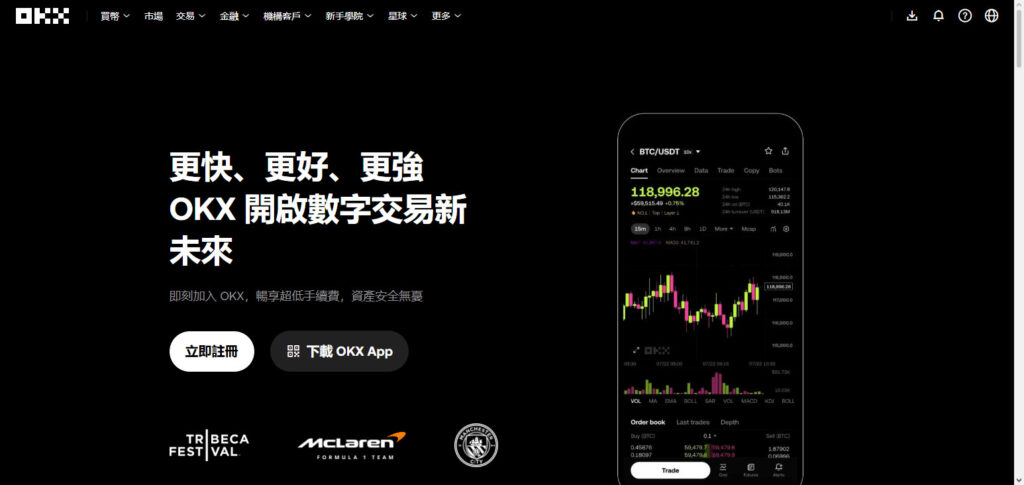
OKX Europe Limited is one of the very first global exchanges to achieve a full MiCA CASP license from the Maltese MFSA, allowing it to passport its services to all 30 EEA member states. This places OKX among the top MiCA licensed crypto firms in terms of early, extensive EU compliance. Spot trading fees begin at 0.08% for makers and 0.10% for takers.
OKX Features, Pros & Cons
Features
- First global exchange to receive a complete MiCA license (Malta’s MFSA, January 2025)
- 240-500+ cryptocurrencies in the EU, 300+ trading pairs
- Base fees: 0.08% maker / 0.10% taker
- OKX Pay and OKX Card due to receive a Payment Institution license (February 2026)
- OKX Wallet supporting 100+ chains and DEXs with aggregate liquidity
Pros
- Segregated customer funds with monthly Proof of Reserves using zk-STARK
- Lots of derivatives and copy-trading
- High tiered trading volume brings negative maker fees
Cons
- USDT pairs removed in the EEA to comply with MiCA’s e-money token compliance
- Account freezes and withdrawals have lagged in some user cases
- Previously received a €1.1 million fine for AML issues from Malta’s FIAU
8. Revolut
Founded in 2015 by Nikolay Storonsky and Vlad Yatsenko, and registered in Vilnius, Lithuania as Revolut Bank UAB, Revolut is one of the top MiCA licensed crypto firms and provides banking services and crypto all in one app.

Revolut provides over 100 cryptocurrencies and the trading fee in the banking app can diminish to 0.49% depending on account tier, while Revolut X has a fee of 0% for makers and 0.09% for takers.
Revolut Features, Pros & Cons
Features
- With MiCA via Revolut Bank UAB in Lithuania
- 100+ cryptocurrencies
- Tiered fees at 1.49% (Standard) down to 0.49% (Ultra), Revolut X at 0%/0.09%
- All banking, stocks, and savings in one app
- Fee-free 1:1 USD to stablecoin swaps recently added
Pros
- Very easy for existing Revolut users
- Intuitive interface
- Handy for day-to-day purchases and multi currency features
Cons
- Limited support for withdrawals to external wallets
- No advanced trading features
- Costs are high due to large spreads (1.5% to 2.5%) in addition to already high fees
9. Bit2Me
Bit2Me was launched in Spain in 2014 and provides services for clients, companies, and institutions involving over 360 cryptocurrencies.
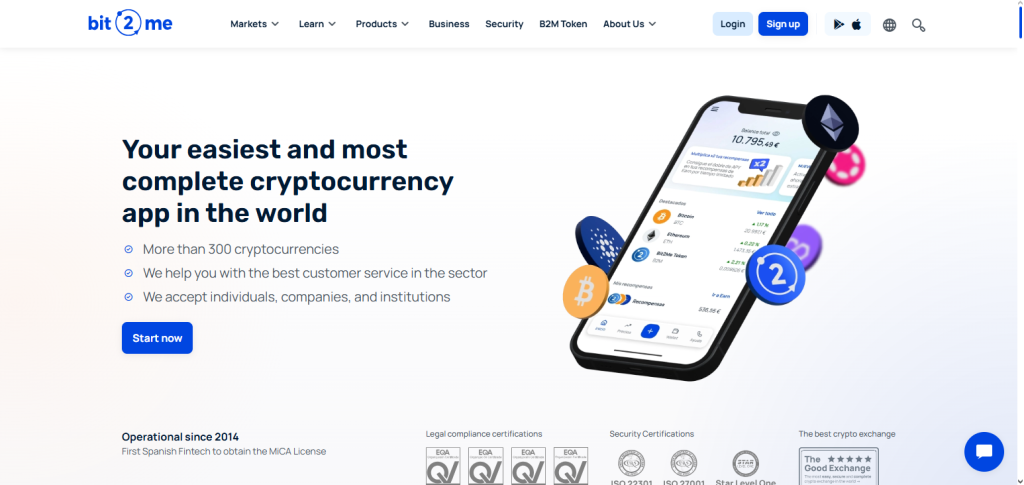
It has become the first Spanish-speaking fintech to obtain a MiCA license as a CASP, earning praise as one of the best MiCA licensed Spanish and Latin American crypto companies.
Additionally, it is the first company in the world to be registered with the Bank of Spain to provide virtual currency and custody services.
Bit2Me Features, Pros & Cons
Features
- Authorized as a CASP by Spain’s CNMV under MiCA (as of July 2025) in all Spanish-speaking countries
- 360+ Cryptocurrencies
- Bit2Me Card and Earn products
- Insurance for €100 million plus cold storage
- Offers crypto education
Pros
- First company in the world with registration from the Bank of Spain for Virtual Currency/Custody Services
- Excellent support for Spanish speakers
- Funded by major institutions like Telefónica, BBVA Spark, and Tether Ventures
Cons
- Smaller user base than large global exchanges
- Less selection than Gate.io or KuCoin
- Limited recognition outside of Spain and Europe
10. Gate.io
Gate.io was established in 2013 (originally as Bter). Since then, and as a result of China’s increased crypto policies, Gate.io has been transferred to the Cayman Islands.
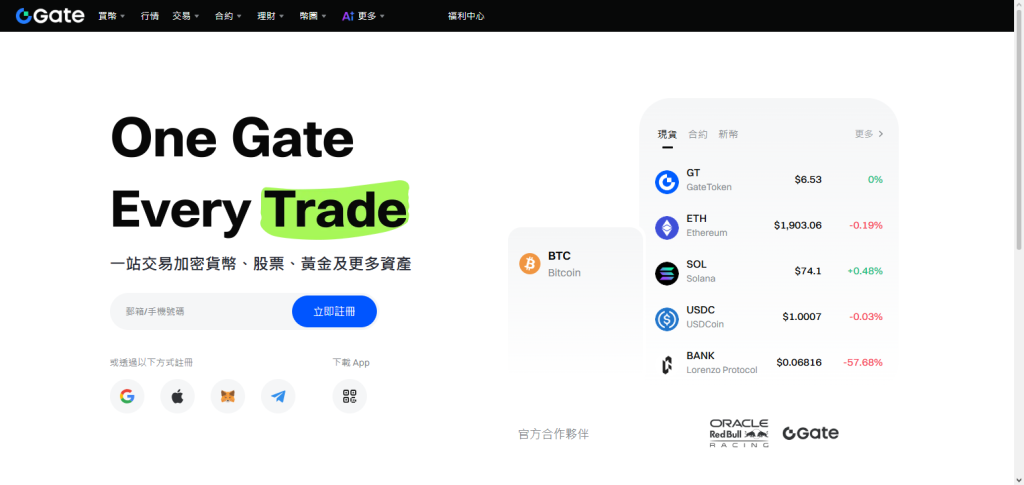
Gate.io has listed between 3,500 and 3,800 of the most traded cryptocurrencies, having one of the most comprehensive catalogs in the industry.
Its European subsidiary, Gate Technology Ltd, received a MiCA license from the Maltese MFSA on the 1st of September 2025, and will be able to conduct exchange and custody services across the EU. With that extensive list of cryptocurrencies, it is also one of the best MiCA licensed crypto companies in Europe for altcoin users.
Gate.io Features, Pros & Cons
Features
- MiCA license enabling crypto trading via Gate Technology Ltd with Malta’s MFSA (September 2025)
- 3,500+ cryptocurrencies
- Trading for advanced instruments like Perpetual Futures
- PSD2 Payment Institution license (February 2026)
- Comprehensive “earn” and savings products
Pros
- Lots of token access
- AA security (CER.live), ISO 27001 and verified Proof of Reserves
- High global trading volume ($3.8T in 2024)
Cons
- Older, and an alleged 2018 data breach still raises transparency concerns
- Varied feedback on slow customer support and frozen accounts
- Restricted from U.S. residents
Conclusion
With MiCA, Europe means business. Unlike previous fragmented national registrations, Europe has created the structure for a legitimate governance review of exchanges that includes the assessment of the adequacy of the capital of the exchange, its AML controls, IT security, and more.
The ten platforms (Coinbase, Kraken, Bitstamp, Bitpanda, Crypto.com, KuCoin, OKX, Revolut, Bit2Me, and Gate.io) covered here represent a sample of what is currently available: long-established firms with a security-focus (like Kraken and Bitstamp), firms with a focus on multiple assets (like Bitpanda and Revolut), firms with a large number of altcoins (like KuCoin and Gate.io), and platforms with a local focus (like Bit2Me for Spanish speaking users).
FAQ
What is MiCA?
MiCA (Markets in Crypto-Assets) is an EU regulation that sets unified rules for crypto-assets and related services across all EU member states, officially in effect since June 2023. It replaced a patchwork of national rules with one common rulebook for exchanges, wallet providers, and other crypto-asset service providers (CASPs).
What exactly is a CASP license?
A CASP authorization isn’t a simple registration — it follows a full regulatory review covering governance, capital adequacy, management suitability, IT security, and AML infrastructure, granted by a national regulator (like Germany’s BaFin, Malta’s MFSA, or Luxembourg’s CSSF).
Does a license from one EU country let a company operate across all of Europe?
es. A license from any one regulator in the European Economic Area “passports” across all 30 EEA countries — the 27 EU states plus Norway, Iceland, and Liechtenstein — so you don’t need a separate license per country.
How many companies are currently MiCA-licensed?
The number keeps climbing. As of May 2026, 204 exchanges held CASP authorization, and a more recent tracker synced to the official ESMA register on 27 July 2026 shows over 260 entries, concentrated most heavily in Germany, France, the Netherlands, Cyprus, and Malta.