


In this article I will be talking about the Best Token Vesting Platforms for Startups that help Web3 businesses handle employee token allocations, automate vesting schedules and secure token distributions. We will look at their key features, pricing, multi-chain support, automation capabilities and startup use cases to help founders choose the right solution to manage employee, investor and contributor token rewards.
- What Are Token Vesting Platforms?
- How We Selected the Best Token Vesting Platforms
- On-Chain vs Off-Chain Token Vesting
- How Much Do Token Vesting Platforms Cost?
- Key Points
- 1. Sablier
- Sablier – Key Features
- 2. Hedgey Finance
- Hedgey Finance – Key Features
- 3. Magna
- Magna – Key Features
- 4. Streamflow
- Streamflow – Key Features
- 5. LiquiFi
- LiquiFi – Key Features
- 6. Toku
- Toku – Key Features
- 7. Team Finance
- Team Finance – Key Features
- 8. UNCX Network
- UNCX Network – Key Features
- 9. Superfluid
- Superfluid – Key Features
- 10. Bonadocs
- Bonadocs – Key Features
- Token Vesting Platforms Comparison Table
- Conclusion
- FAQ
What Are Token Vesting Platforms?
Token vesting platforms are specialized software products that help startups, blockchain firms and Web3 projects to manage and distribute their crypto tokens over a set period of time. These platforms use smart contract technology to automatically distribute tokens to employees, founders, investors, and contributors, with customized vesting schedules, cliff periods, and gradual unlocks.
They give businesses the ability to manage token distribution, keep transparent ownership records, track employee holdings and reduce manual administrative tasks.
Many platforms also have features like multi-chain support, bulk distributions, automated claims, and reporting tools that allow startups to manage token compensation securely, while also encouraging long-term employee dedication and sustainable project growth.
How We Selected the Best Token Vesting Platforms
We evaluated token vesting platforms based on their ability to help startups manage employee allocations, automate token distributions, and maintain transparent vesting records. The following criteria highlight the most important factors considered during our selection.
| Selection Criteria | What We Evaluated |
|---|---|
| Vesting Schedule Flexibility | Evaluated support for linear vesting, cliff periods, milestone-based releases, monthly unlocks, and customizable distribution schedules. |
| Employee Token Allocation | Checked how effectively platforms manage employee grants, founder allocations, contributor rewards, and investor token distributions. |
| Smart Contract Security | Considered smart contract audits, contract permissions, multisignature controls, revocation options, and on-chain transaction transparency. |
| Multi-Chain Support | Compared supported blockchain networks, including Ethereum, Solana, Polygon, Base, Arbitrum, and other compatible ecosystems. |
| Automation Capabilities | Evaluated automated token releases, recurring distributions, auto-claim functionality, bulk contract creation, and scheduled payments. |
| Pricing and Transaction Costs | Compared subscription charges, deployment fees, blockchain gas costs, recipient fees, and enterprise pricing availability. |
| Employee Management Tools | Assessed employee grant administration, wallet management, allocation tracking, vesting records, and stakeholder dashboards. |
| Reporting and Transparency | Examined allocation reports, unlock schedules, transaction histories, ownership visibility, and distribution tracking. |
| Integration Capabilities | Considered compatibility with payroll systems, custody providers, treasury tools, APIs, and other Web3 business infrastructure. |
| Startup Scalability | Evaluated suitability for early-stage startups, growing Web3 teams, and organizations managing large employee and investor allocations. |
On-Chain vs Off-Chain Token Vesting
Startups have two ways to handle employee token allocations and scheduled distributions: on-chain and off-chain token vesting. On-chain token vesting refers to the process of locking tokens in smart contract systems built on a blockchain and automatically unlocking them based on predefined conditions such as a cliff period, monthly unlocks, or linear schedule.
It provides more visibility, auditable transactions and less manual administration. Off-chain token vesting, in contrast, is managed by centralized software or internal databases to handle employee allocations, grant agreements, vesting records, and release schedules.
It offers more administrative flexibility and can streamline HR, payroll and reporting workflows. Startups can opt for on-chain vesting (automated token distribution), off-chain management (internal administration), or a blend of both.
How Much Do Token Vesting Platforms Cost?
The cost of token vesting platforms varies based on the company’s employee allocation needs, supported blockchain networks, token distribution volume, and automation features. Some platforms allow you to create vesting contracts for free, but charge blockchain gas fees, transaction fees or additional service fees for the token distributions.
Others charge a one-time deployment fee, a percentage of distribution or a custom enterprise subscription. Team Finance, for instance, has a published one-time vesting fee, and UNCX Network has fees that depend on the blockchain and vesting setup.
Employee compensation platforms like Toku may have higher monthly fees for services like payroll and grant administration. Startups need to compare the subscription costs, smart contract deployment, network fees, recipient charges, and integration costs when selecting a platform.
Key Points
| Platform | Key Point |
|---|---|
| Sablier | One of the most established on-chain token vesting solutions, offering customizable vesting schedules, cliffs, linear unlocks, token streaming, CSV uploads, and support across numerous EVM chains. |
| Hedgey Finance | Provides on-chain token vesting with revocable and irrevocable plans, governance-enabled locked tokens, milestone-based distributions, and support for multiple EVM networks. |
| Magna | Designed for startup and institutional token management, combining vesting, investor allocations, claim portals, compliance workflows, and token ownership tracking. |
| Streamflow | A leading Solana-native vesting platform that supports token locks, scheduled unlocks, treasury management, and automated token distribution for teams and investors. |
| LiquiFi | Offers token vesting alongside token payroll, grants, compliance, and tax-related workflows, making it suitable for growing Web3 startups with global contributors. |
| Toku | Specializes in employee token grants, vesting administration, payroll integration, and compliance-focused token compensation management. |
| Team Finance | Provides customizable vesting schedules, token locks, bulk recipient management, claim portals, and multi-chain support for startup token distributions. |
| UNCX Network | Offers token vesting and liquidity-locking tools that help startups demonstrate commitment to long-term token distribution and ecosystem stability. |
| Superfluid | Enables programmable real-time token streaming and continuous vesting distributions through protocol-level payment flows and automation. |
| Bonadocs | Provides vesting contract tooling and testing capabilities for teams that need advanced control over custom vesting logic before deployment. |
1. Sablier
Founded in 2019, Sablier is an on-chain token distribution protocol designed to automate vesting, recurring payments and employee token releases. The Lockup feature supports linear, cliff, and custom token distribution schedules, enabling startups to distribute allocations over time rather than in one go.
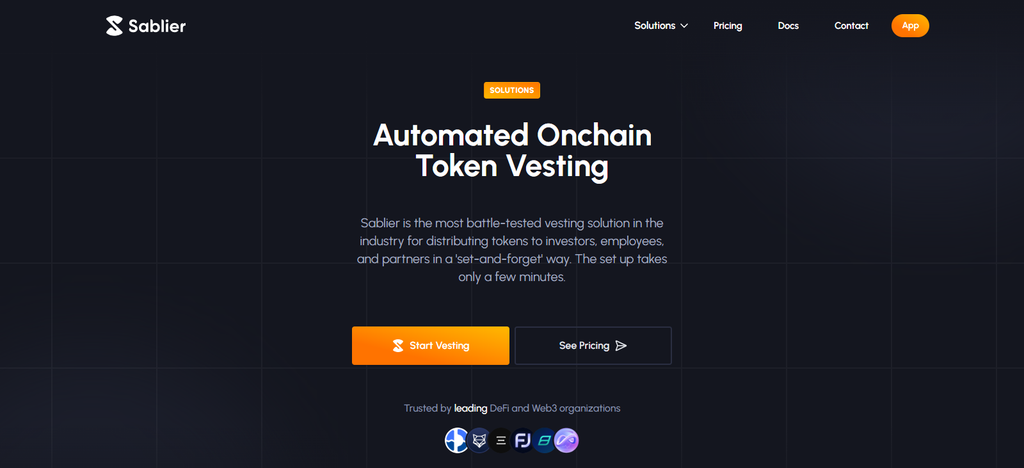
Pricing: There is no published price for an enterprise subscription, you will need to factor in the cost of blockchain transactions and any third party integration costs. Startup Use Case: Ideal for startups issuing founder, employee and contributor tokens on transparent smart contract platforms.
Multi-Chain Support: Primarily EVM networks, with previous support for Solana. Important 2026 limitation: Sablier entered maintenance mode in July 2026 and stopped accepting certain new schedules.
Sablier – Key Features
| Feature | Detailed Explanation |
|---|---|
| Flexible Vesting Schedules | Supports linear, cliff-linear, monthly, exponential, backweighted, and custom token release schedules for employee and investor allocations. |
| Real-Time Token Streaming | Releases tokens continuously over time, allowing employees and contributors to access vested balances without waiting for traditional monthly distributions. |
| NFT-Based Stream Ownership | Represents streams as ERC-721 NFTs, enabling recipients to transfer their stream positions where contract permissions allow. |
| Bulk Token Distribution | Allows startups to create up to 280 streams in bulk and upload recipient information through CSV files. |
| Multi-Chain Support | Supports multiple EVM networks, enabling projects to distribute supported ERC-20 tokens across different blockchain ecosystems. |
| Stream Tracking Dashboard | Provides detailed stream information, including withdrawal history, vesting progress, future payouts, and recipient information. |
| Smart Contract Management | Uses persistent, non-upgradeable smart contracts for transparent token distribution and on-chain execution. |
| Safe Multisig Integration | Supports Safe multisignature wallets, helping startup teams manage treasury-funded vesting operations with additional approval controls. |
2. Hedgey Finance
Hedgey Finance, which launched in 2022, offers on-chain token vesting, investor lockups, token grants and distribution management for Web3 organizations.
Startups can design employee allocations with flexible cliff periods, linear releases, periodic unlocks, and optional post-vesting lockups.
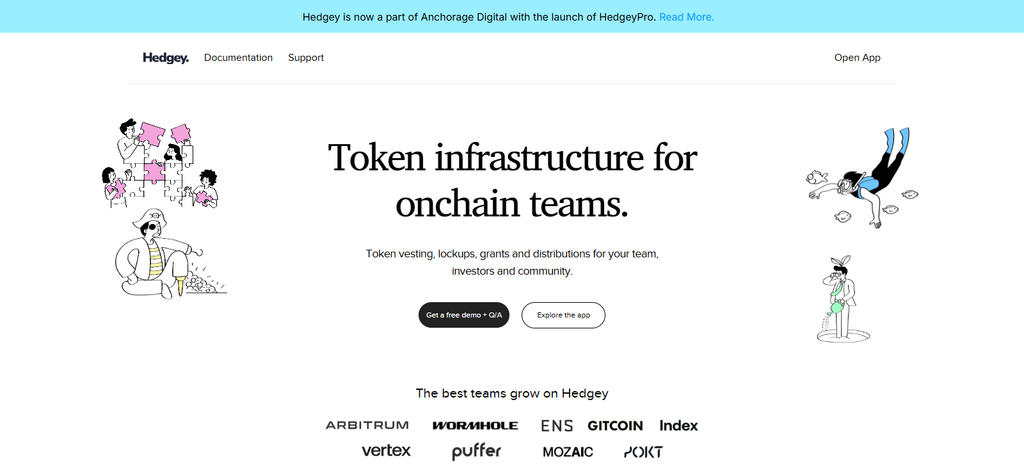
Administrators are able to take back unvested tokens on departure of an employee or contributor based on contract configuration through its revocable vesting contracts. Pricing: The core self-service vesting is advertized as free, other than applicable blockchain gas fees.
Startup Use Case: Ideal for startups that need to manage employee grants, founder allocations and investor distributions. Multi-Chain Support: Compatible with EVM chains like Ethereum, Arbitrum, Optimism, Base, Polygon, Avalanche, BNB Chain, and others.
Hedgey Finance – Key Features
| Feature | Detailed Explanation |
|---|---|
| Employee Token Vesting | Helps startups create token allocation plans for employees, founders, contributors, and other stakeholders through blockchain-based vesting contracts. |
| Custom Vesting Schedules | Supports configurable vesting arrangements, including cliff periods, linear releases, and customized distribution timelines. |
| Revocable Token Grants | Provides revocation functionality for supported contract types, allowing authorized administrators to recover eligible unvested allocations. |
| Investor Token Lockups | Enables projects to establish token lockup agreements for investors and other stakeholders with defined release conditions. |
| On-Chain Transparency | Records vesting agreements through smart contracts, allowing stakeholders to independently verify allocation and release information. |
| DAO Governance Integration | Supports token-related governance workflows, making it useful for organizations coordinating contributor incentives and governance participation. |
| Multi-Chain Deployment | Supports several EVM-compatible networks, allowing startups to create vesting arrangements across supported blockchain environments. |
| Self-Service Management | Provides tools for creating and managing vesting plans without requiring startups to develop every distribution contract independently. |
3. Magna
Magna is a token management platform launched in 2022 to help Web3 companies manage token allocations, employee grants, investor distributions, and vesting. It assists growing startups in handling complex token ownership structures with token cap table management, stakeholder administration, distribution workflows and reporting tools.

Pricing: Enterprise and customized pricing; public subscription price not clearly disclosed, so startups should ask for a quote. Startup Use Case: Ideal for blockchain startups that need to handle multiple funding rounds, employee compensation, investor allocation, and community distribution.
Multi-Chain Support: Works across multiple blockchain ecosystems, with network availability depending on the product and its deployment. In 2026, Magna was integrated into the Kraken-powered infrastructure.
Magna – Key Features
| Feature | Detailed Explanation |
|---|---|
| Token Cap Table Management | Helps startups organize token ownership information, including founder allocations, employee grants, investor holdings, and stakeholder records. |
| Employee Token Administration | Supports structured employee token allocation workflows, helping companies maintain grant information and vesting records. |
| Investor Distribution Management | Provides tools for coordinating investor allocations and token distributions across different fundraising rounds. |
| Vesting Schedule Management | Helps organizations manage token release timelines and monitor stakeholder vesting arrangements. |
| Multi-Chain Token Operations | Supports token management across multiple blockchain ecosystems, depending on the selected product and deployment. |
| Distribution Automation | Helps streamline token distribution processes and reduce manual administrative work for growing blockchain companies. |
| Reporting and Visibility | Provides organizational visibility into token allocations, ownership records, and distribution activity. |
| Enterprise Management | Offers infrastructure for managing complex stakeholder structures, larger token allocations, and more advanced organizational workflows. |
4. Streamflow
Streamflow is a token management platform that launched in 2021 to help blockchain projects with vesting, token lock, airdrops and distributions. Features: Customizable vesting schedules, cliff dates, transferable contracts, automatic claiming, email notifications, bulk recipient management via CSV.
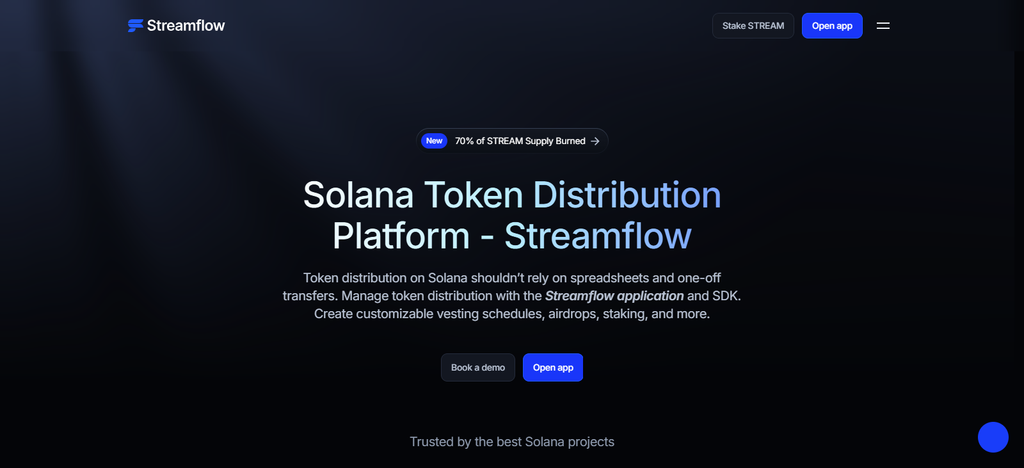
Pricing: Its published Starter and Business pricing includes free initial vesting contracts, then a service fee of 0.16 SOL per additional contract and a 0.19% token fee. Optional auto-claim costs extra. Network fees will also apply.
Startup Use Case: Perfect for Solana startups issuing employee, investor, contributor, and community allocations. Multi-Chain Support: Main ecosystem is Solana, check the availability of other networks before selecting it for a multi-chain deployment.
Streamflow – Key Features
| Feature | Detailed Explanation |
|---|---|
| Custom Token Vesting | Supports linear, cliff, graded, milestone-based, and customized token release schedules for employees, investors, and contributors. |
| Automated Token Claims | Offers auto-claim functionality that automatically transfers unlocked tokens to recipients’ wallets, reducing manual claiming requirements. |
| Bulk Contract Creation | Allows startups to create multiple vesting contracts through CSV uploads, making large employee allocation processes easier to manage. |
| Transferable Vesting Contracts | Supports transferable vesting contracts, allowing eligible recipients to transfer their vesting positions according to contract permissions. |
| Token Locking | Provides token-locking functionality for securing team allocations, investor tokens, and other project reserves for predefined periods. |
| Airdrop Distribution | Supports vested and non-vested airdrops, helping startups distribute tokens to employees, contributors, and community participants. |
| Public Distribution Dashboard | Provides shareable dashboards that allow stakeholders to monitor token allocations, distribution schedules, and vesting activity. |
| Solana-Native Infrastructure | Offers dedicated Solana support, making it particularly relevant for startups managing SPL token allocations and distributions. |
5. LiquiFi
LiquiFi was built to help blockchain companies manage tokens, including employee grants, investor allocations, vesting schedules, and token distributions. In 2026 it was rebranded as Coinbase Token Manager, but kept the underlying vesting schedules and contract functionality.
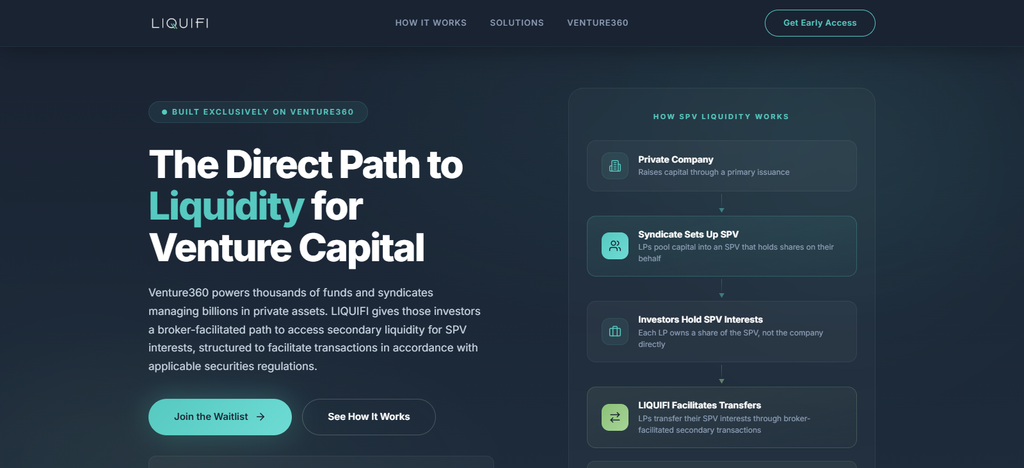
The platform has automated vesting, token cap table management, bulk distributions and custody integrations. Pricing: Custom or quote-based pricing; public subscription rate not disclosed.
Use Case: Startup Well suited for funded startups that require formal records of token allocations, employee grants, and management of investor distributions. Multi-Chain Support: The network availability is chosen through its platform. Startups must check supported chains during onboarding.
LiquiFi – Key Features
| Feature | Detailed Explanation |
|---|---|
| Token Cap Table Management | Helps companies organize token ownership records, employee allocations, founder grants, and investor distributions in a centralized management environment. |
| Automated Vesting Administration | Supports structured vesting workflows that help startups manage employee and stakeholder token release schedules. |
| Employee Grant Management | Helps organizations maintain token compensation records and coordinate employee grants throughout different stages of company growth. |
| Investor Allocation Tracking | Provides administrative capabilities for tracking investor token allocations and managing distribution commitments. |
| Token Distribution Workflows | Helps simplify the administration of token distributions and reduce manual work associated with stakeholder allocation management. |
| Compliance-Oriented Administration | Supports organized grant and ownership records that can assist companies with their internal reporting and legal administration processes. |
| Multi-Chain Operations | Provides token management across supported blockchain ecosystems; exact network availability should be confirmed for the current Coinbase Token Manager offering. |
| Organizational Reporting | Helps finance and operations teams maintain visibility into token ownership, grants, and distribution records. |
6. Toku
Founded in 2020, Toku is a global payroll and token compensation platform that helps Web3 companies manage employee token grants, vesting schedules, tax withholding and distributions. It supports a range of grant structures, including restricted token units, token options and other compensation arrangements.
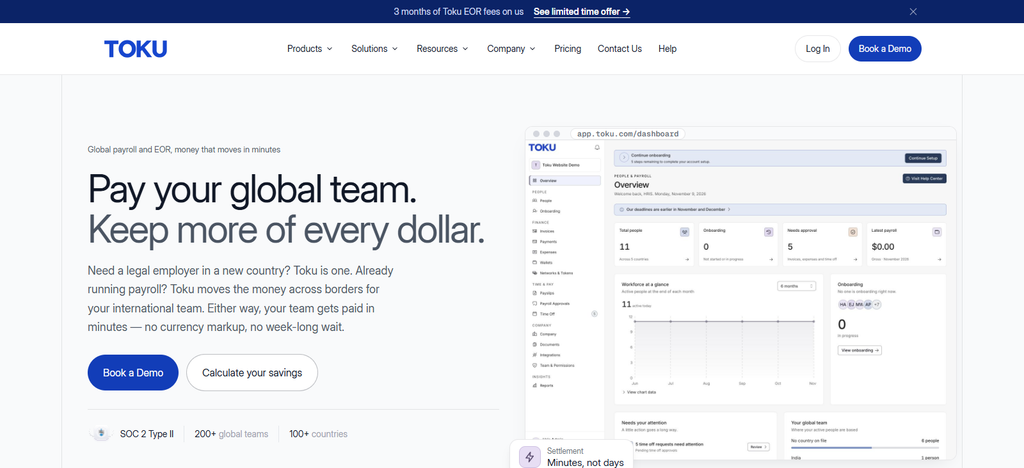
Its reporting tools help finance and HR teams track employee allocations across jurisdictions. Pricing: Token Grant Administration begins at $1,200/month for up to 49 stakeholders. Startup Use Case: Suitable for startups that pay remote employees and contractors in token compensation and need to manage payroll and compliance requirements.
Multi-Chain Support: Enables token payout and distribution workflows across supported blockchain and custody integrations; check for specific network compatibility before onboarding.
Toku – Key Features
| Feature | Detailed Explanation |
|---|---|
| Global Token Payroll | Helps Web3 businesses compensate employees and contractors through token-based payment and payroll workflows across supported jurisdictions. |
| Employee Token Grants | Supports employee token compensation arrangements, allowing startups to organize token grants and maintain compensation records. |
| Vesting Schedule Administration | Helps companies manage employee token vesting timelines and coordinate scheduled compensation releases. |
| Tax Withholding Support | Provides tax-related administration capabilities for token compensation, helping businesses address withholding and reporting requirements where supported. |
| Multi-Country Payroll | Supports global payroll operations, making it useful for startups working with distributed employees and international contractors. |
| Compensation Reporting | Helps finance and HR teams organize employee compensation information, grant details, and payroll-related records. |
| Token Distribution Management | Supports token compensation distribution workflows through available blockchain and custody integrations. |
| HR and Finance Workflows | Combines payroll, token compensation, and administrative processes to reduce the operational complexity of managing Web3 employee rewards. |
7. Team Finance
Team Finance is a token management platform that offers vesting contracts, liquidity locking, staking pools, token creation and distribution services for Web3 projects. Its vesting capability lets startups create customized vesting schedules for employees, founders, investors, and contributors.
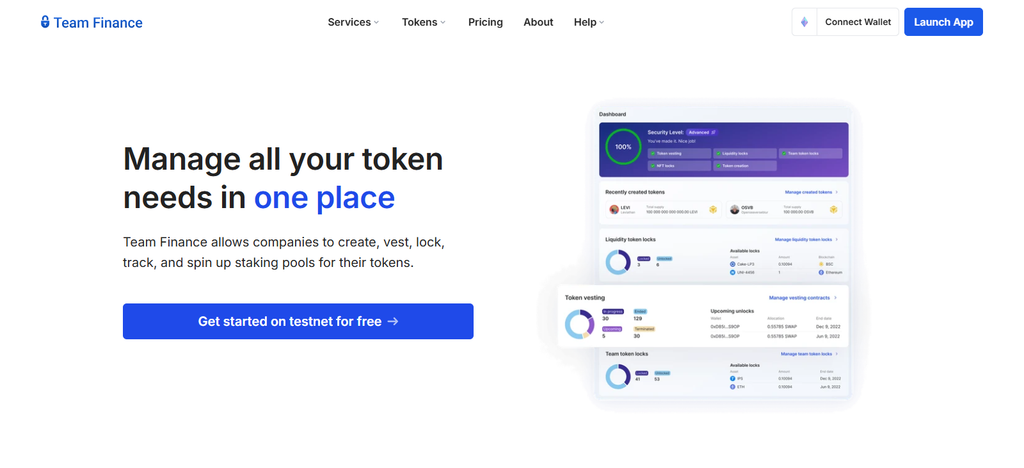
The platform also has dashboards to track allocations and monitor unlock dates. Pricing: The published vesting offering is $100 one-time fee, unlimited wallet addresses during the initial setup and free recipient claims. Use case: startup.
A perfect fit for early-stage startups looking to roll out employee vesting and investor lockups without the need to develop their own smart contract. Multi-Chain Support: Supports 30+ blockchain networks including Ethereum, BNB Chain, Base, Polygon, Arbitrum, Avalanche and more.
Team Finance – Key Features
| Feature | Detailed Explanation |
|---|---|
| Token Vesting Contracts | Allows startups to establish token release schedules for founders, employees, investors, and contributors through predefined smart contract arrangements. |
| Liquidity Locking | Provides liquidity-pool locking functionality to help projects demonstrate that designated liquidity tokens remain locked for a specified period. |
| Token Locking | Enables projects to lock tokens for predefined durations, supporting team allocation restrictions and project tokenomics. |
| Staking Pool Creation | Offers staking infrastructure that allows projects to create token staking arrangements and manage participant rewards. |
| Token Creation Tools | Provides token creation functionality that helps startups configure and launch supported tokens without building all infrastructure independently. |
| Vesting Dashboard | Helps administrators monitor token locks, vesting arrangements, contract information, and relevant release timelines. |
| Multi-Chain Support | Supports multiple blockchain networks, allowing startups to use available token management services across supported ecosystems. |
| No-Code Contract Deployment | Simplifies the creation of token-related smart contracts through an interface designed for projects without extensive blockchain development resources. |
8. UNCX Network
UNCX Network is a decentralized token vesting, liquidity locking, and staking infrastructure for blockchain projects, established in 2020. Cliff periods, linear vesting, and stepped distributions let startups tailor token release schedules for employee, founder, investor, and ecosystem allocations.
Its on-chain public records allow stakeholders to verify the lock duration and upcoming token releases. Pricing: Fees vary depending on the blockchain, for example, the cost of vesting on Ethereum is 0.05 ETH + 0.1% of vested tokens and on Solana is 0.5 SOL + 0.1%.
Startup Use Case: Great for DeFi startups looking to transparently allocate employees and lock liquidity. Multi Chain Support: Support Ethereum, BNB Chain, Base, Polygon, Arbitrum, Optimism, Avalanche, Solana and more networks.
UNCX Network – Key Features
| Feature | Detailed Explanation |
|---|---|
| Token Vesting Management | Enables blockchain projects to create vesting arrangements for team members, founders, investors, and ecosystem contributors. |
| Liquidity Locking | Provides liquidity-locking functionality that helps projects secure designated liquidity-provider tokens for predetermined periods. |
| Custom Lock Durations | Allows projects to configure lock periods according to their tokenomics requirements and stakeholder distribution commitments. |
| On-Chain Verification | Records supported vesting and locking arrangements on blockchain networks, allowing stakeholders to verify contract information independently. |
| Multi-Chain Infrastructure | Supports multiple blockchain ecosystems, helping startups manage token locks and vesting across supported networks. |
| Token Launch Support | Provides token-related infrastructure that can assist projects with launch preparation, liquidity management, and distribution activities. |
| Automated Contract Execution | Uses smart contracts to enforce configured lock and vesting conditions without requiring administrators to manually release every allocation. |
| Public Lock Information | Provides access to relevant lock records and contract information, helping projects demonstrate transparency around restricted token allocations. |
9. Superfluid
Superfluid, founded in 2020, builds programmable on-chain money streaming infrastructure for salaries, recurring payments, rewards and token vesting. Its Super Token framework lets startups distribute tokens on a continuous basis, not just monthly or quarterly transfers. Distribution pools also help projects distribute tokens to multiple recipients.
Pricing: The protocol does not provide a traditional subscription for monthly vesting. Startups should take into account the network gas fees and any integration/implementation fees. Startup Use Case useful for Web3 startups paying employees, contributors and ecosystem participants via continuous token streams.
Multi-chain support: Its ecosystem has expanded beyond Polygon and Gnosis to many networks and the compatibility for deployment depends on the Superfluid contracts and supported tokens.
Superfluid – Key Features
| Feature | Detailed Explanation |
|---|---|
| Continuous Token Streaming | Allows startups to distribute tokens continuously over time, enabling employees and contributors to accumulate withdrawable balances instead of waiting for fixed payment dates. |
| Programmable Token Payments | Provides programmable payment infrastructure that helps businesses configure recurring token transfers and automated compensation arrangements. |
| Super Tokens | Uses Super Tokens to enable streaming and other programmable financial operations across supported blockchain networks. |
| Automated Salary Distribution | Helps Web3 startups distribute recurring token-based compensation to employees, contractors, and contributors through configured streams. |
| Distribution Pools | Supports distribution pools that help projects allocate tokens among multiple recipients through coordinated payment arrangements. |
| Real-Time Balance Tracking | Allows recipients to monitor their accumulating balances and withdraw available tokens according to the stream configuration. |
| Multi-Chain Support | Provides deployments across multiple blockchain networks, including supported EVM ecosystems, allowing projects to implement streaming payments in different environments. |
| Developer Integration | Offers smart contract infrastructure and developer tools for building customized payment, reward, and token distribution applications. |
10. Bonadocs
Bonadocs is a Web3 developer tooling platform for smart contract documentation, integration and developer collaboration, not for direct employee token vesting. Its Docgen functionality generates interactive contract documentation, while its widgets and playground enable developers to test and interact with smart contract methods.
Founded Year: No clear, verified public founding year. Pricing : Pricing schedule for public is not explicitly revealed. Startup Use Case: Great for startups that build custom vesting contracts and require clear technical documentation and developer onboarding.
Multi-Chain Support: Its protocol registry has contracts on multiple EVM-compatible blockchain ecosystems. Important limitation: Bonadocs should be viewed as complementary developer infrastructure, not as a platform for direct employee token allocation or vesting management.
Bonadocs – Key Features
| Feature | Detailed Explanation |
|---|---|
| Smart Contract Documentation | Helps blockchain developers create understandable documentation for smart contracts, making technical functionality easier for startup teams to review and maintain. |
| Interactive Contract Interfaces | Provides interactive documentation experiences that help users explore contract methods and understand available blockchain operations. |
| Contract Integration Tools | Supports developer workflows for integrating smart contract functionality into decentralized applications and other Web3 products. |
| Developer Playground | Provides an environment for exploring and interacting with documented smart contract functionality during development and testing. |
| API Documentation | Helps organize technical references and contract interaction information so developers can understand and use available interfaces. |
| Contract Function Exploration | Makes smart contract methods and their parameters easier to inspect, helping developers understand how blockchain applications operate. |
| Developer Collaboration | Supports clearer technical communication between developers and other team members working on blockchain application development. |
| Multi-Chain Documentation | Helps document smart contracts across supported blockchain ecosystems, depending on the available contract integrations and deployments. |
Token Vesting Platforms Comparison Table
| Platform | Best For | Main Vesting Features | Multi-Chain Support | Pricing Model |
|---|---|---|---|---|
| Sablier | Continuous token streaming | Linear vesting, cliff schedules, bulk streams | Multiple EVM networks | Gas and applicable service costs |
| Hedgey Finance | Employee and investor vesting | Revocable grants, custom schedules, token lockups | Multiple EVM networks | Free self-service offering; gas fees apply |
| Magna | Token cap table management | Employee grants, allocation tracking, distributions | Multiple supported networks | Custom pricing |
| Streamflow | Solana token vesting | Cliff schedules, auto-claims, bulk distribution | Primarily Solana | Contract and distribution fees |
| LiquiFi | Employee token administration | Token grants, vesting records, cap tables | Confirm supported networks | Custom pricing |
| Toku | Global token compensation | Employee grants, payroll, tax administration | Supported payout networks | Subscription-based pricing |
| Team Finance | Token locking and vesting | Vesting contracts, liquidity locks, staking | 30+ networks claimed | One-time and service fees |
| UNCX Network | DeFi token vesting | Custom locks, token vesting, on-chain verification | Multiple blockchain networks | Network-specific fees |
| Superfluid | Continuous token payments | Real-time streaming, distribution pools | Multiple supported networks | Gas and integration costs |
| Bonadocs | Smart contract documentation | Contract documentation, interactive interfaces | Supported contract ecosystems | Public pricing not clearly disclosed |
Conclusion
Choosing the best token vesting platform in 2026 depends on a startup’s employee allocation requirements, blockchain ecosystem, budget and long-term growth plans.
There are platforms like Hedgey Finance, Magna, Streamflow and Toku that take a different approach to employee grant management, investor allocations, automated vesting and token distributions.
Startups should compare the founding capabilities, pricing, multi-chain support, smart contract security, and employee management features before deciding.
A good platform can help facilitate token compensation, make allocation more transparent, reduce administrative tasks and help growing Web3 teams be more efficient in managing their employee and contributor rewards.
FAQ
What Is a Token Vesting Platform?
A token vesting platform is a software solution that helps startups distribute cryptocurrency tokens to employees, founders, investors, and contributors according to predefined schedules. It automates token releases and manages allocation records.
Why Do Startups Need Token Vesting Platforms?
Startups use token vesting platforms to manage employee token compensation, prevent immediate token selling, automate scheduled releases, maintain transparent allocation records, and establish long-term incentives for employees and contributors.
Which Token Vesting Platform Is Best for Startups in 2026?
Hedgey Finance, Magna, Streamflow, and Toku are options worth evaluating. The right choice depends on whether a startup prioritizes smart contract vesting, employee grant administration, payroll integration, or multi-chain token distribution.
How Much Do Token Vesting Platforms Cost?
Pricing varies depending on the platform, blockchain network, contract deployment, and distribution volume. Some platforms charge transaction fees or one-time deployment costs, while enterprise solutions may require customized subscriptions.