



In this article, I will talk about the best crypto security tools to detect malicious wallet approvals. These tools help cryptocurrency users to find suspicious smart contract transactions, monitor token permissions, detect unlimited spending allowances, and prevent unauthorized access to assets. They offer approval scanning, transaction monitoring, risk alerts and revoking capabilities to reinforce wallet security and protect digital property on multiple blockchain networks.
- What Are Malicious Wallet Approvals?
- Key Points
- 1. Revoke.cash
- Revoke.cash Features
- Revoke.cash Pros & Cons
- 2. Etherscan Token Approval Checker
- Etherscan token approve checker Features
- Etherscan Token Approval Checker Pros & Cons
- 3. Rabby wallet
- Rabby Wallet Features
- Rabby Wallet Pros & Cons
- 4. Pocket Universe
- Universe in a Pocket Features
- Pocket Universe Pros & Cons
- 5. Scam Sniffer
- Scam Sniffer Features
- Scam Sniffer Pros & Cons
- 6. Blockaid
- Blockaid Features
- Blockaid Pros & Cons
- 7. De.Fi Shield
- Defi Shield Features
- De.Fi Shield Pros & Cons
- 8. Blowfish
- The Blowfish Features
- Blowfish Pros & Cons
- 9. Revokescout
- Revoke scout Features
- Revokescout Pros & Cons
- 10. MetaMask Portfolio
- MetaMask Portfolio Features
- MetaMask Portfolio Pros & Cons
- Conclusion
- FAQ
What Are Malicious Wallet Approvals?
Malicious wallet approvals happen when users of cryptocurrency unknowingly approve suspicious intelligent contracts to access, spend or transfer their digital possessions. These permissions are generally created when you interact with dApps, DeFi platforms, NFT marketplaces, or unfamiliar blockchain websites.
Attackers leverage these approvals through phishing links, fake token claims, malicious contracts, and fraudulent signature requests. Unlimited token allowances can be especially dangerous because they may allow an approved contract to spend a user’s tokens without requiring confirmation each time.
ERC-20 tokens, NFTs and other blockchain assets could be affected by malicious approvals. The crypto security tools assist users in identifying suspicious spender addresses, auditing existing permissions, flagging risky transactions and revoking unnecessary approvals to reduce wallet exposure.
Key Points
| Tool | Key Point |
|---|---|
| Revoke.cash | Industry-leading wallet approval checker that scans active token approvals, identifies risky unlimited allowances, and lets users revoke malicious or unused permissions across multiple blockchain networks. |
| Etherscan Token Approval Checker | Official Ethereum-based approval management tool that shows approved spenders, allowance amounts, and assets at risk while allowing direct approval revocation. |
| Rabby Wallet | Security-focused wallet featuring transaction simulation and approval warnings that help users detect suspicious contracts before signing wallet permissions. |
| Pocket Universe | Real-time transaction simulation platform that previews wallet interactions and flags potentially dangerous approvals or phishing-related transactions before execution. |
| Scam Sniffer | Anti-phishing security tool that monitors Web3 transactions, detects wallet-draining threats, and warns users about malicious approval requests and scam websites. |
| Blockaid | Advanced Web3 security infrastructure that analyzes transactions and smart contract interactions in real time to identify harmful approvals and wallet-draining attacks. |
| De.Fi Shield | Wallet security dashboard that audits token approvals, detects risky permissions, and helps users manage and revoke vulnerable contract access. |
| Blowfish | Transaction simulation and risk-analysis engine that evaluates wallet approvals before signing, helping prevent interactions with malicious smart contracts. |
| Revokescout | Approval monitoring tool powered by Blockscout explorers that enables users to review and revoke token permissions granted to smart contracts. |
| MetaMask Portfolio | Portfolio management platform with token approval monitoring capabilities, allowing users to review and revoke unnecessary smart contract permissions from connected wallets. |
1. Revoke.cash
Revoke.cash is a wallet approval management tool that helps users identify excessive, outdated, and potentially dangerous token permissions across more than 100 blockchain networks. It supports Ethereum, BNB Chain, Polygon, Base, Arbitrum, Optimism, Avalanche, Linea and other EVM-compatible networks.
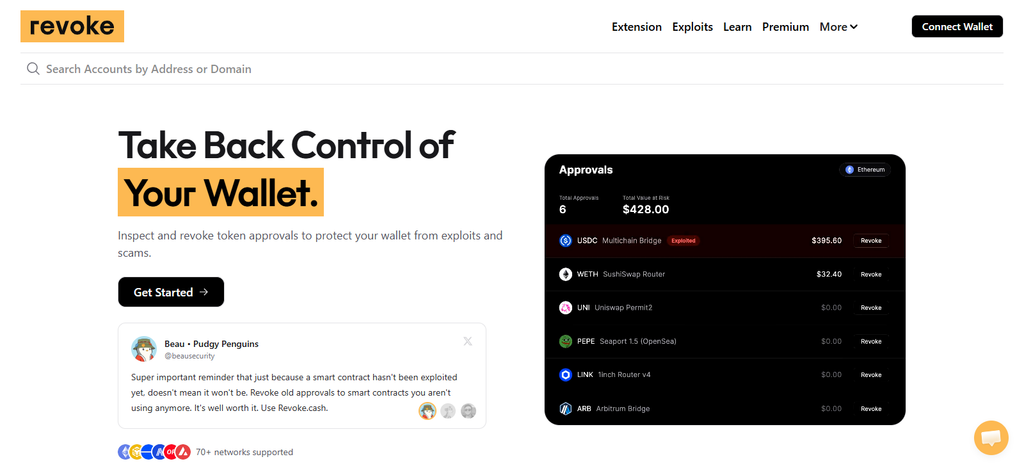
Users can see the approved token amounts, spender addresses, approval history, and permissions related to known exploits. Its Exploit Checker finds approvals that are attached to compromised contracts, and its revoke function lets users strip away unwanted permissions or cut down spending allowances.
The free plan is $0, but individual revocations cost network gas. Premium is $99/year, and Ultimate is $199/year and has automated revocation features.
Revoke.cash Features
- Multichain Approval Scanner: Scans existing token and NFT approvals across 100+ supported blockchain networks.
- Unlimited Allowance Detection: helps find out when decentralized applications are given permissions to spend too many tokens.
- Exploit Checker: Checks wallet approvals against known smart contract exploits and compromised contracts.
- Revoking approval: Users can revoke unwanted approvals or reduce the approved token spend limit.
- Automated Approval Monitoring. Ultimate plan provides ongoing monitoring and automated revocation of risky approvals.
Revoke.cash Pros & Cons
| Pros | Cons |
|---|---|
| Supports 100+ blockchain networks for multichain approval monitoring. | Some advanced monitoring features require paid subscriptions. |
| Identifies unlimited token allowances and suspicious approvals. | Revoking permissions requires network gas fees. |
| Provides an approval dashboard for reviewing wallet permissions. | Users must review and select permissions before individual revocation. |
| Includes an Exploit Checker for identifying risky approvals. | Unsupported or non-standard approval events may not appear. |
| Allows users to revoke unwanted token and NFT permissions. | Revoking approvals does not recover already stolen assets. |
2. Etherscan Token Approval Checker
The Etherscan Token Approval Checker is a tool to audit on-chain permissions, which helps Ethereum users to check smart contract contracts that have been approved to spend their tokens or manage their NFTs.
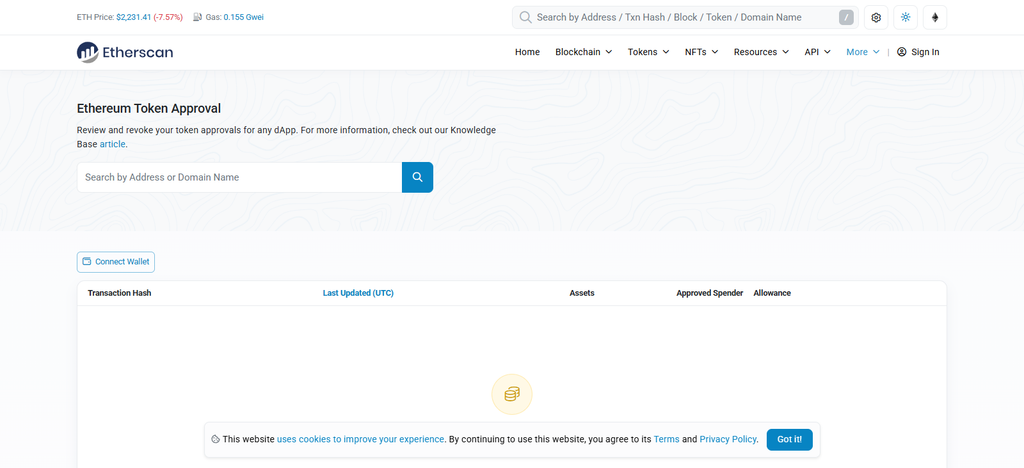
It detects ERC-20, ERC-721 and ERC-1155 approvals and shows spender addresses, approved token amounts and current allowances. Entering a public wallet address allows users to check the permissions without connecting their wallet. Connecting the wallet allows users to modify and revoke approvals. Its primary network coverage is Ethereum and users should not expect the Ethereum checker to cover all EVM chains.
The tool supports connections via MetaMask, WalletConnect and Coinbase Wallet. Approval inspections are free, but changing or revoking permissions requires a blockchain transaction and associated gas fees.
Etherscan token approve checker Features
- ERC-20 Approval Tracking: Shows smart contract transactions that have been approved to spend ERC-20 tokens from a wallet.
- NFT Permission Monitoring: Finds ERC-721 and ERC-1155 token approvals and operator permissions.
- Public Wallet Inspection: Users can search for a public wallet address or ENS name without the need of connecting their wallet.
- Spending Allowance Visibility: Displays approved spender addresses and remaining token allowances.
- Approval Revocation: Revoke individual approvals or reduce approved token amounts from a connected wallet
Etherscan Token Approval Checker Pros & Cons
| Pros | Cons |
|---|---|
| Provides direct access to on-chain token approval information. | Primarily focuses on Ethereum through its main checker. |
| Supports ERC-20, ERC-721, and ERC-1155 approval inspection. | Users may need separate explorers for other networks. |
| Allows public wallet address inspection. | Interface may be difficult for beginners to understand. |
| Displays approved spender addresses and token allowances. | Does not provide comprehensive automated approval monitoring. |
| Supports revoking unwanted token permissions. | Each revocation requires a blockchain transaction and gas fees. |
3. Rabby wallet
Rabby Wallet is a non-custodial Web3 wallet that helps users protect themselves before they approve a blockchain transaction with transaction simulation, suspicious contract detection and approval management.
It supports 100+ EVM-compatible networks including Ethereum, BNB Chain, Arbitrum, Optimism, Polygon, Base, Avalanche, Linea, Scroll, and zkSync Era. Its transaction simulation feature shows users what token transfers, balance changes and approval permissions they can expect before signing.
The built-in Risk Scanner will detect suspicious contracts, known wallet drainers, and potentially dangerous dApp interactions. Its Approval Manager displays existing permissions and can revoke them individually and in batch. Rabby Wallet is free to download and use, and standard blockchain gas fees are applied for revocation of approval and transactions.
Rabby Wallet Features
- Transaction Simulation: See the token transfers, balance changes, contract interactions and approval permissions you are about to confirm
- Built-in Risk Scanner: Detects suspicious contracts, known drainer addresses, honeypots, and risky transactions.
- Approval Manager: Shows current token permissions and helps users find unnecessary spending allowances.
- One-Click Revocation: Users can revoke individual approvals and revoke multiple permissions in a batch.
- Auto Network Switching: Automatically identifies the blockchain network needed for a dApp and switches to the supported one.
Rabby Wallet Pros & Cons
| Pros | Cons |
|---|---|
| Simulates transactions before users confirm wallet interactions. | Primarily focuses on EVM-compatible blockchain networks. |
| Provides built-in risk scanning for suspicious transactions. | Some advanced features may require supported network integrations. |
| Includes approval management and permission review features. | New users may need time to understand transaction simulations. |
| Supports multiple blockchain networks and Web3 applications. | Security warnings cannot guarantee that every malicious transaction is detected. |
| Offers batch approval revocation functionality. | Users still need to pay network gas fees for revocations. |
4. Pocket Universe
Pocket Universe is a Web3 security tool that sits in your browser and reviews transaction and signature requests before they reach your wallet for confirmation. It helps identify malicious token approvals, fake NFT listings, suspicious DEX interactions and transactions that could move valuable wallet assets to unauthorized contracts. It supports networks such as Ethereum, Polygon, BNB Chain, Optimism, Arbitrum, Base, Blast, Linea, and Scroll.
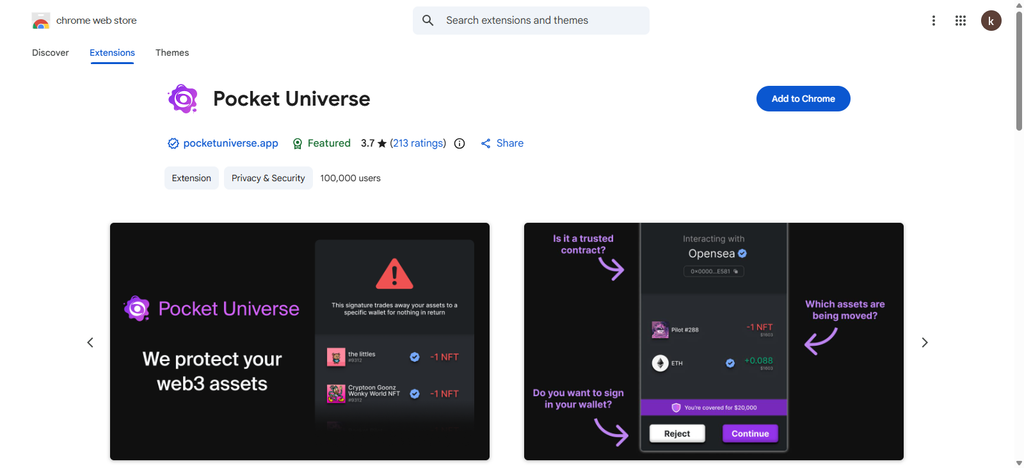
It works with popular wallets like MetaMask, Coinbase Wallet, Rabby, Frame and Taho, but WalletConnect and some other wallets are not currently supported. Pocket Universe is focused on detection before signing, not a dedicated historical approval revoker. The browser extension is free to install; optional transaction coverage and swap-related fees may apply depending on the service and transaction.
Universe in a Pocket Features
- Pre-Signing Transaction Protection: It reviews wallet transaction requests before users sign potentially risky operations.
- Malicious Approval Detection: Identifies suspicious token approvals and permissions that could put wallet assets at risk.
- Asset Movement Preview: Describes expected asset transfers so users can see unexpected token movements.
- Phishing Website Detection: Notifies users of suspicious Web3 websites and potentially fraudulent dApp interactions.
- Browser Wallet Integration: Integrates with supported browser wallets to provide security warnings during Web3 transactions.
Pocket Universe Pros & Cons
| Pros | Cons |
|---|---|
| Analyzes transactions before wallet confirmation. | Does not primarily function as a historical approval revocation dashboard. |
| Helps identify suspicious token approvals and wallet-draining transactions. | Browser extension compatibility may limit some wallet users. |
| Provides transaction previews to explain potential asset movements. | Simulation results cannot predict every possible contract behavior. |
| Detects potentially malicious Web3 websites and dApp interactions. | Some blockchain and wallet combinations may not be supported. |
| Offers browser-based protection during Web3 interactions. | Users must still review warnings before signing transactions. |
5. Scam Sniffer
Scam Sniffer is a Web3 security platform that detects phishing websites, malicious wallet interactions, dangerous signatures and suspicious smart contract activity. It looks at website domains, contract information, transaction simulations, spender addresses and potentially malicious signature requests before users confirm transactions for security checks.
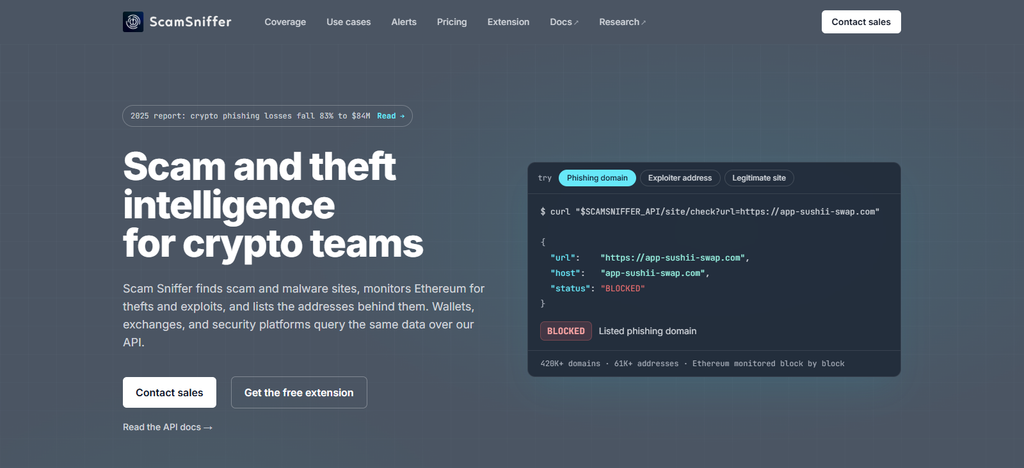
It detects risky approve actions such as approve, allowance, and setApprovalForAll to help users find suspicious token and NFT permissions. Its browser protection is built for Ethereum-compatible Web3 interactions, but users should check individual network compatibility, not assume universal multichain approval scanning.
Scam Sniffer has a free browser extension and a public scam database, with commercial API plans starting at $999 a month. This is mainly a detection and warning solution and not a dedicated approval revocation dashboard.
Scam Sniffer Features
- Phishing Website Detection: Detects suspicious web3 domains and websites associated with crypto scams.
- Malicious Signature Analysis: Analyzes suspicious authorization requests and risky wallet signatures.
- Approval Risk Detection: Helps detect potentially malicious token approvals and NFT permission requests.
- Address Scam Detection: It generates alerts for suspicious interactions using threat intelligence and known malicious address information.
- Browser Extension Protection: Alerts users to browser security when interacting with decentralized applications.
Scam Sniffer Pros & Cons
| Pros | Cons |
|---|---|
| Detects phishing websites and suspicious Web3 domains. | Primarily focuses on threat detection rather than approval revocation. |
| Identifies potentially dangerous wallet signatures. | Advanced API services can be expensive for smaller projects. |
| Helps identify malicious token approval requests. | Detection depends partly on available threat intelligence. |
| Provides browser extension-based security warnings. | False positives may occur with unfamiliar websites or contracts. |
| Maintains scam-related address and website intelligence. | Does not replace a dedicated multichain approval management tool. |
6. Blockaid
Blockaid is an on-chain security infrastructure platform that helps wallets, exchanges, and Web3 apps to detect malicious transactions, suspicious contracts, and dangerous token permissions. Its transaction simulation engine simulates what a transaction is likely to do before it is signed, including token movements, approval changes and interactions with potentially malicious contracts.
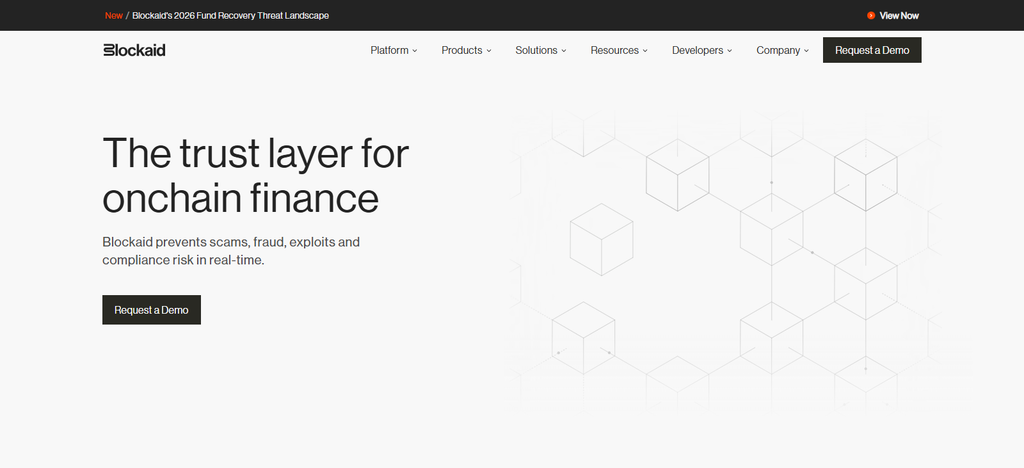
It supports major networks and ecosystems such as Ethereum, Solana, Bitcoin, Base, Linea, Blast, Optimism and other supported chains. Its security system also features address scanning, token scanning and dApp detection to detect malicious addresses, scam tokens and compromised websites.
Blockaid is not your average consumer approval-revocation dashboard. It is mainly geared toward preventive detection and security integration. Typically pricing is offered as custom business and enterprise arrangements rather than as a publicly listed individual subscription.;
Blockaid Features
- Transaction Risk Analysis: Simulates blockchain transactions to identify potentially risky outcomes prior to wallet confirmation.
- Malicious Contract Detection: Scans for suspicious activity and known security vulnerabilities in intelligent contracts.
- Wallet address screening: Blockchain addresses are checked against security intelligence to detect potentially harmful destinations.
- Token Security Scanning : Scans for suspicious tokens and potentially malicious token interactions.
- Multichain Security Infrastructure: Delivers security integration for supported blockchain networks, wallets, exchanges and Web3 applications.
Blockaid Pros & Cons
| Pros | Cons |
|---|---|
| Provides advanced transaction simulation and risk analysis. | Primarily designed for business and Web3 security integrations. |
| Detects suspicious smart contracts and malicious addresses. | Custom pricing may be unsuitable for individual users. |
| Supports security integrations across multiple blockchain ecosystems. | Not a standard consumer approval revocation dashboard. |
| Helps wallets identify potentially dangerous transaction outcomes. | Integration requirements may be complex for smaller applications. |
| Provides token, address, and dApp security screening. | Detection capabilities depend on supported networks and integrations. |
7. De.Fi Shield
De.Fi Shield is a wallet security and risk monitoring tool that scans smart contract data, token holdings, NFTs, and existing approvals to find potentially dangerous permissions. It supports more than 10 blockchain networks and helps users to understand which third-party contracts have access to their assets.
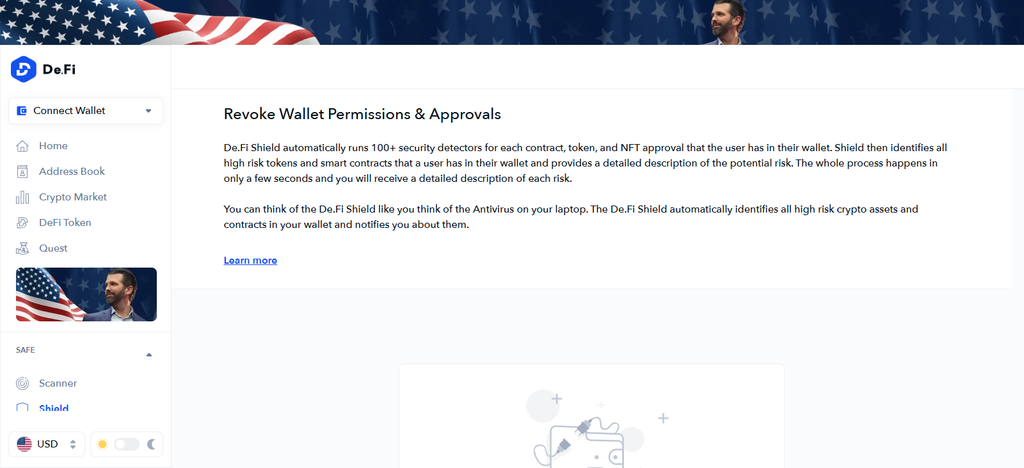
Its approval monitoring capability finds contracts that may be exploitable and flags them as high-risk security findings. Users can verify the risk explanation, revoke unwanted permissions, or reduce token approval amounts through its advanced mode. De.Fi Shield checks for vulnerabilities of ERC-20 tokens and approvals of NFTs including ERC-721 and ERC-1155 standards.
It has a risk dashboard that separates findings into critical, high, medium and low risk. Prices vary depending on the De.Fi product plan and services you choose. Be sure to check your account tier to understand which advanced security features are included free of charge.I find it really beautiful and so glad that I can be a part of it.
Defi Shield Features
- Wallet Security Scanning: Scans wallet activity, token holdings, and smart contract interactions for possible security risks.
- Approval Risk Detection: Identifies potentially risky token allowances and permissions granted to third party contracts.
- Smart Contract Auditing: Analyzes vulnerabilities in contracts and anomalous properties that may put digital resources at risk.
- NFT Approval Tracking: Users can see permissions related to NFT standards and operator access.
De.Fi Shield Pros & Cons
| Pros | Cons |
|---|---|
| Scans wallets for potential security risks and suspicious permissions. | Some advanced features depend on the selected product plan. |
| Helps identify risky token allowances and smart contract access. | Users may need experience to interpret detailed security findings. |
| Supports wallet and smart contract risk analysis. | Not every blockchain or token standard receives identical coverage. |
| Provides tools for reviewing and revoking unwanted approvals. | Revocation transactions require applicable network gas fees. |
| Includes NFT and DeFi security monitoring capabilities. | Security scans cannot guarantee complete protection against every exploit. |
8. Blowfish
Blowfish is a Web3 transaction security and simulation solution that helps users understand the implications of wallet signatures before they approve them. Its security technology analyzes transaction instructions, detects suspicious contract interactions, and explains potential asset movements to help users identify malicious approvals and wallet-draining attempts.

It is especially relevant for wallets and dApps that need to detect risk before transactions happen, instead of just relying on historical approvals reviews. In comparing implementations , note that Ethereum compatible networks and Solana support are separate and depend on the specific Blowfish integration and supported transaction format .
Blowfish is not a token approval revocation dashboard, but a preventative transaction simulation and security detection solution. It’s business-facing services are priced by integration and there is no universal public consumer subscription price.
The Blowfish Features
- Transaction Simulation: Estimates the expected outcome of transactions before a user confirms blockchain actions.
- Suspicious Contract Detection: Detects potentially malicious smart contract interactions and risky transaction requests.
- Asset Transfer Preview: Details incoming and outgoing assets to help users understand transaction consequences.
- Wallet Security Integration: Infrastructure for wallets and Web3 applications to integrate transaction security.
- Phishing and Drainer Protection: Identifies suspicious interactions that may result in unauthorized asset transfers.
Blowfish Pros & Cons
| Pros | Cons |
|---|---|
| Simulates transactions to explain their expected outcomes. | Primarily operates through wallet and application integrations. |
| Helps identify suspicious contract interactions. | Does not offer a dedicated consumer approval revocation dashboard. |
| Provides transaction security infrastructure for Web3 applications. | Direct access may be limited for individual wallet users. |
| Helps detect potentially harmful asset transfers. | Network support depends on the specific integration. |
| Provides pre-signing security information to supported wallets. | Enterprise integration and pricing may be less accessible to small users. |
9. Revokescout
Revokescout is a token approvals management tool built within the Blockscout ecosystem that enables users to review and revoke permissions given to dapps. It displays active token approvals in a wallet-connected dashboard so users can check what contracts they’ve approved, see what they’ve been allowed to spend, and revoke anything they don’t want to give access to.

It supports networks like Ethereum, Base, Optimism, Arbitrum, Soneium, Ink, Celo, Rootstock and other chains supported by Blockscout. The user chooses a blockchain explorer, connects their wallet, reviews the approval list and confirms the revocation transaction. Revokescout, unlike transaction simulation tools, is focused on existing permissions rather than primarily warning about new signatures.
The tool is available within Blockscout’s Essential Dapps ecosystem and does not have a separate subscription price publicly stated. Network transaction costs applicable vary with chain and implementation.
Revoke scout Features
- Token Approval Inspection: Shows existing smart contract permissions associated with connected blockchain wallets.
- Spender Address Identification: Enables users to see which decentralized applications and contracts have access to their tokens.
- Multichain Approval Support: Supports approval inspection across supported Blockscout-connected blockchain networks.
- Revoking Individual Permission: Users can revoke unwanted smart contract permissions by triggering a transaction on the blockchain.
- Integration with Blockscout Ecosystem: Leverages Blockscout explorer infrastructure to offer wallet approval management and on-chain permission visibility.
Revokescout Pros & Cons
| Pros | Cons |
|---|---|
| Provides visibility into existing smart contract permissions. | Its functionality is more focused on approval management than transaction simulation. |
| Helps identify approved spender addresses. | Coverage depends on supported Blockscout-integrated networks. |
| Supports revocation of unwanted token permissions. | Users must connect a compatible wallet to perform revocations. |
| Offers access through the Blockscout ecosystem. | Does not provide the same threat intelligence as dedicated security platforms. |
| Helps users manage permissions across supported blockchain explorers. | Each revocation requires a transaction and applicable gas fees. |
10. MetaMask Portfolio
MetaMask Portfolio also has a Spending Caps feature that enables users to review and revoke token allowances that have been granted to decentralized applications in the past. It shows the permissions granted to supported tokens, helping users to spot excessive spending limits and revoke access that is no longer required.
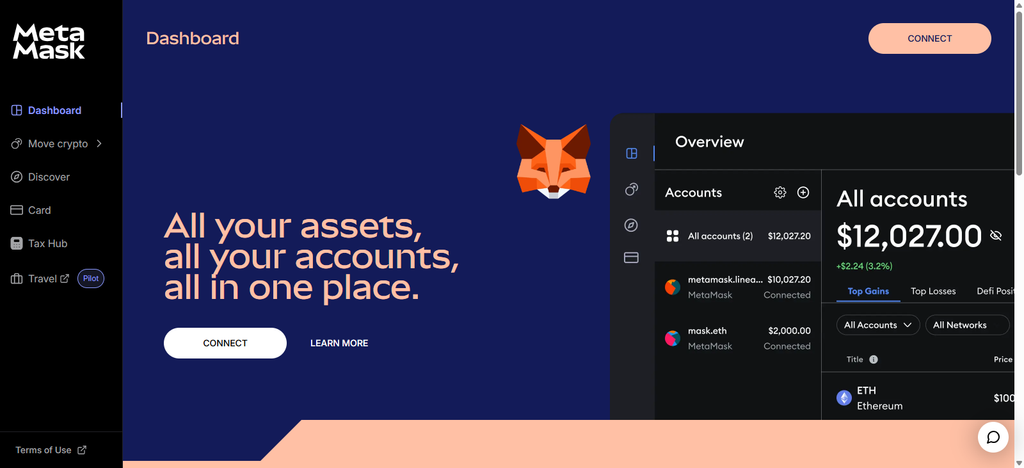
Currently documented supported networks are Ethereum Mainnet, Polygon, BNB Chain, Optimism and Base. Users will be able to open the Spending Caps section, see the permissions of the connected accounts and revoke allowances one by one by confirming a transaction through MetaMask.
The feature is especially useful to review unlimited ERC-20 and ERC-777 spending permissions . This feature is free on MetaMask Portfolio, but revocation is a blockchain transaction and will incur gas fees. It is more a feature of approval management than a full-featured independent malicious-contract detection platform.
MetaMask Portfolio Features
- Spending Cap Monitoring: Shows previously approved token spending permissions for decentralized applications.
- Unlimited Allowance Review: Helps users identify excessive token spending limits that may put wallet assets at risk.
- Supported Network Coverage: Ethereum, Polygon, BNB Chain, Optimism, and Base with spending cap management.
- Individual Approval Revocation: Users can revoke selected token allowances via connected MetaMask accounts.
- Wallet-Based Permission Management: Brings approval monitoring to MetaMask Portfolio, so users can review and manage permissions without needing a separate wallet dashboard.
MetaMask Portfolio Pros & Cons
| Pros | Cons |
|---|---|
| Provides a Spending Caps feature for reviewing token allowances. | Supported network coverage is more limited than dedicated multichain tools. |
| Integrates with the existing MetaMask wallet ecosystem. | Does not offer comprehensive independent malicious contract detection. |
| Allows users to revoke unwanted token permissions. | Advanced NFT approval monitoring is not its primary focus. |
| Provides a simple interface for managing spending permissions. | Requires a connected MetaMask account for approval management. |
| Offers free access to approval management functionality. | Revocation transactions still require applicable blockchain gas fees. |
Conclusion
Crypto security tools for malicious wallet approval detection are important in securing digital resources against unauthorized access, suspicious smart contract transactions, and excessive token permissions.
Platforms like Revoke.cash, Etherscan, Rabby Wallet, Pocket Universe, Scam Sniffer, Blockaid, De.Fi Shield, Blowfish, Revokescout, and MetaMask Portfolio offer a range of solutions for approval monitoring, transaction simulation, risk detection, and permission revocation.
When choosing a tool, users should consider covered networks, detection features, NFT approval tracking, Permit2 compatibility, revocation options, and price. Reviewing wallet permissions regularly and revoking unnecessary approvals can help reduce the risk of exposure to malicious dApps and the potential loss of crypto assets.
FAQ
What Are Malicious Wallet Approvals in Crypto?
Malicious wallet approvals occur when users unknowingly grant suspicious smart contracts permission to spend their tokens or manage their NFTs. Attackers can exploit these permissions to transfer digital assets without requesting a new approval each time.
How Do Crypto Security Tools Detect Malicious Wallet Approvals?
These tools scan on-chain token allowances, smart contract addresses, spender permissions, and transaction signatures. Some also use contract reputation databases, transaction simulation, and risk scoring to identify potentially dangerous wallet interactions.
Which Is the Best Tool to Detect and Revoke Malicious Wallet Approvals?
Revoke.cash is a dedicated option for reviewing and revoking existing token permissions. Etherscan Token Approval Checker, De.Fi Shield, and MetaMask Portfolio also help users inspect and manage wallet approvals.
Can Unlimited Token Approvals Drain a Crypto Wallet?
Yes. Unlimited token approvals can allow an authorized smart contract to spend a user’s tokens without requiring repeated permission. If the approved contract becomes malicious or gets compromised, the user’s assets may be at risk.