

In this article, I am going to talk about the Best Decentralized RPC Providers for Web3 developers and blockchain apps. I’ll be comparing their blockchain network coverage, decentralization architecture, pricing, free tiers, API and developer tools, security, privacy, performance, failover, and redundancy.
- What is a decentralized RPC provider?
- Are decentralized RPCs better than centralized RPCs?
- Key Points
- 1. Chainbase
- Chainbase Characteristics
- 2. Dwellir
- Dwellr Characteristics
- 3. GetBlock
- GetBlock API Characteristics
- 4. PublicNode
- PublicNode Characteristics
- 5. 1RPC
- 1RPC Characteristics
- 6. Gateway.fm
- Gateway.fm Characteristics
- 7. SubQuery Network
- SubQuery Network Characteristics
- 8. BlockPI Network
- BlockPI Network Characteristics
- 9. Uniblock
- Uniblock Characteristics
- 10. Validierung-Cloud
- Cloud of validation Characteristics
- Conclusion
- FAQ
This will help you find the right decentralized RPC provider to connect to blockchains reliably and at scale.
What is a decentralized RPC provider?
A decentralized RPC provider allows Web3 applications to access blockchain data and transaction services using distributed infrastructure instead of a single centralized server or node operator.
Remote Procedure Call (RPC) is the communication layer between applications such as dApps, wallets, and blockchain networks. Decentralized RPC systems can improve redundancy and availability by employing multiple nodes, geographic locations, independent operators, or multiple underlying providers.
This type of architecture can help to address single points of failure, improve resilience to network congestion, and reduce dependence on a single infrastructure provider, while providing a more flexible way for developers to connect applications to multiple blockchain networks.
Are decentralized RPCs better than centralized RPCs?
Decentralized RPCs could be a better choice than centralized RPCs if the application emphasizes redundancy, resilience, censorship resistance, and less dependence on a single infrastructure provider.
The distributed nodes and routing can allow the applications to still access the blockchain data in case of congestion or downtime of individual nodes. That said, centralized RPCs can still offer easier management, predictable performance, dedicated support and easier enterprise deployment. Which is better depends on the needs of the application.
This is especially helpful for high-traffic dApps, wallets, DeFi protocols, and multichain applications, which can take advantage of resilient, decentralized or multi-provider RPC infrastructure. For smaller or less complex workloads, centralized RPCs may be enough.
Key Points
| Provider | Key Point 1 | Key Point 2 |
|---|---|---|
| Chainbase | Multichain RPC and data infrastructure | Supports EVM and non-EVM networks |
| Dwellir | 150+ blockchain networks | HTTP and WebSocket RPC support |
| GetBlock | Broad blockchain coverage | JSON-RPC and WebSocket APIs |
| PublicNode | Free public RPC access | 78 supported blockchain networks |
| 1RPC | Privacy-first RPC architecture | Protects RPC-user metadata |
| Gateway.fm | Enterprise-grade blockchain infrastructure | Managed RPC and node services |
| SubQuery Network | Decentralized RPC infrastructure | Distributed node-operator model |
| BlockPI Network | Distributed RPC architecture | 70+ blockchain networks |
| Uniblock | Multi-provider RPC orchestration | Unified API access |
| Validation Cloud | Enterprise-focused RPC infrastructure | Multichain API services |
1. Chainbase
**Chainbase — Founded 2022.Chainbase is a combination of blockchain RPC access and a broader decentralized data infrastructure network. Chain RPC service supports Ethereum, BNB Chain, Polygon, Arbitrum, Optimism, Base, Avalanche, Aptos, Sui, TON and others in 20+ mainnet and testnet environments, offering full and archive access. Pricing starts at Free plan with 200,000 credits/month.
Developer plan is $99/month with 10 million credits and Enterprise pricing is custom. Its API and tooling includes JSON-RPC, Web3 APIs, SQL, custom APIs & data pipelines.
Chainbase’s architecture features a globally distributed infrastructure, intelligent routing and multi-cloud deployment. Its decentralized network harnesses data providers, consensus and ZK-based verification to enhance data integrity and reduce reliance on a single provider.
Chainbase Characteristics
- Multi-Chain Infrastructure: Supports multichain applications across a wide variety of EVM and non-EVM blockchain networks.
Scalable RPC Access: Offers high-availability RPC infrastructure for developers handling expanding Web3 workloads.
Blockchain Data Tools: Offers RPC access and broader blockchain data APIs, indexing and data infrastructure. - Developer-Friendly Dashboard: Tools to manage API access and monitor usage, work with blockchain data.
- ** Distributed Data Architecture ** : Its architecture is more than just traditional centralized RPC access, but rather distributed blockchain data services.
| Advantages | Disadvantages |
|---|---|
| Broad multichain infrastructure | Advanced features may be complex for basic RPC users |
| RPC and blockchain data services in one platform | Higher usage can increase costs |
| Supports EVM and non-EVM ecosystems | Capabilities vary between supported networks |
| Developer-focused APIs and tooling | Full feature set may require a learning curve |
| Suitable for scalable Web3 applications | Decentralization architecture should be evaluated for specific workloads |
2. Dwellir
**Dwellir — Established 2021. Dwellir is a Sweden-based blockchain infrastructure provider focused on providing reliable, distributed RPC access to 150+ blockchain networks spanning the EVM, Substrate, Cosmos, and Move ecosystems.
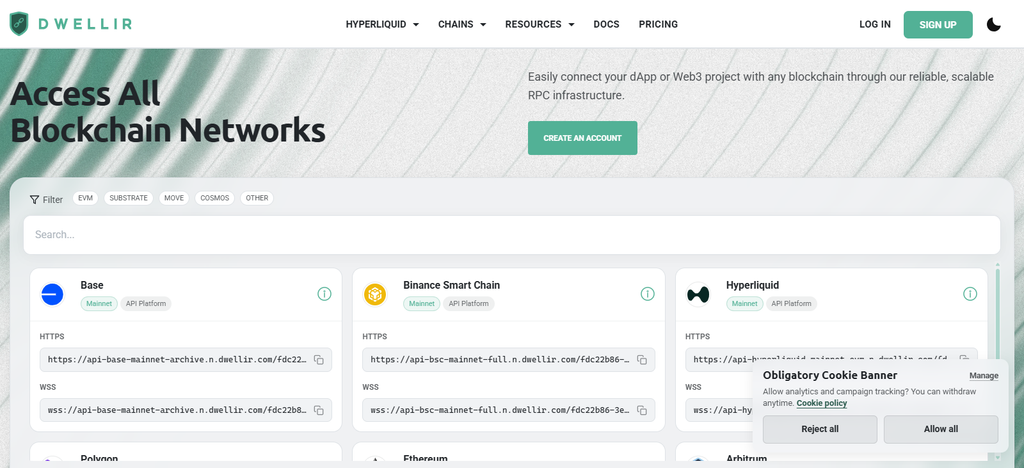
The Free plan gives you 100,000 responses per day and 20 responses per second, and paid shared-node plans start at $49/month and go up to $299 and $999 plans; unlimited nodes start at $119/month for 25 RPS. Developers receive HTTP and WebSocket APIs. For paid plans, there are trace, debug and autoscaling features.
Dwellir operates globally distributed bare-metal nodes in several regions with automatic failover, load balancing, monitoring and redundancy. Dedicated archive clusters are built with redundant nodes, not a single server, increasing availability and production resilience.
Dwellr Characteristics
- 150+ Blockchain Networks: Access to EVM, Substrate, Move, Cosmos, Bitcoin, Filecoin, TON, TRON and other ecosystems.
High Throughput: Paid plans scale up to 5,000 RPS with burst capacity up to 10,000 RPS. - HTTP & WebSocket APIs: Provides standard HTTP RPC and WebSocket connections, and trace and debug APIs.
- Archive Infrastructure: Full historical blockchain data, dedicated redundant archive-node clusters.
- Flexible Infrastructure: Offers shared, unlimited and dedicated node clusters to satisfy varying workload requirements.
| Advantages | Disadvantages |
|---|---|
| Supports 150+ blockchain networks | Premium plans can be costly for high-volume users |
| Strong HTTP and WebSocket support | Advanced infrastructure may be unnecessary for small projects |
| Archive-node access available | Features differ between blockchain networks |
| High-throughput infrastructure | Large network coverage can make selection more complicated |
| Redundant infrastructure for production workloads | Some advanced capabilities are aimed at professional users |
3. GetBlock
GetBlock – Started in 2019.** GetBlock offers managed RPC infrastructure on 130+ blockchain networks, such as Ethereum, Bitcoin, BNB Chain, Solana, Arbitrum, Base, Polygon, Optimism, Avalanche, Tron and many other ecosystems.
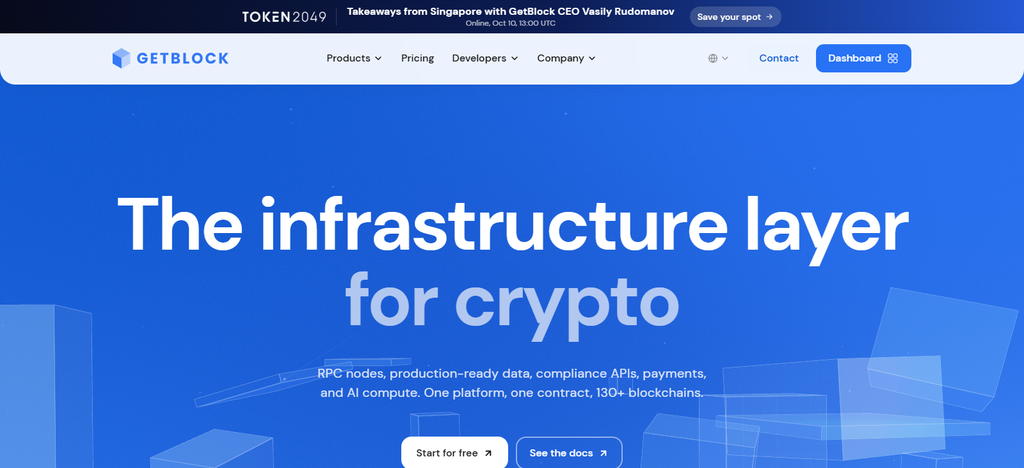
It has a **Free plan ** for registered users, with limited daily compute units. Paid shared-node plans start at $39/month for now, and dedicated infrastructure is available for larger workloads.
Its tooling includes JSON-RPC, WebSockets, GraphQL, REST, archive data, analytics, MEV protected endpoints and configurable node infrastructure. GetBlock is deploying geo-distributed infrastructure across Frankfurt, Singapore and New York with intelligent routing, node-health monitoring and automatic failover.
We’re committed to security with SOC 2 Type II, ISO 27001/27017 and other compliance controls. This makes us especially well-suited for production applications that require formal reliability and security standards.
GetBlock API Characteristics
- Multi-Chain RPC: Hosted blockchain-node access to multiple networks via standardized RPC endpoints.
- Developer APIs: support for JSON-RPC and WebSocket (other APIs and tools depend on the supported blockchain).
Regional Endpoints: Infrastructure can expose endpoints in different geographic locations, allowing applications to find appropriate node infrastructure.
Archive Support: Provides access to historical blockchain data for applications that require more in-depth on-chain queries. - Production Infrastructure: Designed to enable developers to access blockchain nodes without the need to run and maintain their own infrastructure.
| Advantages | Disadvantages |
|---|---|
| Supports a wide range of blockchain networks | Free usage has limitations |
| Easy access to hosted blockchain nodes | Costs can rise with heavy traffic |
| JSON-RPC and WebSocket support | Less infrastructure control than self-hosting |
| Archive-node options available | Features are not identical across all chains |
| Reduces the need for node maintenance | Creates dependency on an external infrastructure provider |
4. PublicNode
**PublicNode – Founded in 2022 by Allnodes.PublicNode is not about paid enterprise RPC subscriptions, but free, privacy-oriented public RPC infrastructure. Its current network provides RPC access for 78 blockchain networks with support across EVM and non-EVM ecosystems and interfaces such as HTTP RPC, WebSocket, REST, gRPC, gRPC-Web and LCD depending on the network.
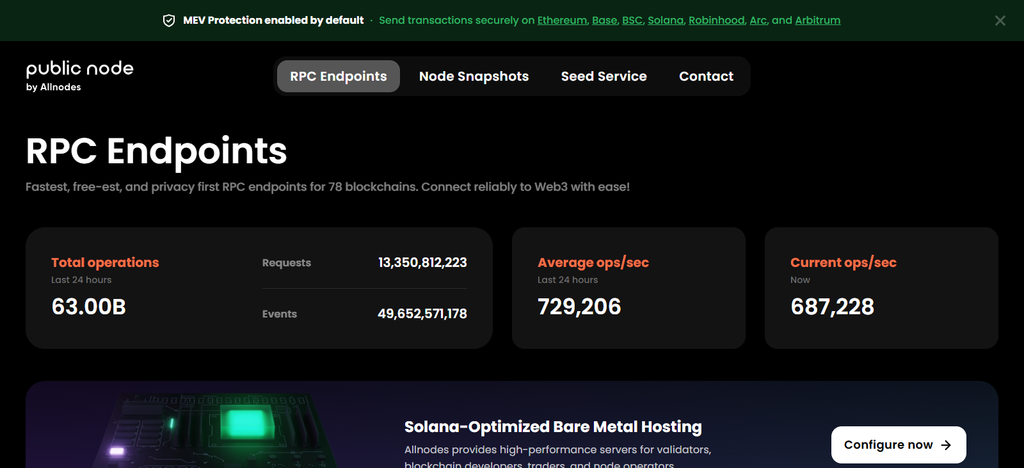
PublicNode is built on privacy, free access and MEV protection and doesn’t rely on the traditional paid pricing structure for its public endpoints. It’s infrastructure exposes node-operation information and live network statistics so users can see operational activity instead of relying on a generic endpoint.
The architecture is tightly integrated with the distributed node infrastructure of Allnodes, while the regional and multi-node operation provides redundancy. This is why PublicNode is particularly appealing to developers looking for public RPC infrastructure that’s easy to access and utilizes privacy-focused routing.
PublicNode Characteristics
- Free Public RPC: Offers publicly available RPC endpoints so developers don’t have to run their own nodes.
- 78 Blockchain Networks: The existing infrastructure supports a list of 78 blockchains, covering the spectrum of Web3 ecosystems.
- Privacy First: Positions privacy as a core feature of its public RPC infrastructure.
- MEV Protection: MEV protection is on by default for supported transaction endpoints.
- High Activity Capability: Its infrastructure is capable of handling hundreds of thousands of operations per second across supported networks.
| Advantages | Disadvantages |
|---|---|
| Free public RPC access | Public endpoints can experience congestion |
| Supports many blockchain networks | Limited customization compared with private infrastructure |
| Privacy-focused approach | May not be ideal for mission-critical workloads |
| Simple integration for developers | Performance can vary by network |
| Useful for testing and smaller applications | Public infrastructure provides less dedicated capacity |
5. 1RPC
1RPC — launched in 2022, product of Automata Network 1RPC is designed for privacy-preserving RPC relaying, whereas typical RPC providers compete primarily on throughput. Public service is free The Public plan gives you 200 requests per day and the free Starter plan gives you 1,000 requests per day.
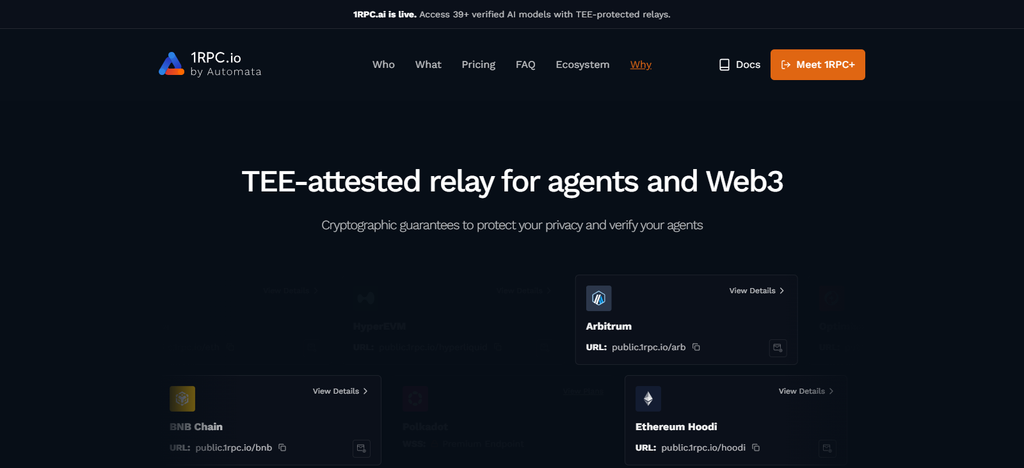
The paid Personal and Developer plans are $9.90/month and $29.90/month respectively, and come with higher limits, API keys, WebSocket/LCD access and a 99.9% uptime SLA.
Its API infrastructure offers a privacy relay that masks user metadata from RPC providers, and Automata verifies the secure-enclave infrastructure supporting the relay. Multi-region coverage provides redundancy and its architecture is better described as a privacy-first decentralized Web3 relay rather than a traditional distributed RPC marketplace.
1RPC Characteristics
- RPC with Privacy: Created to limit the possibility of user metadata leaks in apps that communicate with blockchain networks.
- RPC Relay Architecture: Incorporates a privacy-preserving layer between applications and underlying blockchain infrastructure.
- Multi-Chain Access: Connect to multiple Web3 networks with the same RPC connectivity.
- Dev Integration: Offers well-known RPC-style endpoints so that apps get connected without major architectural changes.
- Privacy-Conscious Infrastructure: Its main distinguishing feature is to protect RPC users from undue exposure of network and request information.
| Advantages | Disadvantages |
|---|---|
| Strong privacy-oriented architecture | Free usage limits may restrict large applications |
| Helps reduce RPC metadata exposure | Privacy is prioritized over extensive infrastructure features |
| Simple RPC integration | Advanced enterprise tooling is limited |
| Supports multiple blockchain networks | Relay performance can vary with network conditions |
| Useful for privacy-conscious Web3 applications | Supported features should be checked for each blockchain |
6. Gateway.fm
Gateway.fm — Founded 2021. Gateway.fm offers institutional-grade blockchain infrastructure including RPC services, validators, node infrastructure and L2 technology. Their RPC offer covers networks like Ethereum, Gnosis, and Stellar.
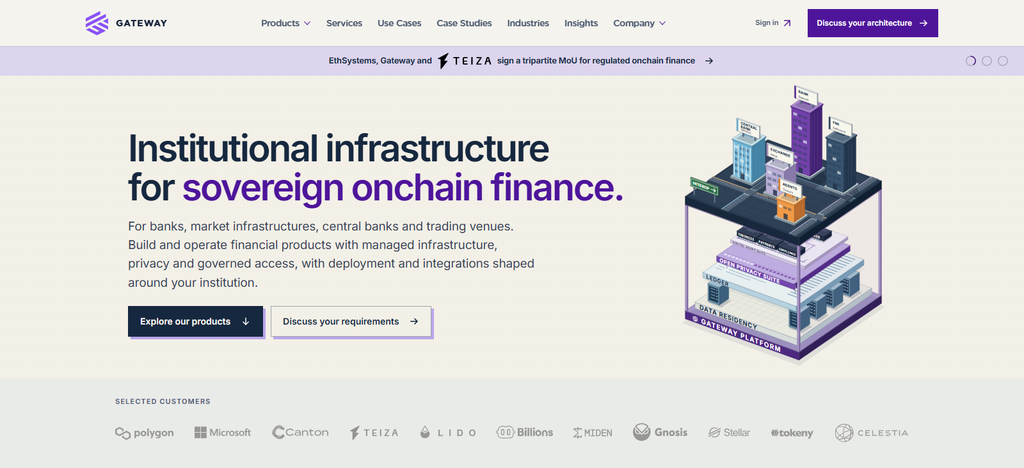
The broader infrastructure stack supports rollups, Polygon zkEVM environments and other blockchain deployments. Gateway has standard JSON-RPC endpoints, WebSocket connectivity and managed archival infrastructure as part of its API tooling.
API-key authentication is available for supported services. Its infrastructure focuses on high-performance nodes, regional deployment, monitoring and production operations rather than a permissionless RPC marketplace.
A Gnosis Chain production deployment showed about 10.2 billion monthly requests, sub-22 ms latency and 99.99% uptime, with ~40 nodes and a hybrid bare-metal/cloud architecture.
Prices are typically determined by the specifics of the deployment and are not simply listed as a public RPC tier, so Gateway.fm is more aligned with the infrastructure needs of professionals and institutions.
Gateway.fm Characteristics
- Managed RPC Services: Provides managed blockchain-node and RPC infrastructure instead of having teams run nodes themselves.
- High Availability: Enables reliable blockchain access with production infrastructure, monitoring and distributed deployment approaches.
- Node Infrastructure: Also offers RPC services for validator and blockchain-node infrastructure.
- Enterprise-focused: Ideal for organizations that require managed infrastructure, professional support and production-grade deployment.
| Advantages | Disadvantages |
|---|---|
| Enterprise-focused blockchain infrastructure | Pricing may require a custom quote |
| Managed RPC and node services | May be excessive for small applications |
| Professional infrastructure management | Network coverage is not as broad as some large RPC aggregators |
| High-availability infrastructure | More infrastructure-focused than consumer-oriented |
| Suitable for institutional workloads | Enterprise deployments can require greater technical planning |
7. SubQuery Network
SubQuery – established in 2021.SubQuery Network is one of the best fits for a true decentralized RPC category as its infrastructure relies on globally distributed node operators instead of just a single centralized RPC fleet.
Its public decentralized RPC service supports a wide range of ecosystems. SubQuery now supports 304 supported blockchain networks including 196 EVM networks, 48 Cosmos networks, 50 Polkadot networks, Solana, Stellar, Algorand, NEAR and more. Developers are able to use public RPC endpoints and SubQuery Data Nodes.

The network’s incentive model enables node operators to earn rewards for serving RPC requests. Its architecture includes service verification, payment rails, dispute resolution and a roadmap for more data-node sharding .
This model directly addresses the decentralization of RPC, availability and reduced concentration of infrastructure.
SubQuery Network Characteristics
- Decentralized RPC network: Based on the distributed infrastructure and aims to reduce the reliance on centralized RPC providers.
- Wide Network Support: Supports a wide variety of EVM, Cosmos, Polkadot, Solana, Stellar, NEAR and other ecosystems.
- Open Node Participation: It’s architecture allows node operators and professional RPC providers to participate in the network.
Service Verification: Implements payment, service verification and dispute resolution mechanisms for decentralized RPC services.
Data-Optimized Nodes: SubQuery Data Nodes are more than just RPC providers, they allow you to query and filter your blockchain data.
| Advantages | Disadvantages |
|---|---|
| Strong focus on decentralized infrastructure | Decentralized architecture can be more complex |
| Broad blockchain ecosystem coverage | Performance can vary across network participants |
| Distributed node-operator model | Developers may need to understand the network architecture |
| RPC and blockchain data capabilities | Functionality can differ between supported chains |
| Reduces reliance on traditional centralized RPC infrastructure | Enterprise users may prefer simpler managed services |
8. BlockPI Network
BlockPI Network — Alpha-net launched in 2022 BlockPI is specifically built for distributed RPC infrastructure, with a network structure that includes users, gateways, load balancers and scalable node clients to eliminate single points of failure and enhance scalability.
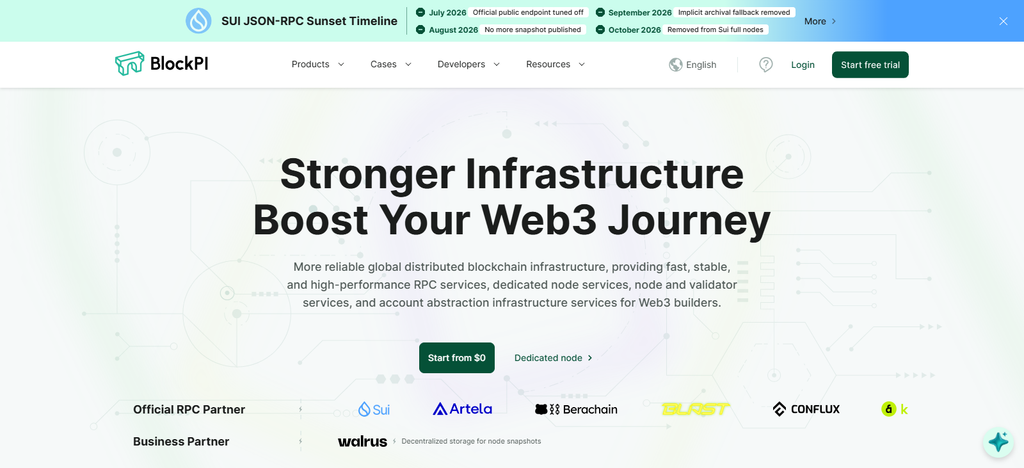
Its network has support for 70+ blockchain networks, and its infrastructure offers standard RPC services and additional functions such as archive data, debug and trace methods, ERC-4337 bundling, MEV protection, and transaction acceleration. Registered users receive a free allocation of 50 million RUs per month, with additional usage available for purchase through flexible prepaid packages.
Dedicated nodes provide higher-performance infrastructure and enterprise SLA options. The architecture uses distributed working nodes and load balancing for redundancy. The dashboard offers usage monitoring, balance alerts, automatic renewal and team management.
BlockPI Network Characteristics
- Distributed Node Structure: Employs a distributed infrastructure architecture that aims to lower reliance on a single node or endpoint.
70+ Blockchain Networks: Provides RPC infrastructure for a broad spectrum of blockchain ecosystems.
Load balancing: distributes requests across the available infrastructure using gateways and load balancing components. - Archive & debug access: Supports archive data and additional trace and debug for supported networks.
- Developer Dashboard: Provides usage analytics and infrastructure management tools for monitoring RPC consumption and performance.
| Advantages | Disadvantages |
|---|---|
| Distributed RPC infrastructure | Advanced features may be unnecessary for simple applications |
| Supports 70+ blockchain networks | High-volume usage requires cost monitoring |
| Load balancing distributes RPC requests | Performance can vary between networks |
| Archive, debug, and trace capabilities | Distributed architecture may require additional configuration |
| Dashboard supports usage monitoring | Smaller projects may prefer simpler public RPC services |
9. Uniblock
Uniblock — year of foundation not disclosed on its current official materials.** Uniblock takes a unique approach to decentralization, acting as a RPC orchestration and routing layer that connects applications to over 55 RPC providers through a single unified API.
The Free Startup plan offers up to 40 million compute units, 1,000 CU/s, two projects, basic routing and automatic backups. The Growth plan starts at $49/month for monthly billing and offers 500 million CUs and optimized routing.
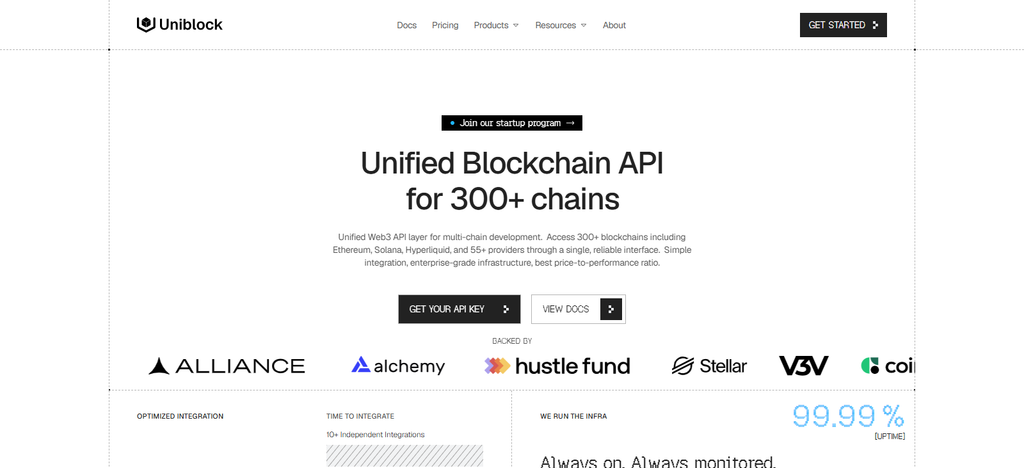
API tooling includes unified JSON-RPC access, provider management, routing controls, and automated backups. Uniblock is a multi-provider routing solution that reduces single-provider dependency instead of being one independent node network, with performance monitoring and automatic failover.
This architecture makes it particularly useful for applications that want redundancy across multiple RPC infrastructure providers without having to build their own routing layer.
Uniblock Characteristics
- Automatic Failover: Direct requests across providers to reduce the effect of individual endpoint failures.
- Unified API Access: Developers are able to use a standard interface to access blockchain infrastructure, instead of having to work with multiple providers individually.
- Multi-Chain Support: Designed for apps requiring RPC access to various blockchain networks.
- Data Aggregation: Combines RPC connectivity with blockchain data capabilities, useful for applications in need of token, NFT, and other Web3 data services.
| Advantages | Disadvantages |
|---|---|
| Connects multiple RPC providers | Adds another infrastructure layer |
| Unified API simplifies integration | Users remain dependent on the orchestration platform |
| Automatic failover improves redundancy | High-volume usage can increase costs |
| Useful for multichain applications | Actual decentralization depends on underlying providers |
| Reduces the need to manage individual RPC endpoints | Advanced routing may require configuration and monitoring |
10. Validierung-Cloud
Validation Cloud – Node infrastructure launched in 2022** Validation Cloud offers high-performance RPC and node APIs for developers, enterprises and blockchain networks, supporting major ecosystems including Ethereum-compatible networks, Bitcoin, Binance, Polygon, Solana, Hedera, ICP, Aptos-related environments and emerging networks.
Its Free plan offers up to 50 million Compute Units per month at $0, while its Scale model is pay-as-you-go, with published rates from $0.50 to $0.35 per million CUs as monthly usage increases; Private plans are custom.

The API tooling provides network-specific endpoints, access to archives (when available), code examples, API keys, usage tracking, and multi-chain faucets. Smart routing sends requests to nearby nodes to reduce latency .
Global distribution of infrastructure provides resilience . Validation Cloud also holds SOC 2 Type 2 compliance, further fortifying its security stance for enterprise workloads.
Cloud of validation Characteristics
- Multi-Protocol Support Supports Ethereum and many other blockchain protocols in its infrastructure platform.
Smart Routing: Uses routing infrastructure to direct requests to appropriate nodes, improving application response performance. - Developer APIs: Gives developers access to the blockchain API, usage management, documentation and infrastructure tools.
Enterprise Reliability: Integrates globally distributed infrastructure with monitoring and enterprise-grade operational controls for production workloads.
| Advantages | Disadvantages |
|---|---|
| Enterprise-grade blockchain infrastructure | Enterprise features may be unnecessary for small projects |
| Supports multiple blockchain protocols | Costs can increase with higher usage |
| Smart routing can improve request performance | Some advanced services require custom plans |
| Developer-focused APIs and infrastructure tools | Capabilities differ across blockchain networks |
| Strong focus on reliability and security | More infrastructure-oriented than purely decentralized RPC networks |
Conclusion
How to Choose the Right Decentralized RPC Provider in 2026: Looking Beyond Blockchain Pricing & Coverage Chainbase, Dwellir, GetBlock, PublicNode, 1RPC, Gateway.fm, SubQuery Network, BlockPI Network, Uniblock and Validation Cloud all have different approaches to infrastructure, routing, privacy, redundancy and developer access.
For developers, the main aspects should be real decentralization, supported networks, API capabilities, performance, fail-over, security and total cost of use. Distributed infrastructure providers can limit reliance on a single RPC endpoint, and aggregator-based solutions can provide another layer of routing and redundancy.
The best choice ultimately comes down to your application’s traffic, blockchain requirements, expectations for reliability, and development needs.
FAQ
What is a decentralized RPC provider?
A decentralized RPC provider gives applications access to blockchain data and transaction endpoints through distributed infrastructure rather than depending entirely on one centralized server or infrastructure location. This can improve redundancy and resilience.
Why use a decentralized RPC provider?
Decentralized RPC infrastructure can reduce single-provider dependency, improve availability, support multiple blockchain networks, and provide alternative routing when individual nodes or endpoints experience congestion or downtime.
Which decentralized RPC provider is best in 2026?
The best provider depends on your requirements. SubQuery Network and BlockPI Network are strong choices for decentralized infrastructure, while Chainbase, GetBlock, Dwellir, and Validation Cloud are useful for broad network coverage and production-focused RPC access.
Are decentralized RPC providers free?
Some providers offer free access or free usage tiers. PublicNode and 1RPC provide free options, while Chainbase, BlockPI Network, Uniblock, and Validation Cloud also provide free allocations or plans with usage limits. Higher-volume workloads generally require paid plans.