

This article is about the Best Blockchain Infrastructure Provider for developers and businesses building scalable Web3 applications. In our comparison, we’ll cover top providers by blockchain coverage, RPC and API access, pricing, free plans, dedicated nodes, archive data, security, developer tools, performance, and scalability to help you find the right infrastructure platform for your unique blockchain needs.
- What Are Blockchain Infrastructure Providers?
- How We Ranked These Blockchain Infrastructure Providers
- Blockchain Infrastructure Pricing Comparison
- Key Points
- 1. Zeeve
- Best For Zeeve
- Key Strengths of Zeeve
- 2. Validation Cloud
- Best For Validation Cloud
- Key Strengths of Validation Cloud
- 3. POKT Network
- Best For POKT Network
- Key Strengths of POKT Network
- 4. dRPC
- Best For dRPC (Distributed RPC)
- Key Strengths of dRPC
- 5. On Finality
- Best For On Finality
- Key Strengths of OnFinality
- 6. Tenderly
- Best For Tenderly
- Key Strengths of Tenderly
- 7. Lava Network
- Best For Lava Network
- Key Strengths of Lava Network
- 8. GetBlock
- Best For GetBlock
- Key Strengths of GetBlock
- 9. NOWNodes
- Best For NOWNodes
- Key Strengths of NOWNodes
- 10. Ankr (ANKR)
- Best For Ankr
- Key Strengths of Ankr
- Security and Compliance
- Conclusion
- FAQ
What Are Blockchain Infrastructure Providers?
Blockchain infrastructure providers are platforms that provide the technical services developers and businesses need to connect applications to blockchain networks without having to build and maintain all the nodes themselves.
These providers generally provide RPC and API access, full and dedicated nodes, archive data, WebSocket connections, staking and validator infrastructure, monitoring and developer tools. They can support multiple Layer-1 and Layer-2 networks, enabling dApps, wallets, exchanges,
DeFi platforms and enterprise applications to access blockchain data and submit transactions. The main advantages are better infrastructure management, easier scalability, more reliable and faster Web3 application deployment.
How We Ranked These Blockchain Infrastructure Providers
Coverage of Blockchain Networks: We examined the number of major blockchain networks supported by each provider, including top Layer-1, Layer-2, EVM and non-EVM ecosystems.
Pricing & Free Plans: We examined the publicly available pricing, free tiers, usage-based billing, compute-unit models, and cost considerations in general for developers and businesses.
Access to Archive Data: Providers were assessed on the availability of historical blockchain data, archive nodes, trace support, and support for applications that need to perform more in-depth on-chain queries.
Development tools. We looked at APIs, SDKs, WebSockets, dashboards, monitoring, debugging, indexing, documentation and other tools that make it easier to develop applications on the blockchain.
Security and Reliability: Security controls, infrastructure protection, access management, monitoring, uptime commitments, redundancy, and enterprise-grade compliance capabilities were considered.
Can scale: We studied the scalability of each provider supporting applications as RPC traffic, users, transactions and infrastructure requirements grow.
Use Case Flexibility: Providers were compared across use cases for dApps, wallets, exchanges, DeFi applications, validators, enterprise blockchain projects, analytics platforms and Web3 development.
Total Infrastructure Value: Finally, we looked at the balance between coverage, performance, features, pricing, reliability, developer experience and infrastructure flexibility, rather than simply ranking providers by their popularity.
Blockchain Infrastructure Pricing Comparison
| Provider | Free Plan | Starting Pricing | Pricing Model | Dedicated Nodes | Archive Data |
|---|---|---|---|---|---|
| Zeeve | Limited/free options may be available | Custom / plan dependent | Subscription / infrastructure based | Yes | Yes |
| Validation Cloud | Yes | $19.99/month | Subscription / usage based | Yes | Network dependent |
| POKT Network | Yes | From $3 per 1M RPC requests | Usage based | Provider dependent | Yes, supported networks |
| dRPC | Yes | From $0.30 per 1M Compute Units | Compute Unit based | Yes / enterprise options | Network dependent |
| OnFinality | Yes | From $49/month | Subscription + usage | Yes | Yes |
| Tenderly | Yes / limited access | Plan and usage dependent | Usage / subscription based | Not its primary model | Development/data dependent |
| Lava Network | Availability varies | Usage/service dependent | RPC usage based | Provider dependent | Network dependent |
| GetBlock | Yes | From around $39/month | Credits / usage based | Yes | Yes |
| NOWNodes | Yes | Plan dependent | Subscription / usage based | Yes | Network dependent |
| Ankr | Yes | Pay-as-you-go from usage | API-credit / usage based | Yes | Yes |
Key Points
| Provider | Key Point |
|---|---|
| Zeeve | Managed blockchain infrastructure with strong validator, staking, dedicated node, and enterprise deployment capabilities. |
| Validation Cloud | Enterprise-focused platform combining blockchain nodes, staking infrastructure, and scalable blockchain data services. |
| POKT Network | Decentralized RPC infrastructure designed to provide distributed, multi-provider blockchain connectivity. |
| dRPC | RPC aggregation platform focused on load balancing, routing, redundancy, and multi-provider blockchain access. |
| OnFinality | Multi-chain infrastructure provider offering RPCs, dedicated nodes, archive access, and developer-focused APIs. |
| Tenderly | Developer-centric platform combining blockchain access with transaction simulation, debugging, monitoring, and gas analysis. |
| Lava Network | Decentralized RPC network that connects applications with multiple infrastructure providers for resilient blockchain access. |
| GetBlock | Multi-chain node and RPC provider offering shared and dedicated infrastructure, archive access, and multiple API options. |
| NOWNodes | Managed blockchain node and API service focused on straightforward multi-chain connectivity for wallets, exchanges, and Web3 applications. |
| Ankr | Broad Web3 infrastructure platform combining multi-chain RPCs, advanced APIs, developer tools, staking, and scalable node services. |
1. Zeeve
Zeeve is a blockchain infrastructure automation platform based in the United States, founded in 2021 and has offices in Irvine, California. It supports managed RPCs, full nodes, archive nodes, validator infrastructure, staking, and appchain deployment. Dedicated RPC plans with support start at around $149/month; pricing depends on network.
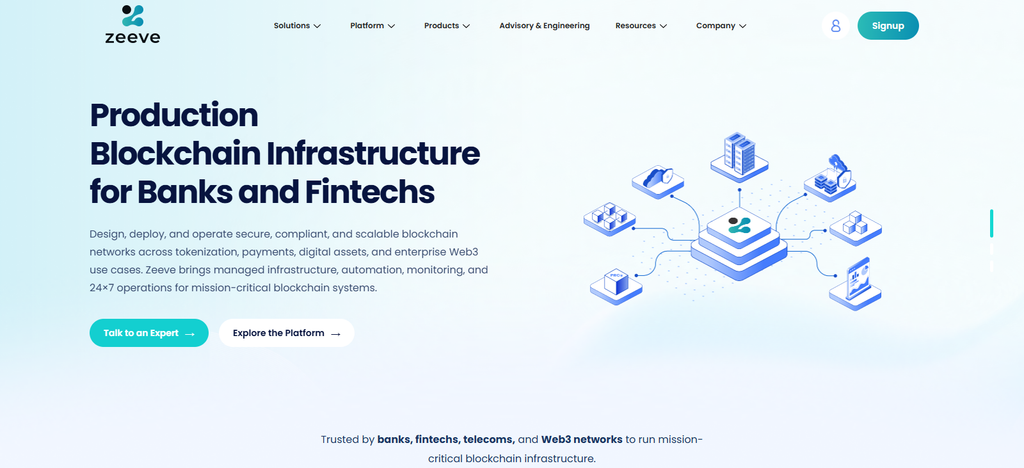
Zeeve supports Ethereum, Polygon, Avalanche, Arbitrum, Optimism, Solana, Cosmos, Polkadot, Near, and other network. Developer tools are APIs, monitoring, analytics, CI/CD automation, dashboards, indexing, enterprise management. Security: SOC 2 Type 2, ISO 27001, GDPR, IP Whitelist, SLA-backed infrastructure.
Best For Zeeve
- Enterprise blockchain infrastructure — Infrastructure management for enterprises hosting production-grade blockchain workloads.
- Validator & staking operations — Ideal for teams that want to run validators and staking infrastructure as a managed service.
- Dedicated RPC infrastructure — Ideal for apps that need controlled and scalable RPC access.
- Appchain deployment — Useful for projects that build and manage blockchain networks for a specific application.
- Multi-chain Web3 projects – Designed for teams developing infrastructure within multiple blockchain ecosystems.
Key Strengths of Zeeve
| Key Strength | Details |
|---|---|
| Infrastructure Automation | Simplifies deployment, management, monitoring, and scaling of blockchain infrastructure. |
| Validator Management | Supports managed validator infrastructure and staking operations. |
| Dedicated Infrastructure | Provides dedicated environments for projects requiring greater control and performance. |
| Multi-Chain Support | Enables teams to manage infrastructure across multiple blockchain ecosystems. |
| Enterprise Focus | Designed for businesses requiring managed Web3 infrastructure and operational support. |
2. Validation Cloud
Validation Cloud is a Zug, Switzerland based Web3 infrastructure and data platform that specializes in enterprise blockchain connectivity. It offers Node API, staking infrastructure and data services.
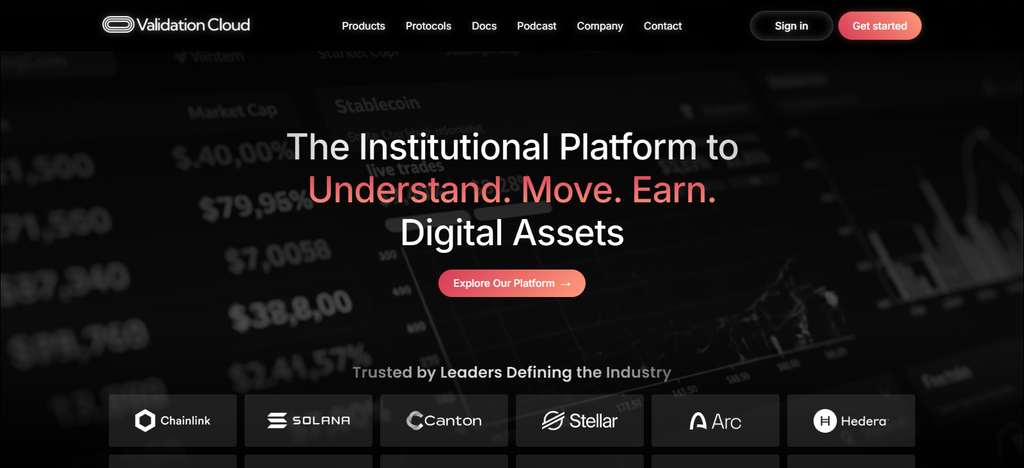
It supports networks including Ethereum, Polygon, Hedera, Chainlink, Stellar, Aptos, EigenLayer, Base and other ecosystems. Its free tier has offered as much as 50 million Compute Units per month, while the Scale Plan has started at $19.99 per month with unlimited CUs and zero rate limits.
Node access is available to developers via API, global delivery, staking tools, data services, and scalable infrastructure for production applications.
Best For Validation Cloud
- Enterprise Web3 infrastructure — Built for organizations that need scalable, professionally managed blockchain infrastructure.
Staking infrastructure — For institutions and businesses that manage staking operations across supported networks. - Blockchain data access — For applications requiring structured and reliable blockchain data.
- High-scale API workloads – Good for applications requiring scalable node and API connectivity.
Institutional Web3 projects – A good fit for businesses that value reliability, compliance, and enterprise support.
Key Strengths of Validation Cloud
| Key Strength | Details |
|---|---|
| Enterprise Infrastructure | Built around scalable infrastructure for institutional and enterprise Web3 workloads. |
| Staking Services | Provides infrastructure for professional staking and validator operations. |
| Blockchain Data | Offers access to blockchain data for applications and enterprise use cases. |
| Scalability | Designed to handle growing workloads without requiring teams to operate their own infrastructure. |
| Compliance Focus | Strong emphasis on enterprise security, reliability, and compliance requirements. |
3. POKT Network
POKT Network’s distributed RPC network enables decentralized blockchain infrastructure and its POKT.ai gateway offers managed access to multiple blockchain networks.
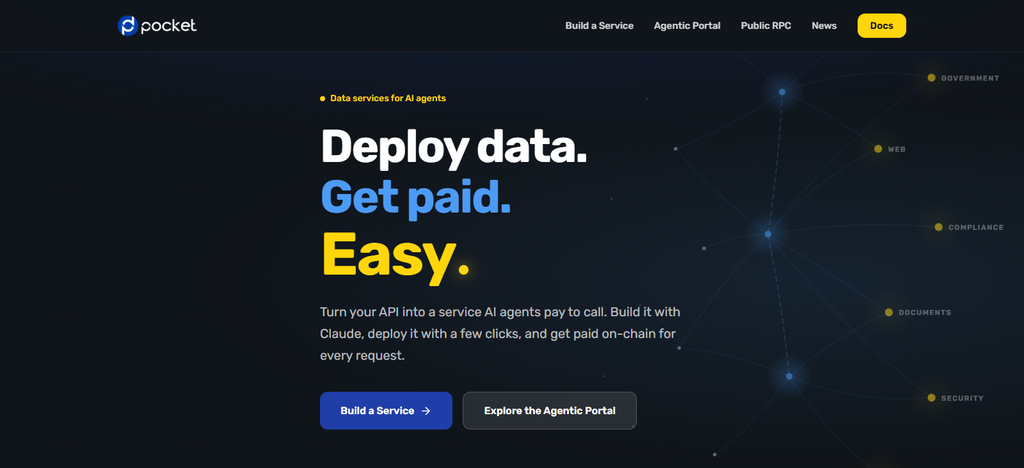
The platform supports 50+ networks such as Ethereum, Polygon, Arbitrum, Optimism, Base, Avalanche, BSC, Fantom, Solana, and Cosmos. Current POKT.ai pricing is usage-based: $3/million requests for full-node RPC and $6/million requests for archive RPC.
Its infrastructure provides RPC/API access, endpoint management, usage analytics, billing controls and AI-agent MCP functionality. It’s perfect for scalable multi-chain applications and developers looking for decentralized infrastructure.
Best For POKT Network
- Decentralized RPC access – Perfect for apps looking for an alternative to centralized RPC infrastructure.
- Multi-chain apps — Ideal for developers who want to access a variety of blockchain networks.
- RPC redundancy — Great for workloads that benefit from distributed infrastructure and multiple node providers.
- Scalable Blockchain Access — A great choice for applications with high RPC traffic.
- Distributed Web3 infrastructure — For teams who value decentralized infrastructure and a variety of providers.
Key Strengths of POKT Network
| Key Strength | Details |
|---|---|
| Decentralized RPC | Uses a distributed infrastructure model rather than relying entirely on centralized node providers. |
| Provider Diversity | Connects applications with multiple infrastructure providers for greater redundancy. |
| Multi-Chain Connectivity | Supports blockchain access across numerous networks through a unified infrastructure layer. |
| Infrastructure Resilience | Distributed architecture can help reduce dependence on individual infrastructure providers. |
| Web3 Accessibility | Makes blockchain connectivity easier for developers building multi-chain applications. |
4. dRPC
dRPC is a decentralized RPC infrastructure provider where multiple node providers are used instead of one infrastructure source to route blockchain requests. It supports all the major EVM networks and other blockchain ecosystems through RPC endpoints, load balancing, fallback routing and verification features.

dRPC bills based on usage using Compute Units, with standard RPC methods costing 20 CU and published pricing of $0.30 per one million CU.
Its free tier offers 210 million CU over 30 days using public nodes, with paid access granting access to wider providers, load balancing, and verification. The availability of archive-node depends on the network supported.
Best For dRPC (Distributed RPC)
- Decentralized RPC infrastructure – For developers who want to access blockchain nodes in a distributed way.
- RPC load balancing — Useful if you want to spread requests over multiple infrastructure providers.
- High-traffic dApps – Well suited for applications that need reliable RPC routing at scale.
Multi-provider redundancy It’s best to avoid relying on a single provider for infrastructure nodes. - Multi-chain development — Ideal for teams developing applications that will interact with multiple blockchain networks.
Key Strengths of dRPC
| Key Strength | Details |
|---|---|
| RPC Aggregation | Connects applications with multiple RPC providers through a unified infrastructure layer. |
| Load Balancing | Helps distribute blockchain requests across available infrastructure. |
| Failover Routing | Can route requests between providers to improve infrastructure resilience. |
| Multi-Chain Access | Provides RPC connectivity for applications working across multiple blockchain ecosystems. |
| Decentralized Architecture | Offers an alternative to depending on a single centralized RPC provider. |
5. On Finality
OnFinality is an internal infrastructure project that started their API service in 2020. The company provides multi-chain RPC and dedicated node infrastructure for Web3 developers. Supported networks include Polkadot, Ethereum, Avalanche, Cosmos, Solana, Bitcoin, Polygon, Arbitrum, Optimism, Base, BNB Smart Chain, Aptos, Sui, Starknet and many more.
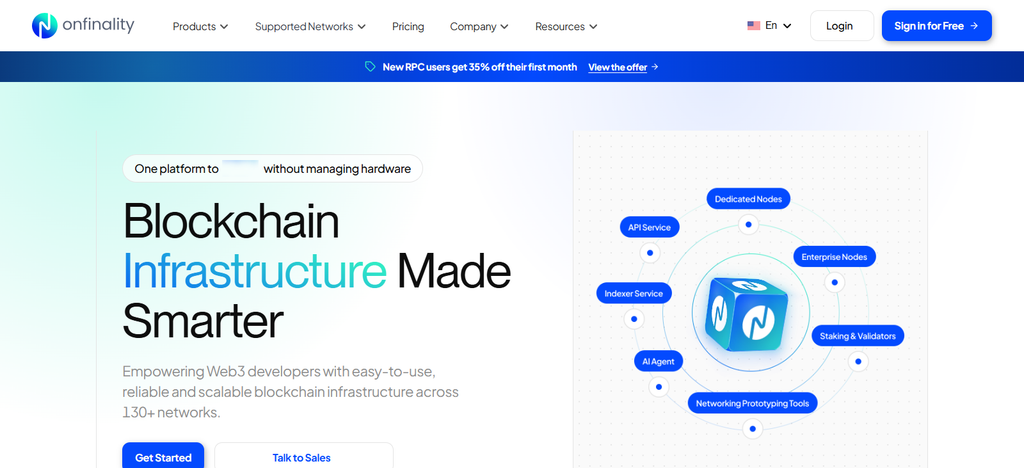
The Developer plan is free with 400,000 RPC response units per day, Growth starts at $49/month and Accelerate at $249/month. OnFinality also offers archive access, Trace API, WebSocket support, analytics, API keys, dedicated nodes and enterprise support.
Best For On Finality
- Multi-chain developers — Good for developers that need RPC access to many different networks.
- Dedicated blockchain nodes – Best suited for projects needing dedicated infrastructure and predictable performance.
- Enterprise applications – Great for businesses that need scalable infrastructure and professional support.
- Archive data workloads — Well suited for applications that need historical blockchain data.
- Polkadot ecosystem projects – Very helpful for teams that are building or running infrastructure around Polkadot and associated networks.
Key Strengths of OnFinality
| Key Strength | Details |
|---|---|
| Broad Network Coverage | Provides infrastructure and RPC access across numerous blockchain ecosystems. |
| Dedicated Nodes | Offers dedicated infrastructure for applications requiring more predictable resources. |
| Developer APIs | Provides APIs and connectivity tools for integrating blockchain infrastructure into applications. |
| Archive Support | Useful for applications that require access to historical blockchain data. |
| Enterprise Scalability | Supports workloads ranging from development environments to production applications. |
6. Tenderly
Tenderly is a blockchain development and infrastructure platform focusing on Ethereum and EVM-compatible development, debugging, simulation, monitoring, and transaction infrastructure. Its Node API provides RPC connectivity and blockchain data access, and its developer tooling includes transaction simulation, debugging, gas analysis, development environments and monitoring.

Tenderly also operates public RPC infrastructure, with Polygon RPC support. Pricing is based on Tenderly product and usage selected, not a single universal node price. Its infrastructure is especially helpful for developers who want RPC/API access as well as transaction simulation, debugging, gas estimation, testing, and production monitoring in one development environment.
Best For Tenderly
- Smart contract debugging – Ideal for developers that require deep transaction debugging and execution analysis.
Transaction simulation – Good for testing transactions before sending them to a live chain. - EVM development — Good choice for developers building and testing Ethereum-compatible applications.
- Gas optimization – Helps you analyze transaction execution and discover potential gas savings.
- Web3 development teams — Perfect for teams that want to develop, simulate, debug, and monitor in one place.
Key Strengths of Tenderly
| Key Strength | Details |
|---|---|
| Transaction Simulation | Allows developers to test transaction execution before sending transactions on-chain. |
| Smart Contract Debugging | Provides detailed debugging tools for identifying execution problems. |
| EVM Development Tools | Strong tooling for developers building Ethereum and EVM-compatible applications. |
| Gas Analysis | Helps developers understand transaction execution and optimize gas usage. |
| Development Monitoring | Combines infrastructure access with tools for testing, debugging, and monitoring Web3 applications. |
7. Lava Network
Lava Network is a decentralized RPC and blockchain data infrastructure network that connects applications to independent infrastructure providers. It is not a typical centralized node provider model but rather focuses on programmable RPC access, provider competition, routing, reliability and multi-chain connectivity.

Developers use RPC services to connect to supported blockchain networks and infrastructure providers provide node resources to the network. Pricing and capacity may vary by service and network selected.
Lava is a highly relevant solution for developers interested in decentralized RPC architecture, provider redundancy, censorship resistance and scalable access to blockchain data across multiple ecosystems.
Best For Lava Network
- Decentralized RPC – For apps that need distributed blockchain infrastructure.
- RPC provider networks — Useful for enabling applications to connect to multiple infrastructure providers.
- Multi-chain connectivity — Perfect for developers working on multiple blockchain platforms.
- Infrastructure redundancy — Provides alternate RPC paths for applications, increased reliability
Censorship-resistant infrastructure — Ideal for projects that value decentralized access to blockchain data
Key Strengths of Lava Network
| Key Strength | Details |
|---|---|
| Decentralized RPC Network | Provides blockchain connectivity through a decentralized infrastructure model. |
| Provider Competition | Enables multiple infrastructure providers to participate in delivering RPC services. |
| RPC Reliability | Distributed infrastructure can provide alternative routes when individual providers experience issues. |
| Multi-Chain Infrastructure | Designed to provide RPC connectivity across different blockchain ecosystems. |
| Open Infrastructure Model | Offers a more decentralized approach to accessing blockchain infrastructure. |
8. GetBlock
GetBlock, a blockchain RPC and infrastructure provider, launched in 2019 and offers API access to more than 130 blockchain networks via shared and dedicated nodes. Supported ecosystems include Ethereum, Bitcoin, BSC, Polygon, Solana, Base, Arbitrum, Optimism, Aptos, Sui, TRON and more.
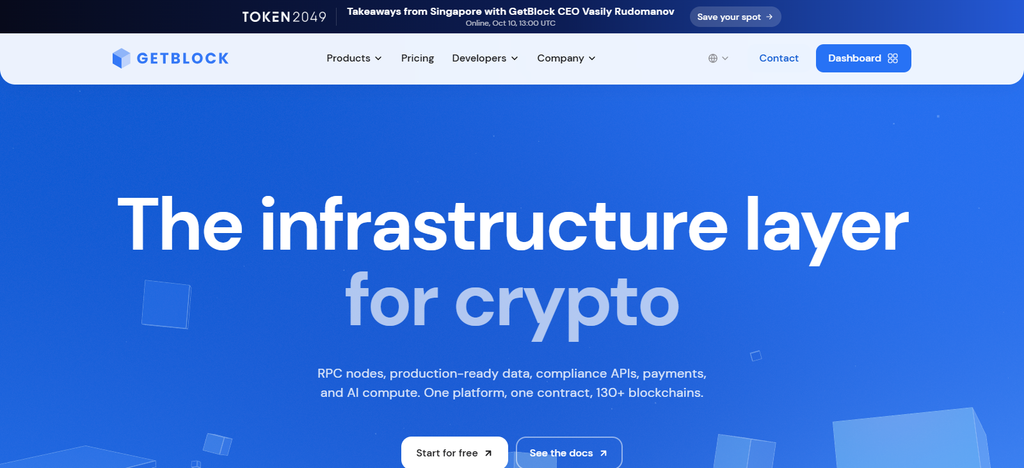
Its current shared pricing includes a Free plan, and paid plans start at about $39/month on its current pricing page, with compute-unit limits and higher RPS. GetBlock offers JSON-RPC, WebSocket, gRPC, archive data, dedicated nodes, MEV protection, analytics, multi-region routing, and SLA-backed enterprise infrastructure.
Best For GetBlock
- Multi-chain RPC access — A perfect solution for developers that have to connect to more than one blockchain network.
- Dedicated nodes — For businesses that need more predictable and controlled node resources.
- Blockchain APIs — Useful for wallets, dApps, exchanges, and applications that need managed access to blockchain data.
Archive data – A good choice for projects that use historical blockchain data.
Scaling Web3 applications — For teams that need to scale infrastructure with increasing application traffic.
Key Strengths of GetBlock
| Key Strength | Details |
|---|---|
| Large Network Coverage | Provides RPC and node access across a wide range of blockchain networks. |
| Dedicated Nodes | Offers dedicated infrastructure for applications requiring greater control over node resources. |
| Multiple API Options | Supports different blockchain connectivity methods for developers and applications. |
| Archive Infrastructure | Provides historical blockchain data capabilities for supported networks. |
| Scalable RPC Access | Suitable for applications that need to increase blockchain requests as usage grows. |
9. NOWNodes
NOWNodes is a blockchain node infrastructure provider which provides access to more than 60 blockchain networks including Bitcoin, Ethereum, Dogecoin, BSC and other major networks via API and RPC.
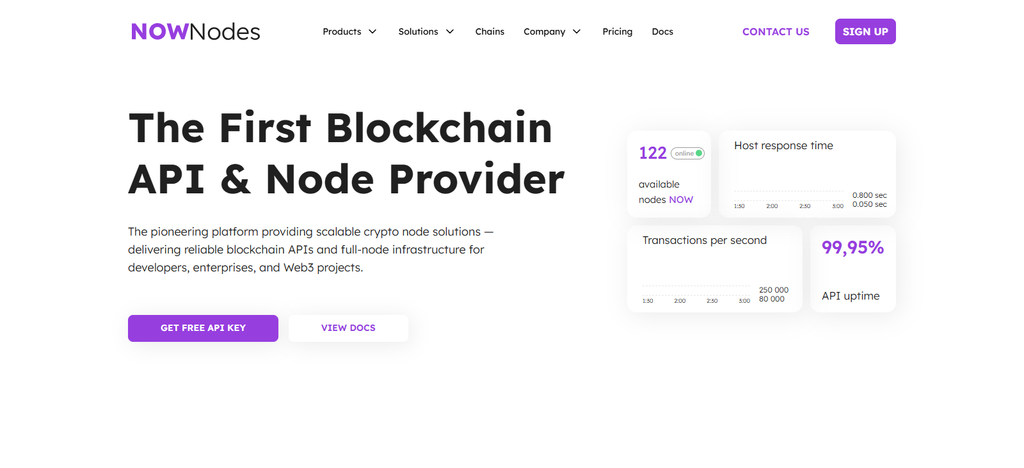
Infrastructure includes full nodes, blockchain explorers, WebSocket connections, and API endpoints for connecting applications to blockchain networks. NOWNodes offers free API key access to developers and paid plans and custom arrangements for higher volume needs.
Its services are ideal for wallets, exchanges, explorers, payment applications, and Web3 products that need managed node access without the headache of running their own blockchain infrastructure.
Best For NOWNodes
- Blockchain API integration — Best for developers looking for easy access to blockchain data via APIs.
Wallet applications – Good for applications that need managed blockchain connectivity. - Crypto exchanges — Handy for exchanges wishing to connect to nodes and blockchain APIs.
- Blockchain explorers — Suitable for apps that parse and visualize on-chain data.
Multi-chain capabilities – Developed for projects that want to access multiple chains without the hassle of running their own nodes.
Key Strengths of NOWNodes
| Key Strength | Details |
|---|---|
| Simple API Access | Makes blockchain connectivity accessible through managed APIs. |
| Multi-Chain Support | Provides access to numerous blockchain networks from one infrastructure provider. |
| Full Node Infrastructure | Gives applications managed access to blockchain nodes without requiring self-hosting. |
| Wallet Integration | Suitable for wallet applications requiring reliable blockchain connectivity. |
| Exchange Infrastructure | Can support exchanges and other crypto applications that need blockchain API access. |
10. Ankr (ANKR)
Ankr is a global Web3 infrastructure provider offering public and premium RPC, advanced APIs, staking, AppChains and developer infrastructure on more than 80 blockchain networks. Supported networks are Ethereum, Solana, BNB Smart Chain, Arbitrum, Base, Bitcoin, TRON, TON, Sui, and many more.
Public access, Freemium plan (200 million API credits/month), PAYG Premium pricing, and enterprise solutions are available from Ankr.
The premium RPC pricing starts at API credits based on usage, with each EVM request costing $0.00002. For developers we have JSON-RPC, WebSockets, Advanced APIs, SDKs, gRPC, trace/debug access, analytics and verifiable RPC.
Best For Ankr
- Multi-chain Web3 development—Ideal for developers creating applications for multiple blockchain ecosystems.
- RPC and API access — Perfect for applications that require scalable blockchain connectivity and data APIs.
High-traffic dApps — Great for apps that require scalable RPC infrastructure and dependable network access.
Advanced blockchain APIs – A good choice for developers who need more than simple JSON-RPC connections. - Enterprise Web3 infrastructure — For enterprises that need scalable nodes, APIs, staking and broader blockchain infrastructure services.
Key Strengths of Ankr
| Key Strength | Details |
|---|---|
| Extensive Multi-Chain Infrastructure | Provides RPC and infrastructure services across a broad range of blockchain networks. |
| Advanced APIs | Offers specialized APIs beyond basic blockchain RPC access for application development. |
| Scalable RPC | Designed to support applications ranging from early development to high-traffic production workloads. |
| Developer-Friendly Tools | Provides APIs, SDKs, WebSockets, and other tools for Web3 development. |
| Broad Web3 Ecosystem | Combines RPC, APIs, staking, and other infrastructure services within one platform. |
Security and Compliance
Zeeve: Enterprise-focused infrastructure including security controls, monitoring, access management, and compliance-oriented infrastructure tailored for production blockchain deployments.
Validation Cloud: Supports enterprise blockchain and staking workloads with institutional-grade security, controlled infrastructure access, monitoring and compliance requirements.
POKT Network: Decentralized infrastructure to reduce reliance on a single provider, with distributed node architecture for resilient blockchain access.
dRPC: Uses distributed RPC infrastructure, provider redundancy, routing and control of access to increase reliability and reduce risk of relying on a single RPC provider.
OnFinality: Provides managed infrastructure with security controls, API authentication, monitoring, access management and enterprise-grade infrastructure for production blockchain workloads.
Tenderly: Offers security-focused development and monitoring tools that allow teams to test transactions, find issues with smart-contract execution, and monitor application behavior both before and after deployment.
Lava Network: Employs a decentralized infrastructure model with multiple providers to reduce reliance on a single provider, and to offer resilient and distributed blockchain RPC access.
GetBlock: offers managed node infrastructure with API authentication, control of access, monitoring, and dedicated infrastructure options for applications requiring stronger resource isolation.
NOWNodes: Hosted blockchain infrastructure with API authentication, access control, monitoring, and infrastructure protection for wallets, exchanges and other Web3 apps.
Ankr: Enterprise-grade infrastructure that includes API authentication, control of access, monitoring, scalable RPC infrastructure and security features built for production Web3 apps.
Conclusion
In 2026, the right blockchain infrastructure provider will be chosen based on the network coverage, RPC performance, pricing, scalability, developer tools, security, and infrastructure flexibility.
Validation Cloud and Zeeve do a good job in managing enterprise infrastructure and POKT Network, dRPC and Lava Network provide decentralized RPC solutions. OnFinality, GetBlock, NOWNodes and Ankr offer broad multi-chain access, while Tenderly is especially useful for developers seeking powerful debugging and transaction simulation tools. Which provider should you choose?
Examine the supported networks, availability of free plans, archive data, dedicated nodes, APIs and reliability and pricing, and compare them to the actual requirements of your application.
FAQ
What are blockchain infrastructure providers?
Blockchain infrastructure providers offer managed services such as RPC endpoints, blockchain nodes, APIs, archive data, WebSocket connections, staking infrastructure, and developer tools. They allow businesses and developers to access blockchain networks without operating and maintaining all node infrastructure themselves.
Which blockchain infrastructure provider is best in 2026?
There is no single best provider for every use case. Ankr, Zeeve, Validation Cloud, OnFinality, GetBlock, and others serve different requirements. The right choice depends on supported networks, pricing, RPC performance, dedicated nodes, archive access, security, and developer requirements.
Which provider supports the most blockchain networks?
Ankr, GetBlock, OnFinality, and other multi-chain providers offer broad network coverage. However, network counts can change, so users should verify whether their required blockchains and specific RPC methods are supported before choosing a provider.
Do blockchain infrastructure providers offer free plans?
Yes. Several providers offer free tiers or limited free access. Ankr, OnFinality, GetBlock, Validation Cloud, and some other providers provide ways for developers to start without immediately purchasing enterprise infrastructure. Free limits vary by provider and usage model.
What is an RPC endpoint in blockchain infrastructure?
An RPC endpoint allows an application, wallet, dApp, or development tool to communicate with a blockchain node. Developers can use RPC calls to retrieve blockchain data, submit transactions, query smart contracts, and interact with supported networks.