




I will examine Modular Data Availability Layers Challenging Monolithic Chains in this article. I will include examples of innovative blockchain infrastructures and how they are changing the scalability, security, and efficiency.
Modular solutions decouple data availability and execution, this provides the blockchain ecosystem with quick and cheaper transactions. We will review the most advanced platforms and modular data availability, their blockchain ecosystem features, benefits, and their future in Web3.
Key Point & Modular Data Availability Layers Challenging Monolithic Chains
| Modular Data Availability Layer | Key Points |
|---|---|
| Celestia | • First modular blockchain network focused on Data Availability (DA).• Uses data availability sampling (DAS) for scalable verification.• Enables developers to launch custom rollups easily.• Separates consensus, execution, and data layers for flexibility.• Reduces blockchain costs by providing efficient blob storage. |
| EigenDA | • Ethereum-based decentralized Data Availability service built by EigenLayer.• Uses restaked ETH security for enhanced trust.• Supports high-throughput rollups and Layer 2 networks.• Provides low-cost data storage compared with Ethereum calldata.• Designed for enterprise-scale blockchain applications. |
| Avail | • Modular blockchain layer focused on secure data availability.• Uses advanced erasure coding and data availability sampling.• Supports rollups, appchains, and sovereign blockchain ecosystems.• Provides scalable infrastructure independent of execution layers.• Helps developers build customizable Web3 applications. |
| Near DA | • Data availability solution developed by the NEAR ecosystem.• Provides affordable DA services for rollups and Web3 apps.• Uses NEAR’s scalable blockchain infrastructure.• Enables fast transaction processing with lower costs.• Supports developers building application-specific chains. |
| Polygon Avail | • Originally developed as Polygon’s modular DA solution before becoming independent Avail.• Focuses on scalable blockchain data publishing.• Uses cryptographic proofs for data availability verification.• Supports Layer 2 rollups and app-specific chains.• Improves scalability without increasing mainnet congestion. |
| Mantle DA | • Data availability layer integrated with Mantle Network’s modular architecture.• Uses EigenDA technology for scalable data storage.• Supports high-performance Layer 2 applications.• Reduces transaction costs through optimized data handling.• Designed for DeFi, gaming, and Web3 applications. |
| Fuel DA | • Modular execution layer with dedicated data availability architecture.• Focuses on parallel transaction processing and scalability.• Uses UTXO-based design for efficient execution.• Supports rollups requiring high throughput.• Provides flexible infrastructure for decentralized applications. |
| Quasar DA | • Modular data availability project focused on scalable blockchain infrastructure.• Designed to improve data distribution efficiency.• Supports decentralized application and rollup ecosystems.• Aims to reduce costs associated with blockchain data storage.• Provides flexible solutions for future modular chains. |
| Cevmos DA | • Data availability solution connected with the Cevmos ecosystem.• Combines Cosmos interoperability with Ethereum compatibility.• Supports modular blockchain development.• Helps developers create specialized rollups and appchains.• Focuses on scalable Web3 infrastructure. |
| Dymension DA | • Modular blockchain ecosystem supporting RollApps.• Provides flexible data availability options for developers.• Uses Cosmos-based architecture for interoperability.• Enables fast deployment of application-specific chains.• Helps reduce infrastructure complexity for blockchain builders. |
1. Celestia
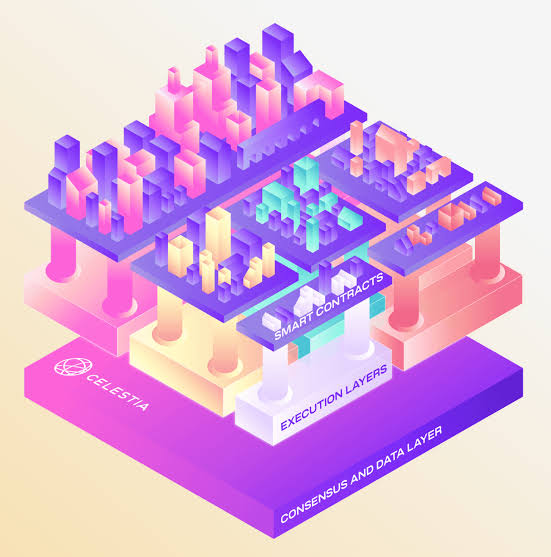
Celestia is among the first modular blockchain networks and is built as a specific Data Availability (DA) layer. Monolithic chains (that manage execution, settlement, consensus, and storage of data) lack modularity, while Celestia focuses on separation for more scalability.
Celestia uses Data Availability Sampling (DAS) allowing network participants to sample blocks without the need to download Celestia in its entirety.

Modular Data Availability Layers Challenging Monolithic Chains like Celestia empower blockchain developers to build custom rollups and application-specific chains at a very low cost and in a highly flexible manner.
Its design supports the Web3 potential for processing transactions in a less congested manner and continuing to build on the blockchain.
Celestia Features, Pros & Cons
Features
- Modular Data Availability Architecture – improves blockchain scalability by separating the consensus, execution, and data availability layers.
- Data Availability Sampling (DAS) – allows users to efficiently verify substantial portions of blockchain data without the need to download the entire dataset.
- Rollup-Friendly Infrastructure – gives developers the ability to rapidly launch customizable sovereign rollups.
- Low Transaction Costs – offers rollups their own data availability services, which reduces costs by avoiding expensive mainnet storage.
- Flexible Blockchain Development – provides an alternative for developers needing application-specific chains requiring greater scalability and customizability.
Pros
- Easy, rapid, and low-cost deployment of new blockchains.
- Strong focus on and integration with rollup ecosystems.
- Lower data storage costs compared to traditional chains.
- High scalability using modular architecture.
- Uses state-of-the-art cryptographic verification methods.
Cons
- Dependent on rollup projects and developer adoption.
- Security is dependent on the participation of validators.
- Relatively limited execution compared to full blockchains.
- Unmatured ecosystem and new, emerging technology.
- Increasing competition from other DA solutions.
2. EigenDA
EigenDA, based on Ethereum’s EigenLayer restaking system, is the first decentralized Data Availability service. It gives rollups and Layer 2 networks the ability to effectively store transaction data while utilizing the security framework of Ethereum.
Unlike monolithic blockchains that visually require all nodes to process all the data, EigenDA allows operators to store data on demand. Modular Data Availability Layers Challenging Monolithic Chains like EigenDA allows blockchain applications to expand, innovate, and push the boundaries of what is possible while reducing costs.
It is especially helpful for those applications and workloads that push the performance of the blockchain, such as high frequency applications and games.
EigenDA Features, Pros & Cons
Features
- Ethereum-Based Security – leverages EigenLayer restaking to provide security guarantees.
- High Throughput Data Availability – built for rollups requiring rapid data availability at a large scale.
- Layer 2 Ready – provides infrastructure for Ethereum scaling solutions.
- Cost Efficient – avoids the expensive Ethereum calldata and thus reduces transaction costs.
- Enterprise Scalable – built for blockchain applications that demand high performance and reliability.
Pros
- Enterprise ready.
- High transaction volume support.
- Strong Layer 2 integration.
- Flexible data availability.
- Additional security from the Ethereum ecosystem.
Cons
- Reliance on EigenLayer ecosystem adoption.
- Complex restaking model adds potential risks.
- Less autonomy than self-standing DA chains.
- Needs restaking operators for security.
- Competition from other Ethereum solutions.
3. Avail
Avail is an adaptable infrastructure within modular blockchain systems that delivers safe Data Availability solutions emphasizing scalability for rollups, appchains, and Layer 2 solutions.
By decoupling data storage from execution, developers can create bespoke environments for blockchain technologies without the constraints of monolithic architectures.

Utilizing both erasure coding and Data Availability Sampling, Avail ensures the accessibility and verifiability of data on the blockchain. Modular Data Availability Layers Challenging Monolithic Chains.
Chains like Avail Blockchains enables to share a secure data layer which greatly increases scalability. Avail’s flexible architecture is designed for Web3, which demands higher throughput, lower transaction costs, and optimized blockchain efficiency.
Avail Features, Pros & Cons
Features
- Dedicated Data Availability Layer – Scalable infrastructure for rollups and appchains.
- Sophisticated Erasure Coding – Promotes reliability and recoverability of data.
- Data Availability Sampling – Lightweight validation of on-chain data.
- Multi-Chain Compatibility – Operates across different blockchain ecosystems.
- Developer-Centric – Eases building of customizable blockchains.
Pros
- Modular blockchain infrastructure.
- High scalability.
- Multiple blockchain frameworks.
- Secure data verification.
- Built for Web3.
Cons
- Focus on infrastructure adoption.
- Competes with other DA solutions.
- Developer migration and integration necessary.
- Lack of consumer-facing solutions.
- Partnerships required for network growth.
4. Near DA
Near DA provides a cost-effective and strong scalable data storage solution for blockchain applications in the NEAR ecosystem via Data Availability. Near DA is designed to make data availability and execution more modular, providing more choices to developers using Near’s Rollups and dApps.
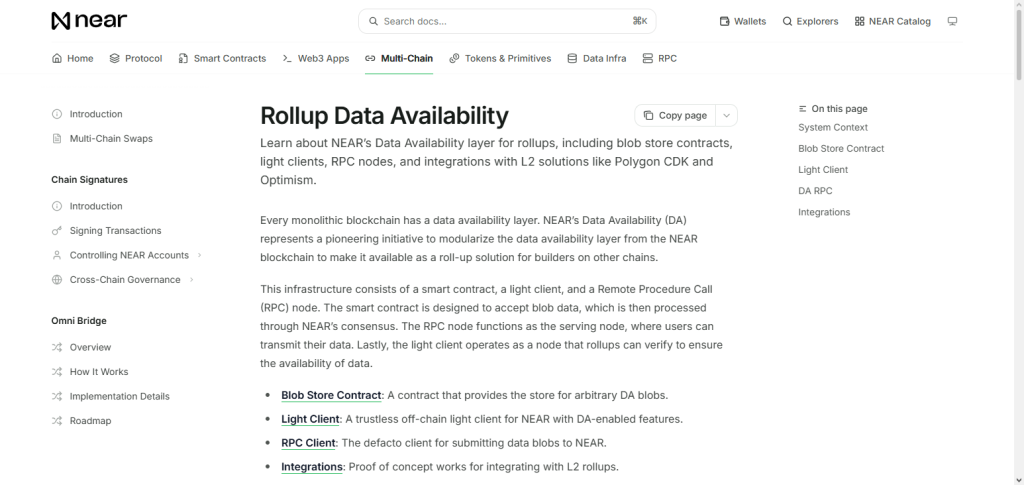
To balance the competing activities for space in the available data blocks of a Monolithic chain, Near DA structures and organizes data to facilitate blockchain operations. Modular Data Availability Layers, like Near DA, reduce the costs associated with transactions and support scalable design.
Near DA is designed to support dApps, multi-player games, and specialized and application specific chains that promote Web 3.0.
Near DA Features, Pros & Cons
Features
- NEAR Ecosystem Integration – Combines NEAR’s scalable blockchain for data availability.
- Cheap Data Storage – Cost-effective solutions for rollups.
- Fast Infrastructure – Supports rapid blockchain applications.
- Rollup Flexible – Developers can create scalable, application-specific chains.
- Developer Friendly – Simplifies the processes of building on blockchain.
Pros
- Less cost for data availability.
- Gains from NEAR efficiency.
- Scalable Web3.
- Simplified Developer Integration.
- Great interoperability.
Cons
- Smaller DA ecosystem vs Celestia.
- Adoption is still growing.
- Developers’ limited knowledge.
- Competes with Ethereum-centered DA solutions.
- Future demand for the network is unknown.
5. Polygon Avail
Polygon Avail started as Polygon’s dedicated data availability product. It is now an independent modular blockchain. Before Avail’s launch, Polygon Avail had already started working on securing and scaling data availability for rollups and blockchain applications.

Avail added novel cryptography to blockchains with the introduction of data availability sampling. This helped blockchains, especially rollups, verify huge amounts of data efficiently. Modular Data Availability Layers Most rollups rely on monolithic chains to scale.
Avail’s main selling point is that it helps developers avoid this and build scalable Layer 2 blockchains by separating data handling and execution. This also helps developers build cost efficient and performant blockchain applications.
Polygon Avail Features, Pros & Cons
Features
- Modular Blockchain Infrastructure: Scalable data availability.
- Cryptographic Data Verification: Secure access to blockchain data.
- Rollup Support: Enhancement for Layer 2.
- Scalable Architecture: Alleviates congestion on traditional blockchains.
- Developer-Focused Tools: Modular custom deployments.
Pros
- Strong ecosystem integration.
- Highly scalable.
- Multiplicity of blockchain applications.
- Data verification is efficient.
- Layer 2 enhancement.
Cons
- Modular custom deployments.
- Newer DA providers are more efficient.
- Requires a migration of developer resources.
- Low adoption.
- Emerging technology.
6. Mantle DA
Mantle DA is the Data Availability component of Mantle Network’s modular blockchain system. It uses EigenDA technology to provision Layer 2 applications with data storage that is faster and cheaper than the current market.
Other modular blockchains may refine execution and availability to improve transaction throughput and lower the level of congestion among transaction submissions.
Mantle DA and other Modular Data Availability Layers promote high performance decentralized applications while lowering operational costs. Mantle DA is modular with the DeFi and gaming ecosystems in mind. It also focuses enterprise applications in Web3 that require fast and reliable data processing.
Mantle DA Features, Pros & Cons
Features
- EigenDA Integration: Scalable data availability.
- Layer 2 Optimization: Designed for Mantle’s modular blockchain.
- Low-Cost Transactions: Less cost for storage.
- High Performance: Modular support for DeFi and Web3.
- Modular Design: Separation of execution and data availability.
Pros
- Focus on Layer 2 scalability.
- Benefits from EigenDA.
- Lower transaction cost.
- DeFi applicable.
- Highly modular.
Cons
- Strong focus on the Mantle ecosystem.
- Less independent from modular DA solutions.
- Still developing adoption.
- Depends on EigenDA.
- Low integration in external ecosystems.
7. Fuel DA
Fuel DA is part of Fuel’s highly scalable modular blockchain. Fuel separates execution and DA to accelerate transactions. Fuel’s architecture allows parallel transaction execution.
Therefore, Fuel DA can execute multiple transactions at the same time, differentiating it from ordinary blockchain execution. Modular Data Availability Layers Challenging Monolithic Chains allow decentralized application developers to design flexible applications on Layer 1 and Scale on Layer 2.
Fuel’s technology is integrated into a range of fast, low latency blockchain and business applications, especially decentralized finance and gaming.
Fuel DA Features, Pros & Cons
Features
- Modular Blockchain Architecture: Separates execution and data availability functions.
- Parallel Transaction Processing: Enables faster transaction execution.
- High Throughput Design: Supports demanding blockchain applications.
- Developer Flexibility: Allows customized blockchain environments.
- Efficient Resource Usage: Improves network performance.
Pros
- Strong scalability approach.
- Supports high-performance applications.
- Efficient transaction execution.
- Innovative modular architecture.
- Good potential for gaming and DeFi.
Cons
- Smaller ecosystem compared with competitors.
- Limited developer adoption.
- Technology complexity may slow adoption.
- Competes with many modular solutions.
- Long-term market position is uncertain.
8. Quasar DA
Quasar DA is a new modular Data Availability service looking to expand the scalability of blockchains and the efficiency of data distribution. Quasar DA wants to offer the infrastructure needed for decentralized applications and rollups to store and retrieve data without the need for costly monolithic blockchains.
Quasar DA flexibly supports diverse blockchain architectures and scalable Web3 ecosystems. It challenges monolithic blockchain designs the same way that other modular DA layers do. Quasar DA looks to alleviate bottlenecks and increase efficiency and speed for blockchain applications that modular DA layers improve.
Quasar DA Features, Pros & Cons
Features
- Modular Data Infrastructure: Optimizes scalable data distribution on the blockchain
- Optimized Data Design: Enhanced storage and access
- Roll-up Friendly: Assists blockchain models that handle large amounts of data
- Customizable Infrastructure: Built for bespoke Web3 solutions
- Scalability Oriented: Designed with the capabilities to overcome legacy blockchains
Pros
- Eases scalability of blockchains
- Emphasizes a modular approach
- High potential for fast data processing
- Infrastructure design is flexible
- Future blockchain application friendly
Cons
- Limited Recognition
- Developing Ecosystem
- Not as Tested as Celestia or Eigen DA
- Limited Adoption Data
- Stiff Competition
9. Cevmos DA
Cevmos DA is part of the Cevmos ecosystem. Cevmos combines the interoperability features of the Cosmos network and Ethereum-compatible blockchains. It aims to offer modular infrastructures that support rollups and application-specific chains.
Instead of integrating all blockchain functions into a single network layer, Cevmos DA splits data availability and execution to further scalability. Modular Data Availability Layers Challenging Monolithic Chains, like Cevmos DA, empower developers to design flexible blockchain ecosystems that operate efficiently.
With an emphasis on interoperability, Cevmos DA creates customizable applications and efficient data handling for developers to design scalable Web3 solutions across a multitude of blockchain environments.
Cevmos DA Features, Pros & Cons
Features
- Cosmos-Ethereum Synergy: Integrates CT with Ethereum
- Modular Blockchain Design: Custom application blockchains
- Roll-up Ready: Scalable blockchain applications
- Interoperability Design: Connects all blockchain systems
- Modular Infrastructure: Flexible for developer use
Pros
- Encourages cross-chain development
- Merges two of the largest blockchain systems
- Modular design is flexible
- Custom application friendly
- Enhances Interoperability of Blockchains
Disadvantages
- Development of the ecosystem is still in the early stages.
- Less usage in comparison to the major distributed application (DA) networks.
- Smaller community of developers.
- High degree of complexity of the technology.
- Competing products are increasing in the marketplace.
10. Dymension DA
Dymension DA is part of building modular blockchain infrastructure for RollApps in the Dymension ecosystem. While separating the execution from the other blockchain functions, Dymension DA provides the developers with flexible Data Availability options. Modular Data Availability Layers Challenging Monolithic Chains, like Dymension DA, provide faster and more cost efficient scalability.
Dymension DA provides support for RollApps and a Cosmos-based ecosystem for developers and allows them to create custom blockchain solutions for decentralized applications, games, DeFi, social, Web3 and other next-generation applications.
Dymension DA Features, Pros & Cons
Features
- RollApp Infrastructure: Use for launch of application-specific RollApps.
- Modular DA: Separation of execution and data availability.
- Cosmos Interoperability: Reaches across Cosmos.
- DA Flexibility: Freedom to choose various data layers.
- Streamlined Custom Chain DA: Fast framework for tailored chains.
Pros
- High RollApps support.
- Simplifies application-specific RollApps.
- Supports interoperability.
- Flexible modular architecture.
- Lowers developmental barriers.
Cons
- Developing ecosystem.
- Lesser adoption vs Ethereum-based solutions.
- RollApp adoption dependent.
- New tech, new risks.
- Competes with many modular platforms.
Conclusion
Monolithic chains can be expensive and slow. Modular Data Availability Layers change this. Solutions like Celestia, EigenDA, Avail, Near DA, and more evolving solutions distinguish data availability from execution.
Layer 1 chains are faster and cheaper to use. Even more importantly, they give developers greater freedom. As growth in rollups, appchains, and Web3 applications continue, Modular Data Availability Layers Challenging Monolithic Chains will be crucial to building flexible and efficient blockchain systems.
These are the next generation of data availability solutions and will continue providing speed to the programs that use them while maintaining the security and decentralization that blockchain provides.
FAQ
What are Modular Data Availability Layers?
Modular Data Availability Layers are blockchain infrastructure solutions that separate data storage and verification from execution and settlement. They allow rollups and application-specific chains to access secure data availability without relying on a single monolithic blockchain.
How do Modular Data Availability Layers challenge monolithic chains?
Modular Data Availability Layers challenge monolithic chains by solving scalability issues. Instead of one network handling execution, consensus, and data storage together, modular systems divide these tasks, improving transaction speed, reducing costs, and increasing blockchain flexibility.
Why is Data Availability important in blockchain networks?
Data Availability ensures that transaction data is publicly accessible and can be verified by network participants. Without reliable data availability, rollups and decentralized applications cannot securely process transactions or maintain transparency.
What is the difference between modular and monolithic blockchains?
Monolithic blockchains manage execution, settlement, consensus, and data availability on one layer. Modular blockchains separate these functions into specialized layers, allowing each component to scale independently and improve overall network efficiency.
How does Celestia support modular blockchain development?
Celestia provides a dedicated Data Availability layer using Data Availability Sampling (DAS). It enables developers to launch customizable rollups and blockchains without building their own consensus and data storage infrastructure.