Year: 2026

  • 10 Best Crypto Exchanges Built to Survive Regulatory Shifts

    10 Best Crypto Exchanges Built to Survive Regulatory Shifts

    This article features the Best Crypto Exchanges Built to Survive Regulatory Shifts. The implementation of more stringent regulation means that finding a secure and compliant exchange is more critical.

    We will look at the top platforms that enable investors to trade with confidence in a changing crypto environment through their commitment to security and compliance as well as long-term transparency.

    What Are Regulatory-Compliant Crypto Exchanges?

    Regulatory-compliant crypto exchanges are cryptocurrency exchanges that follow the prescribed laws and rules for financial standards.

    These exchanges are sure to have KYC and AML procedures, obligations to other financial institutions who have to report suspicious activities, and the licensing and reporting required to operate. Exchanges that are regulatory-compliant partner with financial authorities to operate legally and transparently.

    These exchanges are also sure to have the prescribed security measures. Examples of these exchanges include Coinbase, Kraken, Gemini, and Bitstamp.

    Because of their commitment to these standards, these exchanges are much more likely to be operational, and in a much safer and more reliable environment, for investors and traders.

    Key Factors That Help Crypto Exchanges Survive Regulatory Changes

    Regulatory Compliant

    Crypto Exchanges that uphold the most stringent local and international regulations to inform their business are the ones that will suffer least from enforcement actions.

    Multinational Licensing

    Crypto Exchanges that obtain licensing to operate in multiple countries can better position themselves to operate freely across borders with the added benefit of decreasing the impact that regulations in any singular jurisdiction may have on their operations.

    Effective KYC and AML

    Implementing KYC and AML procedures ensures that the legal and financial criminal obligations of structuring monetary exchange systems are satisfied.

    Investment in Infrastructure

    Trust from regulatory bodies can be earned by implementing systems that vault user funds and enhance the security of the systems along with the resources of the regulatory bodies as well.

    Business Accountability

    A transparent business model that publicly discloses financial statements and operational policies divests trust of regulatory bodies of the need to constantly supervise business operations.

    Proof of Reserves

    Displaying reserves solidifies the trust of users that the exchange has met the statutory obligations of financial reserves.

    Financial Resilience

    The abstraction of the sustainability of the business model from the trust of regulatory bodies and the supervision of business operations ensures that the business can sustain the costs associated with compliance.

    Legal and Compliance Workforce

    Having an in house competent legal and compliance workforce allows the Crypto Exchange to remain abreast of the shifts in the regulatory environment that will affect their operations most.

    Risk Control

    The loss of monetary systems and the trust of users can be mitigated by the comprehensive systems of controls designed to manage operational and financial risks.

    Regulatory Friendly Relations

    Having institutional partners ease the regulatory position of the business and augment the trust of users while satisfying the legal obligations of structuring monetary systems.

    User Fund Safety

    Protecting user funds through custodial solutions and insurance while satisfying the regulatory obligations is the goal of every Crypto Exchange.

    Geographic Diversification

    Reducing reliance on a single regulatory environment through operations in various regions bolsters long-term resilience.

    Potential Drawbacks of Highly Regulated Exchanges

     Required Identity Confirmation

    Highly regulated exchanges have strict KYC requirements, meaning government ID and proof of address must be submitted, which may diminish user privacy.

    Loss of Anonymity

    Users cannot trade anonymously because storage of personal information is required by law and is carried out by the exchanges.

    Regional Limitations

    Due to local regulations and the need for licensing, there may be entire platforms, or some features, unavailable in certain countries.

    Slower Approval to Open an Account

    Identity verification, as well as KYC and AML compliance, will delay opening an account and using the trading features.

    Costly Compliance

    Higher fees to trade, withdraw funds, or use exchange services may be caused by the additional compliance costs incurred by the exchange.

    More Frequent Review of Accounts

    If large transactions are out of the ordinary, or a compliance concern, periodic reviews are more likely to be conducted for that account.

    Compliance of Transactions

    Every transaction will be monitored, and information may be requested to support deposits, withdrawals, and transfers of a significant value.

    Potential Account Limitations

    Accounts may be temporarily frozen or limited if compliance questions arise, or more verification is needed.

    Less Token Access

    Compared to less regulated exchanges, users have less options to invest because of restrictions on what cryptocurrencies can be offered.

    Innovation Restrictions

    Highly regulated exchanges must undergo a lengthy approval process to offer any new services or features to users.

    Key Point & Best Crypto Exchanges Built to Survive Regulatory Shifts

    Crypto ExchangeKey Points
    Coinbase• Publicly traded exchange• Strong regulatory compliance focus• High security standards• Supports hundreds of cryptocurrencies• Popular among institutional investors
    Kraken• Known for transparency and security• Holds multiple regulatory licenses• Advanced trading tools available• Strong proof-of-reserves practices• Supports spot and futures trading
    Binance Global (Regulated Entities)• Operates through regulated regional entities• Extensive cryptocurrency selection• High global liquidity• Advanced trading features• Continuous compliance expansion efforts
    Gemini• Founded with a compliance-first approach• Strong custody and security solutions• Regulated in multiple jurisdictions• Insurance coverage for certain assets• Suitable for institutions and retail traders
    Bitstamp• One of the oldest crypto exchanges• Focuses on regulatory compliance• Reliable fiat-to-crypto gateway• Strong reputation in Europe• User-friendly trading platform
    OKX• Global exchange with diverse products• Supports DeFi and Web3 integration• High trading volumes• Advanced risk management systems• Expanding regulatory framework compliance
    Bybit (Regulated Divisions)• Growing regulatory presence globally• Popular derivatives trading platform• Competitive trading fees• Strong liquidity across markets• Enhanced KYC and compliance procedures
    Crypto.com Exchange• Comprehensive crypto ecosystem• Regulatory approvals in several regions• Supports spot, margin, and derivatives trading• Strong mobile app experience• Extensive rewards and staking options
    KuCoin (Compliance Upgrade)• Broad range of listed assets• Enhanced KYC requirements introduced• Global user base• Multiple earning and staking products• Ongoing compliance and security improvements
    Huobi Global (HTX)• Large international trading platform• Supports a wide variety of digital assets• Strong liquidity in Asian markets• Expanding compliance initiatives• Offers spot, futures, and earning products

    1. Coinbase

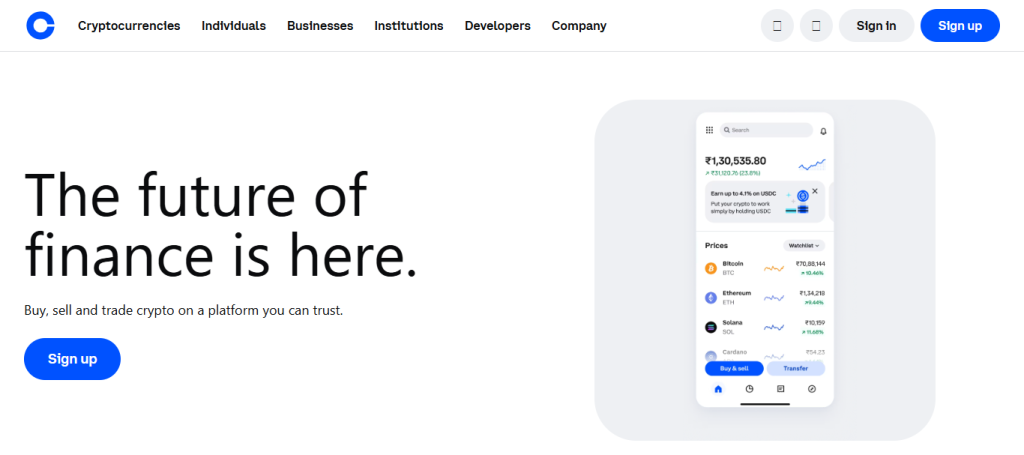
    As a leading, US-based, regulation-conscious exchange, Coinbase has rightfully earned a reputation of one of the most trusted exchanges in the industry. Founded in 2012, Coinbase offers access to hundreds of digital assets across 100 countries.
    Coinbase

    Fees vary depending on the platform and trading volume, with rates anywhere from 0.00% to 0.60%. Coinbase has established itself as a leading exchange with a focus on regulation, compliance, and security while being listed on the NASDAQ.

    With an extensive network of regulators, Coinbase is a go-to exchange for retail and institutional investors looking for a curated digital asset platform.

    Coinbase Features, Pros & Cons

    FeaturesProsCons
    Publicly traded company on NASDAQStrong regulatory complianceHigher trading fees than many competitors
    Supports 250+ cryptocurrenciesBeginner-friendly interfaceLimited advanced trading tools on standard platform
    Institutional-grade custody servicesHigh security standardsSome services unavailable in certain regions
    Staking and rewards programsTrusted by institutionsCustomer support can be slow during peak periods
    Mobile and web trading platformsStrong fiat on/off rampsAdvanced features require Coinbase Advanced

    2. Kraken

    As an exchange founded in 2011, Kraken has cemented its place in history as one of the oldest cryptocurrency exchanges that is still operational.

    Kraken

    Trading occurs across supported markets in more than 190 countries, with flexibility to engage in spot and futures trading, staking, and margin trading, as permitted in each jurisdiction. Fees for trading contracts typically start at 0.40% taker and 0.25% maker, with discounts for those that are high-volume.

    Among the Best Crypto Exchanges Built to Survive Regulatory Shifts, Kraken is well-known for its robust security features and regulatory diligence, as well as its licensure across the globe.

    Kraken Features, Pros & Cons

    FeaturesProsCons
    Spot, margin, and futures tradingExcellent security reputationInterface may be complex for beginners
    Proof-of-reserves transparencyCompetitive feesLimited payment methods in some countries
    Staking services availableSupports many fiat currenciesVerification can take time
    Advanced trading toolsStrong compliance frameworkFewer listed tokens than some competitors
    Institutional trading solutionsTrusted global brandSome features restricted by region

    3. Binance Global (Regulated Entities)

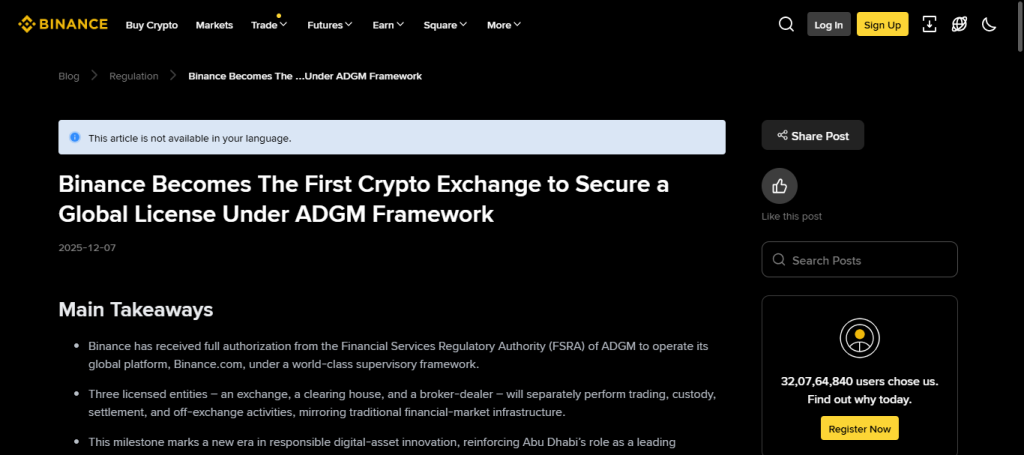
    Binance is the largest cryptocurrency exchange in the world by trade volume. Established in 2017, Binance offers regional, regulated entities to comply with local laws, while servicing clients in over 100 countries.
    Binance Global (Regulated Entities)

    Binance has 0.10% spot trading fees to provide a competitive edge over potential rivals. Binance has made significant investments in partnerships with regulatory authorities,

    licensing, KYC, and AML, as it is one of the Best Crypto Exchanges Built to Survive Regulatory Shifts. With hundreds of cryptocurrencies, Binance provides a varied and liquid trading environment with futures, staking, and Web3 services.

    Binance Global (Regulated Entities) Features, Pros & Cons

    FeaturesProsCons
    Massive cryptocurrency selectionVery low trading feesRegulatory restrictions in some countries
    Spot, margin, futures, and optionsIndustry-leading liquidityPlatform can be overwhelming for beginners
    Launchpad and Earn productsAdvanced trading featuresAvailability varies by jurisdiction
    Web3 wallet integrationLarge ecosystem of servicesCompliance requirements increasing
    High-volume trading infrastructureExtensive global reachCertain products not available everywhere

    4. Gemini

    Gemini was founded by the Winklevii in 2014, and is a highly secure and compliant exchange with a solid reputation. Gemini primarily serves dozens of countries and is expanding more internationally. The trading fees vary, however, ActiveTrader fees with Gemini are approximately 0.20% for maker and 0.40% for taker.
    Gemini

    Gemini is one of the Best Crypto Exchanges Built to Survive Regulatory Shifts. Gemini’s extensive staking solutions, custody services, and crypto trading are very appealing for investors who are looking for a transparent and a highly regulated trading environment.

    Gemini Features, Pros & Cons

    FeaturesProsCons
    Compliance-first exchange modelStrong regulatory standingHigher fees compared to competitors
    Institutional custody servicesExcellent security practicesSmaller asset selection
    ActiveTrader platformSuitable for institutionsLimited advanced earning products
    Insurance protections on select assetsTransparent operationsLower trading volume than major rivals
    Staking and recurring purchasesUser-friendly interfaceFewer international markets served

    5. Bitstamp

    With a launch date in 2011, Bitstamp is one of the longest-standing exchanges in the world. Available to customers in 100 different countries, Bitstamp offers a straightforward and reliable interface to access major cryptocurrencies.
    Bitstamp

    Trading fees typically start at around 0.30% with lower fees associated with greater trading volume. Dedicating resources to the protection of customers and the transparency of operations, Bitstamp is listed among the Best Crypto Exchanges Built to Survive Regulatory Shifts.

    With multiple licenses across a number of jurisdictions, Bitstamp is a trusted exchange for both retail and institutional investors wanting a protective and stable digital asset trading environment.

    Bitstamp Features, Pros & Cons

    FeaturesProsCons
    One of the oldest crypto exchangesLong-standing industry reputationFewer cryptocurrencies available
    Strong regulatory complianceEasy-to-use platformLimited advanced trading features
    Fiat deposit and withdrawal supportReliable customer serviceSmaller ecosystem than competitors
    Institutional trading servicesHigh trust among investorsHigher fees for low-volume traders
    Mobile trading applicationSecure infrastructureFewer staking opportunities

    6. OKX

    Established in 2017, OKX has developed into a significant global exchange with over 100,000 users. OKX offers a wider range of services with spot and derivatives trading alongside lending, staking, and Web3 wallets.

    OKX

    OKX’s trading fees are on the lower end of the scale starting at 0.08% and 0.10% for the maker and taker fees, respectively.

    OKX is also listed among the Best Crypto Exchanges Built to Survive Regulatory Shifts and is known for trading depth and variety of assets making it an exchange of choice for active users and traders.

    OKX Features, Pros & Cons

    FeaturesProsCons
    Spot, futures, and options tradingCompetitive trading feesNot available in some regulated markets
    Web3 wallet ecosystemStrong liquidityComplex for new users
    Staking and DeFi integrationWide range of productsRegulatory environment varies by region
    Advanced charting toolsLarge cryptocurrency selectionSome services may face restrictions
    Automated trading strategiesFast trading engineLearning curve for beginners

    7. Bybit (Regulated Divisions)

    Bybit was founded in 2018 and has quickly established itself as a global leader in cryptocurrency derivatives and spot trading. Bybit, which serves customers in multiple regions, is expanding its regulated operations in several jurisdictions. Spot trading generally costs 0.10% and is lower for Bybit’s VIP customers.
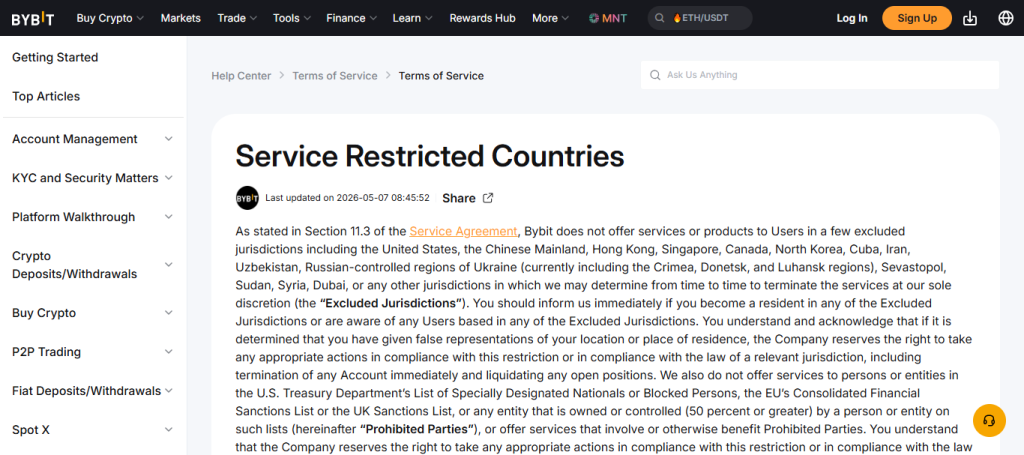
    Bybit (Regulated Divisions)

    Bybit is one of the Best Crypto Exchanges Built to Survive Regulatory Shifts because they have updated their compliance structures, enhanced their KYC, and are actively pursuing licenses for their targeted markets.

    Bybit has futures, copy, and stake trading; plus, an arsenal of sophisticated and professional trading tools, which brings a lot of attention to Buybit from experienced as well as novice traders.

    Bybit (Regulated Divisions) Features, Pros & Cons

    FeaturesProsCons
    Spot and derivatives tradingCompetitive fee structureLimited availability in certain countries
    Copy trading functionalityStrong liquidityRegulatory changes may affect services
    Trading bots and automationUser-friendly trading platformFewer fiat gateways than some rivals
    Earn and staking productsFast order executionKYC requirements have expanded
    Advanced risk management toolsPopular among active tradersDerivatives may not suit beginners

    8. Crypto.com Exchange

    Since 2016, Crypto.com has emerged as an all-encompassing cryptocurrency ecosystem for its more than 90 million users. Crypto.com’s exchange features spot and derivative trading, staking, crypto cards, and payment services.
    Crypto.com Exchange

    Trading generally costs 0.075%, and platform token holders receive additional discounts. Crypto.com is one of the Best Crypto Exchanges Built to Survive Regulatory Shifts because the company zealously attains worldwide approvals for operations, meets regulatory standards, and pursues compliance certifications.

    Because Crypto.com prioritizes security, customer protection, and transparency, the all-encompassing nature of their financial products and services and the ease of use of the mobile app have propelled Crypto.com to the forefront of the cryptocurrency market.

    Crypto.com Exchange Features, Pros & Cons

    FeaturesProsCons
    Complete crypto ecosystemWide range of servicesSome products depend on CRO holdings
    Crypto Visa cardsStrong regulatory focusFee structure can be complex
    Spot and derivatives tradingAttractive rewards programsCustomer support response times vary
    Staking and lending productsMobile-friendly experienceCertain features restricted by country
    NFT and payment solutionsGlobal brand recognitionSpread can be higher for some trades

    9. KuCoin (Compliance Upgrade)

    Since it’s founding in 2017, KuCoin has quickly become one of the most popular ways for international customers to access digital currency. Global users can trade hundreds of assets with a starting trading fee of 0.1%, which can be reduced by holding KuCoin’s proprietary token.
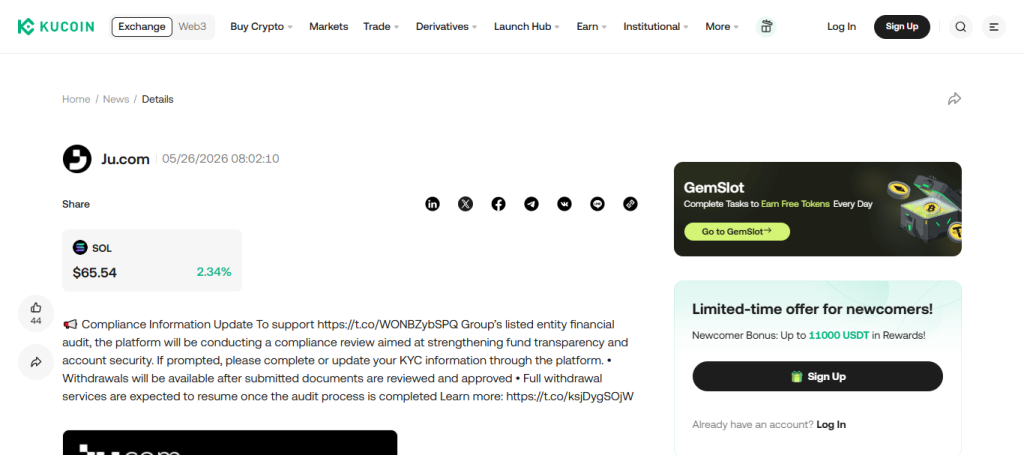
    KuCoin (Compliance Upgrade)

    KuCoin is an example of a crypto exchange designed to adapt to future regulation. Recently, KuCoin has added infrastructure elements to support advanced KYC and greater consideration of cross-border regulations.

    KuCoin started as a spot trading exchange, but has expanded its offerings to futures, margin trading, staking, and automated trading. The low trading fee structure in conjunction with a wide variety of assets draws many customers.

    KuCoin (Compliance Upgrade) Features, Pros & Cons

    FeaturesProsCons
    Hundreds of listed cryptocurrenciesLarge altcoin selectionRegulatory scrutiny in some markets
    Spot, futures, and margin tradingCompetitive feesMandatory KYC requirements introduced
    Trading bots includedStrong passive income optionsLimited availability in some countries
    Staking and earning productsFrequent token listingsLess institutional presence
    Native KCS token benefitsUser-friendly trading toolsCompliance transition may affect users

    10. Huobi Global (HTX)

    Coming to the industry in 2013, Huobi Global (now HTX) is one of the longest standing and most popular exchanges. Offering many digital assets, HTX has worldwide users.

    Huobi Global (HTX)

    Trading fees generally start at 0.20% and can be reduced by loyalty programs or holding the exchange’s token.

    Being one of the Best Crypto Exchanges Built to Survive Regulatory Shifts, HTX has been adjusting and increasing their compliance and risk management procedures for changing regulations. HTX provides spot and derivative trading, staking, and wealth management services for retail and professional investors.

    Huobi Global (HTX) Features, Pros & Cons

    FeaturesProsCons
    Spot and derivatives marketsLarge selection of digital assetsRegulatory status varies by region
    Wealth management productsCompetitive trading feesLess presence in Western markets
    Staking and earning servicesStrong liquidity for major assetsComplex platform for new traders
    Advanced trading toolsGlobal customer baseSome services restricted geographically
    HTX ecosystem integrationMultiple investment productsRegulatory uncertainty in certain jurisdictions

    Conclusion

    With the continual global evolution of cryptocurrency regulation, selecting exchanges that emphasize compliance, security, and an adaptive approach to regulation has never been more critical.

    The Best Crypto Exchanges Built to Survive Regulatory Shifts includes Coinbase, Kraken, Binance, Gemini, Bitstamp, OKX, Bybit, Crypto.com, KuCoin, and HTX.

    All have built an impressive track record of being able to meet legal obligations while servicing customers worldwide. All of them have a strong focus on security coupled with licensing and transparency, as well as a focus on their customers and this has sustained their competitive advantage in the regulatory race.

    Investors benefit from the risk reduction and the confidence offered from selecting the compliant exchange which enables more extensive and more sustained cryptocurrency trading and investing.

    FAQ

    What are crypto exchanges built to survive regulatory shifts?

    These are cryptocurrency exchanges that prioritize compliance, licensing, security, and transparency. They actively adapt to changing regulations in different countries to continue operating legally and protect user assets.

    Why is regulatory compliance important for crypto exchanges?

    Regulatory compliance helps exchanges maintain legal operations, reduce the risk of shutdowns, enhance security standards, and provide better protection for customer funds and personal information.

    Which crypto exchange is considered the most regulation-friendly?

    Coinbase and Gemini are often regarded as highly regulation-friendly exchanges due to their strong compliance programs, regulatory licenses, and commitment to transparency in multiple jurisdictions.

    Are regulated crypto exchanges safer than unregulated exchanges?

    Generally, regulated exchanges offer greater security, stronger consumer protections, and better operational transparency. However, users should still follow good security practices such as enabling two-factor authentication.

    Can I use Binance in all countries?

    No. Binance availability varies by country. The exchange operates through different regulated entities and may offer different services depending on local laws and regulatory requirements.

  • Top 10 Air-Gapped Signing Tips for Keystone Wallet Security

    Top 10 Air-Gapped Signing Tips for Keystone Wallet Security

    In this article, I will explore the Top Air-Gapped Signing Tips for Keystone Wallet Security, covering what practices are most important for safeguarding cryptocurrency via completely offline secured transaction signing.

    I will elaborate on the functioning of air-gapped wallets, the significance of QR-based verification and the effects of further protection such as passphrase combined with clear-sign technology on the total security of users in Keystone wallet.

    Understanding Air-Gapped Signing

    A hardware wallet like Keystone uses a method called Air-Gapped signing for optimal security. The Air-Gapped signing method operates in a completely isolated system. This hardware wallet does not need USB, Bluetooth, or WiFi connections to sign transactions.

    Instead, the wallet uses QR codes for transactions. The signed transactions and data are transferred directly between the wallet and the companion app. This method ensures private keys stay in the wallet, which makes it more resistant to hacks, malware, and remote access attacks.

    Air-gapped systems also require physical confirmation for every transaction directly on the hardware device. This method is currently the most secure for storing cryptocurrency in modern Web3 environments.

    Best Practices Summary

    • Keeping Keystone totally offline is the only way to ensure full air-gapped protection.
    • Signing data in a QR code can be a technical attack. This can be avoided in a signing process by verifying the QR code before signing.
    • Isolation prevents attacks through the built-in camera outside the Keystone device.
    • Always validate transaction data to mitigate the risks of phishing.
    • Hidden wallets are protected by recovery seeds more than passphrase protection.
    • Protect unlock and access to funds in a multi-signature setup.
    • Protect your recovery seed by keeping it in a safe and secure offline in a physical location.
    • Prevent accidental large losses by testing small transactions first.
    • The only way to maintain the security and integrity of your device is through official Keystone sources.
    • To prevent signing attacks, a Clear-Sign technology is put in place.

    Top Air-Gapped Signing Tips for Keystone Wallet Security

    Best PracticeKey Benefit
    Always Keep Keystone OfflinePrevents internet-based hacks and remote attacks
    Verify QR Codes CarefullyAvoids malicious transaction tampering via fake QR data
    Use Keystone’s Built-In Camera OnlyEnsures secure scanning without external device exposure
    Cross-Check Transaction MetadataConfirms recipient address and amount accuracy before signing
    Enable Passphrase ProtectionAdds an extra security layer beyond the seed phrase
    Use Multi-Sig with KeystoneReduces risk by requiring multiple approvals for transactions
    Keep Recovery Seed OfflineProtects wallet recovery phrase from online theft
    Test Signing with Small TransactionsMinimizes risk before executing large transfers
    Update Keystone Firmware SecurelyEnsures device has latest security patches without compromise
    Enable Clear-Sign TechnologyImproves transparency by showing readable transaction details before signing

    1. Always Keep Keystone Offline

    The foundation for true air-gapped security is having your Keystone hardware wallet completely offline. The fact that it doesn’t connect to WiFi, Bluetooth, or a USB for data transfer greatly reduces the chances of an attack from a distance or a malware attack.

    Always Keep Keystone Offline

    Transactions are internal and signed and sent to their destination through a QR code. The private keys are kept safely within the device and never leave the device in any case.

    In Top Air-Gapped Signing Tips for Keystone Wallet Security, having the device completely offline is the most effective way of protecting yourself from phishing and spyware and is therefore the most important tip for protecting your crypto assets.

    Always Keep Keystone Offline Benefits & Drawbacks

    Benefits:

    • No risk from online attacks
    • Strong protection of private keys
    • Less risk of malware incidents

    Drawbacks:

    • Less convenient for multiple transactions
    • Requires an understanding of a QR-based workflow
    • Takes more time to perform the task

    Always Keep Keystone Offline

    FeatureDescription
    Air-Gapped DesignOperates without internet connectivity
    No Wireless ModulesNo WiFi, Bluetooth, or cellular access
    QR-Based WorkflowUses QR codes for all transactions

    2. Verify QR Codes Carefully

    Since QR codes serve as a link between the Keystone device and external applications, they should be validated. One method that a hacker can use is to put a fake QR code that looks legitimate and injects malicious transaction data.

     Verify QR Codes Carefully

    Only scan from a wallet or a verified interface that you trust, and before signing, review the information on the device screen and what the QR code has in it.

    In Top Air-Gapped Signing Tips for Keystone Wallet Security, carefully checking a QR code can avoid address transactions and manipulation. Transaction integrity can be compromised when users scan QR codes from a source or screenshot that is unverified.

    Verify QR Codes Carefully Benefits & Drawbacks

    Benefits:

    • Prevents address spoofing attacks
    • Confirms authenticity of transactions
    • Gives an added manual security layer

    Drawbacks:

    • Human errors are always a possibility
    • Requires great focus every time
    • Malicious QR codes are prepared in advance and can achieve their purpose

    Verify QR Codes Carefully

    FeatureDescription
    Transaction EncodingQR contains full transaction data
    Visual ConfirmationAllows manual verification before signing
    Tamper DetectionHelps identify altered QR data

    3. Use Keystone’s Built‑in Camera Only

    Each Keystone wallet contains a camera designed for QR code scanning. Other cameras or scanners should not be used. Using only the built-in camera of your Keystone wallet will keep transaction data secure and confined.

     Use Keystone’s Built‑in Camera Only

    In Top Air-Gapped Signing Tips for Keystone Wallet Security, the signing process is fully isolated, and the built-in camera should be used exclusively.

    Using the built-in camera minimizes the signing process from being reliant on a signing device, which may have been compromised, and ensures that private keys, along with transaction signing, remain in the secure hardware of the device.

    Use Keystone’s Built-in Camera Only Benefits & Drawbacks

    Benefits:

    • Keeps the system fully isolated
    • Reduces the risk of using external devices
    • Keeps air-gapped integrity

    Drawbacks:

    • Hardware dependency
    • Less flexibility
    • Slower scanning opportunity

    Use Keystone’s Built-in Camera Only

    FeatureDescription
    Internal ScannerSecure in-device QR scanning
    Isolated ProcessingNo external device interaction
    Hardware SecurityReduces attack surface risk

    4. Cross‑Check Transaction Metadata

    Before any transaction is signed, be sure to check relevant elements of the transaction or transaction metadata, such as the recipient’s address, the tokens being transacted, the network, and the transaction amount.

    Cross‑Check Transaction Metadata

    Many modern crypto hacks are done via a small address change, or by using a transaction data element to cause a change that appears subtle. The Keystone wallet allows users to view this data in a readable way.

    In Top Air-Gapped Signing Tips for Keystone Wallet Security, verifying transaction metadata is a defense that should not be overlooked, as it ensures funds are being sent to the correct address. If any transaction data is the least bit incorrect, the transaction should be rejected and a warning should be issued.

    Cross-Check Transaction Metadata Benefits & Drawbacks

    Benefits:

    • Prevents funds from being sent to the wrong address
    • Detects tampered transactions
    • Improves user accuracy and control

    Drawbacks:

    • Can be confusing for absolute beginners
    • A manual review is required
    • Errors can still go undetected

    Cross-Check Transaction Metadata

    FeatureDescription
    Full Transaction DetailsShows address, amount, and network
    Pre-Sign ReviewConfirms data before approval
    Human-Readable DisplaySimplifies verification process

    5. Enable Passphrase Protection

    Passphrase protection adds yet another extra layer to your wallet. It is like a second password on top of your recovery seed.

    Enable Passphrase Protection

    Even if someone has access to your seed phrase, they cannot access your funds without the correct passphrase. For those with recovery seed passphrase enabled wallets, wallet security is elevated infinitely against theft and recovery seed attempts.

    In Top Air-Gapped Signing Tips for Keystone Wallet Security, enabling a strong and unique passphrase, is essential. Users should never use a passphrase that is predictable and should keep the passphrase stored safely and separated from the recovery seed.

    Enable Passphrase Protection Benefits & Drawbacks

    Benefits:

    • Adds a strong additional layer of protection
    • Provides protection if the seed is compromised
    • Supports the creation of a concealed wallet

    Drawbacks:

    • Risk of losing access to the passphrase
    • More complicated backup
    • User errors can result in irreversible losses

    Enable Passphrase Protection

    FeatureDescription
    Extra Security LayerWorks beyond recovery seed
    Hidden WalletsCreates separate secure accounts
    Password-Based AccessRequires passphrase to unlock funds

    6. Use Multi‑Sig with Keystone

    Multi-signature (multi-sig) makes it impossible for one person to singlehandedly sign or authorize a transaction. This means that by dispersing signing authority or signing rights across different wallets or devices, one significantly reduces the risk of a single point of failure.

    Use Multi‑Sig with Keystone

    Even if one wallet is compromised, funds remain safe without the other required signatures. In Top Air-Gapped Signing Tips for Keystone Wallet Security, incorporating multi-sig adds a level of security framework that is typical of an institutional level protection for personal or business crypto holdings.

    This is especially important for DAO operations and shared accounts where large funds are involved, and where security and traceability are of utmost importance.

     Use Multi-Sig with Keystone Benefits & Drawbacks

    Benefits:

    • Requires multiple approvals
    • Avoids single-point security failures
    • Ideal for large or shared funds

    Drawbacks:

    • Complex setup process
    • Sluggishness in transaction execution
    • Coordination is required among all signatories

    Use Multi-Sig with Keystone

    FeatureDescription
    Multiple ApprovalsRequires more than one signature
    Distributed ControlWallet security shared across devices
    Fraud ProtectionPrevents single-point compromise

    7. Keep Recovery Seed Offline

    Recovery seed is the master key to your crypto assets, never should be kept digitally written on paper or engraved on metal. They are safe from being hacked, having malware, or being stolen in the cloud.

    Keep Recovery Seed Offline

    They can be stored in a safe and concealed place that is resistant to fire. In the Top Air-Gapped Signing Tips for Keystone Wallet Security, it is essential to keep the recovery seed offline. Whoever has the seed phrase can control the funds. This makes it very important to secure it.

    Keep Recovery Seed Offline Benefits & Drawbacks

    Benefits:

    • Completely safe from online mechanisms
    • Provides an ability to recover the wallet
    • Backup is easy and dependable

    Drawbacks:

    • It can be damaged and lost
    • Must be stored with care
    • Is not easy to substitute

    Keep Recovery Seed Offline

    FeatureDescription
    Physical StorageWritten or engraved backup only
    No Digital ExposureNever stored online or on devices
    Full Recovery AccessRestores wallet if device is lost

    8. Test Signing with Small Transactions

    You should sign your first transaction to transfer a very small amount of crypto to test if the system is designed to reach the address it is assigned on the right network. This also answers the configuration questions and the set up risks.

    Test Signing with Small Transactions

    In Top Air-Gapped Signing Tips for Keystone Wallet Security, test transactions serve as a safety check. Users can be confident of the proper and secure operation of the Keystone Wallet as the system to protect the assets operates safely and as intended prior to transferring any significant value.

    Test Signing with Small Transactions Benefits & Drawbacks

    Benefits:

    • Large loss is unlikely
    • Allows the user to verify the signatory setup
    • Increases confidence with the signing process

    Drawbacks:

    • Results in an additional fee on the transaction
    • Additional time is required
    • Large, complicated transactions makes it an undesired hurdle for many experienced users

    Test Signing with Small Transactions

    FeatureDescription
    Low-Value TransfersUses small crypto amounts first
    System ValidationConfirms correct setup and address
    Risk ReductionPrevents large-scale errors

    9. Update Keystone Firmware Securely

    Even if firmware updates are crucial, people still tend to avoid them. Keystone avoids this risk by allowing users to download firmware’s at their own discretion. They must sign their updates, and users can validate the signatures before applying an update.

    Update Keystone Firmware Securely

    Without user validation, firmware updates are entirely at the users’ risk. Users should avoid third-party firmware updates, as they are always likely to contain malware, and have not gone through the same update disclaimer that Keystone would use.

    Although some updates may include security patches and improvements, they carry significant risk to users with potentially malicious code. In Top Air-Gapped Signing Tips for Keystone Wallet Security, it is recommended that you verify digital signatures and follow Keystone’s update instructions, and then use your own discretion to validate or authorize updates.

    Update Keystone Firmware Securely Benefits & Drawbacks

    Benefits:

    • Provides an update for known vulnerabilities
    • Enhances device operation
    • Keeps the firmware current

    Drawbacks:

    • Risks tampering if the un-official firmware is used
    • Additional steps required
    • Temporary loss of the use of the device

    Update Keystone Firmware Securely

    FeatureDescription
    Official Updates OnlyFirmware from trusted source
    Security PatchesFixes vulnerabilities regularly
    Integrity ChecksEnsures authentic software installation

    10. Enable Clear‑Sign Technology

    With clear-sign technology, you can view the details of a signed transaction in a human-readable form instead of a string of raw data. Keystone displays fields like amount, address, and network, as opposed to raw data, making the understanding and signing of the transaction more apparent to the user.

    Enable Clear‑Sign Technology

    In Top Air-Gapped Signing Tips for Keystone Wallet Security, it is recommended that you enable this technology, as it creates a better user experience with confidence and transparency that an approval will not be a stupid action. Additionally, this technology is a preventative measure for phishing attacks and transaction spoofing in crypto operations.

    Enable Clear-Sign Technology Benefits & Drawbacks

    Benefits:

    • Defense against signing without the ability to view the contents of the transaction
    • Favors mechanisms that improve transaction clarity

    Drawbacks:

    • Some data may still be complicated
    • Requires the user to be engaged
    • Not all applications support this feature

    Enable Clear-Sign Technology

    FeatureDescription
    Human-Readable DataConverts complex info into simple text
    Transaction TransparencyShows exact details before signing
    Anti-Phishing ProtectionHelps detect hidden malicious actions

    Conclusion

    Achieving the security for your digital assets requires more than just obtaining a hardware wallet, but a commitment to safety and security. The Top Tips for Air-Gapped Signing properly demonstrate how offline protection, careful QR code, and metadata along with the advanced features of passphrases and multi-signature provide a modern and strong defense to the modern threats for cryptocurrencies.

    The protective barriers that the air-gapped design of the Keystone Wallet utilize are at their strongest when supplemented by good operational security. Continued use and practice of these methods drastically minimize threats such as phishing, transaction spoofing, and revealing your private keys.

    Security, in the rapidly advancing age of Web3, requires a paradigm shift to the new borderless and digital world shift. Best practices for safety are no longer optional. The extensive, complete control and protection of your digital assets is only achieved through consistent and good practices of safety and security.

    FAQ

    What is air-gapped signing in Keystone Wallet?

    Air-gapped signing is a security method where the Keystone hardware wallet stays completely offline while signing transactions. Instead of using USB, Bluetooth, or WiFi, it communicates through QR codes. This ensures private keys never leave the device. The Top Air-Gapped Signing Tips for Keystone Wallet Security emphasize this method because it significantly reduces hacking risks and protects users from online threats like malware, phishing, and remote attacks.

    Why is keeping Keystone offline so important?

    Keeping Keystone offline eliminates direct exposure to the internet, which is the primary attack vector for hackers. Without network connectivity, malicious software cannot access private keys or alter transactions. In the Top Air-Gapped Signing Tips for Keystone Wallet Security, offline usage is considered the core defense layer that ensures all signing activities remain isolated, secure, and tamper-resistant.

    How do QR codes improve transaction security?

    QR codes securely transfer transaction data between the wallet and external apps without requiring internet-based connections. This reduces interception risks. However, users must verify QR content carefully before signing. The Top Air-Gapped Signing Tips for Keystone Wallet Security recommend scanning only trusted QR codes to avoid spoofed or malicious transaction data.

  • 10 Top Transaction Simulation Tools Hidden Inside Rabby Wallet

    10 Top Transaction Simulation Tools Hidden Inside Rabby Wallet

    This article will identify the Top Transaction Simulation Tools Embedded In Rabby Wallet, allowing users to understand and secure their Web3 transactions pre-execution.

    Rabby Wallet’s tools model gas fees, swaps, approvals, and cross-chain actions, all in a dynamic environment. Knowledge of these tools enhances transaction safety, decreases risks, and provides clarity for intelligent blockchain decisions.

    Why Transaction Simulation Tools Hidden Inside Rabby Wallet

    Rabby Wallet wants Web3 interactions to be safer, more transparent, and more predictable; this is what simulation tools are designed to do. Unlike blindly signing transactions on the blockchain, Rabby’s users can see the outcomes and evaluate the risks before making a decision. Here’s why these tools matter:

    Safer TransactionsMalicious or incorrect transactions can be avoided as every action is simulated prior to execution.

    Less Financial Loss: Prevents the loss of tokens and the failure of swaps and unexpected token losses.

    Identifies Risks of Smart Contracts: Shows harmful and suspicious contract behaviors before being approved.

    Brings Transparency to Fees: Helps to avoid overestimating the costs by providing gas fees estimates.

    Stops Scam Approvals: Identifies dangerous token permissions that can take all of the funds from the wallet.

    Improved Decision-Making in DeFi: Clear previews calm uncertainty in all DeFi interactions including swaps, staking, bridging, and providing liquidity.

    Increases Confidence in Transactions: Users are able to verify the outcomes of their actions and gain confidence.

    Safety Across Networks: Helps avoid failed transfers by simulating transactions on other networks.

    Better Trading Decisions: Users gain understanding on slippage and price impact and execution outcomes.

    Why It Is Transaction Simulation Tools Hidden Inside Rabby Wallet Matter

    Transaction simulation tools integrated in Rabby Wallet’s offer an extra layer of protection and transparency to all Web3 interactions. In DeFi, transactions are irreversible, and even the smallest errors can result in permanent loss. These tools allow users to visualize the consequences of their actions, ensuring a safer and more predictable experience on the blockchain.

    Avoid Unrecoverable Errors: Simulations help users approve or transfer actions without errors.

    Provides Safety Against Smart Contract Threats: Uncommitted funds are safe from contracts that behave suspiciously.

    Increases Asset Safety: The correct swap can be performed to avoid loss of assets.

    Promotes Transaction Clarity: Movements of tokens, fees, and final results can all be seen prior to confirming the transaction.

    Eliminates Unwanted Premium Gas Fees: Congestion on the network can be estimated, allowing users to avoid transaction fees for the network.

    Prevents Token Approval Threats: Risk permissions, which are a threat to draining wallets and are therefore smart contract approvals, are detected.

    Promotes Defi Options: Simulations show users a preview of possible options.

    Simplifies Problems Causing Stress: Transactions that move across the blockchain can be simplified, proper, and verifiable using these tools.

    Key Point & Top Transaction Simulation Tools Hidden Inside Rabby Wallet

    FeatureKey Point
    Pre-Execution SimulationShows what will happen before confirming a transaction, helping avoid mistakes.
    Gas Fee EstimatorPredicts the exact network fee required for the transaction.
    Token Balance Change PreviewDisplays how your token balances will change after execution.
    Slippage Impact SimulationSimulates price movement impact during swaps to avoid losses.
    Approval Risk CheckDetects risky token approvals that could drain funds.
    NFT Transfer SimulationPreviews NFT movement and verifies destination safety.
    Cross-Chain Bridge SimulationTests asset movement across chains before execution.
    Contract Call TraceBreaks down smart contract actions for transparency.
    DEX Swap SimulationSimulates token swaps on DEXs before confirming.
    Liquidity Pool Impact PreviewShows how entering/exiting liquidity pools affects returns and pool balance.

    1. Pre‑Execution Simulation

    Pre-Execution Simulation is one of the many simulations Rabby Wallet uses to ensure safety and allow users to preview a complete transaction outcome. It shows users the potential events that are going to occur with their assets and wallets and what is going to happen with the contracts.

    Pre‑Execution Simulation

    It helps users avoid malicious contracts. Rabby Wallet uses this feature to verify the accuracy of the transaction before it is executed. This feature is aimed to prevent users from losing money due to a failed transaction and also prevents malicious contracts from failing due to aimed scams from going through.

    Pre-Execution Simulation Details

    FeatureDetails
    Transaction PreviewShows full transaction outcome before signing
    Asset Impact CheckDisplays how assets will change after execution
    Risk DetectionIdentifies suspicious or unexpected contract behavior
    Failure PredictionWarns if transaction is likely to fail
    User TransparencyGives clear visibility into blockchain actions
    Scam ProtectionHelps avoid malicious smart contracts

    2. Gas Fee Estimator

    Gas Fee Estimator produces transaction costs for users and helps users understand the cost that has to be paid to execute a transaction over the blockchain. It helps users avoid underfunding or overpaying transaction fees, and falling victim to failed transactions due to a lack of funds.

    Gas Fee Estimator

    Rabby Wallet enhances users’ decision making and transaction timing by providing them the tools to understand the optimal time to transact due to changes in network conditions. This tool is especially helpful during high network congestion and gas price volatility along EVM compatible networks.

    Gas Fee Estimator Details

    FeatureDetails
    Dynamic Fee CalculationEstimates gas based on network congestion
    Chain AwarenessAdjusts fees for different EVM networks
    Speed OptionsShows fast, standard, and slow fee levels
    Cost PredictionPrevents underpaying or overpaying gas
    Real-Time UpdatesUpdates fee based on market conditions
    Budget ControlHelps users manage transaction expenses

    3. Token Balance Change Preview

    The Token Balance Change Preview provides users with a straightforward, step-by-step indication of how a transaction will change the balance of tokens held in a wallet. It is particularly beneficial for users participating in a diverse range of DeFi operations, as Token Balance Change Preview explains the exact extent of a token balance reduction, increase, gain, loss, or swap.

    Token Balance Change Preview

    Within the Top Transaction Simulation Tools Hidden Inside Rabby Wallet, it provides perfect transparency for users and eliminates guesswork. Users can evaluate and ensure that the final outcome of a transaction will match the expected result before giving their approval, which protects users from potential unexpected outcomes, loss of tokens, and outputs of incorrect tokens.

    Token Balance Change Preview Details

    FeatureDetails
    Before/After ViewShows wallet balance changes clearly
    Multi-Token TrackingSupports multiple tokens in one transaction
    Swap Outcome PreviewDisplays expected received tokens
    Loss PreventionHelps avoid unexpected token deductions
    DeFi IntegrationWorks with swaps, staking, and farming
    Accuracy CheckValidates transaction result before approval

    4. Slippage Impact Simulation

    The Slippage Impact Simulation provides users with an estimate of how price shifts after a token swap will affect the settlement value of the transaction. It is primarily designed for token swaps that occur in a very active or highly volatile marketplace, where the price of a token is in a constant state of fluctuation.

    Slippage Impact Simulation

    The tool offers users the opportunity to avoid the possibility of a swap price deviating significantly from the expected price by letting users define a more conservative and tighter slippage tolerance.

    As part of the Top Transaction Simulation Tools Hidden Inside Rabby Wallet, the tool acts as a safeguard against the loss of value during a swap, and provides reassurance to users that greater control over the execution of the swap is maintained despite the potential for active liquidity conditions and market volatility.

    Slippage Impact Simulation Details

    FeatureDetails
    Price Movement ForecastPredicts price changes during swaps
    Slippage WarningAlerts when tolerance is too high
    Trade Outcome PreviewShows possible final received amount
    Volatility AnalysisEvaluates market fluctuation risk
    Safe Limit SuggestionRecommends optimal slippage settings
    DEX CompatibilityWorks across decentralized exchanges

    5. Approval Risk Check

    The Approval Risk Check enables Rabby Wallet to analyze token permissions before they are approved by smart contracts and observe how much access the contract is requesting. This has the capability to detect possible malicious approvals and attempts to drain the wallet.

    Approval Risk Check

    It acts as a security check and is the first of the Top Transaction Simulation Tools Hidden Inside Rabby Wallet. It enables users to revoke or alter permissions before approving transactions. It provides control over the user’s assets in a DeFi ecosystem and addresses the unauthorized spending issues.

    Approval Risk Check Details

    FeatureDetails
    Permission ScanChecks token approval requests
    Risk ScoringRates contract safety level
    Unlimited Access WarningFlags unlimited spending permissions
    Scam DetectionIdentifies suspicious smart contracts
    Revocation SuggestionSuggests removing risky approvals
    Security LayerPrevents wallet draining attacks

    6. NFT Transfer Simulation

    NFT Transfer Simulation enables users to simulate how NFTs will move before actually transferring them. It enables users to view the moving NFT’s source and destination wallet as well as what the source wallet will look like after the move.

     NFT Transfer Simulation

    This eliminates the risk of transferring the NFT to the desired destination by using an incorrect address or causing an NFT to be transferred instead of what was intended to be transferred.

    As part of the Top Transaction Simulation Tools Hidden Inside Rabby Wallet, this feature gives NFT traders the ability to check the authenticity of an NFT as well as its destination. This is particularly important for NFTs that are valued more than the majority of NFTs where an irreversible move may result in a substantial loss.

    NFT Transfer Simulation Details

    FeatureDetails
    Transfer PreviewShows NFT movement before confirmation
    Destination CheckConfirms receiving wallet address
    Metadata ValidationVerifies NFT details and authenticity
    Ownership ConfirmationEnsures correct ownership transfer
    Error PreventionStops accidental NFT loss
    Marketplace SupportWorks with NFT platforms

    7. Cross‑Chain Bridge Simulation

    Cross-Chain Bridge Simulation shows how different blockchains move assets. It runs bridges and shows what steps, fees, delays, and what token is received on the destination chain. This simulation helps users avoid failed or stuck bridge transactions.

    Cross‑Chain Bridge Simulation

    Cross-Chain Bridge Simulation, as part of the Top Transaction Simulation Tools Hidden Inside Rabby Wallet, brings light to intricate multi-chain processes.

    Users can confirm the output of a transaction before attempting to send tokens from Ethereum, Arbitrum, or Polygon, and improve the ease of interoperability. It also diminishes the consequences linked to the transfer of assets between chains.

    Cross-Chain Bridge Simulation Details

    FeatureDetails
    Bridge Path PreviewShows route across blockchains
    Fee EstimationCalculates bridge and gas costs
    Transfer Time EstimatePredicts transaction completion time
    Success ProbabilityEvaluates bridging success rate
    Token Conversion PreviewShows wrapped token outcomes
    Multi-Chain SupportWorks across major networks

    8. Contract Call Trace

    Contract Call Trace shows a view of what happens in a smart contract interaction. It shows what function calls led to the movement of tokens and what other smart contracts the transaction is reliant on.

    Contract Call Trace

    This gives users a clearer picture and an improved level of understanding of what a contract is doing out of view. As part of the Top Transaction Simulation Tools Hidden Inside Rabby Wallet, Contract Call Trace helps advanced users validate what a contract is going to do after they give it the go-ahead.

    It is particularly helpful in showcasing stealth features and ill-intentioned logic in the contracts behind DeFi protocols and how they interact with users’ assets.

    Contract Call Trace Details

    FeatureDetails
    Step-by-Step BreakdownShows internal contract calls
    Function VisibilityDisplays executed smart contract functions
    Token Flow TrackingTracks asset movements inside contract
    Debug ModeHelps detect hidden logic
    Developer InsightUseful for advanced users
    Transparency LayerImproves trust in dApps

    9. DEX Swap Simulation

    Available in Rabby, a Token Swap Simulation can help traders save time and avoid bad trades on decentralized exchanges by providing an estimate of how a trade will end, determining price slippage, and displaying the path of the trade and all the liquidity pools that will be used to execute the trade.

    DEX Swap Simulation

    In the simulation, traders are able to determine how the trade will turn out before it is executed, thus analyzing the risk and whether the trade will be profitable. For accurate trading and execution of orders, the DEX Swap Simulation provides insulation for all Rabby Wallet users.

    DEX Swap Simulation Details

    FeatureDetails
    Swap PreviewShows expected token output
    Price Impact CheckMeasures effect of trade size
    Fee BreakdownDisplays trading and gas fees
    Route OptimizationFinds best liquidity path
    Execution ForecastPredicts final swap result
    Slippage IntegrationWorks with slippage protection

    10. Liquidity Pool Impact Preview

    The Liquidity Pool Impact Preview, also part of the Rabby Wallet, lets you know how deepening or reducing the liquidity in a certain pool will change the ratios of the tokens, the earned yield, and how much of a token you will have after the pool is exited.

     Liquidity Pool Impact Preview

    This will help you analyze the yield and the realization of impermanent loss that you will receive if you execute the trade, thus enabling you to make better and more informed decisions.

    For liquidity pool yield farming purposes, the prediction of how the trading dynamics of the liquidity pool will change after the trade execution helps to improve the effectiveness of a yield farming strategy by helping liquidity providers finish the trade before the market changes.

    Liquidity Pool Impact Preview Details

    FeatureDetails
    Pool Ratio SimulationShows token ratio changes
    Impermanent Loss EstimationPredicts potential losses
    Reward ForecastEstimates yield farming returns
    Entry/Exit ImpactShows effect of adding/removing liquidity
    Token Exposure AnalysisDisplays risk distribution
    DeFi Strategy SupportHelps optimize liquidity decisions

    Comparison Table – Transaction Simulation Tools

    FeatureWithout Simulation ToolsWith Rabby Wallet Simulation Tools
    Transaction PreviewNo visibility before signingFull pre-execution preview available
    Gas Fee EstimationUnpredictable or inaccurate feesReal-time accurate gas fee estimation
    Token Balance CheckUsers guess final balanceClear before/after balance preview
    Slippage ControlHigh risk of price lossSlippage impact simulated before swap
    Smart Contract SafetyHidden risks in contractsRisk detection before approval
    Approval PermissionsUnlimited risky approvals possibleApproval risk warnings and checks
    NFT TransfersEasy to send to wrong addressNFT transfer preview and validation
    Cross-Chain TransfersHigh chance of bridge failureBridge simulation with outcome preview
    DEX SwapsUnexpected price executionSwap simulation with price impact
    Liquidity ActionsUnknown impermanent loss riskLiquidity impact preview shown

    Conclusion

    Rabby Wallet’s Top Transaction Simulation Tools make it easier to perform DeFi interactions that are not only safe and smart, but also transparent. Simulation tools assist users in determining the outcome of a transaction by providing insights on pre-execution checks, estimations on gas and slippage, and tracing the calls on contracts.

    The tools within the Rabby Wallet protect users from scams, rapid loss of tokens, and transaction failures. The simulation features provide a safety net for both advanced users and beginners. Overall, the tools simplify Web3 interactions and provide a friendly transactional experience.

    FAQ

    What are transaction simulation tools in Rabby Wallet?

    Transaction simulation tools in Rabby Wallet are built-in features that preview blockchain transactions before you confirm them. They show expected outcomes like token changes, gas fees, and contract actions, helping users avoid mistakes and scams.

    Why is Pre-Execution Simulation important?

    Pre-Execution Simulation helps users see the full result of a transaction before signing it. It ensures transparency by showing how assets will move and whether the transaction is safe, reducing the risk of failed or malicious interactions.

    How does Gas Fee Estimator work?

    The Gas Fee Estimator calculates the estimated cost of executing a transaction based on network activity and complexity. It helps users avoid overpaying or underestimating fees that could cause transaction failure.

    Can Rabby Wallet detect risky approvals?

    Yes, the Approval Risk Check feature identifies dangerous or excessive token permissions. It warns users before granting access to smart contracts that could potentially misuse or drain funds.

    What is Slippage Impact Simulation used for?

    Slippage Impact Simulation predicts price differences during token swaps. It helps users understand how market volatility can affect final trade results and set safer slippage limits.

  • Top 10 Essential Privacy Extensions for MetaMask Web3 Users

    Top 10 Essential Privacy Extensions for MetaMask Web3 Users

    I will cover the best must-have privacy extensions for MetaMask Web3 users in this article. These extensions assist in safeguarding your cryptocurrency wallet, improving your online privacy, and providing the capability to eliminate trackers and harmful scripts.

    These extensions will protect you during your online engagement with DeFi, NFTs, and decentralized apps. These extensions will provide a strong protective shield, improve performance, and increase security while enabling you to engage with the Web3 ecosystem in 2026.

    What Are Privacy Extensions?

    Privacy extensions act as protective barriers against online tracking and data collection, and help users avoid dangerous scripts as they surf the internet.

    For MetaMask and Web3 users, these extensions filter ads, and tracking cookies, and help create secure connections which also helps maintain wallet security, as well as blocking phishing attempts among other threats such as trackers, which can further compromise a user’s online anonymity.

    With fewer threats present to actively endanger user’s assets and online anonymity, users can experience a faster and safer online environment for assets and applications that are decentralized.

    Benefits of Using Privacy Extensions with MetaMask

    More Robust Wallet Security: Privacy extensions enhance your wallet protection, as they prevent scripts, phishing sites, and malicious dApps from attacking MetaMask.

    Fewer Tracking and Surveillance Issues: Privacy extensions enable your browsing on Web3 without being tracked by advertisers and without Web3 surveillance.

    More Phishing Attack Protection: Privacy extensions prevent you from entering suspicious crypto sites that are intended to steal your assets by identifying and blocking them.

    Faster Browsing: The removal of ads, trackers, and scripts allow Web3 pages to load faster, enhancing your browsing experience.

    More Secure dApp Access: Connecting your MetaMask to DeFi, dApps, and marketplaces is now more safe due to privacy extensions.

    Enhanced Browsing Satisfaction: Privacy extensions provide clutter-free and easy to navigate web pages.

    More Privacy Control: Privacy extensions allow you to control consent, which improves privacy in the digital space.

    Reduced Risk of Privacy Breach;Enhancements provide a safe browsing environment for MetaMask, and prevent tool-based privacy breaches.

    Key Point & Top Essential Privacy Extensions for MetaMask Web3 Users

    ExtensionKey Point
    Privacy BadgerAutomatically blocks invisible trackers that follow your browsing behavior without needing manual setup.
    uBlock OriginPowerful ad and tracker blocker that reduces page load time and enhances privacy efficiently.
    HTTPS EverywhereForces websites to use secure HTTPS connections to protect data from interception.
    NoScriptBlocks all active scripts by default, allowing only trusted sites to run JavaScript.
    Cookie AutoDeleteAutomatically removes cookies from closed tabs to prevent tracking across sessions.
    DecentraleyesServes local versions of common CDN files to block third-party content tracking.
    ClearURLsRemoves tracking parameters from URLs to keep browsing clean and private.
    GhosteryDetects and blocks trackers while also showing who is tracking your activity.
    AdGuard ExtensionBlocks ads, trackers, and phishing sites with customizable filtering options.
    ScriptSafeGives advanced control over JavaScript execution to prevent malicious scripts from running.

    1. Privacy Badger

    Privacy Badger is a tracker protection extension designed to learn and block invisible web trackers. Unlike standard blocklists, Privacy Badger’s methods are less pre-defined. It uses a custom rule to detect potentially problematic web trackers and malicious scripts.

    Privacy Badger

    There is no need for extensive testing to capture newer malicious scripts. Privacy Badger uses a fingerprinting and data protection model designed to limit the data leaked and the risk of fingerprinting.

    In the context of Top Essential Privacy Extensions for MetaMask Web3 Users, Privacy Badger is important in circumventing third-realm tracking which could endanger the activity of a user’s wallet and browsing history.

    Privacy Badger Features, Pros & Cons

    Features

    • Learns and blocks invisible trackers
    • Tracking behavior is learned over time
    • Automatic operation
    • Third party cookies and scripts are blocked
    • EFF developed

    Pros

    • Easy to use
    • Adaptive system enhances protection
    • Implements effective measures to decrease
    • Lightweight and rapid
    • Emphasis on privacy

    Cons

    • Doesn’t block all ads
    • Manual control is limited
    • Phase of learning is expected to take time
    • Does not block ads completely
    • Some website features may no longer work

    2. uBlock Origin

    uBlock Origin is a customizable, light content blocker that blocks ads, trackers, and malicious scripts. It is designed to enhance the performance of a web browser along with protection against phishing, tracking, and harmful web analytics in the Web3 ecosystem. Block lists can be filtered for multiple levels and orders of protection.

     uBlock Origin

    In Top Essential Privacy Extensions for MetaMask Web3 Users, uBlock Origin is a primary protection layer for apps used in Web3 such as decentralized apps and crypto marketplaces targeted for trading NFTs and various crypto funds.

    uBlock Origin Features, Pros & Cons

    Features

    • Tracks and blocks ads
    • Blocklists rely on filters
    • Blocks malware and phishing
    • Uses minimum memory
    • Element blocking mode

    Pros

    • Rapid performance
    • Excellent customization
    • Excellent protection against trackers
    • Works silently while present
    • Open source so it is audited and trusted

    Cons

    • Initial use may be difficult
    • Over blocking may impair the function of a site
    • Requires configuration for advanced options
    • Lacks VPN and identity protection tools
    • Usability may be low for some users

    3. HTTPS Everywhere

    HTTPS Everywhere is a privacy extension that forces websites to use encrypted HTTPS connections whenever possible.

    This secures sensitive information like wallet interactions, login details, and browsing history from being captured by hackers.

    HTTPS Everywhere

    It is very critical when you are on a public Wi-Fi network or using Web3 applications. In Top Essential Privacy Extensions for MetaMask Web3 Users, HTTPS Everywhere creates an encrypted communication channel between your web browser and the decentralized web, significantly decreasing the chances of man-in-the-middle attacks.

    By enforcing encryption, HTTPS Everywhere builds trust and integrity when connecting MetaMask to blockchain-based services via the web, and ensures that transactional data will not be exposed.

    HTTPS Everywhere Features, Pros & Cons

    Features

    • Enforces use of HTTPS
    • Redirects to HTTPS
    • Data is protected while transferred
    • Operates on its own; no configuration
    • There is EFF involvement

    Pros

    • Increased security while browsing
    • Data cannot be accessed during transfer
    • No configuration is required; automatic
    • Minimal resource overhead
    • Protects data while browsing

    Cons

    • Most Browsers Auto-Convert to HTTPS
    • Minimal Today Feature Set
    • No Tracker or Ad Blocking
    • No Personalization
    • Might Be Incompatible with Some Modern Websites

    4. NoScript

    NoScript is a sophisticated security extension that blocks JavaScript, Java, and other executable content by default, allowing users to whitelist only trusted sites. This significantly reduces the risks of falling victim to malicious scripts that are often used during phishing and crypto wallet exploitation.

    NoScript

    Although it is not very user friendly, it is among the most comprehensive browser-based threats offerings. In Top Essential Privacy Extensions for MetaMask Web3 Users,

    NoScript is of particular importance, given that a number of Web3-based threats manifest as scripts that are injected for the purpose of connecting to wallets. As a result of restricting script execution, it empowers users to retain total control over what is allowed to run in their browser.

    NoScript Features, Pros & Cons

    Features

    • Disable JavaScript and other active content
    • Allows whitelisting
    • Blocks browser plugin-based attacks
    • Blocks browser plugins and other unsafe elements
    • Allows for extensive customization

    Pros

    • Excellent security protection
    • Blocks script-based attacks and XSS
    • Complete control of webpage elements
    • Advanced protection is available
    • Blocks malware scripts

    Cons

    • High learning curve
    • Many websites will not work
    • Lack of setup wizard
    • Lengthy to set up
    • Can block usability of Web3 decentralized apps

    5. Cookie AutoDelete

    Cookie AutoDelete automatically removes cookies from websites once you close their tabs, preventing long-term tracking and data retention. This helps maintain clean browsing sessions and reduces the chances of being tracked across multiple Web3 platforms. It also allows users to whitelist trusted sites like MetaMask or DeFi apps for convenience.

    Cookie AutoDelete

    In Top Essential Privacy Extensions for MetaMask Web3 Users, Cookie AutoDelete is instrumental in deleting cookies that could be used for persistent tracking, thus creating potential behavioral profiles, exposing user habits, and ultimately violating user privacy and increasing the risk of a safety breach in the digital realm.

    Cookie AutoDelete Features, Pros & Cons

    Features

    • Deletes cookies on tab close
    • Sites can be whitelisted
    • Cross-site tracking is blocked
    • Real-time processing
    • Very low system resource usage

    Pros

    • Very good protection
    • Blocking tracking made persistent across multiple sessions
    • Easy management of whitelist
    • Keeps your browser clean
    • Minimal system resource usage

    Cons

    • Frequent logouts
    • May affect usability
    • Adjusting app preferences may be necessary for convenience
    • Inadequate protection against tracking
    • No advanced features

    6. Decentraleyes

    Decentraleyes delivers privacy protection by providing a local storage version of commonly used CDN files as opposed to having to load them via external vendors.

    Decentraleyes

    This means that third-party content delivery networks can no longer track user activity across multiple sites. Using Decentraleyes as one of the privacy extensions in Top Essential Privacy Extensions for MetaMask Web3 Users, Web3 users are protected from indirect tracking mechanisms in the front-end of the decentralized applications that they are using.

    Since external CDN requests are blocked, it means that fewer external parties can track users’ wallets and/or their browsing activities.

    Decentraleyes Features, Pros & Cons

    Features

    • Stops requests for external CDN
    • Serves files locally
    • Stops tracking by external parties
    • Improved load time for pages
    • Functions offline for frequently used assets

    Pros

    • Reduces exposure to external parties
    • Substantially improves privacy
    • Enhancements on load time for webpages
    • No advanced management required
    • Small extension

    Cons

    • Limited database coverage
    • Effectiveness at targeting some trackers only
    • Potentially limited support for contemporary frameworks
    • Needs routine updating to maintain accuracy
    • Standardization of features with little customization

    7. ClearURLs

    ClearURLs automatically deletes the tracking parameters added to the end of URLs, such as referrals and analytics. This protects users from being tracked across various websites by companies and advertising networks, and reduces exposed URLs that are susceptible to data harvesting.

    ClearURLs

    In Top Essential Privacy Extensions for MetaMask Web3 Users, ClearURLs is effective in handling crypto links shared via social media and DeFi, in that no tracking mechanisms will be appended to links after user navigation, thus ensuring a higher degree of anonymity and significantly reducing data exposure when navigating within Web3 ecosystems.

    ClearURLs Features, Pros & Cons

    Features

    • Automatic deletion of tracking parameters
    • Automatic cleansing of referrer tags
    • Blocking of tracking through URL sharing
    • Operates in the background
    • Multi-browser support

    Pros

    • Increases browsing privacy
    • Simplifies links
    • No action needed on the part of the user
    • Small
    • Lessens data profiling

    Cons

    • Ads and scripts not blocked
    • Protection is limited
    • May cause affiliate links to fail
    • Lacks sophisticated protection
    • Only addresses tracking through URLs

    8. Ghostery

    Ghostery is a privacy extension that stands out as it is capable of detecting and blocking a multitude of trackers, including, but not limited to, analytics scripts, advertising networks, and social media tracking mechanisms.

    Ghostery

    It shows which trackers are trying to track your online activity, creating better privacy. You can manually set the blocking levels for each of the sites.

    In Top Essential Privacy Extensions for MetaMask Web3 Users, Ghostory provides an understandable way for crypto users to control trackers while using decentralized applications (dApps) and NFT marketplaces, thus providing a transparent browsing experience while interacting with the Web3 ecosystem.

    Ghostery Features, Pros & Cons

    Features

    • Identifies and blocks trackers
    • Privacy control panel with real time updates
    • Capability to block ads
    • Personalized block settings
    • Transparency reports on trackers

    Pros

    • UI is self explanatory
    • Excellent track identifier
    • Privacy and usability is easily balanced
    • Great information about tracking
    • Excellent customization options for protection

    Cons

    • Real time alerts and some other features are paywall
    • Some websites become more sluggish
    • Tends to block more than needed
    • Not truly open source
    • Needs manual work to achieve best results

    9. AdGuard Extension

    AdGuard protects on a number of levels from a wide range of ads, trackers, phishing domains, and malicious websites. AdGuard achieves this by offering highly advanced protection and filtering and an improvement to page load speed and a reduction in bandwidth usage.

    AdGuard Extension

    Within Top Essential Privacy Extensions for MetaMask Web3 Users, AdGuard protects crypto users from fake crypto ads, phishing wallet pages, and the shady side of Web3 during their journeys across blockchain-based solutions.

    AdGuard Extension Features, Pros & Cons

    Features

    • Ads, trackers, and phishing sites are blocked
    • Multiple advanced options and settings
    • Filters DNS and HTTPS with multiple advanced options
    • Integrated parental control features differ
    • Protection is proactive and persistent

    Pros

    • Comprehensive protection with ease
    • Phishing protection is excellent
    • Greater productivity and performance
    • Filters are completely customizable
    • Protection is consistent across the web

    Cons

    • Can become demanding for the PC
    • Premium features required for full use
    • Complex settings for starters
    • May block appropriate content
    • Needs continuous updating

    10. ScriptSafe

    ScriptSafe provides full control over the execution of JavaScript in the browser. Therefore, unwanted scripts, frames, plugins, and almost everything that could be abused for tracking or attacked a malicious browser can be eliminated.

    ScriptSafe

    The only drawback is that active content may be used and advanced users can add the desired trusted domains to the whitelist. Therefore, within Top Essential Privacy Extensions for MetaMask Web3 Users, ScriptSafe is very helpful preventing tracking-based attacks that abuse MetaMask wallets and Web3 apps.

    The ability to control JavaScript execution in such a way greatly enhances protection services in this area for the Decentralized Web and Cryptocurrencies.

    ScriptSafe Features, Pros & Cons

    Features

    • Blocks JavaScript and active content
    • Modular settings for script control
    • Frame and plugin control
    • Advanced options for security control

    Pros

    • Very good control over script security
    • Modular settings over what content is executed in the browser
    • Excellent for users with experience
    • Valuable control over security and privacy

    Cons

    • Overwhelming for novice users
    • Significantly impacts use of many modern web pages
    • Requires exhausting routine to slowly add to the allow list
    • Configuration is very time intensive
    • Lacks support for Web3

    Challenges and Limitations

    Problems with Websites Not Being Supported

    Some privacy extensions block critical scripts, and that can lead dApps and DeFi or NFT operating applications to load incorrectly or even break functionality.

    Ineffectively Managing Extensions for Beginners

    NoScript or ScriptSafe is an advanced tool that private browsing requires, and for beginners, this requires a lot of manual whitelisting and setup, which can get rather confusing.

    Over-Blocking

    A strict filter excessive negative side effects can cause even Web3 interactions or regular browsing to be challenging.

    Compatibility Issues of Performance Between Extensions

    Using more than one privacy tool together can cause overlap, conflicts, or decrease the performance of the browser.

    Ranges of Adjustability Are Often Required

    Users have to frequently adjust the settings and even add other sites to the whitelist to improve and maintain the experience of using MetaMask.

    Not All Threats Have Vulnerability Protection

    Security extensions can improve protection, but they cannot prevent all kinds of crypto scams, social engineering, or mistakes that an individual makes.

    Problems with Logins and Sessions are to be Expected

    Cookie-blocking tools can log you out frequently or even reset your preferences for the sites you go.

    Conclusion

    With the speedily changing Web3, your digital identity is more vulnerable, especially with tools such as MetaMask, as you are likely to access DeFi, NFTs, and Decentralized Apps.

    The Top Essential Privacy Extensions for MetaMask Web3 users combine important tools that offer a defense against phishing and tracking called a multi-layered defense. These tools include Privacy Badger, uBlock Origin, HTTPS Everywhere, and NoScript.

    Together, the extensions have the capacity to limit users’ digital footprint and protect wallet management issues, notching up defense against tracking to wallet management issues, browsing speed, and security. Consequently, users are equipped with the confidence to navigate Web3 platforms. Ultimately, the tools decentralize online security and allow users to manage their security.

    FAQ

    Why do MetaMask users need privacy extensions?

    MetaMask users interact with DeFi apps, NFTs, and blockchain platforms, which are often targeted by trackers and phishing attacks. Privacy extensions help block malicious scripts, prevent data tracking, and secure wallet activity from exposure.

    Are these privacy extensions safe to use with MetaMask?

    Yes, most reputable extensions like uBlock Origin, Privacy Badger, and ClearURLs are safe. However, users should always install them from official browser stores and avoid unverified or duplicate extensions.

    Which is the most important extension for beginners?

    uBlock Origin is often considered the best starting point because it blocks ads, trackers, and malicious content automatically without complex setup, making browsing safer instantly.

    Can these extensions affect MetaMask functionality?

    Some strict extensions like NoScript or ScriptSafe may block scripts required by Web3 sites. Users may need to whitelist trusted crypto platforms for smooth MetaMask interaction.

    Do these extensions improve wallet security directly?

    They don’t control MetaMask directly, but they reduce exposure to phishing sites, trackers, and malicious scripts, which indirectly strengthens wallet security.

  • 10 Best Blockchain Explorers & Data Dashboards for Market Research

    10 Best Blockchain Explorers & Data Dashboards for Market Research

    This article will include the Best Blockchain Explorers & Data Dashboards for Market Research. These platforms allow the users to study the on-chain data, keep track of the transactions, examine other market factors and even study the active blockchain.

    These platforms support the users with the necessary tools to carry out their own market research, and to make informed investment and research decisions regarding the cryptocurrency. These tools range from Bitcoin and Ethereum explorers to sophisticated analytics dashboards.

    What is Blockchain Explorers?

    Blockchain explorers are tools for viewing and analyzing the data of a blockchain network. Explorers present a transparent view of data and show information such as transactions, wallet addresses, blocks, token transfers, smart contracts, and network statistics.

    Explorers function as a search query for blockchain data. Users can verify transactions and monitor wallets, analyzes real time network data, track the flow of cryptocurrency, and many other functions.

    Explorers are tools for measuring and analyzing a blockchain’s health and performance. Some tools, such as Etherscan, Blockchain.com Explorer, and BscScan, serve different blockchain ecosystems, but are all valuable tools for assessing the state of a cryptocurrency, and all provide valuable data for researchers, developers, and traders.

    Importance of the Best Blockchain Explorers & Data Dashboards for Market Research

    Real-Time Data on the Blockchain

    The platforms give users the ability to view transactions, wallet and network performance in real time. The explorers and dashboards will definitely give you the most current data for the market.

    Better Decisions on Investments

    With on-chain data analysis and metrics, the risk levels when making investment decisions can be reduced.

    Watch Whales

    With the explorers, you can see when whales are making large transactions and that will impact the market.

    Greater Market Clarity

    Because of the transparency of the blockchain data, the explorers and dashboards can show the activity for the projects and people can verify for themselves.

    Analyze the Health of the Blockchain

    Explorers and dashboards will show data such as the active wallets, pending transactions, validators and the health of the blockchain.

    Spot a New Trend

    Most explorers and dashboards can show the early signs of the trends for users, tokens, DeFi, and NFTs.

    Evaluate for Credibility

    When researchers look at the distribution of the wallets and ecosystem activity, they can determine if the project is sustainable and credible.

    Help Analyze the Competition

    For analysts, they can see the growth of the blockchain ecosystems and networks and compare them to their competition.

    Promote Research Based on Data

    Explorers and dashboards take the metrics from the blockchain and identify data from the past to help form decisions that can impact the future.

    Assist Traders and Institutions

    Professional traders and institutions use market analytics to understand the ebb and flow of capital in order to formulate more comprehensive trading strategies.

    Criteria for Choosing the Best Blockchain Explorers & Data Dashboards for Market Research

    Real-Time Data Precision

    The platform should offer timely blockchain data with little lag for users to track transactions, wallet activity, and market data as they occur.

    Blockchain Network Support

    Multi-chain Explorers and Dashboards should simplify the analysis of various cryptocurrencies and ecosystems by supporting one or multiple blockchain networks.

    Efficient Data Search

    A convenient and responsive search engine should allow users to access transactions, wallet addresses, blocks, tokens, smart contracts, and other data with ease and speed.

    On-Chain Data Analysis

    The explorer should provide metrics including active addresses, transaction volume, token allocation and transfers, staking, and behavioral analysis of investors.

    Simplified Design

    An easy-to-navigate, uncluttered dashboard design should help all users, irrespective of prior experience with blockchain data, find insights.

    Access to Legacy Data

    The ability to view historical data makes it possible for researchers to analyze data trends and compare activity and cycles of the blockchain marketplace.

    Smart Contract Parity

    The ability to view and verify smart contracts means users can better understand the security and scope of the projects.

    Data Interpretation Ease

    Undifferentiated blockchain data should be made intelligible and useful by a responsive dashboard with customizable heat maps, graphs and market data.

    Data Use & Analysis

    To facilitate thorough research and data backed business decisions, the platform should allow users to download or publish the data.

    Key Point & Best Blockchain Explorers & Data Dashboards for Market Research

    PlatformKey Point
    EtherscanThe most widely used Ethereum blockchain explorer, offering detailed transaction tracking, wallet analysis, smart contract verification, and token monitoring.
    Blockchain.com ExplorerProvides real-time visibility into Bitcoin blockchain activity, including transactions, blocks, addresses, and network statistics.
    BlockchairA multi-chain explorer that supports several blockchains and offers advanced search, filtering, export tools, and privacy-focused analytics.
    BscScanThe leading explorer for BNB Smart Chain, enabling users to monitor transactions, BEP-20 tokens, validators, and smart contracts.
    SolscanA dedicated Solana explorer that delivers real-time transaction data, wallet insights, NFT tracking, and DeFi analytics.
    TronscanThe official TRON blockchain explorer used for tracking transactions, token transfers, staking activities, and governance participation.
    PolkascanFocuses on the Polkadot ecosystem, providing detailed insights into parachains, governance proposals, staking, and network performance.
    Cardano Explorer (AdaScan)A Cardano-focused explorer that helps users analyze transactions, stake pools, wallet activity, and blockchain metrics.
    Near ExplorerThe primary explorer for the NEAR Protocol, offering transaction monitoring, account tracking, smart contract visibility, and validator data.
    Glassnode StudioAn advanced on-chain analytics dashboard that transforms blockchain data into actionable market intelligence, investor behavior insights, and trend analysis.

    1. Etherscan

    Etherscan is an industry-leading Ethereum network tracker, allowing for a variety of searches including wallet addresses, transactions, smart contracts, gas fees, and token transfers. Investors, developers, and researchers all use the site for its transparency.

    Etherscan

    Etherscan is rated as one of the Best Blockchain Explorers & Dashboards for Market Research. The site gives insights on whale movements, token distributions, and DeFi. Etherscan’s advanced analytics helps researchers and Ethereum developers access the latest and most trustworthy blockchain data to discover market trends and assess the legitimacy of various cryptocurrency projects.

    Etherscan Traits

    FeatureDetails
    Transaction TrackingView complete Ethereum transaction history in real time.
    Wallet AnalysisMonitor wallet balances, token holdings, and activity.
    Smart Contract VerificationVerify and inspect smart contract source code.
    Token ExplorerTrack ERC-20, ERC-721, and ERC-1155 tokens.
    Gas TrackerMonitor Ethereum gas fees and network congestion.

    2. Blockchain.com Explorer

    Blockchain.com Explorer is an easily understood Bitcoin transactional tracker and block analyzer. The site gives access to data on blocks, wallet addresses, transactions, and even mining.

    Blockchain.com Explorer

    This site is one of the Best Blockchain Explorers & Dashboards for Market Research due to its ability to help users assess the health of the Bitcoin network and the volume of transactions as well as develop market sentiment.

    Experienced analysts and novices alike use this site to understand the data, as it presents information clearly. This site is a good resource for real-time market analyses.

    Blockchain.com Explorer Traits

    FeatureDetails
    Bitcoin Transaction SearchSearch and verify Bitcoin transactions instantly.
    Address MonitoringAnalyze wallet addresses and balances.
    Block InformationView newly mined blocks and confirmations.
    Network StatisticsMonitor hash rate, difficulty, and transaction volume.
    Historical DataAccess past blockchain activity and trends.

    3. Blockchair

    Blockchair is a multi-chain explorer which covers many of the most popular networks, including Bitcoin, Ethereum, Litecoin, Dogecoin, and Bitcoin Cash.

    It is a front-runner for its powerful search engine, options for sophisticated filtering, and an ample collection of accessible blockchain data. Users can search transactions, addresses, blocks, and smart contracts and can export data for additional analysis.

    Blockchair

    Highlighted as one of the Best Blockchain Explorers & Data Dashboards for Market Research, Blockchair provides users and analysts the ability to assess activity across many blockchains within a single data collection framework.

    The tools and statistics the framework provides focuses on privacy and helps researchers determine market activity and develop strategies based on cross-chain analysis data.

    Blockchair Traits

    FeatureDetails
    Multi-Blockchain SupportSupports Bitcoin, Ethereum, Litecoin, Dogecoin, and more.
    Advanced Search EnginePowerful filtering and query capabilities.
    Data ExportExport blockchain data for research and analysis.
    Privacy ToolsProvides privacy scores and transaction insights.
    Blockchain ComparisonCompare metrics across multiple networks.

    4. BscScan

    BscScan is the most popular blockchain explorer for the BNB Smart Chain and is an indispensable tool to assess on-chain activity. Users can explore BNB Smart Chain transactions, wallet addresses, token transfers, validators, and smart contracts and their interactions.

    BscScan

    The platform is a great resource for DeFi and blockchain gaming BNB Smart Chain project investors. Listed as one of the Best Blockchain Explorers & Data Dashboards for Market Research,

    BscScan offers a clear view of on-chain data to users allowing them to discover hot tokens and liquidity pools, assess BNB Smart Chain project outputs, and conduct research and analysis for investments in a booming ecosystem.

    BscScan Traits

    FeatureDetails
    BNB Smart Chain MonitoringReal-time BNB Chain transaction tracking.
    Token AnalyticsAnalyze BEP-20 token performance and transfers.
    Validator InformationView validator status and staking activity.
    Smart Contract VerificationVerify and inspect contract code.
    DeFi TrackingMonitor decentralized finance activity on BNB Chain.

    5. Solscan

    Solscan is the primary dedicated blockchain explorer for the Solana ecosystem. It offers detailed views into transactions, wallet activity, NFTs, staking, and DeFi. Investors and developers alike use Solscan to monitor the health of the network, and track the movement of their assets across the Solana ecosystem.

    Solscan

    Solscan, as one of the Best Blockchain Explorers & Data Dashboards for Market Research, helps to analyze the use of the Solana Network by evaluating the growth of the network, the activity of the users, and the transfer of tokens.

    Additionally, Solscan provides a user-friendly solution to access and analyze complex blockchain data. Market analysts and researchers can leverage Solscan to identify trends and evaluate the Solana Network for possible investment opportunities.

    Solscan Traits

    FeatureDetails
    Solana Transaction TrackingView transaction details and confirmations.
    NFT AnalyticsExplore NFT collections and ownership records.
    Staking InformationMonitor validator and staking performance.
    Wallet ExplorerAnalyze wallet balances and token holdings.
    DeFi MonitoringTrack activity across Solana DeFi protocols.

    6. Tronscan

    Being the official blockchain explorer of the TRON Network, Tronscan provides a comprehensive analysis of network transactions, user accounts, and smart contracts, as well as an analysis of the stake and governance activities.

    Tronscan

    It provides a transparent way for users to analyze and assess the activities of the blockchain. Tronscan is one of the Best Blockchain Explorers & Data Dashboards for Market Research as it provides the assessment of the circulation of tokens, decentralized applications, and user activities of the TRON Network. Users of the TRON Network utilize the platform to assess transactions and determine trends, while developers use it to assess contracts.

    Tronscan Traits

    FeatureDetails
    TRON Transaction ExplorerReal-time transaction monitoring.
    Account AnalysisView wallet balances and activity.
    Governance TrackingMonitor voting and governance participation.
    Smart Contract ExplorerAnalyze deployed TRON smart contracts.
    Token MonitoringTrack TRC-10 and TRC-20 token movements.

    7. Polkascan

    Polkascan is a dedicated blockchain explorer of the Polkadots ecosystem, and provides a comprehensive view of all network and governance activities on the Polkadot Network. Users can track the performance of parachains, and reward staking and monitoring activities of validators, as well as governance activities.

    Polkascan

    Polkascan is used by researchers and investors to analyze and design the framework of the Polkadot Network and assess network activities. As one of the Best Blockchain Explorers & Data Dashboards for Market Research, Polkascan provides excellent data analytics.

    The platform enables users to detect network patterns, track blockchain activity, and analyze project progress across multiple, interconnected chains. Since it prioritizes transparency and the ease of accessing data, it is one of the best tools for Polkadot market research.

    Polkascan Traits

    FeatureDetails
    Polkadot Ecosystem AnalysisMonitor Polkadot network activity.
    Governance ExplorerTrack proposals, referendums, and voting.
    Staking DashboardAnalyze staking rewards and validator performance.
    Parachain MonitoringView parachain activity and metrics.
    Network AnalyticsAccess detailed chain statistics and reports.

    8. Cardano Explorer (AdaScan)

    Cardano Explorer, or AdaScan, is a blockchain explorer that is exclusively for Cardano. Users can access data related to transactions, the activity of wallets, and information on stake pools and the performance of the blockchain.

    Cardano Explorer (AdaScan)

    Investors and researchers use AdaScan to view network development and research on Cardano projects. Built as one of the Best Blockchain Explorers & Data Dashboards for Market Research, it provides clear data for participants in Cardano’s staking, the movement of the network’s tokens, and the growth of the ecosystem.

    It also provides users with the ability to view the network’s health and discover other participatory projects on the Cardano network. Thanks to its simple design, users can view and conduct a wide variety of market research.

    Cardano Explorer (AdaScan) Traits

    FeatureDetails
    Transaction SearchExplore Cardano transactions and confirmations.
    Stake Pool AnalysisMonitor stake pools and delegation activity.
    Wallet TrackingView address balances and transaction history.
    Blockchain StatisticsAnalyze network growth and performance.
    Asset MonitoringTrack native Cardano assets and token transfers.

    9. Near Explorer

    The primary blockchain explorer of the NEAR Protocol is the Near Explorer. Users can view real-time data for transactions, accounts, validators, and smart contracts.

    Users of the Near Explorer can view information on the performance of the NEAR Protocol and also gain an understanding of how decentralized applications that operate on the NEAR Protocol perform.

    Near Explorer

    Near Explorer is one of the Best Blockchain Explorers & Data Dashboards for Market Research as it permits users to view participation trends and the growth of the NEAR network. Its clear, detailed analyses of the NEAR blockchain greatly assist researchers.

    Users can perform analyses on the performance of various projects and view the health of the NEAR network’s economy.

    Near Explorer Traits

    FeatureDetails
    Transaction ExplorerMonitor NEAR transactions in real time.
    Account TrackingView account balances and activity.
    Validator DashboardAnalyze validator performance and rewards.
    Smart Contract MonitoringExplore deployed contracts and interactions.
    Ecosystem AnalyticsTrack dApp and protocol activity across NEAR.

    10. Glassnode Studio

    Glassnode Studio is an advanced on-chain analytics platform that transforms raw blockchain data into actionable market insights.

    Unlike conventional blockchain explorers, it targets investor behavior, metrics of market sentiment, and network health of many cryptos.

    Glassnode Studio

    Indicators of active addresses, exchange flows, realized profits, and long-term holders are a few of the metrics the platform provides. Honored as one of the Best Blockchain Explorers & Data Dashboards for Market Research,

    Glassnode Studio provides traders, institutions, and analysts, with the ability to make decisions based on data. Glassnode’s advanced charting and analytics exposes market and investor behavioral trends. It’s a great resource to analyze market cycles and estimate forthcoming activity.

    Glassnode Studio Traits

    FeatureDetails
    On-Chain AnalyticsAdvanced blockchain data analysis across multiple cryptocurrencies.
    Market IntelligenceProvides investor behavior and sentiment indicators.
    Exchange Flow TrackingMonitor inflows and outflows from exchanges.
    Custom DashboardsCreate personalized analytics and reports.
    Institutional MetricsAccess professional-grade market indicators and research tools.

    Conclusion

    The functionality of data dashboards and blockchain explorers is vital for investors, analysts and even researchers specializing in blockchain technology. There is no shortage of options in explorers, ranging from Etherscan, Blockchain.com Explorer, to Blockchair, BscScan, Solscan, Tronscan, Polkascan, Cardano Explorer (AdaScan), Near Explorer, and even Glassnode Studios.

    Most explorers offer insight to transaction and/or user activity, as well as network or even behavioral analytics. The top explorers make research simple, allowing users to analyze real-time blockchain activity, keep track of community sentiment, and even verify the credibility of projects in order to make timely investments.

    The rapidly shifting market can be challenging to navigate, but the explorers themselves analyze cryptocurrency activity and offer great insight to users.

    FAQ

    What are blockchain explorers and data dashboards?

    Blockchain explorers and data dashboards are tools that allow users to view, analyze, and monitor blockchain activity in real time. They provide information about transactions, wallet addresses, blocks, smart contracts, token transfers, and network performance, helping users conduct detailed market research.

    Why are blockchain explorers important for market research?

    Blockchain explorers provide transparent access to on-chain data, allowing investors and analysts to track market trends, monitor whale transactions, evaluate project activity, and verify blockchain transactions. This data helps users make more informed investment and trading decisions.

    Which is the best blockchain explorer for Ethereum?

    Etherscan is widely considered the leading Ethereum blockchain explorer. It offers detailed transaction tracking, smart contract verification, wallet analysis, token monitoring, and advanced analytics for Ethereum-based projects.

    What is the difference between a blockchain explorer and an analytics dashboard?

    A blockchain explorer primarily focuses on viewing raw blockchain data such as transactions and addresses, while an analytics dashboard like Glassnode Studio processes on-chain data into charts, metrics, and market intelligence that help users identify trends and investor behavior.

    Which blockchain explorer supports multiple blockchains?

    Blockchair is one of the most popular multi-chain explorers. It supports several major blockchains, including Bitcoin, Ethereum, Litecoin, Dogecoin, and Bitcoin Cash, making it useful for cross-chain market analysis.

  • Top 10 Sophos Endpoint Rules to Stop Ransomware Fast Now

    Top 10 Sophos Endpoint Rules to Stop Ransomware Fast Now

    This article details Sophos Endpoint configuration rules and aims to help readers better understand its advanced security and protection of systems using its technology on the market.

    This article discusses protection offered by CryptoGuard, Behavior AI Detection, and Application Control. Given Sophos’ rapid occupancy of the Endpoint market, the real time protection offered in the Endpoint solution is configured to combat the sophisticated threat actors of today.

    What is Sophos Endpoint Protection?

    Sophos Endpoint Protection focuses on safeguarding computers, servers, and devices against malware, ransomware, phishing, and evolving threats. Its multiple defense layers involve behavioral analysis, artificial intelligence, and predictive analysis to anticipate and combat sophisticated threats. Tools like CryptoGuard, exploitable application controls, and application controls all play a protective role.

    Top Sophos Endpoint Rules to Stop Ransomware Fast Now outlines ways to engage strict endpoint control security, balancing system and performance threats. Sophos protection offers experts the ability to maintain and deploy robust control for all endpoint connections. Sophos protection offers experts the ability to balance system performance and business threats.

    Benefits of Using Sophos Endpoint Rules

    Immediate Threat Protection from Ransomware: Stops threats from damaging your business with file encryption. Detect and block them instantly.

    Data Security; Protect sensitive files and user information from unauthorized access, theft, and compromise.

    Defense from Zero-Day Threats: AI and behavior analytics are deployed to detect and stop previously unknown and emerging cyber threats.

    Downtime and Recovery Cost ReductionReduces the cost and disruption of recovering data from system downtime issues caused by Ransomware attacks.

    Streamlined Security Management: Simplifies management of endpoint security policies through a user friendly interface for IT teams.

    Compliance and Governance Improved: Facilitates the achievement of industry security benchmarks and increases assurance with regulations for global trading.

    Protection Across the Network: Stops threats from moving through the network, ensuring attacks do not spread across systems.

    Key Point & Top Sophos Endpoint Rules to Stop Ransomware Fast Now

    Security RuleKey Point (Purpose & Function)
    Enable CryptoGuardDetects and blocks ransomware by monitoring file encryption behavior in real time.
    Block Unauthorized PowerShellPrevents attackers from using PowerShell scripts for malicious system changes.
    Restrict Macros in Office FilesStops harmful macro-based malware hidden in Word and Excel documents.
    Application Control PoliciesAllows only trusted applications to run, blocking unknown or risky software.
    Exploit Prevention RulesProtects against known and unknown software vulnerabilities being exploited.
    Behavioral AI DetectionUses AI to detect suspicious behavior patterns linked to ransomware activity.
    Block Lateral Movement ToolsStops tools like PsExec used by attackers to spread across networks.
    File Integrity MonitoringTracks unauthorized file changes to detect early ransomware encryption attempts.
    Restrict Registry ModificationsPrevents unauthorized changes in Windows registry used by malware for persistence.
    Web Filtering & DNS ProtectionBlocks access to malicious websites and phishing domains before infection occurs.

    1. Enable CryptoGuard

    One of the key aspects of Sophos Endpoint protection is enabling CryptoGuard. CryptoGuard offers a unique means of protection outlined in the name. This means of protection monitors the actions performed on files by the Endpoint in real time in search of obfuscation methods characteristic of Ransomware.

     Enable CryptoGuard

    If this behavior is detected, CryptoGuard instantly performs a rollback and quarantines the Ransomware. As a notable aspect of this protection, it defends against Ransomware that is yet to be discovered, or one that is classified as a zero-day threat. Top Sophos Endpoint Rules to Stop Ransomware Fast Now – Enable CryptoGuard gives Sophos CryptoGuard the ability to run in the background seamlessly and impact the performance of the system.

    Enterprises that deal with critical information will especially appreciate this protection due to its capability of automatic restoration, as well as reduced downtime as a result of removal of the payload after the encryption is completed.

    Enable CryptoGuard Features, Pros & Cons

    Features

    1. Detects ransomware behaviors in real-time
    2. Monitors encryption of files in real-time
    3. Reverts files to the state before encryption
    4. Defends against emerging threats
    5. Operates in the background

    Pros

    1. Excellent recovery function in the event of a ransomware attack
    2. Protects files without any intervention from users
    3. Capable of detecting and blocking zero-day ransomware attacks
    4. No noticeable impact on system performance
    5. Protects against the loss of data

    Cons

    1. May generate false positives
    2. Only achieves optimal function with proper setup
    3. May confuse users with advanced settings
    4. Offers minimal rollback function
    5. Requires endpoint to be consistently updated

    2. Block Unauthorized PowerShell

    Blocking unauthorized PowerShell is important because PowerShell is traditionally used by the adversary to implement obfuscation techniques to download the payload of the malware or to execute the payload that is already on the machine.

    Block Unauthorized PowerShell

    Sophos powers administrators the ability to allow the use of PowerShell by trusted users and signed scripts only. This means that the PowerShell scripts will be trusted, and the execution of the scripts will be automated on the Endpoint.

     Top Sophos Endpoint Rules to Stop Ransomware Fast Now – Block Unauthorized PowerShell addresses the concerns of of horizontal administrative abuse. By the measure of standard legitimate IT operations, this rule is one of the best defenses against advanced persistent threats and malware that is file less in nature.

    Block Unauthorized PowerShell Features, Pros & Cons

    Features

    1. Blocks the ability to run PowerShell scripts
    2. Only signed or approved scripts are allowed
    3. Blocks the execution of scripts and commands that contain malware and do not have any files
    4. Monitors command-line scripts
    5. Policies that allow control at the administrator level

    Pros

    1. Blocks attacks that are script-based
    2. Reduces the exploitation of the system
    3. Good defense against malware that is fileless
    4. Improves the security posture of the endpoint
    5. Simple to use policy implementation

    Cons

    1. May interfere with the legitimate activities of IT
    2. May require an extensive whitelist
    3. May have an impact on automated processes
    4. May require an advanced level of expertise from IT Admins
    5. May have an impact on the productivity of users

    3. Restrict Macros in Office Files

    Restricting macros in Office files is critical as many ransomware attacks start with malicious Word or Excel files with embedded VBA scripts. Sophos Endpoint lets organizations block macros by default or allow macros that are digitally signed.

    Restrict Macros in Office Files

    This approach stops the automatic execution of malicious scripts when infected documents are opened. Top Sophos Endpoint Rules to Stop Ransomware Fast Now- Restricting Macros in Office Files greatly reduces the risk of phishing-based attacks.

    It also protects employees from social engineering attacks where attackers disguise malware as invoices or reports, and ensures that document-based attacks are mitigated before they are executed.

    Restrict Macros in Office Files Features, Pros & Cons

    Features

    1. Restrictions on the use of, or complete blocking of, macros
    2. Allows only signed macros that are trusted
    3. Monitors behavior of documents to determine if they are malware
    4. Protects email attachments
    5. Control of execution based on policy

    Pros

    1. Good defense against ransomware that is phishing-based
    2. Good defense against malware that is document-based
    3. Good for use by a large number of users
    • Minimizes the likelihood of human error
    • Solid IT security for office environments

    Cons

    • May compromise business documents
    • More management of macro settings
    • May affect the speed of workflow
    • User education/time needed
    • Reliance on updates to policies

    4. Application Control Policies

    Application Control Policies in Sophos Endpoint offer the ability for an organization to determine what applications are allowed to run on the endpoint devices. By building a trusted software whitelist, all other applications are automatically locked.

     Application Control Policies

    This lessens the possibility of ransomware executing by way of an unauthorized helper application. Top Sophos Endpoint Rules to Stop Ransomware Fast Now- Application Control Policies ensures the use of strictly IT-approved applications, and it minimizes the chances of employees using unauthorized and potentially dangerous applications.

    This rule is particularly applicable for environments like enterprises that are most likely to have jeopardizing applications within their perimeter. It also leads to a significant decrease in the system’s exposure and enhances the overall compliance posture of the organization.

    Application Control Policies Features, Pros & Cons

    Features

    • Whitelisting of trusted applications
    • Blocks unauthorized software execution
    • Centralized application management
    • Continuous monitoring of installed apps
    • Policy-based enforcement

    Pros

    • Prevents unknown software threats
    • Reduces malware infection risk
    • Improves system stability
    • Enhances compliance standards
    • Strong enterprise control

    Cons

    • Time-consuming initial setup
    • Requires constant updates
    • Can block useful new apps
    • Needs IT administration support
    • User resistance to restrictions

    5. Exploit Prevention Rules

    Sophos explains that vulnerabilities can be exploited to run specially crafted malware through unprotected software. Malware is engineered to take advantage of software vulnerabilities. To protect systems from vulnerabilities being exploited, malware must be detected and stopped before it can be executed.

    Exploit Prevention Rules

    Sophos Endpoint utilizes advanced behavior detection to combat attacks aimed at various browsers and document consumption and reading applications, as well as system processes. 

    Top Sophos Endpoint Rules to Stop Ransomware Fast Now – Exploit Prevention Rules addresses vulnerabilities before any patches are applied.

    It offers ransomware-focused zero-day attack protection. To enhance cybersecurity, it is a critical feature of Sophos. Exploit Prevention Rules are platforms that mitigate potential loss of cybersecurity across the entire enterprise network.

     Exploit Prevention Rules Features, Pros & Cons

    Features

    • Blocks software vulnerability exploits
    • Protects browsers and applications
    • Detects memory-based attacks
    • Real-time vulnerability protection
    • Zero-day exploit defense

    Pros

    • Stops attacks before execution
    • Protects unpatched systems
    • Strong defense against zero-days
    • Reduces patch dependency risk
    • Works automatically in background

    Cons

    • Possible false alarms
    • Complex rule tuning required
    • May block legitimate processes
    • Requires frequent updates
    • Needs expert configuration

    6. Behavioral AI Detection

    Sophos states that Behavioral AI Detection applies machine learning techniques to analyze abnormal and disruptive system activities, such as fast file encryption and strange or unauthorized processes.

    Behavioral AI Detection

    Detection of abnormalities and attack behaviors is not limited to behavior-based systems. Top Sophos Endpoint Rules to Stop Ransomware Fast Now – Behavioral AI Detection is a response to more complex and modern-day ransomware threats that have the ability to avoid detection by most of the standards and legacy-based Anti-Virus software.

    The detection and response techniques utilized by this feature create a low time-to-detection approach for modern attacks. This capability represents an improvement in behavioral-based AI attack detection.

    Behavioral AI Detection Features, Pros & Cons

    Features

    • Machine learning-based detection
    • Identifies abnormal behavior patterns
    • Real-time threat analysis
    • Detects unknown ransomware
    • Adaptive learning system

    Pros

    • Strong zero-day detection capability
    • Improves over time with data
    • Reduces reliance on signatures
    • Fast threat response
    • Provide an accurate attack vector

    Cons

    • Initial tuning may be required
    • Can result in false positives
    • Can be resource intensive
    • Can be a challenge for novices
    • Requires ongoing maintenance

    7. Block Lateral Movement Tools

    Preventing lateral movement tools from spreading ransomware within infected networks is key to stopping post-infection ransoming. Sophos Endpoint restricts Microsoft PsExec, WMI, and remote execution utilities used to move across the network. 

    Block Lateral Movement Tools

    Top Sophos Endpoint Rules to Stop Ransomware Fast Now- Prevent Lateral Movement Tools makes sure infected endpoints are not used as additional attack vectors.

    This containment strategy is imperative for enterprises since a single infected workstation may compromise the entire network. This solution complements Segmentation to restrict the movement and accessibility of threat actors within the IT infrastructure.

    Block Lateral Movement Tools Features, Pros & Cons

    Features

    • Blocks remote execution tools
    • PsExec and WMI usage restricted
    • Prevents lateral movement
    • Endpoint isolation
    • Containment controls

    Pros

    • Stops lateral movement of ransomware in the network
    • Limits impact to one endpoint
    • Strong protection for all of enterprise
    • Simplifies policy management
    • Network security is enhanced

    Cons

    • May block IT remote functions
    • Requires exception handling
    • Requires network design
    • Can impact administrative functions
    • Requires maintenance

    8. File Integrity Monitoring

    File Integrity Monitoring is the solution that tracks any changes to critical system and application files. It notifies administrators of unauthorized changes, enabling the identification of early-stage ransomware. Sophos Endpoint ensures sensitive files are only modified through approved processes and actions. 

    File Integrity Monitoring

    Top Sophos Endpoint Rules to Stop Ransomware Fast Now- File Integrity Monitoring provides the ability to monitor suspicious system changes to preemptively identify escalated processes. Safeguarding critical systems not only preserves data and prevents loss, but also mitigates the risk of system lockup due to ransomware. This solution is especially suited for satisfying industry compliance requirements for monitoring behavior.

    File Integrity Monitoring Features, Pros & Cons

    Features

    • Monitors modifications to files
    • Notifies about unauthorized access
    • Monitors the system in real-time
    • Protects critical files
    • Records a history of changes

    Pros

    • Can detect ransomware early
    • Protects valuable data
    • Assists in forensic investigations
    • Simplifies compliance reporting
    • Simplifies auditing

    Cons

    • May produce a significant number of alerts
    • Requires baseline
    • May add some performance overhead
    • Requires management of logs
    • Is complex to set up

    9. Restrict Registry Modifications

    Registry modification restrictions stop malware from changing Windows system settings to maintain persistence or from disabling protection mechanisms. Sophos Endpoint enables modification to registry keys while blocking unauthorized changes. 

    Restrict Registry Modifications

    Top Sophos Endpoint Rules to Stop Ransomware Fast Now- Restrict Registry Modifications prevents ransomware from registering itself to system startup and disabling system defenses.

    This rule is critical to endpoint protection and preventing the system from being continuously compromised. Organizations will benefit from sustained endpoint protection by controlling the modification of system registries.

    Restrict Registry Modifications Features, Pros & Cons

    Features

    • Restricts access to the Windows Registry
    • Blocks unauthorized changes
    • Protects various startup entries
    • Blocks persistence mechanisms
    • Restricts via policy

    Pros

    • Stops malware persistence mechanisms
    • Increases stability of the system
    • Stops stealth persistence mechanisms
    • Increases endpoint security
    • Strong administrative control

    Cons

    • Can hinder legitimate modifications
    • Requires some configuration
    • Requires admin skills
    • May have complicated troubleshooting
    • Possibility of misconfiguration

    10. Web Filtering & DNS Protection

    Web Filtering & DNS Protection blocks malicious websites and phishing and command-and-control servers used to orchestrate malware and ransomware. Sophos Endpoint accounts for both web traffic and DNS requests and stops users from reaching harmful destinations. 

    Web Filtering & DNS Protection

    Top Sophos Endpoint Rules to Stop Ransomware Fast Now- Web Filtering & DNS Protection is the first line of defense and aims to prevent infections that enter the system. It also decreases the probability of phishing emails and drive-by downloads. This protection layer is crucial for enabling safe browsing and secure enterprise access.

    Web Filtering & DNS Protection Features, Pros & Cons

    Features

    • Blocks dangerous websites
    • Filters out phishing domains
    • Threats blocked using DNS
    • Real-time scan of URLs
    • Filtering of site categories

    Pros

    • Prevents initial point of infection
    • Shuts down phishing attempts
    • Decreases user browsing exposure
    • Straightforward for enterprise
    • Better network protection

    Cons

    • May block websites even if they’re safe
    • Needs to be kept up to date
    • Requires work on the policy
    • Some slight impact on browsing speed
    • Needs admin oversight

    Conclusion

    Top Sophos Endpoint Rules to Stop Ransomware Fast Now is an important step in creating an integrated, strong, and flexible cybersecurity defense to guard against today’s ransomware attacks.

    CryptoGuard, Behavioral AI Detection, Exploit Prevention, and Application Control all provide advanced protection and prevention at every phase/range of the attack cycle. These rules also prevent unauthorized access and file encryption, limit lateral movement, and block Command & Control infrastructure.

    Instituting strict endpoint protection rules will result in the loss of ransomware downtime/damage and the loss of data and revenue. Sophos Endpoint defense provides protection that is integrated, proactive, and automated with the flexibility to quickly adapt to the client’s/society’s diverse needs.

    FAQ

    What are Sophos Endpoint rules for ransomware protection?

    Sophos Endpoint rules are security policies designed to detect, prevent, and respond to ransomware attacks on computers and networks. These rules include CryptoGuard, Behavioral AI Detection, Exploit Prevention, and Application Control. Top Sophos Endpoint Rules to Stop Ransomware Fast Now work together to block encryption-based attacks, stop malicious scripts, and prevent unauthorized system changes. They provide layered defense so even if one security layer fails, others continue protecting the system. This makes Sophos Endpoint highly effective against both known and unknown ransomware threats in real time.

    How does CryptoGuard protect against ransomware?

    CryptoGuard is a core feature that monitors file behavior and detects suspicious encryption activity typical of ransomware. When it identifies abnormal file changes, it automatically stops the process and rolls back encrypted files to their original state. Top Sophos Endpoint Rules to Stop Ransomware Fast Now- Enable CryptoGuard ensures that data loss is minimized even during an active attack. It works silently in the background without affecting system performance, making it one of the most powerful ransomware recovery and prevention tools in Sophos Endpoint security.

    Why is PowerShell restriction important in endpoint security?

    PowerShell is often used by attackers to execute hidden scripts, download malware, or bypass security systems. By blocking unauthorized PowerShell activity, Sophos Endpoint reduces the risk of fileless malware attacks. Top Sophos Endpoint Rules to Stop Ransomware Fast Now- Block Unauthorized PowerShell ensures that only approved and signed scripts are executed. This significantly limits attacker capabilities and prevents system-level exploitation. It is especially useful in enterprise environments where administrative tools can be misused for launching ransomware attacks.

  • 10 Top CRM Platforms for Web3 Community & Token Drop Growth

    10 Top CRM Platforms for Web3 Community & Token Drop Growth

    This article discusses the best CRM Platforms for Web3 Community & Token Drop Growth. These CRM tools help blockchain projects manage community members and track wallet activity.

    They also help automate engagement campaigns and manage token distributions. Other tools help build governance, community retention, and analytics. These tools are vital for growing DAOs, NFT Projects, DeFi, and other Web3 tools.

    Why Use CRM Platforms for Web3 Community & Token Drop Growth

     Manage Your Community Better

    With a unified dashboard, Web3 CRM platforms support the organization and management of community members, who may be distributed over Discord, Telegram, and other social and communication platforms.

    Track Users by Wallet

    Web3 CRMs track users by their unique wallet addresses. This means that projects can see analysis of their community members’ tokens, NFTs, and their interactions on the blockchain.

    Token Drops that Work

    Based on wallet activity and community engagement and participation, CRM platforms identify users who will be airdropped tokens and/or rewarded.

    Segmentation of Users is Simple

    Users may be segmented by tokens, participation in staking and governance, and by their NFTs and activity on the blockchain. This allows projects to run customized and targeted campaigns.

    Community Engagement that Works

    Offering quests, loyalty programs, and gamified systems that reward participation are effective means to keep community members engaged throughout the process.

    Retention of Membership

    CRM platforms can lower community member churn by creating long lasting relationships with the community through the rewarding of loyal members.

    Tracking Governance Engagement

    Web3 CRM systems can track members’ voting and proposal and DAO participation to enhance engagement in the governance of the project.

    Rewards Made Easy

    Based on set thresholds of participation and engagement, CRM platforms can automatically dispense rewards of tokens, NFTs, badges and other items.

    The On-Chain Analytics You Need

    With thorough analysis and consideration of the on-chain user data, systems can track users, their interactions, and their wallet and asset balances.

    Targeted Marketing Campaigns

    Projects can run specific campaigns for concentrated user segments, leading to higher conversion rates for more effective campaigns.

    Token-Based Community Access

    Many have verification systems where investment tokens grant users access to premium content, private channels, or special events.

    Improved DAO Operations

    Web3 CRMs ease the management of DAO members, their tasks, and governance workflows, as well as the coordination of DAO members.

    Key Point & Top CRM Platforms for Web3 Community & Token Drop Growth

    PlatformKey Points
    Coinvise CRMWallet-based user profiles, creator token management, NFT community engagement, on-chain reputation tracking, automated member segmentation.
    Galxe (Project Galaxy)Credential-based marketing campaigns, community growth quests, wallet analytics, token reward distribution, multi-chain user acquisition.
    Crew3 (Zealy)Gamified community tasks, quest tracking, leaderboard management, reward automation, Discord and Web3 integration.
    CharmVerse CRMDAO contributor management, task assignment workflows, member onboarding, governance participation tracking, token-holder engagement.
    Tally.xyz CRMDAO governance analytics, proposal tracking, voter segmentation, token-holder communication, governance engagement insights.
    Collab.Land CRMToken-gated community access, Discord role automation, wallet verification, member segmentation, NFT-based membership management.
    Unlock Protocol CRMNFT membership subscriptions, token-gated content access, recurring membership management, wallet-based customer profiles, decentralized access control.
    Rally.io CRMCreator economy management, fan engagement tracking, social token communities, reward campaigns, audience monetization tools.
    SuperLayer CRMWeb3 user lifecycle management, community engagement analytics, campaign tracking, token incentive programs, growth optimization tools.
    DeBank CRMOn-chain portfolio analytics, wallet activity tracking, user segmentation by assets, DeFi engagement insights, community intelligence dashboard.

    1. Coinvise CRM

    Coinvise CRM is a Web3 company focused on making a customer relations management tool for creators, DAOs, NFT projects and token-based communities. With Coinvise CRM, DAOs and NFT communities can easily build a profile for their members based on their crypto wallet, without having to build and maintain an email list.

    Coinvise CRM

    Token ownership and NFT-based participation can easily be queried with the blockchain. As one of the Top CRM Platforms for Web3 Community & Token Drop Growth, Coinvise allows projects to already start rewarding members with social tokens, and reputation and incentive automation.

    With Coinvise’s built-in analytics, brands are able to run campaigns easily with the goal to maximize the adoption of their tokens in a fully decentralized ecosystem.

    Coinvise CRM Features, Pros & Cons

    Features

    1. Wallet-based profiles.
    2. Support for social tokens and creator economies.
    3. On-chain reputation.
    4. Community analytics.
    5. Automated rewards.

    Pros

    1. Made for Web3 communities.
    2. Strong monetization for creators.
    3. Simplified token rewards.
    4. Works with decentralized identities.
    5. Engagement and loyalty insights.

    Cons

    1. Lacks many traditional CRM features.
    2. Difficult for anyone not in the Web3 space.
    3. Smaller community than traditional CRMs.
    4. Some features need a lot of understanding.
    5. Only for crypto-based projects.

    2. Galxe (Project Galaxy)

    Galxe (previously Project Galaxy) is one of the most used Web3 platforms for growth and community engagement. Their product allows the creation of quests, loyalty programs, credential-based campaigns and token drop events.

    Galxe (Project Galaxy)

    Galxe offers a way for businesses to easily verify and collect their community members’ credentials across multiple blockchain networks. As one of the Top CRM Platforms for Web3 Community & Token Drop Growth,

    Galxe allows teams to tokenize and/or NFT their members on the basis of their on-chain participation to facilitate governance. Furthermore, Galxe offers the tools to manage campaigns and improve the growth of the ecosystem while maintaining transparency.

    Galxe (Project Galaxy) Features, Pros & Cons

    Features

    1. Marketing based on credentials.
    2. Distribution of NFTs and tokens.
    3. Cross-chain verification.
    4. Create quests for your community.
    5. Detailed analytics.

    Pros

    1. Great for getting new users.
    2. Great for getting others to adopt your ecosystem.
    3. Works with multiple chains.
    4. Great for managing a loyalty program.
    5. Large and active users.

    Cons

    1. Can be complicated to set up a campaign.
    2. Costly to use paid features.
    3. Heavy focus on growth campaigns.
    4. Analytics can get complicated for beginners.
    5. Must actively use the community.

    3. Crew3 (Zealy)

    Renamed to Zealy, Crew3 provides growth and engagement solutions to Web3 communities. Zealy allows projects to create missions, challenges, and reward prompted activities to drive engagement. Zealy community members can perform actions like sharing, voting, creating, or chaining activities to capture points and rewards.

    Crew3 (Zealy)

    Zealy is recognized amongst the Top CRM Platforms for Web3 Community & Token Drop Growth for its ability to help teams recognize dedicated members and build their community. The platform can be integrated into Discord, wallets, and social networks.

    For sustainable growth, Zealy provides analytics around participation, engagement, and the impact of campaigns.

    Crew3 (Zealy) Features, Pros & Cons

    Features

    1. Gamified community challenges.
    2. Quest and mission management.
    3. Leaderboards and rankings.
    4. Reward distribution system.
    5. Discord integration.

    Pros

    1. Great for community engagement.
    2. Simple to create tasks.
    3. Great gamification.
    4. High user retention.
    5. Simple for beginners.

    Cons

    1. Traditional CRM features are missing.
    2. Heavy reliance on community activity.
    3. Can create low-quality participation.
    4. Limited advanced customization.
    5. Reporting features could be more advanced.

    4. CharmVerse CRM

    CharmVerse CRM offers a community management and collaboration solution to DAOs, and decentralized teams. The platform provides a single solution for project and people management, and governance engagement.

    CharmVerse CRM

    CharmVerse aides teams in the assignment of tasks, visibility of contributions, and engagement rewards. Utilizing the platform helps decentralized teams with contributor relationships, and to develop a culture of accountability.

    CharmVerse provides teams with the ability to design interactive strategies to expand their community, and develop their token ecosystem sustainably, due to the platform’s integration with wallets and governance systems.

    CharmVerse CRM Features, Pros & Cons

    Features

    1. Contributor management.
    2. DAO collaboration workspace.
    3. Task assignment.
    4. Governance participation.
    5. Rewards distribution.

    Pros

    1. Great for DAO operations.
    2. Builds contributor accountability.
    3. Enhances project management.
    4. Works for decentralized teams.
    5. High collaboration.

    Cons

    1. Not for traditional businesses.
    2. Needs DAO governance knowledge.
    3. Smaller community.
    4. Lacks marketing automation.
    5. Complex advanced features.

    5. Tally.xyz CRM

    Tally.xyz aims to meet the needs of governance-centered CRMs for DAOs and token communities. The platform builds tools for projects to manage their proposals, voting, delegation, and participation.

    Tally.xyz CRM

    Tally provides organizations with the means to enhance their processes by offering advanced analytics to interpret voters and token holders. Recognized as one of the Best CRM Platforms for Web3 Community & Token Drop Growth, Tally helps projects to recognize key members of their community and promote governance participation initiatives.

    Teams can use the tool for analytics to determine the engagement of members and to maintain communication with their token holders. The tool helps build a community and advance the goals of decentralized governance.

    Tally.xyz CRM Features, Pros & Cons

    Features

    1. Governance proposals.
    2. Voting analytics.
    3. Delegates.
    4. Token-holder engagement.
    5. DAO focused reporting.

    Pros

    1. Governance features.
    2. Voting improves.
    3. Easy proposals.
    4. DAO support.
    5. Decision transparency.

    Cons

    1. Governance use only.
    2. Marketing lacks.
    3. DAO support.
    4. CRM support lacking.
    5. Community reward support lacking.

    6. Collab.Land CRM

    Collab.Land CRM builds tools for gated community management and access management solutions. The platform verifies wallet ownership and automatically assigns Discord or Telegram roles based on NFT, token, or other on-chain activity.

    Collab.Land CRM

    This creates a personalized community and governance participation experience while also reducing a community manager’s administrative burden. Recognized as one of the Best CRM Platforms for Web3 Community & Token Drop Growth, Collab.Land builds tools for projects to offer their community members loyalty rewards such as exclusive content, community channels, and token access before the general public.

    The tools to automate community governance participation help projects to sustain management of their community and focus on scaling Community 3.0 in a governance participation context.

    Collab.Land CRM Features, Pros & Cons

    Features

    1. Token gated access.
    2. Wallet verification.
    3. Automated role assignment.
    4. Discord and Telegram integration.
    5. NFT membership.

    Pros

    1. Easy community access.
    2. Less manual moderation.
    3. Scalable design.
    4. Multiple token support.
    5. Wallet security.

    Cons

    1. Access control features only.
    2. Minimal analytics.
    3. Incomplete CRM.
    4. Community platform integration.
    5. Some features need tech setup.

    7. Unlock Protocol CRM

    Unlock Protocol CRM specializes in the decentralization of memberships, subscriptions, and access management. Organizations can develop NFT-based memberships that unlock various content and community resources and facilitate access to events.

    Unlock Protocol CRM

    Membership credentials are stored on the blockchain, allowing members to retain them. Unlock Protocol is one of the Top CRM Platforms for Web3 Community & Token Drop Growth.

    With wallet-based members and automated access controls, Unlock Protocol makes community management easy. Organizations are then able to deliver tailored community experiences that promote loyalty and engagement.

    Unlock Protocol CRM Features, Pros & Cons

    Features

    1. NFT Membership Creation.
    2. Subscription management.
    3. Token-gated content access.
    4. Wallet-based authentication.
    5. Automated membership verification.

    Pros

    1. Offers sustainable income.
    2. Membership ownership is decentralized.
    3. Robust tools for content monetization.
    4. Access control is easy to see.
    5. Membership management is easy.

    Cons

    1. Limited other CRM capabilities.
    2. Not all audiences will adopt NFTs.
    3. Must understand blockchains.
    4. Limited to membership-related activities.
    5. Few options for integration.

    8. Rally.io CRM

    Rally.io CRM is one of the Top CRM Platforms for Web3 Community & Token Drop Growth because it allows users to create social tokens, reward their followers, and create engagement programs.

    Rally.io CRM

    Users can develop token-based programs that strengthen community engagement and allow members to earn rewards for participating or creating content. As a creator-based platform, Rally.io’s token-based structures allow users to strengthen their community and engagement while growing their ecosystem.

    Rally.io CRM Features, Pros & Cons

    Features

    1. Social token creation.
    2. Fan engagement tracking.
    3. Creator monetization tools.
    4. Community reward programs.
    5. Audience analytics dashboard.

    Pros

    1. Excellent for creators & influencers.
    2. Supports a token-based system.
    3. Builds a dedicated fan base.
    4. Monetizing an audience is simple.
    5. Community engagement is built in.

    Cons

    1. Doesn’t cater to larger enterprises.
    2. Focus on creator economy is critical.
    3. Token systems are hard to adopt.
    4. Small ecosystem vs competitors.
    5. Customization is not easily done.

    9. SuperLayer CRM

    SuperLayer CRM is a Web3 growth solution that streamlines user acquisition, retention, and community engagement campaigns. With a focus on lifecycle management, SuperLayer tracks member activity from multiple blockchains.

    SuperLayer CRM

    Teams can analyze interaction, automate the distribution of rewards, and fine-tune token incentive programs. SuperLayer is on our list of the Top CRM Platforms for Web3 Community & Token Drop Growth due to its analytics and focus on community trends.

    SuperLayer’s analytics and data-driven solutions allow clients to create engagement campaigns and community-building efforts that actively participate and optimize their token drops.

    SuperLayer CRM Features, Pros & Cons

    Features

    1. Community growth tracking.
    2. User lifecycle management.
    3. Campaign performance analytics.
    4. Token incentive management.
    5. Engagement monitoring tools.

    Pros

    1. Excellent analytics on growth.
    2. Community scaling support.
    3. Optimization of community engagement.
    4. Helps make informed decisions.
    5. Improvement of token launches.

    Cons

    1. Not well known compared to others.
    2. Not a lot of documentation.
    3. Requires knowledge in Web3.
    4. Fewer integrations.
    5. Slow growth in enterprise area.

    10. DeBank CRM

    DeBank CRM is a top-rated product on our list of Top CRM Platforms for Web3 Community & Token Drop Growth that combines on-chain data with wallet analysis and user insights for Web3 communities.

    DeBank CRM

    DeBank helps projects understand the behavior of their community members by analyzing data on DeFi engagements and asset holdings. With this information, targeted marketing and engagement campaigns can be developed.

    DeBank’s analytics solution is very robust and can easily segment members for precise outreach campaigns, which increases retention and growth of the community.

    DeBank CRM Features, Pros & Cons

    Features

    1. Wallet portfolio tracking.
    2. On-chain activity monitoring.
    3. DeFi analytics dashboard.
    4. User segmentation tools.
    5. Community intelligence reporting.

    Pros

    • Top-notch blockchain analytics
    • Comprehensive wallet analysis
    • DeFi ecosystem coverage
    • Good audience segmentation
    • Identifies high-value users

    Cons

    • Primarily analytics
    • Sparse marketing automation
    • Not a traditional CRM
    • Data is complex for novices
    • Advanced insights demands Web3 knowledge

    Conclusion

    A strong original community is one of the most important factors for a successful Web3 project, and choosing the right community management tool is crucial for building and scaling your original community.

    Web3 focused CRMs are built to take advantage of the community members’ wallets and on-chain behavior, and as a result these tools allow for a higher level of engagement. More traditional CRMs will track things like member activity governance and token ownership, but will not do so in a personalized way.

    CRMs like Coinvise, Galxe, Zealy, CharmVerse, Tally, Collab.Land, Unlock Protocol, Rally, SuperLayer, and DeBank, include community building, token distribution, engagement, retention, and analytics.

    By leveraging these Community and Token Drop Management tools, Web3 projects can strengthen relationships and foster user engagements, which leads to better campaigns and an ecosystem that helps sustain growth in the decentralized digital economy.

    FAQ

    What is a Web3 CRM platform?

    A Web3 CRM platform is a customer relationship management system designed specifically for blockchain-based communities. Unlike traditional CRMs that rely on email addresses and customer records, Web3 CRMs use wallet addresses, token ownership, NFT holdings, and on-chain activity to track and engage community members.

    Why do Web3 projects need a specialized CRM?

    Web3 projects require specialized CRMs because community interactions often occur through wallets, decentralized applications (dApps), DAOs, and blockchain networks. These platforms help manage token holders, automate rewards, analyze on-chain behavior, and improve community engagement more effectively than traditional CRM solutions.

    Which CRM is best for Web3 community growth?

    The best CRM depends on your goals. Galxe excels in user acquisition and loyalty campaigns, Zealy is ideal for gamified community engagement, Collab.Land specializes in token-gated communities, and DeBank provides advanced on-chain analytics for audience segmentation.

    How do Web3 CRM platforms support token drops?

    Web3 CRM platforms help identify eligible users based on wallet activity, token holdings, quest completion, or community participation. This allows projects to distribute tokens more accurately while reducing fraud and improving the effectiveness of airdrop campaigns.

  • 10 Top Tokenomics Auditing Software for Sustainable Growth

    10 Top Tokenomics Auditing Software for Sustainable Growth

    Here, I will analyze the leading Tokenomics Auditing Software for Sustainable Growth. I will describe how these tools assist developers in designing blockchain systems with effective, secure, and easily adjustable token economies and review their features and drawbacks.

    I will also review their auditing tools, focusing on how they tackle the economic risk challenges in the Web3 space, improve incentive alignment, governance, and support ecosystem sustainability.

    Key Point & Top Tokenomics Auditing Software for Sustainable Growth

    Tokenomics Auditing SolutionKey Points
    Gauntlet Network Simulation• Advanced economic stress testing• Simulates user and market behavior• Identifies incentive vulnerabilities• Optimizes protocol parameters• Supports long-term ecosystem stability
    OpenZeppelin Defender• Automated smart contract monitoring• Governance and security controls• Transaction automation tools• Risk management features• Enhances operational reliability
    CertiK Tokenomics Audit• Reviews token supply mechanisms• Evaluates reward structures• Detects economic attack vectors• Analyzes sustainability metrics• Provides detailed audit reports
    Quantstamp Tokenomics Review• Examines token distribution models• Assesses economic security risks• Simulates incentive alignment• Reviews staking and reward systems• Supports scalable ecosystem growth
    Chainsight Analytics• Real-time on-chain data analysis• Tracks token performance metrics• Monitors user behavior trends• Detects unusual ecosystem activity• Supports data-driven decisions
    Economics Design Audit Suite• Comprehensive tokenomics evaluation• Models ecosystem incentives• Reviews inflation and emission schedules• Identifies economic weaknesses• Improves long-term sustainability
    SolidProof Tokenomics Audit• Token distribution verification• Liquidity and vesting analysis• Economic risk assessment• Transparency-focused reporting• Supports investor confidence
    Hacken Tokenomics Audit• Evaluates token utility models• Reviews governance structures• Analyzes reward mechanisms• Detects sustainability concerns• Enhances ecosystem resilience
    Paladin Tokenomics Tools• Economic design validation• Staking and farming analysis• Token emission reviews• Incentive structure optimization• Focus on DeFi ecosystem health
    Sherlock Tokenomics Audit• Incentive security assessment• Economic exploit detection• Governance model review• Risk-focused tokenomics analysis• Strengthens protocol sustainability

    1. Gauntlet Network Simulation

    Gauntlet Network Simulation is advantageous in modeling and stress-testing blockchain environments preemptively to major protocol updates.

    Gauntlet Network Simulation

    This platform is capable of evaluating user, validator, liquidity provider, and investor behavior using sophisticated simulation methods. Being one of the Top Tokenomics Auditing Software for Sustainable Growth, Gauntlet allows projects to pinpoint issues regarding staking rewards, governance, and liquidity inducements.

    With its predictive analytics, teams are able to diminish economic threats and fine-tune protocol parameters. Simulating thousands of scenarios, Gauntlet aids Web3 projects in constructing resilient ecosystems, capital efficiency, and fostering token value in the long run.

    Gauntlet Network Simulation Qualities

    1. Advanced simulations for economic stress tests.
    2. Models for predicting user and market behavior.
    3. Tools for optimizing protocol parameters.
    4. Staking and liquidity risk assessments.
    5. Sustainable ecosystem solutions based on research.

    Gauntlet Network Simulation

    BenefitsDrawbacks
    Advanced economic stress testingCan be expensive for smaller projects
    Predicts user and market behaviorRequires technical expertise to interpret results
    Helps optimize protocol parametersComplex setup process
    Identifies tokenomic vulnerabilities earlyMay require extensive data inputs
    Supports long-term ecosystem sustainabilityFocuses more on simulation than implementation

    2. OpenZeppelin Defender

    OpenZeppelin Defender is a security and operations framework for blockchain projects that need to automate smart contract functions in a governance-friendly manner. This tool makes monitoring, transaction automation, access management, and incident response possible.

     OpenZeppelin Defender

    Being one of the Top Tokenomics Auditing Software for Sustainable Growth, OpenZeppelin Defender adds stability in an ecosystem by securing and streamlining token operations.

    By automating workflows, Open Zeppelin Defender lessens the possibility of human error and increases the response rate to the unusual. This platform also secures the management of governance and treasury, making it a must for DAOs and DApps that are focused on growing in a stable, secure, and transparent token environment.

    OpenZeppelin Defender Qualities

    1. Automated monitoring of smart contracts.
    2. Secure transaction execution and management.
    3. Support for treasury and governance operations.
    4. Security alerts and notifications.
    5. Automation of blockchain operation workflows.

    OpenZeppelin Defender

    BenefitsDrawbacks
    Automates smart contract operationsLimited tokenomics-specific analysis
    Enhances protocol securitySubscription costs may increase with usage
    Reduces operational risksRequires integration with existing workflows
    Provides real-time monitoringLearning curve for new users
    Supports governance managementPrimarily focused on security and automation

    3. CertiK Tokenomics Audit

    CertiK Tokenomics Audit evaluates the economic models of projects, specifically the token supply, distribution, incentives, and governance. The platform analyzes if the reward mechanisms promote healthy participation and help mitigate the risk of abuse.

    CertiK Tokenomics Audit

    Being one of the Top Tokenomics Auditing Software for Sustainable Growth, CertiK aids blockchain projects in identifying the risks of inflation, the threats of liquidity, and potential economic attacks. The reports issued with the audits include described threats and ways the ecosystem can become more sustainable and gain the trust of more investors.

    By diversifying security with the science of economics, CertiK allows for the innovation of token models that help encourage sustained adoption along with the balance of community participation of all members.

     CertiK Tokenomics Audit Qualities

    1. Detailed analyses of token supply.
    2. Assessment of incentives and reward structures.
    3. Evaluation of governance models.
    4. Identification of economic attack vectors.
    5. In-depth audit reports with suggestions.

    CertiK Tokenomics Audit

    BenefitsDrawbacks
    Comprehensive tokenomics assessmentsPremium audits can be costly
    Identifies economic attack vectorsAudit timelines may be lengthy
    Improves investor confidenceRecommendations require implementation effort
    Evaluates governance structuresNot all risks can be predicted
    Detailed professional reportingLimited continuous monitoring after audit

    4. Quantstamp Tokenomics Review

    Quantstamp Tokenomics Review aims to provide an analysis of the economic framework for tokenized systems that fosters safe and scalable growth. Within the review, the issuance of the tokens and the structure of incentives and governance, as well as the staking, are all analyzed.

    Quantstamp Tokenomics Review

    Being one of the Top Tokenomics Auditing Software for Sustainable Growth, Quantstamp helps to identify the risks and threats that would aid in the sustained participation of users and the value of the token.

    The platform analyzes the alignment of incentives and the interactions of all stakeholders. Through modeling, along with risk assessment, Quantstamp helps projects design sustainable and robust token economies.

    Quantstamp Tokenomics Review Qualities

    1. Analysis of token distribution and allocation.
    2. Assessment of economic security risks.
    3. Review of staking and rewards.
    4. Evaluation of governance and sustain tokenomics.

    Quantstamp Tokenomics Review

    BenefitsDrawbacks
    Strong reputation in blockchain auditingHigher costs for comprehensive reviews
    Reviews incentive and reward structuresPrimarily assessment-focused
    Detects sustainability risksMay require additional consulting services
    Enhances ecosystem securityReview process can take time
    Supports scalable growth planningLimited real-time analytics features

    5. Chainsight Analytics

    Chainsight Analytics has the tools to examine on-chain activities and user behaviors centered on data. For help with growth-related activities for your blockchain projects, Chainsight Analytics earns a spot on the Top Tokenomics Auditing Software for Sustainable Growth.

    Chainsight Analytics

    It develops tools to help teams track the analysis of transactions, the movement of liquidity, the activities of wallets, and the participation of users within governance.

    With the data on the blockchain that is accurate, along with advanced analytics, projects using blockchain technology are empowered to drive the economic engagement of the community and aid in the development of a sustainable of a healthy, thriving decentralized ecosystem.

    Chainsight Analytics Qualities

    1. Monitoring of real-time blockchain data.
    2. Dashboards for tracking token performance.
    3. Analytics for user behavior and wallets.
    4. Tools for visualizing on-chain activities.
    5. Optimizing ecosystems with research-based analytics.

    Chainsight Analytics

    BenefitsDrawbacks
    Real-time blockchain analyticsAnalytics quality depends on data availability
    Tracks user and token behaviorMay require technical expertise
    Supports data-driven decisionsCan become costly at scale
    Identifies emerging ecosystem trendsLess focused on formal auditing
    Helps optimize growth strategiesAdvanced features may have a learning curve

    6. Economics Design Audit Suite

    As one of the Top Tokenomics Auditing Software for Sustainable Growth Economics Design Audit Suite has developed a streamlined and effective way of assessing the kind of negative impacts that a poor tokenomics has on an ecosystem.

    Economics Design Audit Suite

    By looking at the incentive structures, governance, and token models and their impact on the sustainable health of the ecosystem, design audit suite provides teams the models needed to do robust economic modeling of their ecosystems and iterate on the design to eliminate the poor impacts.

    The eco-health modeling that this suite provides is an effective constraint on the kind of design structures that teams are able to develop, and provides actionable insights through its eco-health models.

    Economics Design Audit Suite Qualities

    1. Evaluation of economic models.
    2. Analysis of token emission schedules.
    3. Design and validation of incentives.
    4. Economic modeling of various scenarios.
    5. Recommendations for growth.

    Economics Design Audit Suite

    BenefitsDrawbacks
    Deep economic model evaluationMay require custom configurations
    Tests incentive mechanisms thoroughlyCan be resource-intensive
    Identifies inflation and sustainability risksNot always suitable for smaller projects
    Supports long-term ecosystem planningRequires experienced analysts
    Provides strategic recommendationsResults depend on model assumptions

    7. SolidProof Tokenomics Audit

    The SolidProof Tokenomics Audit aims to enhance transparency, security, and sustainability in blockchain projects. This audit analyzes the allocation of tokens, the structure of liquidity, the timing of token release, and incentive programs to detect potential economic vulnerabilities.

    SolidProof Tokenomics Audit

    SolidProof is regarded as one of the Top Tokenomics Auditing Software for Sustainable Growth. It prepares a meticulous report for project token models to instill confidence in investors and the community.

    It analyzes the distribution of tokens to determine if the practices aid the development of the ecosystem in a healthy manner while also mitigating the risk of centralization. SolidProof offers detailed reporting and expert recommendations to help projects improve their economic models and create a foundation to support growth that is sustained over a long period.

    SolidProof Tokenomics Audit Qualities

    1. Review of token vesting and allocation.
    2. Assessment of liquidity structures.
    3. Verification of economic transparency.
    4. Analysis of token distribution risks.
    5. Audit documentation and reporting.

    SolidProof Tokenomics Audit

    BenefitsDrawbacks
    Focuses on transparency and trustLess recognized than some larger audit firms
    Reviews token allocation structuresLimited advanced simulation capabilities
    Assesses liquidity and vesting plansAudit scope may vary by package
    Improves investor confidenceOngoing monitoring may require additional services
    Provides clear audit documentationRecommendations need project implementation

    8. Hacken Tokenomics Audit

    The Hacken Tokenomics Audit is a comprehensive evaluation of blockchain tokenomics with a focus on the sustainability of the economy, safety, and the incentives for the end-user. This service looks at the utility of the tokens along with governance structures, staking, and rewards to assess if the tokenomics is aligned with the objectives of the project.

    Hacken Tokenomics Audit

    Hacken is also recognized as one of the Top Tokenomics Auditing Software for Sustainable Growth. Hacken aids firms in diagnosing problems that would lead to inflationary tokenomics, user apathy, and governance problems, along with providing recommendations to help enhance economic balance and stability to the ecosystem. Hacken’s unique blend of cybersecurity tokenomics provides an economic model that encourages sustained growth.

    Hacken Tokenomics Audit Qualities

    1. Analysis of token adoption and utility.
    2. Evaluation of governance structures.
    3. Evaluation of staking and reward model.
    4. Assessments of inflation and long-term viability.
    5. Security oriented tokenomics advisory.

    Hacken Tokenomics Audit

    BenefitsDrawbacks
    Strong cybersecurity expertisePremium services can be expensive
    Reviews governance and incentivesAudit duration may vary
    Detects tokenomics vulnerabilitiesLimited predictive simulation features
    Enhances protocol credibilityRequires follow-up implementation efforts
    Supports ecosystem sustainabilityNot a complete ecosystem management solution

    9. Paladin Tokenomics Tools

    Paladin Tokenomics Tools offers valuable insights into DeFi and blockchain incentive systems. The Paladin Tokenomics Tools specializes in analyzing staking rewards, liquidity mining, governance involvement, and token emission systems.

    Recognized as one of the Top Tokenomics Auditing Software for Sustainable Growth, Paladin Tokenomics Tools allows projects to adjust their economic structures and balance the risks of sending out unsustainable incentives.

    Paladin Tokenomics Tools

    The platform helps project teams to determine if token rewards align with user behaviors that the project is trying to promote while avoiding unintended sell-offs. Using their extensive reports and custom suggestions,

    Paladin Tokenomics Tools fosters the development of ecosystems that promote and reward participation and engagement while balancing the growth and long-term value for the project’s stakeholders.

    Paladin Tokenomics Tools Qualities

    1. Analysis of staking and farming mechanisms.
    2. Tools for the optimization of token emissions.
    3. Evaluation of incentive alignment.
    4. Economic analysis with a DeFi lens.
    5. Assessment of the long-term viability of an ecosystem.

    Paladin Tokenomics Tools

    BenefitsDrawbacks
    Strong focus on DeFi ecosystemsBest suited for DeFi-focused projects
    Evaluates staking and farming mechanismsLimited enterprise-level features
    Optimizes token emission schedulesSmaller market presence than major auditors
    Improves incentive alignmentAdvanced analysis may require expert guidance
    Helps maintain ecosystem healthLess comprehensive outside DeFi use cases

    10. Sherlock Tokenomics Audit

    Sherlock Tokenomics Audit attempts to discover economic-related and incentive-specific risks in exploitation-centered blockchain ecosystems. The platform analyzes governance models, staking models, token distribution models, and reward systems to assess their long-term viability.

    Sherlock Tokenomics Audit

    Recognized as one of the Top Tokenomics Auditing Software for Sustainable Growth, Sherlock Tokenomics Audit assists projects in improving their economic security and in turning community skeptics into supporters.

    The audit specifically aims to identify risks of exploitation, centralization, and growth that is difficult to control and sustain. Based on their extensive findings and practical suggestions, Sherlock Tokenomics Audit assists blockchain teams to improve their token models and develop ecosystems that are DeFi, decentralized, and difficult to control as well as sustained and scalable.

    Sherlock Tokenomics Audit Qualities

    1. Identifying economic risks.
    2. Governance and incentive audit.
    3. Review of token distribution models.
    4. Risk of exploitation and manipulation assessment.
    5. Suggestions for the long-term sustainability of a protocol.

    Sherlock Tokenomics Audit

    BenefitsDrawbacks
    Identifies economic exploit risksAudit costs may be significant
    Reviews governance and incentive systemsRecommendations require implementation resources
    Enhances protocol securityNot all future market conditions can be predicted
    Improves community and investor trustLimited operational management tools
    Supports long-term ecosystem resiliencePrimarily focused on assessment rather than execution

    Conclusion

    Selecting an appropriate tokenomics auditing solution plays an integral part in developing a successful and sustainable blockchain ecosystem. Several auditing tools help projects analyze their economic models, discover obstacles, and make adjustments to their incentive structures.

    Gauntlet Network Simulation, OpenZeppelin Defender, CertiK, Quantstamp, Chainsight Analytics, Economics Design Audit Suite, SolidProof, Hacken, Paladin, and Sherlock help projects gauge the definition and design of their token distributions, governance, staking, and the overall sustainability of their projects.

    Using the Top Tokenomics Auditing Software for Sustainable Growth, Web3 projects can optimize economic security, increase customer engagement, improve investor confidence and provide sustainable token ecosystems.

    FAQ

    What is tokenomics auditing software?

    Tokenomics auditing software is a specialized tool or service that evaluates a blockchain project’s economic model. It analyzes token supply, distribution, staking rewards, governance systems, and incentive mechanisms to identify risks and improve long-term sustainability.

    Why is tokenomics auditing important for Web3 projects?

    Tokenomics auditing helps projects detect economic vulnerabilities before launch or expansion. It ensures that incentives are aligned, inflation is controlled, and governance structures support healthy ecosystem growth, reducing the risk of failure or exploitation.

    Which are the top tokenomics auditing software solutions?

    Some of the Top Tokenomics Auditing Software for Sustainable Growth include Gauntlet Network Simulation, OpenZeppelin Defender, CertiK Tokenomics Audit, Quantstamp Tokenomics Review, Chainsight Analytics, Economics Design Audit Suite, SolidProof, Hacken, Paladin, and Sherlock.

    How does tokenomics auditing improve sustainability?

    Tokenomics audits evaluate reward structures, token emissions, and governance mechanisms to ensure they remain effective over time. This helps projects maintain user engagement, reduce inflationary pressure, and support long-term ecosystem stability.

  • 10 Best DID Systems for Sybil-Resistant User Growth in Web3

    10 Best DID Systems for Sybil-Resistant User Growth in Web3

    In this article, I highlight the Best DID Systems for Sybil-Resistant User Growth in Web3. I outline how these systems assist projects in user verification, in stopping fake accounts, and in building trust in the community.

    As the Web3 Ecosystems expand, the importance of Decentralized Identity systems in protecting airdrop, DAO, and user growth systems while maintaining privacy, security and the potential for growth in the future, becomes even greater.

    What is DID Systems?

    Decentralized identity (DID) systems allow individuals and organizations to create, manage, and control digital identities on the blockchain without the need to depend on governments, social networking sites, or centralized corporations.

    Unlike legacy identity systems, DID solutions empower users with full control of their personal information and credentials through cryptographic signature verification using a decentralized network. DID systems enable secure verification, privacy-preserving authentication, and trusted interactions in the Web3 paradigm.

    DID systems are particularly effective in preventing Sybil attacks, enabling user verification, supporting DAO governance and participation, and facilitating a trustworthy decentralized ecosystem, all while ensuring user data privacy and ownership.

    Why Sybil Resistance Matters in Web3

    Deters Identity Fraud: Presence of Sybil resistance mechanisms makes it difficult for users to create multiple identities and to abuse Web3 applications and reward systems.

    Maintains Token Fairness: Airdrop farming is curbed and token drops are made to community members instead of bot users.

    Secures DAO Integrity: With unique user verification, voting and decision making in DAO is less susceptible to manipulation.

    Minimizes Bot Distortion: Community engagement and growth can be negatively impacted by bot user accounts and Sybil-resistant systems help eliminate their presence.

    Community Participation: Protection from bad actors makes users more likely to participate in the ecosystem.

    Improves Incentive Programs: Grants, loyalty rewards, and referrals are more effective and target real users instead of bots.

    Incentives Abuse: Sybil resistance prevents multiple rewards from the same incentive system using different accounts.

    Promotes Real Growth: Genuine users have been prioritized over bots, making user growth more focused and realistic.

    Improves Security: There is a lower chance of coordinated exploitation of a dApp with fewer fake user accounts.

    Accurate Data: With genuine users, engagement and growth metrics are more reliable.

    Fair Distribution Drives Participation: Many genuine users are likely to contribute to the ecosystem when opportunities are equitable.

    Verifiable Projects Boost Credibility: Investors, partners, and community members are more likely to support a project with verifiable user systems.

    Key Features to Look for in a DID System

    User Uniqueness Check: The system should confirm that an identity corresponds to a real and unique user.

    Sybil Attack Prevention: Users should not be able to create multiple fake identities.

    Identity Verification Privacy: Users should be able to verify their identity without revealing their private information.

    Self-Sovereign Identity: Users should control their credentials and data.

    Trusted Verifiable Credentials: The system should provide credentials that can be cryptographically verified and are secure.

    Zero Knowledge Proofs: Advanced DID systems will allow users to verify claims without disclosing the data that substantiates the claim.

    Decentralized Identity System: No single identity management system should be fully trusted.

    Cross System Compatibility: The DID system will be usable across various blockchains, wallets, and distributed applications.

    Expandable System: A growing number of users should not negatively affect the security or performance of the system.

    System Usability: users should easily create, verify, and manage their identity and credentials.

    Credential Portability: Users should be able to carry the same identity across multiple Web3 systems and decentralized services.

    User Controlled Identity Data: Users’ credentials and identity information should be maintained by the users.

    System Security and Encryption: Robust security and cryptography should ensure that identities are not compromised.

    Optional KYC/AML Compliance: The system should be able to customize compliance with varying degrees of KYC and AML.

    Web3 System Development Tools: The system should provide APIs, SDKs, and extensive documentation to enhance ease of development.

    Reputation and Trust Scoring: The system should support the building of reputation and trust based on real, verifiable activity and credentials.

    Community Governance Support: DID systems should promote equitable voting participation in DAOs and other decentralized communities.

    Cross-Platform Interoperability: Identities should work across all dApps, ecosystems, and networks.

    Fraud Detection and Prevention: The system should recognize and restrict the abuse of identity within systems.

    Sustainable Development: The DID protocol should be self-sustaining with an evolving ecosystem and community integration.

    Benefits of Using DID Systems for User Acquisition

    Draws Real Users: DID systems capture authentic platform sign-ups and minimize fake sign-ups and bots.

    Minimizes Sybil Attacks: Users cannot manufacture multiple identities to abuse reward systems, airdrops, or referral schemes.

    Better Airdrops: Organizing a targeted airdrop for a user group may maximize user acquisition.

    Builds Community Confidence: Verified identities create a trusted space for users, stakeholders, and partners.

    Grows User Base: Real users will integrate and maintain themselves within the ecosystem.

    Stretches Marketing Budget: Increased financial resources may be used to capture users as funds are not allocated to capture fake sign-ups.

    Rewards Legit Participants: Incentives, stipends, and loyalty programs are distributed to participants that don’t seek to exploit the system.

    Improves DAO Voting: Participants vote as members of the community rather than as DAOs.

    Better User Data: Accurate user metrics improve the quality of growth.

    Safer Platforms: Verified identities improve trust and reduce spam, malice, and fraud within the ecosystem.

    Builds a Reputation: Users can gain trust and verified credits.

    Real User Interactions: Communities gain meaningful user interactions versus bot-based engagement.

    Eases Regulation: Some DID systems can do KYC and regulation-compliant activities while protecting user identity.

    Improved Multi-Service Identities: Users can transport their verified identities across a multitude of Web3 services.

    Facilitates Fast Growth: DID solutions streamline secure user onboarding for larger numbers.

    Safeguards Referral System: Identity verification stops account duplication and referral reward exploitation.

    Enhances Brand Trust: Verified user acquisition reflects healthy user growth, increasing trust for the project from investors and partners.

    Allows Verification with Privacy: Sensitive personal information can remain private.

    Builds Resilient Ecosystems: Real user growth establishes active, sustainable Web3 communities.

    Improves Competitive Advantage: Over time DID systems help projects attract better user quality and grow the network.

    Key Point & Best DID Systems for Sybil-Resistant User Growth in Web3

    • Worldcoin (World ID) – Uses biometric verification to prove unique human identity and prevent Sybil attacks.
    • BrightID – Verifies users through social trust networks without requiring government-issued documents.
    • Proof of Humanity – Combines video submissions and community validation to establish unique human identities.
    • Gitcoin Passport – Aggregates on-chain and off-chain credentials into a trust score for user verification.
    • Civic Pass – Provides reusable identity verification credentials for compliant Web3 access and rewards.
    • Polygon ID – Leverages zero-knowledge proofs to enable privacy-preserving identity verification.
    • Lens Protocol Profiles – Creates portable, user-owned social identities across decentralized applications.
    • Spruce ID – Enables self-sovereign identity using wallet-based authentication and verifiable credentials.
    • KILT Protocol – Allows users to create and manage decentralized credentials while maintaining data ownership.
    • Serto DID – Offers decentralized identity infrastructure for secure credential issuance and verification.

    10 Best DID Systems for Sybil-Resistant User Growth in Web3

    1. Worldcoin (World ID)

    Worldcoin (World ID) is an internationally popular solution to verify unique human participation in a system through a decentralized identity solution. This system utilizes biometric verification using Worldcoin’s Orb device that scans an individual’s iris to create a privacy-preserving digital identity.

    Worldcoin (World ID)

    This system is especially important for Web3 projects during a token airdrop or community attacks, as it is effective in limiting fake accounts, bot activities, and Sybil attacks. World ID, one of the Best DID Systems for Sybil-Resistant User Growth in Web3, assists applications in verifying human beings without the disclosure of private information.

    This makes World ID a system of flexibility and great importance to DAOs, decentralized applications, and blockchain-based social networks.

    Worldcoin (World ID) Why It Matters

    Why It MattersDetails
    Prevents duplicate accountsUses biometric uniqueness verification to ensure one person has only one identity.
    Reduces Sybil attacksProtects airdrops, voting systems, and community rewards from manipulation.
    Improves token distribution fairnessEnsures incentives reach genuine users rather than bots.
    Supports large-scale onboardingCan verify millions of users across global Web3 ecosystems.
    Enhances trust in communitiesCreates confidence that participants are real individuals.

    2. BrightID

    BrightID is a decentralized identity network that uses social-graph connections for user verification as an alternative to government-issued documents and biometrics. In fact, BrightID is a communal network of trust built amongst participants, and as such, makes it easy for one user to create multiple rogue accounts.

    BrightID

    BrightID is one of the Best DID Systems for Sybil-Resistant User Growth in Web3. As a result, BrightID enables community-driven Web3 ecosystems to create fair governance, token distribution, and reputation systems. Its privacy-preserving design enables users to remain anonymous while proving they are unique. This is important for decentralized applications.

    BrightID Why It Matters

    Why It MattersDetails
    Uses social trust verificationConfirms uniqueness through human connections instead of documents.
    Protects user privacyAvoids collecting sensitive personal information.
    Strengthens DAO governanceMakes voting systems more resistant to fake accounts.
    Encourages authentic participationRewards real community members rather than automated bots.
    Enables decentralized verificationEliminates dependence on centralized identity providers.

    3. Proof of Humanity

    Decentralized identity registries combine video verification, social vouching and community review processes. Proof of Humanity uses video submissions and member endorsements to establish identity. It is commonly used for fair token distribution, decentralized governance, and Universal Basic Income (UBI) in blockchain ecosystems.

    Proof of Humanity

    Proof of Humanity, among the Best DID Systems for Sybil-Resistant User Growth in Web3 is very effective at combating duplicate accounts and fraudulent participation. Its community-governed verification system balances trust and decentralization, while minimizing reliance on centralized systems.

    Proof of Humanity Why It Matters

    Why It MattersDetails
    Verifies real humansCombines video submissions and community validation.
    Prevents fraudulent participationMakes it difficult for users to create multiple identities.
    Supports fair governanceHelps DAOs maintain accurate voting processes.
    Enables trusted airdropsReduces token farming through fake accounts.
    Builds transparent identity systemsUses public verification mechanisms for accountability.

    4. Gitcoin Passport

    Gitcoin Passport is a reputation-based, decentralized identity system and credential aggregator. It allows users to upload verifiable credentials by connecting their wallet, social accounts, and developer profiles to build a trust score (the Passport Score).

    Gitcoin Passport

    This score is used to determine whether an individual is a legitimate participant and to filter bots during grants, airdrops, and governance.

    Gitcoin Passport is also among the Best DID Systems for Sybil-Resistant User Growth in Web3. Its flexible identity solutions enable the assessment of trust across a variety of blockchain ecosystems and decentralized communities, without the need for personally intrusive information.

    Gitcoin Passport Why It Matters

    Why It MattersDetails
    Creates reputation-based trustAggregates credentials from multiple trusted sources.
    Improves grant allocationHelps funding programs identify legitimate applicants.
    Reduces bot influenceHigher trust scores make Sybil attacks less effective.
    Supports Web3 growth campaignsVerifies users participating in community initiatives.
    Flexible verification approachAllows projects to customize trust requirements.

    5. Civic Pass

    Civic Pass offers reusable identity credentials that balance compliance with privacy for Web3 applications. Users can verify their identity one time and retain this verified identity for use in other decentralized applications.

    Civic Pass

    Civic Pass is able to implement anti-bot measures, age verification, KYC, and access control for blockchain applications. As one of the Best DID Systems for Sybil-Resistant User Growth in Web3,

    it allows projects to focus on user growth and engagement while fraud and multiple account attempts are reduced. Civic Pass is an optimal solution for privacy-focused and compliance-centric Web3 and tokenized applications.

    Civic Pass Why It Matters

    Why It MattersDetails
    Simplifies complianceSupports KYC and regulatory requirements.

    Provides reusable credentialsUsers verify once and access multiple services.
    Reduces onboarding frictionSpeeds up access to Web3 platforms.
    Prevents fraudulent usersScreens out suspicious or duplicate participants.
    Improves ecosystem securityStrengthens trust across decentralized applications.

    6. Polygon ID

    Based on zero-knowledge proof technology, Polygon ID allows users to verify credentials in a privacy-preserving manner, and proves age, membership, reputation and eligibility without revealing private information.

    Polygon ID

    Polygon ID is one of the Best DID Systems for Sybil-Resistant User Growth in Web3 because it allows decentralized applications to maintain user privacy while also being able to onboard verified users.

    Placed in the Polygon ecosystem, and enhanced credential verification of scalable solutions, Polygon ID is extremely appealing for Web3 developers.

    Polygon ID Why It Matters

    Why It MattersDetails
    Protects user privacyUses zero-knowledge proofs for secure verification.
    Enables selective disclosureUsers reveal only necessary information.
    Supports scalable identity verificationDesigned for high-volume Web3 applications.
    Reduces identity fraudCryptographic proofs increase security.
    Enhances user controlIndividuals maintain ownership of personal data.

    7. Lens Protocol Profiles

    Lens Protocol Profiles are self-sovereign digital identities in decentralized social networks that are portable and owned by the user. In comparison to social media accounts that are locked on centralized platforms, Lens profiles are fully owned by the user and secured on the blockchain.

     Lens Protocol Profiles

    These user profiles store your history, reputation, content, social network, and interactions across all applications.

    Lens Protocol is one of the Best DID Systems for Sybil-Resistant User Growth in Web3 and helps projects on the Web3 platform build more trustworthy and engaged communities. Its composable frameworks mitigate the negative influence of automated social attacks and fake accounts while promoting the experimentation of new ideas.

    Lens Protocol Profiles Why It Matters

    Why It MattersDetails
    Creates portable identitiesProfiles can move across decentralized applications.
    Encourages authentic engagementReputation is tied to user-owned profiles.
    Reduces fake social activityMakes bot-driven interactions easier to detect.
    Supports creator economiesGives creators ownership of audience relationships.
    Builds long-term trustIdentity history follows users across platforms.

    8. Spruce ID

    Spruce ID also falls in the category of self-sovereign identities, but focuses on claiming control of one’s own identity and credentials. This is achieved through the use of wallet-authentication and verified credential technology.

    Spruce ID

    Now users can prove they own a certain credential, are a member of a group, or possess a certain qualification, all without a third-party centralized identity provider. Spruce ID is one of the Best DID Systems for Sybil-Resistant User Growth in Web3.

    Its privacy-preserving, user-empowered identity framework enables businesses to develop verifiable trust. Spruce ID adopts a standards-based design to enable cross-chain compatibility and frictionless integration of user credentials across a variety of blockchains.

    Spruce ID Why It Matters

    Why It MattersDetails
    Promotes self-sovereign identityUsers fully control their credentials.
    Enhances interoperabilityWorks across multiple blockchain networks.
    Reduces reliance on centralized systemsEliminates third-party identity dependence.
    Strengthens authentication securityUses cryptographic wallet-based verification.
    Improves user privacyMinimizes unnecessary data sharing.

    9. KILT Protocol

    KILT Protocol is a decentralized credentialing network where individuals and organizations can issue, manage, and verify digital credentials. The platform allows users to retain ownership of their personal data and enables verified trust.

    KILT Protocol

    Users are able to maintain control of their digital identity by using cryptographic proofs to disclose information selectively.

    As one of the Best DID Systems for Sybil-Resistant User Growth in Web3, KILT Protocol actively works to limit identity fraud and duplicate participation in various decentralized ecosystems. Its credentialing system is flexible enough to be used by enterprises, as well as various blockchain and Web3 based ecosystems that require identity verification.

    KILT Protocol Why It Matters

    Why It MattersDetails
    Enables verifiable credentialsProvides trusted digital identity proofs.
    Gives users data ownershipIndividuals control their personal information.
    Supports enterprise adoptionSuitable for business and institutional use cases.
    Reduces credential fraudVerification mechanisms prevent forgery.
    Encourages privacy-preserving verificationShares only essential information when required.

    10. Serto DID

    Serto DID enables organizations and users to exchange credentials securely without a central database. Serto DID is built using self-sovereign identity principles, and therefore enables credential verification and user authenticity across blockchain ecosystems.

    Serto DID

    With Serto DID, organizations are able to establish trusted relationships within decentralized networks. One of the Best DID Systems for Sybil-Resistant User Growth in Web3, Serto DID contributes to prevention of fraud, verification of credentials, and authenticity of users across a variety of blockchain ecosystems.

    Its ready-to-use and flexible architecture for enterprises provides a functional basis for the management of identity within Web3.

    Serto DID Why It Matters

    Why It MattersDetails
    Provides decentralized trust infrastructureSupports secure credential exchanges.
    Improves identity portabilityCredentials can be used across multiple platforms.
    Enhances security and privacyEliminates dependence on centralized databases.
    Supports enterprise-grade identity solutionsSuitable for large-scale digital ecosystems.
    Facilitates trusted Web3 interactionsEnables reliable verification between participants and organizations.

    Comparison Table: Best DID Systems for Sybil-Resistant User Growth in Web3

    DID SystemVerification MethodPrivacy LevelSybil ResistanceBest ForKey Strength
    Worldcoin (World ID)Biometric Iris VerificationHighVery HighLarge-scale airdrops and user onboardingProves unique human identity at scale
    BrightIDSocial Graph VerificationVery HighHighCommunity-driven Web3 projectsNo documents or biometrics required
    Proof of HumanityVideo + Community VouchingMediumHighDAOs and governance systemsStrong community validation process
    Gitcoin PassportCredential-Based Reputation ScoreHighHighGrants, airdrops, and DAO votingAggregates multiple trust signals
    Civic PassKYC and Identity CredentialsMedium-HighHighCompliance-focused Web3 platformsReusable verification credentials
    Polygon IDZero-Knowledge Proofs (ZKPs)Very HighHighPrivacy-focused dAppsVerifies data without revealing it
    Lens Protocol ProfilesOn-Chain Social ProfilesHighMediumDecentralized social networksPortable user-owned reputation
    Spruce IDSelf-Sovereign Identity CredentialsVery HighMedium-HighWallet-based authenticationFull user control over identity
    KILT ProtocolVerifiable CredentialsVery HighHighEnterprise and Web3 ecosystemsSecure credential issuance and verification
    Serto DIDDecentralized Credentials InfrastructureHighHighEnterprise identity managementInteroperable DID infrastructure

    Quick Comparison Summary

    CategoryBest Choice
    Best Overall Sybil ResistanceWorldcoin (World ID)
    Best Privacy ProtectionPolygon ID
    Best Community VerificationBrightID
    Best DAO GovernanceProof of Humanity
    Best Airdrop ProtectionGitcoin Passport
    Best Regulatory ComplianceCivic Pass
    Best Decentralized Social IdentityLens Protocol Profiles
    Best Self-Sovereign IdentitySpruce ID
    Best Enterprise Credential ManagementKILT Protocol
    Best DID Infrastructure PlatformSerto DID

    Conclusion

    The growing demand for trustworthy and Sybil-resistant Web3 ecosystems has made certain technologies indispensable, including Decentralized Identity (DID) systems. With DID solutions like Worldcoin, BrightID, Proof of Humanity, Gitcoin Passport, Civic Pass, Polygon ID, Lens Protocol Profiles, Spruce ID, KILT Protocol, and Serto DID, projects are able to verify real users while maintaining privacy and decentralization. These tools help achieve sustainable growth of users and fair token distribution by decreasing bots, stopping multiple account creations, and increasing the quality of participation. The selection of a DID solution for your project is highly dependent on project goals, and privacy and compliance preferences, as well as the preferred methods of verification. For these reasons, identity infrastructure is a key factor in Web3 growth strategies.

    FAQ

    Is Polygon ID suitable for privacy-focused applications?

    Yes. Polygon ID is designed around zero-knowledge proof technology, allowing users to prove credentials and eligibility while keeping personal information private.

    How do I choose the best DID system for my Web3 project?

    Consider factors such as verification method, privacy features, scalability, compliance requirements, ecosystem compatibility, user experience, and resistance to Sybil attacks. The best choice depends on your project’s specific growth and security goals.

    Are DID systems useful for token airdrops?

    Absolutely. DID solutions help projects distribute tokens more fairly by ensuring rewards go to genuine users rather than bots or individuals operating multiple wallets.

    Which DID platform is best for DAO governance?

    Gitcoin Passport, BrightID, and Proof of Humanity are commonly used for DAO governance because they help verify unique participants and improve voting integrity.

  • Top 10 High-Speed Benefits of Solana Blockchain

    Top 10 High-Speed Benefits of Solana Blockchain

    I will talk about the highest benefits of the speedy Solana Blockchain in this article. They include lower gas fees, fast block times of 400ms, scalable dApp performance, instant transfers of NFTs, and speedy trading of DeFi.

    Solana is the fastest blockchain in crypto which means developers can build optimum Web3 apps, and that means better speed, scalability, and user experience of digital payments, decentralised finance, and gaming.

    Why are low gas fees important on Solana?

    Gas fees are low on Solana, making transactions cheaper for users and developers. Fast and cheap transactions enable all applications, but are especially important for DeFi, NFT marketplaces, gaming applications, and payment applications.

    Low fees encourage more user activity, improve accessibility for small investors, and provide developers with a means to build large applications. Congestion on other blockchains leads to slow transaction processes and prohibits the building of scalable applications.

    Solana achieves the goal of processing thousands of transactions concurrently, with low gas fees, fast transaction processes, and scalable applications. Solana is highly efficient for large-scale Web3 and other real-time applications.

    Top High-Speed Benefits of Solana Blockchain & Key Point

    • 400ms Block Times – Solana processes blocks in around 400 milliseconds, enabling near-instant transaction confirmations.
    • Microsecond Transaction Propagation – Transactions spread across the network extremely fast, reducing latency and improving responsiveness.
    • High-Speed DeFi Trading – Solana supports rapid decentralized trading with minimal delays for swaps and liquidity actions.
    • Instant NFT Minting & Transfers – NFTs can be minted and transferred quickly, improving user experience for creators and collectors.
    • High-Frequency Payments – Businesses can process thousands of fast transactions efficiently for real-time payment systems.
    • Low Gas Fees Despite Speed – Solana maintains very low transaction costs even while handling high-speed network activity.
    • Fast Cross-Chain Bridges – Assets can move between blockchains more quickly, reducing waiting times for users.
    • Real-Time Market Data Feeds – Applications receive and process market updates instantly for accurate trading insights.
    • High-Speed DAO Voting – Governance voting on Solana happens quickly, helping DAOs make decisions faster.
    • Scalable dApp Performance – Solana’s architecture supports high-performance decentralized apps without major slowdowns.

    Top 10 High-Speed Benefits of Solana Blockchain

    1. 400ms Block Times

    One of Solana’s most well-known features is its 400ms block time. This lets them confirm transactions nearly instantaneously. This solves many problems with the overall efficiency of dapps, especially for a large range of use cases such as gaming, NFT marketplaces, and payment systems.

    400ms Block Times

    One of the Top High-Speed Benefits of Solana Blockchain is that Solana users can enjoy rapid transaction confirmation compared to delays of several minutes with many traditional blockchains. Additionally, developers building Web3 apps can enjoy building dapps with fast and responsive user experiences.

    Businesses and users enjoy reducing delays to zero and users especially appreciate being able to quickly execute trades with Solana even in volatile trading situations. The transaction processing speed of Solana makes it a perfect candidate for a large-scale global decentralized ecosystem.

    400ms Block Times Features, Pros & Cons

    Features

    1. Highly rapid block confirmation
    2. Minimum transaction waiting times
    3. Real-time decentralized apps
    4. Advanced responsiveness of blockchain
    5. Valued smoothness of user experience

    Pros

    1. Rapid transaction completion
    2. Further advancement of Web3 apps
    3. Shortened network delays
    4. Beneficial to gaming and DeFi
    5. Enhanced scalability

    Cons

    1. Increased validator hardware requirements
    2. Possibility of inflated infrastructure costs
    3. Complicated fast architecture
    4. Performance impacted by outages
    5. High traffic can overwhelm the network

    2. Microsecond Transaction Propagation

    The other benefit of the network architecture of Solana is that it helps to maintain low latency and high efficiency by propagating transaction data across all validators in under a microsecond. Transaction data crossing the Solana network nodes helps in maintaining sync on a heavily loaded network.

    Microsecond Transaction Propagation

    One of the Top High-Speed Benefits of Solana Blockchain is the network Solana is able to implement that handles thousands of transactions without severe bottlenecks and network congestion. Rapid propagation of transaction data is a must for the areas of decentralized finance, online gaming, and real time financial applications.

    This is especially true for use cases where the performance of the system is largely dependent on the speed of the system. In this case, Solana helps make such systems truly useful and reliable by helping developers with the peace of mind that transactions are quickly being propagated throughout the network.

    Microsecond Transaction Propagation Features, Pros & Cons

    Features

    1. Swift transactions among validators
    2. Low latency transaction transmission
    3. Node synchronization with minimal delays
    4. Enhanced communication among nodes
    5. Improved blockchain throughput

    Pros

    1. Highly timely transactions
    2. Enhanced network efficiency
    3. Improved support for real-time apps
    4. Minimal confirmation delays
    5. Complete ecosystem improvement

    Cons

    1. Needs good Internet
    2. Complicated network architecture
    3. High cost of infrastructure
    4. Hard for small validators
    5. Hard to maintain

    3. High‑Speed DeFi Trading

    The speed and low latency of the Solana Blockchain merit its status as a popular choice in the DeFi space. They minimize the delays traders face when making trades, providing liquidity, and executing orders.

    High‑Speed DeFi Trading

    With one of the Top High-Speed Benefits of Solana Blockchain, platforms build decentralized trading similar to centralized trading. In the unpredictable world of blockchain trading, every second counts.

    With the high throughput of transactions, failed transactions and congestion in the network are less likely to happen, even in a high volume market. The speed and low latency of Solana are optimal for automated trading, DEX, and other real-time global financial systems.

    High-Speed DeFi Trading Features, Pros & Cons

    Features

    1. Fast transactions on decentralized exchanges
    2. Support for trading bots
    3. Instant liquidity transactions
    4. Fast transactions with matching
    5. Minimal transaction latency

    Pros

    1. Quick trading options
    2. Less slippage
    3. Market becomes more efficient
    4. Enhanced trader satisfaction
    5. High volume of transactions

    Cons

    1. Existing market volatility
    2. Flaws in programs that automate transactions
    3. Needed active liquidity
    4. Trading bots monopolizing the market
    5. Automated Decentralized Finance breaches affecting user funds

    4. Instant NFT Minting & Transfers

    Solana is an optimal choice for the buying and selling of digital assets and NFTs because of the near instantaneous processing of transactions. Solana supports seamless launches of NFT collections, as users do not face long wait times.

    Instant NFT Minting & Transfers

    With one of the Top High-Speed Benefits of Solana Blockchain, users are still able to buy and sell NFTs when there are large NFT drops.

    In-game and marketplace assets from the hundreds of games built on Solana are able to be traded quickly, even Highly sought after ones. The rapid processing and low fees of Solana have supported NFT platforms in scaling their active users to the millions.

    Instant NFT Minting & Transfers Features, Pros & Cons

    Key Features

    1. Speedy NFT creation
    2. Instant transfer of digital assets
    3. Cheap NFT transactions
    4. Gaming NFTs are catered for
    5. Quick interactions with the marketplace

    Pros

    1. Better experience for creators
    2. Swift NFT transactions
    3. Shorter delays for minting
    4. Low transaction costs
    5. Better scalability for collections

    Cons

    1. NFT scams are abundant
    2. Demand can be uncertain
    3. Potential copyright problems
    4. NFTs can be overproduced
    5. May require wallet integrations

    5. High‑Frequency Payments

    Solana can handle a large volume of transactions that can be completed in seconds. This allows businesses and financial applications to execute large numbers of microtransactions and delays people from making transactional payments with subscriptions and transfers, even across borders and internationally.

     High‑Frequency Payments

    One of the Top High-Speed Benefits of Solana Blockchain is its ability to handle decentralized finance and global commerce payment transactions in real-time. Compared to Solana, traditional payment networks have long transaction times with costly payment settlements.

    This means Solana has the competitive edge and will be favored by merchants, gaming websites, streaming services, and digital marketplaces, more than traditional payment networks, because customer satisfaction is dependent on how fast payments are processed.

    The fast confirmation time of payment will guarantee smooth and continuous financial transactions that will be conducted by customers on decentralized applications and customer platforms.

    High-Frequency Payments Features, Pros & Cons

    Key Features

    1. Processes large batches of payments within moments
    2. Instant settlement of transactions
    3. Cheap to process payments
    4. Transfers funds at the speed of a transaction
    5. Greatly benefits from microtransactions

    Pros

    1. Payments are processed faster for customers
    2. Enhanced efficiency for cross border payments
    3. Shorter wait times for banking transactions
    4. Overall reduction in costs for transactions
    5. Operations for the business are improved

    Cons

    1. Regulation of crypto is not uniform across the globe
    2. Adoption of payments is still in its early stages
    3. Price fluctuations can cause volatility
    4. Security of wallets can be a risk
    5. The Internet is a must-have

    6. Low Gas Fees Despite Speed

    Most fast blockchains have a problem with very high costs to make transactions, especially during congestion on the network, but Solana continues to have the same very low costs to make payments while still making transactions extremely fast.

     Low Gas Fees Despite Speed

    One of the Top High-Speed Benefits of Solana Blockchain is that people can use Solana for many transactions and the costs will low enough to not matter.

    This advantage leads to a competitive edge for Solana’s development and use in more active decentralized applications, especially when people are doing a lot of transactions in peer-to-peer decentralized exchanges and payments systems. Solana has all the right features that they are far enough ahead of the competition.

    Low Gas Fees Despite Speed Features, Pros & Cons

    Key Features

    1. Inexpensive transactions
    2. Sustains low fees during a transaction
    3. Cost-efficient usage of the blockchain
    4. Frequent transactions are supported
    5. Optimized model of scalability

    Pros

    1. Reduced costs for operations
    2. Greater access for users
    3. NFTs and gaming become more affordable
    4. More developers will want to use the system
    5. More users of the system will increase engagement

    Cons

    1. Rewards for validators may decrease
    2. Reduced costs can create spam
    3. There may be an opportunity for the network to be abused
    4. There may be a risk of an economy with an unsustainable system
    5. The opportunity cost of the system may be high

    7. Fast Cross‑Chain Bridges

    Cross-chain bridges on Solana help users move digital assets across almost any blockchain in a fast and efficient manner. The increased speed of bridging improves the movement of liquidity and lessens the friction of users moving their assets across different blockchain ecosystems.

    Fast Cross‑Chain Bridges

    One of the Top High-Speed Benefits of Solana Blockchain is cross-chain transfer with reduced latency in comparison with other slower blockchain networks. The speed of cross-chain transfer is critical for traders, investors, and DeFi users.

    Developers also benefit from the cross-chain transfer speed in building multi-chain decentralized applications. Fast bridging technology enhances the interoperability among blockchain systems and increases the overall structure of decentralized finance services across different ecosystems.

    Fast Cross-Chain Bridges Features, Pros & Cons

    Features

    1. Transfer assets between chains quickly
    2. Better blockchain connectivity
    3. Flexible across multiple chains
    4. Quick liquidity transfer
    5. Works with decentralized systems

    Pros

    1. More cross-chain options
    2. More flexible DeFi
    3. Transfer funds quickly
    4. More convenient for the user
    5. Better efficiency for liquidity

    Cons

    1. More opportunities for bridge hacks
    2. More potential security risks
    3. More technical difficulties
    4. More cross-chain issues
    5. More wrapping risks

    8. Real‑Time Market Data Feeds

    The high-speed technology of Solana allows decentralized applications to process and update market data in real-time. This is vital for trading platforms, analytics dashboards, games, and prediction markets.

     Real‑Time Market Data Feeds

    One of the Top High-Speed Benefits of Solana Blockchain is the low-latency data synchronization across decentralized networks. Real-time data feeds allow users to make better trades and more informed decisions in a rapidly changing market.

    Developers are able to build highly responsive financial applications with sophisticated analytics and real-time tracking of transactions. The speed of processing is so fast that it increases the overall transparency and reliability of the blockchain financial ecosystem and decentralized applications.

    Real-Time Market Data Feeds Features, Pros & Cons

    Features

    1. Market info updates are instant
    2. On-the-go blockchain data
    3. Up-to-the-second trade data
    4. Price syncs in seconds
    5. Predictive tools supported

    Pros

    1. Higher accuracy in trading
    2. Make financial decisions faster
    3. Greater transparency
    4. Better analysis
    5. More interaction on system use

    Cons

    1. Over-saturation of data
    2. System must always be connected
    3. More infrastructure needs for faster feeds
    4. Issues with APIs
    5. Poor data can lead to poor trading

    9. High‑Speed DAO Voting

    Decentralized Autonomous Organizations (DAOs) depend on rapid and efficient governance, and Solana offers speedy voting for participants to make governance decisions. Proposals and votes can be submitted instantly with no delay due to long transaction confirmation times.

    High‑Speed DAO Voting

    One of the Top High-Speed Benefits of Solana Blockchain is the ability for large communities to seamlessly and efficiently participate in governance. DAOs can also adjust quicker to market dynamics and protocol shifts thanks to the fast voting and growing operational efficiency. Reduced transaction costs also assist in driving higher voter turnout.

    The speed combined with the scalability of the Solana network offers a robust infrastructure for decentralized governance systems that need to manage complex ecosystems, a variety of financial and NFT communities, and large-scale blockchain networks globally.

    High-Speed DAO Voting Features, Pros & Cons

    Features

    1. Quickly carried out proposals
    2. Fast community votes
    3. Participate in governance instantly
    4. Decentralized decision making done quickly
    5. Inexpensive to vote

    Pros

    1. Quickly updated protocols
    2. Engaged community
    3. Reduced voting delays
    4. Cheap participation
    5. More effective governance

    Cons

    1. Possible low turnout
    2. Governance can be attacked
    3. There will still be whale vulnerabilities
    4. Proposals can be too complex
    5. Lack of transparency in voting

    10. Scalable dApp Performance

    The architecture of the Solana blockchain is designed for rapid and scalable decentralized application development that can support huge numbers of users and sustained activity without slowdowns. Solana enables the development of responsive and latency free platforms for gaming, social and financial applications and NFT ecosystems.

    Scalable dApp Performance

    One of the Top High-Speed Benefits of Solana Blockchain is that even with sustained high transaction volumes, the applications will not lose their efficiency. Users will benefit from and appreciate the improved scalability and the prolonged growth of the ecosystem.

    Entrepreneurship focused on the implementation of large scale Web3 solutions is now viable with the Solana network as congested networks and high operational costs are no longer a concern. The combination of speed, scalability, and affordability on the Solana networks makes it one of the best blockchain technologies available.

    Scalable dApp Performance Features, Pros & Cons

    Features

    1. High levels of activity supported
    2. Large volumes of transactions handled
    3. Fast application responsiveness
    4. Effective decentralized systems
    5. Advanced scalable systems

    Pros

    1. Faster application responsiveness
    2. Addresses mass adoption
    3. Low congestion
    4. Enhanced user experience
    5. Well suited for enterprise Web3 applications

    Cons

    1. High level of development required
    2. High costs for upkeep of infrastructure
    3. Applications can be affected by downtime of the network
    4. Competition for scalability
    5. Complex integration of ecosystems

    Conclusion

    Solana ranks among the faster and more scalable of all the blockchain networks available in the Web3 industry today. Sports that leverage the Solana network exhibit block times of about 400 ms with transaction propagations in the microseconds.

    That allows for more speed and less latency for DeFi trades and NFT transfers. The Top High-Speed Benefits of Solana Blockchain also include low gas fees, scalable dApps, fast cross-chain transfers, and real-time data. With these numerous advantages, Solana continues to lead in modern decentralized applications.

    As the Web3 industry continues to grow, the combination of the speed and low costs of Solana Blockchain makes an excellent foundational layer for not only DeFi, but also decentralized gaming, payment systems, NFTs, and enterprise-layer solutions.

    FAQ

    What makes Solana blockchain so fast?

    Solana uses advanced technologies like Proof of History (PoH) and parallel transaction processing to achieve extremely high transaction speeds and low latency across the network.

    How fast are Solana transactions?

    Solana transactions are typically confirmed within seconds, while block times average around 400 milliseconds, making the network one of the fastest blockchains available.

    Why are low gas fees important on Solana?

    Low gas fees allow users and developers to perform frequent transactions without paying high costs, which is essential for DeFi, NFTs, gaming, and payment applications.

    How does Solana benefit DeFi trading?

    Solana supports high-speed DeFi trading by reducing transaction delays, minimizing failed trades, and enabling real-time order execution for decentralized exchanges.

  • 10 Top Fiat-to-Crypto Banking Partners Global B2B Transfers

    10 Top Fiat-to-Crypto Banking Partners Global B2B Transfers

    The article will cover the top fiat-to-crypto banking partners used globally in B2B transfers and the service they provide to help businesses transfer funds easily across traditional banking systems and digital assets.

    These banking partners execute secure payment systems, provide faster cross-border settlement solutions, help companies comply with regulations, and provide institutional-grade financial services. Companies seeking optimal partner choice for effective global transactions will benefit from understanding the partner’s capabilities.

    What is Fiat-to-Crypto Banking Partners Global B2B Transfers?

    Fiat-to-Crypto Banking Partners Global B2B Transfers are the banks and financial institutions that help businesses make international B2B transfers using a combination of traditional fiat currencies and digital currencies.

    Tasks that these banking partners help with include, but are not limited to: the use of fiat ramps, digital asset custody, payment and liquidity services, and compliance and settlement solutions.

    These banking partners are able to offer the combination of traditional banking and blockchain solutions to help businesses transfer funds faster and cheaper, while increasing the business’ transactional transparency and providing access to international markets.

    These banking solutions help businesses especially in the financial technology space, crypto exchanges, conglomerate businesses, international trading businesses, and digital asset businesses.

    Why Fiat-to-Crypto Banking Partners Global B2B Transfers

    Quicker Cross-Border Transfers

    Fiat-to-crypto banking partners provide the opportunity for near-instant transfers, as opposed to international wire transfers that can take several days to process.

    Reduced Transfer Fees

    Utilizing blockchain for cross-border transfers allows companies to eliminate or significantly reduce both intermediary and currency conversion fees.

    Continued Availability

    Most banking systems only process and settle transfers during normal business hours. Many banking systems that use crypto enable 24/7 transfers and settlements.

    Increased Global Liquidity

    The ability to easily convert fiat into crypto and vice versa allows companies to flexibly manage cash flows and access to markets.

    Greater Payment Clarity

    Payments made on the blockchain provide a permanent, traceable record of transfers, allowing companies to track a payment at any time.

    Better International Market Accessibility

    Some regions have slow, costly, or limited banking options. Banking partners that utilize crypto enable accessing these banking systems.

    Better Security

    Most fiat-to-crypto banking partners provide secure, encrypted transactions and secure custody, along with multi-layer authentication.

    Compliance

    The top banking partners provide KYC and AML tools to help customers remain compliant with regulations.

    Easy Fiat and Crypto Integration

    These partners connect digital assets and traditional banking, allowing companies to manage both fiat and crypto transactions on one platform easily.

    Scalability for Enterprise Operations

    Since enterprise-level fiat-to-crypto banking solutions are built to handle high volume transactions, they’re ideal for large corporations, fintechs, and international payment businesses.

    Key Point & Top Fiat-to-Crypto Banking Partners Global B2B Transfers

    InstitutionKey Role in Fiat-to-Crypto BankingKey Point
    Silvergate BankCrypto-focused banking infrastructurePioneered real-time crypto settlement network (SEN) for institutional transfers
    Signature BankInstitutional crypto paymentsSignet network enabled 24/7 USD transfers for crypto clients
    Custodia BankDigital asset bankingFocused on regulated crypto custody and tokenized banking services
    Anchorage Digital BankCrypto custody & settlementFirst federally chartered crypto-native bank in the US
    Sygnum BankCrypto banking & tokenizationOffers regulated digital asset banking and tokenized securities
    SEBA BankInstitutional crypto servicesProvides fiat-to-crypto gateway and asset custody solutions
    ClearBank UKBanking-as-a-serviceEnables embedded banking and fiat settlement for fintech/crypto firms
    Bank FrickCrypto-friendly private bankingEarly adopter supporting crypto trading and custody integration
    Deltec BankGlobal fiat settlement supportProvides offshore banking services for crypto businesses
    Fidor BankDigital-first banking platformEarly fintech bank enabling API-driven crypto integrations

    1. Silvergate Bank (Legacy)

    Silvergate Bank was one America’s pioneering crypto banks. They created the Silvergate Exchange Network (SEN) and were able to facilitate in the first ever real-time USD transfers among Silvergate’s institutional crypto customers and the exchange and liquidity clients.

    Silvergate Bank (Legacy)

    Their infrastructure built the silver lining for liquidity in the crypto space in their peak operational years.

    For the Top Fiat-to-Crypto Banking Partners Global B2B Transfers, Silvergate built the first bank framework for “on-demand” 24-hour crypto settlement. Their infrastructure improved transactional efficiency and settled the reliance on traditional banking hours.

    Silvergate Bank Features, Pros & Cons

    Features

    1. Instant settlements with Silvergate Exchange Network (SEN).
    2. Crypto-centered institutional banking.
    3. Year-round, 24 hours a day service to move USD.
    4. Other banking services with major crypto exchanges.
    5. Superior infrastructure for liquidity management.

    Pros

    1. Fast, real-time transaction processing.
    2. Trusted by crypto institutional firms.
    3. Shorter settlement time.
    4. Adept banking skill for digital assets.
    5. Capital efficiency.

    Cons

    1. Services ceased in 2023.
    2. High impact to crypto volatility.
    3. Limited services presently.
    4. Growth was affected due to regulation.
    5. Unsuitable for establishing new banking relations.

    2.Signature Bank (Signet)

    Signature Bank built the Signet payment network, which is effectively a real-time payment rail for their institutional clients based on blockchain technology.

    Signature Bank (Signet)

    This allowed institutional clients of Signature Bank to trade USD among themselves without any intermediaries or delays. This made Signet an operational liquidity solution for institutional crypto clients and was part of the Top Fiat-to-Crypto Banking Partners Global B2B Transfers.

    Signature raised the bar for operational liquidity, counterparty risk, and enhanced capital efficiency through a clearing mechanism that operated 24 hours a day, 7 days a week.

    Signature Bank Features, Pros & Cons

    Features

    1. Payment network using blockchain – Signet.
    2. Real-time settlements for institutions.
    3. USD payment systems.
    4. Crypto business banking.
    5. Year-round, 24 hours a day service.

    Pros

    1. Quick and safe transfers.
    2. Large institutional client base.
    3. Low friction for cross-border payments.
    4. High transactional transparency.
    5. Effective liquidity.

    Cons

    1. Banking services ceased in
    2. Concerns with regulation affected services.
    3. No longer accepting new clients.
    4. Heavy impact to crypto industry.
    5. Dependent to institutional clients.

    3. Custodia Bank

    Custodia Bank is a U.S.-regulated bank focusing on the compliant side of crypto. Their institutional offerings include custody services, tokenized deposits, and blockchain settlement.

    Custodia Bank

    Located in the Top Fiat-to-Crypto Banking Partners Global B2B Transfers, Custodia creates a fully regulated infrastructure for the intersection of traditional finance and blockchain networks.

    They focus on compliance and transparency and offer crypto exposure for businesses that prefer to manage their risks. Their model focuses on the elimination of the inefficiencies of legacy banking and provides corporate treasury and cross-border settlement programmable money solutions.

    Custodia Bank Features, Pros & Cons

    Features

    1. Custodial services for digital assets.
    2. Settlement systems built on blockchain.
    3. Regulatory-first banking.
    4. Tokenized deposits.
    5. Banking for institutions.

    Pros

    1. Strong focus on compliance and regulation.
    2. Creative use of blockchain.
    3. Focus on security for institutions.
    4. Clear banking service.
    5. Newer infrastructures for finance.

    Cons

    1. Limited services.
    2. Smaller client base.
    3. Higher regulations.
    4. Less presence for international services.
    5. Expanding market coverage

    4. Anchorage Digital Bank

    Anchorage Digital Bank was the first crypto-native bank in the U.S. to receive a federal charter. Their services include custody, trading, staking, and settlement of digital assets, and they focus on the institutional side of the market. Anchorage is also a member of the Top Fiat-to-Crypto Banking Partners Global B2B Transfers.

    Anchorage Digital Bank

    Their regulated custody is attractive to hedge funds, asset managers, and other institutional firms, as their infrastructure also supports the settlement of cross-border transactions along with the conversion of fiat to crypto.

    Anchorage Digital Bank Features, Pros & Cons

    Features

    1. Federally chartered digital bank.
    2. Institutional crypto custody.
    3. Staking and governance.
    4. Trading and settlement.
    5. Enterprise security.

    Pros

    1. Solid regulation.
    2. High security.
    3. Institutional trust.
    4. Full crypto service.
    5. Cutting edge technology.

    Cons

    1. High cost.
    2. Institutional focus.
    3. Limited retail.
    4. Regulation shifts.
    5. Complicated process.

    5. Sygnum Bank

    Sygnum Bank is a licensed Swiss digital asset bank combining the features of a crypto bank with digital asset custody, trading, and tokenization services. Sygnum caters to institutional clients by providing access to both traditional fiat banking and blockchain-based financial products, all within a regulated framework.

     Sygnum Bank

    As ranked in the Top Fiat-to-Crypto Banking Partners Global B2B Transfers, Sygnum is integral to facilitating compliant global crypto transactions.

    Sygnum Bank emphasizes tokenized securities, digital asset custody, and institutional banking solutions. Because of Sygnum’s location in Switzerland, it is a trusted partner for secure cross-border fiat-to-crypto financial transactions.

    Sygnum Bank Features, Pros & Cons

    Features

    1. Swiss regulation.
    2. Crypto custody.
    3. Tokenization.
    4. Crypto trading.
    5. Banking.

    Pros

    1. Strong Swiss regulation.
    2. High client trust.
    3. All crypto services.
    4. Institutional security.
    5. Supports global business.

    Cons

    1. High cost.
    2. Retail avoidance.
    3. High compliance.
    4. Geographic limits.
    5. Complicated approvals.

    6. SEBA Bank

    SEBA Bank is a fully licensed Swiss bank providing a complete array of crypto and fiat banking services. SEBA Bank offers institutional clients the trading, custody, lending, and asset management services for digital bankable securities.

    SEBA Bank

    As listed in the Top Fiat-to-Crypto Banking Partners Global B2B Transfers, SEBA Bank integrates enterprise crypto and fiat banking services and ensures a compliant banking framework for innovation in blockchain finance.

    This makes SEBA Bank a popular choice for planning and executing secure cross-border payment, treasury, and digital asset services.

    SEBA Bank Features, Pros & Cons

    Features

    1. Digital asset bank.
    2. Crypto custody.
    3. Institutional trading.
    4. Asset management.
    5. Fiat-crypto support.

    Pros

    1. Strong compliance.
    2. Digital assets.
    3. Bank security.
    4. Global clients.
    5. Professional services.

    Cons

    1. High fees.
    2. Strong institutional focus.
    3. High onboarding.
    4. Limited retail.
    5. Crypto market reliance.

    7. ClearBank UK

    ClearBank UK operates as a cloud-based, clearing bank and provides Banking-as-a-Service (BaaS) for fintech and crypto companies. Banking-as-a-Service does not function the same way as a retail bank.

    ClearBank UK

    Traditional banks conduct clearing and settling activities, while ClearBank allows such operations to be done in real-time by its clients. It is a member of the Top Fiat-to-Crypto Banking Partners Global B2B Transfers, and as such, enables embedded financial services and USD payment rails for crypto platforms.

    ClearBank’s API-led infrastructure helps businesses add real-time banking services and build scalable cross-border fiat-to-crypto transactional systems.

    ClearBank UK Features, Pros & Cons

    Features

    1. Cloud banking.
    2. Banking-as-a-Service.
    3. Instant payments.
    4. API-Centric Architecture
    5. UK Clearing and Settlement

    Pros

    1. Boundlessly scalable.
    2. Rapid payment settlement.
    3. Superior fintech integrations.
    4. Cutting edge tech stack.
    5. Streamlined operational services.

    Cons

    1. Not solely focused on crypto.
    2. Custody services are limited.
    3. UK operations predominant.
    4. Limited to enterprise services.
    5. Needs technical integrations.

    8. Bank Frick

    Bank Frick is one of Europe’s first crypto-friendly private banks. Its services include custody, token issuance, trading, and payments.

    Bank Frick

    Bank Frick is a member of the Top Fiat-to-Crypto Banking Partners Global B2B Transfers and aids institutional clients who wish to operate in a regulated environment.

    It is a designated and innovative bank that balances the world of legislation and crypto by offering institutional clients a safe environment to conduct fiat-to-crypto conversions. The bank supports fintech and crypto funds by offering integrated banking services for international operations.

    Bank Frick Features, Pros & Cons

    Features

    1. Crypto custody.
    2. Blockchain banking.
    3. Token issuance.
    4. Institutional trading.
    5. Regulated finance.

    Pros

    1. Early crypto banking.
    2. Good compliance.
    3. Innovative digital services.
    4. Good reputation in Europe.
    5. Grants support to innovation projects.

    Cons

    1. Small global reach.
    2. Expensive banking.
    3. Limited retail services.
    4. Customer due diligence is extensive.
    5. Focus on niche institutions.

    9. Deltec Bank

    Deltec Bank is an offshore private bank with a focus on facilitating banking access for crypto businesses and high-net-worth individuals. They began obtaining notoriety with their banking services provided to stablecoin issuers and to digital asset companies.

    Deltec Bank

    Deltec is part of the Top Fiat-to-Crypto Banking Partners Global B2B Transfers, and as such, is one of the many companies that bring liquidity to the world, and enable cross-border transactions and trade outside of the conventional banking system.

    Their offshore setup provides operational flexibility, and because of this, Deltec bank is often an appropriate partner for crypto businesses that need fiat transaction services and treasury management solutions.

     Deltec Bank Features, Pros & Cons

    Features

    1. Offshore banking.
    2. Crypto friendly banking.
    3. International finance on demand.
    4. Global payments.
    5. Corporate banking.

    Pros

    1. Flexible international banking.
    2. Crypto friendly.
    3. Global payments.
    4. Specialized services.
    5. Cross-border banking.

    Cons

    1. Offshore banking concerns.
    2. Perception issues in compliance.
    3. Limited retail services.
    4. Smaller banking network.
    5. Higher compliance demands.

    10. Fidor Bank

    Fidor Bank has developed an early API banking model in the German market, and as such, has established themselves as a leader in completely digital, integrated, and third-party banking services. Fidor Bank is also a pioneer for the rest of Europe; they established the first available banking access to crypto services.

    Fidor Bank

    They are also part of the Top Fiat-to-Crypto Banking Partners Global B2B Transfers list. Their digital banking services are completely integrated with the contemporary financial technology services and solutions in Europe, and provide high-speed, real-time, online payment services.

    Fidor Bank Features, Pros & Cons

    Features

    1. API-driven Banking.
    2. Fintech Friendly.
    3. Digital Banking.
    4. Payments in Real Time.
    5. Supported Crypto Services.

    Pros

    1. Crypto services early adopter.
    2. Banking services highly modern.
    3. Simple Fintech Integrations.
    4. Services highly digital.
    5. Focused on innovation.

    Cons

    1. Lack of global expansion.
    2. Smaller clientele.
    3. Less support for institutions.
    4. Stiff competition in the fintech industry.
    5. Generalized banking services with little crypto.

    Conclusion

    Connecting traditional fiat services with the growing digital asset economy has been crucial for Global B2B Transfers. Silvergate Bank, Signature Bank, Custodia Bank, Anchorage Digital Bank, Sygnum Bank, and SEBA Bank have enabled easier B2B Transfers from the fiat to crypto marketplace.

    ClearBank UK, Bank Frick, Deltec Bank, and Fidor Bank are lending their efforts to newer banking routes to provide B2B Transfer innovations. Innovation in Settlements, Liquidity, and Regulation are being designed by the institutions listed and will aid B2B Transfers internationally in the near future. These innovations in banking will facilitate better business to business service.

    FAQ

    What are fiat-to-crypto banking partners?

    Fiat-to-crypto banking partners are financial institutions that help businesses convert traditional currencies such as USD, EUR, or GBP into cryptocurrencies and vice versa. They provide banking infrastructure, payment rails, custody services, and settlement solutions that connect conventional finance with digital asset ecosystems.

    Why are fiat-to-crypto banking partners important for B2B transfers?

    These banking partners enable businesses to move funds across borders quickly and securely. They reduce settlement delays, improve liquidity management, support regulatory compliance, and provide reliable fiat on-ramp and off-ramp services for corporate crypto transactions.

    Which banks are considered top fiat-to-crypto banking partners?

    Some leading institutions include Silvergate Bank, Signature Bank, Custodia Bank, Anchorage Digital Bank, Sygnum Bank, and SEBA Bank due to their specialized digital asset banking services.

    What features should businesses look for in a fiat-to-crypto banking partner?

    Key features include regulatory compliance, secure custody solutions, real-time settlement capabilities, global payment support, liquidity management tools, API integrations, institutional-grade security, and reliable fiat-to-crypto conversion services.

    Are fiat-to-crypto banking services regulated?

    Yes. Most reputable crypto-friendly banks operate under banking licenses and financial regulations in their respective jurisdictions. Regulatory oversight helps ensure security, transparency, and compliance with anti-money laundering (AML) and know-your-customer (KYC) requirements.

  • 10 Top On-Chain Analytics Tools for dApp User Acquisition

    10 Top On-Chain Analytics Tools for dApp User Acquisition

    This article outlines the best On-Chain Analytics Tools for dApp User Acquisition. These tools track activity at the wallet level and analyze user behavior, transaction patterns, and growth metrics.

    These tools help Web3 project teams understand their dApp users and improve user engagement and retention.

    On-Chain Analytics Tools also provide metrics that help teams build better marketing campaigns optimized for dApp growth and adoption within their ecosystems. (Note: dApp stands for decentralized application)

    What is On-Chain Analytics Tools?

    On-Chain Analytics Tools are software platforms built to access and analyze data from specific blockchain networks.

    They help analyze user behaviors, wallet analyses, transactions, movements of tokens, and evaluate how the protocols function. Investors, marketers, and developers of Web3 rely on these tools to analyze users of dApps and interactions with the blockchain.

    Analytics Tools focus on metrics for the acquisition, retention, engagement, and growth of users. They help visualize data through reports and dashboards.

    Dune Analytics, Nansen, and Glassnode, are platforms that help businesses in Web3 analyze data “in real-time” to help optimize marketing approaches and find opportunities for growth in the Web3 ecosystem.

    Why On-Chain Analytics Matter for dApp User Acquisition

    Analyzes Wallet Activity: On-chain analytics allow dApp teams to look at activity and engagements on wallets and dApps directly from the blockchain.

    Evaluates User Acquisition Efforts: Analytics help projects determine which users came from which channels to evaluate the success of campaigns.

    Enhances User Retention: The analytics help the teams figure out the retention reasons and implement the retention strategies.

    Recognizes Valuable Users: The analytics allow the teams to find traders, investors and community members who are active and help the ecosystem grow.

    Gathers Data with Integrity: Because of the verifiability of blockchain data, projects can look at the data and make informed and accurate decisions.

    Refines Marketing Efforts: The teams are able to evaluate which partnerships, campaigns and other activities bring the most valuable and high-quality users.

    Analyzes User Pathways: The data shows teams how users navigate through the dApp allowing the team to make adjustments for ease and improvement.

    Encourages Data-Based Growth: Because of the metrics that are made readily available, teams can decide next steps on the dApp growth and strategies using real data.

    Evaluates Engagement Across Chains: Many analytic platforms have the capability to observe activity on multiple chains and can help projects understand user activity.

    Gain Market Knowledge: The data helps teams look at other dApps and evaluate user interaction to determine how they can better their dApp.

    Benefits of Using On-Chain Analytics for dApp Growth

    Analytics are Real-Timed: App developers gain behavioral insights by monitoring user, wallet, and transaction activity in real-time.

    User Acquisition Optimized: On-Chain analytics help teams discover the best campaigns and the most valuable partnerships.

    User Engagement Increased: On-Chain analytics help teams discover patterns that facilitate user retention and engagement.

    Loyal Users are Identified: dApp developers are better able to structure user rewards and retention programs to target whales and loyal users.

    Business and Product Decisions are Data-Driven: Accurate On-Chain metrics align with user feedback to provide a data-driven foundation for product and business decision.

    User Behavior and Engagement Monitor Marketing: Marketing efforts and user engagement improve with transaction-based metrics.

    User Experience is Enhanced: On-Chain analytics target areas that impact user onboarding and ease of use.

    dApp Adoption is Monitored: dApp and feature user engagement is monitored after roll out.

    Cross-Chain User Behavior Defined: On-Chain analytics provide a singular view of user behavior across blockchains.

    User Community is Strengthened and More Active: On-Chain analytics are applied to community user engagement.

    Key Point & Top On-Chain Analytics Tools for dApp User Acquisition

    ToolKey Points
    Dune AnalyticsCustom SQL-based dashboards, community-created analytics, multi-chain data access, real-time blockchain insights, ideal for dApp growth tracking.
    NansenWallet labeling system, smart money tracking, user behavior analysis, token flow monitoring, investor activity insights.
    GlassnodeAdvanced blockchain metrics, network health monitoring, user adoption indicators, market intelligence, institutional-grade data.
    MessariProtocol performance tracking, ecosystem analytics, governance insights, market research tools, detailed project metrics.
    Token TerminalRevenue and earnings analytics, protocol valuation metrics, user activity tracking, financial KPI monitoring, investment research.
    Flipside CryptoOn-chain user segmentation, wallet behavior analysis, community rewards programs, custom dashboards, growth measurement tools.
    CovalentUnified blockchain API, multi-chain data aggregation, wallet analytics, transaction indexing, developer-friendly integration.
    IntoTheBlockAI-powered blockchain analytics, holder behavior insights, transaction analysis, risk assessment metrics, DeFi monitoring.
    SantimentOn-chain and social metrics, user sentiment tracking, whale activity monitoring, token analytics, behavioral indicators.
    Arkham IntelligenceEntity identification, wallet attribution, fund flow tracking, investigative analytics, detailed user behavior monitoring.

    1. Dune Analytics

    Dune Analytics is among the most widely used dApp user acquisition and engagement analytics tools. Using Dune’s SQL and dashboard functionalities, users can analyze on-chain data and draft analytics from various blockchain networks.

    Dune Analytics

    Businesses, developers, and marketers can analyze their users’ wallet interactions, user transactions, dApp retention, and protocols’ growth. Dune Analytics is among the Top On-Chain Analytics Tools for dApp User Acquisition.

    It creates easily interpretable dashboards and visualizations based on user contributions. Using Dune’s tools, teams can interpret behavioral patterns, assess the growth of their dApp, and evaluate the effectiveness of user acquisition campaigns and strategies.

    Dune Analytics – Why It Matters

    PointWhy It Matters
    Custom DashboardsAllows teams to build tailored reports that track specific dApp acquisition metrics.
    Real-Time DataHelps projects monitor user growth and transaction activity as it happens.
    Community QueriesSaves time by leveraging dashboards already created by blockchain analysts.
    Multi-Chain SupportProvides insights across different blockchain ecosystems from one platform.
    Data TransparencyUses public blockchain data, ensuring trustworthy and verifiable analytics.

    2. Nansen.ai

    Nansen is blockchain analytics and wallet intelligence tool, which is very useful for dApp growth teams. The platform has wallet intelligence on millions of categorized and labeled wallets, for example, users, funds, and whales.

    Nansen.ai

    This helps dApps implement wallet analytics and understand user origins and their interactions with dApps. As one of the Top On-Chain Analytics Tools for dApp User Acquisition, Nansen gives teams the ability to analyze token movement, assess user migration, and analyze the interactions of so-called smart money.

    Nansen’s dashboards help teams understand the audience their dApp has captured, the performance of their marketing campaigns, and which wallets are of high influence for the growth of dApp’s protocols and adoption.

    Nansen.ai – Why It Matters

    PointWhy It Matters
    Wallet LabelingIdentifies influential users, investors, and institutions interacting with a dApp.
    Smart Money TrackingReveals where successful investors are allocating capital.
    User SegmentationHelps projects target valuable audience groups more effectively.
    Token Flow AnalysisTracks movement of assets across wallets and protocols.
    Growth IntelligenceSupports strategic user acquisition decisions using behavioral data.

    3. Glassnode

    Leading on-chain analytics, Glassnode offers a comprehensive source of insightful blockchain metrics and market analytics. Glassnode analytics reports transactions and user behavior, and analyzes the composition and growth patterns of a network’s user base.

    Glassnode

    Organizations use Glassnode to analyze user behavior across blockchain protocols over a period of time. As one of the Best On-Chain Analytics Tools for dApp User Acquisition, Glassnode provides advanced metrics for the trend of address creation, the trend of active address users, and the trend of user engagement.

    Insights from the metrics are used to evaluate the performance of a dApp, identify new opportunities for the dApp, and make strategic decisions to optimize the growth of user acquisition and retention.

    Glassnode – Why It Matters

    PointWhy It Matters
    Network Activity MetricsMeasures blockchain adoption and user participation.
    Active Address TrackingHelps determine whether user acquisition campaigns are working.
    Market IntelligenceProvides deeper insights into blockchain ecosystem trends.
    Historical DataEnables comparison of current growth against past performance.
    Institutional AnalyticsOffers advanced metrics suitable for professional decision-making.

    4. Messari Protocol Analytics

    With a wide range of crypto analytics and research-based protocol analytics, Messari is a useful tool for investors, developers, and Web3 entrepreneurs. Messari provides in-depth analysis of blockchain projects, governance, and other forms of protocol activity.

    Messari Protocol Analytics

    Teams can research dApp user behavior, transaction activity, and other metrics that reflect the adoption of a network. As one of the Best On-Chain Analytics Tools for dApp User Acquisition, Messari provides a framework for organizations in the analysis of the growth of users, as well as the competitive landscape for user acquisition.

    Its analytics dashboards and research reports promote the assessment of a protocol’s positioning to identify opportunities and enhance acquisition efforts.

    Messari Protocol Analytics – Why It Matters

    PointWhy It Matters
    Protocol ResearchProvides detailed information about blockchain projects and ecosystems.
    Competitive AnalysisHelps compare user growth against competing protocols.
    Governance InsightsTracks community participation and protocol decision-making.
    Ecosystem MonitoringIdentifies factors driving user adoption and engagement.
    Reliable Data SourcesCombines research and analytics for informed strategic planning.

    5. Token Terminal

    Token Terminal specializes in the analysis of the financial and operational metrics of blockchain protocols and decentralized applications. The platform logs revenues, fees, profits, and active users, as well as metrics describing the performance of the protocol.

    Token Terminal

    This metric collection allows businesses to analyze the ways in which users contribute to the growth and sustainability of the ecosystem. As one of the Top On-Chain Analytics Tools for dApp User Acquisition, Token Terminal allows teams to quantify customer value, user activity, and long-term growth.

    Moreover, Token Terminal’s consistent metric collection across protocols and domains assists businesses in determining the best user acquisition strategy and optimizing their business model for growth and profitability.

    Token Terminal – Why It Matters

    PointWhy It Matters
    Revenue AnalyticsShows how effectively users contribute to protocol earnings.
    Financial MetricsHelps evaluate long-term sustainability of user growth.
    Protocol ComparisonStandardized KPIs make benchmarking easier.
    User Value AnalysisMeasures the financial impact of acquired users.
    Investment InsightsSupports growth decisions with financial performance data.

    6. Flipside Crypto

    Flipside Crypto offers powerful analytics and user segmentation tools on the blockchain. Using building block analytics, the platform offers insights on journeys, transactional engagement, and retention. The dashboard capabilities are customizable, providing users the ability to analyze their community and assess business initiatives.

    Flipside Crypto

    As one of the Top On-Chain Analytics Tools for dApp User Acquisition, Flipside Crypto helps projects tackle growth challenges by targeting the most engaged user segments. Its framework describes the ways in which users interact with decentralized apps and the use cases which promote engagement.
    Flipside Crypto – Why It Matters

    PointWhy It Matters
    User SegmentationIdentifies high-value and highly engaged user groups.
    Behavioral AnalysisReveals how users interact with dApps over time.
    Community InsightsHelps improve engagement and retention efforts.
    Custom DashboardsEnables detailed tracking of acquisition campaigns.
    Actionable DataConverts complex blockchain activity into business insights.

    7. Covalent HQ

    Covalent HQ aggregates data from various blockchains into a single unified API and offers a data retrieval solution for blockchain development and analysis.

    Covalent HQ

    With Covalent HQ, developers and analysts can view wallet activity, track blockchain transactions, view balance and holdings of tokens, and see which protocols users have interacted with, all without the hassle of configuring or managing a blockchain indexing system.

    As one of the Top On-Chain Analytics Tools for dApp User Acquisition, Covalent HQ is dedicated to simplifying the process of analyzing user behavior in the different blockchain ecosystems, and managing extensive data infrastructure for marketing analytics, customer segmentation, and product optimization.

    By using Covalent HQ, companies can paint the complete picture of how their users utilize their product and offer suggestions for how their product can be improved and grow user acquisition.

    Covalent HQ – Why It Matters

    PointWhy It Matters
    Unified Blockchain APISimplifies access to blockchain data across networks.
    Multi-Chain AnalyticsTracks user activity regardless of blockchain choice.
    Wallet InsightsProvides detailed views of user behavior and asset holdings.
    Developer EfficiencyReduces the need for complex blockchain indexing.
    Comprehensive Data AccessSupports advanced acquisition and engagement analysis.

    8. IntoTheBlock

    IntoTheBlock offers the first combination of blockchain analytics and artificial intelligence for advanced user and market behavioral analysis.

    IntoTheBlock

    IntoTheBlock studies wallet activity, transaction trends, token distribution, network participation, and user engagement patterns. It is one of the Top On-Chain Analytics Tools for dApp User Acquisition and provides behavioral metrics and predictive indicators to gauge user interaction with blockchain ecosystems.

    These metrics help projects to recognize where and how to grow and retain users and help teams to better understand market dynamics. Its AI-based solution allows teams to easily and accurately determine how to use the data for user acquisition.

    IntoTheBlock – Why It Matters

    PointWhy It Matters
    AI-Powered AnalyticsDelivers predictive insights based on blockchain activity.
    Behavioral IndicatorsHelps understand user engagement patterns.
    Risk AssessmentIdentifies potential concerns affecting growth strategies.
    Market IntelligenceCombines user and market data for deeper analysis.
    Growth ForecastingAssists in planning future acquisition initiatives.

    9. Santiment

    Santiment scans social networks, blockchains, and trading platforms to track and analyze community activity, discussion, and mood.

    Santiment

    This includes monitoring wallet and token activity. Santiment’s method of scanning different platforms and social networks to analyze user and community engagement makes it one of the Top On-Chain Analytics Tools for dApp User Acquisition.

    This helps companies analyze the different ways users engage and how they can improve that engagement. It also helps companies identify the different social and community trends emerging. With all these features, Santiment helps companies analyze their dApp user acquisition campaigns.

    Santiment – Why It Matters

    PointWhy It Matters
    Social and On-Chain DataConnects community sentiment with blockchain activity.
    Whale TrackingMonitors actions of major holders and investors.
    Sentiment AnalysisHelps understand market perception of a project.
    Trend DetectionIdentifies emerging opportunities before competitors.
    Marketing OptimizationImproves campaign performance using behavioral insights.

    10. Arkham Intelligence

    Arkham Intelligence is focused on blockchain and wallet research, allowing users to see who is behind the wallet. Arkham provides analysis of the activity, interaction, and funding of wallets across different blockchains.

    Arkham Intelligence

    Arkham is one of the Top On-Chain Analytics Tools for dApp User Acquisition since it helps companies analyze the movement and engagement of users across wallets.
    Arkham’s analysis also helps companies learn who their competitors are and how they can improve user acquisition. On both research and analysis fronts, Arkham is an asset to companies who wish to expand their dApp user base.

    Arkham Intelligence – Why It Matters

    PointWhy It Matters
    Wallet AttributionIdentifies entities behind blockchain transactions.
    Fund Flow TrackingReveals how assets move through blockchain ecosystems.
    Competitive IntelligenceHelps analyze competitor user activity and strategies.
    Investigative AnalyticsProvides deeper visibility into user behavior.
    Audience DiscoveryIdentifies valuable user segments for acquisition campaigns.

    Comparison Table

    ToolPrimary FocusBest ForKey StrengthMulti-Chain SupportAI/Advanced IntelligenceCustom Dashboards
    Dune AnalyticsBlockchain Data VisualizationDevelopers & AnalystsSQL-based custom analyticsYesNoYes
    Nansen.aiWallet IntelligenceGrowth Teams & InvestorsSmart money trackingYesYesYes
    GlassnodeOn-Chain MetricsMarket ResearchNetwork health and adoption metricsLimitedAdvanced MetricsLimited
    Messari Protocol AnalyticsProtocol ResearchInvestors & ResearchersComprehensive crypto researchYesNoModerate
    Token TerminalFinancial AnalyticsProtocol FoundersRevenue and valuation trackingYesNoModerate
    Flipside CryptoUser Behavior AnalyticsWeb3 Growth TeamsUser segmentation and engagement insightsYesNoYes
    Covalent HQBlockchain Data InfrastructureDevelopersUnified blockchain API accessYesNoModerate
    IntoTheBlockPredictive AnalyticsInvestors & AnalystsAI-powered blockchain intelligenceYesYesModerate
    SantimentSentiment & On-Chain AnalyticsMarketers & TradersSocial and blockchain data integrationYesAI-AssistedModerate
    Arkham IntelligenceBlockchain IntelligenceInvestigators & EnterprisesWallet attribution and entity trackingYesYesYes

    Feature Comparison Table

    ToolWallet TrackingUser Acquisition AnalysisRevenue MetricsSentiment AnalysisSmart Money TrackingAPI Access
    Dune Analytics✔️✔️LimitedLimited
    Nansen.ai✔️✔️✔️✔️
    Glassnode✔️✔️LimitedLimited✔️
    Messari Protocol Analytics✔️✔️✔️✔️
    Token TerminalLimited✔️✔️✔️
    Flipside Crypto✔️✔️Limited✔️
    Covalent HQ✔️✔️✔️
    IntoTheBlock✔️✔️LimitedLimited✔️
    Santiment✔️✔️✔️Limited✔️
    Arkham Intelligence✔️✔️✔️✔️

    Overall Comparison Summary

    ToolEase of UseData DepthUser Acquisition InsightsEnterprise SuitabilityOverall Rating
    Dune AnalyticsHighHighHighMedium⭐⭐⭐⭐⭐
    Nansen.aiHighHighVery HighHigh⭐⭐⭐⭐⭐
    GlassnodeMediumVery HighHighHigh⭐⭐⭐⭐⭐
    Messari Protocol AnalyticsHighHighMediumHigh⭐⭐⭐⭐
    Token TerminalHighMediumMediumHigh⭐⭐⭐⭐
    Flipside CryptoHighHighVery HighMedium⭐⭐⭐⭐⭐
    Covalent HQMediumHighMediumHigh⭐⭐⭐⭐
    IntoTheBlockMediumHighHighHigh⭐⭐⭐⭐
    SantimentHighHighHighMedium⭐⭐⭐⭐
    Arkham IntelligenceMediumVery HighVery HighHigh⭐⭐⭐⭐⭐

    Conclusion

    Choosing the correct on-chain analytics tool shapes your opportunities to better understand user behaviors and adoption measures for dApps.

    The analytics tools most widely used for dApp user acquisition – Dune Analytics, Nansen, Glassnode, Messari Protocol Analytics, Token Terminal, Flipside Crypto, Covalent HQ, IntoTheBlock, Santiment, and Arkham Intelligence – help users understand wallet and transaction analytics and user and ecosystem analytics and offer varying degrees of assistance toward your end goals.

    Some analytics tools offer tailor-fit dashboards and smart-money tracking, while others use AI analytics and offer financial performance metrics.

    The competitive blockchain space drives dApp developers to focus on user acquisition and offers growth and retention opportunities to capture and convert high-value users. Use all of these tools to your advantage!

    FAQ

    What are on-chain analytics tools for dApp user acquisition?

    On-chain analytics tools are platforms that collect and analyze blockchain data to help dApp developers understand user behavior, wallet activity, transaction patterns, retention rates, and acquisition channels. These insights enable projects to optimize marketing strategies and improve user growth.

    Why are on-chain analytics important for dApps?

    On-chain analytics provide transparent and verifiable data directly from blockchain networks. They help teams track active users, identify growth opportunities, measure campaign effectiveness, and make data-driven decisions that improve user acquisition and retention.

    Which is the best on-chain analytics tool for beginners?

    Dune Analytics is often considered one of the best options for beginners because it offers community-created dashboards, customizable reports, and easy access to blockchain data without requiring advanced technical knowledge.

    How does Nansen help with dApp user acquisition?

    Nansen tracks and labels millions of wallet addresses, allowing projects to identify smart-money investors, influential users, and high-value audiences. This helps dApps target the right users and understand acquisition trends more effectively.