



This article features the Best Crypto Exchanges Built to Survive Regulatory Shifts. The implementation of more stringent regulation means that finding a secure and compliant exchange is more critical.
- What Are Regulatory-Compliant Crypto Exchanges?
- Key Factors That Help Crypto Exchanges Survive Regulatory Changes
- Regulatory Compliant
- Multinational Licensing
- Effective KYC and AML
- Investment in Infrastructure
- Business Accountability
- Proof of Reserves
- Financial Resilience
- Legal and Compliance Workforce
- Risk Control
- Regulatory Friendly Relations
- User Fund Safety
- Geographic Diversification
- Potential Drawbacks of Highly Regulated Exchanges
- Required Identity Confirmation
- Loss of Anonymity
- Regional Limitations
- Slower Approval to Open an Account
- Costly Compliance
- More Frequent Review of Accounts
- Compliance of Transactions
- Potential Account Limitations
- Less Token Access
- Innovation Restrictions
- Key Point & Best Crypto Exchanges Built to Survive Regulatory Shifts
- 1. Coinbase
- Coinbase Features, Pros & Cons
- 2. Kraken
- Kraken Features, Pros & Cons
- 3. Binance Global (Regulated Entities)
- Binance Global (Regulated Entities) Features, Pros & Cons
- 4. Gemini
- Gemini Features, Pros & Cons
- 5. Bitstamp
- Bitstamp Features, Pros & Cons
- 6. OKX
- OKX Features, Pros & Cons
- 7. Bybit (Regulated Divisions)
- Bybit (Regulated Divisions) Features, Pros & Cons
- 8. Crypto.com Exchange
- Crypto.com Exchange Features, Pros & Cons
- 9. KuCoin (Compliance Upgrade)
- KuCoin (Compliance Upgrade) Features, Pros & Cons
- 10. Huobi Global (HTX)
- Huobi Global (HTX) Features, Pros & Cons
- Conclusion
- FAQ
We will look at the top platforms that enable investors to trade with confidence in a changing crypto environment through their commitment to security and compliance as well as long-term transparency.
What Are Regulatory-Compliant Crypto Exchanges?
Regulatory-compliant crypto exchanges are cryptocurrency exchanges that follow the prescribed laws and rules for financial standards.
These exchanges are sure to have KYC and AML procedures, obligations to other financial institutions who have to report suspicious activities, and the licensing and reporting required to operate. Exchanges that are regulatory-compliant partner with financial authorities to operate legally and transparently.
These exchanges are also sure to have the prescribed security measures. Examples of these exchanges include Coinbase, Kraken, Gemini, and Bitstamp.
Because of their commitment to these standards, these exchanges are much more likely to be operational, and in a much safer and more reliable environment, for investors and traders.
Key Factors That Help Crypto Exchanges Survive Regulatory Changes
Regulatory Compliant
Crypto Exchanges that uphold the most stringent local and international regulations to inform their business are the ones that will suffer least from enforcement actions.
Multinational Licensing
Crypto Exchanges that obtain licensing to operate in multiple countries can better position themselves to operate freely across borders with the added benefit of decreasing the impact that regulations in any singular jurisdiction may have on their operations.
Effective KYC and AML
Implementing KYC and AML procedures ensures that the legal and financial criminal obligations of structuring monetary exchange systems are satisfied.
Investment in Infrastructure
Trust from regulatory bodies can be earned by implementing systems that vault user funds and enhance the security of the systems along with the resources of the regulatory bodies as well.
Business Accountability
A transparent business model that publicly discloses financial statements and operational policies divests trust of regulatory bodies of the need to constantly supervise business operations.
Proof of Reserves
Displaying reserves solidifies the trust of users that the exchange has met the statutory obligations of financial reserves.
Financial Resilience
The abstraction of the sustainability of the business model from the trust of regulatory bodies and the supervision of business operations ensures that the business can sustain the costs associated with compliance.
Legal and Compliance Workforce
Having an in house competent legal and compliance workforce allows the Crypto Exchange to remain abreast of the shifts in the regulatory environment that will affect their operations most.
Risk Control
The loss of monetary systems and the trust of users can be mitigated by the comprehensive systems of controls designed to manage operational and financial risks.
Regulatory Friendly Relations
Having institutional partners ease the regulatory position of the business and augment the trust of users while satisfying the legal obligations of structuring monetary systems.
User Fund Safety
Protecting user funds through custodial solutions and insurance while satisfying the regulatory obligations is the goal of every Crypto Exchange.
Geographic Diversification
Reducing reliance on a single regulatory environment through operations in various regions bolsters long-term resilience.
Potential Drawbacks of Highly Regulated Exchanges
Required Identity Confirmation
Highly regulated exchanges have strict KYC requirements, meaning government ID and proof of address must be submitted, which may diminish user privacy.
Loss of Anonymity
Users cannot trade anonymously because storage of personal information is required by law and is carried out by the exchanges.
Regional Limitations
Due to local regulations and the need for licensing, there may be entire platforms, or some features, unavailable in certain countries.
Slower Approval to Open an Account
Identity verification, as well as KYC and AML compliance, will delay opening an account and using the trading features.
Costly Compliance
Higher fees to trade, withdraw funds, or use exchange services may be caused by the additional compliance costs incurred by the exchange.
More Frequent Review of Accounts
If large transactions are out of the ordinary, or a compliance concern, periodic reviews are more likely to be conducted for that account.
Compliance of Transactions
Every transaction will be monitored, and information may be requested to support deposits, withdrawals, and transfers of a significant value.
Potential Account Limitations
Accounts may be temporarily frozen or limited if compliance questions arise, or more verification is needed.
Less Token Access
Compared to less regulated exchanges, users have less options to invest because of restrictions on what cryptocurrencies can be offered.
Innovation Restrictions
Highly regulated exchanges must undergo a lengthy approval process to offer any new services or features to users.
Key Point & Best Crypto Exchanges Built to Survive Regulatory Shifts
| Crypto Exchange | Key Points |
|---|---|
| Coinbase | • Publicly traded exchange• Strong regulatory compliance focus• High security standards• Supports hundreds of cryptocurrencies• Popular among institutional investors |
| Kraken | • Known for transparency and security• Holds multiple regulatory licenses• Advanced trading tools available• Strong proof-of-reserves practices• Supports spot and futures trading |
| Binance Global (Regulated Entities) | • Operates through regulated regional entities• Extensive cryptocurrency selection• High global liquidity• Advanced trading features• Continuous compliance expansion efforts |
| Gemini | • Founded with a compliance-first approach• Strong custody and security solutions• Regulated in multiple jurisdictions• Insurance coverage for certain assets• Suitable for institutions and retail traders |
| Bitstamp | • One of the oldest crypto exchanges• Focuses on regulatory compliance• Reliable fiat-to-crypto gateway• Strong reputation in Europe• User-friendly trading platform |
| OKX | • Global exchange with diverse products• Supports DeFi and Web3 integration• High trading volumes• Advanced risk management systems• Expanding regulatory framework compliance |
| Bybit (Regulated Divisions) | • Growing regulatory presence globally• Popular derivatives trading platform• Competitive trading fees• Strong liquidity across markets• Enhanced KYC and compliance procedures |
| Crypto.com Exchange | • Comprehensive crypto ecosystem• Regulatory approvals in several regions• Supports spot, margin, and derivatives trading• Strong mobile app experience• Extensive rewards and staking options |
| KuCoin (Compliance Upgrade) | • Broad range of listed assets• Enhanced KYC requirements introduced• Global user base• Multiple earning and staking products• Ongoing compliance and security improvements |
| Huobi Global (HTX) | • Large international trading platform• Supports a wide variety of digital assets• Strong liquidity in Asian markets• Expanding compliance initiatives• Offers spot, futures, and earning products |
1. Coinbase
As a leading, US-based, regulation-conscious exchange, Coinbase has rightfully earned a reputation of one of the most trusted exchanges in the industry. Founded in 2012, Coinbase offers access to hundreds of digital assets across 100 countries.
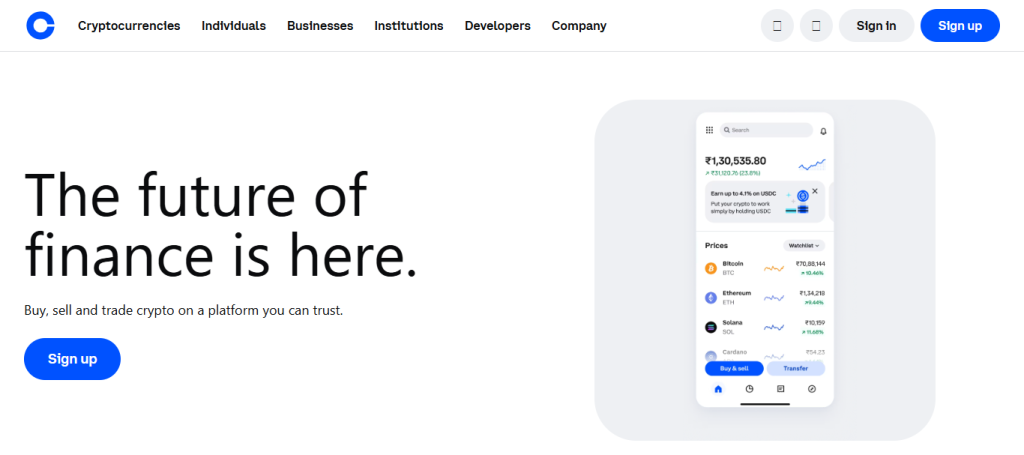
Fees vary depending on the platform and trading volume, with rates anywhere from 0.00% to 0.60%. Coinbase has established itself as a leading exchange with a focus on regulation, compliance, and security while being listed on the NASDAQ.
With an extensive network of regulators, Coinbase is a go-to exchange for retail and institutional investors looking for a curated digital asset platform.
Coinbase Features, Pros & Cons
| Features | Pros | Cons |
|---|---|---|
| Publicly traded company on NASDAQ | Strong regulatory compliance | Higher trading fees than many competitors |
| Supports 250+ cryptocurrencies | Beginner-friendly interface | Limited advanced trading tools on standard platform |
| Institutional-grade custody services | High security standards | Some services unavailable in certain regions |
| Staking and rewards programs | Trusted by institutions | Customer support can be slow during peak periods |
| Mobile and web trading platforms | Strong fiat on/off ramps | Advanced features require Coinbase Advanced |
2. Kraken
As an exchange founded in 2011, Kraken has cemented its place in history as one of the oldest cryptocurrency exchanges that is still operational.

Trading occurs across supported markets in more than 190 countries, with flexibility to engage in spot and futures trading, staking, and margin trading, as permitted in each jurisdiction. Fees for trading contracts typically start at 0.40% taker and 0.25% maker, with discounts for those that are high-volume.
Among the Best Crypto Exchanges Built to Survive Regulatory Shifts, Kraken is well-known for its robust security features and regulatory diligence, as well as its licensure across the globe.
Kraken Features, Pros & Cons
| Features | Pros | Cons |
| Spot, margin, and futures trading | Excellent security reputation | Interface may be complex for beginners |
| Proof-of-reserves transparency | Competitive fees | Limited payment methods in some countries |
| Staking services available | Supports many fiat currencies | Verification can take time |
| Advanced trading tools | Strong compliance framework | Fewer listed tokens than some competitors |
| Institutional trading solutions | Trusted global brand | Some features restricted by region |
3. Binance Global (Regulated Entities)
Binance is the largest cryptocurrency exchange in the world by trade volume. Established in 2017, Binance offers regional, regulated entities to comply with local laws, while servicing clients in over 100 countries.
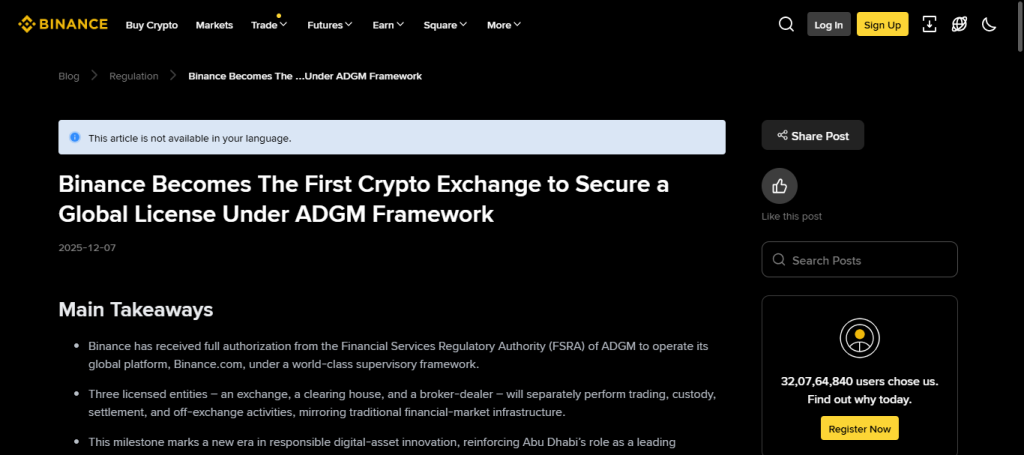
Binance has 0.10% spot trading fees to provide a competitive edge over potential rivals. Binance has made significant investments in partnerships with regulatory authorities,
licensing, KYC, and AML, as it is one of the Best Crypto Exchanges Built to Survive Regulatory Shifts. With hundreds of cryptocurrencies, Binance provides a varied and liquid trading environment with futures, staking, and Web3 services.
Binance Global (Regulated Entities) Features, Pros & Cons
| Features | Pros | Cons |
| Massive cryptocurrency selection | Very low trading fees | Regulatory restrictions in some countries |
| Spot, margin, futures, and options | Industry-leading liquidity | Platform can be overwhelming for beginners |
| Launchpad and Earn products | Advanced trading features | Availability varies by jurisdiction |
| Web3 wallet integration | Large ecosystem of services | Compliance requirements increasing |
| High-volume trading infrastructure | Extensive global reach | Certain products not available everywhere |
4. Gemini
Gemini was founded by the Winklevii in 2014, and is a highly secure and compliant exchange with a solid reputation. Gemini primarily serves dozens of countries and is expanding more internationally. The trading fees vary, however, ActiveTrader fees with Gemini are approximately 0.20% for maker and 0.40% for taker.
Gemini is one of the Best Crypto Exchanges Built to Survive Regulatory Shifts. Gemini’s extensive staking solutions, custody services, and crypto trading are very appealing for investors who are looking for a transparent and a highly regulated trading environment.
Gemini Features, Pros & Cons
| Features | Pros | Cons |
| Compliance-first exchange model | Strong regulatory standing | Higher fees compared to competitors |
| Institutional custody services | Excellent security practices | Smaller asset selection |
| ActiveTrader platform | Suitable for institutions | Limited advanced earning products |
| Insurance protections on select assets | Transparent operations | Lower trading volume than major rivals |
| Staking and recurring purchases | User-friendly interface | Fewer international markets served |
5. Bitstamp
With a launch date in 2011, Bitstamp is one of the longest-standing exchanges in the world. Available to customers in 100 different countries, Bitstamp offers a straightforward and reliable interface to access major cryptocurrencies.
Trading fees typically start at around 0.30% with lower fees associated with greater trading volume. Dedicating resources to the protection of customers and the transparency of operations, Bitstamp is listed among the Best Crypto Exchanges Built to Survive Regulatory Shifts.
With multiple licenses across a number of jurisdictions, Bitstamp is a trusted exchange for both retail and institutional investors wanting a protective and stable digital asset trading environment.
Bitstamp Features, Pros & Cons
| Features | Pros | Cons |
| One of the oldest crypto exchanges | Long-standing industry reputation | Fewer cryptocurrencies available |
| Strong regulatory compliance | Easy-to-use platform | Limited advanced trading features |
| Fiat deposit and withdrawal support | Reliable customer service | Smaller ecosystem than competitors |
| Institutional trading services | High trust among investors | Higher fees for low-volume traders |
| Mobile trading application | Secure infrastructure | Fewer staking opportunities |
6. OKX
Established in 2017, OKX has developed into a significant global exchange with over 100,000 users. OKX offers a wider range of services with spot and derivatives trading alongside lending, staking, and Web3 wallets.

OKX’s trading fees are on the lower end of the scale starting at 0.08% and 0.10% for the maker and taker fees, respectively.
OKX is also listed among the Best Crypto Exchanges Built to Survive Regulatory Shifts and is known for trading depth and variety of assets making it an exchange of choice for active users and traders.
OKX Features, Pros & Cons
| Features | Pros | Cons |
| Spot, futures, and options trading | Competitive trading fees | Not available in some regulated markets |
| Web3 wallet ecosystem | Strong liquidity | Complex for new users |
| Staking and DeFi integration | Wide range of products | Regulatory environment varies by region |
| Advanced charting tools | Large cryptocurrency selection | Some services may face restrictions |
| Automated trading strategies | Fast trading engine | Learning curve for beginners |
7. Bybit (Regulated Divisions)
Bybit was founded in 2018 and has quickly established itself as a global leader in cryptocurrency derivatives and spot trading. Bybit, which serves customers in multiple regions, is expanding its regulated operations in several jurisdictions. Spot trading generally costs 0.10% and is lower for Bybit’s VIP customers.
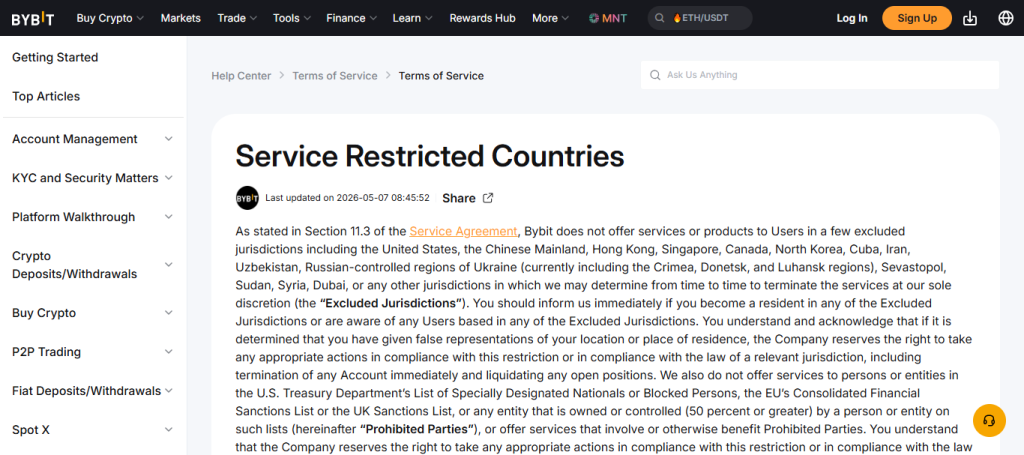
Bybit is one of the Best Crypto Exchanges Built to Survive Regulatory Shifts because they have updated their compliance structures, enhanced their KYC, and are actively pursuing licenses for their targeted markets.
Bybit has futures, copy, and stake trading; plus, an arsenal of sophisticated and professional trading tools, which brings a lot of attention to Buybit from experienced as well as novice traders.
Bybit (Regulated Divisions) Features, Pros & Cons
| Features | Pros | Cons |
| Spot and derivatives trading | Competitive fee structure | Limited availability in certain countries |
| Copy trading functionality | Strong liquidity | Regulatory changes may affect services |
| Trading bots and automation | User-friendly trading platform | Fewer fiat gateways than some rivals |
| Earn and staking products | Fast order execution | KYC requirements have expanded |
| Advanced risk management tools | Popular among active traders | Derivatives may not suit beginners |
8. Crypto.com Exchange
Since 2016, Crypto.com has emerged as an all-encompassing cryptocurrency ecosystem for its more than 90 million users. Crypto.com’s exchange features spot and derivative trading, staking, crypto cards, and payment services.
Trading generally costs 0.075%, and platform token holders receive additional discounts. Crypto.com is one of the Best Crypto Exchanges Built to Survive Regulatory Shifts because the company zealously attains worldwide approvals for operations, meets regulatory standards, and pursues compliance certifications.
Because Crypto.com prioritizes security, customer protection, and transparency, the all-encompassing nature of their financial products and services and the ease of use of the mobile app have propelled Crypto.com to the forefront of the cryptocurrency market.
Crypto.com Exchange Features, Pros & Cons
| Features | Pros | Cons |
| Complete crypto ecosystem | Wide range of services | Some products depend on CRO holdings |
| Crypto Visa cards | Strong regulatory focus | Fee structure can be complex |
| Spot and derivatives trading | Attractive rewards programs | Customer support response times vary |
| Staking and lending products | Mobile-friendly experience | Certain features restricted by country |
| NFT and payment solutions | Global brand recognition | Spread can be higher for some trades |
9. KuCoin (Compliance Upgrade)
Since it’s founding in 2017, KuCoin has quickly become one of the most popular ways for international customers to access digital currency. Global users can trade hundreds of assets with a starting trading fee of 0.1%, which can be reduced by holding KuCoin’s proprietary token.
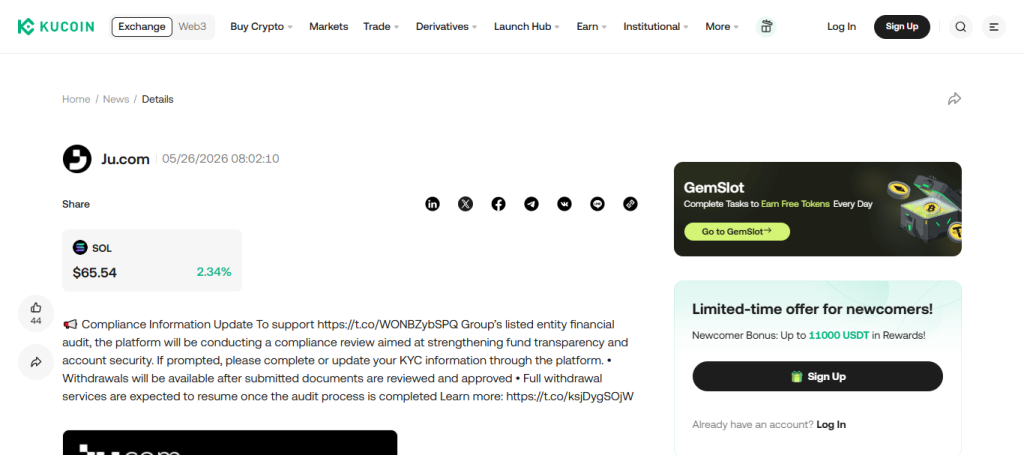
KuCoin is an example of a crypto exchange designed to adapt to future regulation. Recently, KuCoin has added infrastructure elements to support advanced KYC and greater consideration of cross-border regulations.
KuCoin started as a spot trading exchange, but has expanded its offerings to futures, margin trading, staking, and automated trading. The low trading fee structure in conjunction with a wide variety of assets draws many customers.
KuCoin (Compliance Upgrade) Features, Pros & Cons
| Features | Pros | Cons |
| Hundreds of listed cryptocurrencies | Large altcoin selection | Regulatory scrutiny in some markets |
| Spot, futures, and margin trading | Competitive fees | Mandatory KYC requirements introduced |
| Trading bots included | Strong passive income options | Limited availability in some countries |
| Staking and earning products | Frequent token listings | Less institutional presence |
| Native KCS token benefits | User-friendly trading tools | Compliance transition may affect users |
10. Huobi Global (HTX)
Coming to the industry in 2013, Huobi Global (now HTX) is one of the longest standing and most popular exchanges. Offering many digital assets, HTX has worldwide users.
Trading fees generally start at 0.20% and can be reduced by loyalty programs or holding the exchange’s token.
Being one of the Best Crypto Exchanges Built to Survive Regulatory Shifts, HTX has been adjusting and increasing their compliance and risk management procedures for changing regulations. HTX provides spot and derivative trading, staking, and wealth management services for retail and professional investors.
Huobi Global (HTX) Features, Pros & Cons
| Features | Pros | Cons |
| Spot and derivatives markets | Large selection of digital assets | Regulatory status varies by region |
| Wealth management products | Competitive trading fees | Less presence in Western markets |
| Staking and earning services | Strong liquidity for major assets | Complex platform for new traders |
| Advanced trading tools | Global customer base | Some services restricted geographically |
| HTX ecosystem integration | Multiple investment products | Regulatory uncertainty in certain jurisdictions |
Conclusion
With the continual global evolution of cryptocurrency regulation, selecting exchanges that emphasize compliance, security, and an adaptive approach to regulation has never been more critical.
The Best Crypto Exchanges Built to Survive Regulatory Shifts includes Coinbase, Kraken, Binance, Gemini, Bitstamp, OKX, Bybit, Crypto.com, KuCoin, and HTX.
All have built an impressive track record of being able to meet legal obligations while servicing customers worldwide. All of them have a strong focus on security coupled with licensing and transparency, as well as a focus on their customers and this has sustained their competitive advantage in the regulatory race.
Investors benefit from the risk reduction and the confidence offered from selecting the compliant exchange which enables more extensive and more sustained cryptocurrency trading and investing.
FAQ
What are crypto exchanges built to survive regulatory shifts?
These are cryptocurrency exchanges that prioritize compliance, licensing, security, and transparency. They actively adapt to changing regulations in different countries to continue operating legally and protect user assets.
Why is regulatory compliance important for crypto exchanges?
Regulatory compliance helps exchanges maintain legal operations, reduce the risk of shutdowns, enhance security standards, and provide better protection for customer funds and personal information.
Which crypto exchange is considered the most regulation-friendly?
Coinbase and Gemini are often regarded as highly regulation-friendly exchanges due to their strong compliance programs, regulatory licenses, and commitment to transparency in multiple jurisdictions.
Are regulated crypto exchanges safer than unregulated exchanges?
Generally, regulated exchanges offer greater security, stronger consumer protections, and better operational transparency. However, users should still follow good security practices such as enabling two-factor authentication.
Can I use Binance in all countries?
No. Binance availability varies by country. The exchange operates through different regulated entities and may offer different services depending on local laws and regulatory requirements.