


This article covers the best strategies on how to get yield when liquid staking in Lido Finance. I will share how to earn the best Ethereum staking rewards using DeFi.
- Key Point & Top Lido Finance Liquid Staking Yield Strategies
- 1. Balancer stETH Pools
- 2. Curve stETH Pools
- 3. Aave stETH Collateral
- 4. MakerDAO stETH Vaults
- 5. Yearn stETH Vaults
- 6. Rocket Pool + Lido Combo
- 7. Pendle stETH Yield Trading
- 8. EigenLayer Restaking with stETH
- 9. Liquidity Mining Campaigns
- 10. Cross‑Chain stETH Bridges
- Conclusion
- FAQ
I will teach you about staking liquidity pools, lending protocols, yield farming, restaking, and how to utilize stETH to take advantage of cross-chain opportunities.
I will inform you about the advantages, risks, and features of each of these techniques. Each of these strategies helps improve the income you can earn passively from DeFi.
Key Point & Top Lido Finance Liquid Staking Yield Strategies
| Strategy | Key Points |
|---|---|
| Balancer stETH Pools | Earn trading fees, provide deep ETH liquidity, supports boosted staking rewards, compatible with DeFi farming, flexible LP strategies |
| Curve stETH Pools | Low slippage swaps, stable liquidity incentives, CRV token rewards, widely used ETH staking pool, efficient stable asset trading |
| Aave stETH Collateral | Borrow against stETH holdings, maintain staking rewards while borrowing, supports leverage strategies, flexible lending options, strong DeFi integration |
| MakerDAO stETH Vaults | Mint DAI using stETH collateral, unlock liquidity without selling ETH, maintain staking exposure, useful for leveraged farming, decentralized borrowing system |
| Yearn stETH Vaults | Automated yield optimization, compounds staking rewards, reduces manual management, integrates multiple DeFi strategies, passive income focused |
| Rocket Pool + Lido Combo | Diversified liquid staking exposure, reduces platform dependency, combines rETH and stETH benefits, flexible staking allocation, improved risk distribution |
| Pendle stETH Yield Trading | Trade future staking yields, fixed or variable return options, advanced yield speculation, maximize APY opportunities, flexible yield tokenization |
| EigenLayer Restaking with stETH | Additional rewards through restaking, secure multiple protocols simultaneously, boosted ETH yield potential, supports shared security models, emerging DeFi innovation |
| Liquidity Mining Campaigns | Earn bonus governance tokens, temporary APY boosts, incentivized staking participation, extra farming rewards, short-term high-yield opportunities |
| Cross-Chain stETH Bridges | Move stETH across blockchains, access multi-chain DeFi yields, improved liquidity access, supports broader ecosystem participation, enables cross-chain farming strategies |
1. Balancer stETH Pools
Among the Top Liquid Staking Yield Strategies in Lido Finance, the Balancer stETH Pools resonate with users for their option to earn Ethereum staking rewards while providing liquidity. Users that deposit stETH and ETH in Balancer’s liquidity pools receive LP Tokens.
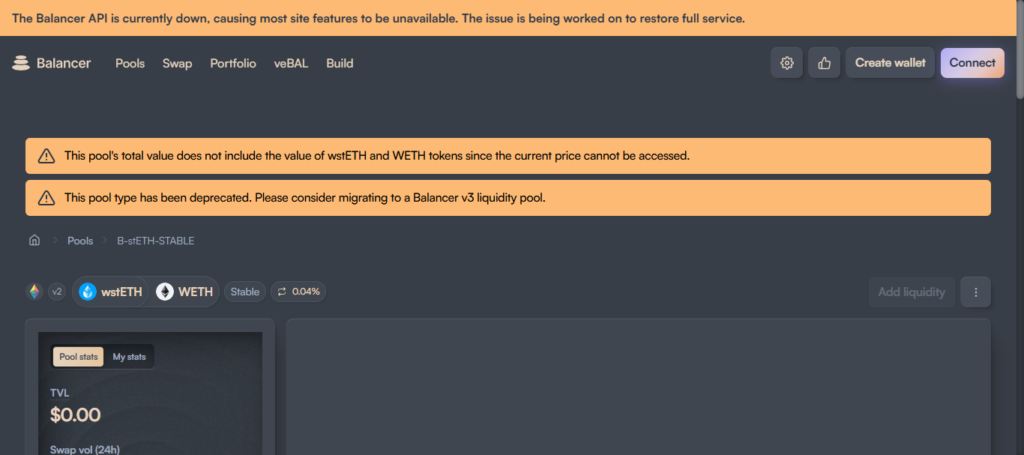
These pools earn money from swap fees, liquidity rewards, and governance tokens. For a user, Balancer’s customizable pool ratios augment capital efficiency. Of the liquid staking and DeFi farming strategies, this one has a highly sought facility of integrating flexible liquidity and lends itself to other DeFi solutions built on Ethereum.
Balancer stETH Pools
| Features | Pros | Cons |
|---|---|---|
| Multi-asset liquidity pools | Earn swap fees and staking rewards together | Impermanent loss risk |
| Flexible pool weighting | High capital efficiency | Requires DeFi knowledge |
| BAL token incentives | Additional farming rewards | Gas fees can be expensive |
| Deep Ethereum liquidity | Supports large trades | Rewards may fluctuate |
| Integration with DeFi apps | Easy portfolio diversification | Smart contract risks |
2. Curve stETH Pools
Among the Top Liquid Staking Yield Strategies in Lido Finance, the Curve stETH Pools are known for providing effective liquidity management for ETH and for their stability. Balancer focuses on low-slippage trading of like assets, making it the best option for liquid staking. Users are able to earn ETH staking yields, and also CRV token emissions and earnings from transaction fees.
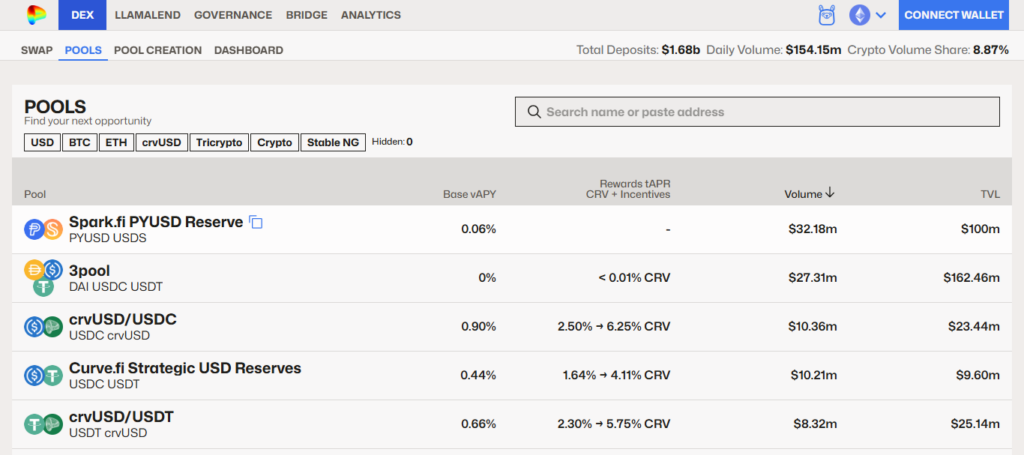
Curve’s deep liquidity pools are in high demand by those DeFi participants, both retail and institutional, who are looking for reliable passive returns.
Many yield farmers that employ Curve pools also employ Convex Finance in conjunction, for greater rewards and higher annual percentage yields. This strategy is founded in providing a far lower risk of impermanent loss when put next to other highly volatile liquidity pools.
Curve stETH Pools
| Features | Pros | Cons |
|---|---|---|
| Low-slippage stable swaps | Efficient ETH/stETH trading | Lower returns during low volume |
| CRV token rewards | Extra yield opportunities | Complex reward systems |
| Deep liquidity pools | Reduced trading impact | Depends on Curve ecosystem |
| Popular DeFi integration | Strong market adoption | Governance changes may affect rewards |
| Stable asset focus | Lower impermanent loss | APY can vary frequently |
3. Aave stETH Collateral
Aave stETH Collateral is one of the Top Lido Finance Liquid Staking Yield Strategies that allows DeFi users to borrow funds while earning passive staking rewards. By depositing stETH into Aave, users can obtain a loan for stablecoins or cryptocurrencies.
This method allows the user to retain their Ethereum staking collateral while also gaining the benefits of an active asset. DeFi traders typically borrow funds for leverage trading, yield farming, or diversifying their portfolios. In addition to staking collateral, Aave’s lending systems and smart contracts offer extreme transparency, and a high level of security.
This strategy is especially favored by advanced users that want to optimize the efficiency of their capital with exposure to Ethereum staking rewards, while also benefiting from the DeFi ecosystem.
Aave stETH Collateral
| Features | Pros | Cons |
|---|---|---|
| Borrow against stETH | Unlock liquidity without selling ETH | Liquidation risk |
| Decentralized lending | Flexible borrowing options | Interest rate fluctuations |
| Maintain staking rewards | Double utility for assets | Collateral monitoring required |
| Supports leverage strategies | Higher profit potential | Increased exposure to volatility |
| Multi-asset borrowing | Portfolio flexibility | Smart contract dependency |
4. MakerDAO stETH Vaults
MakerDAO stETH Vaults rank among the top Lido Finance Liquid Staking Yield Strategies. As a stETH holder, you can mint DAI stablecoins to access liquidity. This way, you can continue to earn staking rewards for Ethereum while also accessing liquidity.

This strategy is common among the DeFi classes for opportune access to capital for trading, farming and re-investment. MakerDAO also provides a borrowing system with multiple collateral and debt management options that are transparent and trustworthy.
However, users need to be cautious with changing markets and monitor their collateral ratios to avoid liquidation. MakerDAO Vaults are especially popular in leveraged yield farming strategies that incorporate various liquid stakings, stablecoin borrowing, and DeFi systems to achieve maximal outputs.
MakerDAO stETH Vaults
| Features | Pros | Cons |
|---|---|---|
| Mint DAI using stETH | Access stablecoin liquidity | Risk of liquidation |
| Decentralized borrowing | No need to sell stETH | Stability fees apply |
| Flexible collateral ratios | Capital efficiency | Requires active management |
| Ethereum staking exposure | Continue earning staking rewards | Market volatility risks |
| DeFi integration | Useful for leveraged farming | Complex for beginners |
5. Yearn stETH Vaults
Yearn stETH Vaults are automated in that they allow staked Ether yield optimization without user interference, placing them among the Top Lido Finance Liquid Staking Yield Strategies. Yearn Finance will automatically redeploy users’ staked Ether (stETH) to the highest yielding opportunities in the DeFi space. Users no longer have to deal with management and strategy changes.
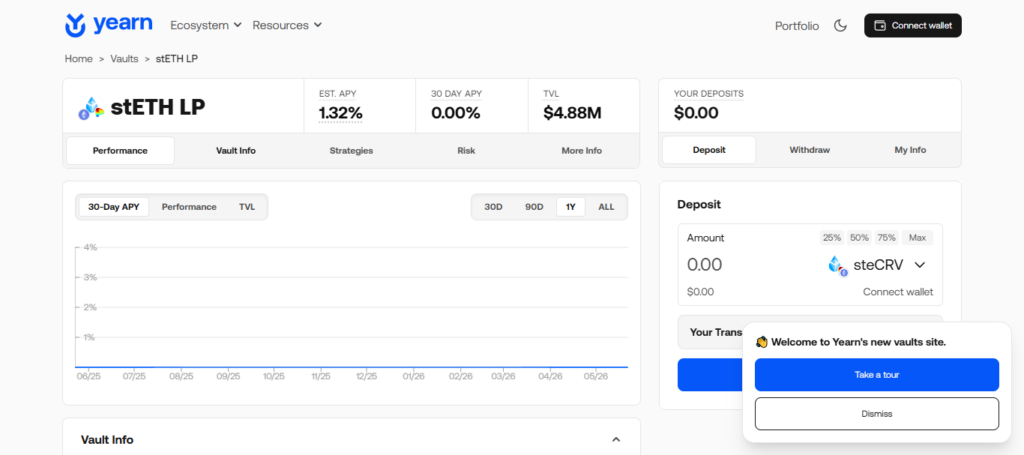
Users will enjoy the benefits of automated compounding, enhanced farming, and income generation, all while leaving their Ether stake untouched.
Yearn vaults have the ability to integrate with other major DeFi protocols such as Curve and Convex to improve the user’s annual percentage yield (APY) while minimizing time and complexity. This is the reason so many investors have adopted this Yield Farming strategy; it grants advanced DeFi exposure with Ethereum staking while saving the users time.
Yearn stETH Vaults
| Features | Pros | Cons |
|---|---|---|
| Automated yield strategies | Passive income generation | Vault fees may reduce profits |
| Auto-compounding rewards | Saves time and effort | Less user control |
| Integrates multiple protocols | Optimized APY opportunities | Strategy risks vary |
| Professional strategy management | Beginner-friendly automation | Smart contract exposure |
| Dynamic yield allocation | Improved capital efficiency | APY changes regularly |
6. Rocket Pool + Lido Combo
The Rocket Pool + Lido Combo among the Top Lido Finance Liquid Staking Yield Strategies has to be one of the best in DeFi for the diversification-focused investor. Investors are encouraged to stake their Ether with Lido for stETH and Rocket Pool for rETH to reduce concentration on one single staking provider.

This strategy helps to reduce the risk concentration of staking providers while still retaining liquid staking exposure across varied ecosystems. Users of rETH and stETH can engage in DeFi lending, liquidity farming, and yield aggregation all at once.
Combining liquid staking protocols will improve decentralization of the Ethereum network. Depending on the staking provider, the investor will also get other forms of rewards, take part in governance, and participate in other DeFi protocols.
Rocket Pool + Lido Combo
| Features | Pros | Cons |
|---|---|---|
| Diversified staking assets | Reduced protocol dependency | More complex management |
| Uses rETH and stETH | Better decentralization exposure | Multiple platform risks |
| DeFi compatibility | Flexible farming opportunities | Different reward structures |
| Portfolio diversification | Lower concentration risk | Requires active monitoring |
| Multi-platform rewards | Access to broader ecosystems | Bridging costs may apply |
7. Pendle stETH Yield Trading
Pendle stETH Yield Trading has tokenizes future staking yield making it one of the most sophisticated of all Lido Finance Liquid Staking Yield Strategies. Pendle separates the principal value of stETH from its future yield component allowing investors of all shapes and sizes to trade and speculate on staking returns.

Users can lock in a fixed return or opt for the higher and variable return as dictated by the flow of the market. This strategy especially attracts DeFi traders looking for a way to manage and optimize their yield further.
Pendle continues to support a host of the most sophisticated hedging and yield optimization strategies beyond the traditional staking systems. As the DeFi space grows Pendle is fast becoming a favorite amongst investors for increasing Ethereum liquid staking as well as gaining a competitive edge in the market.
Pendle stETH Yield Trading
| Features | Pros | Cons |
|---|---|---|
| Tokenized future yield | Trade staking rewards separately | Advanced strategy complexity |
| Fixed and variable yields | Flexible investment options | Higher volatility risk |
| Yield speculation tools | Potentially high returns | Not beginner-friendly |
| Advanced DeFi trading | Innovative market opportunities | Liquidity may vary |
| Hedging functionality | Better risk management | Complex pricing mechanics |
8. EigenLayer Restaking with stETH
EigenLayer Restaking with stETH is one of the most cutting edge of all of the Lido Finance Liquid Staking Yield Strategies in the Ethereum ecosystem. This strategy enables users to restake their stETH to secure additional decentralized services and protocols and earn more on top of their stETH.
Through the Ethereum layered security, investors can simultaneously earn from different protocols and services by staking the same and single asset. EigenLayer creates more yield opportunities without having to purchase more ETH.
While restaking creates more protocol risks and complex structures, many DeFi users consider that it is a major step forward in staking’s efficiency. Because it increases the Ethereum ecosystem more broadly while increasing the potential profit for participants in liquid staking.
EigenLayer Restaking with stETH
| Features | Pros | Cons |
|---|---|---|
| Restake stETH for extra rewards | Multiple income streams | Additional protocol risk |
| Shared security model | Increased ETH utility | Early-stage ecosystem |
| DeFi ecosystem expansion | Innovative staking opportunities | Complex mechanics |
| Extra validator rewards | Higher APY potential | Smart contract vulnerabilities |
| Supports decentralized services | Improved capital efficiency | Possible slashing exposure |
9. Liquidity Mining Campaigns
The highest reward strategy for active participants in DeFi at the moment is Liquidity Mining Campaigns, specifically at Lido Finance. To incentivize liquidity providers to use stETH pairs, many protocols use temporary APY offerings and bonus governance tokens.

Through these campaigns, stETH investors can receive various ecosystem rewards, farming rewards, and trading rewards in addition to the staking rewards. While these campaigns are present in most DeFi protocols, specifically at the decentralized exchanges, lending protocols, and yield farming protocols in the Ethereum and Layer 2 networks, they can be very appealing.
Users must be wary of impermanent loss and the dynamically changing reward structures, as these are very common in these campaigns. As a result of the changing nature of the DeFi space, many investors opt to use liquidity mining as a short-term strategy to maximize their profits.
Liquidity Mining Campaigns
| Features | Pros | Cons |
|---|---|---|
| Bonus governance token rewards | High temporary APY | Rewards may decline quickly |
| Incentivized liquidity programs | Extra passive income | Impermanent loss risk |
| Short-term farming opportunities | Rapid earning potential | High competition |
| Multi-platform campaigns | Diverse yield options | Constant monitoring needed |
| Community participation rewards | Additional ecosystem benefits | Market volatility affects profits |
10. Cross‑Chain stETH Bridges
Among Lido’s Liquid Staking Yield Strategies, Cross-Chain stETH Bridges are becoming increasingly crucial as more blockchains implement staking. By utilizing these bridges, traders can transfer their stETH to Layer-2 networks and other blockchains outside of Ethereum to take advantage of lower trading fees and faster transaction times.
For those looking to cross the boundaries of Ethereum’s staking by creating cross-chain farming, cross-chain lending, and cross-chain liquidity mining, this strategy is ideal.
With incentives for creating and supplying liquidity for stETH on popular blockchains, cross-chain bridges can also be used to create yield on many blockchains at the same time. Many sophisticated DeFi users have a diverse strategy utilizing cross-chain bridges to maximize their returns to the fullest.
Cross-Chain stETH Bridges
| Features | Pros | Cons |
|---|---|---|
| Transfer stETH across chains | Access multi-chain DeFi | Bridge security risks |
| Lower transaction costs | Reduced gas fees | Possible bridge delays |
| Layer-2 integration | Faster transactions | Cross-chain complexity |
| Multi-network yield farming | Broader earning opportunities | Liquidity fragmentation |
| Expands DeFi accessibility | Ecosystem diversification | Smart contract vulnerabilities |
Conclusion
Top Lido Finance’s Liquid Staking Yield Strategies are meant to optimize Ethereum staking rewards within the framework of decentralized finance offerings. Each of the several strategies available integrates various components of the DeFi ecosystem and can be used for passive income generation.
The liquidity and flexibility available through the combination of Balancer and Curve liquidity pools, Pendle yield trading, and Pendle yield trading and EigenLayer restaking, allow for relatively quick assimilation of liquidity staking rewards and lending and borrowing, farming and cross-chain activities that are available through the DeFi ecosystem.
Each of the aforementioned staking strategies carries smart contract risk, market risk, and the risk of losing funds due to an unsecure operating platform. Strategies need to be selected based on personal risk, investment goals, and the level of sophistication in DeFi of the user.
FAQ
What are Lido Finance Liquid Staking Yield Strategies?
Lido Finance Liquid Staking Yield Strategies are DeFi methods that help users earn Ethereum staking rewards while keeping their assets liquid through stETH. These strategies include lending, liquidity farming, restaking, and yield optimization across multiple decentralized finance platforms.
What is stETH in Lido Finance?
stETH is a liquid staking token issued by Lido Finance when users stake Ethereum. It represents staked ETH plus accumulated staking rewards while remaining tradable and usable in DeFi applications.
Are Lido liquid staking strategies profitable?
Yes, many Top Lido Finance Liquid Staking Yield Strategies can generate additional returns through staking rewards, liquidity mining incentives, lending interest, and DeFi farming opportunities. However, profits depend on market conditions and platform performance.
What are the risks of using stETH strategies?
The main risks include smart contract vulnerabilities, liquidation risks in lending protocols, impermanent loss in liquidity pools, market volatility, and possible depegging between ETH and stETH prices.


