




This article describes the Best MiCA-Compliant European Crypto Exchanges. These exchanges represent the best crypto trading services currently offered in Europe which are in accordance with today’s cryptocurrency trading standards and regulations.
We will examine their licenses, trading options, supported security features, chosen compliance frameworks, applicable fees, and the most appropriate audiences for their offerings. This analysis is intended to allow users to select top quality cryptocurrency trading services in the quickly developing European digital asset markets.
What Makes a Crypto Exchange MiCA-Compliant?
A MiCA compliant crypto exchange is a cryptocurrency exchange that complies with all the standards of the MiCA framework.
To gain proper authorization as a Crypto-Asset Service Provider (CASP), compliance with regulations and the maintenance of effective Anti-Money Laundering (AML) and Know Your Customer (KYC) programs, secure customer assets through adequate custody solutions, and disclose to users crucial information such as fees, risks, and supported digital assets.
MiCA compliance also requires exchanges to implement robust governance, cybersecurity, market abuse prevention, and operational risk management practices.
Compliant stablecoin platforms are required to enforce reserve policies that align with the requirements of the EU for stability, transparency, and accountability of the stablecoin issuers.
The regulations promote the interests of European users trading crypto and institutional investors by enhancing the safety and transparency of the crypto trading environment.
Why Choose MiCA-Compliant European Crypto Exchanges
Strong Regulatory Protection
MiCA-compliant exchanges grant users better legal protections and more transparent operations as a result of the European regulatory framework requiring authorization as Crypto-Asset Service Providers (CASPs).
Better Security Measures
Crypto asset service providers are required to uphold specific cybersecurity, custody, and risk management standards. They are obligated to implement measures to minimize trading risks such as secure wallets, transaction monitoring, protective orders, etc.
Improved Transparency and Trust
MiCA aims to increase client confidence by mandating that exchanges make trading conditions, fees, and risks associated with digital assets clear.
Safety Enhancements for Client Assets
Satisfying MiCA regulations means exchanges must treat client assets in a safe manner and clearly outline potential risks.
Expanded Service Offerings Throughout Europe
As a result of MiCA, crypto asset service providers can provide their services under a harmonized regulatory framework across Europe.
Regulated Stablecoin Provision
MiCA provides the regulatory framework for stablecoins warranting sufficient reserves and creating transparency.
Pro Trading Features
In order to cater to the needs of professional clientele, trading features and services offered can include advanced orders, trading tools, liquidity, OTC, order books, as well as custody.
Lower Regulatory Risk
Using a regulated exchange mitigates the risk of sudden service disruptions, unclear business practices, and compliance issues as experienced by users of offshore or unlicensed platforms.
Key Point & Best MiCA-Compliant European Crypto Exchanges
| Exchange | Regulator | Best For | Key Features |
|---|---|---|---|
| Kraken | Central Bank of Ireland | Best overall | Trading‑venue license, 600+ assets, free SEPA Instant |
| Coinbase EU | CSSF Luxembourg | Beginners | Transparent fees, fiat ramps, 300+ assets |
| Bitstamp | CSSF Luxembourg | Established users | Oldest EU exchange, strong EUR liquidity |
| OKX EU | MFSA Malta | Altcoin traders | 350+ assets, regulated perps, low fees |
| Bitpanda | BaFin Germany + FMA Austria | Multi‑asset investors | Crypto + stocks, strong DACH presence |
| Bybit EU | FMA Austria | Low‑cost spot trading | 600+ assets, 0.10% fees |
| Gate EU | MFSA Malta | Token diversity | 1,000+ assets, wide selection |
| Crypto.com EU | MFSA Malta | Ecosystem users | Visa debit card, staking |
| Bitvavo | AFM Netherlands | Low‑fee traders | 200+ assets, simple UX |
| Nexo EU | Bulgarian regulator (MiCA CASP) | Lending + trading | Crypto loans + exchange |
1. Kraken
Founded in 2011, Kraken has never been hacked, establishing its security and credibility as one of the oldest exchanges. Spot trading fees are 0.16% for makers and 0.26% for takers, with possible reductions for higher volume trading.
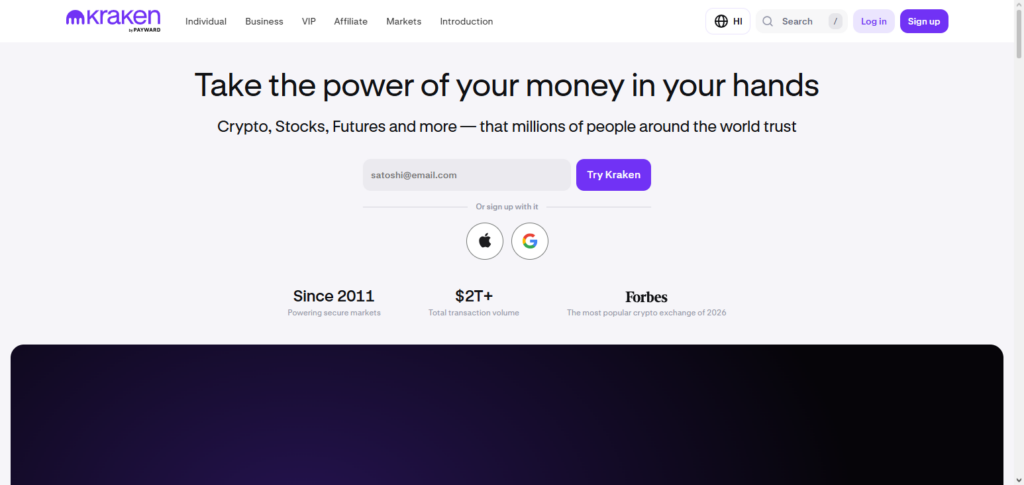
Kraken has a wide variety of crypto with over 250 assets, and offers staking with competitive yields for 60+ assets. Liquidity is noteworthy on BTC/EUR and ETH/EUR pairs.
Proof of reserves audits and 250 million insurance coverage create confidence in the platform. Its design is better for intermediate level traders when compared to Coinbase.
Kraken Features
- Established in 2011, US HQ with Irish EU operations.
- MiCA compliant with good regulatory coverage.
- Trading fees: 0.16% maker/0.26% taker.
- Trade over 250 cryptocurrencies.
- Offers high liquidity in these EUR pairs (BTC/EUR, ETH/EUR).
- Security: proof-of-reserves, insurance, cold storage.
- Institutional trading focus.
| Pros | Cons |
|---|---|
| Oldest, most secure EU exchange (founded 2011) | Interface less beginner-friendly |
| Strong liquidity in BTC/EUR & ETH/EUR | Fees slightly higher than Bitvavo |
| Proof-of-reserves & insurance coverage | Limited altcoin selection compared to Gate EU |
| Institutional-grade trust | Complex for casual users |
2. Coinbase EU
Founded in 2012, and operating under MiCA authorization of Luxembourg and Ireland, spot trading fees on Coinbase are 0.40% for makers and 0.60% for takers. However, trading fees can be eliminated with Coinbase One.
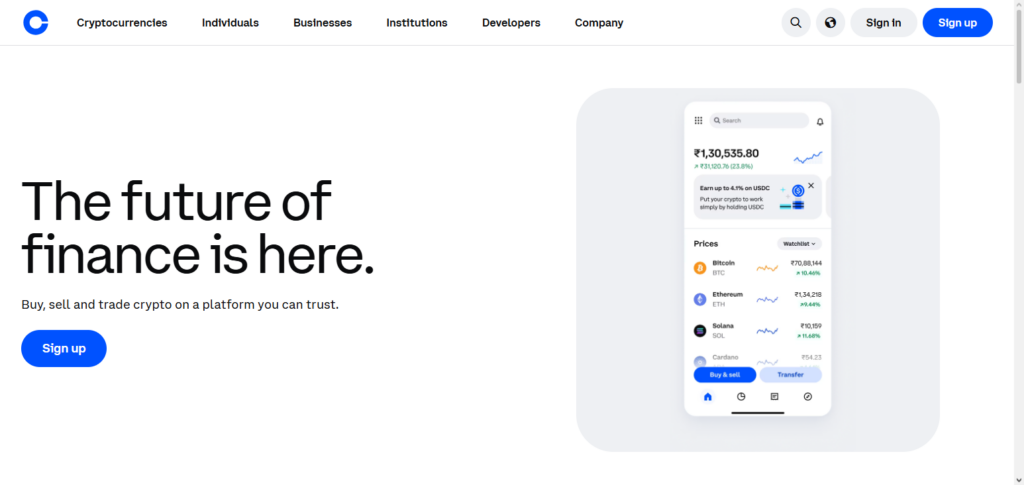
With a total trading pair number greater than 300 and a focus on the larger crypto market, Coinbase EU offers staking. Because of the global spread of Coinbase, liquidity is good, and while there is some coverage for alternative coins, it is less than Gate.io.
The design of the app is simple, and with great compliance, it is a good platform as a retail investor, though the design and fees aren’t great for active traders.
Coinbase EU Features
- Established in 2012, HQ in Ireland/Luxembourg.
- MiCA compliant with strong consumer protection.
- Trading fees: 0.40% maker/0.60% taker.
- Trade over 300 assets.
- High liquidity due to a large global user base.
- Security: cold storage, vaults, insurance.
- Focused on beginner trading.
| Pros | Cons |
|---|---|
| Beginner-friendly app & UX | Higher fees (0.40%–0.60%) |
| Strong compliance & regulation | Limited advanced trading tools |
| Supports 300+ assets | Narrower altcoin coverage |
| High liquidity from global base | Expensive for active traders |
3. Bitstamp
Founded in 2011 and headquartered in Luxembourg, Bitstamp is fully MiCA compliant under CSSF and is Europe’s oldest exchange.
Spot fees are 0.30% taker and 0.10% maker at launch, and decline to 0.06% taker and 0.16% maker for frequent traders. The exchange facilitates trading on 80–100 cryptocurrencies, biasing towards significant assets rather than micro-cap altcoins.
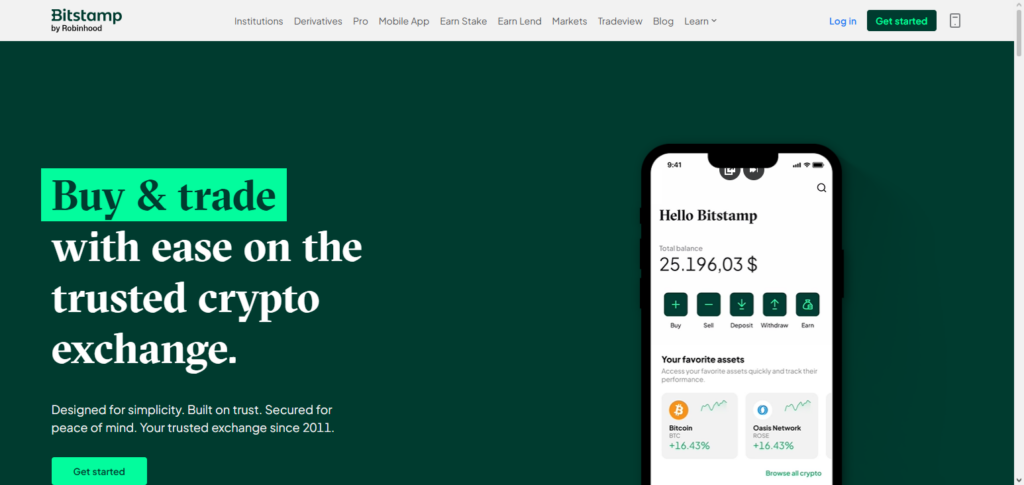
It is a preferred platform for most institutional traders due to strong liquidity on the EUR pairs. Security features are a combination of 95% cold storage, SOC 2 audits and multi-signature wallets.
It is a conservative trading platform focused on regulations, and while it is reliable, Bitstamp does not offer futures or margin trading.
Bitstamp Features
- Established in 2011, Luxembourg HQ.
- MiCA compliant with CSSF.
- Trading fees: 0.10% maker/0.30% taker.
- Trade 80-100 major cryptocurrencies.
- Excellent liquidity in EUR, trusted by institutions.
- Security: SOC 2 audits, cold storage.
- Best for cautious traders.
| Pros | Cons |
|---|---|
| Oldest EU exchange (2011) | Limited crypto selection (~100) |
| Strong EUR liquidity | No futures or margin trading |
| SOC 2 audits & cold storage | Conservative product range |
| Trusted by institutions | Less innovation vs competitors |
4. OKX EU
The first MIca licensed exchange from Malta, OKX offers trading at 0.08% maker and 0.10% taker fees for spot markets. Founded in 2017, it now services over 400 cryptocurrencies with deep liquidity and ranks among the top three exchanges in the world.
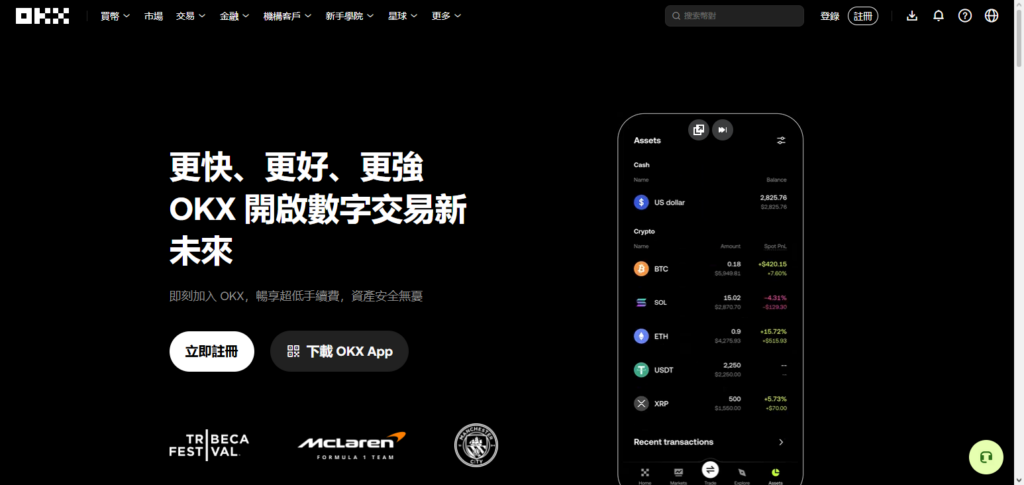
OKX also offers futures trading at fees of 0.02% for the maker and 0.05% for the taker. It is also known for a Web3 wallet for DeFi and NFTs. Liquidity is great for BTC and ETH. Monthly proof-of-reserves audits and segregated accounts improve trust of users. Due to the complexity of the platform, it is more suited for advanced traders.
OKX EU Features
- Established in 2017, licensed in Malta.
- MiCA compliant with advanced trading facilities.
- Trading fees: 0.08% maker/0.10% taker.
- Trade 400+ assets.
- Outstanding liquidity, ranked in the top three globally.
- Security: proof-of-reserves, segregated accounts.
- Best for depth oriented advanced traders.
| Pros | Cons |
|---|---|
| Low fees (0.08%–0.10%) | Dense interface for beginners |
| 400+ supported assets | EU entity excludes derivatives |
| Excellent liquidity globally | Complex for casual traders |
| Proof-of-reserves audits | Advanced tools may overwhelm new users |
5. Bitpanda
Founded in 2014, Bitpanda offers a number of services from trading of cryptocurrencies, stocks, ETFs, metals, and even more, and is partnered with Austria’s FMA, Germany’s BaFin, and Malta’s MFSA under MiCA.
Bitpanda charges 1.49% per trade of cryptocurrencies traded, however, trading on Bitpanda Pro costs 0.05%/0.10%. Bitpanda trades over 400 assets with great liquidity of trades in its 7.4M users across Europe. MiFID II and 2FA compliance along with cold storage helps users.
Bitpanda Features
- Established in 2014, Vienna HQ.
- MiCA compliant of Austria & Germany.
- Trading fees: 1.49% Retail/ 0.05% Pro.
- Trade 400+ assets including stocks & ETFs.
- Strong liquidity with 7M+ users.
- Security: Cold storage, MiFID II compliance.
- Best suited for beginners to multi-asset investing.
| Pros | Cons |
|---|---|
| Multi-asset platform (crypto, stocks, ETFs) | Retail fees high (1.49%) |
| Beginner-friendly app | Altcoin coverage smaller than Gate EU |
| Strong EUR liquidity | Pro version needed for low fees |
| MiFID II compliance | Less suited for high-frequency traders |
6. Bybit EU
Since 2018, Bybit EU GmbH has run as a MiCA compliant exchange under Austria’s FMA. Bybit has competitive spot fees of 0.10% maker/taker which draws retail traders to the platform.
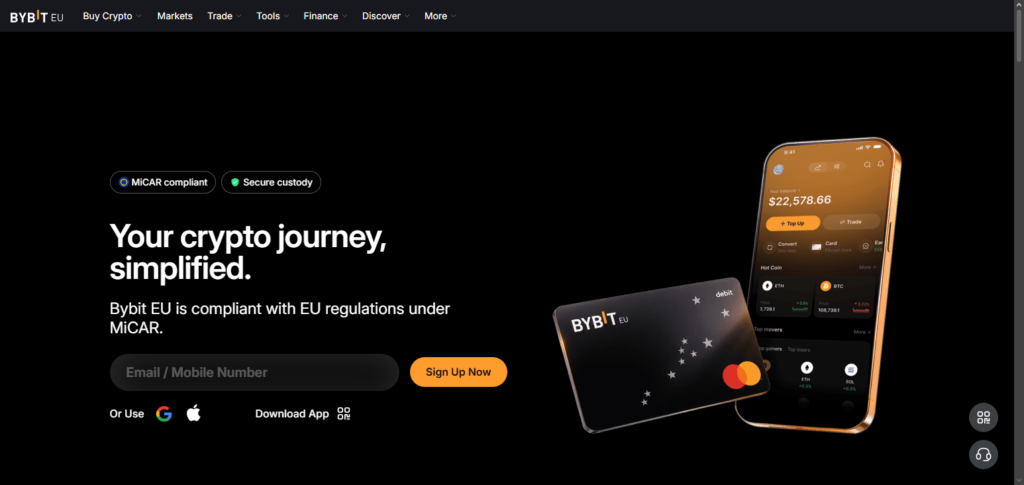
Bybit sports over 80 cryptocurrencies with staking and margin trading, but EU futures are currently unavailable. Bybit sees billions of dollars in daily trades, making them one of the most liquid options globally, though EU users are limited to spot and margin trading.
Bybit uses segregated custody, has 2FA, and anti-phishing features as part of their trading security. Bybit EU has an easy to use interface and offers Earn products and a debit card, but has no derivatives for EU users.
Bybit EU Features
- Founded in 2018, registered in Austria.
- MiCA compliant under the FMA.
- Spot trading fees: 0.10% for maker and taker.
- Supports 80+ cryptocurrencies.
- Good global liquidity, limited EU futures trading.
- Security: 2FA, segregated custody.
- Best suited for Spot and Margin trading.
| Pros | Cons |
|---|---|
| Competitive fees (0.10%) | EU entity excludes futures |
| Strong global liquidity | Smaller asset list (~80) |
| User-friendly interface | Limited advanced trading options |
| Earn products & debit card | Less institutional trust vs Kraken |
7. Gate EU
Since the 2013 rebranding of Gate.io to Gate, the exchange has operated with a MiCA license from Malta. Spot fees are 0.10% maker/taker, with a discount for using GT tokens.
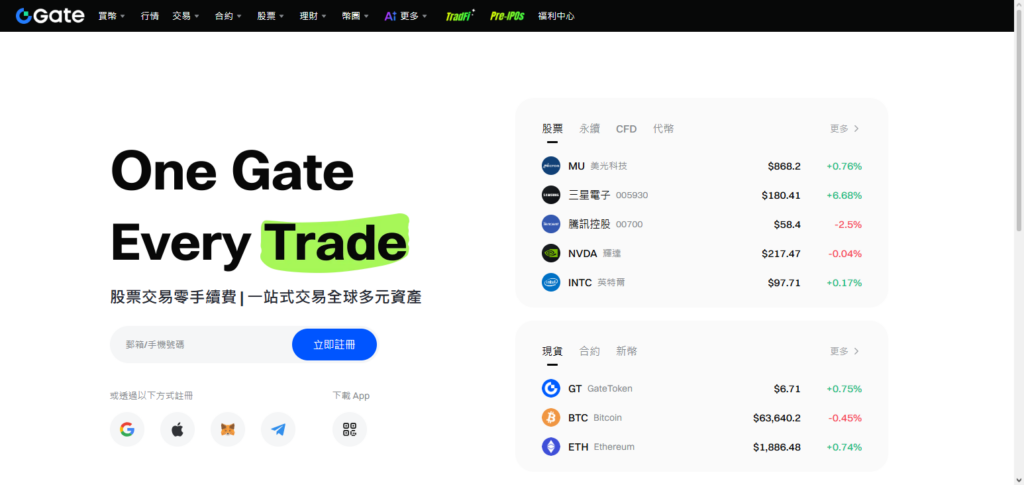
Gate has over 2,000 cryptocurrencies which draws traders as the exchange with the most altcoins among major exchanges. Liquidity is good on major pairs, but of course, is poorer on micro-cap assets.
Gate’s security features include proof-of-reserves, cold storage, and 2FA. Gate EU has 269 spot pairs within the bounds of their regulated entity, but futures are also excluded from the EU version. Gate is best for traders looking for a high variety of available coins under MiCA compliance.
Gate EU Features
- Founded in 2013, licensed in Malta.
- MiCA compliant.
- Spot trading fees: 0.10% for maker and taker.
- Supports 2,000+ cryptocurrencies.
- Good liquidity for major currencies, limited for micro-caps.
- Security: cold storage, proof-of-reserves.
- Best suited for altcoin trading.
| Pros | Cons |
|---|---|
| Largest asset coverage (2,000+) | Liquidity thinner on micro-caps |
| Competitive fees (0.10%) | EU entity excludes futures |
| Proof-of-reserves & cold storage | Complex for beginners |
| Best for altcoin hunters | Riskier small-cap trading |
8. Crypto.com EU
Since 2016, Crypto.com has operated under MiCA via Malta and France. The spot fees are 0.25% maker and 0.50% taker, but trading with CRO tokens has fees as low as 0% maker. Crypto.com has over 200 cryptocurrencies with staking yields of up to 10% APY. With a trading volume of $1.5B and a user base of.
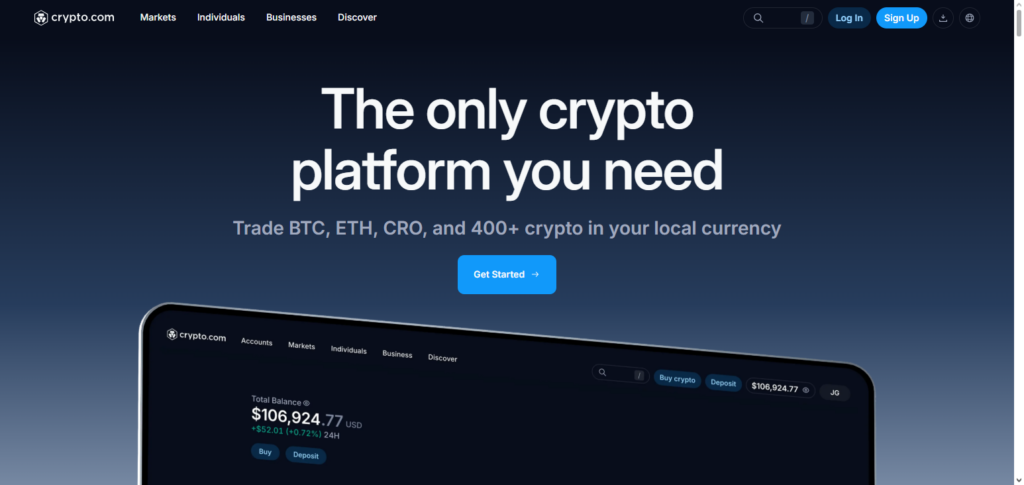
Security features include segregated accounts, proof-of-reserves, and EU client protection of €20,000. Despite restrictions on derivatives in the EU, their card and app infrastructure are excellent for routine crypto transactions.
Crypto.com EU Features
- Founded in 2016, licensed in Malta and France.
- MiCA compliant.
- Spot trading fees: 0.25% for makers and 0.50% for takers.
- Supports 200+ cryptocurrencies.
- Strong liquidity with more than 50 million users.
- Security: proof-of-reserves, segregated accounts.
- Best suited for convenient daily crypto use and offers Visa card.
| Pros | Cons |
|---|---|
| Visa card with cashback | Higher fees (0.25%–0.50%) |
| Supports 200+ assets | Limited EU derivatives |
| Strong liquidity (50M+ users) | CRO staking required for best rates |
| Proof-of-reserves & insurance | Ecosystem tied to CRO token |
9. Bitvavo
Bitvavo was established in 2018 and is Amsterdam’s EUR spot exchange with AFM’s MiCA licensing, now, the largest in Europe. With fees of 0.03%–0.25%, it also has the lowest fees. With over 390 cryptocurrencies available, its trading pairs are EUR dominated. Retail liquidity is excellent with over 4M users.
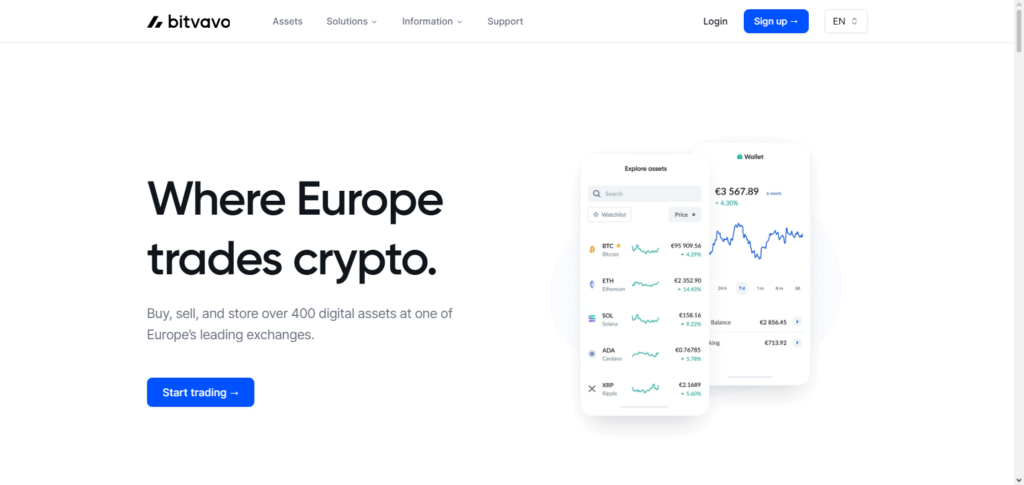
Security features include cold storage of 98%, Coinbase/Copper custody and account insurance of €100K. With no futures or leverage, it is also friendly for beginners. Its SEPA deposit, which is free and ultra-low fees, also add great value for EU traders.
Bitvavo Features
- Founded in 2018, located in Amsterdam.
- MiCA compliant.
- Spot trading fees: 0.03% to 0.25%, the lowest in the EU.
- Supports 390+ cryptocurrencies.
- Strong EUR liquidity and more than 4 million users.
- Security: insurance, 98% cold storage.
- Best suited for efficient EUR spot trading.
| Pros | Cons |
|---|---|
| Lowest fees (0.03%–0.25%) | No futures or leverage |
| Supports 390+ assets | Limited advanced tools |
| Strong EUR liquidity | Focused mainly on spot trading |
| Beginner-friendly & insured | Less global reach vs Kraken/OKX |
10. Nexo EU
Nexo was launched in 2018 and operates as a digital assets platform with exchange, lending, and yield products, is licensed under MiCA via Germany’s BaFin. This is in partnership with Tangany for custody and DLT Finance for brokerage.
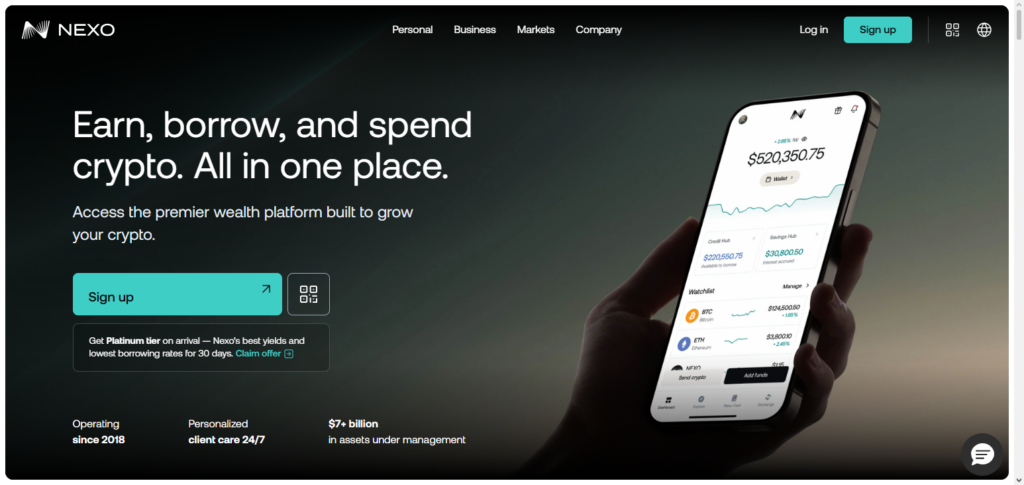
Its fees for spot trading are pleasant, and its lending and earn products yield up to 12% of assets, with over 50 cryptocurrencies available, primarily BTC and ETH, as well as stablecoins.
While lending liquidity is strong, it is moderate in comparison to Kraken or Coinbase. Security is comprised of segregated accounts, institutional custody, and MiFID II compliance. For borrowing and yield services, Nexo is optimal.
Nexo EU Features
- Founded in 2018, regulated in Germany.
- MiCA compliant.
- Competitive spot trading fees with lending integrated.
- Supports 50+ cryptocurrencies.
- Good liquidity with lending.
- Security: MiFID II compliance, institutional custody.
- Best suited for lending and yield services.
| Pros | Cons |
|---|---|
| Integrated lending & yield services | Smaller asset list (~50) |
| Competitive spot & earn products | Moderate liquidity vs Kraken |
| Institutional custody & compliance | Less suited for active traders |
| Best for borrowing & passive income | Limited trading depth |
Conclusion
The European crypto ecosystem is cracking under MiCA regulation, and is now secure, and allows for easy trading. Institutional-grade liquidity and strong compliance attract institutional clients to Coinbase EU and Kraken, the leader of the veteran pack that is Bitstamp.
Other traders may consider OKX EU and Gate EU, as these exchanges offer low fees and offer a large selection of assets. Bitpanda and Bitvavo offer simple user interfaces and low fees for EUR trading.
Bybit EU and Crypto.com EU add debit cards to their offerings, while Bitvavo incorporates earning features and draws inspiration from Bybit EU for their product offering. Other exchanges like Nexo EU have followed the trend and added lending as well as earning and yield features.
FAQ
What is MiCA compliance?
MiCA (Markets in Crypto-Assets Regulation) is the EU’s framework ensuring crypto exchanges meet strict standards for transparency, consumer protection, and financial stability.
Which exchanges are MiCA-compliant?
Top platforms include Kraken, Coinbase EU, Bitstamp, OKX EU, Bitpanda, Bybit EU, Gate EU, Crypto.com EU, Bitvavo, and Nexo EU.
Which exchange has the lowest fees?
Bitvavo offers fees as low as 0.03%, while OKX EU charges 0.08% maker / 0.10% taker, making them cost leaders.
Which exchange has the best liquidity?
Kraken and OKX EU dominate in liquidity, especially for BTC/EUR and ETH/EUR pairs, ensuring minimal slippage for large trades.