



In this article, I will talk about the Top Web3 Node Infrastructure Platforms for developers, Web3 projects and enterprises. We’ll compare their RPC and node infrastructure, APIs, pricing, performance, scalability, data services and developer tools, as well as their blockchain support. This manual will walk you through the key differences between the top platforms and help you select the appropriate infrastructure for various Web3 application requirements.
What Is Web3 Node Infrastructure Platforms?
Web3 node infrastructure platforms are managed services that provide the underlying blockchain connectivity that decentralized applications, wallets, exchanges, protocols and Web3 businesses need.
Instead of running and maintaining blockchain nodes themselves, developers are able to leverage these platforms for RPC endpoints, full nodes, archive nodes, APIs, indexing, real-time data, and transaction access. Many providers also support multiple blockchain networks and provide scalable infrastructure, monitoring, routing and security features.
Depending on the platform, services may also include staking, validator management, Web3 data APIs, dedicated nodes, and enterprise infrastructure. These services help teams build and operate blockchain applications without managing the entire node stack themselves.
Key Points
| Platform | Founded | Blockchain Support | Pricing Model | Node & RPC Infrastructure | API & Data Services | Performance & Scalability | Best Use Case |
|---|---|---|---|---|---|---|---|
| Moralis | 2020 | EVM chains, Solana and other major networks | Subscription + usage-based | RPC Nodes, archive data, managed infrastructure | Wallet, Token, NFT, DeFi, Price, Streams APIs | Scalable RPC and API infrastructure | dApps, Web3 data apps, wallets |
| InfStones | 2018 | Multiple EVM and non-EVM networks | Usage/infrastructure-based | Managed nodes, validators, RPC infrastructure | Blockchain APIs and node access | Managed and scalable enterprise infrastructure | Institutions, protocols, staking |
| Tatum | 2018 | 100+ blockchain networks | Free tier + paid subscription/usage | Full nodes, archive nodes, RPC, intelligent routing | Data APIs, Webhooks, Smart Wallets | Load balancing, caching, failover, high throughput | Multichain dApps and fintech |
| GetBlock | 2019 | 130+ blockchain networks | Free tier + Compute Units + dedicated plans | Shared, dedicated, archive nodes and RPC | RPC APIs, WebSockets, developer tools | Geo-routing, dedicated capacity, scalable RPS | dApps, wallets, exchanges |
| Validation Cloud | 2019 | 50+ networks across major ecosystems | Free tier + usage-based | Managed Node API and infrastructure | Node APIs, staking and Web3 data | Global routing and high-throughput infrastructure | Enterprise Web3 and staking |
| Figment | 2018 | Major Proof-of-Stake networks | Institutional/custom pricing | Managed validators and staking infrastructure | Staking APIs, Rewards API, reporting | Enterprise validator operations and monitoring | Institutions and asset managers |
| RockX | 2019 | 20+ EVM and non-EVM networks | Per-request + custom dedicated pricing | AccessNode, full nodes, archive nodes | RPC access and infrastructure APIs | Geo-routing, caching, hybrid-cloud failover | Institutional Web3 infrastructure |
| PoktScan Gateway / POKT.ai | 2020* | 50+ blockchain networks | Per-million-request pricing | Full-node and archive RPC | RPC gateway, analytics, endpoint management | Decentralized RPC infrastructure | Multichain RPC and AI-agent access |
| Infura | 2016 | Major EVM and Web3 networks | Free tier + paid plans | Managed RPC and node infrastructure | Blockchain APIs, archive data, developer APIs | Scalable managed RPC infrastructure | dApps and Web3 developers |
| Blockdaemon | 2017 | 70+ networks | Free access + usage/enterprise pricing | RPC, dedicated nodes and managed infrastructure | Data, RPC, staking and transaction APIs | Auto-scaling, enterprise infrastructure | Institutional and enterprise Web3 |
1. Moralis
Moralis makes it easy for developers to access Web3 APIs, RPC and structured on-chain data. Launched in 2020, it supports networks like Ethereum, Solana, Base, Polygon, BNB Chain, Avalanche, Arbitrum, Optimism and more. It currently has Starter at $149/mo and Pro at $249/mo when billed annually, with higher enterprise capacity available.
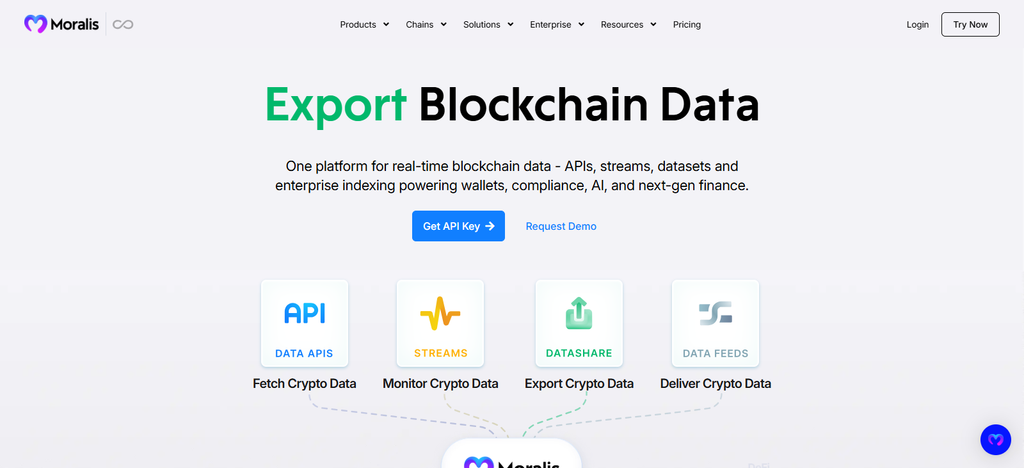
Moralis provides RPC Nodes, full archive data, Wallet, Token, NFT, Price, Defi and Streams APIs with throughput scaling on plans. This infrastructure is ideal for dApps, wallets, analytics platforms, and use cases requiring RPC connectivity and structured blockchain data.
Moralis Features
- Web3 Data APIs: Wallet, Token, NFT, Defi, Price, Blockchain APIs
- Multi-Chain RPC Nodes: Offers RPC access to major EVM and selected non-EVM networks.
- Extended RPC Methods: Better methods for token balances, transaction history, token prices, and decoded transactions.
- Real-Time Streams: Delivers blockchain events through real time webhook based data delivery.
- Performance & Security. Scalable infrastructure with advertized response times of 70 ms, 99.9% uptime and SOC 2 Type II certification.
| Pros | Cons |
|---|---|
| Broad Web3 API and RPC infrastructure | Paid plans can become costly for high-volume workloads |
| Provides structured wallet, token, NFT, DeFi, and blockchain data | Compute Unit pricing requires usage monitoring |
| Supports archive data and multiple RPC nodes | Some advanced capabilities are tied to higher plans |
| Business plan supports high API throughput | Better suited to data-rich applications than basic RPC-only needs |
| Enterprise plans provide custom throughput and support | Enterprise pricing is not publicly listed |
2. InfStones
InfStones provides managed blockchain infrastructure with a focus on node deployment, staking, RPC access and blockchain development infrastructure. The platform, founded in 2018, offers support for a wide variety of blockchain networks within the EVM and non-EVM ecosystems.
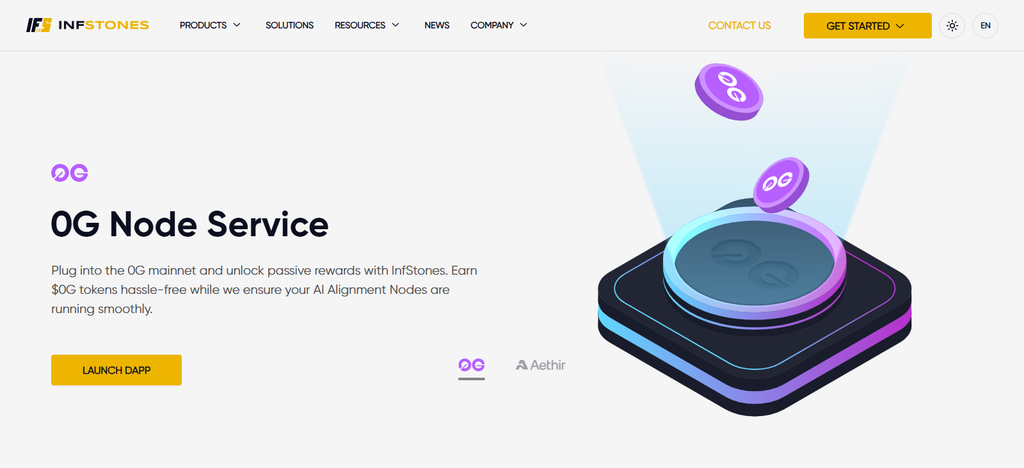
InfStones provides managed node infrastructure so teams don’t have to build and maintain their own individual servers. Its services target organizations seeking scalable blockchain connectivity, validator infrastructure and enterprise-oriented deployment.
Pricing is generally based on usage and infrastructure, with custom plans for larger workloads. Its infrastructure model is well suited for protocols, institutions, Web3 apps, and teams looking for managed node operations.
InfStones Features
- Multi-Chain Support: Provides infrastructure for various blockchain protocols.
- Managed Node Infrastructure: Offers managed blockchain nodes, allowing developers to connect to networks without the burden of running node infrastructure themselves.
- Fast API: Allows applications and developers to access the blockchain via APIs.
Usage Based Pricing: The cost of each request is calculated based on resource consumption. The cost varies for different RPC methods. - Auto-Scaling: The infrastructure can scale automatically and service plans can be scaled up according to the requirements and usage of the application.
| Pros | Cons |
|---|---|
| Managed blockchain node infrastructure | Pricing can be less straightforward than simple RPC providers |
| Supports multiple blockchain ecosystems | Extensive infrastructure may be more than small projects need |
| Reduces the operational burden of running nodes | Enterprise-oriented features may require sales engagement |
| Suitable for staking and validator infrastructure | Feature availability varies by supported blockchain |
| Designed for institutional and production workloads | Less focused on consumer-friendly developer tooling |
3. Tatum
Tatum provides one API for blockchain, notifications and data services, SDK, RPC access. Founded in 2018, Tatum currently supports 142 networks, including Ethereum, Bitcoin, Solana, Polygon, Base, Arbitrum, Avalanche, BNB Smart Chain, and other major chains. It has an infrastructure that is organized in different support tiers, with higher tiers offering higher availability and direct support.
Dedicated API keys start at $99/month for 10 RPS, with higher throughput options up to 100 RPS for $1,049/month. Tatum offers multi-chain applications with RPC, blockchain APIs, smart wallet capabilities, notifications and data services.
Tatum: Features
- 130+ Blockchain Networks: It offers integrated access to more than 130 blockchain networks via its infrastructure layer.
- Smart RPC Routing: Distributes requests across healthy nodes using load balancing, geo routing, caching and failover.
Blockchain Data APIs: Offers standardized wallet, token, transaction and DeFi data. - Web3 Notifications: Webhook-based transaction alerts and smart-contract event notifications.
- High-Performance RPC: Advertizes up to 200 requests/sec, sub-50 ms latency, WebSocket support, 99.99% uptime.
| Pros | Cons |
|---|---|
| Unified infrastructure across 100+ blockchain protocols | Broad feature set can require a learning curve |
| Provides full and archive node access | Usage-based pricing requires monitoring |
| Includes indexed Data APIs and blockchain notifications | Advanced workloads can increase costs |
| Intelligent RPC routing includes caching and automatic failover | Some infrastructure capabilities depend on supported networks |
| Smart Wallets add transaction and wallet functionality | Developers needing only basic RPC may not need the complete stack |
4. GetBlock
GetBlock has been running since 2019 and offers managed RPC infrastructure for over 130 blockchain networks. It includes Ethereum, Bitcoin, Solana, BNB Chain, Polygon, Arbitrum, Base, Aptos, Sui and other networks.
GetBlock provides shared and dedicated nodes, archive access, Websockets, MEV-protected endpoints, geo-routing, analytics and API connectivity.
Current shared plans start at a free tier and scale to paid tiers via Compute Units and requests per second. Dedicated infrastructure provides high-volume workloads and custom configurations. This makes GetBlock a good fit for dApps, wallets, exchanges, analytics platforms and enterprise applications.
Get Block Features
- Multi-Chain RPC Access: RPC endpoints for 100+ blockchains and multiple blockchain interfaces. ([Documentation GetBlock][6])
- API Access: Allows applications to connect to supported blockchain nodes with authenticated access tokens.
Developer Tools: RPC documentation, SDK documentation, API documentation, developer resources. - Node Connectivity: Interact with blockchains using standard RPC methods on supported networks.
Scalable Infrastructure: Built to provide fast and dependable blockchain connections for dApps and applications experiencing increasing traffic.
| Pros | Cons |
|---|---|
| Supports 130+ blockchain networks | Compute Unit pricing can make usage forecasting harder |
| Offers shared and dedicated node options | Higher-performance dedicated infrastructure costs more |
| Provides archive data and WebSocket access | Advanced capabilities may require paid plans |
| Offers geo-routing and high-throughput plans | Free tier has limited capacity |
| Dedicated nodes can provide customized infrastructure | Large-scale users may need enterprise arrangements |
5. Validation Cloud
Validation Cloud offers staking infrastructure, Node APIs, and Web3 data services to developers and enterprises. The Node API connects to over 50 networks including Ethereum, Solana, Bitcoin, BNB Chain, Polygon, Hedera, ICP, Optimism, Monad, and others.
The platform provides a free tier that supports up to 50 million Compute Units per month, and then a usage-based Scale pricing starting at $0.50 per million CUs, with discounted rates at higher volumes.
It offers a worldwide delivery network and scalable API infrastructure for high-volume blockchain applications. Validation Cloud is especially useful for developers needing managed RPC access and enterprise-grade infrastructure.
Validation Cloud Features
- Node API: High performance blockchain connectivity to 50+ networks.
Smart Routing: Automatically routes requests to the best nearby nodes, decreasing latency and increasing reliability. - Archive Access: Full history/archive access on supported networks where the feature is enabled.
- Enterprise scale: Infrastructure built for high throughput workloads and large scale monthly interactions.
- Staking Infrastructure: Non-custodial staking, validator deployment, DVT support, rewards reporting and API-based staking services.
| Pros | Cons |
|---|---|
| Combines node and staking infrastructure | Supported-network coverage varies by service |
| Designed for high-volume blockchain access | Enterprise features may require customized arrangements |
| Provides scalable Node API infrastructure | Usage-based models require workload monitoring |
| Supports institutional blockchain workloads | May be more infrastructure than small projects require |
| Offers additional staking and validator services | Pricing can be less transparent for specialized requirements |
6. Figment
Founded in 2018, Figment is an institutional blockchain infrastructure company, best known for staking, validator and blockchain infrastructure services.
Designed for institutions, custodians, asset managers and Web3 businesses, it supports major proof-of-stake ecosystems. Rather than primarily positioning itself as a low-cost public RPC provider, Figment is a managed validator infrastructure, staking, rewards, and institutional connectivity provider.
Pricing is typically shaped by network and institutional needs rather than a simple public monthly RPC tier. The operational model is built on security, reliability, monitoring and scalability, making it relevant for organizations managing large digital-asset infrastructure.
Figment Features
- Institutional Staking: Gives institutions and digital-asset businesses with enterprise-grade staking infrastructure.
- Validator Infrastructure: Running and managing validators on the major Proof-of-Stake networks.
- Staking API: A single API to integrate staking workflows into applications and platforms.
- Rewards API: Provides uniform access to reward, balance, penalty and historical staking data for supported networks. [Figment][8]
- Rewards Reporting: Dashboards, APIs and downloadable reports to track validator and portfolio performance.
| Pros | Cons |
|---|---|
| Strong focus on institutional staking infrastructure | Not primarily designed as a general-purpose low-cost RPC provider |
| Managed validator operations reduce infrastructure burden | Pricing is generally tailored to institutional requirements |
| Supports multiple Proof-of-Stake networks | Best features are oriented toward staking workflows |
| Provides institutional-grade operational infrastructure | Smaller developers may not need its full capabilities |
| Suitable for custodians, institutions, and asset managers | Node/RPC use cases are less central than staking |
7. RockX
Founded in 2019, RockX offers institutional staking, RPC, validator and node infrastructure. Today, its AccessNode product supports 20+ blockchain networks across the EVM and non-EVM ecosystems, including Ethereum, Binance, Polygon, Avalanche, Arbitrum, Base, Solana, Aptos, Sui, Polkadot and others.
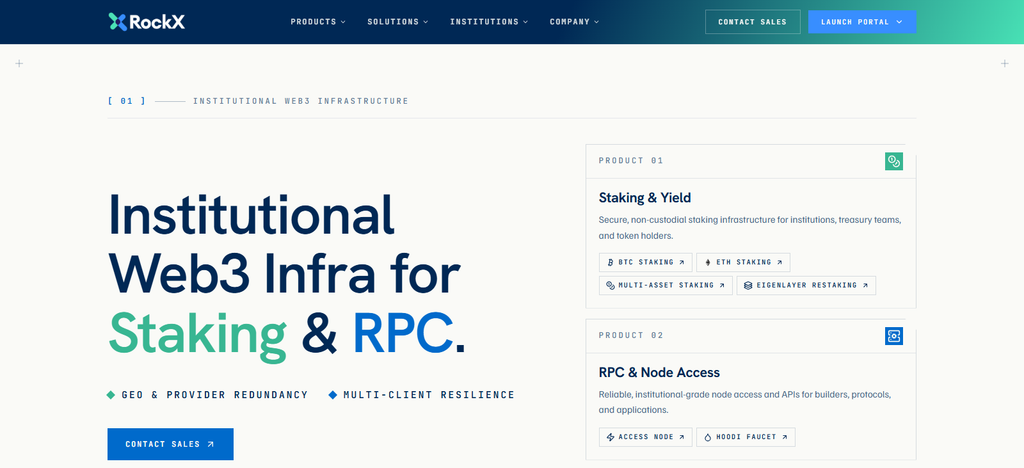
RockX uses geo-routed infrastructure, caching, hybrid-cloud failover, multi-region deployment and advertizes an average response time of around 0.05 seconds. AccessNode charges predictable per-request pricing, instead of Compute Units.
The platform offers dedicated infrastructure, validators, staking, 24/7 monitoring, and institutional support for exchanges, custodians, protocols and enterprises.
Rock X Features
- AccessNode RPC: Institutional RPC access to 20+ blockchain networks.
- Speed: Geo-routed nodes, caching, advertized average response time of ~0.05 sec.
- Hybrid-Cloud Failover: Multi-region and Multi-cloud infrastructure with failover.
Predictable Pricing: Pricing is based on per request basis, 1 RPC call is considered as 1 unit and not varying Compute Units. - Dedicated Infrastructure: Dedicated full and archive nodes with private capacity, custom configurations and high volume support.
| Pros | Cons |
|---|---|
| AccessNode supports 20+ blockchain networks | Chain coverage is smaller than some broad multichain competitors |
| Predictable per-request pricing | Less suitable if you need hundreds of supported networks |
| Average response time is advertised around 0.05 seconds | Some advanced infrastructure requires dedicated arrangements |
| Hybrid-cloud failover improves resilience | Institutional positioning may exceed the needs of small projects |
| Provides dedicated infrastructure and 24/7 monitoring | Enterprise features can require direct sales engagement |
8. PoktScan Gateway
The existing RPC gateway infrastructure of Pocket Network provides access to 50+ blockchain networks through the POKT.ai gateway such as Ethereum, Polygon, Arbitrum, Optimism, Base, Avalanche, BNB Chain, Solana, Cosmos and Gnosis. Full-node RPC is $3/million requests, archive RPC is $6/million requests.
Built on Pocket Network’s infrastructure, the gateway offers endpoint management, usage analytics, billing and team controls. Its architecture is geared toward scalable distributed RPC delivery, not toward single self-managed nodes. It supports applications that require multichain RPC access with simple request-based pricing.
PoktScan Gateway / POKT.ai Features
- Usage Analytics: Tools for usage tracking, endpoint management, invoicing and billing.
- Full-Node RPC: Provides production RPC access, priced per request volume.
- Archive RPC: Provides dedicated archive RPC access for historical blockchain queries.
- Multi-Chain Connectivity: Connects to multiple blockchains via the Pocket infrastructure.
- AI/MCP Support: Provides AI agents with access to MCP built on top of its RPC infrastructure and platform tools.
| Pros | Cons |
|---|---|
| Simple per-million-request RPC pricing | Archive requests cost more than full-node requests |
| Full-node RPC priced at $3 per million requests | Pricing can rise quickly at very large request volumes |
| Archive RPC available for historical workloads | Feature depth differs from full Web3 data platforms |
| Includes usage analytics and endpoint management | Developers needing extensive indexed APIs may need additional services |
| Adds MCP access for AI-agent workflows | AI-agent features are less relevant to traditional dApps |
9. Infura
Infura offers managed blockchain RPC and API infrastructure to developers building decentralized applications. Its Core plan is currently free and gives you access to 40+ supported networks, full archive data and expansion APIs, Developer starts at $50/month and Team at $225/month.
Higher plans offer more throughput and support. Infura also offers APIs for blockchain access, debugging & tracing and other Web3 development needs.
It’s infrastructure is built to take the operational burden away from directly maintaining blockchain nodes. It is especially suited for developers and teams building dApps that need managed RPC connectivity and scalable blockchain access.
Infura Features
- Managed RPC Infrastructure: Provides access to the blockchain without the need to run your own nodes.
- Multi-Chain Connectivity: Managed RPC endpoints & APIs to connect to major blockchain ecosystems.
- Archive Data: Access to blockchain history data for supported networks and more.
- Developer APIs: Provides infrastructure to query blockchain data, build on top of it, and connect to Web3.
Scalable Plans: Offers tiered infrastructure to accommodate projects from development and testing to higher-volume application workloads.
| Pros | Cons |
|---|---|
| Established managed blockchain infrastructure | Some advanced capacity requires paid plans |
| Simplifies blockchain node access | Pricing and quotas vary by service |
| Suitable for dApps and production applications | Developers may need additional tools for specialized indexing |
| Provides RPC and blockchain API capabilities | Large-scale workloads can require customized arrangements |
| Strong fit for teams that prefer managed infrastructure | Less control than operating dedicated nodes yourself |
10. Blockdaemon
Blockdaemon has been providing blockchain infrastructure since 2018, including nodes, APIs, staking, data and transaction services for institutional and enterprise users. Its infrastructure powers 70+ networks and its node platform offers over 300 node types with multiple deployment options.
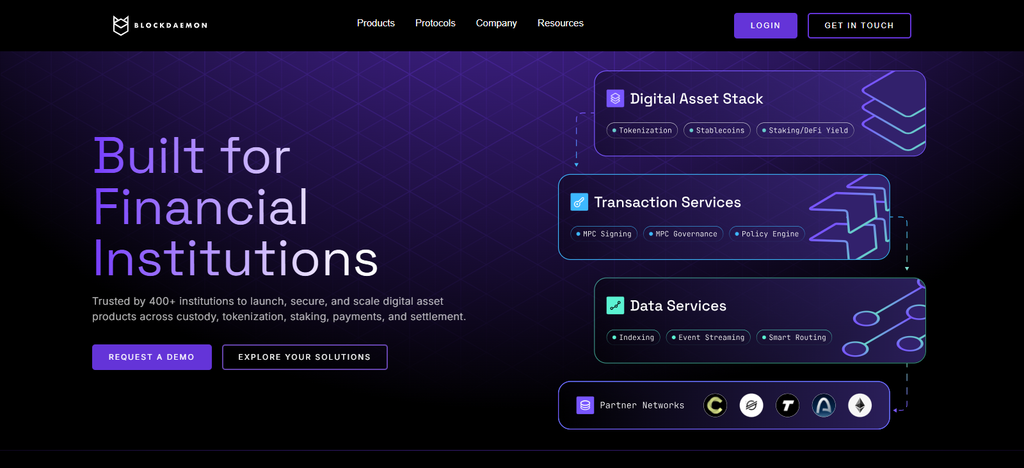
The supported networks are Bitcoin, Ethereum, Solana, Polygon, Avalanche, Arbitrum, Base, Polkadot, Near, Stellar, Tron and others. Blockdaemon provides free API access for testing, with paid plans scaling via Compute Units & request limits.
Its node infrastructure supports deployment on cloud and hosting environments with security certifications and enterprise-oriented operational controls.
Blockdaemon Features
- Enterprise RPC API: Get REST and RPC access to 20+ blockchain protocols.
Blockchain Data APIs: Offers standardized access to blockchain data via its API suite. - Historical Data: Gives access to historical data on the blockchain for application and analytics workloads.
- Real-Time Monitoring: Offers WebSockets and webhooks enabling real-time monitoring of on-chain events and activities.
- Institutional infrastructure: Unites staking, RPC, node infrastructure, transaction services and blockchain APIs for institutional use cases.
| Pros | Cons |
|---|---|
| Strong institutional and enterprise focus | Enterprise pricing is customized |
| Provides RPC, Data, and Staking APIs | Broad product portfolio can be complex for beginners |
| Supports scalable blockchain access without node management | Some advanced capabilities require paid plans |
| Offers auto-scaling on eligible paid plans | Compute Unit usage needs monitoring |
| Provides customizable API solutions and institutional support | May be more infrastructure than small dApps require |
Conclusion
For developers, protocols, enterprises and applications that need reliable blockchain connectivity, but don’t want the headache of managing complex node operations themselves, web3 node infrastructure platforms have become essential.
Moralis, InfStones, Tatum, GetBlock, Validation Cloud, Figment, RockX, PoktScan Gateway, Infura, and Blockdaemon all provide different combinations of RPC access, managed nodes, APIs, blockchain data, staking infrastructure, and scalable deployment options.
Compare these platforms across supported networks, pricing models, request capacity, API capabilities, archive data, performance, security and deployment flexibility. In the end, the best platform for you will be determined by your application’s blockchain coverage, traffic needs, infrastructure needs, development workflow, and long-term scaling plans.
FAQ
What are Web3 node infrastructure platforms?
Web3 node infrastructure platforms provide managed access to blockchain nodes through RPC endpoints, APIs, data services, and other infrastructure tools. They allow developers to interact with blockchains without operating and maintaining nodes themselves.
Why do Web3 applications need node infrastructure?
Web3 applications need node infrastructure to read blockchain data, submit transactions, monitor smart contracts, retrieve historical information, and communicate with decentralized networks reliably.
What is the difference between an RPC provider and a node infrastructure platform?
An RPC provider primarily offers blockchain connectivity through RPC endpoints. A broader node infrastructure platform may additionally provide dedicated nodes, archive nodes, indexing, APIs, staking, analytics, monitoring, and enterprise infrastructure.
Which blockchain networks can these platforms support?
Support varies by provider. Common networks include Ethereum, Bitcoin, Solana, Polygon, BNB Chain, Avalanche, Arbitrum, Optimism, Base, Cosmos-based networks, and other EVM and non-EVM chains.