

This article will look at competitors of Public.com for investing in stocks for 2026. Traders have a multitude of options, with commission-free trades and advanced platforms. Traditional brokers like Interactive Brokers, Fidelity, and Charles Schwab, offer a variety of account types and provide customer service.
- What Are Public.com Rivals?
- How To Choose Public.com Rivals for Stock Investing
- Key Points
- 1. Interactive Brokers
- Interactive Brokers Features, Pros & Cons
- 2. Fidelity
- Fidelity Features, Pros & Cons
- 3. E*TRADE
- E*TRADE Features, Pros & Cons
- 4. Charles Schwab
- Charles Schwab Features, Pros & Cons
- 5. Vanguard
- Vanguard Features, Pros & Cons
- 6. Firstrade
- Firstrade Features, Pros & Cons
- 7. Ally Invest
- Ally Invest Features, Pros & Cons
- 8. Alpaca Trading
- Alpaca Trading Features, Pros & Cons
- 9. moomoo
- moomoo Features, Pros & Cons
- 10. eToro
- eToro Features, Pros & Cons
- Public.com Rivals Comparison (2026)
- Conclusion
- FAQ
These brokers, especially Fidelity, offer a variety of fixed income securities and Exchange Traded Funds (ETFs) and are good options for all levels of experience and international trade.
What Are Public.com Rivals?
Public.com’s competitors are online brokerages that provide commission-free trading of stocks and ETFs, and a broader range of investment offerings, including mutual funds and bonds, and different account types and retirement plans.
Well known brokerages, like Fidelity, Charles Schwab and Vanguard, as well as newer brokerages, like moomoo and Alpaca Trading, are competitors. Each competitor attempts to distinguish itself based on the type of investments offered, the level of service provided, the ways in which investments are transferred, and the types of tools and resources available.
Some, for example, offer tools for social trading, like eToro, while others, like Interactive Brokers, allow investors to trade on exchanges throughout the world. These brokerages, in combination, offer investors a myriad of options for trading stocks in 2026.
How To Choose Public.com Rivals for Stock Investing
Fees and Commissions: Look for brokers charging no commissions for stock and ETF trades, but check for hidden costs such as withdrawal fees, margin fees, and options fees.
Account Types: Based on your needs, determine if you need traditional brokerage accounts, retirement accounts (e.g. IRA, 401(k)), or custodial accounts.
Investments: Sufficient offerings in ETFs and bonds.
Customer Service: Look for 24/7 customer service, and if available, service in other languages and in-person locations.
Other: Ability to transfer account to other brokers, and trader-related tools.
Platform Tools – Advanced users might want to check out Interactive Brokers or Alpaca for APIs. Firstrade or moomoo are more new user friendly options.
Global Access – If you want to trade outside the US you will want to look at competitors like Interactive Brokers or eToro.
Social Trading – eToro and moomoo give users the ability to copy or engage in social trading.
Education – Beginner investors might want to look at Fidelity, E*TRADE, or Schwab for educational resources.
Regulation – Check what regulatory bodies the broker is partnered with. If they are partnered with Tier 1 authorities (FCA, SEC, FINRA, CySEC) they are most likely secure.
Key Points
| Broker | Best For | Key Strengths |
|---|---|---|
| Interactive Brokers | Experienced traders | Global market access, advanced tools, low margin rates |
| Fidelity | Beginners & long-term investors | Strong IRA accounts, zero commissions, trusted US giant |
| E*TRADE | Educational content seekers | Excellent research, mobile app, $0 trades |
| Charles Schwab | Full-service investors | Great customer service, wide product range, $0 trades |
| Vanguard | Index fund investors | Commission-free ETFs, strong retirement focus |
| Firstrade | Beginners | Zero commissions, simple interface, multilingual support |
| Ally Invest | Bank-linked investors | Integration with Ally Bank, low-cost trades |
| Alpaca Trading | Developers & algo traders | API-first broker, automation-friendly |
| moomoo | Cost-conscious traders | Commission-free trades, extended hours, social features |
| eToro | Social traders | Copy-trading, global reach, crypto + stocks |
1. Interactive Brokers
Launched in 1978, Interactive Brokers Group provides online trading for various financial instruments across 150+ markets. It charges zero commissions for trades of US-listed stocks and ETFs. International trades are subject to differing fees based on trade volume. Prices for available bonds are displayed through the platform.

There are several options available for user accounts. Clients are provided access to customer support services 24/7 in various languages.
It allows users to transfer their accounts using ACATs and offers clients the ability to transfer their assets across the world. Interactive Brokers provides users tools and platform for automated and algorithmic trading. Around the midpoint, Interactive Brokers is the best competitor of Public.com in 2026.
Interactive Brokers Features, Pros & Cons
| Feature | Pros | Cons |
|---|---|---|
| Founded | Established 1978, highly trusted | Long history may feel complex for beginners |
| Fees | $0 US stock/ETF trades | International trades have tiered fees |
| Bonds | Wide global bond access | Bond pricing can be complex |
| Account Types | Individual, joint, retirement, institutional | Setup process more detailed |
| Platform | Trader Workstation, advanced tools | Steep learning curve |
| Margin | Lowest rates in industry | Requires experience |
| ETFs | Global ETFs available | Some ETFs carry FX fees |
| Transferability | ACAT + global transfers | International transfers slower |
| Customer Support | 24/7 multilingual | Less beginner-friendly |
| Research | Deep analytics & screeners | Overwhelming for casual users |
| API | Algo trading support | Technical knowledge required |
| Options | Advanced derivatives trading | Complex fee structure |
| Global Access | 150+ markets | Too broad for casual investors |
| Security | Strong compliance | Strict verification |
| Reputation | Professional-grade | Not ideal for hobby investors |
2. Fidelity
Founded in 1946, Fidelity is one of the largest brokers in the US, with commission-free trade of stocks and ETFs. It offers a range of other investment products such as mutual funds, bonds, and various types of accounts including IRAs and brokerage accounts. Fidelity has low fees.
Traders can enjoy zero-commission trades on stocks and lower prices on bonds compared to competitors. Customer service is rated well, and help is available through multiple channels. Fidelity has easy asset transferability and ACAT transfers. It provides a variety of investment research and tools.
Overall, Fidelity is a well-rounded investment broker and a good competitor to Public.com. Of the two, Fidelity offers more features for more traditional investing and appears geared more for long term investing for retirement.
Fidelity Features, Pros & Cons
| Feature | Pros | Cons |
|---|---|---|
| Founded | 1946, trusted US giant | Traditional feel may deter younger users |
| Fees | $0 stock/ETF trades | Some mutual funds carry fees |
| Bonds | Strong bond market access | Limited global bonds |
| Account Types | IRAs, 401(k), brokerage | Fewer API tools |
| Platform | Fidelity Active Trader Pro | Less advanced than IBKR |
| ETFs | Commission-free ETFs | Smaller global ETF range |
| Transferability | Smooth ACAT transfers | US-focused |
| Customer Support | 24/7 + branch offices | Branches mainly US-based |
| Research | Excellent tools & screeners | May overwhelm beginners |
| Retirement | Best IRA options | Long-term focus only |
| Options | Competitive pricing | Not as advanced as IBKR |
| Mutual Funds | Huge selection | Some carry expense ratios |
| Security | Strong compliance | Strict account checks |
| Reputation | Highly trusted | Conservative approach |
| Education | Great resources | Less gamified than rivals |
3. E*TRADE
Established in 1982, ETRADE has been offering commission-free trading of stocks, ETFs and options for more than three decades. It offers various account types including traditional and retirement accounts.
Along with trading, ETRADE also provides access to mutual funds and bonds. ETRADE has branches, and customers can reach out to support through phone and in-person. ACAT transfers are also supported. With Power ETRADE, users can access advanced order and options trading.
Compared to other brokers, ETRADE provides reasonably priced and commission-free ETFs. It offers a comprehensive learning center and is suitable for beginners and intermediates. As Public.com also offers research and support, ETRADE and Public.com are equally competing against each other in the industry.
E*TRADE Features, Pros & Cons
| Feature | Pros | Cons |
|---|---|---|
| Founded | 1982, US-based | Smaller global reach |
| Fees | $0 stock/ETF trades | Options contracts cost extra |
| Bonds | Transparent pricing | Limited international bonds |
| Account Types | Individual, retirement, managed | No API trading |
| Platform | Power E*TRADE advanced tools | Less global access |
| ETFs | Commission-free ETFs | Smaller range than Vanguard |
| Transferability | ACAT supported | US-focused |
| Customer Support | 24/7 + branches | Branches limited |
| Research | Strong educational tools | Less advanced than IBKR |
| Retirement | IRA accounts available | Not as strong as Fidelity |
| Options | Advanced charting | Higher fees than Schwab |
| Security | Strong compliance | Strict verification |
| Reputation | Reliable broker | Less innovative |
| Education | Great for beginners | Limited gamification |
| Integration | Morgan Stanley backing | More traditional feel |
4. Charles Schwab
Charles Schwab has offered low-cost brokerage services since 1971 and was a pioneer in the industry by charging no commissions for the purchase or sale of thousands of ETFs and no-load mutual funds.
They charge no commissions for the purchase or sale of stocks, options, or futures. Account types include individual, retirement, education, trust, and managed accounts. Schwab has an extensive and well-developed branch system and 24/7 phone service. Acat transfers are supported.
The StreetSmart Edge platform provides powerful tools for advanced trading and order management. Schwab offers some of the best research and economic analysis in the industry.
Their ETFs and US listed foreign securities carry no commissions. Charles Schwab offers its clients a full service, low cost brokerage service and wealth management with a Trust company and is a good alternative to Public.com.
Charles Schwab Features, Pros & Cons
| Feature | Pros | Cons |
|---|---|---|
| Founded | 1971, trusted US broker | Conservative approach |
| Fees | $0 stock/ETF trades | Options contracts cost extra |
| Bonds | Strong bond market | Limited global bonds |
| Account Types | Individual, retirement, custodial | No API trading |
| Platform | StreetSmart Edge | Less advanced than IBKR |
| ETFs | Commission-free ETFs | Smaller global range |
| Transferability | Smooth ACAT | US-focused |
| Customer Support | 24/7 + branches | Branches US-only |
| Research | Excellent resources | May overwhelm beginners |
| Retirement | Strong IRA options | Long-term focus |
| Options | Competitive pricing | Not as advanced as IBKR |
| Security | Strong compliance | Strict verification |
| Reputation | Highly trusted | Conservative |
| Education | Great resources | Less gamified |
| Integration | Full-service wealth management | More traditional |
5. Vanguard
Vanguard was created in 1975 and pioneered low-cost index investing. Vanguard’s ETFs and funds are some of the most accessible investment options with no trade commissions. Mutual funds and a range of securities are also available.

Individual, IRA, and employer-sponsored retirement plan accounts are available. Vanguard charges very low fees. Phone and online support are available. Other support is very limited.
ACAT is supported. Vanguard is one of the most popular and best choices for long-term investing and building retirement income. For passive investors, it is hard to beat Vanguard. Public.com is similar to Vanguard and focuses on ETFs. Public.com is best used for short-term trading.
Vanguard Features, Pros & Cons
| Feature | Pros | Cons |
|---|---|---|
| Founded | 1975, index fund pioneer | Less tech-driven |
| Fees | $0 Vanguard ETFs | Non-Vanguard funds may cost |
| Bonds | Strong bond funds | Limited trading bonds |
| Account Types | Brokerage, IRAs, retirement | No API trading |
| Platform | Simple interface | Less advanced |
| ETFs | Best low-cost ETFs | Limited global ETFs |
| Transferability | ACAT supported | US-focused |
| Customer Support | Phone + online | Few branches |
| Research | Long-term focus | Less advanced tools |
| Retirement | Best for passive investors | Not for active traders |
| Options | Limited | Not ideal for options |
| Security | Strong compliance | Conservative |
| Reputation | Trusted globally | Passive focus only |
| Education | Long-term investing guides | Less trading education |
| Integration | Retirement planning | Limited innovation |
6. Firstrade
Firstrade is a brokerage that started in 1985 and offers commission-free trades for stocks, ETFs, and options. Mutual funds and bonds have low trading costs. They have standard investment accounts as well as retirement and custodial accounts. Firstrade’s customer support is available in multiple languages.

Support is available by phone and email. Customers can transfer their accounts easily with support from ACAT. Firstrade’s website and trading platforms are less complex compared to other brokerages. Active traders may prefer other brokerages, but Firstrade is adequate for most traders.
Trades for ETFs and stocks are commission-free. Firstrade may be better than Public.com for customers looking for a more full-featured trading platform, and especially for customers looking for a trading platform with lower fees.
Firstrade Features, Pros & Cons
| Feature | Pros | Cons |
|---|---|---|
| Founded | 1985, US broker | Smaller brand |
| Fees | $0 stocks, ETFs, options | Limited advanced tools |
| Bonds | Competitive pricing | Smaller bond market |
| Account Types | Individual, retirement, custodial | No institutional accounts |
| Platform | Simple interface | Less advanced |
| ETFs | Commission-free ETFs | Limited global ETFs |
| Transferability | ACAT supported | US-focused |
| Customer Support | Multilingual support | Limited hours |
| Research | Basic tools | Less advanced |
| Retirement | IRA accounts | Not as strong as Fidelity |
| Options | Commission-free | Limited advanced features |
| Security | Strong compliance | Smaller scale |
| Reputation | Cost-effective | Less known |
| Education | Beginner-friendly | Limited depth |
| Integration | Simple transfers | No banking integration |
7. Ally Invest
Ally Invest has been part of Ally Financial since its inception in 2005. Ally Invest recently removed commissions for US equity and options trades. Other investment products and services available through Ally Invest include mutual funds, forex, and fixed income. They also offer managed portfolios.
Ally Invest offers commission-free ETFs and offers bonds at low prices. Ally Invest’s trading platform integrates with Ally Bank, and a customer can transfer funds between the two accounts with ease.
Ally’s trading platforms are easy to use and offer a variety of research tools. Ally’s managed portfolios provide customers with a way to outsource their investment decisions. Ally Invest is comparable to Public.com, and Ally may have the edge over Public if the customer prefers integrated banking.
Ally Invest Features, Pros & Cons
| Feature | Pros | Cons |
|---|---|---|
| Founded | 2005, part of Ally Bank | Newer broker |
| Fees | $0 stock/ETF trades | Options contracts cost extra |
| Bonds | Competitive pricing | Smaller bond market |
| Account Types | Individual, retirement, managed | No institutional accounts |
| Platform | User-friendly | Less advanced |
| ETFs | Commission-free ETFs | Smaller global ETFs |
| Transferability | ACAT supported | US-focused |
| Customer Support | Phone, chat, email | No branches |
| Research | Strong tools | Less advanced |
| Retirement | IRA accounts | Not as strong as Vanguard |
| Options | Competitive pricing | Higher fees than Firstrade |
| Security | Strong compliance | Strict verification |
| Reputation | Reliable | Smaller scale |
| Education | Beginner-friendly | Limited depth |
| Integration | Ally Bank linked | Limited global reach |
8. Alpaca Trading
Established in 2015, Alpaca Trading positions itself as a developer-centric broker in the algorithmic trading space. It currently offers commission-free trading of US equities and ETFs. Alpaca also offers trading in US fixed income securities.
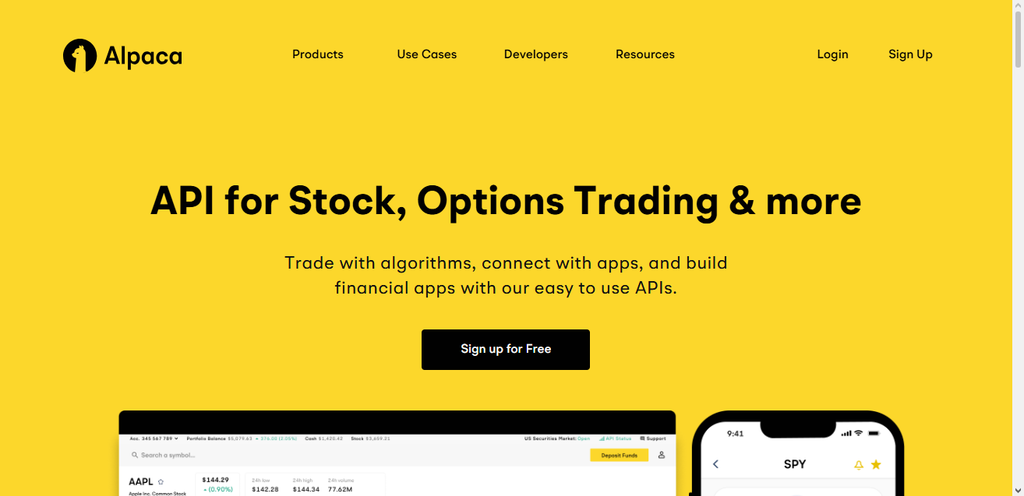
However, it is important to note that access to fixed income securities is provided to only a select group of clients. Similar to other brokers, Alpaca also provides both retail and institutional clientele access to its trading services. Alpaca’s website and documentation are heavily developer centered.
Client support is available, but in a less comprehensive format when compared to other brokers. Clients are, however, able to transfer their account to other brokers. Alpaca is a strong broker in the space with an advanced API and provides commission-free equity and ETF trading. Mid-2021, Alpaca is an excellent alternative to Public.com.
Alpaca Trading Features, Pros & Cons
| Feature | Pros | Cons |
|---|---|---|
| Founded | 2015, API-first broker | Newer player |
| Fees | $0 stock/ETF trades | Limited bonds |
| Bonds | Minimal access | Weak bond market |
| Account Types | Individual, institutional | No retirement accounts |
| Platform | API-driven | Requires coding |
| ETFs | Commission-free ETFs | Limited range |
| Transferability | Supported | Less robust |
| Customer Support | Online support | No phone |
| Research | Developer docs | Limited investor tools |
| Retirement | Not supported | Weak offering |
| Options | Limited | Not advanced |
| Security | Strong compliance | Smaller scale |
| Reputation | Tech-focused | Niche appeal |
| Education | Developer resources | Not investor-focused |
| Integration | API automation | No banking |
9. moomoo
moomoo is a trading app like Robinhood, but with extended trading hours, social features and advanced charting. Accounts are limited to individual brokerages, but moomoo charges lower fees to make up for it. moomoo’s app also has a live chat feature to answer basic customer questions.
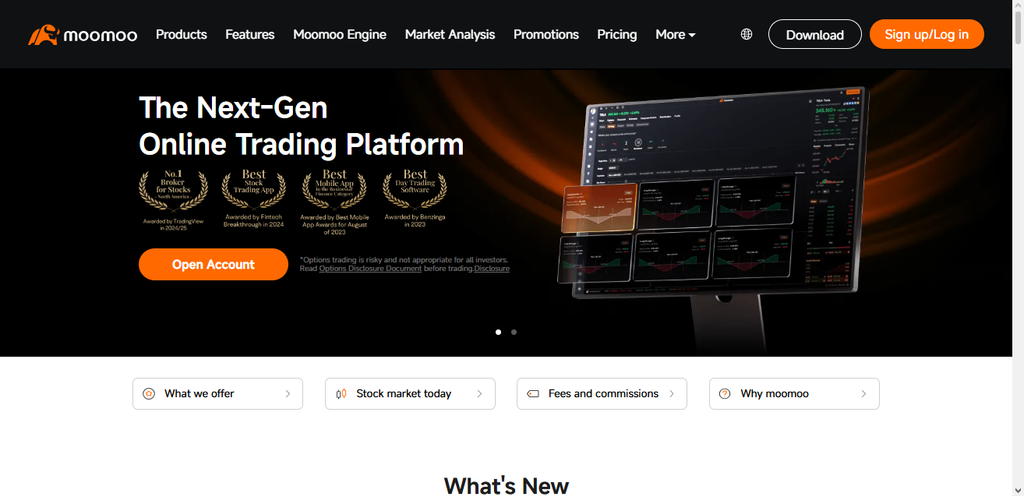
Like most brokerages, moomoo supports ACAT transfers. moomoo draws in a younger clientele with its focus on features, not fees. moomoo also offers strong competitors to Public.com with its integration of social trading. Overall, moomoo’s app is midlevel, but improving, and worth the consideration of commission-free trading customers.
moomoo Features, Pros & Cons
| Feature | Pros | Cons |
|---|---|---|
| Founded | 2018, fintech app | Newer broker |
| Fees | $0 stock/ETF trades | Options contracts cost extra |
| Bonds | Competitive pricing | Smaller bond market |
| Account Types | Individual brokerage | No retirement accounts |
| Platform | Advanced charting | Less global |
| ETFs | Commission-free ETFs | Limited range |
| Transferability | ACAT supported | US-focused |
| Customer Support | In-app chat | Limited phone |
| Research | Strong tools | Less advanced |
| Retirement | Not supported | Weak offering |
| Options | Competitive pricing | Higher fees |
| Security | Strong compliance | Smaller scale |
| Reputation | Growing | Less trusted |
| Education | Beginner-friendly | Limited depth |
| Integration | Social features | Less professional |
10. eToro
Based in the UK, eToro is an online broker with a focus on social trading. It offers stocks, ETFs, and cryptocurrencies. Like most brokers, it charges a spread on cryptos. Equities and ETFs are commission free.

Bonds are not as broadly offered as at US brokers. It offers individual brokerage accounts. Customer service is limited to chat, but is available in multiple languages. It supports account transfers, but this is broker-dependent.
eToro has a unique feature, called copy trading, where users can clone the portfolios of top eToro users. eToro offers commission-free stocks and ETFs. Rival Public is similar to eToro, but offers fewer features and focuses more on equity trading.
eToro Features, Pros & Cons
| Feature | Pros | Cons |
|---|---|---|
| Founded | 2007, global broker | Limited US bonds |
| Fees | $0 stock/ETF trades | Crypto spreads higher |
| Bonds | Limited | Weak bond market |
| Account Types | Individual brokerage | No retirement accounts |
| Platform | Social trading | Less advanced |
| ETFs | Commission-free ETFs | Smaller range |
Public.com Rivals Comparison (2026)
| Broker | Founded | Fees | Bonds | Account Types | Customer Support | Transferability | Stocks & ETFs |
|---|---|---|---|---|---|---|---|
| Interactive Brokers | 1978 | $0 US stocks/ETFs, tiered intl. fees | Wide global access | Individual, joint, retirement, institutional | 24/7 multilingual | ACAT + global transfers | Global stocks & ETFs |
| Fidelity | 1946 | $0 stocks/ETFs | Strong US bond market | IRAs, 401(k), brokerage | 24/7 + branches | Smooth ACAT | US stocks & ETFs |
| E*TRADE | 1982 | $0 stocks/ETFs | Transparent pricing | Individual, retirement, managed | 24/7 + branches | ACAT supported | US stocks & ETFs |
| Charles Schwab | 1971 | $0 stocks/ETFs | Strong bond market | Individual, retirement, custodial | 24/7 + branches | ACAT supported | US stocks & ETFs |
| Vanguard | 1975 | $0 Vanguard ETFs | Strong bond funds | Brokerage, IRAs, retirement | Phone + online | ACAT supported | Vanguard ETFs & stocks |
| Firstrade | 1985 | $0 stocks, ETFs, options | Competitive pricing | Individual, retirement, custodial | Multilingual support | ACAT supported | US stocks & ETFs |
| Ally Invest | 2005 | $0 stocks/ETFs | Competitive pricing | Individual, retirement, managed | Phone, chat, email | ACAT supported | US stocks & ETFs |
| Alpaca Trading | 2015 | $0 stocks/ETFs | Minimal access | Individual, institutional | Online support | Limited transfers | US stocks & ETFs |
| moomoo | 2018 | $0 stocks/ETFs | Competitive pricing | Individual brokerage | In‑app chat | ACAT supported | US stocks & ETFs |
| eToro | 2007 | $0 stocks/ETFs, ~1% crypto | Limited | Individual brokerage | Live chat, email | Limited transfers | Global stocks, ETFs, c |
Conclusion
In summary, the 10 rivals to Public.com for 2026, including Interactive Brokers, Fidelity, E*TRADE, Charles Schwab, Vanguard, Firstrade, Ally Invest, Alpaca, moomoo, and eToro, offer the best commissions and charges, the broadest choice of investments, and the most effective customer support.
They also offer thousands of ETFs and mutual funds, in addition to bonds. Each offers features that make it attractive to various types of investors, from novices to experts, and from those who prefer traditional investing to those who prefer automation and/or social investing.
Investors are free to transfer positions among the supported brokerage accounts, if they wish to consolidate their investments. Overall, these rivals to Public.com offer the best features for investing stocks in 2026.
FAQ
Which broker has the lowest fees?
Most rivals now offer $0 commissions on stocks and ETFs. Fidelity, Charles Schwab, Firstrade, and moomoo stand out for truly commission-free trading with minimal hidden costs.
Do these brokers offer bonds?
Yes. Interactive Brokers, Fidelity, Schwab, Vanguard, and Ally Invest provide strong bond markets. Platforms like Alpaca Trading and eToro are weaker in bond offerings.
Which platforms support retirement accounts?
Fidelity, Vanguard, Charles Schwab, and Ally Invest excel with IRAs and retirement-focused accounts. Interactive Brokers also supports retirement accounts globally.
Who has the best customer support?
Fidelity and Charles Schwab lead with 24/7 support and branch networks. Interactive Brokers offers multilingual support worldwide. Firstrade and moomoo rely more on online chat.
Can I transfer assets easily?
Yes. Most US brokers like Fidelity, Schwab, ETRADE*, and Ally Invest support ACAT transfers. Alpaca Trading and eToro have more limited transferability depending on region.