


This article explains decentralized exchanges that protect market executed value (MEV) and how they stop front running and minimize slippage and gas costs while deploying fair use of liquidity.
- What is MEV‑Protected Decentralized Exchanges?
- Why Choose MEV‑Protected Decentralized Exchanges
- Fair Execution
- Lower Slippage
- Optimized Gas Costs
- Liquidity Protection
- Transparency & Rebates
- Cross-Chain & Rollup Security
- Key Point
- 1. CoW Swap
- 2. UniswapX
- 3. Balancer MEV
- 4. Flashbots Protect Relay
- 5. MEV Blocker
- 6. Eden Network
- 7. Shutter Network
- 8. Chainlink Fair Sequencing
- 9. Espresso Sequencer
- 10. Astria Sequencer
- Comparison Table – Best MEV‑Protected DEXs (2026)
- Conclusion
- FAQ
Where DeFi is headed, these exchanges will become the standard, providing secure and efficient trading while allowing both retail and institutional investors to trade without the issues of the current infrastructure.
What is MEV‑Protected Decentralized Exchanges?
A MEV-Protected Decentralized Exchange (DEX) is a blockchain trading framework that puts a high priority on protecting users’ interests from the growing risks surrounding Maximal Extractable Value (MEV) attacks (e.g., front-running, sandwich attacks, and transaction reordering).
Traditional DEXs are vulnerable to bots and validators that front-run trades by charging high slippage and gas costs (while causing the execution price to be even more unfavorable).
DeFi projects such as CoW Swap, UniswapX, and Flashbots Protect Relay are quickly grasping the need for the protection of retail traders in DeFi. These projects use state-of-the-art solutions, such as Batch Auctions, Private Relays, Encrypted Mempools, Transaction Bundling, and Secure Order Execution.
Why Choose MEV‑Protected Decentralized Exchanges
Fair Execution
With MEV-protected DEXs, traders are able to execute their trades at the displayed prices. MEV-Protected DEXs also mitigate Market Issuance Eating attacks which includes front-running and sandwiching attacks.
Lower Slippage
By shrinking the arbitrage window, MEV-protected DEXs cause slippage to decrease and trades to be executed closer to the expected price.
Optimized Gas Costs
Competition for off-chain txs solvers brings gas prices down, and many of the low gas auctions allow for zero-cost trading.
Liquidity Protection
Balancer MEV Guard’s liquidity protection minigame limits pool manipulation and impermanent loss for its users.
Transparency & Rebates
MEV-protecting DEXs like MEV Blocker return MEV to users and create a safe and cost-effective trading ecosystem.
Cross-Chain & Rollup Security
Sequencers for rollups like Astria and Espresso protect the MEV ecosystem across multiple chains.
Key Point
| DEX | Best For | Key Features |
|---|---|---|
| CoW Swap | DeFi swaps | Batch auctions, eliminates sandwich attacks |
| UniswapX | Retail traders | Off‑chain order routing, gasless swaps |
| Balancer MEV Guard | Liquidity providers | Internal pool protection, prevents manipulation |
| Flashbots Protect Relay | Ethereum traders | Private mempool, front‑running protection |
| MEV Blocker | DeFi users | Shared orderflow protection, gasless routing |
| Eden Network | NFT mints | Priority slots, fair ordering |
| Shutter Network | DeFi protocols | Threshold encryption, encrypted mempool |
| Chainlink Fair Sequencing | Cross‑chain apps | Oracle‑based sequencing, neutral ordering |
| Espresso Sequencer | Rollups | Shared sequencer, fair orderflow |
| Astria Sequencer | Modular chains | Decentralized sequencer, MEV‑neutral rollups |
1. CoW Swap
CoW Swap innovatively avoids sandwich attacks via batch auctions and solver competition. Traders sign their intents off-chain and aren’t exposed to the mempool. Since gas costs are bundled with the execution, swaps are in effect gasless.
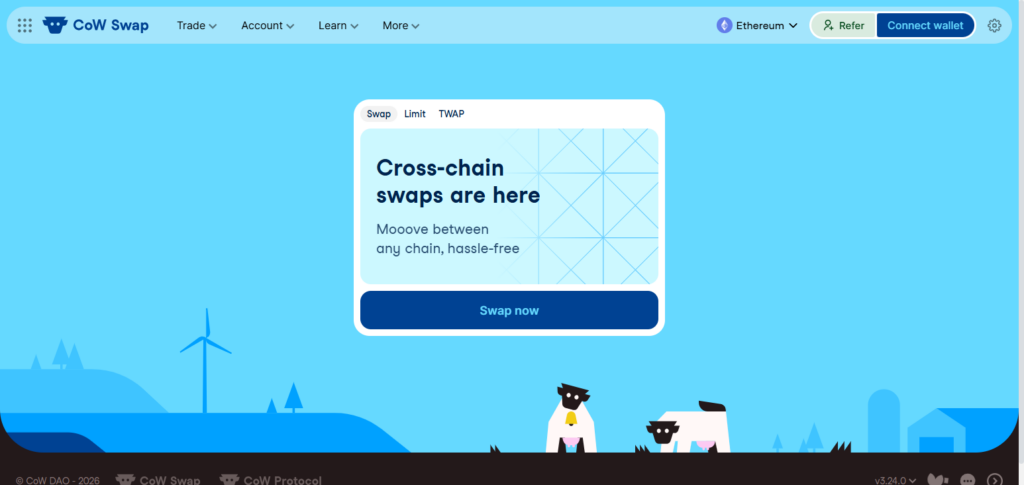
Thanks to surplus solver, prices are optimized and are frequently better than aggregators. CoW Swap boasts billions of liquidity across the Ethereum, Gnosis, Arbitrum, and Base layers.
CoW swap relies on Coincidence of Wants to minimize slippage through peer-to-peer matching. CoW Swap also structurally prevents front running and thus exerts strong MEV coverage. This makes CoW Swap an excellent choice for DeFi swaps to achieve optimal execution and cost.
| Feature | Details |
|---|---|
| Transaction Model | Batch auctions with solver competition |
| Gas Costs | Gasless swaps, solver pays fees |
| Slippage Control | Peer‑to‑peer matching reduces slippage |
| Liquidity | Multi‑chain (Ethereum, Gnosis, Arbitrum, Base) |
| MEV Coverage | Prevents sandwich/front‑running structurally |
| Price Efficiency | Solver surplus often beats aggregators |
| User Base | Billions in volume, strong adoption |
| Best Use Case | Large swaps needing optimal execution |
2. UniswapX
UniswapX employs an intent-based framework to execute swaps through competition amongst Dutch auction fillers. UniswapX’s design permits off-chain signing of intents by users. Subsequent fillers pay gas, and swaps execute under MEV protection.

This design allows gasless swaps and even results in savings of $3 to $10 for a $5,000 swap compared to $15 in gas. Slippage is reduced through the private filler inventory. UniswapX’s MEV coverage works to protect retail wallets from sandwich attacks.
For swaps valued under $100, fillers may fail to stand gas, which will trigger fallback to on-chain swaps. UniswapX’s design achieves a great balance of very low transaction cost, fair sequencing, and ample supply, making this an excellent DEX for retail.
| Feature | Details |
|---|---|
| Transaction Model | Intent‑based Dutch auctions |
| Gas Costs | Gasless swaps, fillers pay fees |
| Slippage Control | Reduced via filler inventory |
| Liquidity | Beyond Uniswap pools, cross‑chain |
| MEV Coverage | Strong protection against sandwich attacks |
| Price Efficiency | Competitive filler pricing |
| User Base | Retail‑friendly, fallback to on‑chain |
| Best Use Case | Small to medium swaps |
3. Balancer MEV
Balancer uses MEV Guard to enable protection against manipulation of liquidity pools. Their tech also allows Balancer to autonomously reduce the opportunity of sandwiching attacks by adjusting pricing in internal pools.
Overall, gas costs remain the same as the typical Ethereum network fees. However, slippage is improved by automated transaction routing. Deep liquidity across Balancer pools helps facilitate large transactions. MEV protection focuses on the safety of liquidity providers to ensure that value extraction is fair.

Even with arbitrage MEV, there has been significant improvement in fair value extraction. From a trader’s perspective, balanced execution has been improved and from the LP side of the equation, the risk of impermanent loss has been minimized.
Balancer MEV Guard is one of the best options for liquidity providers seeking the highest possible protection for their yield.
| Feature | Details |
|---|---|
| Transaction Model | Internal pool pricing control |
| Gas Costs | Standard Ethereum fees |
| Slippage Control | Optimized routing reduces slippage |
| Liquidity | Deep Balancer pools |
| MEV Coverage | Protects LPs from manipulation |
| Price Efficiency | Fairer execution for traders |
| User Base | Strong LP community |
| Best Use Case | Yield farming & liquidity provision |
4. Flashbots Protect Relay
Flashbots Protect Relay offers a clean way to protect swaps using a private RPC to route transactions avoiding the public mempool. This protects swaps from both front-running and sandwich attacks. As for costs, it’s standard plus optional builder tips with a possible MEV or gas overpayment refund.
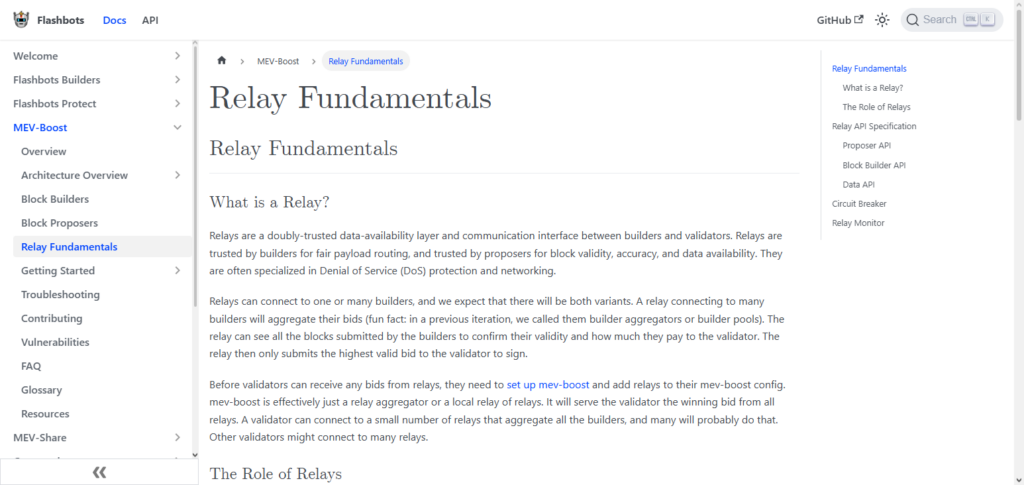
Deep liquidity is available through Ethereum and the major L2s. Slippage is low as the bots can’t see pending trades. While coverage is strong, a builder concentration covers a centralization risk.
For retail users the service is free, while a fee can be charged for priority routing for institutional users. As a private fair execution service, Flashbots Protect remains one of the best MEV-protected decentralized exchanges for Ethereum traders.
| Feature | Details |
|---|---|
| Transaction Model | Private RPC routing |
| Gas Costs | Standard + optional builder tips |
| Slippage Control | Bots cannot see pending trades |
| Liquidity | Broad Ethereum + L2 coverage |
| MEV Coverage | Strong, but builder centralization risk |
| Price Efficiency | Fairer execution |
| User Base | Retail + institutional |
| Best Use Case | Ethereum swaps needing privacy |
5. MEV Blocker
MEV Blocker, a Consensys acquisition, is a protection RPC against sandwich attacks. MEV Blocker routes transactions through backrunning auctions that return value to the users. Gas costs are competitive and over 6100 ETH has been returned as rebates.

Deep liquidity is available through Ethereum and 4.5 million wallets. Slippage is minimized as harmful MEV is blocked. MEV coverage is strong, though RPC protection requires wallet integration.
For everyday DeFi users, MEV Blocker is among the best MEV protected decentralized exchanges (DEXs) for transparent, user-first execution.
| Feature | Details |
|---|---|
| Transaction Model | Backrunning auctions return value |
| Gas Costs | Competitive, rebates distributed |
| Slippage Control | Harmful MEV blocked |
| Liquidity | Ethereum, 4.5M+ wallets |
| MEV Coverage | Strong RPC‑based protection |
| Price Efficiency | Rebates improve execution |
| User Base | Everyday DeFi users |
| Best Use Case | Transparent swaps with rebates |
6. Eden Network
Eden Network provides priority transaction slots and protected order flow. Users stake EDEN tokens to rent blockspace for guaranteed order execution. Gas costs are standard and priority order inclusion offsets order execution delay.
Eden has strong liquidity through Uniswap, SushiSwap, and 1inch integrations. Because Eden protects orders from malicious MEV, slippage is low. As far as MEV coverage is concerned, Eden focuses on priority execution rather than full neutrality.
There are some centralization concerns, but Eden is one of the best MEV protected DEXs for high priority DeFi orders and NFT mints.
| Feature | Details |
|---|---|
| Transaction Model | Priority slots via EDEN staking |
| Gas Costs | Standard, offset by priority |
| Slippage Control | Shielded from malicious MEV |
| Liquidity | Integrations with Uniswap, SushiSwap |
| MEV Coverage | Partial, focuses on priority |
| Price Efficiency | Predictable execution |
| User Base | NFT minters, DeFi traders |
| Best Use Case | High‑priority transactions |
7. Shutter Network
Shutter Network uses threshold encryption to prevent both conduction of sandwich and front-running attacks by masking transaction details until the block is finalized. Though gas costs are standard, latency is increased due to the overhead of encryption.

Shutter Network offers liquidity on Gnosis Chain and some EVM rollups. Slippage is minimized because, while transactions are encrypted, bots are unable to view the trades.
For some, trust in the Shutter Network committee may be a concern, but Shutter is among the best MEV protected DEXs, especially for protocols that require privacy sustaining execution and encrypted mempools.
| Feature | Details |
|---|---|
| Transaction Model | Threshold encryption |
| Gas Costs | Standard, higher latency |
| Slippage Control | Bots cannot see encrypted trades |
| Liquidity | Gnosis Chain + EVM rollups |
| MEV Coverage | Strong, committee trust required |
| Price Efficiency | Privacy‑preserving execution |
| User Base | Privacy‑focused protocols |
| Best Use Case | Encrypted mempool trading |
8. Chainlink Fair Sequencing
Chainlink’s Fair Sequencing Service (FSS) uses a decentralized oracle network to enforce transaction neutrality. There is minimal gas cost and execution is also fair because of the high, steady network uptime, at greater than 99.9%.
There is coverage across most DeFi applications, from Aave to Synthetix. There is less slippage due to the front-running protection mechanism of FSS, which processes earlier orders before later orders to prevent unfavorable order re-sequencing.
Although the MEV coverage is strong, it is subcontracted to Chainlink’s infrastructure. FSS is an excellent choice for decentralized cross-chain applications requiring interactive services with reliable fair ordering.
| Feature | Details |
|---|---|
| Transaction Model | Oracle‑based fair sequencing |
| Gas Costs | Standard Ethereum fees |
| Slippage Control | Neutral ordering prevents unfair reordering |
| Liquidity | Integrated with Aave, Synthetix |
| MEV Coverage | Strong, oracle‑driven |
| Price Efficiency | Reliable execution |
| User Base | Cross‑chain DeFi apps |
| Best Use Case | Fair ordering in lending protocols |
9. Espresso Sequencer
Espresso Sequencer uses HotStuff consensus protocol to decentralize rollup transaction sequencing. It uses neutral auctions to redistribute MEV thereby minimizing the negative extraction.
The gas costs depend on the rollup integration, but the throughput is good. Liquidity spans over multiple rollups allowing for atomic cross-rollup transactions.
Slippage is also decreased by fair ordering lists. MEV protection is wide which gives users more opportunities to place trading orders. Espresso is considered one of the best MEV-protected centralized exchanges for rollups looking for decentralized sequencing and MEV distribution.
| Feature | Details |
|---|---|
| Transaction Model | HotStuff consensus sequencing |
| Gas Costs | Rollup‑dependent, high throughput |
| Slippage Control | Fair ordering lists |
| Liquidity | Multi‑rollup atomic trades |
| MEV Coverage | Strong, democratized auctions |
| Price Efficiency | Neutral redistribution |
| User Base | Rollup ecosystems |
| Best Use Case | Cross‑rollup trading |
10. Astria Sequencer
Astria Sequencer uses CometBFT consensus for transaction ordering while separating sequencing and execution. With batch compression when posting to L1, gas costs are further reduced.
There is strong composability and liquidity that spans multiple rollups. While minimizing slippage with fair ordering, atomicity is still dependent on execution layers.
Sequencing is also more decentralized, reducing the risks of MEV. Astria is a great choice for modular rollups that want sovereignty and censorship resistance since it has MEV protected order books.
| Feature | Details |
|---|---|
| Transaction Model | CometBFT consensus sequencing |
| Gas Costs | Reduced via batch compression |
| Slippage Control | Fair ordering, atomicity varies |
| Liquidity | Multi‑rollup composability |
| MEV Coverage | Strong, decentralized sequencing |
| Price Efficiency | Efficient batch posting |
| User Base | Modular rollups |
| Best Use Case | Sovereign rollup execution |
Comparison Table – Best MEV‑Protected DEXs (2026)
| Exchange | Gas Costs | Slippage Control | Liquidity Depth | MEV Coverage Strength |
|---|---|---|---|---|
| CoW Swap | Gasless swaps, solver pays fees | Peer‑to‑peer matching minimizes slippage | Multi‑chain, billions in volume | Structural prevention of sandwich/front‑running |
| UniswapX | Gasless, fillers cover fees | Reduced via filler inventory | Beyond Uniswap pools, cross‑chain | Strong protection, fallback to on‑chain |
| Balancer MEV Guard | Standard Ethereum fees | Optimized routing reduces slippage | Deep Balancer pools | Protects LPs from manipulation |
| Flashbots Protect Relay | Standard + optional builder tips | Bots blocked from mempool | Broad Ethereum + L2 coverage | Strong, but builder centralization risk |
| MEV Blocker | Competitive, rebates distributed | Harmful MEV blocked | Ethereum, 4.5M+ wallets | Strong RPC‑based protection |
| Eden Network | Standard, offset by priority slots | Shielded from malicious MEV | Integrated with Uniswap, SushiSwap | Partial, focuses on priority execution |
| Shutter Network | Standard, higher latency | Encrypted trades prevent slippage | Gnosis Chain + EVM rollups | Strong, requires committee trust |
| Chainlink FSS | Standard Ethereum fees | Neutral ordering prevents unfair reordering | Integrated with Aave, Synthetix | Strong, oracle‑driven fairness |
| Espresso Sequencer | Rollup‑dependent, high throughput | Fair ordering lists | Multi‑rollup atomic trades | Strong, democratized MEV auctions |
| Astria Sequencer | Reduced via batch compression | Fair ordering, atomicity varies | Multi‑rollup composability | Strong, decentralized sequencing |
Conclusion
The increase in MEV‑protected decentralized exchanges shows that prioritizing fairness, security, and efficiency alongside liquidity allows for progress to happen quickly in DeFi. Some examples are CoW Swap and UniswapX with their gasless intent-based trading and Balancer MEV Guard and Flashbots Protect Relay, both are intent on securing liquidity providers and retail traders.
RPC-based solutions like MEV Blocker and the Eden Network improve the reliability of executions. Fairness is redefined with the new innovations of the Shutter Network, Chainlink FSS, the Espresso Sequencer, and the Astria Sequencer which use encryption and sequencing.
In 2026, traders and liquidity providers will have the choice to use an exchange that provides price efficiency, slippage, gas costs, and coverage of MEV. The evolution and growth of DeFi will happen with these MEV-protected DEXs where decentralized finance will remain transparent, equitable, and allow for scalability for all traders and participants.
FAQ
What is MEV?
MEV (Maximal Extractable Value) refers to profits extracted by miners, validators, or bots through transaction reordering, front‑running, or sandwich attacks in DeFi.
Why do traders need MEV protection?
Without protection, traders face higher slippage, inflated gas fees, and unfair execution. MEV‑protected DEXs ensure fair sequencing, lower costs, and safer swaps.
Which are the best MEV‑protected DEXs in 2026?
Top platforms include CoW Swap, UniswapX, Balancer MEV Guard, Flashbots Protect Relay, MEV Blocker, Eden Network, Shutter Network, Chainlink FSS, Espresso Sequencer, and Astria Sequencer.
Do MEV‑protected DEXs reduce gas fees?
Yes. Many use off‑chain intents, private relays, or batch auctions to minimize gas costs. Some even offer gasless swaps where fillers or solvers pay fees.
How do these exchanges handle slippage?
By blocking sandwich attacks and using encrypted or private order flow, slippage is reduced significantly, ensuring traders get closer to quoted prices.