

I will cover the Best Empower Rivals of 2026 in this article. I will focus on companies that let users control their budgets and investments and see how their money is performing. Empower is a great resource for users to manage their money; however, other companies, such as Monarch Money, Kubera, YNAB, and others, have entered the marketplace and created products that give users the ability to customize how they manage their money and help users with different financial goals. Because of this, users have more options to consider other than Empower.
- Benefits Of Empower Rivals for Tracking Net Worth
- Key Points
- 1. Monarch Money
- Monarch Money Advantages & Disadvantages
- 2. Kubera
- Kubera Advantages & Disadvantages
- 3. YNAB
- YNAB Advantages & Disadvantages
- 4. Copilot
- Copilot Advantages & Disadvantages
- 5. Tiller Money
- Tiller Money Advantages & Disadvantages
- 6. Betterment
- Betterment Advantages & Disadvantages
- 7. Rocket Money
- Rocket Money Advantages & Disadvantages
- 8. Mezzi
- Mezzi Advantages & Disadvantages
- 9. Quicken
- Quicken Advantages & Disadvantages
- 10. X1 Wealth
- X1 Wealth Advantages & Disadvantages
- Conclusion
- FAQ
Benefits Of Empower Rivals for Tracking Net Worth
Greater Net Worth Tracking Freedom: Users can capture their assets, investments, cash, property, and/or liabilities based on their situation.
Advanced Account Comp aggregate: Users can integrate and view all their banking, brokerage, credit, and other financial accounts on one page.
Enhanced Investment Insights: Some applications offer investment research and/or analysis.
Personalized Financial Dashboards: Users can select applications that allow them to design their financial dashboards based on their preferences.
Premium Financial Management: Users can manage their budgets and/or cash flows in addition to tracking their net worth.
Additional Debt Tracking: Users can monitor credit cards and other debts (e.g., mortgages, personal loans, etc.) in addition to their financial holdings.
Financial Worth History: Users can view their financial worth history to see how their financial situation has changed.
Variable Costs: Users can find applications that charge based on the services selected.
Financial Data, My Way: Users can select the applications that allow them to control how their financial data is accessed and/or used.
Key Points
| Rival | Strengths | Best For |
|---|---|---|
| Monarch Money | Collaborative budgeting + net worth graphs | Couples & households |
| Kubera | Tracks crypto, NFTs, private equity, real estate | High-net-worth & complex portfolios |
| YNAB | Zero-based budgeting, strong cash flow control | Active budgeters |
| Copilot | AI-powered categorization, Apple ecosystem integration | Apple users |
| Tiller Money | Spreadsheet-based, customizable dashboards | Spreadsheet power users |
| Betterment | Automated investing, tax-loss harvesting | Robo-advisor seekers |
| Rocket Money | Subscription management, bill negotiation | Reducing recurring costs |
| Mezzi | Tax + portfolio analysis | High earners needing tax strategy |
| Quicken | Legacy budgeting + investment tracking | Traditional finance users |
| X1 Wealth | Tax, estate, advisor coordination | Complex households ($250k+ income) |
1. Monarch Money
Monarch Money is a company that offers financial services through a mobile app and website. They charge their customers a yearly subscription of $99.99. The app allows users to link their banks, credit cards, and other financial services.

Monarch Money focuses on budgeting for families and provides features that allow multiple users to manage their financial services. The app offers users tools to track and visualize their investment portfolio and provide analysis on cash flow and their net worth. Monarch Money is a SaaS company.
The features that Monarch Money offers are comparable to Empower, and one of the major features that Monarch Money provides that Empower does not have is the ability to track and visualize investment portfolio. This feature makes Monarch Money a good replacement for Empower for families and couples.
| Feature | Details |
|---|---|
| Founded | 2020 |
| Cost | $99.99 annually |
| Platform Type | Web + Mobile SaaS |
| Supported Accounts | Banks, credit cards, loans, investments |
| Investment Tracking | Basic portfolio + net worth graphs |
| Budgeting | Collaborative household budgeting |
| Security | Bank-level encryption |
| Pricing Model | Transparent, no upsells |
| Best For | Couples & households |
Monarch Money Advantages & Disadvantages
Advantages
- Gives the user the ability to create a household budget
- Has an attractive, easy to use interface
- Charges a clear and upfront price (annual)
- connects to a wide variety of accounts
- Provides information on a user’s net worth
Disadvantages
- Has no investments or related funds
- Does not assist with tax planning
- May not be used effectively by an individual (user)
- Provides basic reports
2. Kubera
Kubera is a web-based net worth tracking platform founded in 2019. The subscription costs $199 per year. Their client base is high-net-worth individuals and their offering is global including; traditional and cryptocurrencies, NFTs, real estate and Private Equity.

More advanced features of Kubera include time-weighted returns and IRR. From a business model, Kubera is a SaaS company. Kubera caters to complicated and large portfolios, therefore, its client base is accredited investors.
Unlike Empower, which focuses on the traditional and cryptocurrency investment space, Kubera leans towards alternative investments. Kubera is one the few platforms which integrates traditional and alternative investments, therefore, for the purposes of this competition it is one of the most comprehensive platforms of 2026.
| Feature | Details |
|---|---|
| Founded | 2019 |
| Cost | $199 annually |
| Platform Type | Web SaaS |
| Supported Accounts | Banks, crypto wallets, NFTs, real estate, private equity |
| Investment Tracking | IRR, time-weighted returns |
| Estate Planning | Legacy transfer features |
| Security | Encrypted connections |
| Pricing Model | Premium niche |
| Best For | High-net-worth portfolios |
Kubera Advantages & Disadvantages
Advantages
- Track various investments ( i.e. Crypto, NFTs, Real Estate, PE)
- Provides information on IRR and performance
- Integrates estate planning
- Allows the user to access and link accounts worldwide
- Provides a high level of security
Disadvantages
- Is expensive (at $199 per year)
- May be complex and difficult to use by the average user
- Does not assist with budgeting
- Does not promote or assist with collaboration
- Primarily focuses on users with a significant net worth
3. YNAB
You Need a Budget (YNAB) was founded in 2004 and is a subscription-based budgeting platform. The cost is $14.99 a month or $99 a year. There is a free version, but it is very limited. There are mobile and web versions and it allows for bank and credit card connections. Like Empower, its main feature is a budget.

From a business model, YNAB is a SaaS platform and has a very active user community. Although tracking net worth is not a focus for YNAB, it provides the foundation for positive cash flow which builds wealth. It focuses on behavioral changes and leans more toward budgeting and discipline vs. investment dashboards.
| Feature | Details |
|---|---|
| Founded | 2004 |
| Cost | $14.99/month or $99 annually |
| Platform Type | Web + Mobile SaaS |
| Supported Accounts | Banks, credit cards |
| Investment Tracking | Minimal |
| Budgeting | Zero-based budgeting |
| Security | Strong authentication |
| Pricing Model | Subscription |
| Best For | Budget-focused users |
YNAB Advantages & Disadvantages
Advantages
- Zero-based budgeting system
- Strong community support
- Clear cash flow insights
- Behavioral change focus
- Mobile + web accessibility
Disadvantages
- Limited investment tracking
- Subscription cost ($14.99/mo)
- Learning curve for new users
- No estate or tax planning
- Net worth tracking is secondary
4. Copilot
Copilot is an Apple-centric finance app with a subscription cost of $95 per year, launched in 2020. It offers AI-based expense category detection and integration with banks, credit cards and investment accounts, only by means of read-only access.

Copilot’s differentiation from its competitors lies in its focus on design and integration with Apple’s products and automation, rather than deep analysis of investment portfolios.
Empower and Copilot are directly competing products. Younger audiences are more inclined to accept and use Copilot due to its modern interface and automation, compared to Traditional Finance Apps.
| Feature | Details |
|---|---|
| Founded | 2020 |
| Cost | $95 annually |
| Platform Type | iOS + macOS SaaS |
| Supported Accounts | Banks, credit cards, investments |
| Investment Tracking | Portfolio balances |
| Budgeting | AI-powered categorization |
| Security | Apple ecosystem integration |
| Pricing Model | Flat annual fee |
| Best For | Apple users |
Copilot Advantages & Disadvantages
Advantages
- AI-powered categorization
- Seamless Apple ecosystem integration
- Intuitive design-first interface
- Strong expense tracking
- Competitive pricing ($95/yr)
Disadvantages
- Apple-only platform
- Limited investment analytics
- No tax or estate planning
- Less customization than spreadsheets
- Smaller user community
5. Tiller Money
Tiller Money is a $79/year subscription service launched in 2016, focused on integrating users’ finance-related accounts with Google Sheets or Microsoft Excel. Similar to Empower, Tiller Money also allows users to build custom dashboards, focused on net worth. It, however, offers more flexibility.

Considering the mid-market scenario, Tiller Money and Empower are rival products. Tiller Money offers a lower price point compared to Empower.
Its unique value proposition is its focus on automating and integrating users’ finances with spreadsheets. This model, however, limits Tiller Money in tracking investments and other finance-related activities, compared to Empower.
| Feature | Details |
|---|---|
| Founded | 2016 |
| Cost | $79 annually |
| Platform Type | Spreadsheet SaaS |
| Supported Accounts | Banks, credit cards, loans |
| Investment Tracking | Custom dashboards |
| Budgeting | Spreadsheet automation |
| Security | Encrypted feeds |
| Pricing Model | Subscription |
| Best For | Spreadsheet power users |
Tiller Money Advantages & Disadvantages
Advantages
- Spreadsheet-based customization
- Affordable pricing ($79/yr)
- Automated transaction feeds
- Flexible dashboards
- Strong control for power users
Disadvantages
- Limited investment tracking
- Requires spreadsheet skills
- No mobile-native app
- Less intuitive for beginners
- No tax or estate planning
6. Betterment
Launched in 2008, Betterment is a robo-advisor that charges a fee of $5 per month or 0.25% of investment amount. Its key service includes automated investing and trading. Betterment offers investment services beyond conventional ones, such as tax-loss harvesting and retirement planning. Betterment operates as a SaaS business with securities trading undergoes regulatory oversight.

Betterment and Empower target similar customers who prefer automated investment services. Betterment offers more advanced automation services and investment tracking than Empower; however, Betterment’s services are more expensive than Empower’s. Overall, Betterment is a good option for users who want to automate their investment services and track their portfolio in the same location.
| Feature | Details |
|---|---|
| Founded | 2008 |
| Cost | $5/month or 0.25% AUM |
| Platform Type | Web + Mobile SaaS |
| Supported Accounts | Linked banks + investments |
| Investment Tracking | Automated portfolios |
| Tax Features | Tax-loss harvesting |
| Security | SEC-regulated |
| Pricing Model | Transparent advisory fees |
| Best For | Robo-advisor seekers |
Betterment Advantages & Disadvantages
Advantages
- Automated investing portfolios
- Tax-loss harvesting
- Retirement planning tools
- Transparent pricing (0.25% AUM)
- SEC-regulated advisory services
Disadvantages
- Advisory fees can add up
- Less manual customization
- Limited household collaboration
- Focused on investing, not budgeting
- No crypto or alternative asset support
7. Rocket Money
Originally named Truebill, Rocket Money was founded in 2015 and has an annual fee between $84 to $168, based on the level of service. Rocket Money provides services through its mobile app to link and manage user’s financial accounts and subscription services.

Rocket Money provides financial services focused on savings and budgeting. Rocket Money helps customers lower their costs by negotiating bill amounts and helps customers cancels unwanted subscription services. Rocket Money offers services that improve customers’ cash flow. Rocket Money rates are justified by its bill negotiation service. Overall, Rocket Money is good for families who wants to cut unnecessary costs.
| Feature | Details |
|---|---|
| Founded | 2015 |
| Cost | $84–$168 annually |
| Platform Type | Mobile SaaS |
| Supported Accounts | Banks, credit cards |
| Investment Tracking | Minimal |
| Budgeting | Subscription + bill management |
| Security | Encrypted connections |
| Pricing Model | Tiered |
| Best For | Cost-conscious households |
Rocket Money Advantages & Disadvantages
Advantages
- Subscription management
- Bill negotiation services
- Strong budgeting tools
- Mobile-first design
- Affordable tiered pricing
Disadvantages
- Minimal investment tracking
- Limited advanced analytics
- Upsells for premium features
- Focused mainly on cash flow
- Less suited for high-net-worth users
8. Mezzi
Launched in 2022, Mezzi is a finance platform with a subscription range from free to 149 dollars a month. Mezzi’s web and app services provide users the ability to link their banks and brokerages as well as cryptocurrency and tax related services. Mezzi utilizes investment data to project user’s taxes and retirement.

Mezzi is a SaaS platform targeting users with a higher income. Similar to Empower, Mezzi also positions tax integration as its key feature. However, Empower charges a monthly fee, and Mezzi offers a yearly fee. Mezzi distinguishes itself from its competition with its tax integration and focus on high income users.
| Feature | Details |
|---|---|
| Founded | 2022 |
| Cost | Free–$149/month |
| Platform Type | Web + Mobile SaaS |
| Supported Accounts | Banks, brokerages, crypto, tax |
| Investment Tracking | Portfolio analysis |
| Tax Features | Tax optimization |
| Security | Encrypted integrations |
| Pricing Model | Tiered premium |
| Best For | High-income professionals |
Mezzi Advantages & Disadvantages
Advantages
- Tax optimization features
- Portfolio analysis tools
- Supports crypto + brokerage accounts
- Premium advisory integrations
- Flexible pricing tiers
Disadvantages
- Expensive premium plans ($149/mo)
- Complex interface for beginners
- Focused on high-income professionals
- Limited household collaboration
- Smaller market presence
9. Quicken
Established in 1983, Quicken was one of the early personal finance platforms. Its cost structure is an up-front fee in the range of $59-$119. Similar to Empower, Quicken’s software is designed for desktop systems with cloud sync. It offers features for banking, investments and property management.

Quicken’s investment and retirement tracking is detailed with tax optimization and benchmarking. The focus of the platform is wealth management. Similar to Empower, it loses functionality for integration with other apps and services. However, it maintains its relevance by continually integrating new features.
| Feature | Details |
|---|---|
| Founded | 1983 |
| Cost | $59–$119 annually |
| Platform Type | Desktop + Cloud SaaS |
| Supported Accounts | Banks, loans, investments, property |
| Investment Tracking | Robust portfolio analysis |
| Budgeting | Personal + business |
| Security | Desktop-first encryption |
| Pricing Model | Tiered |
| Best For | Traditional finance users |
Quicken Advantages & Disadvantages
Advantages
- Legacy reliability since 1983
- Robust portfolio analysis
- Handles personal + business finances
- Property tracking included
- Tiered affordable pricing
Disadvantages
- Outdated interface compared to rivals
- Desktop-first, less mobile-friendly
- Steeper learning curve
- Limited collaboration features
- No crypto or NFT support
10. X1 Wealth
X1 Wealth is a financial management platform launched in 2023. It offers a range of services for a monthly fee of $97. X1 Wealth offers services for customers to link their banks and brokers, as well as tools for estate planning and taxes.
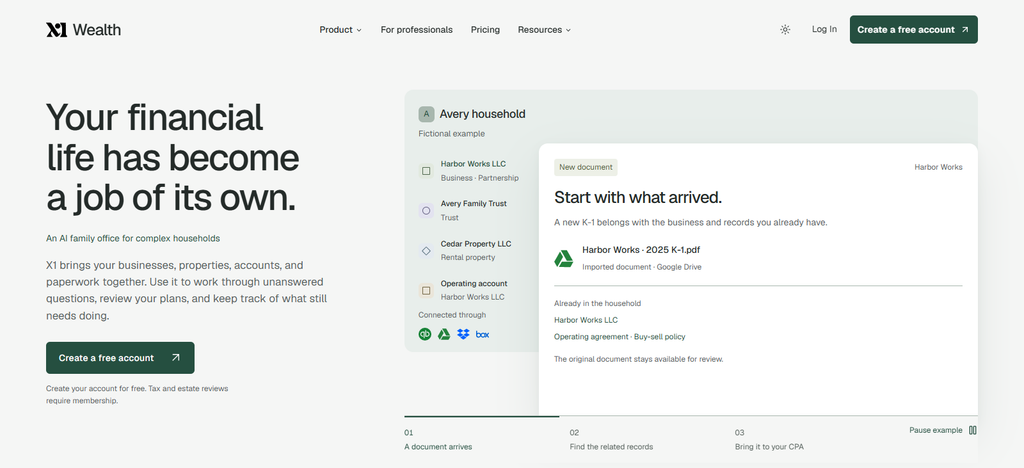
X1 Wealth provides customers the ability to track their investment portfolio and offers more advanced investment services, including finding and working with financial advisors. X1 Wealth caters to clients with complex financial situations, including clients with a household income exceeding $250,000.
Like Empower, X1 Wealth offers tools for estate planning and tax planning. However, its tools and services are more advanced than Empower, making it more suitable for affluent clients. Its services and tools differentiate it from Empower, especially for clients willing to pay for its services. Overall, X1 Wealth is more comprehensive than Empower.
| Feature | Details |
|---|---|
| Founded | 2023 |
| Cost | $97/month |
| Platform Type | Web + Mobile SaaS |
| Supported Accounts | Banks, brokerages, estate, tax |
| Investment Tracking | Advanced portfolio analysis |
| Advisor Features | Household + advisor coordination |
| Security | Encrypted + advisor-level |
| Pricing Model | Premium subscription |
| Best For | Affluent households |
X1 Wealth Advantages & Disadvantages
Advantages
- Advanced analysis of portfolios
- Integrates estate planning, tax planning
- By default set to overseer financial wellbeing of a household
- Allows collaboration of multiple financial advisors
- Employs top notch data security
Disadvantages
- At $97/monthly it’s extremely expensive
- Very limited user base
- Extremely complex to set up
- Doesn’t support budgeting
- Compared to Empower, it has even lesser user base.
Conclusion
As for 2026, the Empower alternative landscape seems competitive. For group budgeting, try Monarch Money. If you invest in crypto or other alternatives, check out Kubera. If you prefer a budgeting hierarchy, look at YNAB. If you are an Apple user, try Copilot. For a spreadsheet budget, try Tiller Money.
Betterment is a good choice if you want to integrate robo-investing. For subscription management, try Rocket Money. If you are in the market for a tax and estate plan, check out Mezzi. Quicken is always an option. Lastly, for ultra-high net worth individuals, check out X1 Wealth. In general, all of these options illustrate that the industry is innovative, competitive, and user-centered.
FAQ
What is Monarch Money?
Monarch Money, founded in 2020, is a subscription-based budgeting and net worth tracker costing $99.99 annually. It supports banks, credit cards, loans, and investments, with collaborative household features.
What is Kubera?
Kubera, founded in 2019, costs $199 per year and specializes in tracking crypto, NFTs, real estate, and private equity alongside traditional accounts. It’s designed for high-net-worth portfolios.
What is YNAB?
You Need A Budget (YNAB), founded in 2004, costs $14.99 per month or $99 annually. It focuses on zero-based budgeting, helping users control cash flow, with limited investment tracking.
What is Copilot?
Copilot, founded in 2020, costs $95 annually and is built for Apple users. It uses AI-powered categorization, supports banks and investments, and provides sleek net worth dashboards.
What is Tiller Money?
Tiller Money, founded in 2016, costs $79 annually. It integrates with Google Sheets and Excel, automating transactions into customizable spreadsheets for net worth and budgeting.