

This article talks about the best crypto transaction simulation APIs on the market. With these APIs, developers test blockchain transactions before execution. They can identify failure causes, price gas estimates, view the state changes, and analyze the behavior of the smart contract.
- What Are Crypto Transaction Simulation APIs?
- Why Transaction Simulation Matters in 2026
- Key Points
- 1. Bitquery
- Bitquery Developer Snapshot
- Key Simulation Capabilities
- Best Use Cases
- 2. Alchemy
- Alchemy Developer Snapshot
- Key Simulation Capabilities
- Best Use Cases
- 3. Moralis
- Moralis Developer Snapshot
- Key Simulation Capabilities
- Best Use Cases
- 4. Crypto APIs
- Crypto APIs Developer Snapshot
- Key Simulation Capabilities
- Best Use Cases
- 5. Binance API
- Binance API Developer Snapshot
- Key Simulation Capabilities
- Best Use Cases
- 6. Kraken API
- Kraken API Developer Snapshot
- Key Simulation Capabilities
- Best Use Cases
- 7. CoinStats API
- CoinStats API Developer Snapshot
- Key Simulation Capabilities
- Best Use Cases
- 8. Glassnode
- Glassnode Developer Snapshot
- Key Simulation Capabilities
- Best Use Cases
- 9. Dune Analytics
- Dune Analytics Developer Snapshot
- Key Simulation Capabilities
- Best Use Cases
- 10. CoinAPI
- CoinAPI Developer Snapshot
- Key Simulation Capabilities
- Best Use Cases
- Conclusion
- FAQ
We’ll compare these technologies and evaluate the leading platforms on their simulation capabilities, developer experience, networks supported, use cases, and overall the ability to develop Web3 applications that are more secure and reliable.
What Are Crypto Transaction Simulation APIs?
Crypto Transaction Simulation APIs are developer tools that allow applications to test a blockchain transaction before they send the transaction to the network. These APIs can simulate a transaction’s execution of a smart contract, and predict gas usage, potential reverts, and updates of user balances, tokens, or contract state.
These features are helpful for wallets, DeFi, trading, and web3 applications, since they allow developers to find out about possible failed transactions and unwanted outcomes that a user would have to pay gas for, or potentially lose funds.
Why Transaction Simulation Matters in 2026
Increased Transaction Success Rate: Transaction simulation enables developers to identify problems that result in the failure of a transaction and consequently recommend the final version that reduces gas cost.
Enhanced Transaction Security: Simulators reveal unanticipated token transfers, approvals, contract invocations, and other types of transactions prior to request signing.
Transparent Gas Cost Simulators: Simulation extends gas limit estimation and costs of gas and transactions to the user and application for optimal decision making.
Predictive State Changes: The more advanced the simulator, the more it is able to preview the changes in balance, movements of tokens, updates on the state of contracts, logs, and calls made internally.
Complex and DeFi Transactions Simulation: Running simulation on DeFi transactions and interaction with smart contracts allows developers to find anomalies prior to interactions with the contracts.
Improved User Experience in Wallets: Wallets translate blockchain execution into simple previews for users, allowing them to see the assets that will be sent and the assets that will be received.
Safe Transaction Execution for AI Agents: As Web3 agents begin to generate transactions, simulation can provide a validation layer for agents that are about to broadcast transactions.
Effective Smart Contract Debugging: Execution traces, decoded reasons for reversions, and reasons for failure allow developers to understand the failure of a transaction and the path that led to the execution of the contract.
Functionality across Multiple Chains: Developers working across multiple networks can validate the expected behavior of transactions using simulation.
Key Points
| API Provider | Strengths | Best For |
|---|---|---|
| Bitquery | GraphQL across 40+ chains, mempool simulation | Developers needing raw blockchain-native transaction simulation |
| Alchemy | Enhanced Web3 RPC, NFT + DeFi simulation | Web3 apps needing reliable node infrastructure |
| Moralis | Cross-chain wallet + token APIs, simulation endpoints | Multi-chain dApps and DeFi dashboards |
| Crypto APIs | Wallet, transaction, Web3 endpoints | Enterprises needing standardized transaction simulation |
| Binance API | Spot + futures + margin trade simulation | Exchange-level execution testing |
| Kraken API | Regulated execution, futures + staking simulation | Institutions needing compliance-ready transaction testing |
| CoinStats API | Wallets, DeFi positions, token security | Portfolio apps needing simulated DeFi transactions |
| Glassnode | 200+ on-chain indicators, entity-adjusted metrics | Research teams simulating macro transaction flows |
| Dune Analytics | SQL queries against any chain, custom simulation | Analysts building custom transaction models |
| CoinAPI | 400+ venues, unified schema | Multi-exchange transaction routing simulations |
1. Bitquery
Bitquery offers multiple APIs for blockchain data example transaction simulation, querying of smart contracts, and an analysis of decentralized finance. Bitquery supports multiple blockchains including Ethereum, BSC, Polygon, and Solana, meaning developers can test transactions before acting to prevent gas waste or unsuccessful calls.
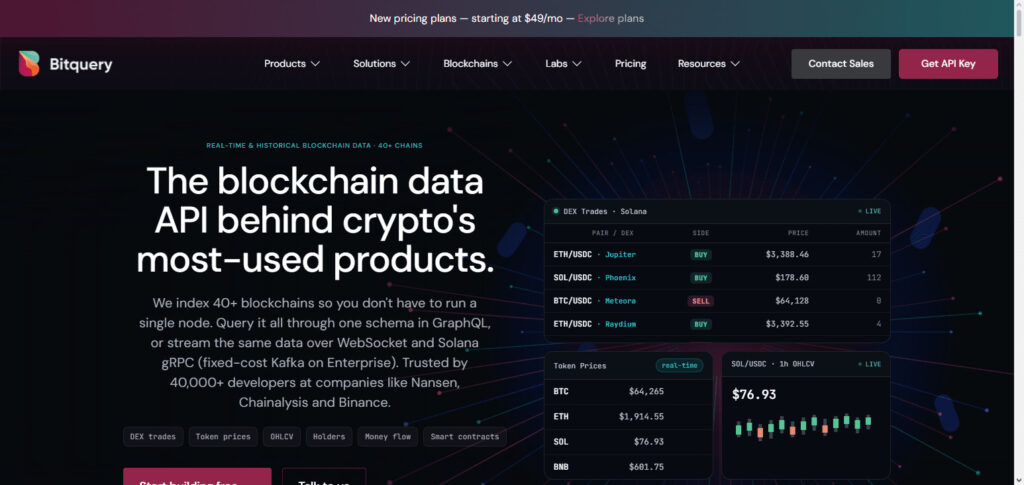
Bitquery uses GraphQL to offer its users the ability to query with a high degree of precision on token transfers, balances and trades on DEXs (decentralized exchanges). Bitquery is often the built the choice to build wallets, trading dashboards, and compliance tools.
Bitquery APIs offer historical data from blockchains making the APIs valuable for research and audits. Finally, developers rely on Bitquery to give them accurate previews of transactions to ensure cost-efficiency and reliability with decentralized applications. Bitquery is, without a doubt, one of the best crypto transaction simulation APIs.
Bitquery Developer Snapshot
| Developer Snapshot | Details |
|---|---|
| Core Platform | Blockchain data and analytics API infrastructure |
| Primary Interface | GraphQL APIs with real-time and historical datasets |
| Transaction Data | Transactions, transfers, contract calls, traces and events |
| Advanced Data | Mempool/pending transactions, DEX trades, balances and wallet flows |
| Best Developer Fit | Web3 apps needing transaction intelligence, mempool monitoring and on-chain data |
Key Simulation Capabilities
- Whether or not a transaction is successful before sending the data to a block.
- Use case data simulation.
- Mempool monitoring.
- Used for simulation of cross-chain transaction and event data.
- Used for event and transaction data.
Best Use Cases
- DeFi transaction analysis.
- MEV and arbitrage analysis.
- Transaction workflow across blockchains.
- Dashboards and blockchain explorers.
- High-frequency Web3 applications.
2. Alchemy
Alchemy has some of the best Web 3.0 APIs for blockchain simulation, transaction reliability and node infrastructure. Alchemy also has some of the fastest and most trustworthy Transaction Simulation APIs.
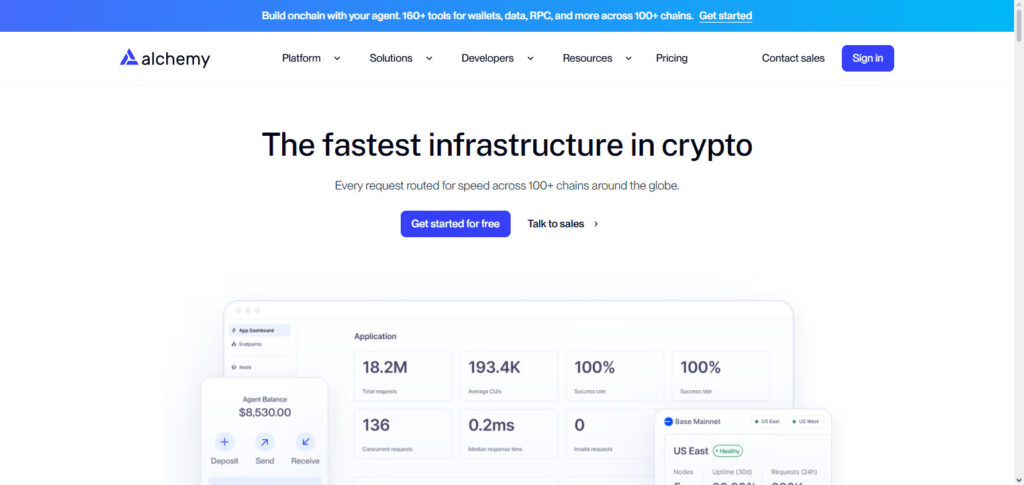
Developers of smart contracts use Alchemy’s APIs to check smart contract interactions for logically correct and gas efficient transactions. Alchemy provides Simulation APIs for Ethereum, Polygon, Arbitrum, and Optimism.
These Simulation APIs include real time transaction status notifications, debugging APIs, and other tools. Major dApps, NFT projects, and DeFi protocols trust Alchemy for its speed and reliability. Alchemy has one of the best crypto transaction simulation APIs.
Alchemy Developer Snapshot
| Developer Snapshot | Details |
|---|---|
| Core Platform | Blockchain development and RPC infrastructure |
| Simulation Interface | Transaction Simulation APIs |
| Simulation Output | Asset changes, execution traces and decoded logs |
| Advanced Capability | Sequential transaction/bundle simulation |
| Best Developer Fit | Wallets, DeFi apps and developers needing pre-execution transaction analysis |
Key Simulation Capabilities
- Simulates the execution of a transaction.
- Changes balance and assets after a transaction.
- Execution logs.
- Transaction simulation.
- Errors with a transaction.
Best Use Cases
- Wallet transaction preview.
- DeFi and DEX applications.
- Debugging of smart contracts.
- Transaction risk assessment.
- Pre-execution checks and validation for developers.
3. Moralis
Moralis has API tools that help developers work through building web 3.0 applications. developers can test call functions of smart contracts within their applications through Moralis’ Transaction Simulation API.
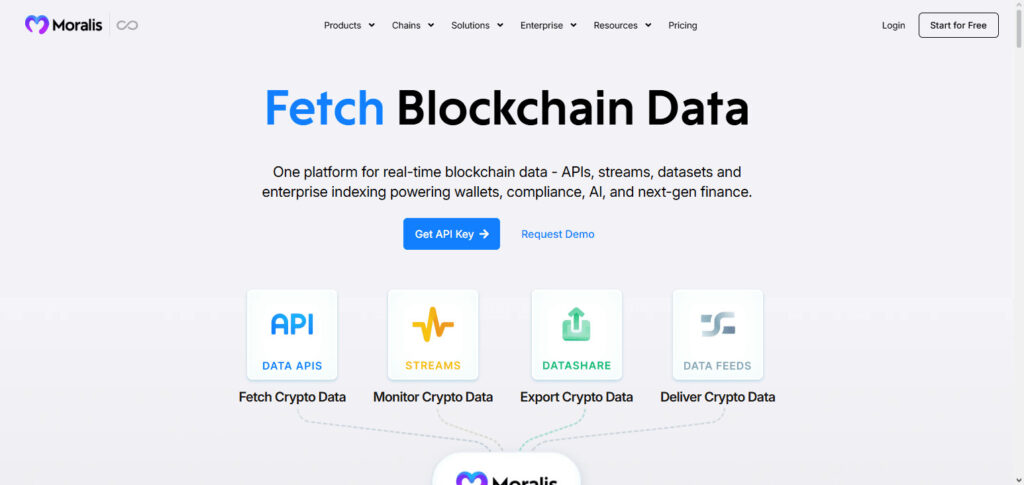
Moralis offers support for Ethereum, BSC, Polygon, and Avalanche. This makes it a prime choice for developers dealing with multi-chain apps. Moralis provides a variety of APIs to developers from which they can build complex dashboards and analytics tools, including APIs for NFT metadata and historical transactions, and for balances of cryptocurrency tokens.
Developers can integrate Moralis’ services rapidly as there are JavaScript SDKs for web and mobile unities. The sake of its speed and simplicity, Moralis stands out amongst other competitors as one of the best cryptocurrency transaction simulation APIs. —
Moralis Developer Snapshot
| Developer Snapshot | Details |
|---|---|
| Core Platform | Multichain Web3 data platform |
| API Coverage | Wallets, tokens, NFTs, transactions, DeFi and blockchain data |
| Transaction Data | Raw, decoded and enriched transaction information |
| Chain Coverage | EVM chains plus Solana data capabilities |
| Best Developer Fit | Wallets, DEXs, portfolio apps, trading terminals and Web3 applications |
Key Simulation Capabilities
- Use blockchain data to validate and construct transaction scenarios.
- Use data related to EVM transactions and contract interactions. ([Moralis][3])
- Gives wallet and token details for context of a transaction.
- Allows developers to check transaction results and on-chain activity.
- Helps developers weave transactional logic with broader Web3 details.
Best Use Cases
- Web3 app dev.
- Dev of DeFi transaction workflows.
- Construction of wallets and portfolio apps.
- Construction of token and NFT apps.
- Development of multichain dApps.
4. Crypto APIs
Transaction simulation, management of cryptocurrency wallets, and blockchain data services are some of Crypto APIs’ offerings. The Transaction Simulation API provides a way for developers to test transactions with different blockchains. This ensures the transactions are accurate and eliminates costly mistakes.

Bitcoin, Ethereum, and BSC are some of the blockchains supported and offer flexibility to exchanges, custodians, and fintech. Crypto APIs provides a variety of APIs to enable businesses to operate easily with blockchain services.
This makes it a prime choice for businesses. Crypto APIs blockchain services are trusted by institutions, and Crypto APIs’ simulation APIs make it one of the best transaction simulation APIs for cryptocurrency.
Crypto APIs Developer Snapshot
| Developer Snapshot | Details |
|---|---|
| Core Platform | Cryptocurrency and blockchain API infrastructure |
| Primary Focus | Digital-asset market and blockchain data |
| Integration Model | API-based access for applications and backend systems |
| Developer Use | Transaction, asset and market-data workflows |
| Best Developer Fit | Fintech, crypto applications, trading and digital-asset infrastructure |
Key Simulation Capabilities
- Uses API infrastructure for blockchain transaction data.
- Supports queries related to transactions executed on blockchains.
- Offers data on networks and transactions for pre-execution analysis.
- Works with blockchain automated workflows.
- Can be used to build systems to monitor transactions.
Best Use Cases
- Dev of crypto payment apps.
- Dev of blockchain-based monitoring systems.
- Dev of exchange infra.
- Dev of wallet apps.
- Enterprise infra for crypto integrations.
5. Binance API
Binance API is the foundation of the world’sleading crypto spot and futures exchange, where users can conduct cryptocurrency trading, access market data, and simulate transactions.
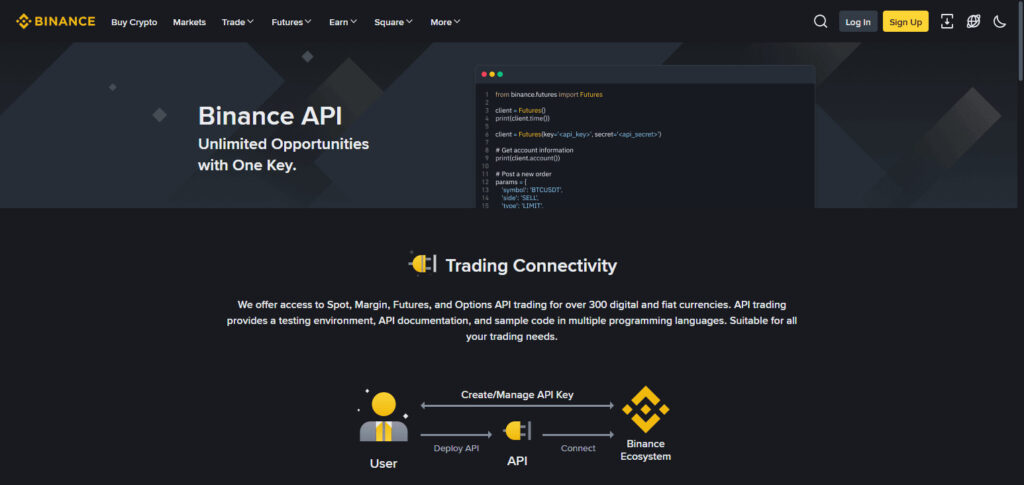
Binance’s comprehensive Spot and Futures APIs give users the opportunity to test their trading strategies and simulate transactions before they are executed. Binance’s open APIs allow live market order book data and price feeds. Binance also has the API infrastructure, as well as smart contract and trading bot sandboxes and testnets.
Binance’s API offers traders the connectivity to liquidity for over a thousand tokens, making it well suited for building advanced order management systems, trading and crypto portfolio apps, and even cryptocurrency arbitrage solutions.
Risk free testing of trading strategies makes the Binance API the best crypto transaction simulation API.
Binance API Developer Snapshot
| Developer Snapshot | Details |
|---|---|
| Core Platform | Binance exchange API ecosystem |
| Primary Focus | Trading, market data and account integration |
| Trading Access | Programmatic order and trading workflows |
| Market Data | Prices, order-book and market activity data |
| Best Developer Fit | Trading bots, algorithmic strategies and exchange-connected applications |
Key Simulation Capabilities
- Offers APIs for accessing Binance market and trading services.
- Offers a range of APIs for order management.
- Allows devs to check trading parameters prior to order placement.
- Offers trading market data for estimating order execution conditions.
- Works with auto trading systems for pre-order checks.
Best Use Cases
- Automated trading systems.
- Trading bot development.
- Market data systems.
- Frameworks for portfolio automation.
- Development of exchange-based trading systems.
6. Kraken API
Kraken API offers users functional access to one of the oldest and most trusted crypto exchanges to enable trading API and market data services, and transaction simulations. Kraken’s REST and WebSocket APIs allow developers to simulate trades in Kraken’s trading sandbox, provide order previews, and test trading strategies.
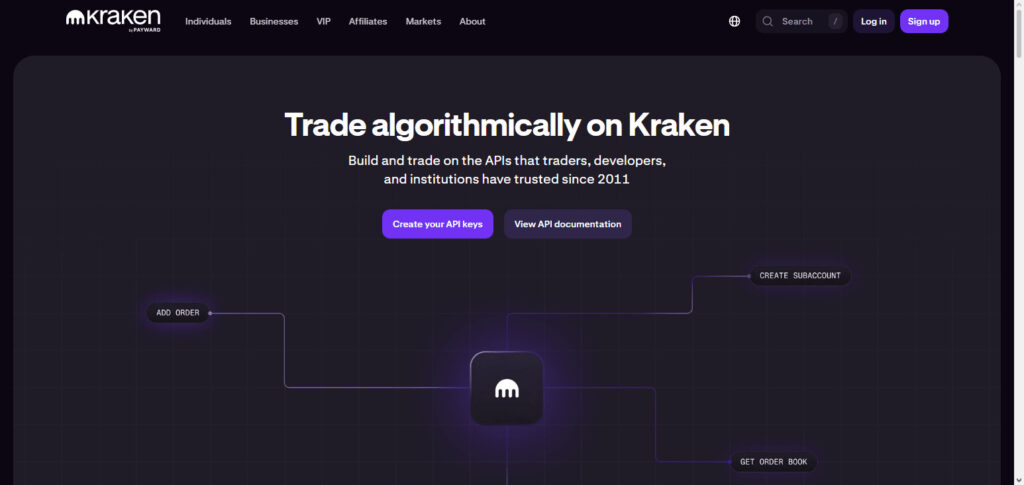
Kraken APIs support spot trading, futures, staking, and margin trading, making them appropriate for use across a variety of financial services. The Kraken API is secure and supports strong authentication.
Kraken’s simulation tools allow developers to test trading bots and trading strategies without exposing users to the risk of real funds. Kraken API is best suited for advanced usage and professional traders, and is widely regarded as one of the best cryptocurrency transaction simulation APIs.
Kraken API Developer Snapshot
| Developer Snapshot | Details |
|---|---|
| Core Platform | Kraken exchange API infrastructure |
| Primary Focus | Market data, trading and account services |
| Trading Access | Programmatic order-management workflows |
| Market Intelligence | Real-time cryptocurrency market information |
| Best Developer Fit | Trading applications, automated strategies and portfolio systems |
Key Simulation Capabilities
- Offers programmatic access for trading and market data provided by Kraken.
- Offers a range of APIs for order management.
- Offers market data to be used for estimating order execution conditions.
- Can be used to integrate trading logic with account data and order data.
- Works with pre-trade validations and auto trading systems.
Best Use Cases
- Development of trading bots.
- Development of automated trading platforms.
- Portfolio management apps
- Market data dashboards
- Automated exchange integrations
7. CoinStats API
CoinStats API helps developers create applications for managing their crypto portfolios and testing hypothetical transactions. Developers can access data from exchanges and track the balances of their wallets, their transaction history, and other metrics.

The CoinStats API is used in a number of wallet applications and portfolio tracking applications, as well as decentralized applications. Because of its ability to unify data, the CoinStats API is useful across multiple blockchains.
It is even used for tests and strategy development by users as they can simulate a variety of potential transactions. These capabilities make it an excellent crypto transaction simulation API regardless of who is using it, whether it is an institutional user or an individual investor.
CoinStats API Developer Snapshot
| Developer Snapshot | Details |
|---|---|
| Core Platform | Crypto portfolio and market-data infrastructure |
| Primary Focus | Portfolio, asset and investment data |
| Portfolio Data | Holdings, balances and cryptocurrency information |
| Integration Value | Useful for combining transaction activity with portfolio context |
| Best Developer Fit | Portfolio trackers, investment dashboards and crypto-fintech applications |
Key Simulation Capabilities
- Pulls crypto market portfolio data
- Summarizes key data for use in transactional data context
- Evaluates potential portfolio imbalances
- Can be used for transactional portfolio calculations
- Can be used to integrate transactional logic with broader portfolio data
Best Use Cases
- Portfolio management
- Tax and crypto reporting
- Investment dashboards
- Multi-wallet applications
- Portfolio tracking
8. Glassnode
One of the best transaction simulation APIs for advanced blockchain analytics, Glassnode API collects data on blockchain transaction and market intelligence while offering simulation and on-chain analytics. While Glassnode is highly recognized for its advanced modeling, it is also a solid choice for transaction simulation and an API to check the health of the network.
Glassnode has support for Bitcoin and Ethereum and other main blockchains. Users can evaluate market behavior, testoko transaction scenarios, and build transaction models based on Glassnode’s data on blockchain liquidity and exchange behavior and on blockchain wallet activity.
Simulating potential transactions helps users avoid failed transactions by checking the combination of congestion and transactions fees. Based on its blockchain on-chain data, Glassnode is regarded as one of the top crypto transaction simulation APIs for research and institutional trading.
Glassnode Developer Snapshot
| Developer Snapshot | Details |
|---|---|
| Core Platform | On-chain market intelligence platform |
| Primary Focus | Blockchain metrics and digital-asset analytics |
| Data Depth | Network, market and on-chain activity metrics |
| Historical Analysis | Useful for researching historical blockchain and market behavior |
| Best Developer Fit | Trading research, institutional analytics and on-chain intelligence |
Key Simulation Capabilities
- Offers data on transactions and network activity for market analysis
- Data on blockchain activity for analysis of market conditions
- Can be used to analyze network and asset-level activity
- Historical data can aid the development of transaction-related models
- Can be used to integrate transactional data with on-chain data
Best Use Cases
- Analytics for on-chain data
- Research for institutional crypto
- Development of trading strategies
- Risk monitoring
- Market and network data intelligence
9. Dune Analytics
Using Dune Analytics API allows developers to collect and analyze blockchain data with dashboard tools built on top of SQL. The API is able to support queries of data from smart contracts, as well as the transaction data from the Ethereum and Polygon blockchain. Dune also provides a community that develops dashboards and queries.
Being able to leverage on pre-built dashboards and queries means that a user may test many different scenarios, without the need to code it themselves from scratch.
Within this collaborative environment, the user is able to run several simulations such as token swaps, liquidity pool interactions, and governance votes. Dune Analytics is regarded as one of the top blockchain API’s for developing simulation and analysis tools for users, researchers, and the DeFi ecosystem.
Dune Analytics Developer Snapshot
| Developer Snapshot | Details |
|---|---|
| Core Platform | Blockchain analytics and data-query platform |
| Query Model | SQL-based blockchain data analysis |
| Transaction Analysis | Custom queries for transactions, contracts and protocol activity |
| Developer Value | Build customized datasets and analytics dashboards |
| Best Developer Fit | DeFi analytics, protocol research and transaction intelligence |
Key Simulation Capabilities
- Offers a blockchain analytics platform to conduct SQL based queries for transactional and smart contract data
- Offers historical data for transactions
- Can be used to understand the activities of protocols and wallets
- Can be used to develop transaction-related data models and risk execution
Best Use Cases
- DeFi analytics
- Smart contract activities
- Analysis of transactional data
- Development of custom protocol dashboards
- Blockchain intelligence
10. CoinAPI
CoinAPI helps developers perform analysis and simulations on trades. CoinAPI helps users perform simulations on transaction data and even produce order book data. Being able to simulate an order on several exchange APIs helps affirms the power of CoinAPI.
The APIs offer order book samples and real time trade streams for algorithmic trading and asset management. CoinAPI is able to help users perform both retail level development and also institutional level trading.
Outside of the ability to perform blockchain transactions, CoinAPI helps users perform market simulations. CoinAPI is a robust and secure system for blockchain API development for researchers and participants of the crypto market.
CoinAPI Developer Snapshot
| Developer Snapshot | Details |
|---|---|
| Core Platform | Cryptocurrency market-data API infrastructure |
| Primary Focus | Real-time and historical digital-asset market data |
| Data Utility | Prices, trading and market information |
| Integration Model | API-based data access for financial applications |
| Best Developer Fit | Trading systems, pricing engines, portfolio applications and market-data platforms |
Key Simulation Capabilities
- Offers standardized cryptocurrency market data infrastructure
- Can be used to support transaction-related calculations
- Performs historical and real-time analysis of market data.
- Assists applications in assessing market conditions pertaining to a prospective transaction.
- Becomes a component of trading and execution systems.
Best Use Cases
- Trading applications.
- Crypto pricing systems.
- Portfolio platforms.
- Institutional market-data infrastructure.
- Automated trading and execution analytics.
Conclusion
To summarize, crypto transaction simulation APIs have a great deal of variety and power for developers, crypto traders, and institutions. Bitquery, Alchemy, and Moralis have excellent multi-chain capabilities and developer friendly SDKs. Meanwhile, Crypto APIs and CoinAPI have great infrastructure with advanced compliance on a more enterprise scale.
Binance API and Kraken API allow users direct access to liquidity and trading simulations, which makes them essential for strategy development. For more advanced analytics, developers use Glassnode and Dune Analytics.
CoinStats API combines portfolio management and simulation. Together, these APIs build trust, confidence, and speed for blockchain development for secure transactions even during testing and optimization.
FAQ
What is a crypto transaction simulation API?
A crypto transaction simulation API allows developers to preview the outcome of blockchain transactions before execution. This helps avoid failed transactions, wasted gas fees, and unexpected smart contract behavior.
Which APIs are best for multi-chain support?
Bitquery, Alchemy, and Moralis stand out for supporting multiple chains like Ethereum, Polygon, BSC, and Avalanche, making them ideal for cross-chain dApps.
Are exchange APIs useful for simulation?
Yes. Binance API and Kraken API provide testnet environments and trading simulation features, enabling developers to test strategies safely with real market liquidity.
Which APIs focus on analytics-driven simulation?
Glassnode and Dune Analytics specialize in on-chain analytics and SQL-based dashboards, allowing simulation of transaction flows, token swaps, and liquidity pool interactions.
What API is best for portfolio simulation?
CoinStats API is excellent for simulating portfolio changes across multiple wallets and exchanges, helping users test strategies and track balances in real time.