

I will focus on the top AppChain-based Perpetual Futures DEXs like Hyperliquid, dYdX v4, GMX v2, the Injective Protocol, Sei Network, Vertex Protocol, ApeX Pro, Perp v3, Kwenta, and Level Finance.
- What Are AppChain-Based Perpetual Futures DEXs?
- Key Criteria to Rank the Best AppChain Perpetual Futures DEXs
- Key Point & Best AppChain-Based Perpetual Futures DEXs
- 1. Hyperliquid
- 2. dYdX v4
- 3. GMX v2
- 4. Injective Protocol
- 5. Sei Network
- 6. Vertex Protocol
- 7. ApeX Pro
- 8. Perp v3
- 9. Kwenta
- 10. Level Finance
- Conclusion
- FAQ
These DEXs are pioneering more sophisticated infrastructure with faster transaction times and superior liquidity, and employing more sophisticated tokenomics and competitive leverage to capture market share.
What Are AppChain-Based Perpetual Futures DEXs?
AppChain-based DEXs for perpetual futures utilize dedicated AppChains for providing highly performant derivatives trading. Unlike other DEXs, AppChain DEXs utilize dedicated blockchains. This allows them to have faster and cheaper transactions, scale better, and create custom trading environments.
These DEXs allow users to trade perpetual futures contracts with no set expiration dates, and come with various financial features like leverage, margin trading, funding rates, automated margin liquidations, and price feeds sourced from decentralized oracles.
By utilizing specialized blockchain technology for highly performant perpetual trading, AppChain DEXs aim to achieve speed comparable to centralized trading platforms, and retain the transparency and self custody of trading innovated with DeFi.
Key Criteria to Rank the Best AppChain Perpetual Futures DEXs
Infrastructure Strength: Determines if the DEX is built exclusively on an appchain, L2 or zk-rollup, and if scalability, latency, and congestion resilience are addressed.
Trading Performance: Analyzes daily trading volume and open interest along with order execution speed and robustness of order matching systems.
Liquidity: Identifies if the trading pair markets are deep and if slippage is acceptable while assessing the TVL of vaults and pools.
Tokenomics and Ecosystem: Evaluates the strength of the staking and the governance system and the distribution of fees across the DeFi ecosystem.
Speed of Transactions and Leverage: Assesses the latency of trades and the finality of settlement along with the risk management and flexibility trading parameters.
Key Point & Best AppChain-Based Perpetual Futures DEXs
| DEX | Best For | Key Features |
|---|---|---|
| Hyperliquid | High-volume perps | Custom L1 appchain, ~$3B daily volume, intent-based perps |
| dYdX v4 | Cosmos-native perps | Appchain architecture, order-book perps, pro trading tools |
| GMX v2 | Arbitrum/Avalanche | GM pools, oracle-priced perps, appchain liquidity |
| Injective Protocol | Cosmos ecosystem | Perp markets, cross-chain appchain, MEV protection |
| Sei Network | High-speed trading | Optimized appchain for perps, sub-second finality |
| Vertex Protocol | Arbitrum-native | Hybrid order book + AMM, appchain liquidity |
| ApeX Pro | Derivatives-first | Appchain execution, intent-based perps |
| Perp v3 | Ethereum scaling | Appchain modularity, oracle-based pricing |
| Kwenta | Optimism ecosystem | Appchain perps, synthetic assets |
| Level Finance | BNB Chain | Appchain perps, liquidity vaults |
1. Hyperliquid
Hyperliquid is the largest perp DEX on its own HyperCore L1 appchain with a CLOB. It boasts $21B+ daily volume and an open interest of $7.3B, and provides market-leading liquidity across 365+ pairs.
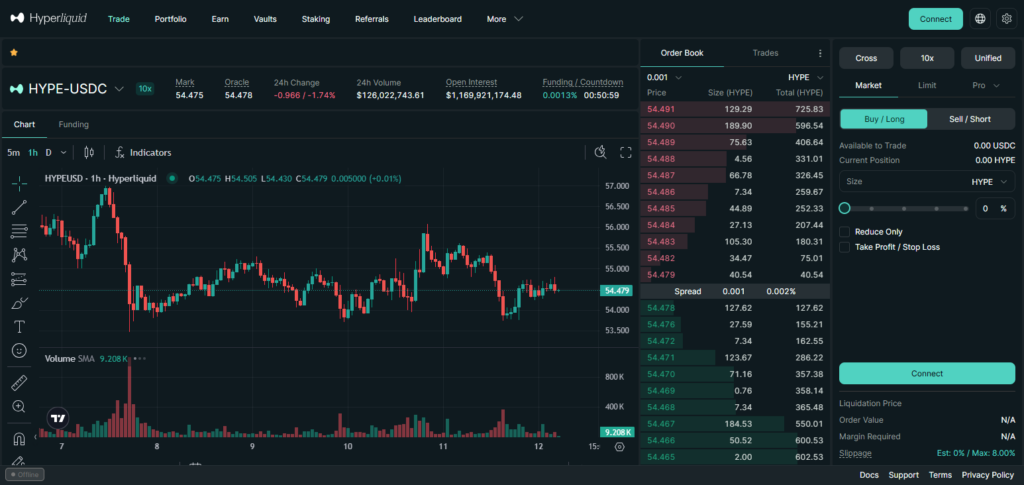
The fees are 0.015% maker / 0.045% taker while the utility hungry HYPE token provides governance, staking, and rewards. The ecosystem has a $1.3B Assistance Fund and $500M+ vault TVL providing support and greatly improving the volatility of the ecosystem.
There is low latency transaction speed that is transaction speed that is fast enough to entice high-frequency traders. Hyperliquid offers 50x leverage, and is a benchmark for AppChain-based perpetual futures trading.
Infrastructure: HyperCore L1 appchain infrastructure with central limit order book (CLOB).
Performance: Processes over $21B in daily trading volume and $7.3B in open interest.
Liquidity: Liquidity is robust with vault TVL across 365+ trading pairs.
Tokenomics: HYPE tokens are used for governance, staking, and rewards. HYPE has a market cap of $15B.
Leverage & Speed: Trades are executed at ultra-low latency with up to 50x leverage.
| Pros | Cons |
|---|---|
| Deep liquidity across 365+ pairs | Still relatively new ecosystem |
| $21B+ daily volume, $7.3B open interest | High leverage (50x) increases risk |
| Ultra-low latency infrastructure | Centralized order book may deter AMM-focused users |
| Strong tokenomics with HYPE governance | Complex for retail traders |
| Robust $1.3B Assistance Fund | Heavy institutional dominance |
2. dYdX v4
dYdX v4 moved to a Cosmos-based appchain and opted for a decentralized order book and serves 267+ pairs. dYdX emphasizes transparency and operates a liquidity preservation protocol. dYdX takers pay 0.02% compared to Hyperliquid’s taker fee of 0.045%.

As such dYdX retains liquidity but at what cost? dYdX’s model v4 is novel but apart from Hyperliquid, there is no dominant player in the field. Meanwhile, dYDX token holders can govern dYdX protocol, earn staking rewards, and receive trading rebates.
dYdX has optimized its Cosmos SDK in efforts for greater scalability and improved protocol throughput. dYdX v4 supports 25x leverage given the extreme nature of the rest of the protocol. dYdX v4 is setting a great example of how to run a successful AppChain perpetual futures DEX.
Infrastructure: Built on a decentralized order book on a Cosmos-based appchain.
Performance: Currently supports over 267 trading pairs.
Liquidity: Liquidity depth is competitive, but less than that of Hyperliquid.
Tokenomics: DYDX tokens are used for governance and staking. DYDX tokens are used for fee rebates.
Leverage & Speed: Settlement is quick and supports up to 25x leverage.
| Pros | Cons |
|---|---|
| Cosmos-based appchain ensures decentralization | Liquidity smaller than Hyperliquid |
| Transparent order book model | Limited leverage (25x) |
| Strong governance via DYDX token | Higher fees vs competitors |
| 267+ trading pairs supported | Ecosystem growth slower |
| High throughput and censorship resistance | Less attractive for high-frequency traders |
3. GMX v2
GMX v2, unlike its competitors, operates on both Arbitrum and Avalanche and uses an AMM + oracle pricing model and employs GM pools for liquidity.
This means GMX v2 has 31+ pairs available for trading and LP participation. Compared to its competitors, GMX v2’s fees come in higher at 0.05% maker / 0.07% taker, but GMX has built a lot of value around its protocol and the utility of its native token, GMX.GMX v2 is definitely worth a look when choosing a perpetual futures DEX.

GMX v2 has the highest leverage at 100x among major perp DEXs attracting aggressive traders. Infrastructure has improved since V1’s exploit enhancing security and reliability.
Transaction finality is optimized based on L2 scalability, and settlement happens efficiently. Although liquidity is narrower than order book models, it is sufficient to interest retail traders seeking high leverage opportunities.
Infrastructure: Built on Arbitrum & Avalanche and uses AMM with oracle pricing.
Performance: Currently supports over 31 trading pairs and has robust retail trading.
Liquidity: Uses pool-based liquidity which is narrower than order book liquidity.
Tokenomics: GMX tokens represent governance and rights to fee accrual.
Leverage & Speed: Supports up to 100x leverage. Speed varies based on L2 throughput.
| Pros | Cons |
|---|---|
| AMM + oracle pricing model | Liquidity narrower than order books |
| Retail-friendly pools for LPs | Dependent on L2 throughput |
| GMX token accrues fees | Past exploit history affects trust |
| Supports 31+ pairs | Limited institutional adoption |
| Offers up to 100x leverage | High risk for traders |
4. Injective Protocol
Injective is a Cosmos-native appchain highly optimized for derivatives and offers order book trading with 1s finality. It supports multiple perp markets with up to 20x leverage. Complemented with integrations across Cosmos IBC, liquidity is continuously growing.

The INJ token enables staking, governance, and fee rebates and has strong ecosystem utility. Infrastructure has a large focus on interoperability allowing for fastexecution and cross chain trades.
The transaction speeds and infrastructure makes it a strong choice for institutions and algorithmic traders over Hyperliquid or dYdX.
Infrastructure: Appchain on Cosmos that is optimized for derivatives.
Performance: Can achieve fast finality of trading at under 1 second, though perpetual contract markets are still growing.
Liquidity: Liquidity is growing through IBC integrations on Cosmos.
Tokenomics: INJ tokens are used for governance, staking, and provide fee rebates.
Leverage & Speed: Supports up to 20x leverage with
| Pros | Cons |
|---|---|
| Cosmos-based appchain optimized for derivatives | Smaller market share |
| Sub-second finality (~1s) | Limited leverage (20x) |
| INJ token with strong staking rewards | Liquidity still growing |
| Interoperability via Cosmos IBC | Ecosystem less diverse |
| Appeals to algorithmic traders | Less retail adoption |
5. Sei Network
Sei Network is a trading optimized L1 in Cosmos with sub-second finality and parallelized execution. It supports perp DEXs with high throughput and up to 20x leverage ensuring it is friendly to latency restricted trading strategies. Sei’s focus on optimized order matching also makes it friendly for trading strategies without high latency.

SEI secures the network, is used for governance and validator staking. Infrastructure including order matching is a large differentiator and allows for institutions to clear trades efficiently. Sei has a rapidly growing ecosystem making it an ideal choice for deploying perp DEX infrastructure.
Performance: Requires a high throughput, low latency trading infrastructure.
Liquidity: Relies on integrated perpetual protocols.
Tokenomics: Uses the SEI token to secure validators and vote on governance.
Leverage & Speed: Offers sub-second finality with up to 20x leverage.
| Pros | Cons |
|---|---|
| Cosmos L1 optimized for trading | Liquidity depends on integrated protocols |
| Parallelized execution for speed | Limited leverage (20x) |
| SEI token secures validators | Ecosystem still maturing |
| Sub-second finality | Smaller perp market coverage |
| Strong infrastructure for latency-sensitive trading | Less adoption compared to Hyperliquid |
6. Vertex Protocol
Vertex runs on Optimism’s OP Stack L2 (Ink) and employs a hybrid of order book and AMM at a 0% maker / 0.02% taker fee which ensures good liquidity. Vertex currently supports 23+ pairs.

The VRTX token encourages LP participation through governance and rewards. Liquidity is moderate-to-high with efficient hybrid matching. Transaction speed is enhanced by L2 scaling and is characterized by low slippage.
Vertex offers 50x leverage and offers mid-tier traders flexibility. Composability and flexibility are strengths for Vertex against other DEXs.
Infrastructure: Built using the Optimism OP Stack L2 (Ink).
Performance: Uses a hybrid order book and AMM model for optimized efficiency.
Liquidity: Offers 23 pairs with moderate liquidity depth.
Tokenomics: Uses the VRTX token for governance and liquidity provision rewards.
Leverage & Speed: Offers up to 50x leverage on fast L2 execution.
| Pros | Cons |
|---|---|
| Hybrid order book + AMM model | Moderate liquidity depth |
| Built on Optimism OP Stack L2 | Smaller ecosystem size |
| VRTX token incentivizes LPs | Limited trading pairs (23+) |
| Low fees (0% maker / 0.02% taker) | Not yet widely adopted |
| Up to 50x leverage | Competes with larger L2 DEXs |
7. ApeX Pro
ApeX Pro offers fast order book trading and security at scale through zk-rollups. It offers professional traders 50x leverage. Liquidity is growing with the APEX token which is used for governance, staking, and fee discounts. Infrastructure is focused on execution and control of trading risks.

Transaction speed is enhanced by zk-tech and is characterized by low slippage. ApeX Pro is a secure and scalable alternative in the perpetual futures trading ecosystem.
Infrastructure: Built using zk-rollups for a secure and scalable architecture.
Performance: High throughput and professional-grade execution.
Liquidity: Improving liquidity with clear and instant settlements.
Tokenomics: Uses the APEX token for governance, staking, and fee discount.
Leverage & Speed: Up to 50x leverage with low latency zk technology.
| Pros | Cons |
|---|---|
| zk-rollup infrastructure ensures scalability | Ecosystem still growing |
| Institutional-grade execution | Limited trading pairs |
| APEX token for governance & discounts | Liquidity smaller than leaders |
| High throughput with low latency | Complex for retail users |
| Up to 50x leverage | Less community-driven tokenomics |
8. Perp v3
Perp v3 is designed for Ethereum L2s, and has an AMM model for perpetual trading. It allows trading of many pairs with up to 20x leverage. It provides accessibility with risk management tools. Liquidity is provided by pools. The PERP token is used for governance, staking, and fees.
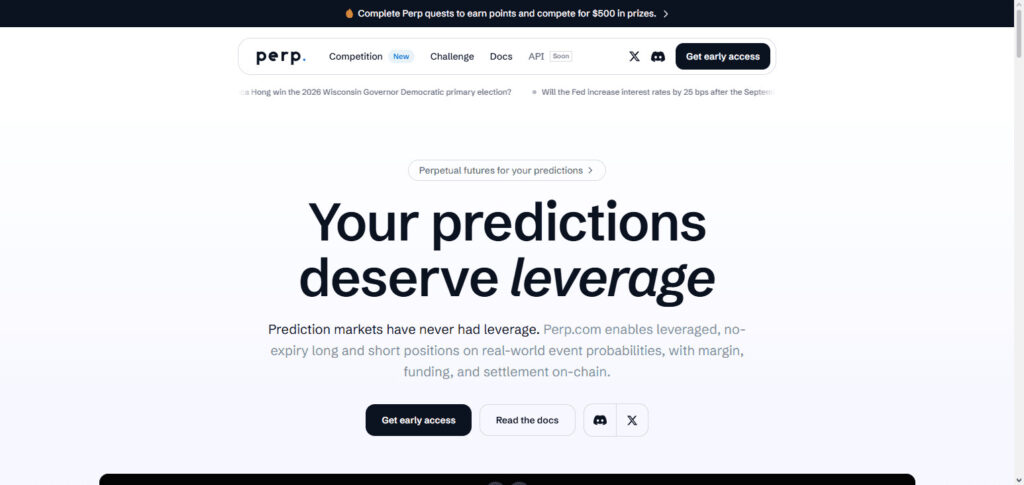
The focus on tokenomics encourages a vibrant community which should result in consistent growth. The speed of the transactions is limited by the scaling of the L2. Perp v3 will be used by traders that want a community focused perpetual futures exchange, that is decentralized.
Infrastructure: Ethereum L2 AMM with perpetual trading.
Performance: Efficient settlements for multiple trading pairs.
Liquidity: Community driven liquidity P2 pools.
Tokenomics: The PERP token is for governance and staking rewards.
Leverage & Speed: 20x leverage with L2 scaling speeds.
| Pros | Cons |
|---|---|
| Ethereum L2 AMM-based model | Limited leverage (20x) |
| Community-driven tokenomics | Liquidity pool dependent |
| PERP token for governance & staking | Smaller adoption vs competitors |
| Efficient settlement via L2 scaling | Narrow market coverage |
| Strong DeFi composability | Less attractive for institutional traders |
9. Kwenta
Kwenta offers synthetic perpetuals on Optimism L2 with up to 25x leverage. Liquidity for synthetic assets is provided by Synthetix pools and extends beyond typical crypto pairs. KWENTA is the governance and incentive token for Kwenta, and has a strong community.
The product is built with different synthetic assets and composable DeFi infrastructure to give users access to a variety of financial markets. Optimism’s scaling solution improves the settlement time. Kwenta is built for traders seeking innovative ways to participate in perpetual futures markets.
Infrastructure: Built on the Optimism L2 for synthetics and perpetual trading.
Performance: Enables the creation of synthetic assets beyond crypto.
Liquidity: Offers depth with liquidity from Synthetix.
Tokenomics: The KWENTA token is for governance and incentives for traders.
Leverage & Speed: Up to 25x leverage with fast L2 execution.
| Pros | Cons |
|---|---|
| Optimism L2 synthetic perp platform | Limited leverage (25x) |
| Deep liquidity via Synthetix pools | Niche synthetic asset focus |
| KWENTA token incentivizes traders | Smaller user base |
| Strong DeFi composability | Less mainstream adoption |
| Exposure beyond standard crypto pairs | Complex for new traders |
10. Level Finance
The BNB Chain hosts Level Finance and its AMM model with isolated pools. Level Finance offers multiple perp pairs with up to 50x leverage, and is therefore geared towards traders with higher levels of risk tolerance.

BNB Chain’s community-driven liquidity encourages the holding of LVL to govern, reward, and distribute fees. The Level Finance infrastructure targets optimal liquidity provision at minimal risk with careful balance of LP rewards and trader demand.
Level Finance utilizes BNB Chain’s high transaction throughput in order to execute trades as quickly as possible. The Level Finance ecosystem is offering perpetual futures trading as a DeFi alternative.
Infrastructure: Built on BNB Chain with AMM and isolated liquidity pools.
Performance: Offers the provisioning of risk-adjusted liquidity.
Liquidity: Offers community built pools with multiple pairs of liquidity.
Tokenomics: The LVL token is for governance, rewards, and distribution of fees.
Leverage & Speed: High throughput on BNB Chain, up to 50x leverage.
| Pros | Cons |
|---|---|
| BNB Chain AMM with isolated pools | Ecosystem less decentralized |
| LVL token for governance & rewards | Liquidity community-driven, less institutional |
| Risk-adjusted liquidity provisioning | Limited trading pairs |
| High throughput via BNB Chain | Competes with larger perp DEXs |
| Up to 50x leverage | Smaller global adoption |
Conclusion
In summary, the leading AppChain-based perpetual futures DEXs exemplify advanced build-outs of decentralized trading. Of these, Hyperliquid and dYdX v4 have the deepest liquidity and strongest ecosystems.
GMX v2 and Vertex Protocol are amongst the first to use high leverage. As for speed and interoperability, Injective and Sei Network shine. Lastly, Kwenta and Level Finance offer synthetic and risk-adjusted markets.
While each of the DEXs stands on its own, AppChain perpetual futures trading as a whole is making positive strides towards greater speed, scale, and empowerment of traders through innovative liquidity models, tokenomics, and TVL.
FAQ
What is an AppChain-based perpetual futures DEX?
An AppChain-based perpetual futures DEX is a decentralized exchange built on a dedicated blockchain (AppChain) optimized for trading perpetual futures contracts. These chains prioritize speed, scalability, and low latency for derivatives trading.
Which are the leading platforms?
The top platforms include Hyperliquid, dYdX v4, GMX v2, Injective Protocol, Sei Network, Vertex Protocol, ApeX Pro, Perp v3, Kwenta, and Level Finance. Each offers unique infrastructure, liquidity models, and leverage options.
Which DEX has the highest liquidity?
Hyperliquid leads with over $21B daily volume and $7.3B open interest, making it the most liquid AppChain perp DEX. dYdX v4 and GMX v2 follow with strong but smaller liquidity pools.
Which DEX is fastest in transaction speed?
Injective Protocol and Sei Network stand out with sub-second finality, making them ideal for algorithmic and high-frequency trading. Hyperliquid also offers low-latency execution.
Which DEX is best overall?
Hyperliquid currently dominates in liquidity, performance, and ecosystem strength, but dYdX v4 excels in decentralization, GMX v2 in leverage, and Injective/Sei in speed. The “best” depends on trader priorities—liquidity, leverage, decentralization, or speed.