




In this article, I will share the Best Blockchain RPC Providers for developers and Web3 applications. We’ll review the best platforms based on supported networks, RPC performance, scalability, node infrastructure, pricing, security, developer tools, and data access. This comparison will help developers to understand the main differences and to choose the right RPC infrastructure for their particular blockchain workloads and application needs.
What Are Blockchain RPC Providers?
Blockchain RPC providers are infrastructure services that enable decentralized applications, wallets, exchanges, and other Web3 platforms to interact with blockchain networks without the need for them to run and maintain their own nodes.
They offer Remote Procedure Call endpoints over HTTPS or WebSockets, allowing applications to read blockchain data, submit transactions, query smart contract data, monitor events and retrieve historical information.
In the background, the providers take care of the node infrastructure, network connectivity, scaling and reliability. Depending on the platform, developers may also get archive data, APIs, dashboards, analytics, dedicated nodes, security controls and enterprise support for production blockchain apps.
Blockchain RPC Pricing: What Should You Compare?
The advertized monthly subscription for a blockchain RPC is not the only factor to consider when considering the cost of a blockchain RPC as providers have different billing models and different resource limits.
Free tier Monthly credits Request limits Compute units Requests per second Overage charges WebSocket usage Archive-data costs Dedicated-node pricing Compare Also see if different blockchain networks or sophisticated APIs consume resources at different rates.
In terms of production, consider the cost of scaling as your traffic grows, not just the entry level plan. Enterprise users should also compare dedicated infrastructure, SLA options, support, data-transfer charges, and custom pricing to estimate total RPC infrastructure cost.
Key Points
| Provider | Best For | Key Strength |
|---|---|---|
| Alchemy | Full-stack Web3 development | Advanced APIs, analytics, and developer tooling |
| QuickNode | High-performance applications | Fast global RPC infrastructure |
| Chainstack | Multi-chain projects | Managed nodes with transparent pricing |
| Ankr | Scalable RPC access | Broad blockchain coverage |
| dRPC | Decentralized infrastructure | Distributed RPC routing network |
| Infura | Ethereum ecosystems | Established developer platform |
| Blockdaemon | Enterprise workloads | Institutional-grade infrastructure |
| GetBlock | Startups and SMBs | Dedicated and shared node access |
| NOWNodes | Multi-chain access | Large range of supported networks |
| Tatum | Rapid blockchain development | RPC infrastructure plus developer APIs |
1.Alchemy
Alchemy was founded in 2017 and provides blockchain RPC and Web3 infrastructure for developers building dApps, DeFi, wallets and financial applications. It supports 100+ blockchain networks including Ethereum, Base, Arbitrum, Polygon, Optimism, Solana, Bitcoin and other major ecosystems.
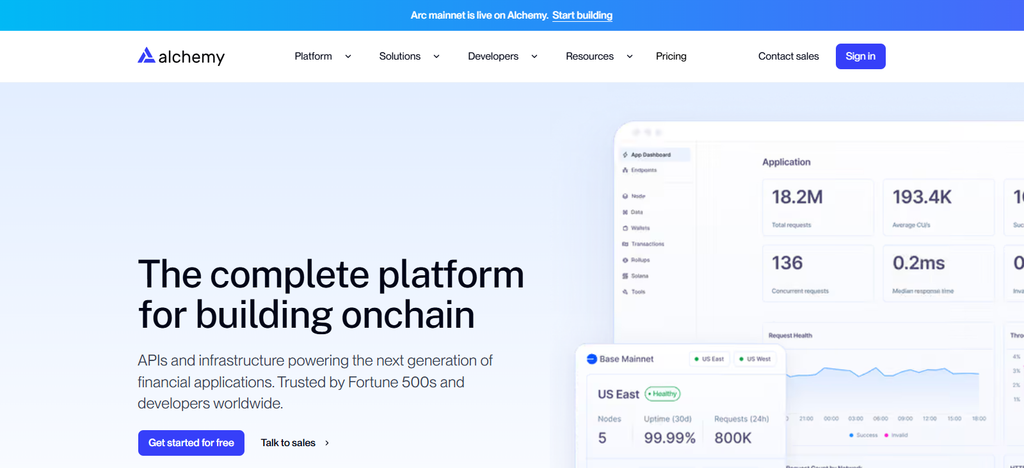
It provides RPC APIs, improved APIs, WebSockets, and developer tooling. Alchemy offers a free tier, with paid usage and enterprise plans.
Scaling is for growing application traffic . Performance is for globally distributed infrastructure and reliable endpoints . Security is API authentication, control of access, and enterprise infrastructure protection.
| Feature | Details |
|---|---|
| Blockchain Coverage | 100+ networks covering Ethereum, major Layer 2s, Solana, and other ecosystems |
| RPC Access | HTTPS and WebSocket RPC endpoints |
| Enhanced APIs | NFT, Token, Transfers, Prices, Portfolio and Simulation APIs |
| Developer Tools | Dashboard, debugging, monitoring, webhooks and developer APIs |
| Performance | Globally distributed infrastructure with routing designed for low-latency access |
| Scaling | Compute Unit-based usage with higher-capacity production infrastructure and Dedicated Clusters |
| Data Access | Standard blockchain data plus historical and enhanced indexed data |
| Transaction Features | Transaction simulation and gas-management capabilities |
| Security | API-key controls, authentication, access management and enterprise security features |
| Best Feature | Strong combination of RPC access and higher-level Web3 APIs |
2. QuickNode
QuickNode is a 2017 founded blockchain infrastructure provider providing RPC endpoints and developer APIs with multiple blockchain ecosystems. Its network coverage includes major EVM chains, Solana, Bitcoin and other Web3 networks.
The platform offers APIs, developer tools, monitoring, and HTTPS and WebSocket access for apps that require real-time data from the blockchain. The pricing is based on usage plans that include free and paid options.
Higher tiers provide more throughput and enterprise capabilities. Its infrastructure is designed for scaling RPC traffic as the applications grow. Security features include API-key controls, endpoint protection and infrastructure designed for production workloads.
| Feature | Details |
|---|---|
| Blockchain Coverage | 70+ blockchains with extensive EVM and non-EVM support |
| RPC Infrastructure | Managed RPC endpoints with HTTPS and WebSocket connectivity |
| Streams | Real-time blockchain data delivery for event-driven applications |
| Marketplace | Add-ons for specialized blockchain data and application functionality |
| Developer Tools | Endpoint dashboard, analytics, logs, APIs and monitoring |
| Performance | Global infrastructure and routing focused on low-latency RPC responses |
| Scaling | API-credit plans, higher RPS options and dedicated infrastructure |
| Data Features | Standard RPC, archive access and specialized APIs depending on network |
| Security | API authentication, endpoint controls and enterprise security capabilities |
| Best Feature | Broad RPC ecosystem combined with modular add-ons and Streams |
3. Chainstack
Chainstack was founded in 2018 and offers managed blockchain nodes, RPC endpoints, APIs, and infrastructure deployment for Web3 applications. It supports many networks on Ethereum, EVM chains, Solana, and other ecosystems and has full and archive node options.
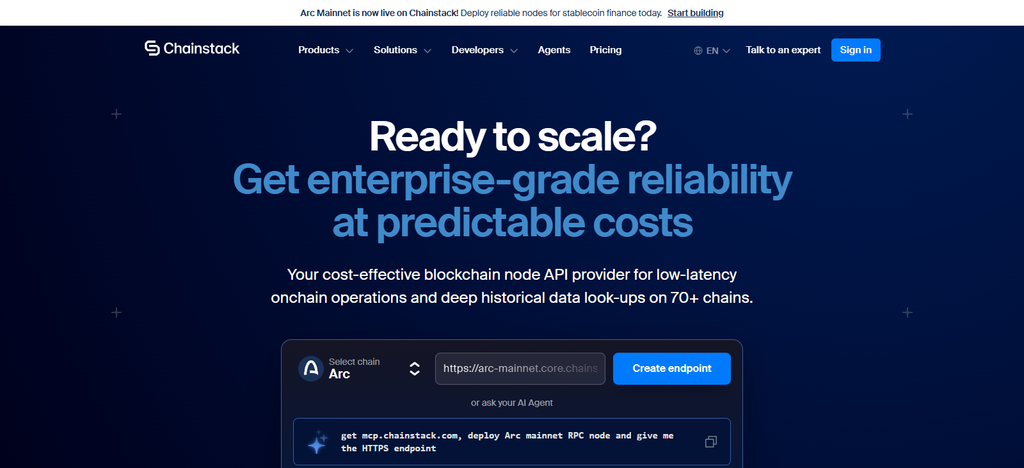
Plans are free for the Developer plan, and paid plans include Growth, Pro, Business and Enterprise. It can scale from simple developer workloads to high volume production traffic, with dedicated nodes for more isolation.
Chainstack also provides self-hosted infrastructure, monitoring, failover and multi-cloud deployment. Security including enterprise control of access, SSO, role-based permissions and compliance-oriented infrastructure.
| Feature | Details |
|---|---|
| Network Support | 70+ blockchain networks across major EVM and non-EVM ecosystems |
| Managed Nodes | Full nodes, archive nodes and dedicated blockchain infrastructure |
| RPC | HTTPS and WebSocket endpoints for supported networks |
| Deployment | Managed infrastructure across multiple cloud and geographic locations |
| Performance | Global routing and infrastructure designed for production workloads |
| Scaling | Shared plans can scale toward dedicated compute and infrastructure |
| Transaction Tools | Warp technology for faster transaction submission on supported networks |
| Developer Experience | Dashboard, API access, node management and usage monitoring |
| Team Controls | Role-based team permissions and enterprise access management |
| Security | Access controls, authentication, enterprise security and isolated infrastructure options |
4. Ankr
Founded in 2017, Ankr is a platform delivering Web3 API infrastructure for blockchain nodes distributed globally. It supports a wide range of EVM and non-EVM networks and offers Node API and Advanced API services for accessing blockchain data.
Ankr has public, freemium, premium and enterprise service plans, with its freemium option providing 200 million API credits free per month. Premium endpoints can handle about 1,500 requests per second and Solana endpoints can handle about 4,000 requests per second. Its infrastructure utilizes distributed nodes, API monitoring, scalable capacity and enterprise configurations for production applications.
| Feature | Details |
|---|---|
| Network Coverage | 80+ blockchain networks across EVM and non-EVM ecosystems |
| RPC Services | Public, Premium and enterprise RPC access |
| API Platform | Blockchain RPC APIs and enhanced APIs for application development |
| Performance | Published Premium capacity can reach 1,500 requests/second and higher for Solana |
| Scaling | Pay-as-you-go capacity with enterprise infrastructure options |
| Archive Access | Archive data is available across its RPC service tiers |
| Security | API-key restrictions including IP, domain/referrer and supported contract-level controls |
| Verifiable RPC | Cryptographically signed responses through its Verifiable RPC system |
| Alerts | Usage and blockchain-status notifications through supported channels |
| Best Feature | Broad multi-chain access combined with verifiable RPC and flexible API infrastructure |
5. dRPC
dRPC is a decentralized RPC infrastructure platform, designed to offer blockchain access via a distributed network of RPC providers. Founded in 2022 It supports multiple blockchain ecosystems and employs compute units to gage RPC workload.
Its current pricing documentation lists $0.30 per 1 million compute units, with supported RPC methods generally charged at 20 compute units. This architecture is designed to distribute requests to infrastructure providers so that applications can access scalable RPC capacity without being dependent on a single node operator.
dRPC is designed for redundancy, routing, performance and availability and API-based access and provider distribution support production Web3 applications.
| Feature | Details |
|---|---|
| Infrastructure Model | Decentralized RPC aggregation and routing network |
| Network Coverage | 100+ blockchain networks, with current published coverage varying by directory |
| Provider Network | Routes requests across multiple underlying RPC infrastructure providers |
| RPC Access | Standard blockchain RPC connectivity for supported chains |
| Load Balancing | Intelligent request routing across available infrastructure |
| Failover | Multiple providers and geographic infrastructure can support redundancy |
| Scaling | Usage-based Compute Unit model and scalable RPC capacity |
| Performance | Distributed routing designed to improve availability and response handling |
| Developer Access | API endpoints, dashboards and RPC management tools |
| Key Differentiator | Multi-provider architecture reduces dependence on a single RPC infrastructure source |
6. Infura
Infura, founded in 2016, is a veteran Web3 developer-focused blockchain infrastructure platform providing RPC endpoints, APIs and access to blockchain data. It currently supports ** 40+ networks ** on its platform . Among its supported infrastructure are Ethereum and major Layer-2 and blockchain ecosystems .
The free Core plan gives you 3 million credits per day. Developer starts at $50 per month and Team at $225 per month. Higher plans come with more throughput and support capabilities. Infura also provides full archive data, Debug and Trace APIs, Gas APIs, and enterprise infrastructure for scalable production applications.
| Feature | Details |
|---|---|
| RPC Infrastructure | Managed blockchain nodes and scalable API endpoints |
| Network Coverage | Major Ethereum, Layer 2 and other supported blockchain networks |
| RPC Protocols | HTTPS and WebSocket access depending on network |
| Developer APIs | Blockchain APIs, Gas API, Debug API and Trace API |
| Archive Data | Historical blockchain data and archive-node access on supported networks |
| IPFS | IPFS infrastructure alongside blockchain APIs |
| Scaling | Credit-based plans with higher capacity for development and production |
| Transaction Access | Transaction submission and blockchain interaction through RPC |
| Reliability | Managed node infrastructure and distributed service architecture |
| Security | API authentication, access controls and enterprise infrastructure protections |
7. Blockdaemon
Blockdaemon, founded in 2017, delivers institutional blockchain infrastructure including node deployment, RPC access, staking, APIs and blockchain connectivity. Its infrastructure is purpose-built for enterprises, financial institutions, exchanges and Web3 applications that require access to production-grade blockchains.
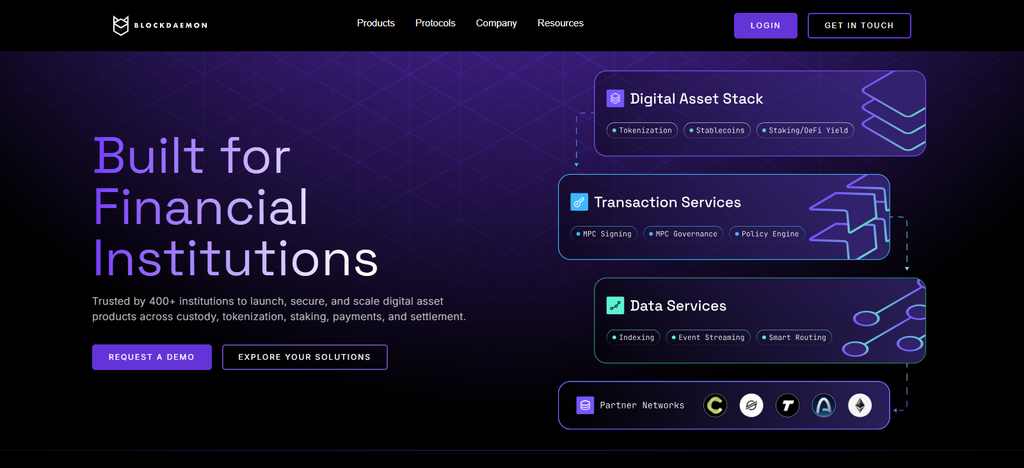
Supported networks are major blockchain ecosystems, although availability may differ based on specific Blockdaemon service. Pricing tends to be geared toward business and enterprise needs rather than simple consumer-style plans.
Performance on managed node infrastructure, reliability, monitoring, and scalable capacity. It can support both dedicated and managed deployments. Enterprise security, control of access, operational monitoring and compliance-centric capabilities are important parts of its infrastructure .
| Feature | Details |
|---|---|
| Enterprise Infrastructure | Blockchain infrastructure designed primarily for institutional and enterprise users |
| Node Services | Managed and dedicated blockchain nodes |
| RPC Access | Protocol-specific RPC and API connectivity |
| Network Coverage | Major blockchain networks with availability dependent on the selected service |
| Deployment | Cloud and dedicated infrastructure options |
| Geographic Reach | Infrastructure distributed across numerous global Points of Presence |
| Scaling | Dedicated nodes and enterprise capacity for higher-volume workloads |
| Monitoring | Infrastructure monitoring and operational management |
| Security | Enterprise access controls, infrastructure security and compliance-oriented services |
| Additional Services | Staking, wallet infrastructure, APIs and institutional blockchain services |
8. GetBlock
Founded in 2019, GetBlock provides RPC node infrastructure and API access for 130+ blockchain networks, supporting EVM and non-EVM ecosystems. Its services include shared nodes, dedicated nodes, archive data, WebSockets, MEV protection, analytics and multi-region routing.
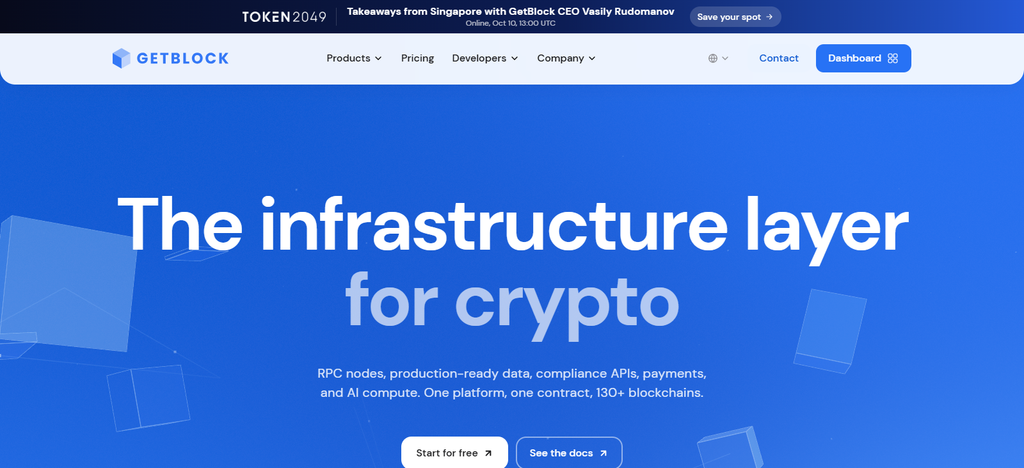
The pricing covers free and paid shared-node plans, with paid plans currently starting at around $39 a month. Enterprise and dedicated infrastructure are arranged separately. Performance scales with higher request per second limits, larger compute unit allocations, and dedicated nodes.
GetBlock also provides Regional infrastructure and enterprise setups. Security capabilities are MEV protection, controlled endpoints, infrastructure isolation and SLA-backed dedicated deployments.
| Feature | Details |
|---|---|
| Blockchain Coverage | 130+ networks according to its current published infrastructure information |
| RPC Access | API endpoints for EVM and non-EVM blockchain networks |
| Node Types | Shared nodes, dedicated nodes and archive infrastructure |
| WebSockets | WebSocket connectivity available for supported networks |
| Archive Data | Historical blockchain access for supported chains |
| Dedicated Infrastructure | Dedicated nodes for high-volume and enterprise workloads |
| Performance | Scalable request capacity with dedicated infrastructure options |
| Security | Protected endpoints and confidential RPC infrastructure |
| Developer Tools | API access, dashboards, monitoring and blockchain-specific endpoints |
| Special Features | MEV-related protection and region-oriented infrastructure options |
9. NOWNodes
Founded in 2019, NOWNodes is a blockchain infrastructure provider that offers full-node access and API access for developers and businesses. Its service gives access to multiple blockchain networks through RPC and blockchain APIs, which makes it suitable for wallets, exchanges, payment apps, explorers and Web3 products.
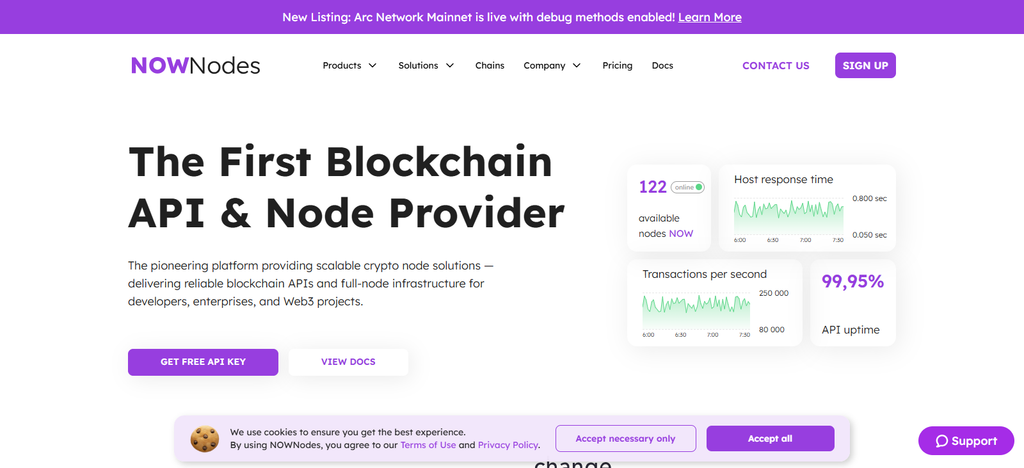
Prices are generally subscription-based and vary depending on the selected blockchain and service needs. Managed node infrastructure and API endpoints support performance and scaling is a matter of plan capacity and network access requested.
Security is centered on secure APIs, infrastructure management, authentication, and operational controls for blockchain apps.
| Feature | Details |
|---|---|
| Blockchain Coverage | 120+ blockchain networks according to current published provider information |
| Full Nodes | Managed full-node access across supported blockchain networks |
| RPC APIs | Blockchain RPC and API connectivity |
| Blockbook | Indexed Blockbook API for balances, transactions and blockchain information |
| Web3 Access | API-based access for wallets, exchanges and Web3 applications |
| Scaling | Shared subscriptions with dedicated infrastructure available for larger workloads |
| Performance | Managed node infrastructure and configurable request capacity |
| Data Access | Raw node information plus indexed blockchain data through supported APIs |
| Security | API authentication and managed infrastructure controls |
| Use Cases | Wallets, exchanges, explorers, payment applications and blockchain products |
10. Tatum
Tatum was founded in 2018 and offers blockchain infrastructure via unified APIs, SDKs, and managed blockchain nodes. Its platform supports many networks such as Ethereum, Bitcoin, Solana, Polygon, Tron, Base, Arbitrum, Avalanche and other major ecosystems. Tatum supports various tiers of blockchains based on availability and performance needs.
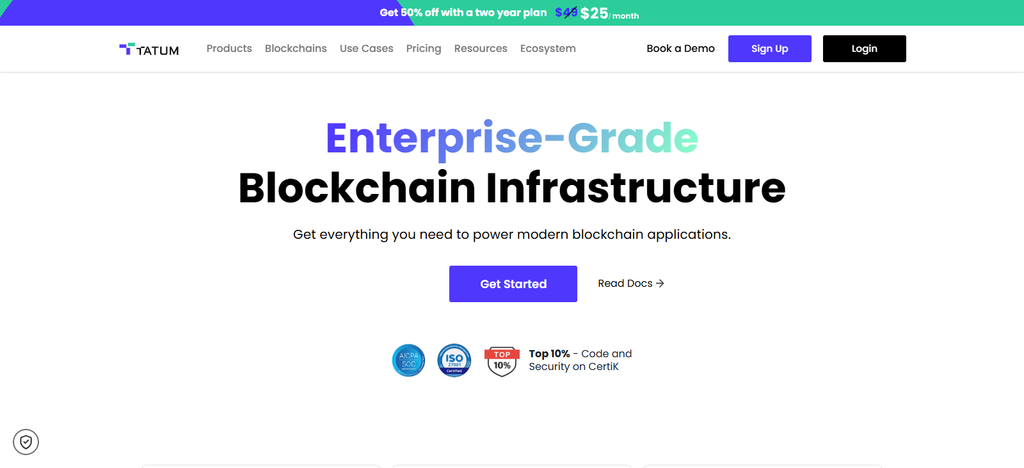
Its infrastructure includes high availability nodes, backup solutions and enterprise oriented support. Pricing starts from $99 per month for 10 RPS with higher throughput available, with dedicated API keys.
With dedicated capacity, applications can grow beyond the limitations of a shared environment, with isolated production capacity and predictable infrastructure costs.
| Feature | Details |
|---|---|
| Blockchain Coverage | 130+ blockchains across EVM and non-EVM ecosystems |
| API Model | Unified blockchain APIs designed to reduce chain-specific integration work |
| RPC Access | Managed RPC gateway and blockchain node connectivity |
| SDKs | Developer SDKs and APIs for blockchain application development |
| Smart Wallets | Smart-wallet and account-abstraction related functionality |
| Data APIs | Blockchain data, transaction and wallet-related APIs |
| Performance | Global routing with published sub-50 ms average latency claims |
| Scaling | Higher-capacity API plans and dedicated infrastructure for production workloads |
| Security | API keys, authentication and managed infrastructure controls |
| Additional Tools | Wallet infrastructure, transaction services, developer APIs and MCP support |
Blockchain RPC Providers Comparison Table
| Provider | Founded | Network Support | RPC Access | Performance & Scaling | Node Infrastructure | Developer Tools | Pricing Model | Security |
|---|---|---|---|---|---|---|---|---|
| Alchemy | 2017 | 100+ networks | HTTPS, WebSocket | Scalable API infrastructure, high-volume capacity | Shared and dedicated infrastructure | Enhanced APIs, SDKs, webhooks, dashboard | Free tier, usage-based, enterprise | API keys, access controls, enterprise security |
| QuickNode | 2017 | 70+ networks | HTTPS, WebSocket | High-throughput endpoints and scalable plans | Managed and dedicated infrastructure | Streams, Marketplace, analytics, dashboard | Free/paid, usage-based, enterprise | API authentication, endpoint controls |
| Chainstack | 2018 | 70+ networks | HTTPS, WebSocket | Global infrastructure and scalable deployments | Full, archive and dedicated nodes | Dashboard, APIs, monitoring, node management | Free, usage-based, paid, enterprise | RBAC, SSO, access controls |
| Ankr | 2017 | 80+ networks | HTTPS, WebSocket | Up to 1,500 RPS on supported Premium endpoints | Distributed node infrastructure | Blockchain APIs, dashboard, alerts | Free credits, pay-as-you-go, enterprise | API restrictions, authentication, Verifiable RPC |
| dRPC | 2022 | 100+ networks | Standard RPC | Distributed routing and multi-provider failover | Decentralized provider network | RPC management, API access, dashboard | Compute-unit based | Distributed architecture and endpoint controls |
| Infura | 2016 | 40+ networks | HTTPS, WebSocket | Credit-based scaling and enterprise capacity | Managed full and archive nodes | Gas, Debug, Trace, APIs, dashboard | Free tier, monthly plans, enterprise | API authentication and access controls |
| Blockdaemon | 2017 | Multiple major networks | RPC/API access | Enterprise-grade capacity and dedicated deployments | Managed, dedicated and institutional nodes | APIs, monitoring, infrastructure management | Custom/enterprise focused | Enterprise security and compliance controls |
| GetBlock | 2019 | 130+ networks | HTTPS, WebSocket | Scalable shared and dedicated capacity | Shared, dedicated and archive nodes | Dashboard, APIs, monitoring | Free, paid, dedicated, enterprise | Endpoint protection and infrastructure isolation |
| NOWNodes | 2019 | 120+ networks | RPC/API | Plan-based capacity and dedicated options | Managed full nodes | Blockbook, APIs, blockchain data tools | Subscription-based and custom | API authentication and managed infrastructure |
| Tatum | 2018 | 130+ networks | RPC/API | Global routing and dedicated capacity | Managed blockchain nodes | Unified APIs, SDKs, wallet tools | Free/paid API plans, dedicated | API keys, authentication, managed infrastructure |
Key Comparison Factors
| Factor | Providers to Compare |
|---|---|
| Broad Multi-Chain Coverage | Alchemy, GetBlock, Tatum, NOWNodes |
| Developer APIs | Alchemy, QuickNode, Tatum, Infura |
| Managed Node Infrastructure | Chainstack, Blockdaemon, GetBlock, NOWNodes |
| Distributed RPC Architecture | dRPC, Ankr |
| Archive & Historical Data | Alchemy, Chainstack, Infura, GetBlock |
| Enterprise Infrastructure | Blockdaemon, Alchemy, QuickNode, Chainstack |
| WebSocket Support | Alchemy, QuickNode, Chainstack, Ankr, Infura, GetBlock |
| Specialized Developer Tools | Alchemy, QuickNode, Infura, Tatum |
| Dedicated Infrastructure | QuickNode, Chainstack, Blockdaemon, GetBlock, Tatum |
| Multi-Chain API Approach | Tatum, Alchemy, Ankr, GetBlock |
Conclusion
Blockchain RPC providers form an integral part of the infrastructure of today’s Web3, enabling reliable access to data and transactions to link decentralized applications with blockchain networks. Alchemy, QuickNode, Chainstack, Ankr, dRPC, Infura, Blockdaemon, GetBlock, NOWNodes, and Tatum provide various combinations of networks, pricing, performance, scaling options, node infrastructure, APIs, and security features.
Developers should consider the supported networks, request limits, latency, WebSocket availability, archive access, pricing structure, reliability, and enterprise requirements when comparing platforms. Ultimately, the right choice depends on the application workload, technical requirements, expected traffic, supported blockchains, and long-term infrastructure needs.
FAQ
What Is a Blockchain RPC Provider?
A blockchain RPC provider offers APIs and node infrastructure that allow applications to communicate with blockchain networks. Developers use RPC endpoints to read blockchain data, submit transactions, monitor events, and interact with smart contracts.
Why Do Developers Use Blockchain RPC Providers?
RPC providers remove the need to operate and maintain blockchain nodes directly. They provide managed infrastructure, scalable endpoints, APIs, monitoring, and network access that can simplify development and production deployment.
Which Blockchain Networks Do RPC Providers Support?
Network coverage varies by provider. Platforms such as Alchemy, QuickNode, Chainstack, Ankr, Infura, GetBlock, and Tatum support multiple blockchain ecosystems, including Ethereum and various Layer-2 and other networks.
Are Blockchain RPC Providers Free?
Many providers offer free tiers or limited free credits for development. Paid plans generally provide higher request limits, additional networks, advanced APIs, dedicated infrastructure, or enterprise support.