




In this article, we will review the best Solana node providers for developers and blockchain projects. We will compare their Solana infrastructure, RPC performance, pricing, historical data access, geographic coverage, scalability and developer tools.
It will help you understand the differences between the top providers and what to consider when choosing reliable Solana infrastructure for applications and production workloads.
What Is Solana Node Providers?
Solana node providers are infrastructure services that provide developers managed access to the Solana blockchain, so developers don’t need to run and maintain their own validator or RPC nodes.
They offer RPC endpoints for reading blockchain data, submitting transactions, and interacting with accounts and programs. Depending on the provider, services may also include WebSockets, Yellowstone gRPC, archive data, webhooks, indexing APIs, dedicated nodes, and improved Solana APIs.
These services enable dApps, DeFi platforms, wallets, NFT applications, analytics programs, and trading systems to access Solana data through scalable infrastructure, performance monitoring, geographic routing and different pricing options depending on application needs.
Benefits Of Solana Node Providers
Faster access to the blockchain: Managed Solana RPC infrastructure provides reliable access to blockchain data for applications without developers having to build node infrastructure from the ground up.
Less Infrastructure Management: The provider takes care of the node deployment, maintenance, upgrades, monitoring, scaling and infrastructure operations, which reduces the technical burden on the development teams.
RPC Capacity Scales: As traffic grows, applications can increase their request capacity. Higher plans offer higher RPS limits, dedicated nodes and customized infrastructure.
Real-time Data Streaming: Support real-time transactions, account updates, blocks, and program activity for data intensive apps with WebSocket and Yellowstone gRPC support.
Historical Data Access: Providers with archival infrastructure allow developers to access older data from the Solana blockchain for analytics, indexing, research, backtesting, and application features.
Improved Reliability Managed services may utilize load balancing, redundancy, automatic failover, and multiple data centers to reduce downtime and improve service availability.
Global Infrastructure: Regional endpoints and geographic routing can allow applications to connect to infrastructure closer to their users or backend systems, perhaps reducing network latency.
APIs and Tools for Developers: Better APIs, webhooks, token data, NFT/DAS services, transaction APIs, SDKs make some common Solana development tasks easier.
Dedicated Infrastructure Options: In cases where shared endpoints are unable to handle the workload, dedicated RPC nodes or customized infrastructure can be deployed for high-volume applications.
Predictable Cost Models: Providers have a variety of models, including free tiers, subscriptions, pay-as-you-go credits, compute-unit pricing, and enterprise plans, allowing teams to select infrastructure that fits their usage.
Specialized Workload Support: Solana node providers can support heavy applications like DeFi, blockchain indexing, analytics, wallets, trading systems, gaming, NFT platforms, and real-time data services.
Key Points
| Solana Node Provider | Key Strength |
|---|---|
| Helius | Solana-native infrastructure with low-latency RPCs, LaserStream gRPC, transaction delivery services, and 99.99% uptime. |
| Alchemy | Enterprise-grade Solana RPC platform offering high throughput, extensive developer tooling, and multi-chain support. |
| QuickNode | Popular Web3 node provider known for reliable Solana RPC endpoints, broad network coverage, and developer-friendly APIs. |
| Triton One | Specialized Solana infrastructure provider focused on ultra-low latency, validator services, and trading workloads. |
| Chainstack | Offers scalable Solana nodes, dedicated deployments, archive access, and Yellowstone gRPC support. |
| Syndica | Solana-focused infrastructure platform providing RPC endpoints, data services, and enterprise-grade support. |
| dRPC | Distributed RPC network offering provider redundancy, load balancing, and affordable Solana access. |
| Ankr | Multi-chain node provider with Solana RPC services, global infrastructure, and cost-effective plans. |
| GetBlock | Managed RPC provider supporting Solana mainnet, testnet, and dedicated node options. |
| Blockdaemon | Institutional-grade node infrastructure with managed Solana nodes and enterprise security features. |
1 . Helius
Helius is an infrastructure provider for Solana RPC nodes, APIs, WebSockets, LaserStream gRPC, transaction services, webhooks, and solana data infrastructure. The Free plan offers 1M credits and 10 RPS.
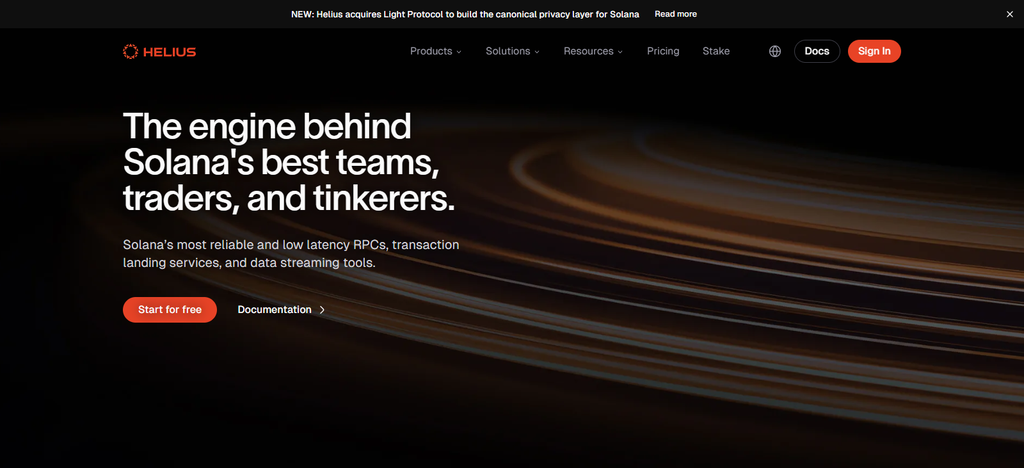
The Developer plan starts from $49/month and provides 10M credits and 50 RPS. The Business and Professional plans increase the capacity to 200 and 500 RPS respectively. Helius also supports archival RPC, saying its archival methods can query historical Solana data with much improved performance.
Its LaserStream system provides global streaming with regional redundancy and Sender has seven regional endpoints . Dedicated Solana infrastructure starts at $2,900/month for teams with custom performance and latency requirements.
| Feature | Details |
|---|---|
| Solana Focus | Solana-native infrastructure focused specifically on developers and applications building on Solana |
| RPC Infrastructure | Managed Solana RPC nodes with production-oriented endpoints |
| RPC Performance | Supports up to 10 RPS on Free, 50 RPS on Developer, and higher limits on larger plans |
| WebSocket | LaserStream-powered WebSockets with ordered streaming capabilities |
| gRPC | LaserStream gRPC for high-throughput, real-time Solana data |
| Transaction APIs | Transaction parsing and enhanced transaction-related APIs |
| Digital Asset APIs | DAS APIs for tokens, NFTs and digital-asset queries |
| Webhooks | Event-based notifications for Solana transactions and account activity |
| Archive Data | Archival RPC access for historical Solana queries |
| Staked Connections | Available for transaction delivery and improved landing performance |
| Dedicated Infrastructure | Dedicated RPC infrastructure available for larger workloads |
| Pricing Model | Credit-based plans; Free includes 1M credits, Developer is $49/month, with larger paid tiers available |
| Developer Tools | SDKs, APIs, dashboards and Solana-specific developer tooling |
| Best Fit | Solana dApps, DeFi, wallets, NFT applications, indexing and high-volume applications |
2. Alchemy
Alchemy provides Solana RPC infrastructure as part of its broader multi-chain developer platform. Its Solana offering includes private JSON-RPC and WebSocket endpoints, enhanced data services, webhooks, and transaction-related APIs.
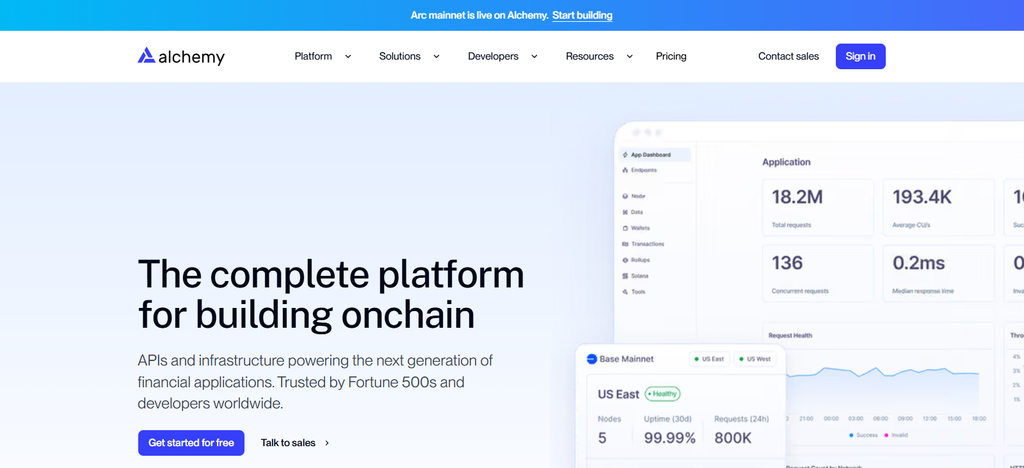
Alchemy’s 2026 comparison published: 30M compute units free allocation per month, pay-as-you-go starts at around $0.45 per 1M compute units, gRPC is priced separately. Its Solana infrastructure also provides archival access to historical transactions, blocks and signatures, with Alchemy claiming its archival techniques are much faster than other options.
Geographically, Alchemy provides production infrastructure through its broader distributed network, but Solana-specific regional node locations are not disclosed publicly in the same way as some providers.
| Feature | Details |
|---|---|
| Multi-Chain Platform | Developer infrastructure covering Solana and many other blockchain networks |
| Solana RPC | HTTP JSON-RPC endpoints for Solana Mainnet and Devnet |
| WebSocket | Native Solana PubSub subscriptions for accounts, programs, logs, signatures, slots, blocks and votes |
| gRPC | Yellowstone-compatible Solana gRPC |
| RPC Performance | Production throughput scales to 300 RPS on the published PAYG configuration |
| Heavy Methods | Optimized infrastructure for heavy methods such as getProgramAccounts |
| Archive Data | Full archival access for historical Solana data |
| Enhanced APIs | Enriched blockchain data and developer APIs |
| Webhooks | Webhook infrastructure for blockchain events |
| Gas Sponsorship | Gasless transaction/sponsorship capabilities |
| Analytics | Request analytics, tracing and monitoring tools |
| Pricing | Free up to 30M compute units; PAYG is currently $0.525 per 1M CU on the published pricing page |
| gRPC Pricing | Starting at $75/TB according to current pricing information |
| Geographic Infrastructure | Multi-region infrastructure with US East, US West, EU Central and APAC coverage |
| Best Fit | Production dApps, multi-chain applications, enterprise developers and teams needing RPC plus broader tooling |
3. QuickNode
QuickNode provides a complete Solana infrastructure stack including JSON-RPC, WebSockets, gRPC streaming, webhooks, full archive access, transaction execution and validator services.
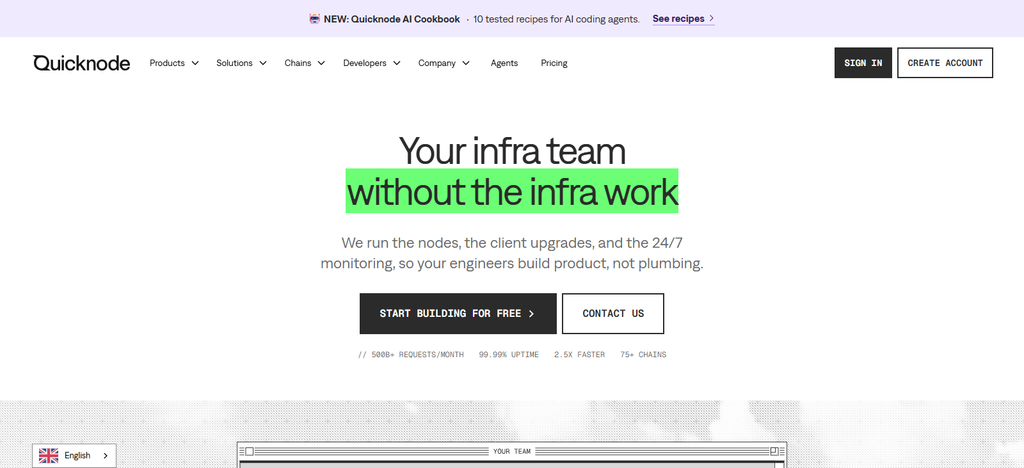
Current pricing: Free trial: 10M credits Build: Starting at $34/month (billed annually) Accelerate: Starting at $212/month (billed annually) Scale: Starting at $424/month (billed annually) Higher tiers offer higher RPS limits and gRPC access. QuickNode boasts 17+ global edge regions and automatic routing to nearby infrastructure.
It offers its Solana platform access to Mainnet, Testnet and Devnet plus full unpruned archive access on Mainnet. QuickNode also posts live metrics for performance, advertising up to 100,000 Solana requests per second across its infrastructure today.
| Feature | Details |
|---|---|
| Solana RPC | Full Solana JSON-RPC infrastructure for Mainnet and Devnet |
| WebSocket | Real-time Solana WebSocket connectivity |
| gRPC | Solana gRPC streaming with Geyser-compatible data |
| Archive | Full Solana historical archive with heavy ledger methods |
| Streaming | Streams for push-based blockchain event delivery |
| Webhooks | Targeted notifications for addresses, programs and on-chain conditions |
| RPC Performance | Published infrastructure supports 100,000+ Solana requests per second |
| Latency Monitoring | Provides P95 Solana RPC latency benchmarking |
| Transaction Tools | Transaction execution and transaction-landing services |
| Validator | Zero-fee Solana validator and validator-as-a-service |
| Swap API | Transaction and swap infrastructure for trading applications |
| SDKs | TypeScript, Python, Rust and Go SDK support |
| Global Infrastructure | 17+ global edge regions according to its current Solana page |
| Security | SOC 1, SOC 2 and ISO 27001 listed for its enterprise infrastructure |
| Pricing | Credit-based plans with free/trial access and paid plans that scale with usage |
| Best Fit | Multi-chain teams, Solana dApps, trading, wallets, analytics and high-throughput applications |
4. Triton One
Triton One is focused heavily on Solana infrastructure, and provides standard JSON-RPC, WebSockets, gRPC, archival access, custom indexes, and specialized streaming services. It is currently priced on a prepaid pay-as-you-go basis, with a minimum deposit of $125.
Standard RPC and unary gRPC are charged at $10 per million calls and $0.08/GB bandwidth, while streaming is mostly charged for bandwidth. Triton also provides full Solana historical data from genesis, with very old queries being sent to its BigTable archival backend, with those specific archive requests costing $25 per million queries.
Triton uses a global network of bare-metal nodes with GeoDNS routing and automatic failover for performance. Its infrastructure is particularly designed for low-latency workloads such as trading, indexing, analytics and real-time Solana data streaming.
| Feature | Details |
|---|---|
| Solana Specialization | Strong focus on high-performance Solana infrastructure |
| JSON-RPC | Full Solana JSON-RPC support |
| WebSocket | Whirligig WebSockets for reliable real-time subscriptions |
| gRPC | Dragon’s Mouth Geyser-powered gRPC streaming |
| Historical Data | Full Solana history back to genesis |
| Archive Technology | BigTable and Old Faithful archival solutions |
| Custom Indexing | Steamboat indexes optimized for heavy getProgramAccounts workloads |
| Transaction Delivery | Cascade transaction network using stake-weighted QoS |
| Digital Asset API | Indexed API for NFTs and other Solana digital assets |
| RPC Performance | Bare-metal infrastructure, GeoDNS routing and automatic failover |
| Geographic Coverage | Global bare-metal infrastructure with regional deployments |
| Pricing | Pay-as-you-go with a $125 minimum deposit; features are not tier-gated |
| Support | One-to-one support from senior engineers |
| Dedicated Nodes | Dedicated infrastructure available for specialized workloads |
| Best Fit | Trading, HFT, MEV, indexing, analytics and latency-sensitive Solana applications |
5. Chainstack
Chainstack offers managed Solana RPC infrastructure such as regional and global nodes, archive nodes, dedicated infrastructure, and Yellowstone Geyser gRPC. Its current Developer plan is free with 3M request units, Growth plans start at $49/month, Pro at $199/month,
Business at $499/month and Enterprise from $990/month. Chainstack’s published plans increase RPS capacity, with higher tiers offering up to 600 RPS and enterprise plans supporting custom RPS. Archive requests require more request units than standard requests, with Chainstack currently allocating two RUs to archive requests.
Its Yellowstone Geyser add-on for gRPC costs $49/month and supports real-time streaming of Solana transactions, accounts, and blocks. Chainstack also provides geo-balanced RPC infrastructure and dedicated-node setups for apps with higher volumes.
| Feature | Details |
|---|---|
| RPC Infrastructure | Managed blockchain nodes with Solana support |
| Deployment Options | Shared, dedicated cloud and self-hosted infrastructure |
| Solana gRPC | Yellowstone Geyser gRPC for transactions, accounts and blocks |
| WebSocket | Available across supported node infrastructure |
| Archive | Archive data available on paid plans |
| RPC Performance | Developer plan starts at 25 RPS; higher plans scale to 250, 400 and 600 RPS |
| Dedicated Nodes | Dedicated nodes available from the Pro tier |
| Unlimited Node | Option designed for high-volume RPC workloads with predictable RPS-based costs |
| Transaction Routing | Warp transactions for optimized transaction propagation |
| MEV Protection | Private transaction routing to reduce MEV exposure |
| Geographic Infrastructure | Regional and global infrastructure across Asia-Pacific, Europe and the United States |
| Pricing | Developer free with 3M request units; Growth $49/month, Pro $199/month, Business $499/month |
| Enterprise | Custom RPS, volume discounts, SLA and higher capacity |
| Security | SOC 2 Type II and ISO 27001 listed |
| Best Fit | Startups, production dApps, enterprises, indexing, trading and teams requiring deployment flexibility |
6. Syndica
Syndica is an infrastructure provider built on RPC access, high-throughput blockchain data, and production-grade developer infrastructure on Solana. The current 2026 comparison data shows free allocation of ~10M requests per month and paid entry point ~$199/month, but exact commercial pricing should be verified directly before publishing.
Its Solana infrastructure provides RPC access and specialized data services for applications requiring increased reliability and throughput. Historical data availability is said to be partial, rather than automatically equivalent to a full genesis archive, so developers should verify the exact historical range required for their application.
Syndica is focused on Solana-native teams and enterprise workloads, with infrastructure built for production. That’s because public geographic node-location details and region-by-region performance figures are not as widely published as those of providers that have openly documented regional dashboards.
| Feature | Details |
|---|---|
| Solana Focus | Infrastructure focused specifically on Solana |
| RPC Nodes | Enterprise-grade dedicated Solana RPC infrastructure |
| RPC Architecture | Elastic RPC architecture designed to automatically scale and load-balance requests |
| RPC Performance | Syndica states its implementation delivers up to 2.5× faster latency per method than competitors |
| Slot Lag | Designed for low average slot lag |
| ChainStream | Real-time streaming of Solana transactions, slots and blocks |
| Monitoring | Detailed RPC request logging and monitoring |
| Observability | Filtering, searching and time-slice analysis for RPC calls |
| Deployment | Infrastructure designed for development through mainnet-scale workloads |
| Reliability | Built for resilience during cloud or hardware outages |
| Archive | Historical-data availability should be checked against the specific required dataset and plan |
| Support | Dedicated enterprise support |
| Security | Infrastructure designed around enterprise and compliance requirements |
| Best Fit | Solana-only applications, enterprise RPC, analytics, monitoring and high-volume workloads |
7. dRPC
Whereas single-provider RPC infrastructure is limited, dRPC operates as a distributed RPC network that can broadcast requests to several infrastructure providers. As of now, comparison data for 2026 is… Public free allocation of ~ 210M compute units per month Paid plans start at ~ $ 6 / month, but pricing is subject to configuration and network .
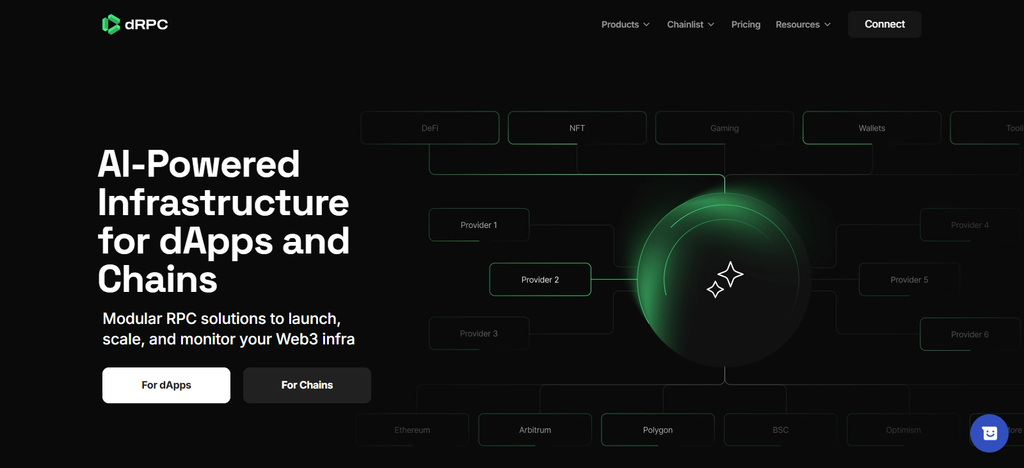
Its architecture can offer redundancy and routing, rather than needing to rely on one Solana node cluster. dRPC also supports configurable pricing rules that can apply different pricing to networks, archive requests and geographic regions. Its infrastructure model includes regional routing and provider selection.
Historical access depends on the underlying providers and available archive sources, so users should check archive depth for specific Solana workloads rather than assuming universal genesis-level coverage.
| Feature | Details |
|---|---|
| Infrastructure Model | Distributed RPC network that can route requests across underlying providers |
| Solana RPC | Solana RPC access through its distributed infrastructure |
| Pricing Model | Pay-as-you-go compute-unit model |
| Compute Units | Standard RPC methods are generally priced at 20 CU according to current documentation |
| CU Price | Current documentation lists $0.30 per 1M CU |
| Routing | Provider-aware routing and infrastructure selection |
| Redundancy | Can provide an additional routing/redundancy layer instead of depending on one infrastructure provider |
| Analytics | Dashboard for monitoring provider and RPC activity |
| RPS | Current comparisons report scaling into high-RPS workloads depending on configuration |
| Geographic Routing | Latency-aware, multi-region routing |
| Archive | Availability can depend on the upstream infrastructure/provider used |
| MEV | Supports infrastructure options for transaction routing and MEV-related workloads |
| Provider Management | Configurable provider pricing and routing rules |
| Best Fit | Multi-provider redundancy, RPC aggregation, routing and cost-sensitive applications |
8. Ankr
Ankr offers multi-chain RPC infrastructure, including Solana support, with HTTPS RPC, WebSocket and gRPC access. Its present pay-as-you-go pricing shows Solana HTTPS requests at 500 API credits, or $0.00005 per request. Solana WebSocket subscriptions and notifications are also priced at $0.00005 each, while gRPC is billed separately based on method calls and data transfer.
This model makes Ankr relevant for developers looking for usage-based infrastructure rather than a single fixed monthly allocation. Its RPC platform is based on a distributed multi-chain infrastructure although the location of the Solana nodes is not as widely represented as some dedicated Solana providers.
The availability of historical/archive can vary between plans and networks. Applications that require deep Solana history should verify the supported archive range before deployment.
| Feature | Details |
|---|---|
| Multi-Chain Infrastructure | RPC infrastructure supporting many blockchain networks |
| Solana RPC | Solana HTTPS RPC support |
| WebSocket | Solana WSS support on applicable paid plans |
| gRPC | gRPC API support is available |
| Archive Data | Full and archive data listed across its service plans |
| RPC Pricing | Solana HTTPS calls are currently priced at 500 API credits or $0.00005 per request |
| WebSocket Pricing | Solana subscriptions and notifications are currently listed at $0.00005 each |
| gRPC Pricing | gRPC method calls and data transfer are billed separately |
| Rate Limits | Current premium documentation lists up to 1,500 requests per second |
| Advanced APIs | Additional API capabilities available on higher plans |
| Global Infrastructure | Global node coverage and distributed infrastructure |
| Enterprise | Custom rate limits, region orchestration, engineering support and custom SLA |
| Multi-Project | Personal API tokens and multi-project statistics on applicable plans |
| Best Fit | Multi-chain applications, cost-sensitive developers and teams needing broad network coverage |
9. GetBlock
GetBlock provides managed blockchain RPC infrastructure with support for Solana via shared and dedicated nodes. Its published plans include a free tier, while paid shared infrastructure starts around $39/month in its current pricing presentation with higher plans increasing compute units, endpoints and RPS.
Shared-node features GetBlock lists archive data WebSockets MEV protection Three-region geo-routing Custom performance, unlimited request configurations and higher guarantyd capacity enabled by dedicated infrastructure, with Solana dedicated configurations supporting JSON-RPC and WebSocket and optional Yellowstone gRPC.
GetBlock also publishes a Solana latency figure of about 6ms for its European benchmark in its comparison materials, but benchmark conditions are important when evaluating performance. Geographic routing is particularly important for applications that need region aware RPC access.
| Feature | Details |
|---|---|
| Solana RPC | Managed Solana RPC infrastructure |
| Interfaces | JSON-RPC and WebSocket |
| gRPC | Yellowstone gRPC available as an add-on |
| Solana Networks | Mainnet and Devnet |
| Archive | Archive-enabled infrastructure for historical queries |
| Shared Nodes | Shared RPC plans with usage-based Compute Unit billing |
| Dedicated Nodes | Private, customizable infrastructure for high-load applications |
| RPC Performance | Shared plans currently scale from 20 to 500 RPS, with dedicated configurations supporting higher capacity |
| Geographic Routing | Solana infrastructure currently lists Frankfurt and Singapore |
| Global Routing | Geo-intelligent routing and automatic failover |
| Monitoring | Latency and node-health monitoring |
| MEV Protection | Available on paid shared infrastructure |
| Pricing | Published shared plans start at $39/month, while dedicated Solana configurations are custom |
| Dedicated Performance | Dedicated infrastructure offers unlimited-request configurations and SLA-backed capacity |
| Best Fit | Multi-chain applications, high-load Solana projects, enterprise infrastructure and teams requiring regional control |
10. Blockdaemon
Blockdaemon offers institutional-grade blockchain infrastructure, including managed node and RPC services, for organizations that need production infrastructure and enterprise Web3 connectivity. Current 2026 comparison info has about 3M compute units in its free allocation and an entry point (paid) of about $600/month.
Enterprise pricing may vary by requirements and should be confirmed directly. Its Solana infrastructure is meant for institutional and staking-adjacent workloads rather than primarily targeting small developer projects.
Today the comparison material shows that the historical data availability is partial, so teams that need the full Solana archive history should check what exact range and methods are supported.
While the broad institutional blockchain network is the spine of Blockdaemon’s geographic infrastructure, the company’s detailed public Solana region-by-region latency figures are not as front and center as those published by providers with dedicated Solana performance dashboards.
| Feature | Details |
|---|---|
| Enterprise Focus | Institutional and enterprise-oriented blockchain infrastructure |
| RPC API | RPC access for blockchain data and transaction broadcasting |
| Solana Infrastructure | Solana infrastructure includes RPC, archival nodes and indexed data services |
| Archive Nodes | Complete historical Solana data for backtesting, investigations and reconciliation |
| Indexer | Purpose-built Solana indexer for filterable blockchain activity |
| API Suite | Data API, RPC API and other blockchain infrastructure services |
| Performance | Current API plans scale from 5 RPS on Free to 100 RPS Starter and 200 RPS Growth |
| Compute Units | Free includes up to 3M CU/month; higher plans provide substantially larger allocations |
| Auto Scaling | Paid plans can automatically scale beyond prepaid CU allocations |
| Enterprise | Custom RPS, custom SLAs and dedicated support |
| Compliance | Institutional-oriented infrastructure and compliance controls |
| Security | API write operations include OFAC screening according to current documentation |
| Pricing | Free tier available; paid tiers are configured around capacity and enterprise requirements |
| Best Fit | Institutions, financial applications, custody/staking ecosystems, enterprise dApps and compliance-sensitive workloads |
Solana Node Providers Comparison
| Provider | Solana RPC | WebSocket | gRPC/Geyser | Archive Data | Dedicated Infrastructure | Pricing Model | Geographic Infrastructure |
|---|---|---|---|---|---|---|---|
| Helius | Yes | Yes | LaserStream | Yes | Yes | Credits / monthly plans | Global infrastructure |
| Alchemy | Yes | Yes | Yellowstone gRPC | Yes | Enterprise options | Compute units / usage | US, Europe, APAC |
| QuickNode | Yes | Yes | Yes | Yes | Yes | Credits / usage | 17+ global regions |
| Triton One | Yes | Whirligig | Dragon’s Mouth | Full history | Yes | Pay-as-you-go | Global bare-metal infrastructure |
| Chainstack | Yes | Yes | Yellowstone Geyser | Yes | Yes | Request units / plans | US, Europe, APAC |
| Syndica | Yes | Yes | ChainStream | Data services | Yes | Enterprise / custom | Distributed infrastructure |
| dRPC | Yes | Yes | Provider-dependent | Provider-dependent | Network-based | Compute units | Distributed global routing |
| Ankr | Yes | Yes | Yes | Available | Enterprise | API credits / usage | Global RPC network |
| GetBlock | Yes | Yes | Yellowstone gRPC | Yes | Yes | Monthly / custom | Frankfurt, Singapore + routing |
| Blockdaemon | Yes | Yes | Service-dependent | Yes | Enterprise | Usage / enterprise | Global institutional infrastructure |
Key Comparison Factors
| Factor | What to Check |
|---|---|
| RPC Performance | RPS, latency, slot lag, rate limits and transaction reliability |
| Real-Time Data | WebSocket, Yellowstone gRPC, Geyser or streaming APIs |
| Historical Data | Archive depth, historical methods and backfill capabilities |
| Scalability | Higher RPS, dedicated nodes, autoscaling and enterprise capacity |
| Pricing | Free tier, credits, compute units, request-based or custom pricing |
| Geographic Coverage | Regional endpoints, edge locations and latency-aware routing |
| Developer APIs | DAS, transaction APIs, webhooks, indexing and enhanced data |
| Production Support | SLA, monitoring, failover, support and infrastructure redundancy |
Conclusion
In 2026 the right Solana node provider for you will depend on your app’s traffic, latency needs, data requirements and budget. Helius, Alchemy, QuickNode, Triton One, Chainstack, Syndica, dRPC, Ankr, GetBlock, and Blockdaemon all provide various combinations of RPC access, WebSocket connectivity, archival data, gRPC streaming, scalability, and geographic infrastructure.
Compare pricing models before you choose a provider. Ask for limits, historical-data availability, regional performance, dedicated infrastructure, and support options. Developers should also consider whether they require standard RPC access or advanced features like Yellowstone gRPC, real-time streaming, webhooks, and specialized Solana APIs for production workloads.
FAQ
What is a Solana node provider?
A Solana node provider offers managed infrastructure that allows developers and applications to connect to the Solana blockchain through RPC endpoints, WebSockets, APIs, and other data services without operating their own nodes.
What are Solana node providers used for?
Solana node providers are used for dApps, DeFi platforms, wallets, NFT applications, blockchain explorers, trading systems, analytics platforms, indexers, and other applications that need reliable access to Solana network data.
How much do Solana node providers cost?
Pricing varies by provider and usage model. Some offer free tiers, while paid services may charge based on requests, compute units, bandwidth, credits, subscriptions, or dedicated infrastructure.
What is Solana RPC?
Solana RPC is the communication interface between an application and the Solana blockchain. Developers use RPC endpoints to retrieve blockchain data, query accounts, submit transactions, and interact with network services.