




I will examine the Best Embedded Lending Platforms for Fintech in 2026 in this article. I will mention how key players such as Plaid, Stripe Capital, Square Loans, PayPal, Upstart, Affirm, Klarna, Marqeta, Railsr, and Tink are revolutionizing digital finance.
These platforms provide fintech companies with the tools to offer credit solutions as embeddable components, improve their user experience, and pioneer new ways of doing business in the world’s trends and markets with flexible APIs, BNPL, and AI underwriting.
What is Embedded Lending Platforms for Fintech?
Embedded Lending Platforms for Fintech enable the embedding of various financial services such as loans and credit, as well as BNPL (Buy Now, Pay Later) services, into fintech apps, payment systems, and other platforms. Unlike traditional banks, these platforms embed lending services directly into user workflows, whether that be a merchant dashboard, a checkout page, or a fintech app.
They use a combination of APIs, open banking data, and AI-based underwriting to provide instant credit decisions and flexible repayment options, and offer white-label solutions. For fintech companies, embedded lending platforms eliminate friction, enhance the user experience, and create additional revenue streams by providing financing services at the point of need.
Why Choose Best Embedded Lending Platforms for Fintech
Easy to Integrate: APIs and the tools of open banking can embed lending within applications, dashboards, and checkout flows.
Instant Credit Decisions: Plaid, Upstart, and Tink, for example, can use real-time data and AI to make faster and more fair underwriting decisions.
Creative Lending Models: From BNPL (Affirm, Klarna) to merchant cash advances (Stripe Capital, Square Loans), fintech companies can create a variety of financing options.
International Operations: PayPal and Klarna, for example, can provide lending solutions that can grow with a business internationally.
White Label Solutions: Marqeta and Railsr, for example, can provide the tools for fintechs and brands to create credit solutions that can be white labeled.
Key Points
| Platform | Core Focus | Key Features | Best For |
|---|---|---|---|
| Plaid | Financial data APIs | Embedded credit scoring, open banking | Fintechs needing instant credit checks |
| Stripe Capital | Merchant lending | Automated cash advances, repayment via Stripe | SaaS & e‑commerce platforms |
| Square Loans | SMB lending | POS‑linked loans, automated repayment | Retail & small businesses |
| PayPal Working Capital | Merchant financing | Revenue‑based lending, global reach | Online merchants |
| Upstart | AI‑driven lending | Embedded personal loans, AI credit scoring | Consumer fintech apps |
| Affirm | BNPL lending | API‑based installment loans | Retail & marketplaces |
| Klarna | BNPL + credit | Embedded checkout financing | Global e‑commerce |
| Marqeta | Card issuing + lending | Embedded credit cards, flexible APIs | Fintechs building credit products |
| Railsr | Banking‑as‑a‑Service | Embedded lending + digital wallets | Fintechs & neobanks |
| Tink | Open banking APIs | Real‑time income verification, lending APIs | EU fintechs & banks |
1. Plaid
Plaid uses its extensive API network to embed lending by directly connects fintechs to consumer bank data. Funding Model: Primary source of funds is venture capital, while the remainder comes from API usage fees. Target Customer: Fintechs, neobanks, and digital lenders. Lending Model: Sells data infrastructure to lenders for creditworthiness determination.
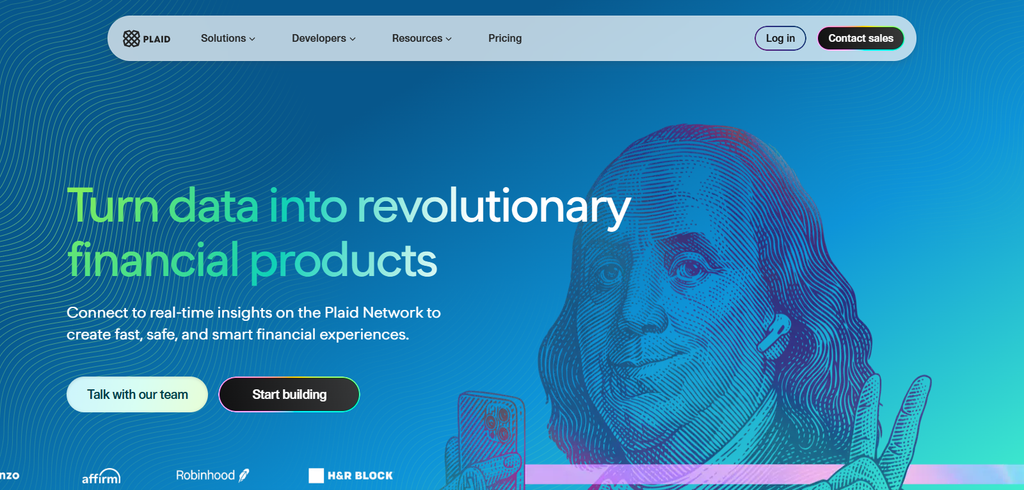
Geographic Focus: Strong presence in the U.S. and other countries. Credit Decisioning: Utilizes bank transaction data for real-time underwriting. White-Label: Offers APIs that fintechs can use as their own. Plaid helps fintechs fulfill the need for lending services in a compliant and user trust-preserving manner.
| Feature | Details |
|---|---|
| Funding Model | Venture-backed, monetized via API usage fees |
| Target Customer | Fintechs, neobanks, digital lenders |
| Lending Model | Provides infrastructure for credit assessment |
| Geographic Focus | U.S. core, expanding globally |
| Credit Decisioning | Real-time underwriting using bank transaction data |
| White-Label | APIs allow fintechs to brand lending solutions |
| Integration | Easy plug-in with fintech apps |
| Compliance | Strong focus on data security and regulatory standards |
| Scalability | Supports high-volume API calls for large institutions |
Plaid Pros & Cons
Pros
- Extensive API infrastructure for fintech interoperability
- Real-time credit decisioning
- White-labeling customization for partners
- International expansion beyond the U.S.
- Compliance and security focus
Cons
- Infrastructure only; no direct lending offerings
- Depends heavily on partner app adoption
- International expansion costs
- High costs for small/medium fintechs
- Open banking competition
2. Stripe Capital
Stripe Capital offers lending services within Stripe’s payments ecosystem. Funding Model: Stripe Capital is funded by Stripe themselves. Target Customer: Stripe’s payment-enabled small business customers. Lending Model: Merchant cash advances with flexible repayment lending where the repayment is tied to the business’s sales volume. Geographic Focus: The U.S., with an focus on Europe.
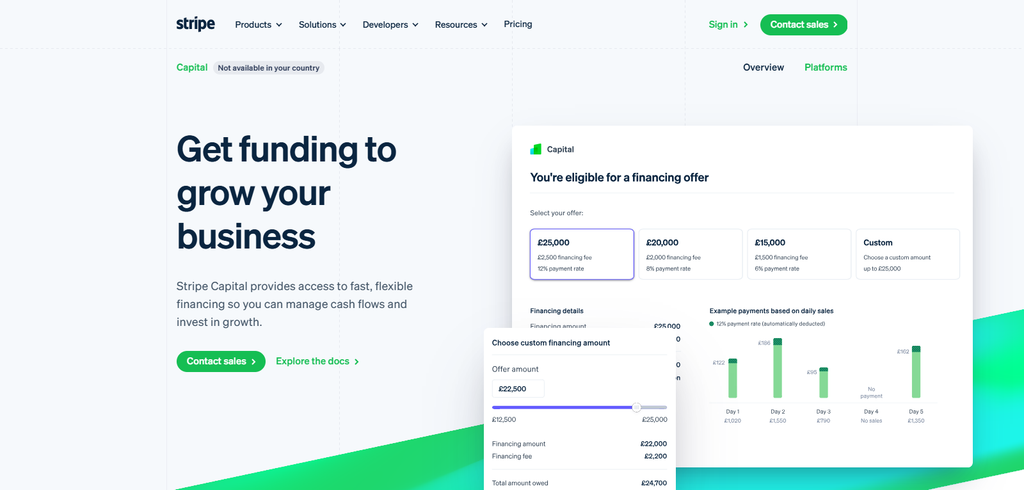
Credit Decisioning: Stripe Capital uses automated underwriting with Stripe’s transaction data. White-Label: Stripe Capital is embedded within Stripe’s dashboard. Stripe Capital helps small and medium-sized enterprises (SMEs) access working capital by embedding loans within payment processes.
| Feature | Details |
|---|---|
| Funding Model | Self-funded via Stripe revenues |
| Target Customer | SMEs using Stripe payments |
| Lending Model | Merchant cash advances tied to sales |
| Geographic Focus | U.S., expanding into Europe |
| Credit Decisioning | Automated underwriting from Stripe transaction data |
| White-Label | Embedded in Stripe dashboard only |
| Repayment | Flexible, deducted from daily sales |
| Integration | Seamless with Stripe ecosystem |
| Accessibility | Quick loan approvals for merchants |
Stripe Capital Pros & Cons
Pros
- Stripe payments integration
- Transaction history-based automated underwriting
- Repayment tied to sales volume
- Quick loan approvals
- Strong trust in the Stripe ecosystem
Cons
- Primarily U.S. operation
- Available only to Stripe merchants
- No white-label offering
- Small business loan caps
- Stripe ecosystem limitation
3. Square Loans
Square Loans (previously Square Capital) offers embedded lending to merchants using Square POS. Funding Model: Funding is backed by Square’s balance sheet and external financing partners. Target Customer: Small retailers and service providers. Lending Model: Repayment is achieved by deducting daily card sales.
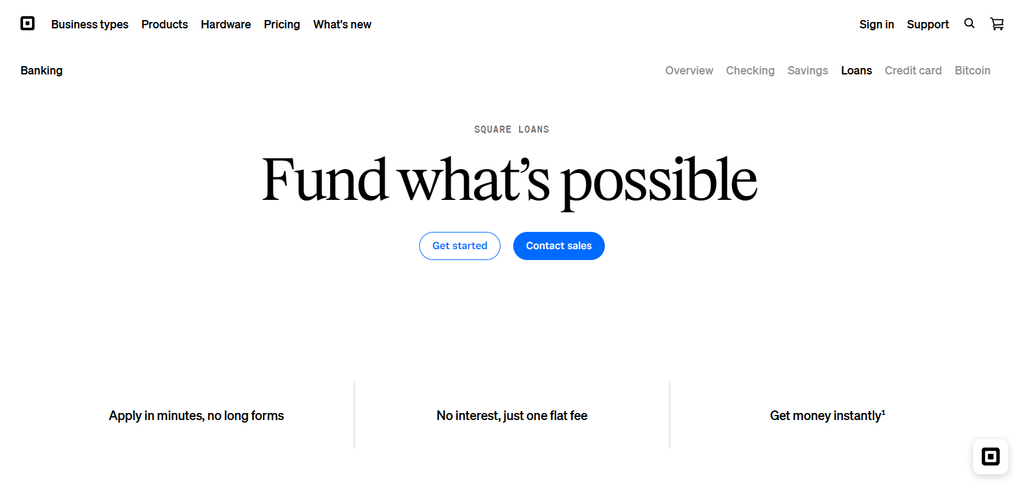
Geographic Focus: United States, with international rollout. Credit Decisioning: POS transaction data is used by proprietary algorithms to make credit decisions. White-Label: Integrated only into Square’s ecosystem. Square Loans provides merchants with the ability to gain quick access to capital using data.
| Feature | Details |
|---|---|
| Funding Model | Backed by Square’s balance sheet & partners |
| Target Customer | Small retailers, service providers |
| Lending Model | Merchant cash advances |
| Geographic Focus | U.S., selective international rollout |
| Credit Decisioning | Proprietary POS transaction algorithms |
| White-Label | Exclusive to Square ecosystem |
| Repayment | Deducted from daily card sales |
| Integration | Embedded in Square POS |
| Accessibility | Fast, data-driven capital access |
Square Loans Pros & Cons
Pros
- Direct integration with Square POS
- Cash advances
- Repayment automatically deducted from sales
- Credit decisioning via square’s proprietary algorithms
- Popular among small retailers
Cons
- Limited to Square ecosystem
- Slow rollout compared to competitors
- Loan amounts would not support a large enterprise
- No white-label offering
- Depends on POS transaction volume
4. PayPal
PayPal has embedded lending through PayPal Working Capital and PayPal Business Loans. Funding Model: Self-funded with robust liquidity. Target Customer: Small and Medium-sized Enterprises (SMEs) and online merchants who use PayPal. Lending Model: Loans and cash advances over a fixed-term an d are provided through PayPal sales.

Geographic Focus: Strong presence in North America and Europe, with a global scope. Credit Decisioning: Automated underwriting based on PayPal transactions. White-Label: Fully embedded in PayPal’s merchant dashboard. PayPal’s lending solutions offer global merchants a white-label, quick and accessible financing.
| Feature | Details |
|---|---|
| Funding Model | Self-funded, strong liquidity reserves |
| Target Customer | SMEs, online merchants |
| Lending Model | Fixed-term loans & cash advances |
| Geographic Focus | Global, strong in NA & Europe |
| Credit Decisioning | Automated via PayPal transaction data |
| White-Label | Embedded in PayPal merchant dashboard |
| Repayment | Flexible repayment tied to sales |
| Integration | Seamless within PayPal ecosystem |
| Accessibility | Quick financing for global merchants |
PayPal Pros & Cons
Pros
- Global reach with liquidity
- Lending embedded in merchant dashboard
- Automated underwriting using transaction data
- Repayment tied to PayPal sales
- Well-known brand
Cons
- Small business loans have cap
- Higher interest rates
- Less control for merchants
- Over-reliance on PayPal
- Competition from BNPL
5. Upstart
Upstart is an AI-based embedded lending company. Funding Model: Publicly traded, revenue from loan origination and servicing fees. Target Customer: Banks, credit unions, and fintechs. Lending Model: Personal loans and auto loans through partner institutions. Geographic Focus: U.S. with growing partnerships abroad.
Credit Decisioning: AI models that use non-traditional data like education and employment. White-Label: Provides white-label lending platforms to banks. Upstart helps financial institutions to offer embedded lending services using advanced AI underwriting.
| Feature | Details |
|---|---|
| Funding Model | Public company, loan origination fees |
| Target Customer | Banks, credit unions, fintechs |
| Lending Model | Personal & auto loans |
| Geographic Focus | U.S., expanding abroad |
| Credit Decisioning | AI-driven, non-traditional data |
| White-Label | Lending platforms for banks |
| Integration | APIs for partner institutions |
| Compliance | Focus on fair lending practices |
| Scalability | Supports diverse lending products |
Upstart Pros & Cons
Pros
- Use of artificial intelligence to underwrite
- White-label lending solutions for banks
- More credit unions partnerships
- Faster loan approvals
- Commitment to equitable lending practices
Cons
- United States centric
- Growth dependent on partnering institutions
- Regulations for artificial intelligence
- Personal and auto loans only
- Other AI lenders
6. Affirm
Affirm is a BNPL (Buy Now, Pay Later) company. Funding Model: Public company that makes money from merchant fees and consumer interest. Target Customer: E-commerce merchants and consumers. Lending Model: Short-term installment loans. Geographic Focus: Primarily the U.S., with focus on Canada and Europe.
Credit Decisioning: Using their own algorithms to determine consumer loan affordability. White-Label: Provides APIs to merchants for BNPL checkout. Affirm promotes consumer adoption of embedded lending by providing financing for seamless checkout.
| Feature | Details |
|---|---|
| Funding Model | Public company, merchant fees & interest |
| Target Customer | E-commerce merchants & consumers |
| Lending Model | BNPL installment loans |
| Geographic Focus | U.S., Canada, Europe |
| Credit Decisioning | Proprietary affordability algorithms |
| White-Label | APIs for merchant checkout |
| Repayment | Short-term installments |
| Integration | Embedded in e-commerce checkout |
| Accessibility | Consumer-friendly financing options |
Affirm Pros & Cons
Pros
- Easy to use BNPL solution for merchants
- Consumers see transparent installment plans
- Popular in U.S. e-commerce
- Merchant APIs
- Increased conversion
Cons
- Limited to BNPL
- Higher interest rates on longer terms
- Less growth than Klarna
- Encourages consumer debt
- Needs merchant partnerships
7. Klarna
Klarna is one of the largest BNPL providers globally. Funding Model: A venture-backed company that makes money from merchant commissions and consumer fees. Target Customer: Online merchants and consumers. Lending Model: Pay-in-4 and other financing options. Geographic Focus: Europe, the United States, and beyond.

Credit Decisioning: Determines consumer creditworthiness with real-time affordability checks. White-Label: Offers APIs for merchant-embedded financing. Klarna’s embedded lending makes e-commerce more viable with more consumer credit options.
| Feature | Details |
|---|---|
| Funding Model | Venture-backed, merchant commissions |
| Target Customer | Online retailers & shoppers |
| Lending Model | Pay-in-4 & long-term financing |
| Geographic Focus | Europe, U.S., global expansion |
| Credit Decisioning | Real-time affordability checks |
| White-Label | APIs for merchant integration |
| Repayment | Flexible installment options |
| Integration | Embedded in online checkout |
| Accessibility | Widely adopted BNPL solution |
Klarna Pros & Cons
Pros
- Most BNPL merchant solutions
- Pay-in-4
- Affordability checks
- U.S. and Europe merchant coverage
- White-label APIs
Cons
- Consumer debt with installment plans
- High merchant fees
- Regulatory issues
- Over-reliance on merchant network
- Intensifying Competition From Affirm and PayPal BNPL
- Profitability Concerns at Scale
8. Marqeta
Marqeta offers card issuing APIs for embedded lending. Funding Model: Public company, revenue from interchange and platform fees. Target Customer: Fintechs, banks, and lenders. Lending Model: API-based credit card and loan issuance.
Geographic Focus: Primarily U.S. credit services, but expanding internationally. Credit Decisioning: Partners build underwriting models and integrate them. White-Label: A fully white-label card issuing platform. Marqeta allows fintechs to build lending programs using custom card issuance.
| Feature | Details |
|---|---|
| Funding Model | Public company, interchange & fees |
| Target Customer | Fintechs, banks, lenders |
| Lending Model | Credit card & loan issuance APIs |
| Geographic Focus | U.S., expanding globally |
| Credit Decisioning | Partner-driven underwriting |
| White-Label | Full card issuing platform |
| Integration | API-first infrastructure |
| Compliance | PCI & regulatory standards |
| Scalability | Supports large-scale card programs |
Marqeta Pros & Cons
Pros
- API-first card issuing platform
- Full white-label capabilities
- Credit card and loan issuance
- Good PCI compliance
- Infrastructure flexible enough for a growing fintech
Cons
- Dependent on partner underwriting
- Weak direct consumer lending
- Competition from Railsr and other issuers
- Primarily U.S. focused
- High costs for aspirational pricing
9. Railsr
Railsr provides embedded finance infrastructure (previously Railsbank). Funding Model: Venture-backed, with revenue from platform usage fees. Target Customer: Fintechs, retailers, and brands. Lending Model: APIs for credit issuance and BNPL.
Geographic Focus: Europe and Asia;pires to go beyond. Credit Decisioning: Partners embed decisioning engines via Railsr APIs. White-Label: Strong white-label capabilities for brands allows Railsr to help non-financial companies embed lending.
| Feature | Details |
|---|---|
| Funding Model | Venture-backed, platform fees |
| Target Customer | Fintechs, retailers, brands |
| Lending Model | APIs for credit issuance & BNPL |
| Geographic Focus | Europe, Asia, global ambitions |
| Credit Decisioning | Partner-integrated decision engines |
| White-Label | Strong brand-focused capabilities |
| Integration | Embedded finance infrastructure |
| Compliance | Regulatory alignment in multiple regions |
| Scalability | Supports diverse embedded finance products |
Railsr Pros & Cons
Pros
- End-to-end embedded finance
- Good white-label capabilities
- API for BNPL and credit issuance
- Expanding in Europe and Asia
- Allows non-financial companies to embed lending
Cons
- Funding concerned with Venture backers
- Operational complexity from diffusion
- Dependent on partner decision engines
- Marqeta and Tink
- Lesser brand recognition compared to market leaders
10. Tink
Tink, now owned by Visa, operates in the open banking-enabled lending space. Funding Model: Visa has invested in Tink, and they make money from API charges. Who They Serve: Banks, fintechs, and lenders. How It Works: Provides data aggregation for credit scoring and loan origination.
Where They Work: Primarily in Europe, but can leverage Visa’s global markets. Credit Decisioning: Relies on open banking for affordability checks. White-Label: Offers lending APIs to banks and fintechs. Tink is creating a platform to facilitate embedded lending, and, through open banking, makes credit decisions facilitation easier.
| Feature | Details |
|---|---|
| Funding Model | Backed by Visa, API usage fees |
| Target Customer | Banks, fintechs, lenders |
| Lending Model | Data aggregation for credit scoring |
| Geographic Focus | Europe, global via Visa |
| Credit Decisioning | Open banking affordability checks |
| White-Label | APIs for embedded lending |
| Integration | Seamless with banking systems |
| Compliance | Strong GDPR & EU standards |
| Scalability | Expanding with Visa’s reach |
Tink Pros & Cons
Pros
- Visa backing, strong finance
- Credit scoring using open banking APIs
- White-label APIs for banking and fintech
- Strong compliance with EU regulations
- Growing scope with Visa
Cons
- Primarily Europe focused, slower global rollout
- Dependent on open banking
- Weak direct lending
- Competition from Plaid
- Smaller fintechs integration complexity
Conclusion
In 2026, embedded lending has become a critical part of fintech innovation to provide credit within digital worlds. Open banking data aggregators like Plaid and Tink are followed by Stripe Capital, Square Loans, and PayPal providing embedded working capital solutions for SMEs. Affirm and Klarna are the BNPL leaders focusing on consumer adoption. Marqeta and Railsr provide the infrastructure for white-label credit issuance for fintechs and brands, along with credit underwriting services using AI and other non-traditional data sources, like Upstart.
All of these providers illustrate how credit is increasingly embedded within digital services and how the financial services industry is changing. For fintech companies, the embedded lending partner they choose depends on their funding model, the customers they wish to serve, their lending attitude, the geographic area they want to cover, and their ability to provide white-label services.
FAQ
What is embedded lending?
Embedded lending integrates credit and loan services directly into digital platforms, allowing fintechs, retailers, and banks to offer financing within their apps or ecosystems.
How do platforms like Plaid and Tink support lending?
Plaid and Tink provide open banking APIs that aggregate financial data, enabling lenders to make smarter credit decisions and embed lending seamlessly into fintech apps.
What is the difference between Stripe Capital and Square Loans?
Stripe Capital focuses on online merchants using Stripe payments, while Square Loans targets brick‑and‑mortar businesses using Square POS, both offering cash advances tied to sales.
How do BNPL providers like Affirm and Klarna work?
Affirm and Klarna offer Buy Now, Pay Later solutions, letting consumers split purchases into installments. Merchants benefit from higher conversion rates and customer loyalty.
How does Upstart differ from traditional lenders?
Upstart uses AI‑driven credit decisioning, analyzing non‑traditional data like education and employment, offering banks and fintechs smarter underwriting via white‑label solutions.