




This article covers the best Crypto Wallet-as-a-Service APIs, and how companies can use these services to develop, manage, and scale secure crypto wallets without the need to develop complicated infrastructures. I will provide an overview of each service depending on wallet capabilities, security, blockchain support, developer tools, scalability, pricing and the available integrations. This is intended to help developers and companies choose the service that best fits their needs for their Web 3 products.
Key Points
| API Provider | Strengths | Best For |
|---|---|---|
| Fireblocks | MPC-based custody, institutional-grade wallet APIs | Banks, fintechs, and exchanges needing secure custody |
| Coinbase Cloud | Wallet-as-a-Service, staking integration | Enterprises leveraging Coinbase ecosystem |
| Alchemy | Web3 wallet APIs, NFT + DeFi support | Developers building dApps with multi-chain support |
| Moralis | Cross-chain wallet APIs, plug-and-play SDKs | Startups needing fast wallet integration |
| BitGo | Institutional custody, hot & cold wallet APIs | Enterprises requiring regulated custody |
| Kraken API | Exchange wallet APIs, staking & futures | Institutions testing exchange-level wallet flows |
| Binance API | Wallet APIs for spot, margin, futures | Global developers needing exchange-linked wallets |
| Crypto APIs | Unified wallet endpoints, blockchain data | Enterprises needing standardized wallet integration |
| Tatum | 100+ blockchain support, wallet SDKs | Developers building multi-chain wallets |
| Circle (USDC) | Wallet APIs for stablecoin payments | Fintechs integrating USDC into apps |
1. Fireblocks
Fireblocks provides wallet infrastructure and supports custody technology, policy controls, and transaction management, as well as blockchain connectivity.
Its wallet infrastructure as a service enables exchanges, fintech, and banks, as well as Web3 companies, to have secure programmatic control over their wallets, without the need to develop an in-house custody infrastructure.
Fireblocks offers the Best Crypto Wallet-as-a-Service APIs. These APIs tap into the range of features that automate transaction workflows with governance policies backed by MPC and are backed by broad blockchain support.
These APIs are especially beneficial to companies with multiple assets, users, and transaction workflow management. Fireblocks is ideal for companies that need enterprise-level digital asset infrastructures that are secure, scalable, and controlled with operational compliance features.
Fireblocks Strengths & Best For
Strengths
- Wallet security and key management with MPC.
- Wallets can easily be created and managed in bulk.
- Policy Engine for governance and ad-hoc transaction approvals.
- Webhooks for transactions and monitoring solutions.
- Raw signing for other chains and native support for 40+ chains.
Best For
- Crypto institutions
- Exchanges and custodial services
- Payment processors and financial technology firms
- Asset management firms
- Client asset management services on a large scale
| Pros | Cons |
|---|---|
| • Enterprise-grade MPC wallet security. | • Can be complex for smaller development teams. |
| • Supports 40+ blockchains natively. | • Enterprise-oriented pricing may be higher than developer-first APIs. |
| • Strong policy and approval controls. | • Requires more operational planning than basic wallet APIs. |
| • Supports high-volume wallet creation and management. ( | • May offer more infrastructure than a simple Web3 application needs. |
| • Transaction APIs, webhooks, monitoring, and raw signing. ( | • Best suited to organizations with advanced security and governance requirements. |
2. Coinbase Cloud
Coinbase utilizes its blockchain technology through its developer ecosystem to provide APIs and services for wallet creation and asset management, as well as payment and Web3 application infrastructure.
Coinbase offers a reliable blockchain connection infrastructure, and its services are built for developers that are already integrated in the Coinbase ecosystem. Coinbase APIs help businesses with most of the work associated with building wallet infrastructure.
It is useful to consider inspection and control over supported networks, authentication and transaction capabilities, the range of covered assets, and the associated commercial terms. For a variety of Web3 and Fintech applications, Coinbase is a preferred infrastructure services provider for a reputable digital asset provider.
Coinbase Cloud Strengths & Best For
Strengths
- Well developed features within the Coinbase ecosystem.
- On-chain app development with embedded/spawning wallets and fiat onramps.
- Excellent support for apps focused on Base, and Ethereum.
- Fireblocks.
Best For
- Web3 apps
- Projects within the Coinbase ecosystem.
- Apps within Base
- Financial technology app developers
- Apps with a need for crypto onramps
| Pros | Cons |
|---|---|
| • Strong developer ecosystem and established crypto infrastructure. | • Product capabilities can vary across Coinbase developer offerings. |
| • Useful for applications integrating Coinbase services. | • May be less focused on institutional custody than dedicated custody platforms. |
| • Suitable for consumer-facing Web3 applications. | • Developers must evaluate network and wallet feature coverage carefully. |
| • Good ecosystem familiarity for teams already using Coinbase products. | • Some advanced requirements may need additional infrastructure. |
| • Suitable for developers building blockchain-based applications. | • Commercial terms and availability can depend on the specific product. |
3. Alchemy
Alchemy provides blockchain development infrastructure, tools, nodes and wallet services for Web3 applications. Developers can build applications to interact with various supported networks and build wallets for their users. Developers don’t have to manage blockchain nodes.
Alchemy offers the best crypto wallet-as-a-service APIs for developers who need quick RPC connections and developer tooling that scales.
Alchemy’s ecosystem includes DeFi applications, wallets, NFT platforms, gaming and other Web3 applications. Before choosing Alchemy, businesses need to evaluate supported networks, wallet functionalities, ways to authenticate users, manage transactions, and pricing.
Alchemy Strengths & Best For
Strengths
- App development with friendly blockchain infrastructure.
- Reliable RPC and blockchain connectivity APIs.
- Supports wallet and on-chain apps.
- Scalable infrastructure to support the development of Web3 apps.
Best For
- Web3 app developers
- Decentralized finance apps
- Non-fungible token apps
- Dashboards for blockchain
- Decentralized apps with a lot of traffic
| Pros | Cons |
|---|---|
| • Developer-friendly wallet and blockchain APIs. | • Wallet functionality may require separate signing or embedded-wallet infrastructure. |
| • Supports gas sponsorship and gasless transactions. | • Advanced wallet operations can require deeper Web3 knowledge. |
| • Supports transaction batching and automatic retries. | • Best fit may depend on the chains and wallet architecture required. |
| • Provides session keys and transaction-status tracking. | • Usage-based infrastructure costs can grow with application scale. |
| • Supports EVM and Solana infrastructure across a broad network ecosystem. | • Not primarily an institutional custody provider like Fireblocks or BitGo. |
4. Moralis
Moralis simplifies blockchain infrastructure for Web3 application development and provides APIs for wallet, blockchain, token, NFT, and portfolio data. Their emphasis on developers can mean a great reduction in the amount of blockchain infrastructure one has to build and maintain.
Moralis, like other best crypto wallet-as-a-service APIs, provides wallet data and balances along with transaction data and portfolio data, and makes blockchain interactions easy with their developer friendly APIs.
Moralis works well with Web3 dashboards, wallets, portfolio applications, trading applications, and decentralized applications. They need to evaluate the APIs, rate limits, authentication, wallet management, and pricing.
Moralis Strengths & Best For
Strengths
- Web3 applications wallet API.
- Supports wallet balances and history.
- Supports NFT and token portfolio.
- Supports wallet activity with transfers and swaps.
- Wallet net worth data and enriched blockchain data available. ([Moralis | Enterprise-Grade Web3 APIs][3])
Best For
- Web3 wallets
- Portfolio trackeres
- DeFi apps
- NFT marketplaces
- Blockchain analytics tools
| Pros | Cons |
|---|---|
| • Strong cross-chain Wallet API for EVM applications. ( | • Primarily focused on wallet and blockchain data rather than institutional custody. |
| • Provides balances, NFTs, transfers, and wallet history. ( | • Coverage and functionality can vary by blockchain. |
| • Provides decoded transaction and wallet activity data. | • Businesses requiring advanced signing controls may need additional infrastructure. |
| • Useful for portfolio and net-worth applications. | • EVM-centric architecture may not suit every multi-chain requirement. |
| • Developer-friendly API integration. | • High-volume applications should evaluate API limits and pricing carefully. |
5. BitGo
BitGo built services dedicated to meeting the needs of institutions using blockchain for digital asset custody. Their service was designed to support control over digital assets on a much more advanced level than what standard blockchain wallets can offer.
BitGo’s service supports enterprise-level clients, including exchanges and financial institutions, in the management of digital crypto wallets at scale. BitGo’s service facilitates a robust security control framework, workflow management, transaction management, and support for a broad range of digital assets.
BitGo’s service would be ideal for companies who require advanced custody and security. Companies considering BitGo’s service should evaluate coverage, operational policies, pricing, compliance, integration, and where supported assets and services are available.
BitGo Strengths & Best For
Strengths
- Digital asset infrastructure focused on the needs of institutions.
- Strong focus on custody and wallet security.
- Offers wallet and transaction management.
- Tailored for organizations that manage large volumes of digital assets.
- Designed for the needs of legally regulated and security-focused financial activities.
Best For
- Institutional clients
- Crypto trading platforms
- Custody solutions
- Financial services
- Digital asset treasury management
| Pros | Cons |
|---|---|
| • Strong institutional digital-asset infrastructure. | • Primarily targeted toward institutional and professional users. |
| • Emphasis on custody and wallet security. | • May be excessive for simple consumer wallet projects. |
| • Suitable for exchanges and financial institutions. | • Integration can require significant security and operational planning. |
| • Designed for managing digital assets at scale. | • Enterprise requirements can increase implementation complexity. |
| • Strong fit for organizations with custody-related requirements. | • Pricing and commercial arrangements may be less transparent than self-service APIs. |
6. Kraken API
Kraken offers APIs for services such as trading, exchange, and account management and supports integrations for use in financial platforms and trading systems.
Whereas comparison products may include Kraken, use cases may warrant dedicated services that embed a Wallet-as-a-Service layer for a suite of integrated digital asset operations. Kraken APIs can be of value for services that need to manage orders, balances, and trading and market operations.
However, companies should differentiate Wallet-as-a-Service APIs from other types of exchange APIs and be clear about custody, responsibilities, supported assets, withdrawal controls, rate limits, and regulations.
Kraken API Strengths & Best For
Strengths
- Programmatic access to services of the Kraken exchange.
- Includes trading and order management.
- Market data API.
- Account and balance control.
- Ideal for automated trading of cryptocurrency.
Best For
- Trading services
- Algorithmic trading systems
- Portfolio services
- Market data APIs
- Crypto exchange services
| Pros | Cons |
|---|---|
| • Provides programmatic access to Kraken exchange functionality. | • Primarily an exchange API rather than a complete Wallet-as-a-Service platform. |
| • Useful for automated trading applications. | • Wallet infrastructure capabilities differ from dedicated WaaS providers. |
| • Provides market-data and trading functionality. | • Depends on Kraken account and exchange infrastructure. |
| • Suitable for account and balance-related integrations. | • Not ideal when businesses need fully embedded wallet infrastructure. |
| • Useful for algorithmic trading workflows. | • Developers must carefully manage API permissions and security. |
7. Binance API
Binance supports different types of APIs for their exchange connectivity, market data, trading, account information and cryptocurrency APIs. These APIs let developers interface their applications with Binance and create automated trading and account management systems.
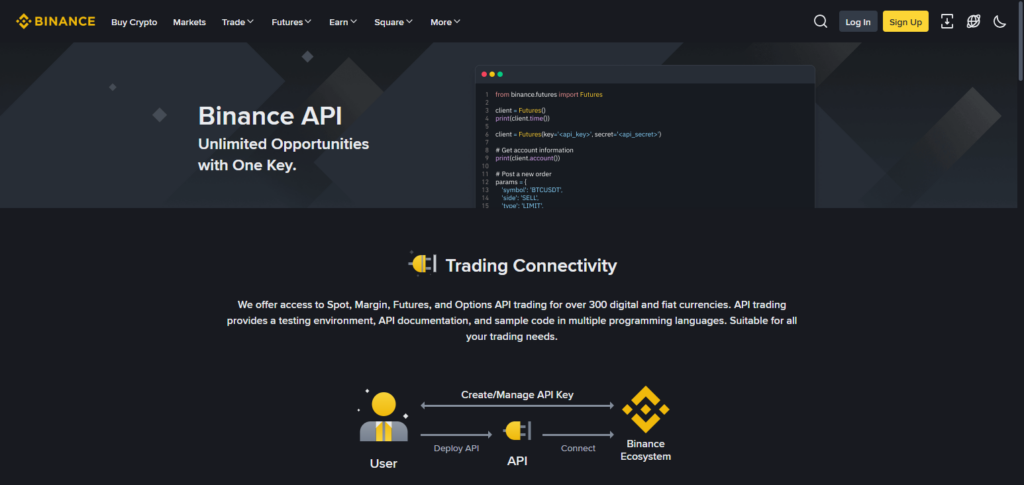
In research for the Best Crypto Wallet-as-a-Service APIs, Binance may be included if a project requires a linked exchange for crypto currency functionality, though this is different from implementing a full embedded wallet-as-a-service platform.
Binance can be useful for trading platforms, portfolio applications, analytics applications and automation systems. Binance should be evaluated based on regional coverage, supported assets, granted API permissions, withdrawal controls, overall security, compliance and commercial terms.
Binance API Strengths & Best For
Strengths
- Comprehensive API for exchange services.
- Features real-time data for trading and markets.
- Automated orders and account management.
- Supports a wide range of cryptocurrency trading pairs.
- Suitable for seamless integration for algorithmic trading.
Best For
- Trading bots
- Cryptocurrency trading services
- Market data services
- Portfolio management
- Exchange-focused services
| Pros | Cons |
|---|---|
| • Broad exchange API ecosystem. | • Primarily designed around exchange connectivity rather than dedicated WaaS. |
| • Supports automated trading workflows. | • API functionality is tied to Binance services and account infrastructure. |
| • Provides market and account data. | • Regional availability and regulatory considerations can matter. |
| • Useful for trading bots and portfolio applications. | • Not a direct replacement for MPC or embedded wallet infrastructure. |
| • Suitable for high-frequency programmatic trading use cases. | • Developers must carefully configure API permissions and withdrawal controls. |
8. Crypto APIs
Crypto APIs wants to reduce the friction associated with developing crypto applications with its blockchain APIs and overall blockchain infrastructure. Developers can employ Crypto APIs as a gateway to blockchain data, transactions, addresses, wallets and various digital asset functionality through standardized interfaces.
Crypto APIs is one of the Best Crypto Wallet-as-a-Service APIs and can be useful for blockchain and Web3 portals that need to have a lot of blockchain integrations without the headache of a significant internal build.
Proprietary wallets, supported blockchains, API endpoints, authentication, rate limits, and the overall maturity of the platform and the depth of the transaction management framework are all areas to be reviewed before a decision is made.
Crypto APIs Strengths & Best For
Strengths
- Comprehensive access to data and services for blockchain.
- Supports wallet and transaction services for cryptocurrency.
- Easy multi-blockchain integration.
- Developer-friendly APIs.
- Minimizes the need for companies to support blockchain services on their own.
Best For
- Financial technology applications
- Cryptocurrency wallets
- Blockchain analytics
- Payment platforms
- Applications using multiple blockchain networks
| Pros | Cons |
|---|---|
| • Provides standardized blockchain APIs. | • Feature depth can vary across supported networks. |
| • Helps reduce the need to operate blockchain infrastructure internally. | • Advanced custody features may require additional services. |
| • Useful for wallet, transaction, and blockchain-data applications. | • Businesses should verify exact wallet capabilities before implementation. |
| • Suitable for multi-chain development. | • Pricing can become important at high API volumes. |
| • Developer-focused infrastructure simplifies blockchain integration. | • May not provide the same institutional governance depth as custody specialists. |
9. Tatum
Tatum offers a range of blockchain APIs and technology to support developers creating crypto apps. This service includes APIs for crypto wallets, transactions, tokens, and blockchain data, and is built to make cross-chain apps easier with a unified API.
Tatum is a service for the best Crypto Wallet-as-a-Service APIs, and is used by fintech companies, Crypto wallets, payment APIs, and crypto exchanges. When evaluating Tatum, developers should consider APIs for supported networks, wallet services, transaction APIs, token support, webhooks, security, documentation, pricing, and scalability. Tatum is ideally used by teams that are looking for full-service blockchain development.
Tatum Strengths & Best For
Strengths
- APIs unify blockchain technology for ease of application development.
- Wallets and transactions APIs available.
- Multi-chain infrastructure for crypto applications.
- Technologies that favor developer use.
- Great for rapid development of payment, token, and even blockchain applications.
Best For
- Cryptocurrency wallets
- Payment platforms
- Exchanges
- Financial technology applications
- Multi-chain products in Web3
| Pros | Cons |
|---|---|
| • Unified APIs simplify multi-chain development. | • Developers still need to understand blockchain-specific requirements. |
| • Useful for wallets, transactions, and token applications. | • Wallet security requirements should be evaluated according to the implementation. |
| • Strong fit for fintech and Web3 development. | • Feature availability differs between supported blockchains. |
| • Helps reduce separate blockchain integrations. | • Large-scale enterprise requirements may need additional infrastructure. |
| • Developer-oriented documentation and tooling. | • Costs should be assessed against transaction and API volume. |
10. Circle (USDC)
Circle has an offering for programming digital assets, which is used in wallets, payments, and USDC stablecoin-native applications. Circle’s wallet infrastructure helps businesses integrate wallets and transact with blockchains without developing the components themselves.
USDC is relevant to financial technology (fintech) and payment services companies, as well as marketplace and Web3 companies that build stablecoins. Businesses should consider supported blockchain wallets, centralized control of funds, functionality for transactions (by users) and compliance (by Circle), business region coverage, and pricing (cost to use and integration complexity).
Circle should be a top candidate if the product relies on USDC (and other stablecoins), payments, and financial infrastructure.
Circle (USDC) Strengths & Best For
Strengths
- A focus on programmable wallets and an infrastructure for stablecoins.
- Good fit for applications using USDC.
- Supports blockchain payments and financial workstreams.
- Good fit for applications using programmable digital assets.
- Good infrastructure for companies looking to create stablecoin offerings.
Best For
- Stablecoin payment platforms
- Financial technology applications
- Digital wallets
- Marketplaces
- Web3 applications and payment services
| Pros | Cons |
|---|---|
| • Strong focus on programmable wallets and digital-asset payments. | • Particularly oriented toward stablecoin and payment use cases. |
| • Strong fit for USDC-based applications. | • Projects requiring broad crypto custody may need additional providers. |
| • Useful for fintech and payment applications. | • Supported blockchain and asset capabilities should be checked for each use case. |
| • Can simplify stablecoin integration. | • May not provide the same breadth of exchange functionality as Binance or Kraken APIs. |
| • Well suited to marketplaces, wallets, and Web3 payment products. | • Businesses should evaluate regional availability, compliance, and pricing before deployment. |
Conclusion
The Best Crypto Wallet-as-a-Service APIs of 2026 give developers the capability to configure, transform, and devise crypto wallets in a hassle free environment, without the need for building the wallet infrastructure from the ground up. With Fireblocks and BitGo being viable alternatives in institutional security and custody, while Alchemy, Moralis and Tatum are developer oriented platforms, Circle has valuable infrastructure for stablecoins and payments. It has programmable wallets, transaction and compliance infrastructure.
When comparing the Best Crypto Wallet-as-a-Service APIs, developers will need to analyze a range of criteria including blockchain support, key-management, security, transaction signing, scalability of wallets, ease of development and integration, price, API stability and compliance. The best option for your needs will depend on your primary focus whether its consumer wallets, institutional custody, payments, trading, Web3 applications or stable coins infrastructure.
FAQ
What are Crypto Wallet-as-a-Service APIs?
Crypto Wallet-as-a-Service APIs are developer tools that allow businesses to create, manage, secure, and operate cryptocurrency wallets through APIs and SDKs instead of building wallet infrastructure from scratch. They can provide features such as wallet creation, transaction signing, asset management, blockchain connectivity, and monitoring.
Why use a Crypto Wallet-as-a-Service API?
Businesses use these APIs to reduce development time, simplify blockchain integration, improve wallet security, and scale wallet operations. Depending on the provider, they can also provide managed blockchain infrastructure, transaction monitoring, compliance controls, and gas-fee management.
Which are the Best Crypto Wallet-as-a-Service APIs in 2026?
Leading options include Fireblocks, Coinbase Cloud, Alchemy, Moralis, BitGo, Tatum, Circle, and other blockchain infrastructure providers. The best choice depends on your required custody model, supported networks, security architecture, transaction volume, compliance requirements, and application type.
Are Crypto Wallet-as-a-Service APIs secure?
Security depends on the provider’s architecture and configuration. Leading platforms may use MPC, policy controls, secure signing infrastructure, authentication, transaction monitoring, and compliance features. For example, Fireblocks uses MPC-based wallet infrastructure and policy controls, while Circle provides MPC or passkey-based security depending on its wallet product.