


This article discusses the Best Python Trading Platforms for Stocks & Crypto Data. I focus on powerful platforms that allow the user to build, test, and automate trading strategies to the global stock and crypto markets.
- Key Point & Best Python Trading Platforms for Stocks & Crypto Data
- 1. Backtrader
- Backtrader Attributes, Advantages & Disadvantages
- Attributes
- Advantages
- Disadvantages
- 2. Freqtrade
- Freqtrade Attributes, Advantages & Disadvantages
- Attributes
- Advantages
- Disadvantages
- 3. KlawTrade
- KlawTrade Attributes, Advantages & Disadvantages
- Attributes
- Advantages
- Disadvantages
- 4. VectorBT
- VectorBT Attributes, Advantages & Disadvantages
- Attributes
- Advantages
- Disadvantages
- 5. Zipline-Reloaded
- Zipline-Reloaded Attributes, Advantages & Disadvantages
- Attributes
- Advantages
- Disadvantages
- 6. Alpaca API
- Alpaca API Attributes, Advantages & Disadvantages
- Attributes
- Advantages
- Disadvantages
- 7. Tradier API
- Tradier API Attributes, Advantages & Disadvantages
- Attributes
- Advantages
- Disadvantages
- 8. yfinance
- yfinance Attributes, Advantages & Disadvantages
- Attributes
- Advantages
- Disadvantages
- 9. OpenBB Terminal
- OpenBB Terminal Attributes, Advantages & Disadvantages
- Attributes
- Advantages
- Disadvantages
- 10. Nasdaq Data Link
- Nasdaq Data Link Attributes, Advantages & Disadvantages
- Attributes
- Advantages
- Disadvantages
- Conclusion
- FAQ
You will see platforms that support backtesting, real-time data analysis, and the automated execution of strategies through Python. Due to the nature of these tools, they are commonly used by quants, developers, and investors, as they help a lot in making trading decisions and strategies.
Key Point & Best Python Trading Platforms for Stocks & Crypto Data
| Platform / Tool | Type | Best For | Key Point |
|---|---|---|---|
| Backtrader | Python Backtesting Framework | Strategy development and testing | Supports multi-asset backtesting with customizable indicators and broker integrations. |
| Freqtrade | Crypto Trading Bot | Automated crypto trading | Open-source bot with strategy optimization, backtesting, and live exchange connectivity. |
| KlawTrade | Algorithmic Trading Platform | Unified stock and crypto trading | Offers automated trading workflows and supports multiple market data sources. |
| VectorBT | Quantitative Analysis Library | High-speed strategy research | Uses NumPy and Pandas for ultra-fast vectorized backtesting and portfolio analysis. |
| Zipline-Reloaded | Backtesting Engine | Institutional-grade strategy testing | Modern fork of Zipline with enhanced support for Python and market simulations. |
| Alpaca API | Brokerage API | Commission-free stock and crypto trading | Provides real-time market data and paper trading for algorithmic traders. |
| Tradier API | Brokerage & Market Data API | Options and stock trading | Delivers brokerage services, market data, and options trading through REST APIs. |
| yfinance | Financial Data Library | Free market data access | Simplifies downloading historical stock, ETF, and index data from Yahoo Finance. |
| OpenBB Terminal | Investment Research Platform | Market research and analytics | Aggregates stock, crypto, forex, and economic data into one open-source toolkit. |
| Nasdaq Data Link | Financial Data Provider | Professional financial datasets | Offers premium and alternative datasets for quantitative research and trading models. |
1. Backtrader
Backtrader is a leading open-source framework for building testing and executing trading strategies in Python. With Backtrader, users can build strategies using external data to trade any asset class.
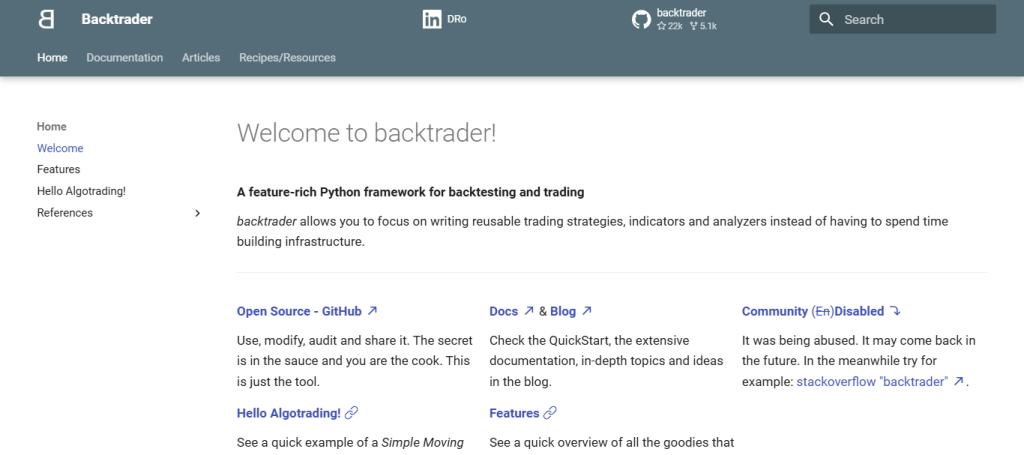
Backtrader has an advanced and easy to use backtesting framework for users to build custom technical indicators and run backtests for their strategies. The community of Backtrader users consists mainly of algorithmic traders and quants.
The advanced backtesting engine of Backtrader, combined with its flexible and easy to use architecture, makes Backtrader a preferred framework for trading strategies in Python. There is no surprise Backtrader makes the list of Best Python Trading Platforms for Stocks and Crypto Data.
Backtrader Attributes, Advantages & Disadvantages
Attributes
- Event-driven backtesting engine
- Multi-asset support (stocks, forex, crypto)
- Custom indicators & strategies
- Broker integration support
- Live trading capability
Advantages
- Highly flexible and customizable
- Strong community support
- Great for strategy development
- Works with multiple data feeds
- Suitable for beginners & pros
Disadvantages
- Slow for large datasets
- Complex for beginners initially
- Limited built-in data sources
- Requires manual setup for live trading
- Documentation can be outdated
2. Freqtrade
Freqtrade is a fully featured open-source crypto trading bot written in Python. Freqtrade was developed for building auto trading systems with Python. Freqtrade offers users the ability to backtrade their systems and use machine learning to optimize their systems for better results.
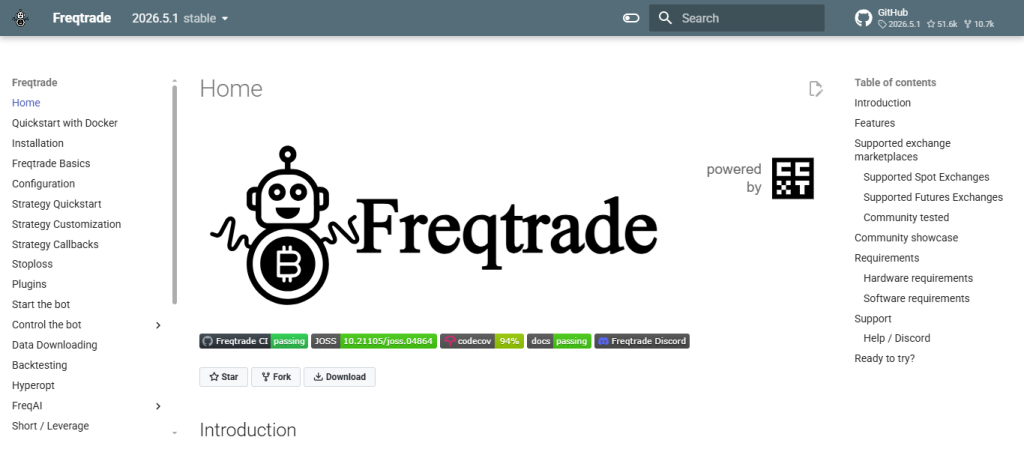
As an added feature, Freqtrade is designed to work with several crypto exchanges thanks to its API. Freqtrade provides users with the ability to build custom trading strategies and backtrade systems with an easy to use interface. The community of Freqtrade users is large and very welcoming to newcomers.
This friendly community along with the advanced features of Freqtrade makes this trading bot a wonderful option for traders. Freqtrade makes the list of Best Python Trading Platforms for Stocks and Crypto Data because of these reasons.
Freqtrade Attributes, Advantages & Disadvantages
Attributes
- Open-source crypto trading bot
- Strategy-based automation system
- Backtesting and optimization tools
- Exchange API integration
- Risk management system
Advantages
- Excellent for crypto automation
- Strong community and updates
- Supports Binance, Kraken, etc.
- Built-in hyperparameter tuning
- Free and open-source
Disadvantages
- Crypto-only focus
- Requires technical knowledge
- Limited stock market support
- Setup can be complex
- Heavy system resource usage
3. KlawTrade
KlawTrade is an innovative platform in algorithmic trading that is designed for easy integration of stock and cryptocurrency trading. Using KlawTrade, traders can develop and implement automated trading strategies for different asset classes using Python.
KlawTrade aims to simplify the burdens of API integration, execution in the market, and tracking portfolios. KlawTrade is a one-stop shop for the management of financial and digital assets for the trader.
It has developed features for creating strategies, controlling risk, and tracking the performance of the strategies. Its support for stocks and cryptocurrency extends its utility and importance in the trading ecosystem and in the category of Best Python Trading Platforms for Stocks & Crypto Data.
KlawTrade Attributes, Advantages & Disadvantages
Attributes
- Unified stock + crypto trading
- Python-based strategy engine
- Real-time market execution
- Portfolio management tools
- Multi-API integration
Advantages
- Supports multiple asset classes
- Simplifies unified trading workflow
- Real-time execution system
- Beginner-friendly interface concept
- Flexible strategy automation
Disadvantages
- Limited documentation available
- New and less community support
- May lack advanced analytics
- Integration still evolving
- Not widely adopted yet
4. VectorBT
VectorBT is a Python library that excels in speed and performance in the area of trading and investing research and analysis of portfolios. Its speed is due to the vectorized operations of NumPy and Pandas.
Testing intricate strategies is not a burden with the trade-off of speed and scalability for the thousands of strategies that can be tested using VectorBT. It is extremely flexible as it supports stocks, crypto, and forex through a custom input.
Its visual aids are great for the analysis of measurement and risk of loss and help in the assessment of risk-adjusted returns. Its framework is in high demand and used a great deal for its rapid prototyping by quantitative researchers and data scientists and is a foundational library in Best Python Trading Platforms for Stocks & Crypto Data.
VectorBT Attributes, Advantages & Disadvantages
Attributes
- Vectorized backtesting engine
- NumPy & Pandas powered
- High-speed strategy testing
- Portfolio analytics tools
- Visualization dashboard support
Advantages
- Extremely fast performance
- Ideal for quantitative research
- Handles large datasets easily
- Simple Python syntax
- Great for optimization testing
Disadvantages
- Not event-driven like others
- Limited live trading support
- Requires coding knowledge
- Memory intensive
- Less beginner-friendly
5. Zipline-Reloaded
Zipline-Reloaded is a newer version of Zipline, a Python-specific backtesting engine, and is more advanced than its predecessor. Designed to be used for large-scale enterprise-level trading simulation, backtesting, and trading research and development, Zipline-Reloaded is a powerful trading research tool that incorporates historical data and backtested trading strategies, custom portfolio construction, and event-oriented strategies.

The newer version is more compatible with various versions of Python and is more flexible in the type of data it can work with. Because of the complexity of the setup/installation, this tool is more widely used in research and trading for more accurate backtesting. Its design and reliability make it indispensable in the collection of trading tools in Best Python Trading Platforms for Stocks & Crypto Data.
Zipline-Reloaded Attributes, Advantages & Disadvantages
Attributes
- Event-driven backtesting system
- Institutional-grade simulation
- Market data ingestion tools
- Portfolio & risk modeling
- Python strategy support
Advantages
- High accuracy simulations
- Used in professional environments
- Strong historical testing engine
- Reliable performance metrics
- Good for research workflows
Disadvantages
- Difficult installation/setup
- Slower compared to modern tools
- Smaller community support
- Update frequency of about one per month.
- Not beginner-friendly.
6. Alpaca API
Alpaca API is a zero-commission brokerage and trading API and is designed specifically for algorithmic traders. Providing fully developed and designed real-time market data, paper trades and live execution for both crypto and stock trading, Alpaca API is trading actively and passively designed for developers.
Alpaca, being REST and WebSocket friendly, provides quick data streaming and order execution. Trading API is used for robo-advisors, trading bots, and portfolio automation and is definitely a developer’s trading API of choice in the collection of tools in Best Python Trading Platforms for Stocks & Crypto Data.
Alpaca API Attributes, Advantages & Disadvantages
Attributes
- Free stock trading API
- Market data is updated in real-time
- Paper trading
- Supports REST & WebSocket
- Crypto trading (in select regions)
Advantages
- Great API for Python
- Useful for algorithmic trading
- No commission
- Documentation is thorough
- System is exceptionally reliable
Disadvantages
- Limited international availability
- System is unsafe for reliability trading
- Not a full brokerage
- Crypto trading is scarce
- Limited features without costs
7. Tradier API
Tradier API offers brokerage and market data services focused on stock and options trading. As a RESTful API, it provides developers with the ability to access real-time quotes, historical data, and execute trades.
Tradier can be seamlessly integrated into algorithmic trading systems via the Python programming language.
This API excels at options analytics and trading. Since Tradier supports trading accounts, the API can be used for live trading. When data and execution capabilities are combined, it provides a powerful trading solution. For these reasons, Tradier is a strong contender in the category of Best Python Trading Platforms for Stocks & Crypto Data.
Tradier API Attributes, Advantages & Disadvantages
Attributes
- Stocks and options trading API
- Real-time data
- Integrated brokerage accounts
- Order execution
- REST API for Python
Advantages
- Excellent options trading
- Advanced trading API
- Infrastructure is reliable
- Accuracy of real-time data
- Highly developer oriented
Disadvantages
- Limited scope of crypto trading
- Paid plans for full features
- Advanced builds required
- US focused API
- Limited ecosystem compared others
8. yfinance
yfinance is a Python library that enables the download of historical market data via Yahoo Finance. It is a popular library for research, learning, and prototyping trading strategies. Users can download equities, ETFs, and Indices, as well as a limited set of crypto data.
Although the library does not support live trading, yfinance is an incredible library for data analysis and backtesting. It is beginner-friendly and an excellent library for developing quick trading ideas.
For researchers and students developing a dataset for a machine learning model, yfinance is an essential resource. For these reasons, it is a popular library in the category of Best Python Trading Platforms for Stocks & Crypto Data.
yfinance Attributes, Advantages & Disadvantages
Attributes
- Access to Yahoo Finance data
- Historical stock price data
- Coverage of ETFs and indices
- Python library
- Data source for finance is free
Advantages
- Completely free
- Extremely easy to use
- Ideal for beginners
- Fast data access
- Good for research projects
Disadvantages
- No live trading
- Data reliability inconsistent
- Limited crypto coverage
- No analytics
- Yahoo Finance scraper
9. OpenBB Terminal
OpenBB Terminal is an open-source investing research toolkit available to both professionals and retail traders. OpenBB Terminal aggregates research data related to equities, cryptocurrencies, the foreign exchange market, and macroeconomics and places it all within a single, easy-to-use interface.
OpenBB Terminal is built with Python and integrates the user’s ability to code proprietary scripts and directly connect APIs. Python has many libraries for data visualization, which OpenBB Terminal users may take advantage of to develop and implement market analysis and build possible trading strategies.
OpenBB Terminal also provides a means for users to build community extensions and plugins. This flexibility is one of the many reasons this platform is largely used for work related to research, and not the actual trading itself. Its analytics capabilities also help it stand out from the competition in the category outlined in Best Python Trading Platforms for Stocks & Crypto Data.
OpenBB Terminal Attributes, Advantages & Disadvantages
Attributes
- Free processing power
- Aggregated market data
- In-depth analysis tools
- Technical indicators & Easys Language
- Open API
Advantages
- All-in-one platform
- Excellent customization
- High community activity makes support easy
- Supports multiple asset classes
Disadvantages
- Advanced features take time to learn
- Requires coding knowledge
- Research tools can slow down analysis
- System heavy
10. Nasdaq Data Link
Nasdaq Data Link (formerly Quandl) is a for-pay financial data platform providing high-quality data for quantitative trade and research. This platform provides data, accessible with Python APIs, for equities, cryptocurrencies, alternative data, and a plethora of economic indicators.
Because of the ease with which analysts build predictive models and algorithmic trading strategies on this platform, Nasdaq Data Link is very popular. Its reliability also makes it a top choice for institutional finance.
Good data structure is very important for machine learning applications in trading, and Nasdaq Data Link excels in this respect, helping it stand out from the competition in the category outlined in Best Python Trading Platforms for Stocks & Crypto Data.
Nasdaq Data Link Attributes, Advantages & Disadvantages
Attributes
- Premium datasets
- Historical & alternative datasets
- Economic indicators
- API & Python datasets
- Datasets ready for machine learning
Advantages
- High-level institutional data
- Great for quantitative trading
- Reliable & structured datasets
- High variety of datasets
- Excellent for research
Disadvantages
- Premium data comes with a cost
- Complex for beginners
- No trading capabilities
- Requires APIs to connect
- Few free datasets available
Conclusion
To sum up, the ecosystem of Best Python Trading Platforms for Stocks & Crypto Data makes available a mix of back-testing engines, APIs, data libraries, and research tools that meet the needs of novice and professional quant traders alike.
Backtrader, VectorBT, and Zipline-Reloaded are examples of platforms offering strong scaffolding for the development and testing of strategies. Alpaca API, Tradier API, and Freqtrade offer the capability for real-time and automated trading in both the stocks and crypto realms.
Regarding data and research, yfinance, OpenBB Terminal, and Nasdaq Data Link provide traders with premium data and analytics. Additionally, KlawTrade is an example of a tool that intends to achieve cross-asset trading in one environment, fully integrated and Python-based. Due to this, Python is, and will probably keep being, one of the most used tools to build trading frameworks.
FAQ
What is the best Python tool for crypto trading automation?
Freqtrade is considered the best open-source Python bot for crypto automation. It supports strategy customization, backtesting, exchange integration (like Binance), and advanced optimization features such as hyperparameter tuning.
Which Python library is best for free financial data?
yfinance is the most popular free library for downloading historical stock, ETF, and index data. It is easy to use and widely adopted for research and learning, though it does not provide live trading capabilities.
What platform is best for financial research and analytics?
OpenBB Terminal is one of the best open-source platforms for financial research. It aggregates stock, crypto, forex, and macroeconomic data into a single interface and supports Python-based customization and analytics tools.
Can Python be used for both stock and crypto trading?
Yes, Python is one of the most widely used languages for both stock and crypto trading due to its rich ecosystem of APIs, data libraries, and backtesting frameworks like Backtrader, Freqtrade, and Alpaca API.
What is the best platform for professional-grade financial data?
Nasdaq Data Link is widely used for institutional-grade datasets, offering high-quality historical, alternative, and economic data suitable for quantitative trading and machine learning models.