


I will evaluate such practices as the Privacy-First Local AI Models You Can Run Offline to show how they enable users to safeguard sensitive personal data by carrying out complex AI tasks offline.
- Key Point & Privacy-First Local AI Models You Can Run Offline
- 1.. LLaMA 3 (Meta)
- Meta LLaMA 3 (Meta)
- 2. Mistral 7B
- Mistral AI Mistral 7B
- 3. Falcon 7B/40B
- Technology Innovation Institute Falcon 7B/40B
- 4. GPT4All
- GPT4All GPT4All
- 5. Alpaca (Stanford)
- Stanford University Alpaca (Stanford)
- 6. Vicuna
- Vicuna
- 7. Koala
- Koala
- 8. RWKV
- RWKV
- 9. Whisper (OpenAI)
- OpenAI Whisper
- 10. Stable Diffusion
- Stable Diffusion Stable Diffusion
- Conclusion
- FAQ
Models meant to operate without the internet provide enhanced privacy, quicker processing, and complete control of your data. The discussion will provide details on the most popular models, LLaMA 3, Mistral 7B, Whisper, Vicuna, and Stable Diffusion.
Key Point & Privacy-First Local AI Models You Can Run Offline
| AI Model | Key Points |
|---|---|
| Meta LLaMA 3 | Advanced open-weight AI model with strong reasoning, coding, and chatbot performance for offline use. |
| Mistral AI Mistral 7B | Lightweight and fast language model optimized for efficiency on consumer hardware. |
| Technology Innovation Institute Falcon 7B/40B | High-performance open-source LLM series designed for enterprise and research applications. |
| GPT4All GPT4All | User-friendly offline AI assistant platform supporting local document chats and private AI tasks. |
| Stanford University Alpaca | Fine-tuned lightweight AI model based on LLaMA, focused on instruction-following tasks. |
| Vicuna | Community-developed chatbot model known for conversational quality and efficient local deployment. |
| Koala | Research-focused conversational AI model trained using publicly available dialogue datasets. |
| RWKV | Hybrid RNN-transformer AI architecture offering lower memory usage and long-context handling. |
| OpenAI Whisper | Offline speech-to-text AI model supporting multilingual transcription and voice recognition. |
| Stable Diffusion Stable Diffusion | Popular offline AI image generator capable of creating realistic art and graphics locally. |
1.. LLaMA 3 (Meta)
The LLaMA 3 model developed by Meta is one of the most advanced large language models with open weights for use by developers, researchers, and AI enthusiasts. The model performs exceptionally well for uses in coding, reasoning, content writing, and chatbots. The model has been optimized to be run locally.
The LLaMA 3 model has been optimized for Privacy-First Local AI Models You Can Run Offline and does not require cloud-based AI services. This model can run on powerful personal computers with frameworks like Ollama, LM Studio, and Text Generation WebUI.
This model has the ability for customization and fine-tuning. It also can perform inference without being connected to the internet, making it a great option for businesses and individuals who need to process AI data but do not want to have their sensitive data be exposed on the internet.
Meta LLaMA 3 (Meta)
| Features | Pros | Cons |
|---|---|---|
| Advanced reasoning and coding support | High-quality AI responses | Requires powerful hardware |
| Open-weight AI model | Strong offline privacy | Large model sizes consume storage |
| Supports local deployment | Customizable and fine-tunable | Setup can be technical |
| Works with Ollama and LM Studio | Good community support | GPU recommended for speed |
| Excellent chatbot performance | No cloud dependency needed | Commercial licensing limitations |
2. Mistral 7B
Mistral 7B is a highly efficient, lightweight open-source AI language model that is designed to be run locally on standard consumer-grade hardware. Mistral 7B incorporates only 7 billion parameters, yet still possess phenomenal text generation, coding support, summarization and conversation capabilities.
Mistral 7B is a popular model in the Privacy-First Local AI Models You Can Run Offline category since it allows users to process sensitive and personal information on a local device without the use of external servers. Mistral 7B runs well on laptops and gaming pcs while using a smaller amount of hardware resources than other AI models.
The combination of speed, low price, and open licensing has made this model popular with startups, students, researchers, and people who want to build privacy-focused offline AI personal assistants.
Mistral AI Mistral 7B
| Features | Pros | Cons |
|---|---|---|
| Lightweight 7B parameter model | Fast performance on laptops | Less powerful than larger models |
| Efficient memory usage | Lower hardware requirements | Limited long-context handling |
| Strong text generation | Ideal for offline use | Smaller training dataset |
| Open-source architecture | Easy local deployment | Can hallucinate responses |
| Coding and chatbot support | Energy efficient | Fewer enterprise integrations |
3. Falcon 7B/40B
The Technology Innovation Institute’s Falcon 7B and Falcon 40B are large, open-source language models applicable to advanced conversational artificial intelligence, coding, content creation, and enterprise automation. Falcon 40B, in particular, is quite competitive with many of the available commercial artificial intelligence products.
Following the trend of Privacy-First Local AI Models You Can Run Offline, the Falcon models enable complete ownership of data while conducting artificial intelligence operations. On the enterprise front, Falcon is useful for secure document analysis and customer assistance.
Offline AI research is also an option, with the models designed for dedicated server and high-performance GPU deployment. This means maximum flexibility and complete transparency are possible without the need to rely on the cloud AI.
Technology Innovation Institute Falcon 7B/40B
| Features | Pros | Cons |
|---|---|---|
| Enterprise-grade AI capabilities | Powerful text generation | Falcon 40B needs high-end GPUs |
| Available in multiple model sizes | Good research flexibility | High memory usage |
| Open-source accessibility | Strong performance benchmarks | Slower on low-end systems |
| Suitable for coding tasks | Supports offline privacy | Complex deployment setup |
| Large-scale conversational AI | Transparent model architecture | Higher energy consumption |
4. GPT4All
GPT4All is a straightforward offline artificial intelligence assistant that helps users achieve privacy and security in their personal technology. Through support of numerous open-source language models, users are able to chat with AI offline.
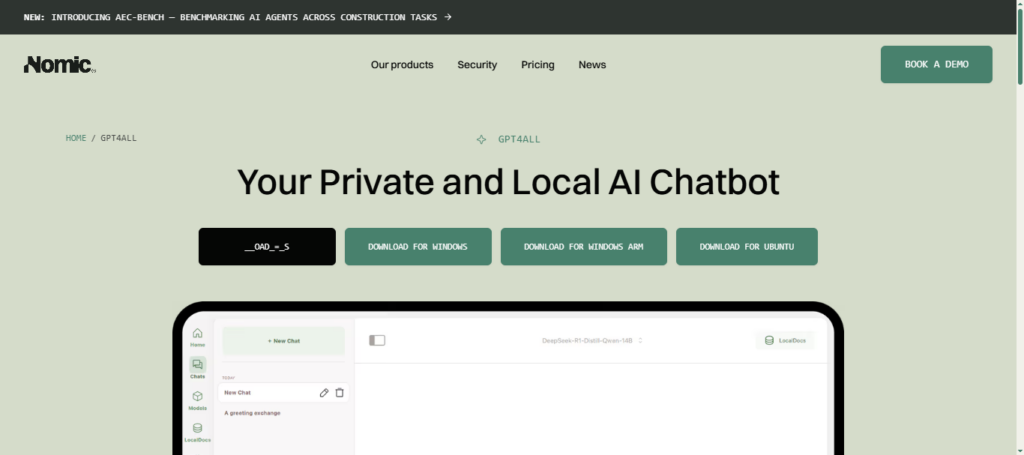
In the category of Privacy-First Local AI Models You Can Run Offline, GPT4All is quite popular because of its complete local processing with a strong commitment to privacy. The software is available to Windows, Linux, and macOS users and is capable of local document analysis, chatbots, and other AI-assisted tasks.
Simplicity makes GPT4All a popular option for those new to the field, and low hardware and software requirements increase accessibility. It helps both individual and organizational users break away from the cloud while maintaining confidentiality.
GPT4All GPT4All
| Features | Pros | Cons |
|---|---|---|
| Easy desktop installation | Beginner-friendly interface | Lower accuracy than premium AI |
| Supports multiple local models | Works fully offline | Limited advanced reasoning |
| Local document chat support | Strong privacy protection | Some models respond slowly |
| Cross-platform compatibility | No internet required | Fewer enterprise features |
| Lightweight AI assistant tools | Free and open-source | Limited multimodal support |
5. Alpaca (Stanford)
Stanford researchers created Alpaca, a lightweight AI model that indicates how smaller AI models can demonstrate advanced conversational capabilities with less fine-tuning. Smaller models are usually associated with being less impressive in terms of conversational skills.
However, Alpaca shows that with smaller models, the tradeoff is not as severe. Alpaca is included in lists of ‘Privacy-First Local AI Models You Can Run Offline,’ since Alpaca is able to run on a local system with no external, cloud-based AI interaction.
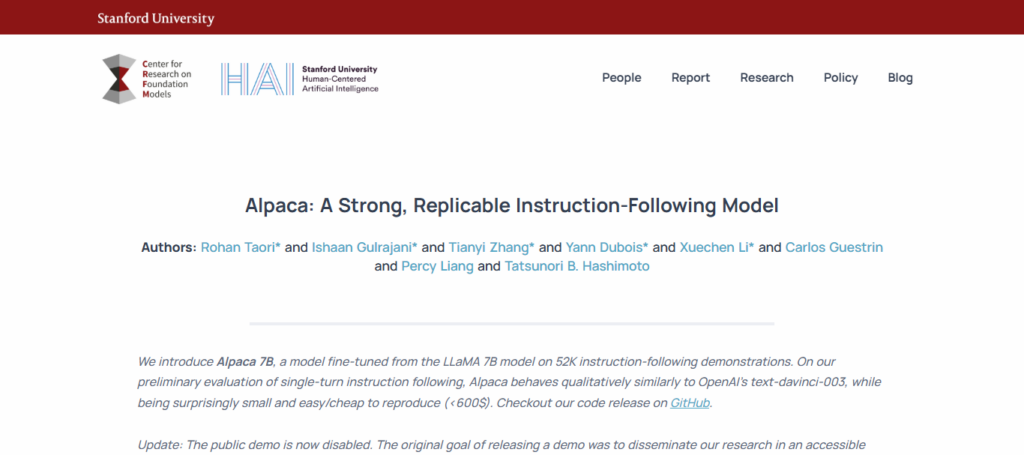
Developers and students use Alpaca for a multitude of purposes spanning research, experimentation, offline chatbots, AI productivity, and education. Alpaca’s small size is coupled with the ability to run on mid-range PC systems, bolstering its appeal even more.
Since Alpaca is the definition of an accessible AI model, community-based projects and frameworks for AI are fostered by its use.
Stanford University Alpaca (Stanford)
| Features | Pros | Cons |
|---|---|---|
| Instruction-following AI model | Lightweight and efficient | Not as advanced as newer LLMs |
| Based on LLaMA architecture | Runs on mid-range PCs | Limited commercial usage |
| Open research project | Great for experimentation | Smaller context window |
| Fine-tuning support | Good educational tool | Accuracy varies by task |
| Local chatbot deployment | Offline privacy benefits | Basic compared to larger models |
6. Vicuna
Vicuna is an open-source conversational AI model that uses prompt data to fine-tune the LLaMA model. It is among the best conversational AI models, and its popularity continues to grow. It is also included in multiple lists of ‘Privacy-First Local AI Models You Can run Offline.’
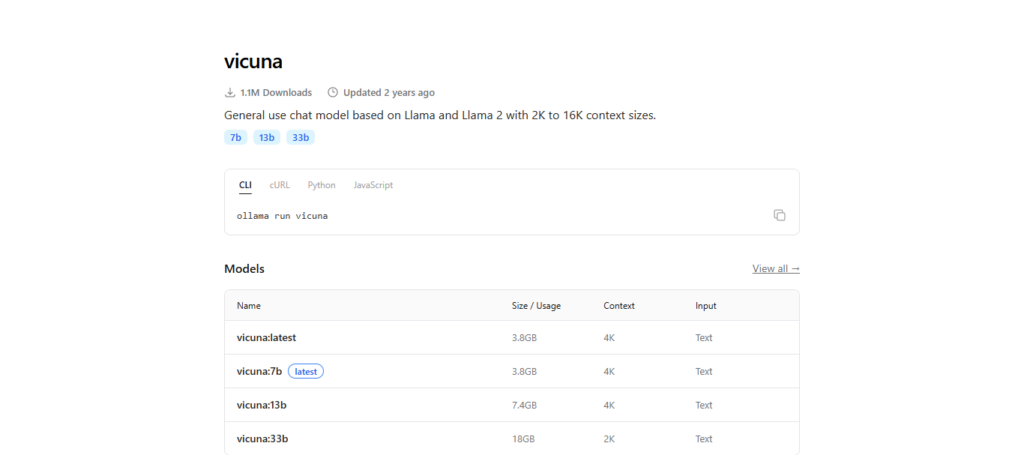
It is a fairly versatile model, as it can support a range of use cases from a conversational AI assistant, dialogue generation, customer service automation, to an interactive learning assistant. Vicuna’s appeal as a conversational AI model stems from its ease of use, as it is often deployed via local AI models developed by the community, such as Ollama and FastChat.
Vicuna
| Features | Pros | Cons |
|---|---|---|
| Conversational AI optimization | Natural chatbot responses | Requires decent GPU resources |
| Community-developed model | Strong open-source support | Dependent on LLaMA base |
| Offline deployment support | Private local conversations | Can generate inaccurate facts |
| Good instruction-following | Flexible customization | Setup complexity for beginners |
| Compatible with AI frameworks | Cost-effective AI solution | Licensing considerations |
7. Koala
Koala is an AI model designed to understand and generate conversational text, making it particularly useful for academic purposes, chatbot development, and testing offline conversational systems. Its backbone consists of interactive data from online forums, which helps it mimic human conversation in a more authentic way.

Koala is a Privacy-First Local AI Model You Can Run Offline, since it only requires a local device to function. This allows it to offer an alternative to the proprietary online AI systems, and helps developers investigate custom fine-tuning and local deployment strategies. This is done while shielding users’ private data from other sources.
Koala
| Features | Pros | Cons |
|---|---|---|
| Dialogue-focused AI model | Useful for research projects | Less advanced than modern LLMs |
| Local deployment capability | Offline data security | Limited enterprise support |
| Open conversational training | Lightweight experimentation | Smaller community ecosystem |
| Academic AI research usage | Transparent AI workflows | Lower response quality |
| Supports chatbot development | Easy testing environment | Limited optimization tools |
8. RWKV
RWKV is a Privacy-First Local AI Model You Can Run Offline that is built using a modular architecture that makes it a powerful tool for local AI applications without the need for extensive computational resources.
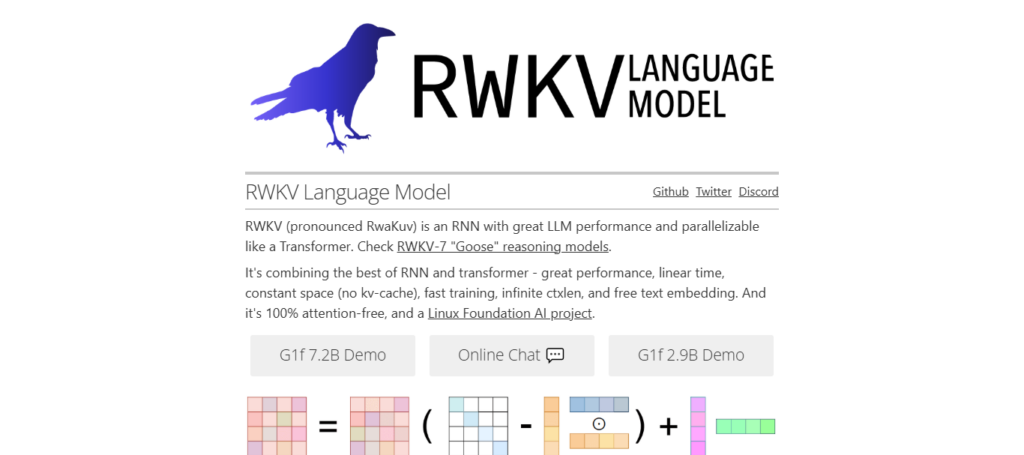
Unlike traditional transformer models, RWKV can carry out extended text-based tasks without the need for excessive VRAM and can create high-quality text outputs. Innovative design allows for high-speed execution that makes it highly deployable across a number of personal use applications.
This architecture is designed for extended operations across many devices and is particularly useful to developers seeking low-effort, offline AI tools.
RWKV
| Features | Pros | Cons |
|---|---|---|
| Hybrid RNN-transformer design | Lower VRAM requirements | Smaller ecosystem support |
| Long-context text handling | Efficient local deployment | Limited mainstream adoption |
| Fast inference speeds | Runs on consumer hardware | Fewer pretrained variants |
| Lightweight architecture | Reduced energy consumption | Less documentation available |
| Offline AI processing | Good scalability options | Weaker than top-tier LL |
9. Whisper (OpenAI)
Whisper is a model developed by OpenAI for conducting speech recognition and generating transcriptions. It is capable of translating speech and providing transcriptions. Whisper supports processing speech in different languages and is able to generate subtitles.
It is often cited as one of the best Privacy-First Local AI Models You Can Run Offline as it can be run on devices without sending speech to the cloud. It is used by journalists, researchers, and businesses who need to process audio and transcribe meetings.
Whisper is able to run efficiently on a laptop and supports open-source tools. Speech recognition can be performed in an environment that is private for the user.
OpenAI Whisper
| Features | Pros | Cons |
|---|---|---|
| Speech-to-text transcription | High transcription accuracy | Slower on CPU-only systems |
| Multilingual language support | Works completely offline | Requires storage space |
| Audio translation capabilities | Strong privacy protection | GPU improves performance |
| Supports subtitle generation | Useful for podcasts and meetings | Large models need more RAM |
| Open-source speech recognition | No cloud upload required | Not designed for chat tasks |
10. Stable Diffusion
Stable Diffusion is an AI model popular for use in generating images, illustrations, and artwork. It is able to generate visually appealing images based on descriptive text. Stable Diffusion is one of the best Privacy-First Local AI Models You Can Run Offline. Creative text is not stored and users maintain full control.
It is popular among artists and is used to enhance illustrations by designers and marketers. Almost everyone who uses Stable Diffusion is able to run the model on a local computer with a GPU for optimization. The model is extensible and supports LoRA models and checkpoints to optimize artwork.
Stable Diffusion Stable Diffusion
| Features | Pros | Cons |
|---|---|---|
| AI-powered image generation | Creates high-quality artwork | Needs GPU for best results |
| Offline text-to-image support | Full creative privacy | Large storage requirements |
| Supports custom models and LoRA | Highly customizable | Learning curve for beginners |
| Works with local AI tools | No cloud dependency | Can generate inconsistent images |
| Photorealistic art generation | Strong open-source community | Hardware-intensive workflows |
Conclusion
Privacy-First Local AI Models You Can Run Offline allow users to take charge of their data and customize their own secure computing environments. Models such as Meta LLaMA 3, Mistral AI Mistral 7B, Falcon, Vicuna, RWKV, Whisper, and Stable Diffusion eliminate the need for potentially harmful and cumbersome cloud-based AI.
Better privacy, speed, and control mean Offline AI is less reliant on the internet. For the developer, business, or researcher who is concerned about the balance between safety and practicality, Offline AI models are the optimal choice.
FAQ
What are Privacy-First Local AI Models You Can Run Offline?
Privacy-first local AI models are artificial intelligence systems that operate directly on your computer without requiring internet access. These models process data locally, helping users keep conversations, files, and sensitive information private and secure.
Why are offline AI models better for privacy?
Offline AI models keep all processing on your personal device instead of sending data to external cloud servers. This reduces the risk of data leaks, tracking, unauthorized access, and third-party monitoring, making them ideal for privacy-focused users and businesses.
Can local AI models work without an internet connection?
Yes, once installed, most local AI models can function completely offline. Models like Meta LLaMA 3, Vicuna, and Stable Diffusion Stable Diffusion can generate responses, images, and content without active internet access.
What hardware is needed to run local AI models?
The hardware depends on the model size. Lightweight models such as Mistral AI Mistral 7B can run on gaming laptops or modern PCs, while larger models like Falcon 40B may require high-end GPUs and more RAM for smooth performance.
Are offline AI models free to use?
Many offline AI models are open-source and free for personal or research use. However, some may have licensing restrictions for commercial applications, so users should always review the model’s official license terms before deployment.