


This article will cover the Best Vanguard Rivals for Low-Fee Index Funds for 2026. I will include sections on other competitors like Fidelity, Schwab, iShares and State Street to provide a well rounded analysis of the current state of the investment industry.
- Why Vanguard Rivals Matter in 2026?
- Who Is Each Vanguard Rival Best For?
- Key Points
- 1. Fidelity ZERO Total Market (FZROX)
- 2. Fidelity ZERO Large Cap (FNILX)
- 3. Fidelity 500 Index (FXAIX)
- 4. Schwab S&P 500 Index (SWPPX)
- 5. Schwab Total Stock Market (SWTSX)
- 6. iShares Core S&P 500 ETF (IVV)
- 7. iShares Total U.S. Market (ITOT)
- 8. SPDR Portfolio S&P 500 ETF (SPLG)
- 9. SPDR S&P 500 ETF (SPY)
- 10. Fidelity Total Market Index (FSKAX)
- Comparison Table: Vanguard Rivals (2026)
- Conclusion
- FAQ
Funds with expense ratios from 0.00% to 0.03% demonstrate to investors the importance of including index funds in their portfolios. I will include analyzes of each funds’ benefits and drawbacks to provide a clear analysis of each fund. I will include my own opinion based on each funds’ benchmarks in relation to Vanguard funds.
Why Vanguard Rivals Matter in 2026?
Fee Compression. The introduction of index funds with 0% expense ratios by firms like Fidelity, forces Vanguard to further decrease its fees to provide even lower costs for its investors.
Investor Choice. The increasing options provided by firms like Schwab and State Street, place Vanguard under further pressure to improve its funds in areas like tax efficiency and design.
Innovation. Proprietary index funds, like the ones offered by Fidelity, pushed Vanguard to create more innovative ETFs.
Liquidity & Trading Depth: As the most traded ETF in the world, SPY has the benefit of high liquidity. IVV and SPLG are considered more cost efficient.
International Exposure: Other ETFs provide international exposures and compete directly with Vanguard international equity funds.
Brokerage Competition: Competitors Fidelity and Schwab offer funds as part of their brokerage services and compete with Vanguard’s brokerage service offering.
Tax Efficiency: ETFs IVV and ITOT provide competitors to Vanguard ETFs and provide investors with tax efficiencies and intraday trading.
Market Equity: Competitors provide similar services to Vanguard and promote fairness in the marketplace.
Who Is Each Vanguard Rival Best For?
Vanguard rivals offer different investment styles in 2026, allowing clients to diversify based on their needs. FZROX and FNILX are the best no-cost index funds/ETFs for first-time investors and are restricted to Fidelity Funds. For a broad range of investments, Fidelity offers Funds with expenses lower than Vanguard and low fees.
Two of those Funds are Fidelity’s FXAIX and FSKAX. Investors looking to attain lower expenses and more diversification within mutual funds should look to Schwab’s SWPPX and SWTSX. Likewise, Vanguard Funds are a great choice as well. ETF investors should look to the iShares core funds or SPDR funds for lower costs. For ETFs in general, SPLG provides the lowest expense ratio, and SPY is the most traded.
Key Points
| Rival Fund | Provider | Expense Ratio (2026) | Key Point |
|---|---|---|---|
| Fidelity ZERO Total Market (FZROX) | Fidelity | 0.00% | Tracks proprietary index, unbeatable fee but limited portability. |
| Fidelity ZERO Large Cap (FNILX) | Fidelity | 0.00% | Free S&P 500-like exposure, exclusive to Fidelity accounts. |
| Fidelity 500 Index (FXAIX) | Fidelity | 0.015% | Massive AUM, near-identical to Vanguard’s VOO. |
| Schwab S&P 500 Index (SWPPX) | Schwab | 0.02% | Low-cost mutual fund with $0 minimum. |
| Schwab Total Stock Market (SWTSX) | Schwab | 0.03% | Broad U.S. market exposure at minimal cost. |
| iShares Core S&P 500 ETF (IVV) | BlackRock iShares | 0.03% | ETF rival to Vanguard’s VOO, widely available commission-free. |
| iShares Total U.S. Market (ITOT) | BlackRock iShares | 0.03% | Total market ETF, strong liquidity and tax efficiency. |
| SPDR Portfolio S&P 500 ETF (SPLG) | State Street | 0.02% | Cheaper alternative to SPY, ideal for long-term investors. |
| SPDR S&P 500 ETF (SPY) | State Street | 0.09% | Oldest ETF, higher fee but unmatched options market depth. |
| Fidelity Total Market Index (FSKAX) | Fidelity | 0.015% | Broad diversification, strong rival to Vanguard’s VTI. |
1. Fidelity ZERO Total Market (FZROX)
Fidelity launched its ZERO Total Market Index Fund (FZROX) in 2018 to give investors exposure to the entire U.S. equity market. Currently, its expense ratio is 0.00%. Because of that, it has gained a lot of popularity.
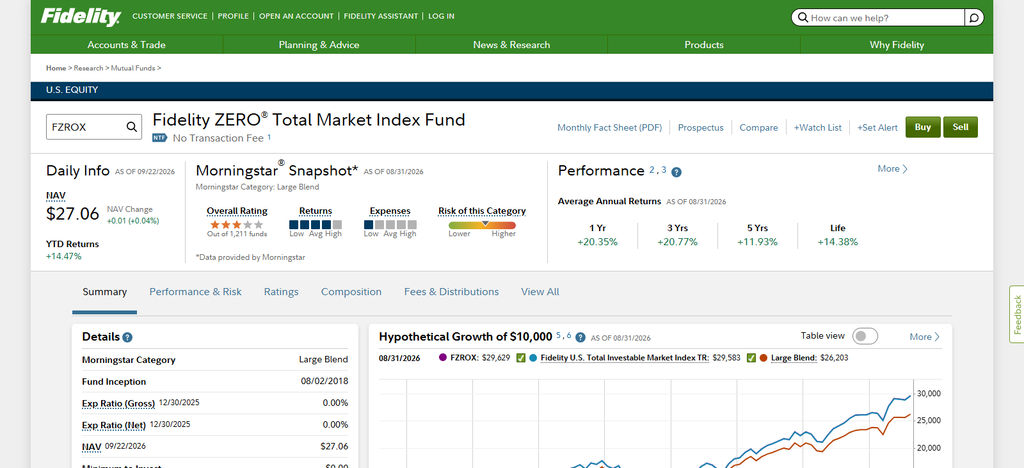
Being a mutual fund gives it some advantages. For example, it has no investment minimums, which means anyone can invest in it. FZROX also has a unique indexing strategy. Instead of using a benchmark index, Fidelity creates its own. This allows Fidelity to eliminate the cost of using a benchmark and passes the savings on to investors.
As mentioned before, it is also an open-end fund, which means it can create shares on demand. It can also issue and redeem shares. It is important to mention again that because it is a mutual fund, it is only available through Fidelity, making it less flexible than an exchange traded fund (ETF).
| Feature | Details |
|---|---|
| Founded | 2018 |
| Fund Type | Mutual Fund |
| Expense Ratio | 0.00% |
| Investment Minimum | $0 |
| Index Coverage | Entire U.S. equity market |
| Benchmark | Fidelity U.S. Total Investable Market Index |
| Accessibility | Exclusive to Fidelity brokerage |
| Diversification | Large-, mid-, and small-cap stocks |
| Key Advantage | No fees, broad exposure |
2. Fidelity ZERO Large Cap (FNILX)
Released in 2018, Fidelity ZERO Large Cap Index Fund (FNILX) offers investors the opportunity to invest in the large cap segment of the U.S. market at a 0.00% expense ratio. Being a mutual fund, it has no minimum investment requirements, and therefore is accessible to all retail investors.
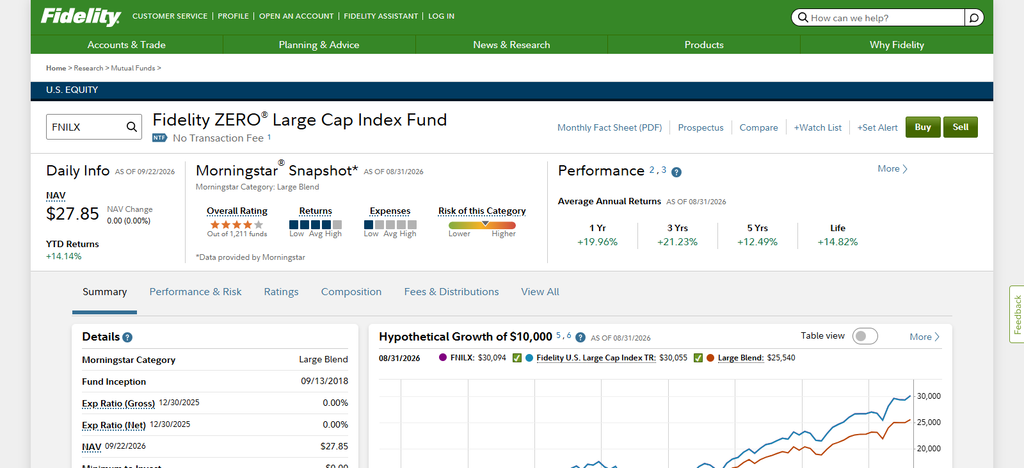
The fund, in addition to having cost advantages over its peers, is positioning itself to benefit from the growth of the large cap segment of the U.S. market. It is managed by Fidelity, and therefore is integrated in the company’s efforts to grow its exchange traded funds.
Similar to other mutual funds managed by Fidelity, FNILX has no per share trading costs. As such, all investment proceeds are directed to the fund. Importantly, Fidelity ZERO Large Cap (FNILX) is only available to investors with Fidelity accounts.
| Feature | Details |
|---|---|
| Founded | 2018 |
| Fund Type | Mutual Fund |
| Expense Ratio | 0.00% |
| Investment Minimum | $0 |
| Index Coverage | Large-cap U.S. companies |
| Benchmark | Fidelity Large Cap Index |
| Accessibility | Fidelity accounts only |
| Diversification | S&P 500-like exposure |
| Key Advantage | Free large-cap investing |
3. Fidelity 500 Index (FXAIX)
The Fidelity 500 Index Fund (FXAIX), originally launched in 1988, has developed into one of the largest and most preferred mutual funds. As of now, the fund charges a fee of 0.015% of the fund’s total assets, thereby making it one of the cheapest mutual funds to provide exposure to the S&P 500. Like other mutual funds managed by Fidelity, FXAIX, has no minimum investment requirements.
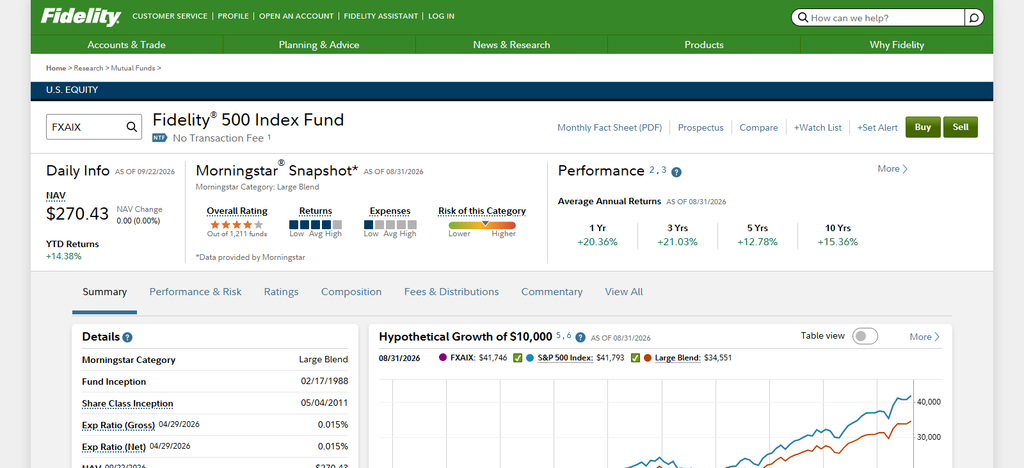
The fund provides exposure to 500 of the largest and most capitalized companies in the U.S. Given its massive size, the fund provides exposure to a significant portion of the U.S. large cap market, and is therefore, an ideal choice to gain exposure to the U.S. equity markets. Midway through, FXAIX offers investment opportunities that are comparable to those of Vanguard’s Total Stock Market Index Fund (VTSMX), Vanguard’s VFIAX and VOO.
| Feature | Details |
|---|---|
| Founded | 1988 |
| Fund Type | Mutual Fund |
| Expense Ratio | 0.015% |
| Investment Minimum | $0 |
| Index Coverage | 500 largest U.S. companies |
| Benchmark | S&P 500 Index |
| Liquidity | Very high, trillions AUM |
| Accessibility | Available across accounts |
| Key Advantage | Ultra-low cost S&P 500 |
4. Schwab S&P 500 Index (SWPPX)
The fund was launched in 1997. It offers exposure to 500 largest companies in the U.S. By charging an expense ratio of 0.02%, it has become one of the least expensive mutual funds to provide exposure to S&P 500.
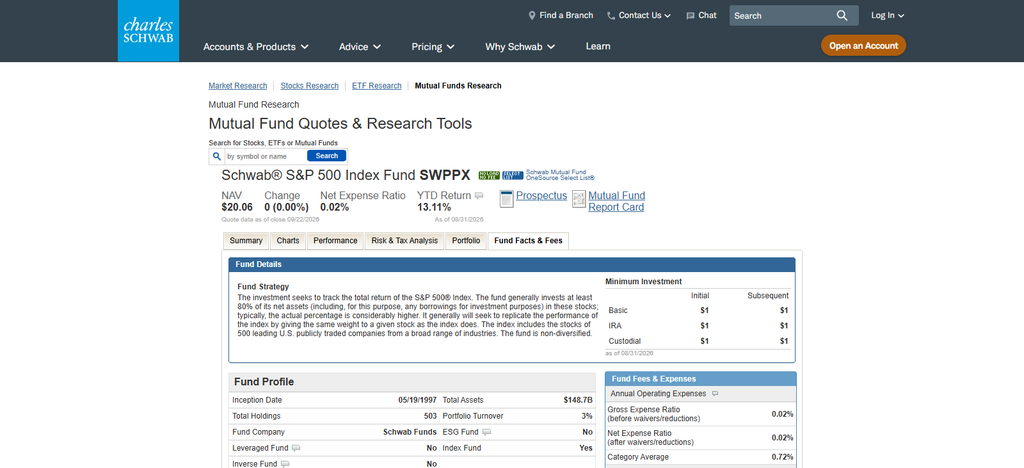
Investors are not required to make a minimum investment. The fund provides exposure to S&P 500 through its investments in 500 largest companies in the U.S. race to provide lowest expense ratio. Vanguard offers mutual fund VFIAX, which competes with SWPPX, and charges expense ratio of 0.16% for exposing investors to S&P 500.
| Feature | Details |
|---|---|
| Founded | 1997 |
| Fund Type | Mutual Fund |
| Expense Ratio | 0.02% |
| Investment Minimum | $0 |
| Index Coverage | 500 largest U.S. companies |
| Benchmark | S&P 500 Index |
| Accessibility | Schwab brokerage |
| Diversification | Broad sector exposure |
| Key Advantage | Low-cost S&P 500 rival |
5. Schwab Total Stock Market (SWTSX)
The total stock market fund of Schwab was launched in 1999. It provides exposure to entire U.S. equity market. The expense ratio charged by the fund is 0.03%. It competes with total stock market fund offered by Vanguard, VTSAX, which charges expense ratio of 0.04%.
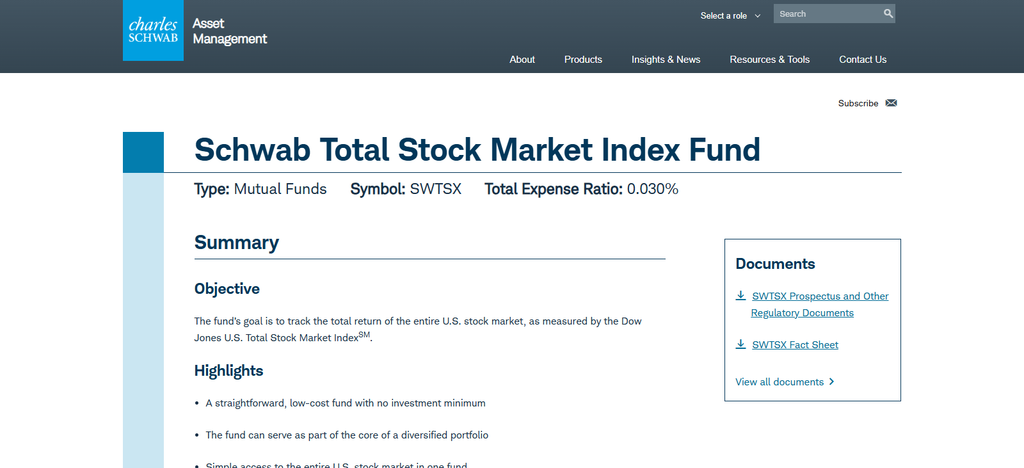
Like VTSAX, the fund provides exposure to entire equity market. The fund is comprised of large, mid and small cap stocks. SWTSX provides exposure to entire U.S. equity market at a lower expense ratio than fund offered by Vanguard.
| Feature | Details |
|---|---|
| Founded | 1999 |
| Fund Type | Mutual Fund |
| Expense Ratio | 0.03% |
| Investment Minimum | $0 |
| Index Coverage | Entire U.S. equity market |
| Benchmark | Dow Jones U.S. Total Stock Market Index |
| Accessibility | Schwab brokerage |
| Diversification | Large-, mid-, small-cap |
| Key Advantage | Broad exposure at low cost |
6. iShares Core S&P 500 ETF (IVV)
Launched in 2000, iShares Core S&P 500 ETF (IVV) is an ETF that is comprised of the components of the S&P 500. IVV has an expense ratio of 0.03% and is thus equivalent to the Vanguard S&P 500 ETF (VOO) with respect to expenses. Like all ETFs, IVV has only the cost of a share as its investment minimum.

IVV, therefore, provides investors exposure to the 500 large cap components of the U.S. market. IVV is a liquid ETF and offers an effective method for exposure to large cap U.S. equities. IVV is also equivalent to VOO in terms of expensives and performance. Halfway through this analysis, it is important to note that IVV and VOO are equivalent ETFs.
| Feature | Details |
|---|---|
| Founded | 2000 |
| Fund Type | ETF |
| Expense Ratio | 0.03% |
| Investment Minimum | 1 share |
| Index Coverage | 500 largest U.S. companies |
| Benchmark | S&P 500 Index |
| Liquidity | Extremely high |
| Accessibility | Commission-free on many platforms |
| Key Advantage | ETF rival to VOO |
7. iShares Total U.S. Market (ITOT)
iShares Total U.S. Market ETF (ITOT) was launched in 2004. The ETF provides exposure to the entire U.S. equities market. ITOT has an expense ratio of 0.03% and is, therefore, equivalent to the Vanguard Total Market ETF (VTI) in terms of expense ratio. Like all ETFs, ITOT has only the cost of a share as its investment minimum.
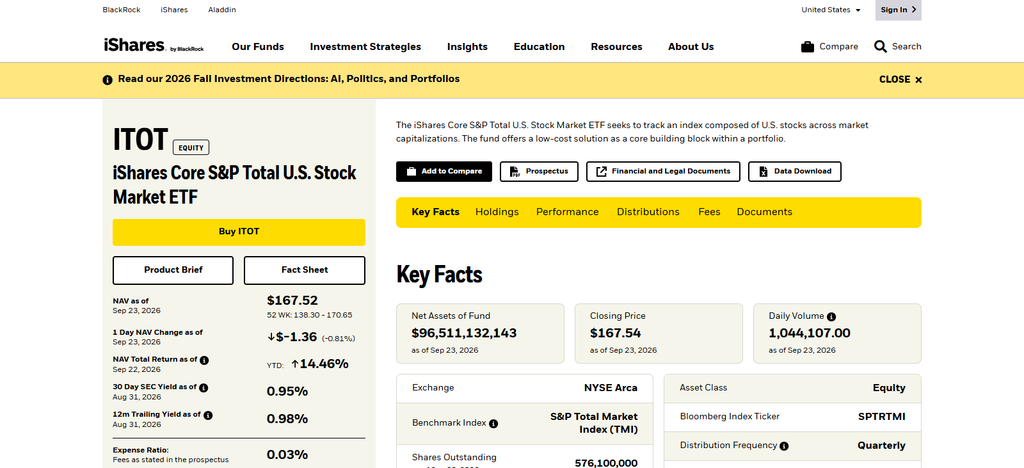
ITOT follows the S&P Total Market Index. As such, the ETF provides exposure to large, mid, small and micro-cap U.S. equities. ITOT, like VTI, is a good ETF to gain exposure to the entire U.S. equities market. ITOT and VTI are equivalent ETFs and it is important to note this half-way through this analysis.
| Feature | Details |
|---|---|
| Founded | 2004 |
| Fund Type | ETF |
| Expense Ratio | 0.03% |
| Investment Minimum | 1 share |
| Index Coverage | Entire U.S. equity market |
| Benchmark | S&P Total Market Index |
| Diversification | Large-, mid-, small-, micro-cap |
| Liquidity | Strong |
| Key Advantage | Rival to Vanguard VTI |
8. SPDR Portfolio S&P 500 ETF (SPLG)
Launched in 2005, SPDR Portfolio S&P 500 ETF (SPLG) offers exposure to the S&P 500 at a very low cost. The expense ratio is only 0.02%. At this time, the rival ETF offered by Vanguard, VOO, has an expense ratio of 0.03%.

One benefit of SPLG that VOO doesn’t provide is easy accessibility. The share price of SPLG is only $20.00, meaning the minimum investment is very low. Because of the low expense ratio and minimum share price, investors of all levels can gain exposure to the S&P 500 with this ETF.
| Feature | Details |
|---|---|
| Founded | 2005 |
| Fund Type | ETF |
| Expense Ratio | 0.02% |
| Investment Minimum | 1 share |
| Index Coverage | 500 largest U.S. companies |
| Benchmark | S&P 500 Index |
| Accessibility | Widely available |
| Liquidity | High |
| Key Advantage | Cheaper than VOO |
9. SPDR S&P 500 ETF (SPY)
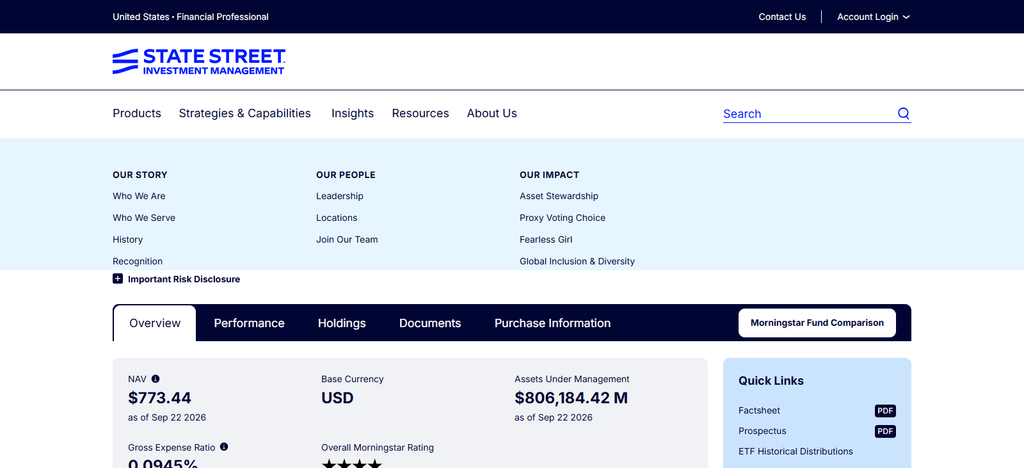
The SPDR S&P 500 ETF (SPY) is the first and most liquid ETF in the world. It has an expense ratio of 0.09%. Although it tracks the S&P 500 like the other ETFs mentioned, it charges a higher fee and therefore, not as efficient as the competition.
Like SPLG, SPY also carries a share price of only $200, making it easily accessible to all investors. SPY is considered the most liquid ETF in the world. The options market also provides depth for this ETF. Due to the liquidity of this ETF, traders prefer SPY over VOO. VOO is considered a better option for long-term investment due to lower expense ratios.
| Feature | Details |
|---|---|
| Founded | 1993 |
| Fund Type | ETF |
| Expense Ratio | 0.09% |
| Investment Minimum | 1 share |
| Index Coverage | 500 largest U.S. companies |
| Benchmark | S&P 500 Index |
| Liquidity | Most liquid ETF globally |
| Accessibility | Traded everywhere |
| Key Advantage | Best for traders/options |
10. Fidelity Total Market Index (FSKAX)
Fidelity Total Market Index Fund (FSKAX) was launched in 2011. It is a mutual fund that provides exposure to the entire United States equity market. The expense ratio of FSKAX is 0.015%. It is among the most inexpensive mutual funds to access the entire U.S. equity market. FSKAX does not have a minimum investment requirement. The fund is managed to track the Dow Jones U.S. Total Stock Market Index.

The index comprises stocks of companies of all market capitalizations. FSKAX is one of the largest mutual funds and has a large number of investors. FSKAX is typically used in investment accounts to which an individual’s retirement assets are rolled over. Currently, the expenses of Fidelity Total Market Index (FSKAX) fund are lower than those of the Vanguard Total Stock Market Index (VTSAX).
| Feature | Details |
|---|---|
| Founded | 2011 |
| Fund Type | Mutual Fund |
| Expense Ratio | 0.015% |
| Investment Minimum | $0 |
| Index Coverage | Entire U.S. equity market |
| Benchmark | Dow Jones U.S. Total Stock Market Index |
| Liquidity | Very high |
| Accessibility | Fidelity brokerage |
| Key Advantage | Rival to Vanguard VTSAX |
Comparison Table: Vanguard Rivals (2026)
| Fund | Provider | Founded | Fund Type | Expense Ratio | Investment Minimum | Index Coverage | Benchmark | Key Advantage |
|---|---|---|---|---|---|---|---|---|
| Fidelity ZERO Total Market (FZROX) | Fidelity | 2018 | Mutual Fund | 0.00% | $0 | Entire U.S. equity market | Fidelity U.S. Total Investable Market Index | No fees, broad exposure |
| Fidelity ZERO Large Cap (FNILX) | Fidelity | 2018 | Mutual Fund | 0.00% | $0 | Large-cap U.S. companies | Fidelity Large Cap Index | Free large-cap investing |
| Fidelity 500 Index (FXAIX) | Fidelity | 1988 | Mutual Fund | 0.015% | $0 | 500 largest U.S. companies | S&P 500 Index | Ultra-low cost S&P 500 |
| Schwab S&P 500 Index (SWPPX) | Schwab | 1997 | Mutual Fund | 0.02% | $0 | 500 largest U.S. companies | S&P 500 Index | Low-cost S&P 500 rival |
| Schwab Total Stock Market (SWTSX) | Schwab | 1999 | Mutual Fund | 0.03% | $0 | Entire U.S. equity market | Dow Jones U.S. Total Stock Market Index | Broad exposure at low cost |
| iShares Core S&P 500 ETF (IVV) | iShares | 2000 | ETF | 0.03% | 1 share | 500 largest U.S. companies | S&P 500 Index | ETF rival to VOO |
| iShares Total U.S. Market (ITOT) | iShares | 2004 | ETF | 0.03% | 1 share | Entire U.S. equity market | S&P Total Market Index | Rival to Vanguard VTI |
| SPDR Portfolio S&P 500 ETF (SPLG) | State Street | 2005 | ETF | 0.02% | 1 share | 500 largest U.S. companies | S&P 500 Index | Cheaper than VOO |
| SPDR S&P 500 ETF (SPY) | State Street | 1993 | ETF | 0.09% | 1 share | 500 largest U.S. companies | S&P 500 Index | Most liquid ETF globally |
| Fidelity Total Market Index (FSKAX) | Fidelity | 2011 | Mutual Fund | 0.015% | $0 | Entire U.S. equity market | Dow Jones U.S. Total Stock Market Index | Rival to Vanguard VT |
Conclusion
Compared to 2016, the low-cost index fund marketplace is more competitive and has lower costs. Fidelity, Schwab, iShares, and State Street are some of Vanguard’s main competitors.
Each of these firms has expenses ratios of 0.00%-0.03% for mutual funds and ETFs. For example, the Fidelity ZERO Total Market ETF (FZROX) and the Schwab S&P 500 Index Fund (SWPPX) have no expenses and have no minimums.
The iShares S&P 500 ETF (IVV) and the SPDR S&P 500 ETF (SPLG) offer shares that are easily traded and provide good tax consequences. When considering these funds, the best option is determined more by an investor’s goals and the broker where the investor has an account, rather than by fees.
FAQ
What makes Fidelity ZERO funds unique?
Fidelity ZERO funds like Fidelity ZERO Total Market (FZROX) and Fidelity ZERO Large Cap (FNILX) stand out because they have a 0.00% expense ratio, meaning investors pay no management fees. However, they track proprietary Fidelity indexes, so they cannot be transferred to other brokerages.
How do Fidelity’s traditional index funds compare?
Funds like Fidelity 500 Index (FXAIX) and Fidelity Total Market Index (FSKAX) track well-known benchmarks (S&P 500 and Dow Jones U.S. Total Market) with ultra-low expense ratios of 0.015%, making them strong rivals to Vanguard’s VFIAX and VTSAX.
What are Schwab’s strongest offerings?
Schwab’s S&P 500 Index (SWPPX) and Total Stock Market Index (SWTSX) are mutual funds with no minimum investment and expense ratios of 0.02–0.03%, offering broad diversification at costs nearly identical to Vanguard.
Why choose iShares ETFs over Vanguard?
iShares ETFs like Core S&P 500 (IVV) and Total U.S. Market (ITOT) offer 0.03% expense ratios, strong liquidity, and tax efficiency. They rival Vanguard’s VOO and VTI, with the added benefit of being widely available commission-free across brokerages.
What’s the difference between SPLG and SPY?
SPDR Portfolio S&P 500 ETF (SPLG) has a 0.02% expense ratio, making it cheaper for long-term investors, while SPDR S&P 500 ETF (SPY), founded in 1993, has a higher fee (0.09%) but remains the most liquid ETF globally, favored by traders for its options market depth.