In this article, I will look at the Best R&D Tax Credit Providers for Tech Firms in 2026, and showcase the strongest service providers within this area who help their clients best maximize innovation credits within the confines of the law. Some of the larger firms, including KPMG and EY, offer services in this area.
- What Are R&D Tax Credit Providers?
- Why Choose R&D Tax Credit Providers for Tech Firms
- Key Points
- 1. KPMG Tax Services
- KPMG Tax Services Pros & Cons
- 2. RSM US
- RSM US Pros & Cons
- 3. alliant
- alliant Pros & Cons
- 4. McGuire Sponsel
- McGuire Sponsel Pros & Cons
- 5. Tri-Merit
- Tri-Merit Pros & Cons
- 6. BDO USA
- BDO USA Pros & Cons
- 7. EY
- EY Pros & Cons
- 8.Grant Thornton
- Grant Thornton Pros & Cons
- 9. Source Advisors
- Source Advisors Pros & Cons
- Conclusion
- FAQ
Also, boutique firms, like Tri-Merit and McGuire Sponsel, offer service offerings as well. These firms offer services specifically for startups, mid-market firms, and global enterprises. Each of these firms helps tech companies better maximize their potential for credits and strengthen their financial strategies.
What Are R&D Tax Credit Providers?
R&D Tax Credit Providers help tech firms navigate the myriad government incentive programs for research and development and provide services to help firms claim R&D credits. Providers assist firms with various tasks associated with R&D credits, including R&D eligibility evaluation, documentation, and compliance with regulatory frameworks, including Internal Revenue Service or HMRC regulations.
These service providers help firms maximize R&D credits and state R&D credits, and provide audit defense in the event the credits are challenged. Their services often include innovative R&D tracking tools, software for the preparation of technical narratives, and mechanisms for linking and incorporating R&D expenses into tax filings.
Firms in the tech sector use these services to protect themselves from a regulatory compliance burden, maintain cash flow, lower their tax liability, and provide financial resources to sustain and increase their investment in innovation.
Why Choose R&D Tax Credit Providers for Tech Firms
Understanding Eligibility
The best R&D tax credit providers know the complexities of the IRS and HMRC eligibility rules in order to assist tech firms in identifying the appropriate software development, AI modeling, and engineering projects as qualifying R&D activities.
Maximum Credits
Their services help firms gain both federal and state credits, maximize tax credits, and enhance cash flow to further allow firms to reinvest in innovation.
Audit Defense
Many providers prepare successful audit defense documentation and either legal or controversy support is available should the IRS choose to audit.
Technology Integration
Many providers have implemented project management tools to assist in tracking project costs and preparing technical narratives that directly link costs to the tax return.
Value
The R&D tax credit provider you select should be based on the size of the firm and your budget. The smaller R&D tax credit firms tend to set their prices at a lower price than the big accounting firms. The big accounting firms tend to specialize in the higher end multinational clients.
Key Points
| Provider | Strengths | Best Fit For Tech Firms |
|---|---|---|
| KPMG Tax Services | Strong documentation governance; dispute workflow support | Large tech firms with complex R&D portfolios |
| RSM US | Audit-oriented packaging; ties experiments to costs | Mid-market tech firms needing clean audit support |
| alliant | High efficiency; strong attorney review; IRS-ready | Startups & scale-ups leveraging payroll tax offsets |
| McGuire Sponsel | Balanced methodology; strong compliance | Growth-stage tech firms |
| Tri-Merit | Efficient claim substantiation; streamlined processes | Firms needing cost-effective R&D support |
| BDO USA | Audit-ready substantiation; allocation traceability | Enterprise tech firms with complex projects |
| EY | Handles multi-state filings; strong audit defense | Global tech firms with diverse R&D programs |
| Grant Thornton | Technical narratives; tax return integration | Mid-market tech firms |
| Source Advisors | Long-standing expertise; compliance focus | Firms needing reliable, established advisory |
1. KPMG Tax Services
KPMG was created in 1987 through the merging of KMG and Peat Marwick, of the now “Big Four” firms which have specialized R&D tax credit services.
Its focus in the technology arena is with advanced compliance and documentation software and tools. Its pricing is at the higher range reflective of its global audit reputation and typically is billed through hourly or retainer services.

For audit support KPMG offers a strong contingency team to defend R&D credit claims from an IRS or HMRC challenge. State credit strategies are comprehensive with a focus on multiple-jurisdiction filings to ensure firms optimize federal and state credit opportunities.
KPMG’s strength is in its strong position defense of complex R&D credit claims involving engineering-driven portfolios.
Key Services: R&D tax credit documentation, audit defense, multi‑state, and global compliance.
Why It Stands Out: Due to their Big Four status, strong IRS/HMRC controversy teams, and some of the best compliance technology.
Best For: Large tech companies with extensive engineering portfolios who need defensible claims.
KPMG Tax Services Pros & Cons
| Pros | Cons |
|---|---|
| Global Big Four reputation | Premium pricing, higher than mid‑tier firms |
| Advanced compliance technology | Complex onboarding for smaller firms |
| Strong IRS/HMRC audit defense | Less flexible fee structures |
| Multi‑state filing expertise | May over‑engineer simple claims |
| Dedicated controversy teams | Heavy documentation requirements |
| Deep engineering portfolio expertise | Best suited for large enterprises only |
| High credibility with regulators | Limited appeal for startups |
| Global reach across jurisdictions | Slower turnaround compared to boutique firms |
| Defensible methodologies | Costly for firms with smaller R&D budgets |
2. RSM US
Providing tax compliance, R&D claim substantiation, and audit documentation services, founded in 1926, RSM US is a leading mid-market firm.

Its technology focus includes ensuring costs of experimental projects are directly linked to company financial reporting systems. Its pricing is mid-range relative to Big Four firms and offered on a fixed fee or project basis for startups or mid-market tech companies.
For RSM, robust audit support includes claim packaging that holds up to IRS challenge. State credits are a primary focus for RSM, with a range of multi-jurisdiction strategies for cost-effective compliance and strong defense. For their technology clients, RSM has a reputation for strong defense with reasonable cost.
Key Services: Tax compliance and audit-ready packaging, cost reporting linkage to innovation systems
Why It Stands Out: Their mid-tier affordability is supported by strong audit and multi-jurisdictional support.
Best For: Mid-market tech companies looking for a balance of affordability and reliability for compliance.
RSM US Pros & Cons
| Pros | Cons |
|---|---|
| Strong audit‑ready documentation | Less global reach than Big Four |
| Affordable mid‑tier pricing | May lack premium controversy teams |
| Tailored strategies for mid‑market firms | Limited resources for very large enterprises |
| Multi‑state credit expertise | Less specialized than boutique firms |
| Clean substantiation linking costs | Less automation compared to tech‑focused providers |
| Balanced compliance and affordability | May require more client involvement |
| Trusted mid‑tier reputation | Not ideal for startups needing speed |
| Flexible project‑based pricing | Limited innovation in methodology |
| Reliable audit support | Less brand prestige than Big Four |
3. alliant
alliantgroup, founded in 2001, is a firm that specializes in assisting clients with R&D credit claims and other tax credits. alliantgroup’s technology provides clients with a system to help prepare and assemble R&D credit claims.

An attorney review is included to ensure a R&D credit claim is prepared in accordance with the Internal Revenue Service’s requirements. alliantgroup’s pricing,which is based upon either a contingency or a project based fee, is typically lower than its competitors. This attracts start-ups and growing cash flow restricted small businesses.
The firm also offers support during an audit challenges claims. Although many competitors do not assist with claims at the state-level, alliantgroup ensures its clients gain all credit opportunities at the state level, including payroll tax credits.
For a firm looking to save time and reduce the compliance burden, alliantgroup is viewed as the firm to maximize R&D tax credits.
Key Services: R&D credit documentation, attorney review, payroll tax credit offset strategies.
Why It Stands Out: Efficiency and legal support for IRS defense.
Best For: Start ups and scale up companies who need a balance of maximum credit harvesting and a low compliance burden.
alliant Pros & Cons
| Pros | Cons |
|---|---|
| Efficient claim preparation | Less global coverage |
| Strong attorney review | May lack Big Four credibility |
| IRS‑ready documentation | Focused mainly on U.S. credits |
| Competitive contingency pricing | Less suited for multinational firms |
| Fast turnaround for startups | Limited depth for complex portfolios |
| Payroll tax offset strategies | May not scale well for enterprises |
| Legal defense expertise | Smaller brand recognition |
| Streamlined processes | Less comprehensive state credit coverage |
| Attractive for scale‑ups | May prioritize speed over depth |
4. McGuire Sponsel
McGuire Sponsel, founded in 2007, provides clients with R&D tax credit claims and cost segregation services. McGuire Sponsel’s technology includes methods and processes that integrate engineering documentation with tax documentation.
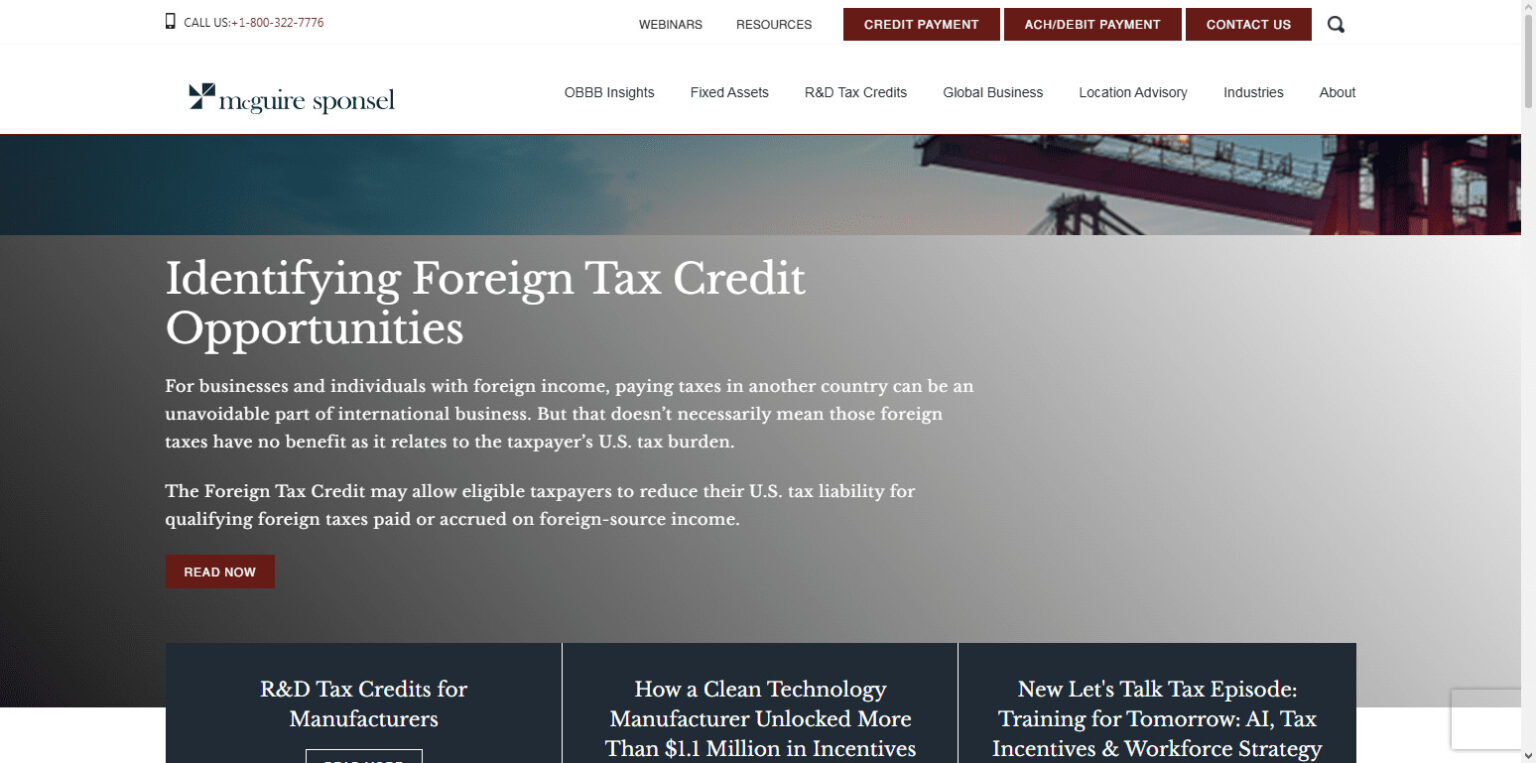
McGuire Sponsel’s project-based pricing is moderate and therefore also attractive to cash flow restricted growing firms. The firm’s process and documentation are strong, thereby giving the firm’s R&D tax credit claims a high degree of protection from IRS review. like alliantgroup,
McGuire Sponsel has a validated state credits process ensuring their clients do not forfeit any potential credits. The firm’s strength is its personalized service, which often involves developing defensible R&D tax credit claims that are cost effective.
Key Services: R&D tax credits, cost segregation and other compliance-based approaches.
Why It Stands Out: With boutique advisory support and personalized strategies coupled with balanced audit support.
Best For: Mid stage growth companies looking for cost effective R&D solutions.
McGuire Sponsel Pros & Cons
| Pros | Cons |
|---|---|
| Boutique personalized advisory | Smaller global presence |
| Balanced compliance methodologies | Less brand prestige |
| Cost‑effective project pricing | Limited controversy teams |
| Strong audit support | May lack advanced automation |
| Tailored strategies for growth firms | Less suited for very large enterprises |
| Expertise in cost segregation | Narrower focus compared to Big Four |
| Defensible documentation | May require more client input |
| Mid‑tier affordability | Limited state credit specialization |
| Trusted boutique reputation | Smaller scale resources |
5. Tri-Merit
Tri-Merit, founded in 2007, specializes in R&D tax credits and has an emphasis on developing efficient and streamlined processes. They use technology to develop systems that reduce data collection burden on engineering teams. They have a twenty year history of providing specialized credit solutions.

Pricing is cost‑effective with fixed fees. This making it attractive for mid‑market tech firms. Audit support is solid with clear documentation and robust methodologies. State credits are incorporated and hollowed out in the workflow. Tri‑Merit’s strength is combining affordability and compliance and is therefore a dominant player in the R&D support services market for tech firms.
Key Services: Simplified R&D credit claims, efficient data collection, audit support.
Why It Stands Out: Low cost fixed fee services and simplified processes to support engineering teams.
Best For: Tech companies in the Mid market seeking low cost effective R&D solutions.
Tri-Merit Pros & Cons
| Pros | Cons |
|---|---|
| Streamlined claim processes | Less global reach |
| Affordable fixed‑fee pricing | Limited brand recognition |
| Simplified data collection | May lack depth for complex portfolios |
| Strong audit substantiation | Less controversy defense capacity |
| Efficient for engineering teams | Focused mainly on U.S. credits |
| Reliable compliance | Not ideal for multinational firms |
| Cost‑effective for mid‑market | May not scale for enterprises |
| Trusted boutique provider | Less automation compared to larger firms |
| Quick turnaround | Limited state credit expertise |
6. BDO USA
BDO USA (established in 1910) is a mid‑tier global accounting firm. BDO services in R&D tax credits are highly efficient, with technology focusing on audit‑ready substantiation and allocation traceability.

Pricing is project‑based which is appealing to enterprise tech firms. BDO offers audit support which includes controversy defense and documentation packages which are designed to hold up in an IRS review. State credits are a focus area in BDO’s expended strategies, and accordingly, BDO is suited well towards tech firms in need of R&D compliance.
Key Services: R&D documentation, allocation tracing, audit defense
Why It Stands Out: Global reach and strong value affordability coupled with audit readiness.
Best For: Enterprise tech firms with complex, multi‑state R&D projects.
BDO USA Pros & Cons
| Pros | Cons |
|---|---|
| Global mid‑tier reputation | Less prestige than Big Four |
| Audit‑ready substantiation | Premium pricing for complex projects |
| Allocation traceability | May lack boutique personalization |
| Strong controversy defense | Slower turnaround than smaller firms |
| Multi‑state filing expertise | Less suited for startups |
| Competitive project pricing | May require heavy documentation |
| Reliable compliance | Limited automation tools |
| Trusted global brand | Not as cost‑effective for small firms |
| Balanced affordability & expertise | Focused more on enterprise clients |
7. EY
Founded in 1989 as the merger of Ernst & Whinney and Arthur Young, EY is a global firm in the Big Four offering R&D tax credit services. EY offers services in multi-jurisdictional R&D taxation planning and complex R&D taxation compliance systems. EY’s pricing reflects its strong and reputation in global tax audits and is structured as risk contingent or remunerated by the hour.

EY provides audit defense with dedicated teams and multi-state tax credit filing expertise. State tax credits are addressed in a holistic manner to ensure tax shelter firms obtain all available federal and regional subsidies. For tech firms, EY is capable of managing complex international R&D programs. EY prepares a strong audit defense position and limit-tests the eligibility of R&D credits for clients.
Key Services: Global R&D tax planning, multi-jurisdiction filings, audit defense.
Why It Stands Out: Big Four scale, advanced compliance systems, strong global reach.
Best For: Multinational tech firms managing diverse R&D programs worldwide.
EY Pros & Cons
| Pros | Cons |
|---|---|
| Big Four global expertise | Premium pricing |
| Advanced compliance systems | Complex onboarding |
| Strong audit defense | Heavy documentation requirements |
| Multi‑jurisdictional planning | Less suited for startups |
| Dedicated controversy teams | Slower turnaround |
| Global reach | May over‑engineer simple claims |
| Defensible methodologies | Costly for smaller firms |
| Trusted brand credibility | Limited flexibility in pricing |
| Effective for multinational firms | Best for enterprises only |
8.Grant Thornton
Grant Thornton was founded in 1924, and has been a leading mid-tier accounting firm since specializing in audits, taxes, and advisory services. Their deep tech knowledge allows them to prepare technical drafts to describe how specific experimental projects relate to tax reporting.

Their pricing is mid-range, and is generally project-based making them mid-market tech options. Strong audit support comes from packages built to withstand IRS review. Their methodology includes State credits to improve the technology firms’ utilization of both Federal and region-based incentives.
For tech companies, Grant Thornton implements a combination of affordability and compliance, making them a trusted ally for companies seeking dependable R&D services for a price that is less than the Big Four.
Key Services: Technical narratives, tax return integration, audit‑ready documentation.
Why It Stands Out: Mid‑tier pricing with strong compliance and IRS defense capabilities.
Best For: Mid‑market tech firms needing reliable R&D support without Big Four costs.
Grant Thornton Pros & Cons
| Pros | Cons |
|---|---|
| Mid‑tier affordability | Less global reach |
| Strong audit support | Limited controversy teams |
| Technical narratives expertise | Less automation |
| Reliable compliance | May lack boutique personalization |
| Flexible project pricing | Not ideal for startups |
| Trusted mid‑tier brand | Less prestige than Big Four |
| Balanced methodologies | May require more client input |
| Multi‑state credit expertise | Limited global coverage |
| Defensible documentation | Slower than boutique providers |
9. Source Advisors
Source Advisors, established in 1983, provides R&D tax credit services with a focus on compliance. When it comes to technology, the main focus is on methods that are defensible during an IRS audit.

Price wise it is usually project based, and therefore attractive to firms who need advisory support, but don’t want to pay the highest price. Audit support is strong, and Source Advisors is known to have excellent controversy defense and documentation.
Firm’s maximize incentives across all jurisdictions. For tech firms, Source Advisors is a reliable provider with compliance focus making it a good choice for defensible R&D claims.
Key Services: R&D tax credit advisory, compliance methodologies, audit defense.
Why It Stands Out: Long‑standing expertise, competitive pricing, strong controversy support.
Best For: Tech firms seeking reliable, established advisory with defensible claims.
Source Advisors Pros & Cons
| Pros | Cons |
|---|---|
| Long‑standing expertise | Smaller global presence |
| Competitive project pricing | Less brand prestige |
| Strong compliance methodologies | Limited controversy teams |
| Reliable audit defense | Less automation |
| Comprehensive state credit handling | Focused mainly on U.S. credits |
| Trusted advisory reputation | May not scale for enterprises |
| Cost‑effective for smaller firms | Less suited for multinational firms |
| Defensible documentation | May require more client involvement |
| Established credibility | Limited innovation compared to Big Four |
Conclusion
In 2026, tech companies will find plenty of options for R&D tax credit service providers, ranging from Big Four companies like KPMG Tax Services and EY to specialized firms like alliant, Tri-Merit, and McGuire Sponsel.
KPMG and EY are strong on global compliance and auditing defense, while RSM and Grant Thornton are strong on cost vs. documentation. alliant and Tri-Merit are strong on ease and efficiency for startups and mid-market companies. BDO and Source Advisors, as established firms, cover reliability and expertise on multiple state tax credits.
The size, the level of complexity, and the risk of audit for the company the tax credits will be performed on will determine whether the service provided it best. Larger companies will likely benefit from the greater rigor of the Big Four of accounting firms, while startups and growing companies will likely benefit from the more specialized firms.
FAQ
What is the R&D tax credit?
The R&D tax credit is a government incentive designed to encourage innovation by reducing tax liability for companies investing in research and development. Tech firms benefit by offsetting payroll taxes, federal income taxes, and in some cases, state taxes.
Which provider is best for startups?
Providers like alliant and Tri-Merit stand out for startups and scale‑ups due to their efficient processes, competitive pricing, and strong payroll tax offset strategies.
Which provider is best for large enterprises?
Big Four firms such as KPMG Tax Services and EY are ideal for large enterprises with complex, multi‑state or global R&D programs. They offer premium audit defense, advanced compliance systems, and global reach.
Do these providers handle state credits?
Yes. Firms like RSM US, BDO USA, and Grant Thornton specialize in multi‑state filings, ensuring tech firms maximize both federal and state incentives.
How much do providers charge?
Pricing varies: Big Four firms (KPMG, EY) charge premium hourly or retainer fees, while mid‑tier firms (RSM US, Grant Thornton, BDO USA) offer project‑based pricing. Boutique providers (Tri-Merit, McGuire Sponsel, Source Advisors) often provide fixed‑fee or contingency models, making them cost‑effective for smaller firms.