


The best decentralized exchange alternatives to Uniswap: A closer look at top platforms with lower fees, advanced trading functions, faster transactions, and multi-chain access.
- What is Decentralized Exchange Alternatives?
- Benefits Of Decentralized Exchange Alternatives to Uniswap
- Lower Transaction Fees
- Multi-Chain Trading Access
- Better Price Optimization
- Specialized Trading Features
- Faster Transaction Speeds
- Enhanced Security and Fund Control
- Higher Yield Opportunities
- Greater Innovation in DeFi
- Key Point & Best Decentralized Exchange Alternatives to Uniswap
- 1. 1inch
- 1inch — Features
- 1inch — Advantages & Disadvantages
- 2. PancakeSwap
- PancakeSwap — Features
- PancakeSwap — Advantages & Disadvantages
- 3. SushiSwap
- SushiSwap — Features
- SushiSwap — Advantages & Disadvantages
- 4. Curve Finance
- Curve Finance — Features
- Curve Finance — Advantages & Disadvantages
- 5. Balancer
- Balancer — Features
- Balancer — Advantages & Disadvantages
- 6. dYdX
- dYdX — Features
- dYdX — Advantages & Disadvantages
- 7. Jupiter
- Jupiter — Features
- Jupiter — Advantages & Disadvantages
- 8. Raydium
- Raydium — Features
- Raydium — Advantages & Disadvantages
- 9. Trader Joe
- Trader Joe — Features
- Trader Joe — Advantages & Disadvantages
- 10. CoW Swap
- CoW Swap — Features
- CoW Swap — Advantages & Disadvantages
- Conclusion
- FAQ
As decentralized finance matures, traders are discovering more than just Uniswap awaits them, with alternative protocols that bring greater liquidity, better safety measures, and exciting new tools for smooth crypto trading.
What is Decentralized Exchange Alternatives?
Alternative DEXes are blockchain-based trading platforms that enable users to purchase, sell and swap cryptocurrencies directly from their wallets without the need for a central authority or intermediary.
Trading on decentralized exchanges utilizes smart contracts and allows users to retain control over their funds, increased privacy, and better security compared to traditional exchanges. DeFi platforms like 1inch, PancakeSwap and Curve Finance offer unique benefits like lower fees, cross-chain trading, better liquidity routing that allows for improved swaps with less slippage and expertise in certain tokens or financial products.
Other types for DEX alternatives grow the decentralized finance ecosystem because they provide quicker transactions with multiple assets while always adding different financial instruments not seen within a single platform.
Benefits Of Decentralized Exchange Alternatives to Uniswap
Lower Transaction Fees
Many of the alternatives run on blockchains where gas is cheaper than Ethereum. Exchanges such as PancakeSwap and Trader Joe offer far lower trading fees, allowing users to trade more frequently.
Multi-Chain Trading Access
Decentralized Exchange (DEX) alternatives: are multichain base, and therefore users can trade valuable assets across multiple blockchain ecosystems. Exchanges, like SushiSwap and 1inch, allow traders to access a greater depth of liquidity across multiple blocks.
Better Price Optimization
Aggregators and advanced routing systems search many liquidity pools to find the best trade rates. Protocols like Jupiter enhance price efficiency, and reduce slippage during swaps.
Specialized Trading Features
Various DEXs cater to specific trading requirements. Curve Finance focus on stablecoin trading, and dYdX provides derivatives and leverage tools for trading.
Faster Transaction Speeds
Others employ high-performance blockchains, enabling trades within a matter of seconds. This allows platforms such as Raydium to facilitate near-instant transactions with minimal network congestion.
Enhanced Security and Fund Control
Users retain control over their private keys and funds since DEX alternatives are non-custodial. Protocols such as CoW Swap further mitigate risk from front-running and MEV attacks.
Higher Yield Opportunities
Staking, farming and liquidity rewards are common offerings on a lot of decentralized exchanges. There are many platforms that let users earn passive income by providing liquidity such as Balancer.
Greater Innovation in DeFi
New financial primitives, governance approaches and liquidity mechanisms have been iteratively launched by the CEX alternatives. This is an innovation that also brings decentralized finance beyond traditional token swapping and enables more flexible investment strategies.
Key Point & Best Decentralized Exchange Alternatives to Uniswap
| Platform | Key Points |
|---|---|
| 1inch | DEX aggregator that finds the best token swap rates across multiple exchanges with optimized gas fees and deep liquidity routing. |
| PancakeSwap | Popular Binance Smart Chain DEX offering low fees, staking, farming rewards, NFT marketplace, and fast transaction speeds. |
| SushiSwap | Community-driven multi-chain DEX providing token swaps, yield farming, staking, lending, and decentralized governance features. |
| Curve Finance | Specialized AMM designed for stablecoin trading with minimal slippage and extremely low transaction fees. |
| Balancer | Automated portfolio manager and liquidity protocol allowing customizable liquidity pools with multiple token ratios. |
| dYdX | Advanced decentralized derivatives exchange focused on perpetual futures trading, leverage trading, and professional-level tools. |
| Jupiter | Leading Solana-based liquidity aggregator delivering optimized swaps, price routing, and fast low-cost trading execution. |
| Raydium | Solana AMM integrated with central limit order book liquidity, enabling fast swaps, farming, and launchpad token offerings. |
| Trader Joe | Avalanche-native DEX offering swaps, staking, lending, liquidity pools, and advanced DeFi trading ecosystem features. |
| CoW Swap | MEV-protected DEX using batch auctions and solver competition to provide optimal pricing and reduced front-running risks. |
1. 1inch
1inch Trade: 1inch is an incredibly popular DEX aggregator known for its ability to look across many liquidity sources to find you the best token swap rates. By taking trades taken on several DEXs rather than one singular exchange, it minimizes gas fees and slippage.
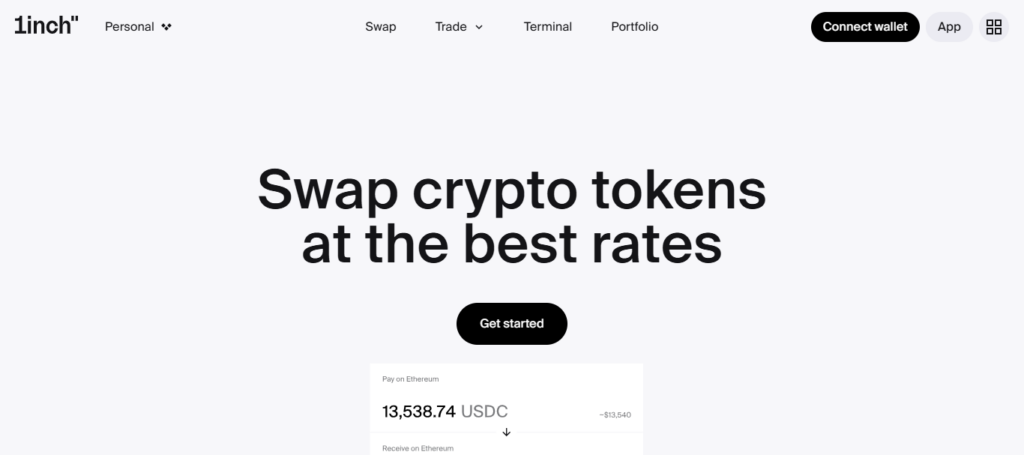
Optimized routing algorithms, limit orders and MEV protection features are beneficial for traders. Nestled within the Top DEX Alternatives for Uniswap, 1inch is ideal for users intent on price efficiency and smart trade execution. It works with multiple blockchains like Ethereum, BNB Chain, Polygon, and Arbitrum — making it perfect for sophisticated DeFi traders.
1inch — Features
- Splits orders among multiple DEXs in order to maximize profit.
- Minimize slippage and gas fees with a smart routing algorithm.
- Includes support for limit orders and advanced trade execution
- Cross-chain support: Ethereum, BNB Chain, Polygon & Arbitrum.
- Native MEV protection with optimized trade splitting.
1inch — Advantages & Disadvantages
| Advantages | Disadvantages |
|---|---|
| Finds best prices by aggregating multiple DEXs | Interface may feel complex for beginners |
| Reduces slippage through smart routing | Gas fees still apply on Ethereum network |
| Supports multiple blockchains | Advanced settings require trading knowledge |
| Limit order functionality available | Execution speed depends on network congestion |
| MEV protection improves trade safety | Not ideal for very small trades |
2. PancakeSwap
PancakeSwap is amongst the most popular, low-cost decentralized exchanges built on BNB Chain with extremely low transaction costs and fast confirmations. Its various offerings include token swaps, staking pools, yield farming, prediction markets, NFTs, and lottery features to create a full DeFi ecosystem.
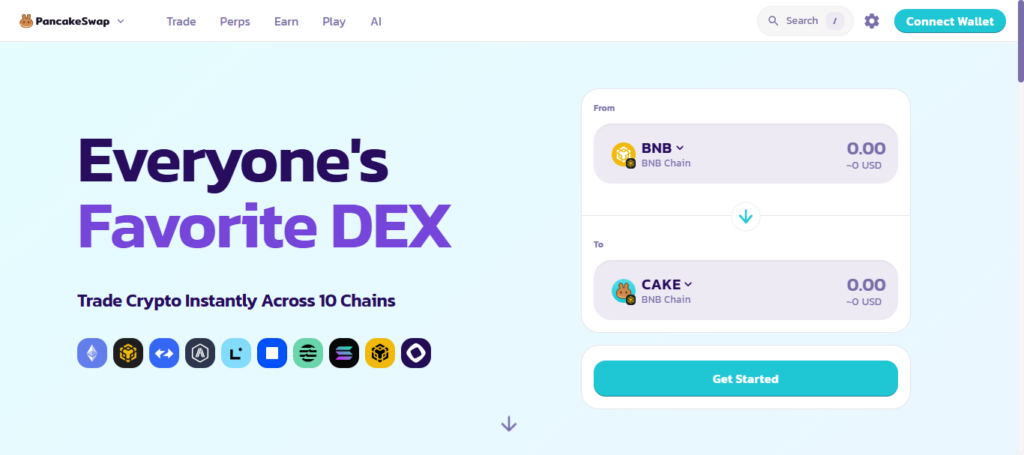
Upon analyzing the Top Alternatives to Uniswap for Decentralized Exchanges, PancakeSwap is appealing because it enables low gas fees compared to Ethereum-based platforms and does best with beginner and high volume trade. Synthetix employs an automated market maker (AMM) model that guarantees deep liquidity, and the governance tokens enable community input on protocol decisions and future improvements.
PancakeSwap — Features
- BNB Chain trades happen at low fees and at high speed.
- AMM (Automated Excess Maker token swapping system
- Yield farming, staking pools and liquidity mining rewards.
- Integration of marketplace and NFT gaming ecosystem
- CAKE token governance by the community
PancakeSwap — Advantages & Disadvantages
| Advantages | Disadvantages |
|---|---|
| Extremely low transaction fees | Mainly dependent on BNB Chain ecosystem |
| Fast trading execution | Fewer institutional-grade tools |
| Easy-to-use interface for beginners | Token quality varies widely |
| Staking and farming rewards | Higher exposure to new-project risks |
| Large liquidity pools | Less decentralization compared to Ethereum |
3. SushiSwap
SushiSwap started as a Uniswap fork but soon became an all-in-one multi-chain De-Fi platform. In addition to token swaps, it offers lending, staking, liquidity mining and cross-chain DeFi products. Ranked as one of the Top-Decentralized Exchange Alternatives to Uniswap, SushiSwap is attractive for users who support decentralization and decentralized governance.
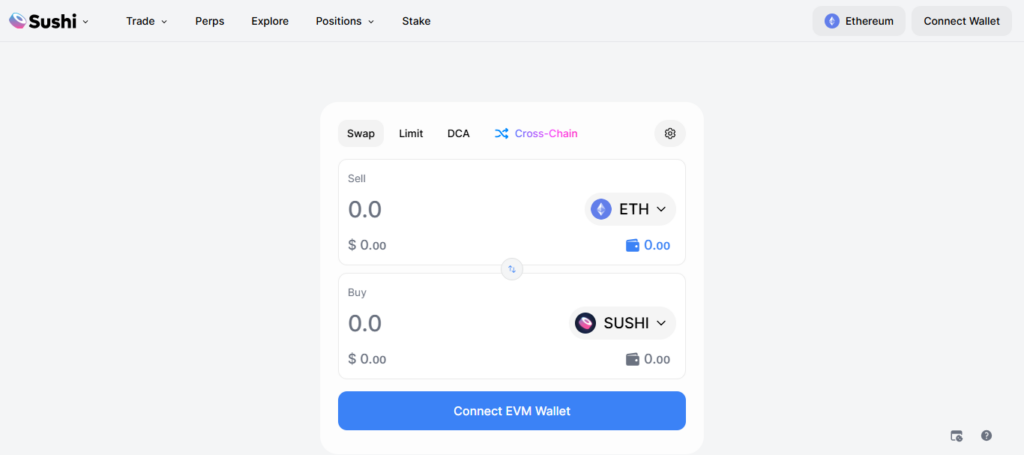
Its ecosystem consists of BentoBox and Kashi lending markets for complex financial slogs. SushiSwap covers a variety of networks including Ethereum, Polygon and Arbitrum while centering their model on innovation, flexibility, and compensation with strong liquidity incentive programs across the board.
SushiSwap — Features
- Cross-chain decentralized exchange functionality.
- Yield farms and staking reward programs.
- Lending and borrow using the BentoBox ecosystem.
- Community-driven governance model.
- The most advanced DeFi integrations across various networks.
SushiSwap — Advantages & Disadvantages
| Advantages | Disadvantages |
|---|---|
| Operates across multiple blockchains | Liquidity fragmented across networks |
| Community governance model | Past governance controversies |
| Offers lending, staking, and swaps | UI can feel overwhelming |
| Attractive liquidity incentives | Rewards fluctuate frequently |
| Strong DeFi ecosystem integrations | Smaller liquidity than leading DEXs |
4. Curve Finance
Curve Finance is a decentralized exchange optimized for stablecoin and wrapped asset trading, with ultra-low slippage and extremely efficient liquidity pools. Instead, Curve uses a unique bonding curve that is specifically tailored to assets with similar prices, making the protocol perfect for USDT, USDC, and DAI swaps—unlike traditional AMMs.
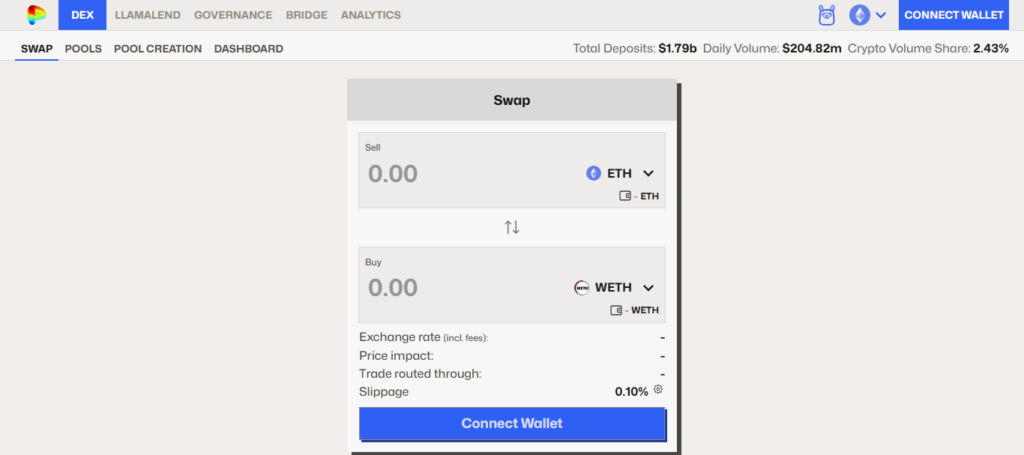
Best Uniswap DEX Alternatives also Curve Finance (despite being favored among liquidity providers and institutional traders focused on stable asset strategies). The native platform also features other DeFi protocol integrations for yield optimization and multi-chain support, allowing users to earn fees and rewards with lower risk of impermanent loss.
Curve Finance — Features
- Improved trading for stables and pegged assets
- Extremely low slippage swaps.
- High capital efficiency liquidity pools.
- Interconnecting with DeFi yield optimization platforms
- Traders take options on the spread or peg, making it less likely for impermanent loss to occur.
Curve Finance — Advantages & Disadvantages
| Advantages | Disadvantages |
|---|---|
| Extremely low slippage for stablecoins | Limited support for volatile tokens |
| High capital efficiency | Complex interface for beginners |
| Reduced impermanent loss risk | Strategy requires DeFi understanding |
| Deep stablecoin liquidity | Less suitable for speculative trading |
| Strong integration with DeFi protocols | Lower trading variety |
5. Balancer
Balancer is a DEX (decentralized exchange) as well as an automated portfolio management system. Custom gain liquidity pools (Multiple Token + Weight Ratio Adjustment) — Users can set up customizable liquidity pools with a variety of tokens and weight ratios, enabling passive portfolio rebalancing. In these discussions a project that stands out as one of the Best Decentralized Exchange Alternatives to Uniswap is Balancer, which enables flexibility and innovation in liquidity provisioning.

Traders pay the liquidity providers, who remain exposed to a diversified portfolio of tokens. Balancer additionally allows for programmable pools, smart treasury management and DAO-of-a-DAO governance, which makes it natural for power-user DeFi end-users along with projects that want capital efficiency as well as automated asset management solutions within DEX markets.
Balancer — Features
- Multi-token and customizable liquidity pools
- Automated portfolio rebalancing system.
- Programmable smart liquidity pools.
- Generating trading fees = passive income
- Tools for DAO governance and treasury management.
Balancer — Advantages & Disadvantages
| Advantages | Disadvantages |
|---|---|
| Customizable multi-token liquidity pools | Advanced setup complexity |
| Automated portfolio rebalancing | Not beginner-friendly |
| Earn fees while holding diversified assets | Lower liquidity than major DEXs |
| Flexible pool weight configurations | Requires technical knowledge |
| DAO governance participation | Smaller user base |
6. dYdX
dYdX is mainly for trading decentralized derivatives, not just token swaps. It has perpetual futures, leverage trading, advanced order types and pro level charting tools you would expect on centralized exchanges. dYdX or Best dApps Alternatives to Uniswap for Pros dYdX is targeted at pro traders who want margin trading without custodial risk.
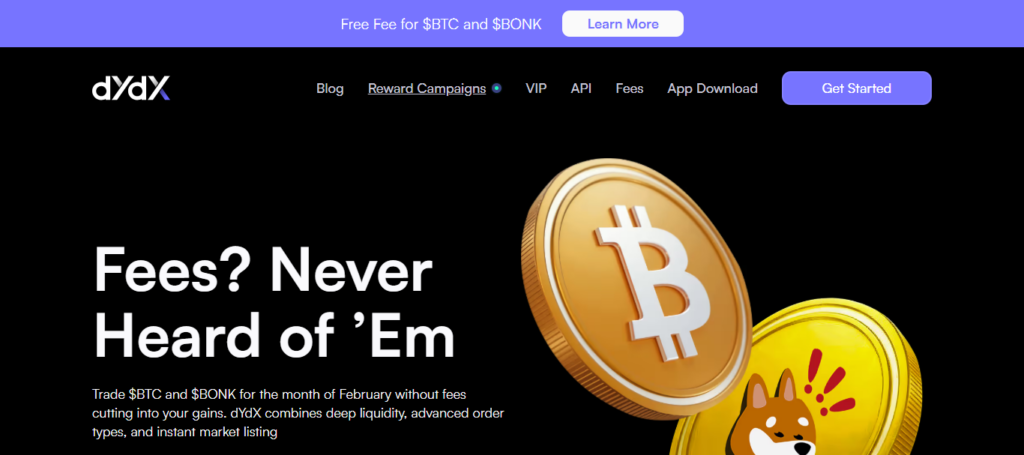
Powered by layer-2 scaling technology, it specializes in fast execution speeds and lower transaction costs. By providing a decentralized governance model that allows token holders to direct platform development, coupled with transparent, secure and non-custodial trading infrastructure so the users can always control their funds.
dYdX — Features
- Support for perpetual futures and margin trading.
- Professional Analysis Tools; Advanced Trading Interface
- Scaling on layer-2 for cheap and fast execution.
- Non-custodial decentralized trading environment.
- Deep liquidity for derivatives markets.
dYdX — Advantages & Disadvantages
| Advantages | Disadvantages |
|---|---|
| Advanced derivatives and leverage trading | Not suitable for beginners |
| Professional trading interface | Higher risk due to leverage |
| Fast Layer-2 execution | Limited spot trading options |
| Non-custodial asset control | Learning curve for new users |
| Deep liquidity for futures markets | Regulatory uncertainty in some regions |
7. Jupiter
Jupiter is the preeminent liquidity aggregator in the Solana ecosystem allowing it to route trades across various decentralized exchanges for better pricing. Jupiter: This tool is well-known for its instantaneous transaction times and low fees, increasing the overall trading efficiency on Solana.
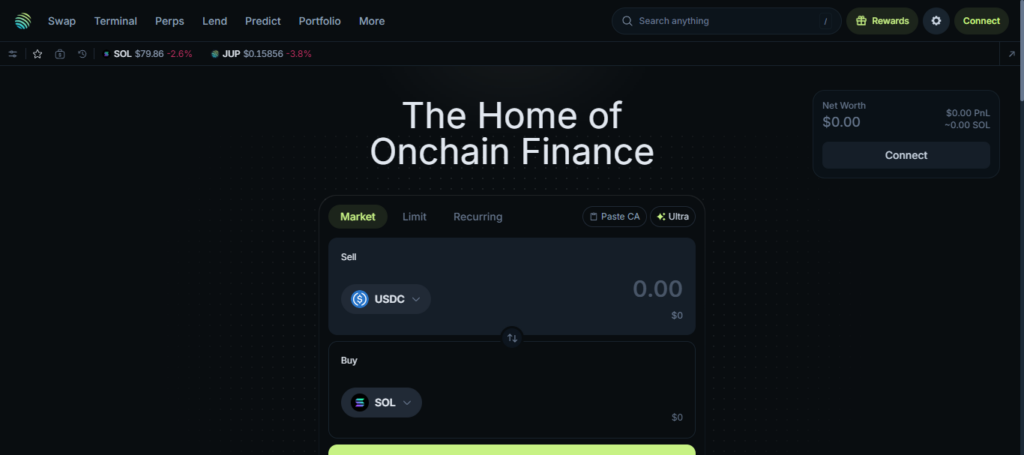
In researching Best Decentralized Exchange Alternatives to Uniswap, Jupiter stands out as a top choice for traders looking for scalability and performance. It supports limit orders, dollar-cost averaging tools, and deep access to liquidity. They are critical to Solana DeFi by streamlining swaps and enabling better price discovery with its smart routing technology.
Jupiter — Features
- Aggregates across the entire Solana DEX ecosystem.
- High-speed swaps at very low transaction fees.
- Intelligent price routing system.
- Tools such as limit orders and dollar-cost averaging
- Good integration with Solana DeFi apps.
Jupiter — Advantages & Disadvantages
| Advantages | Disadvantages |
|---|---|
| Very low transaction costs | Limited mainly to Solana ecosystem |
| Fast transaction execution | Dependent on Solana network stability |
| Best-price routing across Solana DEXs | Smaller token availability vs Ethereum |
| Advanced swap optimization | Less mature ecosystem |
| User-friendly trading interface | Cross-chain options still growing |
8. Raydium
Raydium: An AMM With Access to a Central Limit Order Book Developed on Solana, it provides fast swaps, yield farms, staking options, and token launchpad services. Users looking for Best Decentralized Exchange Alternatives to Uniswap and the benefits of AMM simplicity as well as professional trading liquidity will turn to Raydium.
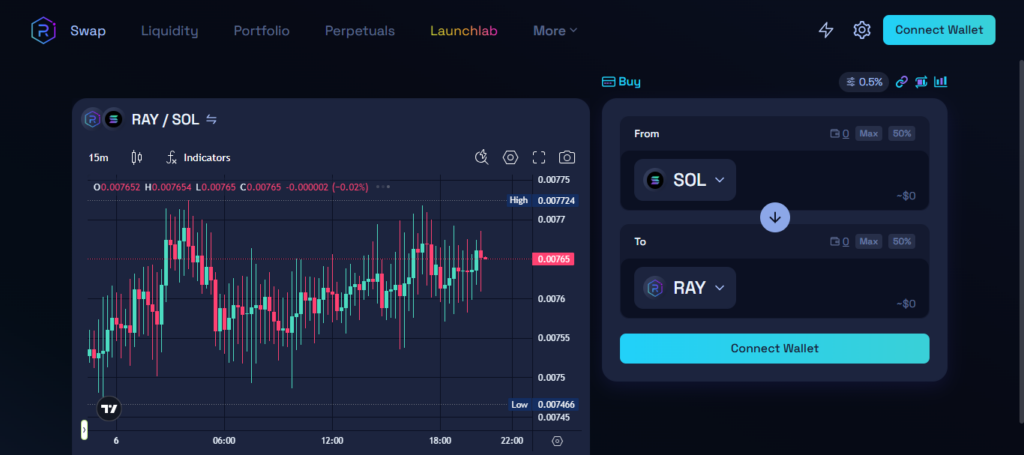
It plugs into Solana’s ecosystem for capital-efficient transactions and nearly instant movements. Collaborative platform — Raydium introduces liquidity incentives, allowing new projects join the market and rewarded liquidity providers in the expanding Solana DeFi ecosystem.
Raydium — Features
- AMM with central limit order book liquidity.
- Solana blockchain powered Out-speed Swaps
- Yield farming and staking opportunities.
- IDO launchpad for new cryptocurrency projects
- Access deep liquidity across Solana markets
Raydium — Advantages & Disadvantages
| Advantages | Disadvantages |
|---|---|
| High-speed swaps on Solana | Ecosystem limited compared to Ethereum |
| Access to order book liquidity | Requires Solana wallet setup |
| Yield farming rewards | Network outages can impact trading |
| Launchpad for new tokens | Exposure to early-stage project risk |
| Low fees and efficient trading | Smaller global adoption |
9. Trader Joe
Trader Joe is a one-stop Decentralized Finance platform primarily built on Avalanche. Its Liquidity Book model offers token swaps, lending, staking, and yield farming as well as advanced liquidity features. Why is Trader Joe listed as one of the Best Decentralized Exchange Alternatives to Uniswap?

It combines a few DeFi services on a single interface. Avalanche’s quick finality and low transaction fees improve trading efficiency, enabling active DeFi participants. The platform focuses on a unique design experience for users including robust community governance and novel liquidity instruments with the goal of maximizing capital efficiency for traders and investors.
Trader Joe — Features
- Liquidity Book model for optimized trade execution.
- Swapping, Lending and Staking in a single platform
- Fast transactions on Avalanche blockchain.
- Liquidity provider and yield-farming rewards
- Beginner and professional trader friendly interface
Trader Joe — Advantages & Disadvantages
| Advantages | Disadvantages |
|---|---|
| Low fees on Avalanche network | Dependent on Avalanche adoption |
| All-in-one DeFi platform | Smaller liquidity than major DEXs |
| Liquidity Book improves capital efficiency | Limited cross-chain features |
| Beginner-friendly interface | Fewer advanced derivatives tools |
| Staking and lending options | Ecosystem still expanding |
10. CoW Swap
Rather than a traditional AMM swap, CoW Swap uses a batch auction to settle trades. To reduce slippage, it matches user orders directly and through solver competition; to minimize gas costs and protect traders from MEV attacks / front-running.
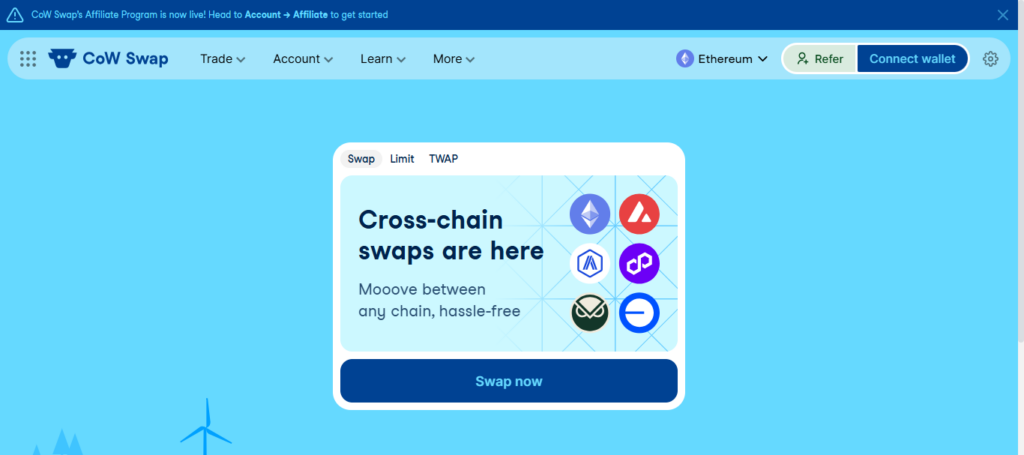
CoW Swap stands out on our Best Decentralized Exchange Alternatives to Uniswap List as it is an ideal fit for users who are particularly worried about the fairness and security of trade execution.
The protocol combines liquidity across multiple sources while optimizing for price execution. This groundbreaking settlement model marks the next evolution of decentralized trading with a focus on transparency, efficiency and user protection.
CoW Swap — Features
- A trading model based upon batch auctions for optimal pricing
- MEV and front-running attacks protection.
- Dynamic matching for gas efficient trades
- Aggregates liquidity from multiple sources.
- Deterministic data availability and rollup consistency.
CoW Swap — Advantages & Disadvantages
| Advantages | Disadvantages |
|---|---|
| Protects traders from MEV attacks | Trade execution may take longer |
| Batch auction ensures fair pricing | Not ideal for instant trades |
| Optimized gas fee usage | Limited advanced trading tools |
| Aggregates liquidity sources | Smaller liquidity compared to major DEXs |
| Improved trade transparency | Less known among beginner users |
Conclusion
The decentralized finance ecosystem has moved way past one platform, with traders having many powerful options depending on their goals, preferred blockchain and trading strategy.
But although Uniswap continues to be a leader in the realm of decentralized trading, other platforms — such as 1inch, PancakeSwap, SushiSwap and Curve Finance — have taken it upon themselves to explore unique advantages ranging from low fees and advanced liquidity optimization methods to specialized trading models.
Leading edges are also being pushed in DeFi innovation through innovative exchanges such as Balancer, dYdX, Jupiter, Raydium, Trader Joe and CoW Swap which provides users with faster transactions, derivatives trading, MEV protection and access to cross-chain liquidity.
At the end of the day, which decentralized exchange alternatives to Uniswap are best for you comes down to what your priorities as a user are, be that low gas fees, more robust trading tools, stablecoin efficiency or multi-chain compatibility.
This gives rise to alternatives, where traders experience more autonomy, better pricing options, and the opportunity to tap into an ever-growing network of financial services built on the principles of decentralization.
FAQ
What are decentralized exchange (DEX) alternatives to Uniswap?
Decentralized exchange alternatives to Uniswap are blockchain-based trading platforms that allow users to swap cryptocurrencies without intermediaries. Platforms like PancakeSwap, SushiSwap, and Curve Finance provide similar or improved trading features, lower fees, and multi-chain access.
Why should traders consider alternatives to Uniswap?
Many traders look for alternatives due to high Ethereum gas fees, limited trading features, or specific blockchain preferences. Exchanges such as 1inch and Jupiter offer optimized trade routing, faster execution speeds, and better pricing across multiple liquidity sources.
Which DEX alternative has the lowest trading fees?
Low-fee trading is commonly found on non-Ethereum networks. PancakeSwap on BNB Chain and Trader Joe on Avalanche are popular choices because they provide significantly lower transaction costs compared to Ethereum-based platforms.
What is the best DEX for stablecoin trading?
For stablecoin swaps, Curve Finance is widely considered one of the best options. Its specialized automated market maker minimizes slippage and offers efficient liquidity pools optimized for assets with similar prices.