

In this article, I highlight the top business credit reporting platforms of 2026. This year’s top reporting platforms help businesses review potential client financial health, assess supplier risk, and gain business reputation credit with ease.
- What Is a Business Credit Reporting Platform?
- Benefits Of Business Credit Reporting Platforms
- Key Points
- 1. Experian Business
- Experian Business Advantages & Disadvantages
- Advantages
- Disadvantages
- 2. Dun & Bradstreet (D&B)
- Dun & Bradstreet (D&B) Advantages & Disadvantages
- Advantages
- Disadvantages
- 3. Equifax Business
- Equifax Business Advantages & Disadvantages
- Advantages
- Disadvantages
- 4. Nav
- Nav Advantages & Disadvantages
- Advantages
- Disadvantages
- 5. eCredable
- eCredable Advantages & Disadvantages
- Advantages
- Disadvantages
- 6. Creditsafe
- Creditsafe Advantages & Disadvantages
- Advantages
- Disadvantages
- 7. Ansonia Credit Data
- Ansonia Credit Data Advantages & Disadvantages
- Advantages
- Disadvantages
- 8. Cortera
- Cortera Advantages & Disadvantages
- Advantages
- Disadvantages
- 9. Small Business Financial Exchange (SBFE)
- Small Business Financial Exchange (SBFE) Advantages & Disadvantages
- Advantages
- Disadvantages
- 10. CreditSignal by D&B
- CreditSignal by D&B Advantages & Disadvantages
- Advantages
- Disadvantages
- Conclusion
- FAQ
These reporting platforms include advanced credit reports, monitoring software, and global coverage for all clients, big and small. The reporting platforms help lenders make informed decisions. If you understand the features and the reporting platform’s pros and cons, you can bolster financial reporting and your firm’s reputation and maintain compliance with the security standards for data privacy.
What Is a Business Credit Reporting Platform?
A Business Credit Reporting Platform collects, analyzes, and distribute credit and financial data and reports on companies. Lenders, suppliers, and partners use these reports to evaluate a company’s credit standing and financial position.
These platforms also include monitoring services that provide real time alerts on changes to a company’s credit report. Founded by the major credit bureau and niche providers, business credit reporting platforms use a subscription and freemium pricing model to cover data from local markets to international markets.
These platforms improve credit markets by providing standardized data and more transparency. They help businesses make better decisions leading to reduced risk exposure and ensuring compliance to privacy laws.
Benefits Of Business Credit Reporting Platforms
Risk Assessment: Offer lenders, suppliers, and business partners with relevant data to gauge the financial health of a business and avoid bad debt and potentially risky partnerships.
Credit Monitoring: Businesses will receive real time updates and can address potential issues before they arise.
Global Data Availability: Several platforms provide international data which enable firms to assess their international suppliers and partners.
Financing: Improved credit status will improve your business’s prospects for financing through loans, trade credit and vendor financing.
Compliance Support: These reporting systems help businesses align with GDPR and DPDP.
Supplier Management: They help procurement teams vet suppliers and make sure the supply chain is reliable.
** Alternative Data**: A few platforms incorporate utility bill data and trade references. This helps build a business’s credibility.
Price: Affordable solutions for SMBs are available.
Reporting: Analytics and reports help businesses make informed decisions.
Key Points
| Platform | Strengths | Best For |
|---|---|---|
| Experian Business | Deep bureau data, decision-ready risk insights | Lenders, B2B credit teams |
| Dun & Bradstreet (D&B) | Comprehensive entity data, monitoring | Supplier onboarding, enterprise risk |
| Equifax Business | Easy-to-use monitoring, fraud signals | Credit risk & fraud teams |
| Nav | SMB-focused, shareable reports | Small businesses, vendor due diligence |
| eCredable | Trade reference validation, alternative data | Procurement & underwriting teams |
| Creditsafe | Global coverage, real-time alerts | Multinational firms |
| Ansonia Credit Data | Transportation & logistics specialization | Freight & logistics companies |
| Cortera | Payment behavior analytics | Mid-market firms |
| Small Business Financial Exchange (SBFE) | Consortium-driven data | Banks & financial institutions |
| CreditSignal by D&B | Free alerts on credit changes | SMBs monitoring credit health |
1. Experian Business
Experian Business was established in 1996 and is one of the largest international credit bureaus with coverage across various business industries. Its reports include payment history, public records, and credit risk scores, which are relied upon heavily by lenders and B2B teams.

Experian Business offers company credit reporting and profile monitoring services, which send alerts for changes to a company’s credit report. Enterprise packages with Experian Business provide deep bureau integration and are priced on a subscription basis. Experian Business has been trusted by multinational companies since its coverage spans North America, Europe, Asia, and Latin America.
Experian Business sets the standard for snapshots of different credit bureaus used for favorable underwriting and risk management of suppliers, while supporting compliance to GDPR and other related laws on data privacy.
| Feature | Details |
|---|---|
| Founded | 1996 |
| Business Credit Coverage | Comprehensive bureau data across industries |
| Credit Reports | Payment histories, public records, risk scores |
| Monitoring | Real‑time alerts on credit changes |
| Pricing Model | Tiered subscription packages |
| Geographic Coverage | Global: North America, Europe, Asia, Latin America |
| Integration | Enterprise‑level APIs for underwriting |
| Compliance | GDPR and international data privacy laws |
| Best For | Lenders, B2B credit teams |
Experian Business Advantages & Disadvantages
Advantages
- Thorough reports on business credit and associated risks
- Detailed business credit profiles
- Business credit scores for risk decision-making
- Credit monitoring tracks changes in your credit report
- Useful for lenders, suppliers, and established businesses
Disadvantages
- Some advanced data is available with add-on costs
- Different reports and services available for different prices
- Coverage for smaller/ newer businesses may differ
- Credit data requires verification for accuracy
- Advanced features are built for large businesses
2. Dun & Bradstreet (D&B)
Established in 1841, Dun & Bradstreet (D&B) was the first credit reporting service for businesses. This service covers company level data, and provides a unique D-U-N-S® Number to each company for identification. D&B includes trade payment reports, financial stress scores, and predictive analytics reports.

For supplier onboarding and enterprise risk management specifically, these types of D&B reports are critical. Some of the monitoring tools D&B has are CreditSignal and advanced dashboards that provide real time updates.
The pricing is subscription based and custom enterprise packages are available for procurement and compliance departments. Dun & Bradstreet has a global presence, with concentration in the U.S., Europe, and Asia. For organizations that need to monitor risk associated with suppliers, vendors, and business partners in international markets, Dun & Bradstreet is essential.
| Feature | Details |
|---|---|
| Founded | 1841 |
| Business Credit Coverage | Entity‑level data with D‑U‑N‑S® Numbers |
| Credit Reports | Trade payments, financial stress scores |
| Monitoring | CreditSignal alerts, predictive dashboards |
| Pricing Model | Subscription‑based enterprise packages |
| Geographic Coverage | Global, strong in U.S., Europe, Asia |
| Integration | Supplier onboarding & compliance workflows |
| Compliance | International data standards |
| Best For | Supplier risk management |
Dun & Bradstreet (D&B) Advantages & Disadvantages
Advantages
- Extensive international database on businesses
- Known D-U-N-S Number for identification of businesses
- Strong business credit and risk information
- Assesses risk of suppliers and customers
- Advanced credit monitoring and analysis for businesses
Disadvantages
- Advanced services are costly
- Many different products can make selection difficult
- Some features are available only with additional purchases
- Smaller businesses will not require all enterprise offerings
- Information on businesses is often stale
3. Equifax Business
Founded in 1899, Equifax Business is a credit reporting company that specializes in business credit. Their credit reports include firmographics, payment history, and fraud indicators.

Credit risk and compliance departments make use of Equifax Business reports. They offer credit monitoring whereby clients choose to receive alerts when there are changes to their credit score or risk indicators. Their pricing model is based on site licenses or subscriptions. Most of their operations cover North America, but through partnerships they have extended their coverage to Europe and Asia.
Equifax Business is known to have easy to use fraud detection workflow integrations. For this reason, financial institutions and multinationals pick Equifax Business for their business credit needs.
| Feature | Details |
|---|---|
| Founded | 1899 |
| Business Credit Coverage | Firmographics, payment histories, fraud signals |
| Credit Reports | Commercial risk scores, public records |
| Monitoring | Customizable alerts on score changes |
| Pricing Model | Subscription tiers for SMBs & enterprises |
| Geographic Coverage | North America, Europe, Asia |
| Integration | Fraud detection & compliance systems |
| Compliance | Data privacy & security standards |
| Best For | Financial institutions, compliance teams |
Equifax Business Advantages & Disadvantages
Advantages
- Established business credit reporting service
- Business credit and risk information
- Evaluating commercial creditworthiness
- Business risk management for credit portfolios
- Helps businesses manage credit-related info
Disadvantages
- Detailed reports are available for an additional cost
- Pricing may lack transparency for each service
- Data may lack availability for certain businesses
- Not meant for users looking for free basic monitoring
4. Nav
Nav was established in 2012 as a SMB-focused business credit reporting tool. Users can create shareable reports that include data from all three bureaus, Equifax, Experian, and D&B. Recommendations for business financing are included in each report. Nav also provides credit score monitoring and financing alerts.
Nav offers a freemium model and users can upgrade to a premium plan for more in-depth reporting. Nav primarily serves U.S.-based users including SMBs, startups, and vendors. Nav also offers serious tools, however, at a fraction of the cost the enterprise credit services provide. Nav has had a large positive impact on business credit reporting and tracking for entrepreneurs.
| Feature | Details |
|---|---|
| Founded | 2012 |
| Business Credit Coverage | Combines Experian, Equifax, D&B data |
| Credit Reports | Shareable SMB‑focused reports |
| Monitoring | Alerts on score changes & financing eligibility |
| Pricing Model | Freemium (free basic, paid premium) |
| Geographic Coverage | Primarily U.S. |
| Integration | Financing recommendation tools |
| Compliance | U.S. credit bureau standards |
| Best For | SMBs, startups, vendors |
Nav Advantages & Disadvantages
Advantages
- Purpose-built small business solution
- Collates business credit information
- Helps small businesses track multiple credit profiles
- Offers insights on business credit health
- Offers resources for small businesses seeking to improve their credit
Disadvantages
- Some features may be available for premium subscribers
- Does not act as a primary business credit bureau
- Depends on connected data sources for information
- Same business credit information can vary amongst bureaus
- Some users may find no need for the additional financial services
5. eCredable
eCredable was launched in 2010 to provide a unique service to businesses for alternative trade and utility payment business credit reporting and trade reference validation. By reporting services for trade lines, payment history, and alternative scoring models, eCredable allows limited credit report history businesses to gain creditworthiness.

Validation monitoring services provide predictive reference updates and record new validations. Pricing is subscription based with SMB and procurement specific pricing tiers. eCredable has U.S. focused coverage, but is expanding partnership based coverage. eCredable is most valuable for the business credit reporting industry for non-traditional credit history businesses. eCredable creates a pathway for building business credit by reporting alternative data sources.
| Feature | Details |
|---|---|
| Founded | 2010 |
| Business Credit Coverage | Alternative data (utilities, trade references) |
| Credit Reports | Verified trade lines, payment performance |
| Monitoring | Alerts on trade reference updates |
| Pricing Model | Affordable subscription tiers |
| Geographic Coverage | U.S.‑centric, expanding globally |
| Integration | Procurement & underwriting workflows |
| Compliance | U.S. data validation standards |
| Best For | Businesses with limited bureau history |
eCredable Advantages & Disadvantages
Advantages
- Has a focus on building business credit
- Can incorporate alternative payment data to build business credit
- Is useful for businesses that do not have a significant traditional credit history
- Helps businesses build payment history
- Offers alternative methods to credit reporting
Disadvantages
- Alternative data may not replace credit history
- May be provided by credit reporting agencies, but not by all
- Benefits vary based on payment records
- Less comprehensive than major commercial credit bureaus
- Businesses may need additional credit reporting services
6. Creditsafe
Creditsafe was founded in 1997. It has business credit reports in over 100 countries. Creditsafe’s product suite includes financials, payment reports, risk scores, alerts, etc. as well as customized product solutions.

Creditsafe’s pricing model is subscription based, making it easy for SMBs and multinationals alike to adopt. The geographic coverage is extensive, making Creditsafe an excellent option for businesses with cross border operations. Creditsafe’s product suites are built with ease of use in mind.
They also offer a host of integrations for global credit monitoring of supply chain ecosystems. For global credit coverage at an affordable price, Creditsafe is the desired vendor for a large portion of its clientele.
| Feature | Details |
|---|---|
| Founded | 1997 |
| Business Credit Coverage | Financials, payment histories, risk scores |
| Credit Reports | Global company profiles |
| Monitoring | Real‑time alerts worldwide |
| Pricing Model | Subscription packages (SMB to enterprise) |
| Geographic Coverage | 100+ countries |
| Integration | Supplier monitoring dashboards |
| Compliance | International data privacy laws |
| Best For | Multinational corporations |
Creditsafe Advantages & Disadvantages
Advantages
- Strong international business credit coverage
- Provides company credit reports and risk information
- Useful for supplier and customer risk assessment
- Supports ongoing business credit monitoring
- Suitable for companies managing large business portfolios
Disadvantages
- Pricing can be higher for advanced business use
- Enterprise features may be excessive for small companies
- International data depth can vary by country
- Large datasets may require some learning
- Advanced risk tools may require additional services
7. Ansonia Credit Data
Ansonia Credit Data was founded in 2006 to provide credit and risk services to the transportation and logistics sector. Its credit reports include freight payment history and carrier performance, along with industry risk scores. Carrier creditworthiness and payment behavior monitoring tools include automated alerts.

Ansonia Credit Data offers subscription based pricing and pricing packages tailored to meet the needs of logistics and freight companies. Its geographic focus is primarily North America, although it is extending its services into other areas of the global logistics network.
Ansonia Credit Data is highly specialized and is essential for the transport, shipping and logistics sectors. With a niche focus, it is capable of providing better informative services and solutions for transportation credit risk management in contrast to general credit bureaus.
| Feature | Details |
|---|---|
| Founded | 2006 |
| Business Credit Coverage | Transportation & logistics focus |
| Credit Reports | Freight payment histories, carrier performance |
| Monitoring | Alerts on carrier creditworthiness |
| Pricing Model | Subscription tailored for logistics |
| Geographic Coverage | North America, expanding globally |
| Integration | Logistics & freight systems |
| Compliance | Industry‑specific standards |
| Best For | Trucking, shipping, logistics firms |
Ansonia Credit Data Advantages & Disadvantages
Advantages
- Specialized in commercial credit information
- Strong focus on trade credit data
- Useful for evaluating customer payment behavior
- Helps businesses make credit-limit decisions
- Relevant for companies managing accounts receivable risk
Disadvantages
- More specialized than broad business intelligence platforms
- May have less appeal for businesses needing general credit monitoring
- Coverage can depend on available trade-credit contributors
- Advanced commercial data may require paid access
- Smaller businesses may not need all available capabilities
8. Cortera
Cortera was founded in 1993 and focuses on payment behavior analytics. Report offerings include customer payment history and behavior, as well as models to predict risk. Services include the ability to monitor payment behavior in real time. Pricing is subscription-based and is tailored for mid-market and enterprise customers. Geographic coverage is primarily in the U.S., although there is some level of concentration in other countries.

Cortera’s greatest strength is its ability to analyze payment behavior of customers and suppliers to identify potential business opportunities. It is especially targeted to mid-market companies that are looking to use more advanced analytics of credit bureau data.
| Feature | Details |
|---|---|
| Founded | 1993 |
| Business Credit Coverage | Payment behavior analytics |
| Credit Reports | Spending patterns, predictive risk models |
| Monitoring | Real‑time alerts on payment performance |
| Pricing Model | Subscription for mid‑market firms |
| Geographic Coverage | U.S.‑focused, expanding internationally |
| Integration | Customer & supplier analytics |
| Compliance | U.S. data standards |
| Best For | Mid‑market firms needing analytics |
Cortera Advantages & Disadvantages
Advantages
- Focuses on commercial credit intelligence
- Provides business credit and payment information
- Useful for evaluating B2B customer risk
- Can support accounts receivable decisions
- Helps businesses identify potential credit-risk signals
Disadvantages
- Primarily focused on commercial credit use cases
- Data availability can vary across businesses
- Advanced information may require a paid solution
- May be less suitable for consumers or personal credit needs
- Users may need other tools for broader business intelligence
9. Small Business Financial Exchange (SBFE)
SBFE was founded in 2001 and is a collaboration of U.S.-based financial entities that consolidate credit data on small businesses. Report offerings include small business loan performance, payment history, and other insights developed by the consortium.
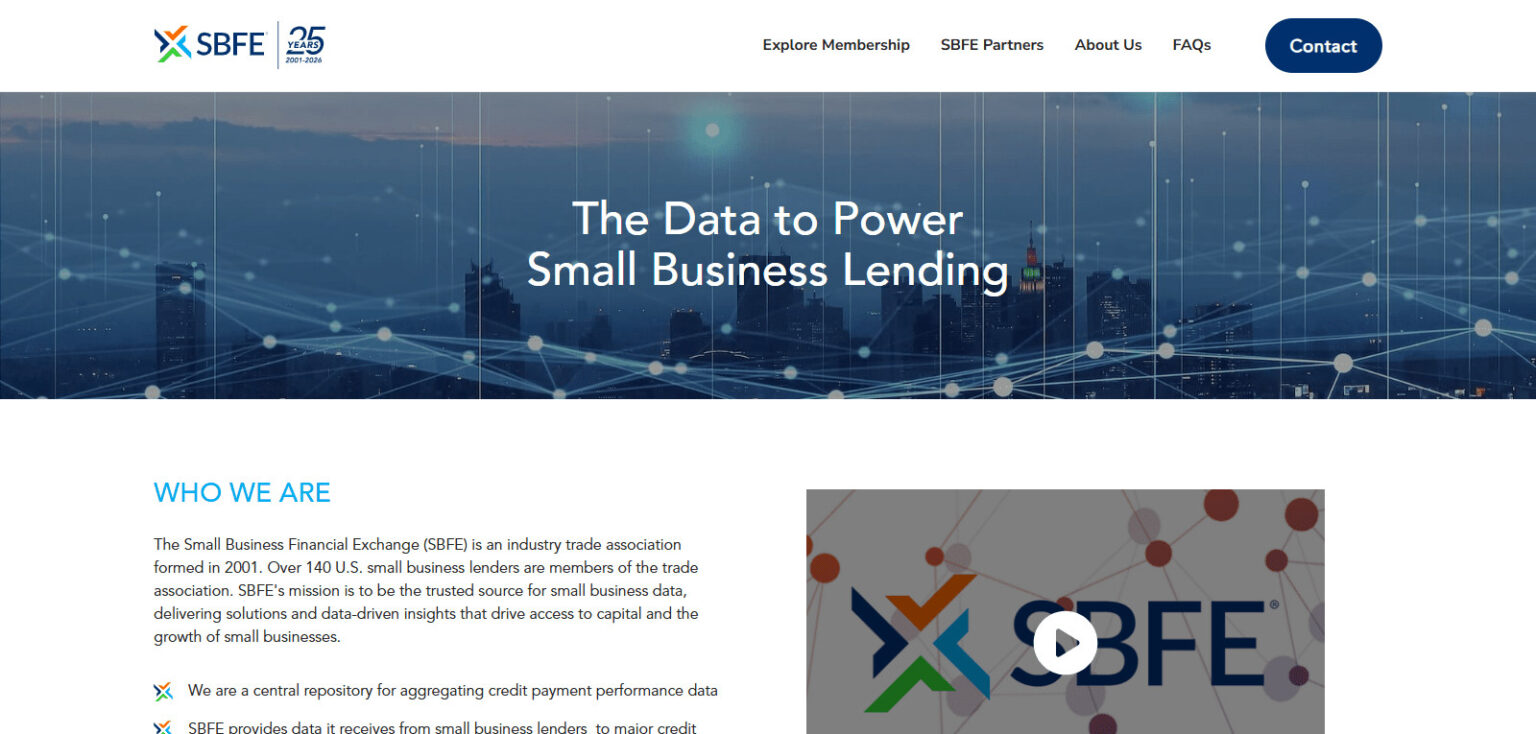
Services include the ability to monitor small business credit on an ongoing basis. Pricing is enterprise focused as stakeholders access SBFE data through member financial institutions and credit bureaus.
Geographically, SBFE data focuses on small business lending in the U.S. SBFE’s greatest strength is its consortium model which enables access to high quality credit data to banks and lenders for credit underwriting and risk assessment.
| Feature | Details |
|---|---|
| Founded | 2001 |
| Business Credit Coverage | Consortium‑driven small business data |
| Credit Reports | Loan performance, payment histories |
| Monitoring | Alerts on small business credit activity |
| Pricing Model | Enterprise‑level via member institutions |
| Geographic Coverage | U.S.‑centric |
| Integration | Bank & lender underwriting systems |
| Compliance | Consortium data standards |
| Best For | Financial institutions, banks |
Small Business Financial Exchange (SBFE) Advantages & Disadvantages
Advantages
- Focuses specifically on small-business financial data
- Provides data to participating financial institutions
- Supports small-business credit underwriting
- Uses contributed financial information from participating members
- Helps improve access to small-business credit intelligence
Disadvantages
- Not a conventional consumer-facing credit reporting platform
- Access is primarily through participating members
- Businesses cannot use it like a typical standalone credit-monitoring service
- Data availability depends on participating contributors
- Less suitable for businesses seeking direct self-service reports
10. CreditSignal by D&B
CreditSignal was launched in 2012 by Dun & Bradstreet to monitor changes in a company’s D&B credit rating and offers free basic credit reporting. Derived reports lack some detail, however, do capture important metrics.

D&B credit monitoring is the core service offering with the free alerts on credit score changes with premium upgrades to gain more insight. The service employs a freemium model, while pricing is free for basic score alerts and paid for premium score alerts.
This service offers international coverage via D&B’s wide data coverage. CreditSignal is adaptable for smaller businesses as a low-cost alternative to monitoring business credit without a full bureau subscription.
| Feature | Details |
|---|---|
| Founded | 2012 |
| Business Credit Coverage | Alerts based on D&B scores |
| Credit Reports | Limited indicators of credit health |
| Monitoring | Free alerts on score changes |
| Pricing Model | Freemium (basic free, premium paid) |
| Geographic Coverage | Global via D&B database |
| Integration | SMB monitoring dashboards |
| Compliance | International data standards |
| Best For | SMBs monitoring credit affordably |
CreditSignal by D&B Advantages & Disadvantages
Advantages
- Free credit monitoring for D&B business credit
- Can provide alerts for credit changes
- Can help companies monitor their D&B credit profile
- Appropriate for business credit monitoring
- Displays vital credit metrics from D&B
Disadvantages
- Less accessibility than paid D&B solutions
- Is not a substitute for a thorough credit report
- Additional business credit information may require paid services
- Focused on D&B only
- For more complex credit monitoring requirements, other business systems are needed
Conclusion
In summary, Business Credit Reporting Platforms help businesses with financial transparency, risk management, and opportunities for growth in 2026. The more well-known players in this space, such as Experian, Dun & Bradstreet, and Equifax, offer a variety of features for larger businesses.
Smaller Business reporting platforms, such as Nav and CreditSignal, offer similarly robust features, but for smaller businesses. These reporting platforms allow businesses to develop their credit score, get financing, and ensure legal compliance for data privacy. These platforms offer the features that businesses need most in today’s financial climate.
FAQ
What is a Business Credit Reporting Platform?
A system that collects and analyzes company financial data, providing credit reports, risk scores, and monitoring tools for lenders, suppliers, and partners.
Why are Business Credit Reports important?
They help assess financial stability, reduce risk, and improve access to loans, trade credit, and vendor agreements.
Which are the top platforms in 2026?
Experian Business, Dun & Bradstreet, Equifax Business, Nav, eCredable, Creditsafe, Ansonia, Cortera, SBFE, and CreditSignal by D&B.
Do SMBs benefit from these platforms?
Yes, SMB‑focused solutions like Nav and CreditSignal offer affordable monitoring and help small businesses build credibility.
How do pricing models work?
Most platforms use subscription tiers, while some (like Nav and CreditSignal) offer freemium models with free basic reports and paid upgrades.