

In this article, I will discuss the Best Blockchain Node Providers for Developers – Supported Networks, Node Infrastructure, RPC APIs, Access to Blockchain Data, Performance, Scalability, Pricing, Integrations, Developer Tools and Security.
- What Are Blockchain Node Providers?
- Why Do Developers Use Blockchain Node Providers?
- Hidden Costs Developers Should Consider
- Key Points
- 1. Chainstack
- Chainstack — Characteristics
- 2. Blockdaemon
- Blockdaemon — Characteristics
- 3. GetBlock
- GetBlock — Characteristics
- 4. NOWNodes
- NOWNodes — Characteristics
- 5. Helius
- Helius — Characteristics
- 6. Chain nodes
- Chainnodes — Characteristics
- 7. Alchemy
- Alchemy — Characteristics
- 8. QuickNode
- QuickNode — Characteristics
- 9. Infura
- Infura — Characteristics
- 10. Ankr
- Ankr — Characteristics
- Blockchain Node Providers Comparison Table
- Conclusion
- FAQ
The comparison will help developers understand the key differences between leading providers and what infrastructure options are available to build, test and scale Web3 applications.
What Are Blockchain Node Providers?
Blockchain node providers are infrastructure platforms that allow developers to access blockchain networks in a managed way, without the need to operate and maintain their own nodes. The companies provide RPC endpoints, APIs, WebSocket connections, archive nodes, full nodes, and blockchain data services to interact with networks like Ethereum, Bitcoin, Solana, Polygon, and Layer-2 ecosystems.
These providers deploy the infrastructure, run and monitor the nodes, and are responsible for upgrades, security, and scalability. Developers are able to leverage their services to efficiently read blockchain data, submit transactions, monitor events, build wallets, develop dApps and create DeFi, NFT, gaming and analytics apps.
Why Do Developers Use Blockchain Node Providers?
Blockchain node providers are used by developers to get reliable blockchain infrastructure without the headache of running and building nodes on their own. The main reasons are:
Faster Development – Developers are able to connect applications to blockchain networks quickly via managed RPC endpoints, without having to spend time setting up node infrastructure.
Multi-Chain Access – Providers can give users access to multiple blockchains from a single platform, making it easier to build cross-chain applications.
Less Infrastructure Management – Providers handle node deployment, updates, maintenance, monitoring, and infrastructure operations.
Scalable RPC Infrastructure – As users increase in activity, the applications can scale blockchain requests without the need to manually scale node infrastructure.
Trustworthy Blockchain Connectivity – Managed infrastructure can provide redundancy, monitoring, load balancing, and multiple endpoints for production apps.
Historical Blockchain Data – Archive nodes and data APIs enable developers to access historical transactions, blocks, events, balances, and other blockchain data.
Developer APIs and Tools – RPC APIs, WebSockets, webhooks, SDKs, indexing services, debugging tools, and data APIs facilitate blockchain application development.
Improved Production Support – Larger applications may be eligible for dedicated nodes, higher request limits, SLAs, monitoring, and technical support under paid and enterprise plans.
Lower Operating Costs – Managed infrastructure can lower the engineering effort needed to deploy, maintain, scale, and troubleshoot nodes, for many teams.
Security and Controls of Access – Vendors usually offer API keys, authentication, access control, monitoring, and other infrastructure-level security features for blockchain applications.
Hidden Costs Developers Should Consider
Just because a blockchain node provider has a monthly plan doesn’t mean that’s all you’ll be paying.
Developers should also check API overage charges, limits for request or compute-unit, higher throughput requirements, archive node charges, dedicated node costs, data transfer charges, WebSocket usage, webhook limits, indexing and premium data APIs, extra endpoints, and enterprise support charges.
Free plans could also limit the number of requests per second, the number of monthly credits, the supported networks, or the amount of historical data. Costs can skyrocket as application traffic increases, especially for high-volume DeFi, gaming, trading, analytics and wallet applications.
Developers should therefore estimate expected requests, peak traffic, data needs, storage needs and scaling needs before comparing providers on starting price alone.
Key Points
| Blockchain Node Provider | Key Points |
|---|---|
| Chainstack | 70+ blockchain networks; managed shared, dedicated and archive nodes; JSON-RPC and WebSocket access; global infrastructure; indexing and data services; developer-focused dashboard; scalable infrastructure; free and paid plans; suitable for multi-chain dApps, DeFi and production Web3 applications. |
| Blockdaemon | Institutional-grade blockchain infrastructure; broad protocol coverage; dedicated nodes and validator infrastructure; RPC and data APIs; staking services; wallet infrastructure; enterprise monitoring; customizable deployments; security and compliance features; designed for institutions, exchanges, custodians and Web3 enterprises. |
| GetBlock | 100+ blockchain networks; Blockchain-as-a-Service infrastructure; full and archive nodes; RPC and WebSocket APIs; multi-chain data access; multiple endpoint locations; developer dashboard; API authentication; scalable node infrastructure; useful for dApps, wallets, exchanges and blockchain applications. |
| NOWNodes | 100+ blockchain networks; managed full and dedicated nodes; RPC and WebSocket access; Blockbook-based APIs; historical blockchain data; trace and debug capabilities; gRPC support; developer dashboard; free monthly request allocation; suitable for wallets, exchanges and multi-chain applications. |
| Helius | Solana-focused infrastructure; dedicated Solana RPC; high-performance data APIs; transaction delivery infrastructure; webhooks; real-time streaming; token, NFT and transaction data; developer tools; scalable production infrastructure; free and paid plans; particularly suited to Solana DeFi, trading, wallets, NFTs and analytics. |
| Chainnodes | EVM-focused RPC infrastructure; Ethereum, Polygon, Arbitrum, Optimism and other networks; HTTP and WebSocket endpoints; archive access; blockchain logs and event queries; trace and debugging APIs; request-based pricing tiers; different throughput limits; straightforward developer integration for EVM applications. |
| Alchemy | 100+ blockchain networks; managed RPC infrastructure; JSON-RPC and WebSocket APIs; NFT and token APIs; Transfers and Portfolio APIs; webhooks; simulation and debugging tools; wallet infrastructure; scalable production endpoints; free and usage-based plans; enterprise security and developer tooling. |
| QuickNode | 80+ blockchain networks; managed RPC infrastructure; JSON-RPC, REST, gRPC and WebSocket access; Streams and Webhooks; blockchain data services; specialized Solana infrastructure; developer dashboard; API documentation; scalable production infrastructure; usage-based plans; suitable for multi-chain and real-time Web3 applications. |
| Infura | Strong Ethereum and Layer-2 infrastructure; managed RPC and WebSocket endpoints; archive access; blockchain data APIs; Gas API; developer documentation; API-key authentication; free and paid credit-based plans; enterprise options; established infrastructure for Ethereum dApps, DeFi, wallets and NFT applications. |
| Ankr | 80+ blockchain networks; distributed RPC infrastructure; public and premium RPC endpoints; dedicated node services; JSON-RPC and WebSocket access; indexed blockchain APIs; token, NFT and transaction data; SDKs and developer tools; geo-distributed infrastructure; pay-as-you-go options; expanding AI-agent and Web3 infrastructure capabilities. |
1. Chainstack
Chainstack was founded in 2018 and is based in Singapore. It offers managed blockchain infrastructure on 70+ networks including Ethereum, Polygon, Arbitrum, Optimism, Base, Avalanche, Solana and other top protocols.
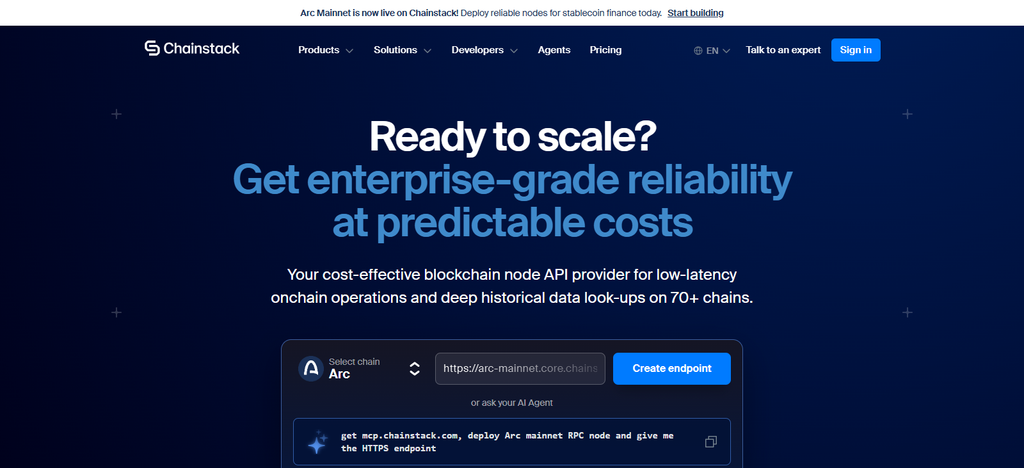
It has a shared global archive and dedicated nodes infrastructure, with HTTP and WebSocket RPC access. Developers are able to use node APIs, indexing, node analytics, transaction tools, Yellowstone Geyser gRPC and Warp transaction routing.
The Developer plan includes 3M request units, with paid plans starting at $49/month. Chainstack also supports AWS, Azure and other deployment environments and has published **SOC 2 Type II and ISO 27001 ** credentials.
Chainstack — Characteristics
| Characteristic | Details |
|---|---|
| Infrastructure Model | Managed blockchain infrastructure with shared, dedicated, archive, and geo-balanced Global Nodes |
| Network Coverage | 70+ blockchain networks, including Ethereum, Polygon, Arbitrum, Optimism, Base, Avalanche and Solana |
| RPC Access | JSON-RPC and gRPC-based access with geo-balanced endpoints |
| Node Options | Full nodes, archive nodes, dedicated nodes and Global Nodes |
| Blockchain Data | Raw chain data and complete historical state for indexing, analytics and monitoring |
| Performance | Global Nodes route requests toward available regions for scalable, lower-latency workloads |
| Scalability | Autoscaled infrastructure designed for high-throughput dApps and traffic spikes |
| Developer Tools | Node deployment, dashboards, RPC endpoints, data tools and transaction infrastructure |
| Security | Encryption in transit and at rest, automated DDoS protection, IP whitelisting and private credentials |
| Best Developer Fit | DeFi, wallets, analytics, multi-chain dApps and production Web3 infrastructure |
2. Blockdaemon
Blockdaemon was founded in 2017 and is based in Los Angeles, California. It provides institutional blockchain infrastructure covering 60+ protocols. Its current product materials also call out 80+ supported protocols across the wider platform.
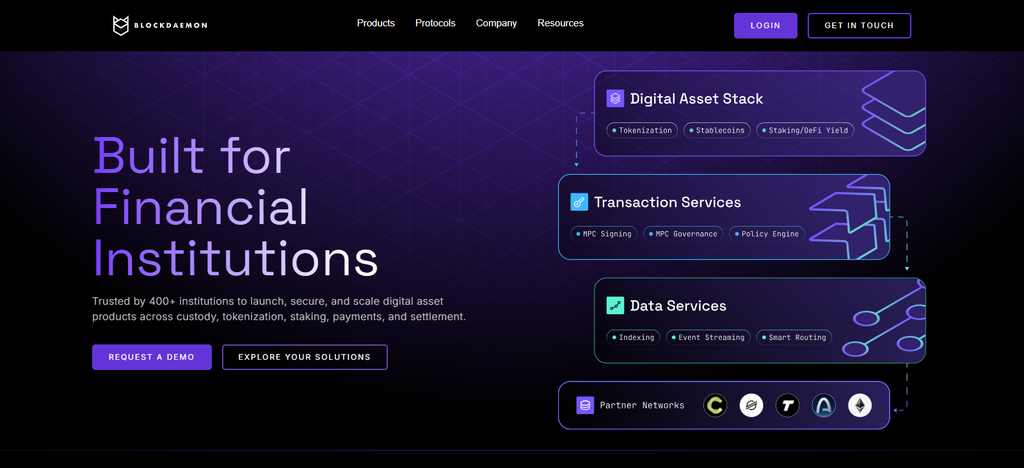
Its infrastructure comprises dedicated nodes, validator infrastructure, staking services and API endpoints. Developers and institutions can access REST and RPC APIs, protocol-specific data and blockchain infrastructure via managed services. Blockdaemon has 70+ global points of presence, and claims to have launched 250,000+ nodes.
Its platform is focused on customizable deployment, monitoring, failover and enterprise support. Security offerings include ISO 27001 certification, SOC 2 Type II compliance, non-custodial products, and 24/7 monitoring.
Blockdaemon — Characteristics
| Characteristic | Details |
|---|---|
| Infrastructure Model | Institutional blockchain infrastructure covering nodes, APIs, validators, staking and dedicated infrastructure |
| Network Coverage | Major protocols including Ethereum, Solana, Polygon, NEAR, Cosmos, Avalanche, Cardano, Polkadot and others |
| RPC Access | Protocol-specific RPC APIs with customizable endpoints |
| Node Options | Dedicated nodes, validator infrastructure and managed blockchain infrastructure |
| Blockchain Data | Indexed blockchain data, historical information and real-time on-chain events |
| API Suite | REST API, RPC API, Data API, DeFi API, Chain Watch and Wallet Transact |
| Staking | Programmatic staking and validator-management capabilities |
| Developer Tools | API documentation, SDKs, API playgrounds, compute-unit tracking and sample projects |
| Security | Enterprise controls, monitoring and compliance-oriented infrastructure; API write operations include OFAC screening |
| Best Developer Fit | Institutional applications, custodians, exchanges, wallets and staking infrastructure |
3. GetBlock
Founded in 2020, GetBlock is headquartered in Singapore. It offers Blockchain-as-a-Service infrastructure on 130+ blockchain networks in major EVM and non-EVM ecosystems. Its infrastructure comprises shared nodes, dedicated nodes, node clusters and custom deployments for production applications.
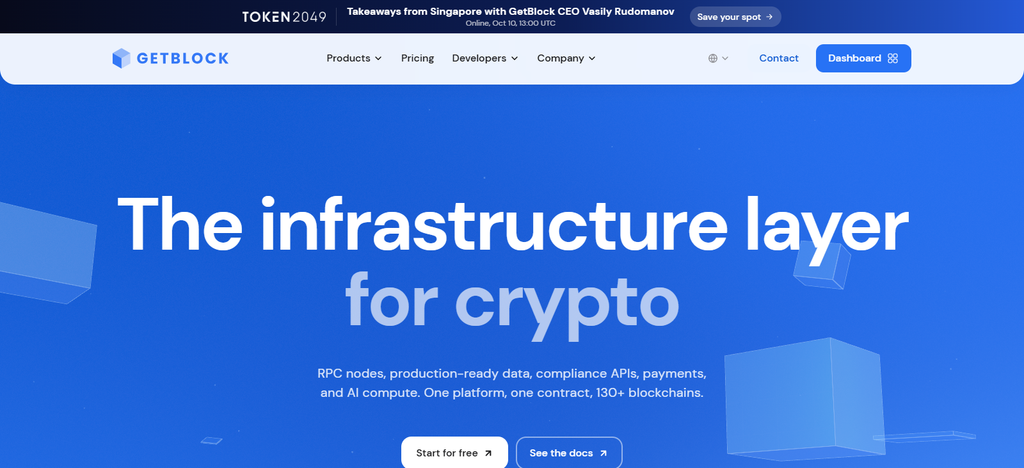
Developers are able to reach blockchain APIs via RPC and other interfaces, and indexed blockchain data is available for the networks that are supported. GetBlock also offers archive and dedicated infrastructure options for larger workloads.
The current comparison data shows a free tier of 50,000 Compute Units per day, while dedicated nodes start publicly from around $1,000/month. Security-focused infrastructure and enterprise oriented services are also available.
GetBlock — Characteristics
| Characteristic | Details |
|---|---|
| Infrastructure Model | Blockchain-as-a-Service platform providing managed node endpoints |
| Network Coverage | 100+ blockchain networks across EVM and non-EVM ecosystems |
| RPC Access | JSON-RPC, WebSockets, GraphQL and network-specific interfaces |
| Node Modes | Full and archive node modes |
| Server Locations | Endpoint locations include Frankfurt, New York and Singapore |
| Blockchain Data | Blockchain node access, historical/archive information and network-specific data |
| API Authentication | Access tokens generated through the developer dashboard |
| Developer Tools | SDK guides, API documentation, endpoint configuration and development examples |
| Scalability | Multiple endpoints and server regions can be configured for different application requirements |
| Best Developer Fit | Multi-chain dApps, wallets, exchanges, analytics and applications requiring broad network coverage |
4. NOWNodes
NOWNodes provides managed blockchain infrastructure for 120+ networks such as Bitcoin, Litecoin, Dogecoin, Ethereum, Solana, Polygon and some privacy networks. Infrastructure includes shared and dedicated nodes.
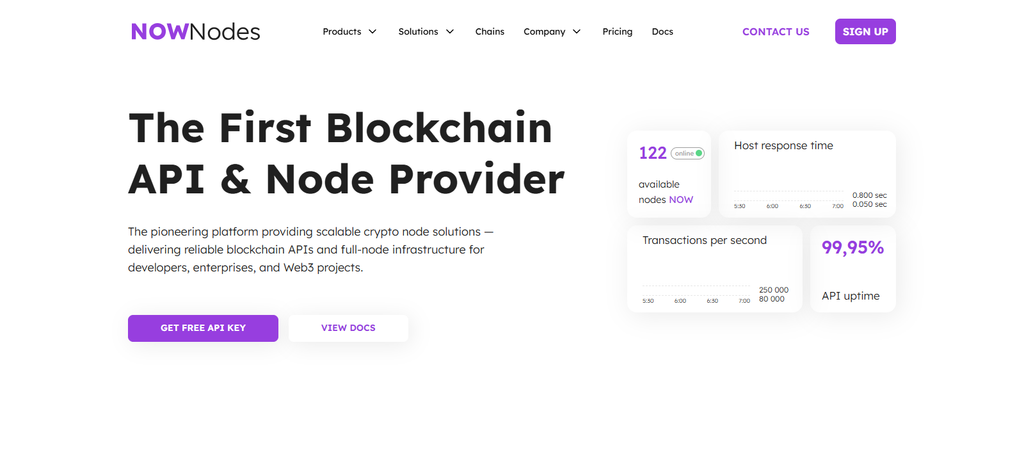
Dedicated deployments exist at the regional and multi-region level for selected workloads. For developers we support gRPC streaming, indexed APIs based on Blockbook, WebSockets and RPC endpoints on chains. Access to blockchain data includes balances, transactions, blocks and historical data, with other APIs available for market-data use cases.
NOWNodes now offers 100,000 free requests per month with shared plans, and custom pricing for dedicated nodes. With its broad non-EVM coverage, it is well suited for applications that need multiple blockchain ecosystems via a single infrastructure provider.
NOWNodes — Characteristics
| Characteristic | Details |
|---|---|
| Infrastructure Model | Blockchain-as-a-Service platform providing managed full nodes, dedicated nodes and blockchain APIs |
| Network Coverage | 100+ blockchain networks |
| RPC Access | JSON-RPC and WebSocket APIs with network-specific interfaces |
| Node Options | Full nodes, dedicated/custom nodes and archive nodes |
| Data Access | Blockbook, archive data, blockchain state, transactions and historical information |
| Advanced APIs | Trace & Debug API, gRPC API and MCP support |
| Developer Tools | Monitoring, API documentation, Mainnet/Testnet selection and team access |
| Scalability | Dedicated/custom infrastructure available for larger or specialized workloads |
| Free Access | Start plan provides 100,000 requests per month without requiring a credit card |
| Best Developer Fit | Wallets, exchanges, dApps and applications needing broad multi-chain access |
5. Helius
Helius was founded in 2022 by Mert Mumtaz, Nicolas Pennie and Liam Vovk and is based in Claymont, Delaware. Helius is laser focused on Solana infrastructure unlike general multi-chain providers.
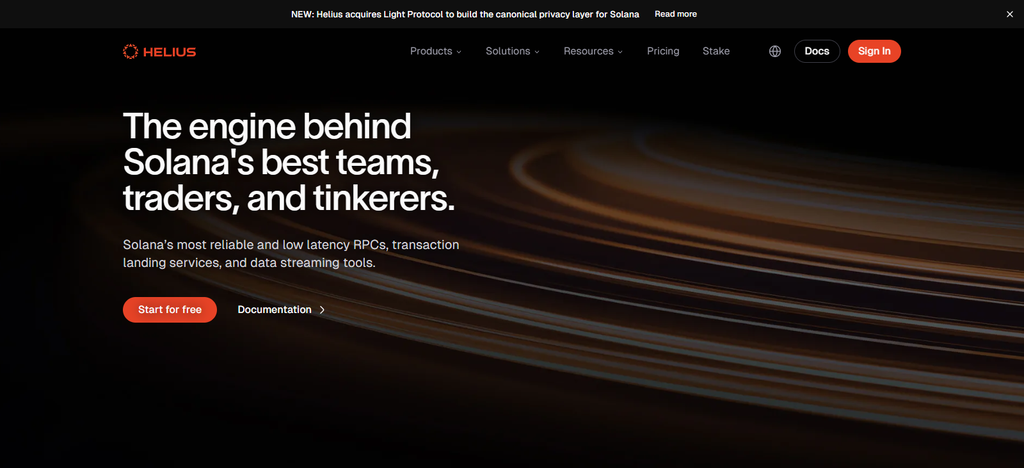
The platform includes high-performance RPC nodes, transaction delivery via Sender, data streaming via LaserStream, webhook, historical and parsed data APIs, token APIs and validator infrastructure. Developers are able to access Solana blockchain data for trading, DeFi, wallets, analytics and more.
Helius has a 1M credit free monthly allowance and its Developer plan is $49/month with dedicated Solana nodes costing around $2,900/month. The infrastructure is built around developer workflows for Solana.
Helius — Characteristics
| Characteristic | Details |
|---|---|
| Infrastructure Model | Solana-focused blockchain infrastructure platform |
| Network Coverage | Primarily Solana mainnet and Solana ecosystem infrastructure |
| RPC Infrastructure | Dedicated Solana RPC and high-performance endpoints |
| Data APIs | Structured Solana data APIs for transactions, tokens, NFTs and accounts |
| Real-Time Data | Webhooks and real-time streaming infrastructure |
| Streaming | LaserStream provides high-throughput Solana data streaming |
| Transaction Infrastructure | Sender infrastructure for transaction delivery and execution workflows |
| Developer Tools | Solana APIs, SDK-oriented tooling, dashboards and developer documentation |
| Scalability | Infrastructure designed for high-throughput Solana applications and production workloads |
| Best Developer Fit | Solana DeFi, trading, wallets, NFT platforms, analytics and high-volume dApps |
6. Chain nodes
Klappp Ltd, a company incorporated in England and Wales, is the owner and operator of the Web3 blockchain JSON-RPC provider Chainnodes. Its infrastructure is primarily Ethereum and other EVM-based networks such as Polygon, Optimism and Arbitrum, with HTTP and WebSocket connectivity.
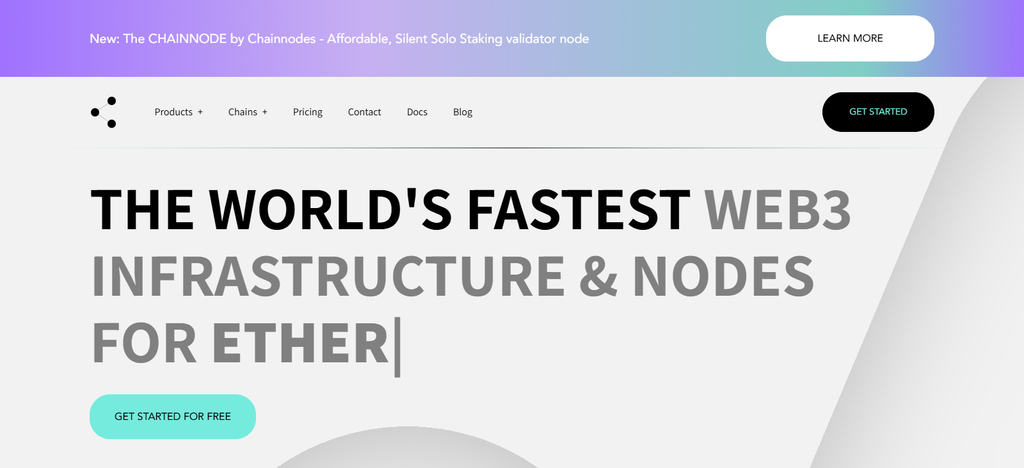
Developers are able to query archives, get logs & events, subscribe to blocks & transactions, and use trace & debug APIs for transaction analysis.
Its current Core plan is free with 12.5M requests/month and 25 RPS. Developer plan is $50/month for 25M requests and 50 RPS. The Team and Growth plans go up to 125M and 500M monthly requests respectively. There are specific nodes for heavier loads.
Chainnodes — Characteristics
| Characteristic | Details |
|---|---|
| Infrastructure Model | Blockchain RPC infrastructure focused primarily on EVM-compatible networks |
| Network Coverage | Ethereum and multiple EVM networks such as Polygon, Arbitrum and Optimism |
| RPC Access | HTTP and WebSocket RPC endpoints |
| Node Capabilities | Full and archive access depending on network and plan |
| Blockchain Data | Blocks, transactions, logs, events and historical blockchain queries |
| Debugging | Trace and debug functionality for supported networks |
| Performance | Plans provide different request-per-second limits |
| Pricing Model | Free and paid usage tiers based on monthly requests and throughput |
| Developer Experience | API endpoints, documentation and straightforward RPC integration |
| Best Developer Fit | EVM dApps, smart-contract development, blockchain analytics and RPC-heavy applications |
7. Alchemy
Alchemy was founded in 2017 and is based in San Francisco, California. Its blockchain development platform supports 100+ networks, with current comparisons distinguishing around 79 production chains, when you consider its published network directory and testnet coverage.
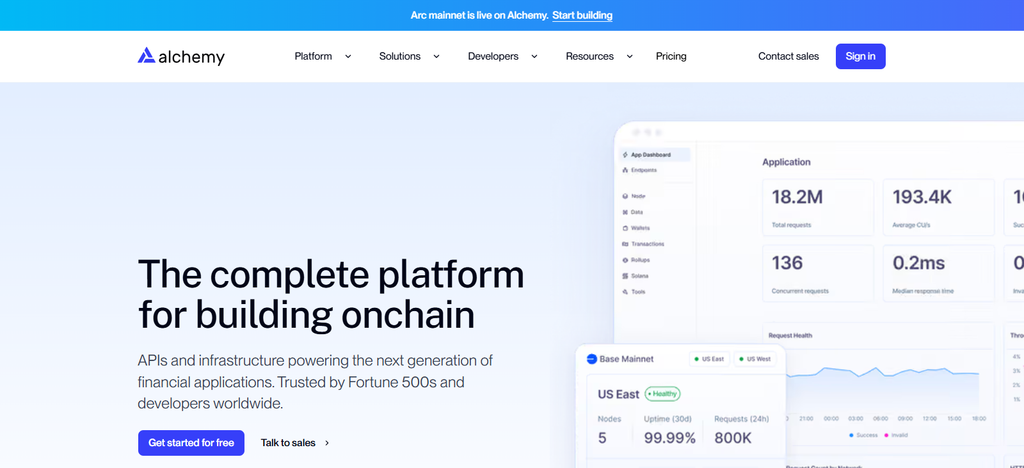
It provides managed RPC endpoints, dedicated clusters, and custom node infrastructure. Developers are able to use JSON-RPC, WebSockets, webhooks, enhanced APIs, NFT and token data, debugging tools, and other services for application development.
Alchemy now has 30M Compute Units/month on their free tier, and then usage-based pricing starting from around $0.45/1M Compute Units. Its platform also publishes SOC 2 Type II security info and enterprise infrastructure options.
Alchemy — Characteristics
| Characteristic | Details |
|---|---|
| Infrastructure Model | Full-stack blockchain developer platform combining RPC, data, wallet and rollup infrastructure |
| Network Coverage | 100+ blockchains |
| Chain APIs | Standard JSON-RPC plus chain-specific APIs |
| Real-Time Access | WebSockets for pending transactions, events and new blocks |
| Data APIs | Portfolio, Transfers, Prices, NFT and other structured indexed-data APIs |
| Developer Tools | Webhooks, Simulation API, Trace API, Debug API and AI development tools |
| Wallet Infrastructure | APIs for smart wallets and account-abstraction workflows |
| Scalability | Production infrastructure with dedicated cluster options |
| Security | Enterprise-oriented infrastructure and API-key authentication |
| Best Developer Fit | Multi-chain dApps, DeFi, wallets, NFTs, analytics and enterprise Web3 applications |
8. QuickNode
QuickNode was established in 2017 and is based in the USA. It supports 79+ chains and 135+ networks including Ethereum, Bitcoin, Solana, Polygon, Arbitrum, Base and other ecosystems through its infrastructure.
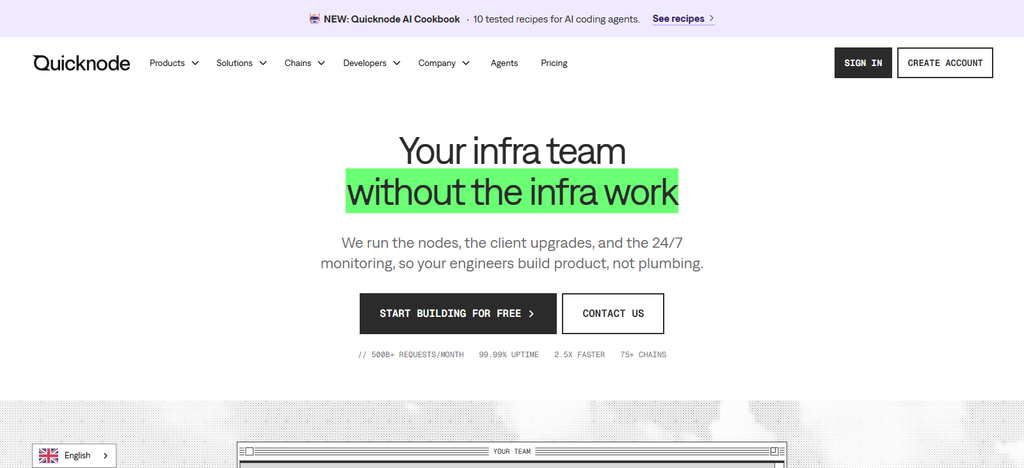
Developers get managed RPC endpoints, archive access, WebSockets, Streams, webhooks, gRPC and specialized add-ons for data, transactions and compliance. The developer tools provide the ability to deliver blockchain data and application integrations in real-time without directly running nodes.
QuickNode has a 1 month trial with 10M API credits and paid plans starting at about $49/month. It also has SOC 1 Type II, SOC 2 Type II and ISO 27001 certifications and enterprise infrastructure and dedicated options.
QuickNode — Characteristics
| Characteristic | Details |
|---|---|
| Infrastructure Model | Managed multi-chain blockchain infrastructure and developer API platform |
| Network Coverage | 80+ blockchains through its current documentation |
| RPC Access | JSON-RPC, REST, gRPC and WebSocket endpoints |
| Data Services | Streams, Webhooks and SQL Explorer for blockchain data workflows |
| Real-Time Data | Event-driven Webhooks and customizable Streams |
| Specialized Access | Solana Yellowstone-compatible Geyser gRPC and Hyperliquid Hypercore support |
| Developer Tools | API documentation, ready-to-run examples, dashboard and Admin API |
| Integrations | IPFS API, Web3 development tools and multiple programming-language examples |
| Security | API-key authentication with account and endpoint management |
| Best Developer Fit | Multi-chain dApps, real-time applications, data pipelines and production Web3 infrastructure |
9. Infura
Infura was founded in 2016 and joined Consensys in 2019. Its infrastructure is primarily designed around Ethereum and Layer-2 networks, while its current platform offers access to 40+ supported networks via its wider network offering.
Developers on eligible plans also have access to managed JSON-RPC APIs, WebSockets, archive data, Gas API and debugging or tracing capabilities. The Infura Core plan is free with 3M daily credits, the Developer plan is $50/month with 15M daily credits, and the Team plan is $225/month with 75M daily credits. Enterprise pricing is tailored.
Its documentation also provides API-key security, authentication guidelines, archive infrastructure, and developer integration resources.
Infura — Characteristics
| Characteristic | Details |
|---|---|
| Infrastructure Model | Managed blockchain RPC and API infrastructure |
| Network Coverage | Ethereum and multiple Layer-2 and other supported blockchain networks |
| RPC Access | Standard JSON-RPC endpoints and WebSockets |
| Node Infrastructure | Managed blockchain nodes with archive access on supported services |
| Blockchain Data | Blocks, transactions, logs, state data and historical/archive information |
| Developer APIs | RPC APIs, data services, Gas API and network-specific interfaces |
| Developer Experience | Documentation, API keys, SDK-compatible endpoints and development resources |
| Scalability | Usage-based plans with different credit and throughput allocations |
| Enterprise Support | Higher-volume infrastructure and customized enterprise arrangements |
| Best Developer Fit | Ethereum, Layer-2, DeFi, wallets, NFT applications and enterprise Web3 development |
10. Ankr
Ankr offers decentralized and managed blockchain infrastructure across ~80 networks, including EVM and other major blockchain ecosystems. Its infrastructure is made up of public RPC endpoints, premium RPC services and dedicated blockchain nodes for applications requiring more control and capacity.
Application developers are able to use RPC and API services to connect their applications, wallets, exchanges, and dApps, with more infrastructure that enables access to blockchain data and Web3 applications.
Ankr’s published comparison currently lists a 200M API-credit free monthly allowance and pay-as-you-go pricing starting around $10 per 100M credits, with a published free-tier rate limit of around 30 requests per second. Its platform also offers enterprise infrastructure and security-focused RPC capabilities.
Ankr — Characteristics
| Characteristic | Details |
|---|---|
| Infrastructure Model | Globally distributed blockchain node and Web3 API infrastructure |
| Network Coverage | 80+ supported blockchain networks |
| RPC Access | Standard JSON-RPC and WebSocket access |
| Node Infrastructure | Public RPC, premium endpoints, node infrastructure and dedicated blockchain services |
| Advanced APIs | Indexed multichain APIs for tokens, NFTs, transactions and blockchain queries |
| Developer Tools | JavaScript/Python SDKs, React Hooks, API testing and usage statistics |
| Performance | Geo-distributed load balancers route requests toward suitable infrastructure |
| AI Infrastructure | Agentic RPC, MCP server and TORPC for AI-agent blockchain access |
| Additional Infrastructure | AppChains and dedicated-chain infrastructure |
| Best Developer Fit | Multi-chain dApps, DeFi, gaming, AI agents and blockchain applications |
Blockchain Node Providers Comparison Table
| Provider | Founded | Network Coverage | Node Infrastructure | APIs & Access | Blockchain Data | Pricing Model | Best Suited For |
|---|---|---|---|---|---|---|---|
| Chainstack | 2018 | 70+ networks | Shared, dedicated, archive, Global Nodes | JSON-RPC, WebSocket, gRPC | Node data, indexing, historical data | Free + paid plans | Multi-chain dApps, DeFi, Web3 |
| Blockdaemon | 2017 | 60+ protocols | Dedicated nodes, validators, staking infrastructure | RPC, REST, Data APIs | Institutional and on-chain data | Custom/enterprise + plans | Institutions, exchanges, staking |
| GetBlock | 2020 | 100+ networks | Full, archive, dedicated nodes | RPC, WebSocket, GraphQL | Blockchain and historical data | Free + usage-based | Multi-chain applications |
| NOWNodes | — | 100+ networks | Full, dedicated, archive nodes | RPC, WebSocket, gRPC | Blockbook, transactions, historical data | Free + paid plans | Wallets, exchanges, dApps |
| Helius | 2022 | Solana-focused | Dedicated Solana RPC infrastructure | RPC, APIs, Webhooks, Streaming | Solana transactions, tokens, NFTs | Free + usage-based | Solana DeFi, trading, wallets |
| Chainnodes | — | EVM-focused | Full and archive access | HTTP, WebSocket, trace/debug APIs | Blocks, logs, events, transactions | Free + subscription tiers | EVM dApps and developers |
| Alchemy | 2017 | 100+ networks | Managed RPC, dedicated infrastructure | JSON-RPC, WebSocket, Webhooks | NFT, token, transfer, portfolio data | Free + usage-based | dApps, DeFi, wallets, NFTs |
| QuickNode | 2017 | 80+ networks | Managed and dedicated infrastructure | JSON-RPC, REST, gRPC, WebSocket | Streams, Webhooks, blockchain data | Trial + paid plans | Multi-chain and high-volume apps |
| Infura | 2016 | Ethereum + L2s and other networks | Managed nodes, archive access | JSON-RPC, WebSocket, APIs | Blocks, transactions, logs, archive data | Free + credit-based plans | Ethereum, DeFi, wallets |
| Ankr | 2017 | 80+ networks | Public, premium and dedicated nodes | JSON-RPC, WebSocket, APIs | Token, NFT, transaction and indexed data | Free + pay-as-you-go | Multi-chain dApps, DeFi, gaming |
Conclusion
Ultimately, the decision of which blockchain node provider you choose will depend on your application’s network needs, data needs, API usage, scalability, and budget. Services like Chainstack, Blockdaemon, GetBlock, NOWNodes, Helius, Chainnodes, Alchemy, QuickNode, Infura and Ankr are all offering different flavors of managed blockchain infrastructure — from multi-chain RPC access to specialized Solana services and enterprise node deployments.
Developers should consider supported networks, node types, RPC performance, archive access, pricing limits, developer tools, integrations and security features before choosing a provider. Partnering with the right node infrastructure provider can make blockchain connectivity easier, reduce operational overhead, and provide the reliability and scalability to support production Web3 apps in 2026.
FAQ
What is a blockchain node provider?
A blockchain node provider offers managed infrastructure that allows developers to connect applications to blockchain networks through RPC endpoints, APIs, WebSockets, archive nodes, and other data services without running and maintaining nodes themselves.
Which blockchain networks do node providers support?
Support varies by provider. Commonly supported networks include Ethereum, Bitcoin, Solana, Polygon, Arbitrum, Base, Optimism, Avalanche, and other Layer-1 and Layer-2 networks.
How much do blockchain node providers cost?
Pricing depends on API usage, supported networks, node type, data requirements, and infrastructure capacity. Many providers offer free tiers, while paid plans use monthly subscriptions, credits, request-based pricing, or custom enterprise pricing.
What is an RPC endpoint in blockchain?
An RPC endpoint allows a decentralized application, wallet, or backend service to communicate with a blockchain node. Developers can use RPC requests to retrieve blockchain data and submit transactions.
What is the difference between a full node and an archive node?
A full node maintains current blockchain state and validates blockchain data, while an archive node stores historical state information. Archive nodes are useful for analytics, historical queries, blockchain explorers, and applications requiring older state data.