
In this article, I will discuss the Best Ethereum Gaming Ecosystems to Explore in 2026. Platforms that are revolutionizing blockchain-based gaming with advanced infrastructure, NFT ownership, and decentralized game economies. I will be discussing their gaming genres, Ethereum connectivity, transaction experiences, player ownership features, unique advantages and limitations to help readers understand what makes each ecosystem different.
- What Is Ethereum Gaming Ecosystems?
- Key Points
- 1. Immutable
- How Does Work?
- Immutable – Pros & Cons
- 2. Ronin
- How Does Work?
- Ronin – Pros & Cons
- 3. Polygon
- How Does Work?
- Polygon – Pros & Cons
- 4. Arbitrum
- How Does Work?
- Arbitrum – Pros & Cons
- 5. Base
- How Does Work?
- Base – Pros & Cons
- 6. Ethereum Mainnet
- How Does Work?
- Ethereum Mainnet – Pros & Cons
- 7. Optimism
- How Does Work?
- Optimism – Pros & Cons
- 8. Treasure Ecosystem (Arbitrum)
- How Does Work?
- Treasure Ecosystem (Originally Arbitrum-Based) – Pros & Cons
- 9. Beam
- How Does Work?
- Beam – Pros & Cons
- 10. zkSync Gaming Ecosystem
- How Does Work?
- zkSync Gaming Ecosystem – Pros & Cons
- Conclusion
- FAQ
What Is Ethereum Gaming Ecosystems?
Ethereum gaming ecosystems are blockchain-based ecosystems that connect game developers, players, digital resources, and decentralized applications via Ethereum and its connected networks. Using smart contract technology, NFTs and blockchain infrastructure, they enable all kinds of gaming, from role-playing games and strategy games to multiplayer adventures, collectible card games and virtual worlds.
These ecosystems offer players the chance to own eligible in-game assets, trade digital collectibles, and engage in blockchain-based gaming economies. Ethereum Layer 2 networks such as Immutable, Arbitrum, Base and Optimism make Web3 gaming even more accessible to developers and players by improving transaction efficiency and reducing costs even further.
Key Points
| Ethereum Gaming Ecosystem | Key Strengths | Notable Games / Projects |
|---|---|---|
| Immutable | Purpose-built Ethereum gaming ecosystem with developer tools, NFT infrastructure, gas-efficient transactions, and extensive Web3 game support. | Gods Unchained, Guild of Guardians, Illuvium |
| Ronin | Ethereum-compatible gaming network optimized for NFT ownership, fast transactions, and player-focused gaming economies. | Axie Infinity, Pixels, Apeiron |
| Polygon | Large Ethereum scaling ecosystem offering low-cost gaming transactions and strong developer adoption. | The Sandbox, Planet IX, Aavegotchi |
| Arbitrum | High-performance Ethereum Layer 2 with growing GameFi and on-chain gaming activity. | Treasure DAO, Pirate Nation, The Beacon |
| Base | Coinbase-backed Ethereum Layer 2 featuring expanding gaming infrastructure and easy user onboarding. | Parallel, FrenPet, various on-chain games |
| Ethereum Mainnet | Most secure and decentralized gaming ecosystem, home to premium NFT assets and fully on-chain projects. | Dark Forest, Conquest.eth, Asphodel |
| Optimism | Ethereum Layer 2 focused on scalability with growing support for gaming and digital ownership. | OP-based GameFi and NFT projects |
| Treasure Ecosystem (Arbitrum) | Community-driven gaming ecosystem connecting multiple games through shared infrastructure and assets. | Bridgeworld, The Beacon, Smolverse |
| Beam | Gaming-focused blockchain ecosystem with Ethereum-compatible asset integrations and dedicated gaming tools. | Sphere, TrialXtreme, Web3 gaming projects |
| zkSync Gaming Ecosystem | Zero-knowledge Ethereum scaling solution supporting low-cost transactions and emerging blockchain games. | Various NFT and blockchain gaming projects |
1. Immutable
Immutable is an Ethereum-based gaming ecosystem that allows developers to build blockchain games with scalable infrastructure and player-owned digital resources. Its Immutable zkEVM is based on Ethereum-compatible technology, enabling studios to add smart contract support, NFTs and sophisticated game economies.
The ecosystem embraces genres like RPG, CCG, strategy, and multiplayer with games like Gods Unchained and Guild of Guardians. Immutable Passport also streamlines wallet creation and onboarding, with a transaction experience focused on low-cost interactions and gas sponsorship.
Players can own eligible in-game collectibles, characters and other NFT assets, subject to the functionality of each game and the rules of its marketplace.
How Does Work?
- Ethereum-Based Infrastructure: Immutable uses Ethereum-connected blockchain infrastructure, such as Immutable zkEVM, for games, intelligent contracts, and digital asset management.
Game Development: Developers use suitable tools and infrastructure to incorporate blockchain features like NFTs, tokenized items, and player accounts into their games. - NFT Ownership: Players are able to own and manage eligible gaming assets via supported wallets. All eligible assets include characters, collectibles, weapons and other digital items.
- Transaction Processing: Its Layer 2 infrastructure can process gaming transactions at a lower cost, and gas sponsorship can reduce the need for players to pay transaction fees individually.
- Player Onboarding: Immutable Passport makes it easy for players to create accounts and access wallets, allowing them to jump straight into supported games without the hassle of setting up a complex wallet.
Immutable – Pros & Cons
| Pros | Cons |
|---|---|
| Gaming-focused infrastructure supports blockchain game development and digital asset integration. | Its ecosystem is primarily focused on Web3 gaming rather than broader blockchain applications. |
| Immutable zkEVM offers Ethereum compatibility and lower-cost transactions. | Players may still need to understand wallets and blockchain asset management. |
| Immutable Passport simplifies player registration and wallet onboarding. | Passport integration can require additional development work for existing games. |
| Supports NFT-based characters, collectibles, and gaming assets. | NFT utility and transferability depend on individual game restrictions. |
| Provides dedicated tools and infrastructure for game studios. | Its success depends on attracting and retaining active games and players. |
2. Ronin
Ronin is an Ethereum Layer 2 gaming ecosystem, built by Sky Mavis, to support the massive gaming economy of Axie Infinity. It is built on Ethereum, providing an extra layer of security, and its gaming infrastructure is optimized for fast transactions and low-cost in-game interactions.
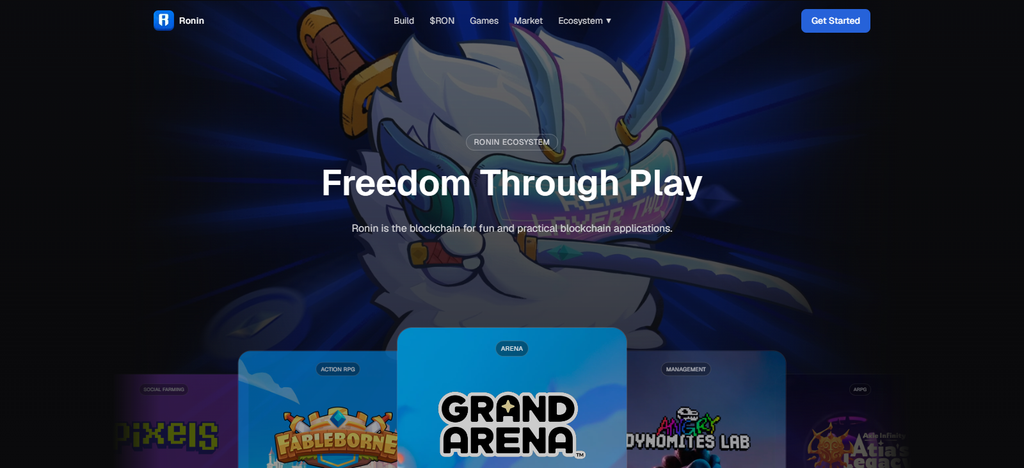
Genres supported by the ecosystem such as collectible games, farming sims, strategy, role-playing and multiplayer. Axie Infinity and Pixels are some of the recognizable titles. Ronin Wallet enables players to manage eligible tokens and NFTs such as game characters, collectibles, and virtual assets.
Its marketplace, wallet and developer infrastructure enable studios to create connected gaming experiences and player-driven digital economies.
How Does Work?
- Gaming-Focused Blockchain: Ronin is a blockchain infrastructure designed for gaming applications, empowering developers to create games with built-in digital economies.
- Ethereum URL: It provides an Ethereum Layer 2 architecture that links gaming activity to Ethereum settlement infrastructure while supporting gaming-centric network operations.
- Game Transactions: Players engage with intelligent contracts to perform actions like buying items, transferring NFTs, and managing in-game assets.
- Digital Asset Ownership: Ronin supports eligible NFTs and tokens related to characters, collectibles and other gaming assets, which can be managed through compatible wallets.
- Gaming Ecosystem: Its wallet, marketplace and developer infrastructure links games like Axie Infinity and Pixels with players and digital asset economies.
Ronin – Pros & Cons
| Pros | Cons |
|---|---|
| Gaming-focused infrastructure supports blockchain games and digital economies. | Its gaming specialization provides less flexibility for unrelated blockchain applications. |
| Established gaming titles include Axie Infinity and Pixels. | Gaming activity can become concentrated around a limited number of popular titles. |
| Ronin Wallet simplifies access to supported games and digital assets. | Beginners still need to understand wallet security and asset management. |
| Supports NFT marketplaces and player-owned gaming collectibles. | NFT demand and resale value depend on individual game communities. |
| Offers an ecosystem designed for frequent gaming transactions. | Its historical bridge security incident highlights the importance of monitoring security and infrastructure risks. |
3. Polygon
Polygon is an infrastructure, smart contract, and digital ownership that powers Web3 gaming in an Ethereum-connected blockchain ecosystem. Its Polygon PoS network offers an Ethereum-compatible environment for developers to build games with NFTs, tokenized rewards and player-driven marketplaces.
Its ecosystem covers gaming genres like metaverse experiences, role-playing, strategy, virtual worlds and collectible games, with Polygon-associated gaming project The Sandbox being a recognizable example.
Transactions are generally cheaper than interacting directly with the Ethereum Mainnet, so it is more practical to move assets around a lot. Players can use compatible wallets and marketplaces to manage eligible characters, land, collectibles and other NFTs.
How Does Work?
- Ethereum Connectivity: Polygon offers Ethereum connectivity via its scaling ecosystem, enabling smart contract technology and decentralized gaming applications.
- GameDeployment: For developers to deploy blockchain games that include NFTs, digital currencies and player-owned assets, the development tools and smart contract software have to be compatible.
- – Transaction Processing : Polygon PoS processes transactions separately through its validator network to offer relatively cheap transactions for game applications.
- NFT Management: Players are able to purchase, hold, transfer and trade supported digital collectibles, characters, virtual land and other game related assets.
- Gaming Integration: Its infrastructure connects gaming apps, wallets, and marketplaces, allowing developers to build experiences with digital ownership and blockchain-based economies.
Polygon – Pros & Cons
| Pros | Cons |
|---|---|
| EVM compatibility makes blockchain game development accessible to Ethereum developers. | Polygon’s different network products can make its architecture difficult for beginners to understand. |
| Polygon PoS offers comparatively low transaction fees. | Polygon PoS does not inherit Ethereum security in the same way as a rollup. |
| Supports NFT marketplaces, gaming collectibles, and tokenized assets. | Digital asset compatibility does not guarantee usability across different games. |
| Provides established developer tools and wallet integrations. | Developers face competition from other Ethereum Layer 2 ecosystems. |
| Supports multiple gaming and metaverse applications. | Gaming experiences and player activity vary considerably between projects. |
4. Arbitrum
Arbitrum is an Ethereum Layer 2 ecosystem for the development of scalable decentralized applications, including blockchain games that require frequent transactions and management of virtual assets.
The Arbitrum One network uses optimistic rollup technology to process transactions efficiently while settling data and transactions on Ethereum. It is active in the gaming field, with projects like The Beacon and Wildcard .
Gaming genres range from role-playing, strategy, multiplayer adventures and competitive games to collectible experiences. Arbitrum supports ERC-721 and ERC-1155 NFTs, enabling developers to create tradeable characters, equipment, and collectibles.
Its relatively cheap transaction experience, wallet compatibility, and developer tools make it ideal for growing onchain gaming economies.
How Does Work?
- Layer 2 Processing: Arbitrum processes transactions off Ethereum Mainnet and batches them for settlement, helping gaming applications to reduce transaction costs.
- Smart Contract Execution: Developers upload Ethereum-compatible smart contract execution to govern game rules, digital currencies, player interactions, and NFT-based gaming assets.
- Game Play: Players link compatible wallets to play games, perform blockchain transactions and interact with decentralized gaming applications.
- Asset Ownership: Arbitrum supports NFT standards like ERC-721 and ERC-1155, enabling players to own eligible characters, equipment, and collectibles.
- Ecosystem Growth: Its developer infrastructure and larger ecosystem are friendly to gaming projects, marketplaces and decentralized applications that require scalable blockchain interactions.
Arbitrum – Pros & Cons
| Pros | Cons |
|---|---|
| Ethereum rollup infrastructure provides an established scaling environment for blockchain games. | Its general-purpose design means gaming-specific tools may require additional integration. |
| Supports Ethereum-compatible smart contracts and development frameworks. | Developers must consider Layer 2 deployment and bridging requirements. |
| Offers lower transaction costs than direct Ethereum Mainnet interactions. | Network fees can still fluctuate depending on activity and transaction complexity. |
| Supports NFT marketplaces and decentralized gaming applications. | Gaming adoption competes with its large DeFi and financial application ecosystem. |
| Arbitrum Orbit enables developers to explore customized blockchain environments. | Custom gaming chains may require independent liquidity, infrastructure, and community development. |
5. Base
Base is an Ethereum Layer 2 network built on the OP Stack and aims to provide developers with an easy-to-use environment to build consumer applications and blockchain games. Its Ethereum connection allows applications to enjoy lower transaction costs and faster execution than many direct Mainnet interactions.
Gaming opportunities include onchain strategy, casual games, collectible experiences, multiplayer applications and social gaming integrations. Developers are able to use familiar Ethereum-compatible smart contract software and wallets to implement NFTs, tokenized rewards and digital collectibles.
The platform’s consumer-facing infrastructure and account onboarding capabilities help to lower the technical barriers associated with Web3 gaming, and players can manage supported assets through compatible wallets.
How Does Work?
- Ethereum Layer 2 Network: Base is an Ethereum Layer 2 network, built on the OP Stack, that provides the infrastructure for scalable blockchain applications and games.
- Game Development: Game developers are able to use Ethereum compatible smart contract software and development tools to build games that integrate digital collectibles, tokenized rewards, and blockchain-based interactions.
Transaction Execution: Base runs transactions through its Layer 2 infrastructure and settles them on Ethereum, which helps to lower costs and increase efficiency. - Player Asset Management: Players can link compatible wallets to manage supported NFTs, in-game currencies, collectibles and other virtual assets.
- Gaming Accessibility: Its consumer-centric infrastructure makes onboarding and wallet integrations simple, offering traditional gamers a gateway into blockchain gaming without requiring deep technical expertise.
Base – Pros & Cons
| Pros | Cons |
|---|---|
| Ethereum Layer 2 architecture supports scalable gaming applications. | Its gaming ecosystem is less specialized than dedicated gaming networks. |
| EVM compatibility makes smart contract deployment easier for Ethereum developers. | Developers face competition from established gaming-focused blockchains. |
| Lower transaction costs support frequent in-game interactions. | Transaction fees are not permanently fixed and depend on network conditions. |
| Coinbase’s ecosystem provides additional consumer onboarding opportunities. | Some players may still face wallet setup and blockchain learning requirements. |
| Supports NFTs, digital collectibles, and tokenized gaming experiences. | Cross-game asset compatibility is not automatically available across applications. |
6. Ethereum Mainnet
Ethereum Mainnet is the original Layer 1 foundation of the Ethereum gaming ecosystem, allowing developers to build games directly through smart contract technology without the need for a separate Layer 2 execution network. It supports genres like full onchain strategy, role-playing, dungeon crawlers, collectible card games and autonomous virtual worlds.
Games like Dark Forest and Asphodel: Prolog shows different approaches to gameplay based on the blockchain. All tokens, eligible NFTs and game-related collectibles are recorded directly on Ethereum and can be owned by players and transferred.
Transactions have the security and transparency of Ethereum, but high gas prices and transaction confirmation times make playing the game frequently less convenient than on Layer 2 networks.
How Does Work?
- Smart Contract Deployment: Game developers deploy smart contract technology directly on Ethereum Mainnet to establish game rules, asset ownership, transactions and decentralized gaming functionalities.
- Onchain Game Logic: In fully onchain games, gameplay rules, game states, and important player activities are implemented using blockchain-based contracts.
- Transaction Validation: Ethereum validators handle the processing and validation of transactions, creating a decentralized ledger of gaming interactions and digital asset transfers.
- NFT Ownership: Players can own Ethereum-based NFTs representing characters, weapons, collectibles, equipment and other in-game assets that are eligible.
- Open Gaming Infrastructure: Developers and communities can engage with public smart contract information and onchain game data to build additional tools, extensions and compatible gaming experiences.
Ethereum Mainnet – Pros & Cons
| Pros | Cons |
|---|---|
| Provides Ethereum’s established decentralized security and validator infrastructure. | Complex games with frequent transactions can face higher execution costs. |
| Smart contracts enable developers to create fully onchain gaming experiences. | Transaction confirmation and settlement can be less convenient for real-time gameplay. |
| Supports widely adopted NFT standards and digital asset ownership. | Frequent gameplay interactions may become expensive during periods of network congestion. |
| Public blockchain data allows developers to build additional tools and applications. | Fully onchain game development can require advanced smart contract expertise. |
| Offers direct access to Ethereum’s established developer ecosystem. | Storing extensive game logic and state directly onchain can be technically challenging. |
7. Optimism
Optimism is an Ethereum Layer 2 ecosystem that delivers scalable infrastructure for decentralized applications such as games and consumer-facing Web3 experiences. Its OP Mainnet uses optimistic rollup technology and its open-source OP Stack lets developers build their own networks connected to Ethereum.
The infrastructure can host games of genres such as strategy, role-playing, multiplayer, collectible and fully onchain games. Ethereum-compatible wallets enable users to interact with compatible smart contract protocols, NFTs and tokenized in-game assets.
Its low transaction costs and known development environment can be exploited to support frequent interactions for gaming. Individual gaming experiences rely on the applications and studios building in its larger ecosystem.
How Does Work?
- Optimistic Rollup Technology: Optimism executes transactions on its Layer 2 network and sends transaction data to Ethereum, relieving Mainnet of much of the load.
- OP Stack Infrastructure: OP Stack empowers developers to create Ethereum-compatible applications and customized blockchains for gaming needs.
- Smart Contract Implementation: Games implement intelligent contracts to govern gameplay, token transactions, NFTs, and other blockchain functionalities.
- Cost-Effective Transactions: Optimism can bundle transactions together to lower the costs of gaming interactions, enabling things like asset transfers and marketplace interactions to cost less.
- Player Participation: Players engage with supported games, manage qualified digital collectibles, and participate in applications built throughout the Optimism ecosystem using supported wallets.
Optimism – Pros & Cons
| Pros | Cons |
|---|---|
| Optimistic rollup technology provides Ethereum-connected scaling infrastructure. | Its gaming-specific ecosystem is less established than dedicated gaming platforms. |
| OP Stack allows developers to build customized blockchain networks. | Operating a customized chain requires additional technical and infrastructure resources. |
| Supports Ethereum-compatible smart contracts and development tools. | Developers must understand rollup deployment and network configuration. |
| Lower transaction costs support blockchain-based gaming interactions. | Transaction fees can vary with network activity and application requirements. |
| Its broader Superchain vision creates opportunities for connected blockchain applications. | Cross-chain interoperability and liquidity are not automatic across every OP Stack network. |
8. Treasure Ecosystem (Arbitrum)
Treasure Ecosystem is a decentralized Web3 gaming ecosystem that brings together games, digital resources, marketplaces, and community engagement into a single gaming economy.
It’s important to remember that when Treasure was first built, the gaming infrastructure was around Arbitrum and then moved to ZKsync around December 2024. So the current Ethereum connection is not the same as the historical Arbitrum foundation.
Its games are fantasy adventures, role-playing, strategy, collectible experiences and interconnected virtual economies. MAGIC token backs economic activities related to the ecosystem. NFTs can represent eligible game assets and collectibles.
Developers are able to build experiences around shared infrastructure, community participation and digital ownership which benefits the players by creating an environment focused on gaming.
How Does Work?
- Gaming Infrastructure: Treasure brings together blockchain games, digital resources, developers and gaming communities in a common Web3 gaming environment.
- Ethereum Ecosystem Connection: Treasure was launched in Arbitrum but the core gaming infrastructure later migrated to ZKsync, so it should not be referred to as just Arbitrum-based in 2026.
- MAGIC Token Utility: The MAGIC token is utilized to perform ecosystem activities and economic interactions within participating gaming applications.
- NFT Gaming: Players can interact with eligible NFTs, collectibles and game assets using supported apps and marketplaces.
Game and Community Integration Treasure connects game developers and players through shared infrastructure, game discovery, digital economies and community participation.
Treasure Ecosystem (Originally Arbitrum-Based) – Pros & Cons
| Pros | Cons |
|---|---|
| Gaming-focused infrastructure connects developers, players, and digital economies. | Its ecosystem depends on the continued development and adoption of participating games. |
| MAGIC token supports ecosystem-related economic activities. | Token-based economies can introduce additional complexity for beginners. |
| Supports NFT-based gaming assets and digital collectibles. | NFT utility and trading opportunities vary across individual games. |
| Offers gaming discovery and community-focused experiences. | Smaller games may have limited player activity and marketplace demand. |
| Provides infrastructure for interconnected Web3 gaming experiences. | Its historical Arbitrum-based architecture and subsequent ZKsync migration can create confusion about its current network setup. |
9. Beam
Beam is a blockchain ecosystem focused on gaming and associated with Merit Circle . It aims to provide infrastructure to developers for blockchain-integrated games and digital economies. Be aware that Beam is an Avalanche-based network, not a Layer 2 on Ethereum (though the BEAM token is also represented on Ethereum-compatible networks).
It includes games such as role-playing games, strategy, multiplayer, competitive and collectible games. Players can interact with supported wallets and applications with eligible NFTs, in-game items, and marketplace assets.
BEAM is used for network gas fees and ecosystem participation, while its gaming-oriented infrastructure provides scalable transactions and asset management.
How Does Work?
- Gaming Blockchain Infrastructure: Beam offers a gaming-friendly blockchain infrastructure linked to Merit Circle, enabling developers to integrate blockchain into gaming applications.
Network Architecture: Beam is based on Avalanche-based infrastructure and is not a native Ethereum Layer 2 network. - Game Development: Developers utilize its blockchain infrastructure to create games that incorporate smart contract technology, digital collectibles, tokenized assets, and economic systems for gaming.
- Digital Asset Ownership: Players will be able to manage their eligible NFTs, collectibles and in-game items through supported wallets and gaming marketplaces.
BEAM Token Utility: The BEAM token is used to pay network transaction fees and support ecosystem activities, enabling players, developers and blockchain gaming applications to interact.
Beam – Pros & Cons
| Pros | Cons |
|---|---|
| Gaming-focused infrastructure is designed for blockchain game development. | Beam is Avalanche-based rather than a native Ethereum Layer 2 ecosystem. |
| Supports gaming applications involving NFTs and digital collectibles. | Ethereum asset compatibility may require additional bridging or network integrations. |
| Provides a dedicated environment for gaming-related transactions. | Its specialized gaming focus may limit appeal for developers building unrelated applications. |
| BEAM supports network gas fees and ecosystem participation. | Players must understand the token and network requirements of supported games. |
| Offers opportunities for game studios to build blockchain-integrated experiences. | Individual games still need to establish their own active communities and sustainable economies. |
10. zkSync Gaming Ecosystem
zkSync Gaming Ecosystem provides Ethereum-connected infrastructure for blockchain games and digital asset applications with zero-knowledge rollup technology. ZKsync Era collects transactions into groups and sends cryptographic validity proofs to Ethereum, lowering transaction fees while ensuring verifiable settlement.
It offers gaming opportunities in the strategy, role playing, collectible, multiplayer and entertainment genres. Developers are able to deploy smart contract technology and embed NFTs, tokenized items and other digital ownership features into their games.
Players experience faster transaction experiences, lower fees than Ethereum Mainnet, and account abstraction features like smart wallets and sponsored transactions. It also has a bigger ecosystem that supports interconnected blockchain environments.
How Does Work?
- Zero-Knowledge Rollup Technology: zkSync uses cryptographic validity proofs to prove that batches of transactions have been executed correctly on Ethereum.
- Smart Contract Deployment: Developers deploy compatible smart contract deployment to build blockchain games, manage gaming economies, and incorporate NFT-based digital resources.
- Gaming Deals: Its Layer 2 infrastructure reduces transaction costs and improves transaction efficiency compared to direct Ethereum Mainnet interactions.
- NFT and Asset Ownership: Players can own eligible NFTs, gaming collectibles, tokenized items and other electronic assets using compatible wallets and applications.
- Account Abstraction: zkSync offers smart account capabilities to make wallet interactions easier, support various transaction authorization methods, and facilitate sponsored transactions in compatible gaming applications.
zkSync Gaming Ecosystem – Pros & Cons
| Pros | Cons |
|---|---|
| Zero-knowledge rollup technology provides Ethereum-connected transaction verification. | ZK-based infrastructure can be technically complex for inexperienced developers. |
| Supports Ethereum-compatible smart contracts through ZKsync Era. | Developers may need to adapt applications to network-specific features and tooling. |
| Lower transaction costs support frequent blockchain gaming interactions. | Fees can still vary depending on network activity and transaction requirements. |
| Account abstraction supports more flexible wallet experiences. | Smart wallet functionality depends on application integration and user configuration. |
| Supports NFT ownership, tokenized assets, and decentralized applications. | Its gaming ecosystem competes with more established blockchain gaming environments. |
Conclusion
Ethereum gaming ecosystems are revolutionizing the Web3 gaming landscape with a mix of blockchain infrastructure, digital asset ownership and more accessible gaming experiences. Platforms like Immutable, Ronin, Polygon, Arbitrum, Base, and zkSync each provide different ways to address scalability, transaction efficiency, NFT integration, and game development.
At the same time, Ethereum Mainnet is the foundation for fully onchain gaming while Optimism, Treasure and Beam offer additional infrastructure and gaming opportunities.
The choice of ecosystem depends on the type of game, transaction fees, wallet availability, asset ownership and developer participation. Gamers in 2026 should expect to value active games, reliable infrastructure, real gameplay value, and sustainable gaming economies above token rewards.
FAQ
What Are Ethereum Gaming Ecosystems?
Ethereum gaming ecosystems are blockchain-based environments that support Web3 games, NFT ownership, smart contracts, and digital economies. They allow developers to create games where players can manage and trade eligible digital assets.
Which Are the Best Ethereum Gaming Ecosystems in 2026?
Some notable ecosystems include Immutable, Ronin, Polygon, Arbitrum, Base, Ethereum Mainnet, Optimism, Treasure, Beam, and zkSync. Each offers different gaming infrastructure, transaction experiences, and player ownership features.
How Do Ethereum Gaming Ecosystems Work?
These ecosystems use blockchain networks and smart contracts to manage gaming transactions, digital assets, NFTs, and tokenized activities. Players connect compatible wallets to interact with supported games and marketplaces.
Can Players Own In-Game Assets Through Ethereum Gaming Ecosystems?
Yes. Players can own eligible NFTs, characters, skins, weapons, and collectibles recorded through blockchain technology. Ownership, trading, and transfer permissions depend on individual game functionality and smart contract rules.