



In this article I’ll talk about the Best Crypto Expense Management Tools for Web3 Teams that help blockchain businesses track digital asset spending, manage employee reimbursements, process crypto payments and simplify financial reporting. Features such as multi-wallet tracking, stablecoin payments, accounting integrations, transaction approvals and expense automation are offered by these platforms to help Web3 teams have better financial control and transparency.
- What Are Crypto Expense Management Tools?
- Why Do Web3 Teams Need Crypto Expense Management Tools?
- Key Points
- 1. Cryptio
- Security
- 2. Bitwave
- Security
- 3. Request Finance
- Security
- 4. Cryptoworth
- Security
- 5. Coinshift
- Security
- 6. Gnosis Safe (Safe)
- Security
- 7. Utopia Labs
- Security
- 8. Radom
- Security
- 9. Multis
- Security
- 10. Airbase
- Security
- Conclusion
- FAQ
What Are Crypto Expense Management Tools?
Crypto expense management tools are financial platforms designed to help Web3 companies, blockchain startups, and decentralized organizations manage their business expenses related to cryptocurrency. These tools allow teams to track their digital asset transactions, monitor wallet spending, handle employee reimbursements, pay vendors, and organize financial records.
They usually support cryptocurrencies and stablecoins like BTC, ETH, USDC and USDT across a number of blockchain networks. Other features include transaction approval, expense categorization, invoice management, accounting integrations and automated reconciliation.
These platforms mix crypto payment tracking with financial reporting and spending controls to help Web3 teams increase financial transparency, reduce manual accounting work and better manage business expenses.
Why Do Web3 Teams Need Crypto Expense Management Tools?
Multi-Wallet Expense Tracking: Web3 teams handle funds across multiple wallets and blockchain networks. Expense management tools gather transaction data, enabling finance departments to track expenses and keep a clear view of company funds.
Stablecoin expense management: Web3 companies often use USDC & USDT for operational payments. Specialized tools help with tracking stablecoin spending, checking the value of payments, and organizing transactions for financial reporting.
Automated Employee Reimbursements: Employees can submit expense claims, upload receipts, and ask for reimbursements. Finance teams can review submissions, approve payments and maintain organized reimbursement records.
Improved Financial Reporting: Crypto expense platforms classify transactions, aggregate financial data, and produce accounting reports, enabling companies to grasp operational expenses and develop more precise financial statements.
Safe Spending Approvals: Web3 organizations need controlled access to company capital. These tools include approval workflows, spending limits, role-based permissions, and multi-signature wallet authorization to reduce unauthorized transactions.
Easy accounting reconciliation: The accounting records created by blockchain transactions can be complex. Expense management platforms reconcile and match payments, invoices, receipts and transaction histories to make reconciliation and financial accuracy easier.
Enhanced Financial Transparency: Centralized expense dashboards give insight into company spending, budget allocations, and payment operations, enabling founders, finance managers, and DAO administrators to make more informed financial decisions.
Key Points
| Tool | Key Point |
|---|---|
| Cryptio | Provides crypto-native accounting, treasury tracking, and expense reconciliation for Web3 organizations managing on-chain transactions. |
| Bitwave | Automates crypto expense tracking, accounting workflows, and financial reporting for companies operating in digital assets. |
| Request Finance | Enables Web3 teams to manage invoices, payroll, expenses, and crypto payments from a single platform. |
| Cryptoworth | Offers transaction reconciliation, bookkeeping automation, and expense management for crypto-focused businesses. |
| Coinshift | Helps DAOs and Web3 teams manage treasury spending, approvals, and expense oversight across multiple wallets. |
| Gnosis Safe (Safe) | Supports multi-signature expense approvals and secure treasury management for decentralized organizations. |
| Utopia Labs | Streamlines crypto payroll, vendor payments, and operational spending for Web3 teams. |
| Radom | Combines crypto payment processing, invoicing, and expense management tools for businesses using digital assets. |
| Multis | Provides treasury management, expense controls, and financial visibility for crypto-native companies. |
| Airbase | Integrates crypto accounting workflows with traditional expense management, approvals, and spend controls for modern finance teams. |
1. Cryptio
Cryptio is a digital asset accounting, reconciliation and financial reporting platform designed primarily for businesses dealing with complex crypto transactions. It supports more than 500,000 assets across multiple blockchain networks, with integrations across wallets, exchanges, custodians and DeFi protocols.
Its expense-management features are geared toward capturing operational expenses, invoices and transaction data, including Request Finance integration for payment workflows. Teams can classify transactions, reconcile balances and produce accounting records for audit purposes.
It also integrates with accounting platforms like QuickBooks, NetSuite, Xero, SAP and Sage. Its two main stand-alone capabilities are employee reimbursements and corporate spending cards. Pricing is tailored to the business needs, integrations and transaction complexity.
Security
- Cryptio is SOC 1 and SOC 2 Type II compliant, giving you independent assurance over controls for financial reporting, security, availability, processing integrity, confidentiality and privacy.
- Controls have been designed with input from the Big Four and audited by firms including KPMG and Aprio, with controls specifically covering indexers, price providers, accounting integrations and reporting.
- Cryptio leverages independent on-chain data from more than 90 blockchains through verified node runners, reducing single point of failure on a third-party data provider.
- The platform is designed for auditability, generating evidence trails and reconciliation records that support enterprise audits, regulatory reviews, and GAAP/IFRS-aligned reporting.
- Customers are still responsible for enforcing least-privilege access, protecting API credentials, and validating ERP and wallet connections. Cryptio handles financial data but does not substitute for the organization’s own access-control discipline.
| Pros | Cons |
|---|---|
| Strong institutional crypto accounting and data-infrastructure platform for reconciliation, reporting, and audit readiness. | Not designed as an employee expense, reimbursement, or corporate-card product. |
| Supports data from wallets, exchanges, custodians, and DeFi protocols, creating a unified auditable ledger. | Pricing is quote-based, which can make budgeting and vendor comparison difficult. |
| SOC 1 and SOC 2 Type II certified, with controls designed for compliance and enterprise audits. | Better suited to finance and accounting teams than to operational teams making frequent payments. |
| Integrates with major ERP systems including NetSuite, Xero, QuickBooks, SAP, Oracle, Sage, Dynamics 365, and Workday. | Deep implementation and data-mapping work may be required for complex organizations. |
| Supports independent on-chain data across 90+ blockchains, reducing reliance on one data source. | Does not provide the payment execution and invoice-management breadth of Request Finance. |
2. Bitwave
Bitwave provides crypto accounting, transaction tracking, stablecoin payments, reconciliation, and financial reporting for Web3 companies and enterprises. It supports thousands of digital currencies across networks like Bitcoin, Ethereum, Solana, Polygon, Avalanche, Arbitrum and Base, including cryptocurrencies, tokens, DeFi assets and NFTs.
Businesses can link blockchain wallets, exchanges and custodial accounts and then automatically import and categorize transactions . Its payment workflows support vendor invoices, stablecoin payouts, payment approvals, and financial documentation.
Bitwave also integrates with QuickBooks, Xero, Sage Intacct and NetSuite, helping finance teams push transaction records into existing accounting systems.
Determine if the plan for reimbursement functionality is required and if the employee card is available. Pricing is normally done through bespoke commercial quotations.
Security
- It boasts an Advanced Security module with a Bring Your Own Key encryption framework, customers control encryption keys and can revoke access when needed.
- BYOK encryption provides control over the key lifecycle, helping organizations meet compliance requirements such as GDPR, HIPAA, SOC 2 and PCI-DSS.
- Bitwave employs secure vendor-wallet verification and allow-listed addresses to minimize the risk of sending crypto payments to the wrong recipient.
- Publishing events in real-time allows the security team to see what is happening on the system, and helps with monitoring, incident response and gathering audit evidence.
| Pros | Cons |
|---|---|
| Enterprise-grade digital-asset accounting platform with high-volume transaction tracking across wallets, exchanges, custodians, and blockchain activity. | Pricing is not publicly transparent; companies must engage sales for Startup, Enterprise, or Institution plans. |
| Provides stablecoin AP/AR workflows, staking, validator operations, and crypto bookkeeping capabilities. | Primarily an accounting and finance platform, not a complete employee reimbursement or expense-card solution. |
| Supports GAAP/IFRS-compliant reporting, customizable impairment, fair-value accounting, and complex wallet assignments. bitwave+1 | Implementation can be complex for organizations with many entities, chains, wallets, and data sources. |
| Offers native bidirectional ERP sync, 80+ blockchain support, and direct blockchain verification for auditors. | May be more expensive and feature-heavy than smaller teams need. |
| Maintains SOC 1 Type II and SOC 2 Type II compliance, with annual independent EY audits. | Advanced security features such as BYOK may require additional configuration and enterprise-level planning. |
3. Request Finance
Request Finance is a more straightforward expense-management solution for Web3 teams, incorporating employee reimbursements, vendor payments, invoices, payroll and accounting workflows.
Employees can submit business expenses in crypto or fiat and finance managers can review, approve, reject and reimburse claims. The platform accepts payments in stablecoins, including USDC and USDT, along with other supported crypto and fiat payment options. Its payment infrastructure for businesses is connected to blockchain wallets and supports a multitude of payment networks.
Bank payouts can be done using local rails and SWIFT. Accounting integrations include QuickBooks Online, Xero and NetSuite on higher plans. Pricing starts at $42 a month when billed annually, with higher tiers offering more team members, entities, automation and approval workflows.
Security
- Request Finance employs encryption for data in transit and at rest, role-based authentication, two-factor authentication for authorized contributors, and continuous system monitoring.
- It regularly audits hosting providers, does security assessments, runs a bug-bounty program and has independent third-party security and intrusion testing.
- Only identified staff have administrative access to servers, minimizing unnecessary privileged access to customer data and infrastructure.
- Request Network and IPFS encrypt the on-chain request data which is only accessible by the counterparties and Request Finance. Webhook payloads are secured with SHA-256 signatures.
- The company recommends segregating test, development and production OAuth applications, storing client secrets in secure secret-management systems and simulating transactions before running them.
| Pros | Cons |
|---|---|
| Combines AP, AR, invoicing, payroll, expenses, and crypto/fiat payments in one platform. | Not as deep as Cryptio, Bitwave, or Cryptoworth for complex crypto accounting, valuation, and financial-close workflows. |
| Supports fiat, 18 blockchains, and 350+ cryptocurrencies, with additional assets available on request. | Businesses needing highly customized enterprise ERP controls may need additional integrations or a dedicated crypto subledger. |
| Strong expense and reimbursement workflow: employees submit receipts, track approvals, and receive crypto or fiat reimbursement. | Crypto payment execution still requires careful wallet, address, and network verification by the finance team. |
| Supports batch payments, approval policies, vendor payments in 190+ countries, and stablecoin or local-currency settlement. | Advanced features may be tied to paid plans, so smaller teams should review plan limits before committing. |
| Transparent pricing starts at $50 per month, with no setup fee and zero fees on stablecoin payouts. | Its broad operational scope means it may not be the best standalone choice for deep institutional accounting. |
4. Cryptoworth
Cryptoworth helps Web3 businesses organize digital asset transactions, automate accounting entries and reconcile financial activity across multiple blockchains. It has support for thousands of digital resources and offers over 1,000 data connections including over 200 blockchain networks, exchanges, custodians and DeFi protocols.
The expense management includes invoice and bill management, transaction categorization, financial reconciliation and accounting exports. Teams can link wallets and switch accounts to aggregate their crypto activity into one financial record.
Accounting integrations include QuickBooks, Xero and NetSuite. It’s not really about employee reimbursement or corporate card management. Entry plans have been $89 per month, with higher business plans being more, for the published pricing.
Security
- Cryptoworth has SOC 1 Type I, SOC 2 Type I, and SOC 2 Type II certifications, and independent audits test internal controls, data security, and compliance protocols.
- All communications on the platform are encrypted using TLS 1.2, meaning that data in transit cannot be viewed by third parties.
- Sensitive financial records, cryptographic keys and transaction data are protected with AES-256 encryption both in transit and at rest.
- Where applicable, the platform uses PCI compliant service providers to store, process and transmit card data.
- Cryptoworth uses an end-to-end encryption approach that is supposed to ensure customer data privacy and that it can only be accessed by authorized users, but customers should still have control over ERP credentials, user roles and API keys.
| Pros | Cons |
|---|---|
| Strong crypto subledger and financial-close platform for reconciliation, classification, valuation, and journal-entry preparation. | Not a payment execution, employee reimbursement, or corporate-card platform. |
| Supports more than 250 chains and more than 1,000 digital-asset data sources. | Custom pricing can make total cost difficult to estimate before sales discussions. |
| Connects directly with QuickBooks, Xero, NetSuite, and Sage, with API connectivity for other general ledgers. | Requires clean source data and finance-team configuration to produce reliable accounting output. |
| Supports FIFO, LIFO, HIFO, WAC, and WAC Perpetual cost-basis methods, plus daily balance snapshots and auditor access. | Better suited to finance teams than DAOs or small teams seeking simple payment workflows. |
| Includes cost-basis tracking, impairment testing, and digital-asset tax workflows. | Does not replace a treasury wallet, multisig signer, or payment-approval platform. |
5. Coinshift
Coinshift is a specialist in managing Web3 treasury operations, organization wallets and on-chain payments for DAOs, crypto startups and blockchain foundations. Built on Safe multisig infrastructure, it enables teams to monitor treasury balances, manage ERC-20 tokens and NFTs, draft transaction proposals and orchestrate multiple approvals.
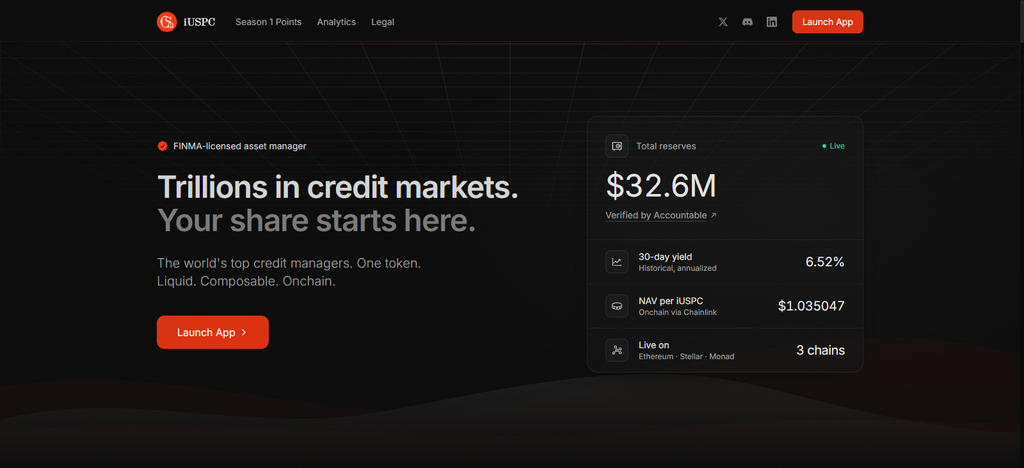
It also enables bulk payouts, recurring payments and transaction management, which helps organizations disburse funds to contributors and vendors. Coverage of wallet and chain depends on the connected Safe accounts and supported integrations.
Coinshift also provides transaction exports and cash-flow visibility, and integrations with Request Finance and DeFi apps extend financial workflows. It’s more treasury-focused than a full employee reimbursement platform. Please contact us directly for pricing and enterprise arrangements.
Security
- Coinshift is built on top of Safe’s multisig infrastructure, so treasury actions can require multiple authorized approvals, rather than a single wallet key.
- Its official documentation points users to verified contract addresses, official interfaces and on-chain verification via Etherscan to avoid impersonation sites and malicious vault interfaces. [docs.coinshift]Trusted Links and Audits
- TLS 1.3, DNSSEC, and DMARC signals are part of the platform’s security posture to help protect web traffic, domain integrity, and risks related to email-based impersonation.
- Users should periodically audit signer permissions, transaction limits and connected DeFi protocols. While Coinshift can provide access to third-party protocols, it cannot remove their underlying smart-contract risk.
| Pros | Cons |
|---|---|
| Strong for DAO and Web3 treasury operations, including bulk payments, budgets, spend controls, and approval workflows. | Less suitable for traditional companies that need fiat payroll, corporate cards, and full ERP-native accounting. |
| Builds on Safe-based multisig infrastructure, allowing multiple approvals for treasury actions. | Crypto-native focus means fiat expense management and reimbursement features are limited compared with Request Finance or Airbase. |
| Provides a unified dashboard for managing multiple Safes and treasury activity across networks. | Accounting integration is generally export- or third-party-based rather than a full native ERP suite. |
| Its csUSDL ecosystem has undergone extensive auditing, with 27 audits by 12 security firms across core infrastructure and vault components. | Users must still verify official contracts and interfaces to avoid impersonation or malicious front-end risks. |
| Security posture includes TLS 1.3, DNSSEC, and DMARC signals. | DeFi and protocol exposure can introduce smart-contract risk beyond Coinshift’s own platform controls. |
6. Gnosis Safe (Safe)
Safe (formerly Gnosis Safe) is a self-custody smart account platform for Web3 teams to manage their organizational crypto funds safely with the help of multisignature approvals. It supports assets and tokens on various networks including Ethereum, Polygon, Optimism, Arbitrum, Base and Gnosis Chain.
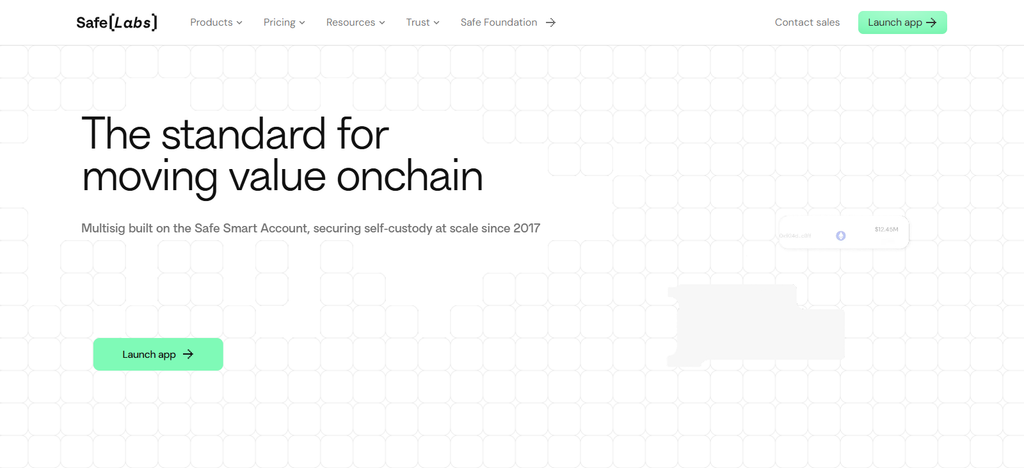
Finance teams can create shared wallets, assign signers, set approval thresholds, review transactions and export CSV records for reconciliation. Other controls are transaction checks and recovery mechanisms, and spending permissions.
Safe doesn’t offer a complete employee expense reimbursement or traditional accounting platform, but its wallet infrastructure can be utilized for controlled business spend. Basic wallet usage is free, blockchain gas fees are charged, and there is a separate pricing for optional Pro services.
Security
- Safe is a self-custody smart-contract wallet: assets reside in an on-chain contract governed by designated signers, not by Safe as custodian.
The multisig signing has configured signer thresholds, so a single compromised key cannot alone move treasury funds. - Safe supports transaction simulation, scanning and review before execution, helping signers inspect recipient, amount, intent, and supporting documentation.
- Safe offers modular security controls to organizations such as modules for recovery, guard, role-based permissions and customizable policies for treasury operations.
- Safe supports 40+ networks and provides APIs that help enterprise teams manage transactions and monitor wallets, but teams still have to guard the signer keys, watch out for phishing interfaces, and verify contract addresses.
| Pros | Cons |
|---|---|
| Provides self-custody smart-contract wallet infrastructure, so the organization retains control of assets and permissions. | Not an accounting, expense-management, reimbursement, or payroll platform. |
| Multisig thresholds prevent a single compromised key from unilaterally moving treasury funds. | Requires operational discipline: signer-key management, approval policies, and transaction review remain the customer’s responsibility. |
| Supports transaction simulation, scanning, and review before execution. | Accounting integration is indirect, usually through exports or third-party crypto accounting tools. |
| Includes recovery modules, guard modules, role-based permissions, and customizable organizational policies. | More technical to operate than a simple payments dashboard, particularly for non-crypto-native finance teams. |
| Supports more than 40 networks and provides APIs for treasury and protocol operations. | Safe Pro pricing starts at €189 per month, with higher tiers and usage limits that may not suit very small teams. |
7. Utopia Labs
Before that, Utopia Labs built financial operations software for DAOs and Web3 organizations — contributor payments, payroll, expense workflows and bookkeeping for organizations. Its platform helped teams handle crypto payments, recurring payouts and organize transaction records via connected wallets.

Businesses could use its payment and accounting workflows to streamline contributor payments and treasury operations. However, Utopia Labs announced on November 6, 2023 it would shutter its original product and close its services.
As such, it should not be featured in a current buying guide for 2026 as an expense-management solution that is actively available. Historical prices, supported assets and integrations are not current purchase information.
Security
- Utopia Labs was a stablecoin payments and finance-operations platform for crypto-native teams and DAOs. It had security controls such as authentication, domain security, and vulnerability disclosure signals.
- It added TLS 1.3 and DMARC to its public security profile, which support encrypted web traffic and guard against certain email-spoofing attacks.
- CertiK’s Skynet profile displayed three security audits and on-chain monitoring for Utopia Labs, but its public Skynet score was 59.81 out of 100.
- Because the platform was built around payments, payroll, invoicing and approval workflows, permission controls and approval thresholds were core to minimizing unauthorized payouts.
- Utopist Labs is no longer independent and former public application and API domains are no longer resolving. Organizations should not rely on Labs for active treasury operations and should migrate any remaining workflows to a supported platform.
| Pros | Cons |
|---|---|
| Was designed for Web3 payroll, contributor payments, invoicing, and approval workflows, making it useful for DAO-style operations. | The company no longer operates independently, and its former public application and API domains no longer resolve. |
| Provided payment, payroll, and approval workflows tailored to crypto-native teams. | It should not be selected for new active treasury or payroll operations because continuity and support are uncertain. |
| Its security profile included TLS 1.3 and DMARC signals, supporting encrypted traffic and email-spoofing protection. | Public security evidence is limited compared with enterprise accounting platforms such as Bitwave, Cryptio, and Cryptoworth. |
| CertiK listed three security audits and on-chain monitoring for the project. | Its public Skynet score was 59.81 out of 100, indicating that security posture should be independently evaluated rather than assumed. |
| Its workflow design emphasized approvals and permissions, which can reduce unauthorized payout risk. | Organizations using it should migrate data and workflows to an actively supported alternative. |
8. Radom
Radom is a crypto payment infrastructure that helps Web3 businesses to receive payments, manage invoices, process recurring transactions and disburse funds. It supports 10+ blockchains and 12+ cryptocurrencies including major networks like Ethereum, Bitcoin, Polygon, Avalanche, Arbitrum and Binance Smart Chain.
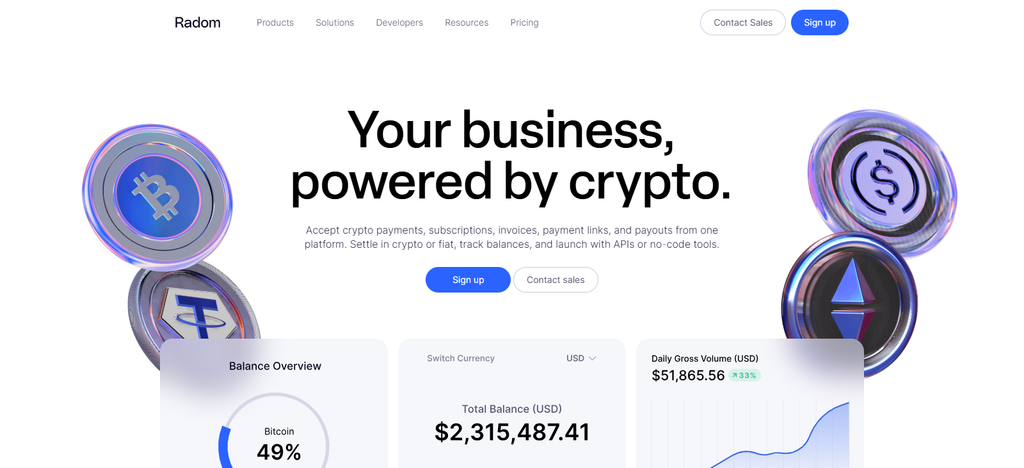
Teams have the ability to manage business transactions using payment links, hosted checkout, crypto invoicing, APIs, and mass payouts. It has team permissions, financial reporting, payment monitoring and withdrawal options on its dashboard. Radom also has APIs and webhooks for automated payouts and reconciliation.
It works particularly well for vendor payment and business disbursement processes, but it’s not really designed for employee expense claims or traditional reimbursement management. The price starts at 0.5% plus $0.50 for each crypto payment, with custom enterprise pricing available.
Security
- Radom has payment infrastructure including hosted checkout, embedded flows, subscriptions, invoices, payment links, and APIs. Security needs to encompass both merchant integrations and customer payment flows.
Supported payment methods define the networks and assets available across payment flows, so merchants need to validate contract addresses, chain selection, and asset compatibility before going live. - Radom supports crypto-to-fiat conversion and payouts so businesses should apply recipient verification, sanctions and fraud screening and reconciliation controls to settlement workflows.
- The platform charges per transaction, not for setup or monthly, but that does not mean that webhook authentication, API-key protection and secure handling of customer payment data are not needed.
- Businesses that integrate Radom must limit API credentials, verify webhook authenticity, track payment status, and use test environments before processing production transactions.
| Pros | Cons |
|---|---|
| Strong for businesses accepting crypto payments through hosted checkout, embedded flows, subscriptions, invoices, payment links, and APIs. | Not a complete expense-management, reimbursement, or accounting platform. |
| Supports 12+ cryptocurrencies, 10+ blockchains, and hundreds of wallets through WalletConnect integration. | Asset and network availability depends on supported payment methods, so merchants must validate coverage before launch. |
| Supports crypto-to-fiat conversion and payouts, including available USD, GBP, and EUR payout flows. | Accounting integration is not its primary differentiator; businesses generally need exports or separate finance-system connections. |
| Per-transaction pricing means no setup fees or monthly fees, which can suit businesses with variable payment volume. | The 0.5% plus 50-cent transaction fee can become meaningful at high volume or for low-value transactions. |
| Suitable for merchant payment acceptance, recurring billing, and cross-border payout use cases. | Businesses must separately manage fraud screening, sanctions checks, reconciliation, and recipient verification. |
9. Multis
Multis was built to help crypto-native businesses and DAOs manage organizational funds, payroll and everyday business spending. The platform combined a self-custody multisig wallet with treasury monitoring, mass payments, corporate cards and accounting exports.
Businesses will be able to hold and manage balances of crypto and stablecoins including USDC and USDT, and pay employees, vendors and business expenses in either crypto or USD. It’s historical capabilities also included ACH and wire transfers, QuickBooks integration and CSV transaction exports. These functions made it relevant to companies that want to connect treasury management to operational spending.
Y Combinator, however, lists Multis as inactive, and its application displays a shutdown and migration notice. Therefore current availability, pricing and new account access are subject to verification before being included as an active recommendation.
Security
- Multis is built for crypto corporate finance, combining corporate wallets, payments, spending controls and accounting-friendly workflows. Therefore the security model should focus on wallet custody, approvals and user permissions.
- Treasury funds should be controlled by multisignature or hardware-backed wallets, so that high-value transfers need approval from multiple authorized approvers rather than a single administrator.
- Role-based access should be set up to separate finance operators, approvers, auditors and administrators so that no single user can create, approve and execute a payment without oversight.
- Leverage spending limits, merchant restrictions, receipt requirements and approval rules in corporate-card and expense workflows to mitigate fraud and unauthorized spending.
Accounting integrations should use least-privilege API credentials, encrypted secrets, audit logs, and periodic reconciliation of on-chain records, card transactions, and the general ledger.
| Pros | Cons |
|---|---|
| Combines corporate wallets, payments, spending controls, and accounting-oriented workflows for Web3 companies and DAOs. | Less specialized for deep institutional crypto accounting than Cryptio, Bitwave, or Cryptoworth. |
| Supports day-to-day company spending, vendor payments, contractor payments, and treasury management from one interface. | May have narrower chain and asset coverage than enterprise accounting platforms that ingest hundreds of data sources. |
| Expense controls can include corporate cards, spending limits, categorization, receipts, and transaction review. | Advanced accounting automation may depend on the company’s ERP setup and integration depth. |
| Approval and role-based controls can reduce unauthorized payments and improve financial oversight. | Teams must still enforce signer security, wallet hygiene, and transaction verification. |
| Useful for organizations that want an operational finance layer rather than only a self-custody wallet. | Pricing and feature availability can be sales-led, making direct comparison harder for smaller teams. |
10. Airbase
Airbase (now part of Paylocity for Finance) is a traditional business spend-management platform – not a native crypto expense solution. It offers corporate card management, employee expense reporting, reimbursements, accounts payable automation and purchase approval workflow.
Employees submit expenses through web and mobile interfaces, capture receipts and receive reimbursements, while finance teams manage spending policies and transaction categorization.
Accounting integrations include NetSuite, Sage Intacct and QuickBooks, with further ERP connectivity dependent on configuration. It doesn’t primarily provide native cryptocurrency wallets, blockchain transaction tracking, or direct on-chain expense management.
Pricing is usually based on a quotation, with packages being tailored to the size of company and the modules required. It can accommodate Web3 companies managing their fiat expenses alongside separate crypto accounting systems.
Security
- Airbase is a corporate spend management platform and its security model is centered around protecting corporate card data, bank payment information, employee data, invoices, and ERP integrations, not around crypto private keys.
- It gives you approval workflows, spending policies, budgets, purchase orders and card controls that reduce unauthorized or out-of-policy spending.
- Employee reimbursements should be protected through identity verification, receipt validation, expense-policy enforcement and segregation of requester and approver roles.
- Airbase’s accounting automation should use least-privileged ERP connections, encrypted credentials, audit trails, and reconciliation controls so that only approved transactions are flowing accurately into the general ledger.
- While Airbase is not a crypto-custody platform, it does manage sensitive financial and employee data, so organizations must enforce SSO, MFA, role-based permissions, vendor due diligence, and periodic access reviews.
| Pros | Cons |
|---|---|
| Excellent for traditional corporate spend management, including cards, bills, reimbursements, purchase orders, budgets, and approvals. | Not a crypto-native treasury, wallet, or on-chain payment platform. |
| Strong expense tracking through receipt capture, categorization, approval workflows, virtual cards, and spend policies. | Does not support crypto asset custody or blockchain-native payment execution. |
| Helps finance teams enforce spending policy and maintain clean ERP data through accounting automation. | Not suitable as the primary system for stablecoin payroll, DAO treasury, or DeFi operations. |
| Reimbursements are a core capability, with employee submissions and approved reimbursement workflows. | Fiat-focused design means companies using crypto treasuries need a separate crypto payments or accounting platform. |
| Integrates with major ERP and accounting systems to move approved transactions into the general ledger. | Pricing is custom and sales-led, so smaller businesses may find it less accessible than self-serve tools. |
Conclusion
Crypto expense management tools help Web3 teams simplify financial operations, track digital asset spending, process payments and keep accurate accounting records. Platforms like Cryptio, Bitwave, Request Finance and Cryptoworth focus on crypto accounting, expense tracking and reconciliation, while Coinshift and Safe support treasury management and secure transaction approvals.
Radom provides crypto payment infrastructure and Airbase helps with traditional business expenses and reimbursements. Businesses should consider supported assets, blockchains, wallet integrations, approval processes, accounting features, security and cost when selecting a platform.
The right solution can increase financial transparency, reduce manual work, and make expense management more efficient as Web3 operations grow.
FAQ
What Are Crypto Expense Management Tools?
Crypto expense management tools are software platforms that help Web3 businesses track cryptocurrency spending, manage employee expenses, process payments, approve transactions, and organize financial records across wallets and blockchain networks.
Which Crypto Expense Management Tool Is Best for Web3 Teams?
Request Finance is a strong option for Web3 teams that need crypto expense tracking, employee reimbursements, invoices, vendor payments, and accounting integrations. Bitwave and Cryptio are useful for businesses with more complex crypto accounting requirements.
Can Crypto Expense Management Tools Support Stablecoin Payments?
Yes. Several platforms support stablecoin transactions involving assets such as USDC and USDT. These capabilities help Web3 companies manage contractor payments, vendor invoices, operational expenses, and international business transactions.
Do Crypto Expense Management Platforms Support Multiple Blockchains?
Yes. Many platforms connect with multiple blockchain networks, wallets, exchanges, and custodians. Supported networks vary by provider, so businesses should verify Ethereum, Polygon, Solana, Arbitrum, Base, and other required network integrations before selecting software.