


In this article I will discuss the Best Crypto Portfolio Trackers for Personal & Business Use, helping investors and companies to manage their digital investments more efficiently. I will discuss their key features, pricing, wallet integrations, DeFi and NFT tracking, tax reporting, and portfolio management capabilities to assist you in choosing the appropriate platform for your financial needs.
- What Are Crypto Portfolio Trackers ?
- Key Points
- 1. CoinTracking
- CoinTracking. io Key Features, Benefits & Cons
- 2. CoinStats
- CoinStats Key Features, Benefits & Cons
- 3. CoinTracker
- CoinTracker Key Features, Benefits & Cons
- 4. Koinly
- Koinly Key Features, Benefits & Cons
- 5. Delta Investment Tracker
- Delta Investment Tracker Key Features, Benefits & Cons
- 6. Kubera
- Kubera Key Features, Benefits & Cons
- 7. DeBank
- DeBank Key Features, Benefits & Cons
- 8. Zerion
- Zerion Key Features, Benefits & Cons
- 9. Rotki
- Rotki Key Features, Benefits & Cons
- 10. Nansen Portfolio
- Nansen Portfolio Key Features, Benefits & Cons
- Conclusion
- FAQ
What Are Crypto Portfolio Trackers ?
Cryptocurrency portfolio trackers are digital instruments that help individuals and businesses to monitor, organize and manage their cryptocurrency investments across multiple wallets, exchanges and blockchain networks.
These platforms provide a centralized dashboard to check asset balances, transaction history, portfolio performance, profits, losses, and investment allocation. Many also support DeFi positions, NFT holdings, staking rewards and tax reporting.
For personal users, they help streamline investment monitoring and financial planning. For businesses, the right platforms can be used to segregate company-owned crypto holdings, review treasury assets, organize transactions, and maintain financial records.
Key Points
| Crypto Portfolio Tracker | Key Point |
|---|---|
| CoinTracking | Comprehensive portfolio management platform with support for 400+ exchanges and wallets, advanced profit/loss analysis, tax reporting, and business-grade accounting features. |
| CoinStats | All-in-one crypto, DeFi, and NFT portfolio tracker supporting 300+ exchanges and wallets with real-time analytics, performance monitoring, and mobile access. |
| CoinTracker | Well-known portfolio and tax reporting solution that automatically syncs transactions across exchanges and wallets while providing investment performance tracking. |
| Koinly | Popular tracker and crypto tax platform offering extensive exchange integrations, automated transaction imports, capital gains calculations, and business reporting tools. |
| Delta Investment Tracker | Multi-asset portfolio tracker supporting cryptocurrencies, stocks, ETFs, and NFTs, making it ideal for investors managing diversified portfolios. |
| Kubera | Net-worth tracking platform that combines cryptocurrencies, traditional investments, banking assets, and business holdings into a single dashboard. |
| DeBank | Leading Web3 portfolio tracker focused on DeFi assets, wallet monitoring, token positions, and on-chain portfolio visibility across multiple blockchains. |
| Zerion | Web3-native portfolio management application that enables users to track, manage, and interact with DeFi assets and wallets from one interface. |
| Rotki | Open-source, privacy-focused portfolio tracker that stores data locally, supports exchanges, wallets, and DeFi positions, and generates profit/loss reports. |
| Nansen Portfolio | Advanced analytics-driven portfolio tracker providing detailed on-chain insights, smart-money monitoring, and institutional-grade crypto portfolio analysis. |
1. CoinTracking
CoinTracking, a cryptocurrency portfolio tracker, transaction manager and tax reporter for individual and professional users, was established in 2012. Its free plan allows you to view portfolios and paid plans start at $49 per year for Starter, $169 for Pro, $259 for Expert and $899 for Unlimited.
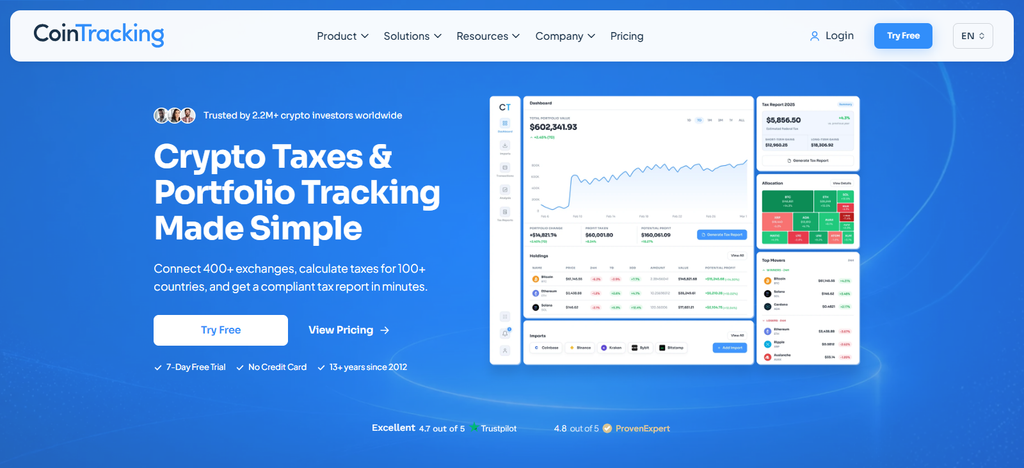
The platform supports more than 400 exchanges and wallets and also tracks DeFi and NFT transactions. Users are able to import transactions, track portfolio performance, calculate gains and losses, and produce financial reports.
The corporate version begins at $1,799 per year and includes multi-client management, three unlimited accounts, additional accounts and custom branding.
CoinTracking. io Key Features, Benefits & Cons
Main Features:
- Monitor cryptocurrency portfolios from multiple exchanges, wallets and blockchain networks.
- Offers comprehensive profit & loss calculations, cost basis tracking and historical transaction analysis.
- Monitors DeFi, staking, and NFT transactions for different crypto investment activities.
- Creates cryptocurrency tax reports using different accounting methods and country-specific reporting options.
• Has CSV import, API sync, portfolio analytics, and corporate account management capabilities.
Benefits
- Exchange and wallet integration with a wide range.
- Detail transaction history and portfolio analytics.
- Aids in difficult DeFi and crypto tax calculations.
- Provides corporate and multi-client management capabilities.
- allows for the customization of financial reports and the export of data.
Cons
- Interface may look complicated for novices.
- Advanced reporting is available only to paid subscriptions.
- Costly plans may be required for large-volume portfolios.
- Some transactions may require manual review or correction.
- Some business features may be locked at higher subscription levels.
2. CoinStats
CoinStats is a centralized portfolio dashboard that helps investors track their cryptocurrency holdings. It was founded in 2017. The free Basic plan offers up to 10 portfolios, with Premium pricing around $13.99/month after the trial.
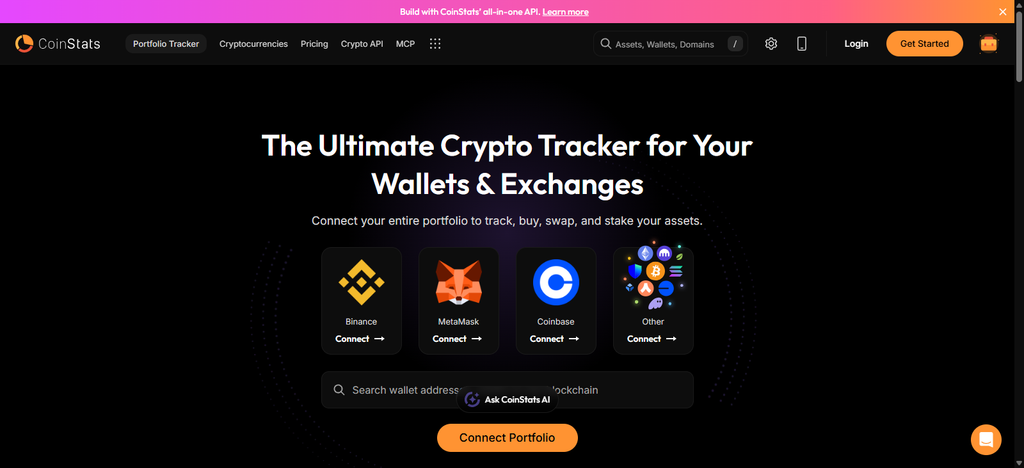
Degen and custom Team plans come with additional features. CoinStats integrates with 300+ wallets and exchanges, multiple blockchain networks, DeFi protocols, staking, yield farming, liquidity pools and NFT tracking. Users can view portfolio allocation, transaction history, asset performance, profit and loss, and price alerts.
It has a Team plan that includes customized functionality and support through a community. Dedicated corporate accounting and legal-entity reporting should be considered separately.
CoinStats Key Features, Benefits & Cons
Main Features
- Consolidates crypto assets from various wallets and exchanges on one dashboard.
- Monitors staking rewards, DeFi investments, yield farming, Liquidity Pools, and NFTs.
- Provides portfolio performance analytics, asset allocation and profit & loss tracking.
- Includes price alerts, transaction notifications, wallet analysis and portfolio insights
- Provides various portfolio management options and customized Team plans.
Benefits
- Easy to use on mobile and desktop.
- Supports many wallets and cryptocurrency exchanges.
- Offers integrated DeFi and NFT monitoring.
- Provides useful portfolio analytics and price alerts.
- The support plans for teams are tailored to your organization’s needs.
Cons
- Advanced analytics is a paid subscription.
- You may need to troubleshoot some of your exchange connections.
- It is not its forte to do tax reporting.
- Subscription level upgrades may be required for larger portfolios.
The features that are unique to corporate accounting are few.
3. CoinTracker
CoinTracker was founded in 2017 and provides a combination of crypto portfolio tracking, transaction reconciliation and tax reporting. The free plan costs $0 and provides portfolio tracking, but doesn’t give you downloadable tax forms.
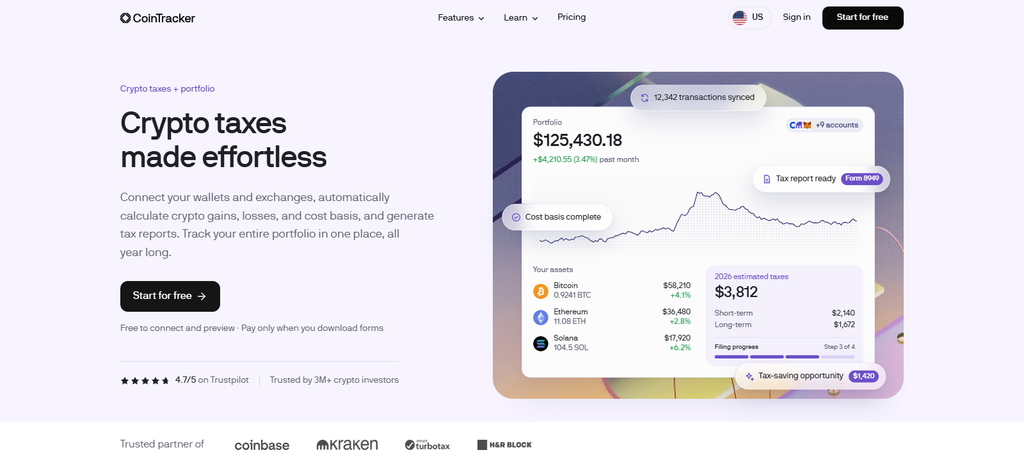
Paid plans begin with Base at $59/year, Prime at $199, and Ultra at $599, with higher transaction limits at higher tiers. Users can link supported wallets, exchanges and blockchain accounts to track balances, transaction history, cost basis and portfolio performance.
The higher-tier plans provide extra support for DeFi activity, staking rewards, liquidity pool transactions and cross-chain transfers. CoinTracker also has professional Full Service support so it is helpful for complicated investor records, but it is not a full business treasury management platform.
CoinTracker Key Features, Benefits & Cons
Main Features
- Monitor your crypto holdings across supported wallets, exchanges and blockchain accounts.
- Automatically imports and classifies transactions to help you manage your portfolio and taxes.
- Provides cost basis calculations, capital gains and P&L reports.
- Enables DeFi activities such as staking rewards, lending, borrowing and liquidity pool trades.
- Offers collaboration with tax professionals, tracking of portfolio performance and downloadable tax reports.
Benefits
- Integrates portfolio monitoring and tax reporting.
- Enables you to import transactions automatically.
-Detailed capital gains calculations - Collaborates with accountants and tax professionals
- Assists in detecting missing or incorrectly categorized transactions.
Cons
- Advanced tax features are only available on paid plans.
- limits on subscription transactions.
- DeFi transactions can be complicated and need manual fixes.
- Minimal corporate treasury management.
- Some integrations may not automatically import all transactions.
4. Koinly
Koinly was founded in 2019 and helps investors and accounting professionals track cryptocurrency portfolios, organize transactions and calculate taxes. It provides free portfolio tracking and allows users to preview tax calculations prior to purchase of a reporting plan.
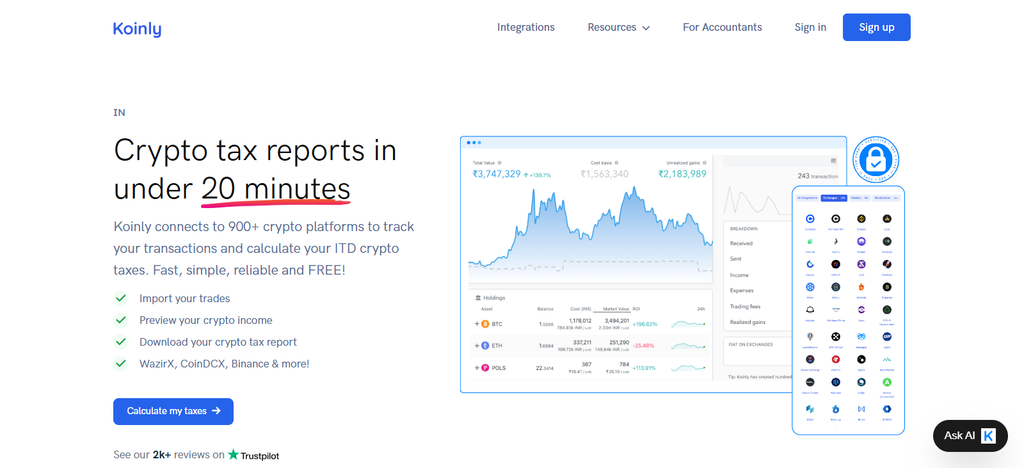
Paid pricing is based on the selected tax year and volume of transactions, not a standard monthly subscription. Koinly supports more than 800 exchanges, wallets and blockchains including crypto trades, transfers, DeFi activities and staking income.
Its reporting features include capital gains, income calculations, cost basis and country-specific tax reports. Organized transaction records can be used by accountants for client work, but other software may be required for businesses needing treasury dashboards, employee permissions, or consolidated entity management.
Koinly Key Features, Benefits & Cons
Key Features
- Connects cryptocurrency exchanges, wallets, and blockchain networks for portfolio tracking.
- Automatically imports transactions and matches transfers between connected wallets.
- Supports DeFi, NFT, staking, lending, mining, and airdrop transaction records.
- Calculates capital gains, cost basis, income, and cryptocurrency tax liabilities.
- Provides international tax reports, transaction editing, and accounting data exports.
Benefits
- Supports a broad range of exchanges and wallets.
- Offers useful automated transaction reconciliation.
- Provides tax reporting for multiple countries.
- Supports different cryptocurrency accounting methods.
- Includes free portfolio tracking and tax previews.
Cons
- Tax reports require paid subscriptions.
- Pricing increases with transaction volume.
- Some DeFi transactions need manual categorization.
- Complex transaction histories can require additional reconciliation.
- Dedicated business treasury features are limited.
5. Delta Investment Tracker
Delta Investment Tracker, launched in 2017, is designed to track multiple investment categories including cryptocurrencies, stocks, ETFs and other financial assets. It offers a free Basic plan, as well as paid PRO and PRO+ subscriptions.

Pricing varies depending on the subscription and location. Users can link supported wallets, exchanges, brokers and investment accounts to view portfolio balances and performance in a single dashboard. It also is useful for people that have a lot of different investments and are trying to keep an eye on everything they own, it combines crypto tracking with more general investment tracking.
Premium plans offer more analytics, asset capacity, portfolio management and investment insights. But its primary purpose is not business accounting, corporate treasury controls and multi-entity financial reporting.
Delta Investment Tracker Key Features, Benefits & Cons
Main Features
- Track cryptocurrency, stocks, ETFs and other investment assets on one dashboard.
- Provides performance monitoring and asset allocation analysis of your portfolio.
- Interacts with chosen exchanges, brokers and investment accounts.
Receive price alerts, watchlists, market information and investment alerts.
Paid subscriptions include advanced portfolio analytics and additional tracking features.
Benefits
- It supports many types of investments besides cryptocurrency.
- Provides a visually organized portfolio dashboard.
- Helps track diversified personal investments.
- Offers useful price alerts and market alerts.
- Available on mobile devices and supported platforms.
Cons
- It is not business accounting oriented.
- Some advanced features require a PRO subscription.
- Weak crypto tax reporting capabilities.
- Exchange and brokers integrations are different.
- DeFi tracking is less extensive than that of specialist platforms.
6. Kubera
Kubera is a net-worth and multi-asset portfolio tracker that brings together traditional investments, cryptocurrency, real estate, and private assets, all in one dashboard. Its standard Essentials subscription starts at $250 a year, while Kubera Black costs $2,500 a year and includes advanced ownership and multi-entity management features.

Users can link crypto exchanges and public wallet addresses to monitor monetary assets, DeFi positions, staking, and NFTs in addition to other investments. The platform provides portfolio performance analysis, cost basis, investment returns, and multi-currency reporting.
Kubera Black is especially relevant for complex wealth structures because it supports ownership tags, nested portfolios, trusts, and entities. It is read-only, so you can track holdings but not make transactions.
Kubera Key Features, Benefits & Cons
Main Features
- Keeps track of cryptocurrency, stocks, bank accounts, real estate and other financial assets.
- Helps keep portfolios organized with ownership tags and separate financial entities.
- Offers consolidated net-worth tracking and historical portfolio valuations.
- Supports integration with supported wallets and exchanges for tracking of crypto assets.
- Advanced multi-entity and ownership management with Kubera Black.
Benefits
- Combines traditional investments and cryptocurrency.
- Helps you keep track of both your personal wealth and business wealth.
- Allows complex ownership structures.
- Gives visibility into consolidated net-worth.
- Combines multiple asset classes into one dashboard.
Cons
- Subscription pricing is on the high side.
- There is no complete crypto currency tax engine.
- Some assets are priced by hand.
Business accounting functionality is not complete.
Advanced entity management requires a premium plan.
7. DeBank
Founded in 2019, DeBank focuses on monitoring on-chain cryptocurrency portfolios, decentralized finance positions and wallet activity. Its core portfolio tracking is free and does not require a standard paid subscription, but other services and advanced features might require separate access.
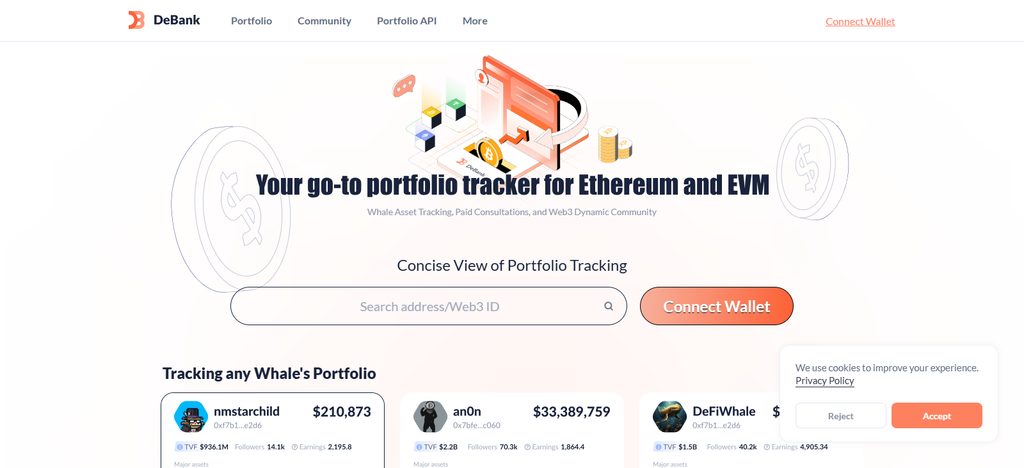
Users can enter public wallet addresses to view token balances, DeFi investments, protocol positions, transaction activity and NFT-related holdings across supported blockchain networks. Its wallet analytics allows investors to see asset allocation, capital flows and exposure to decentralized apps.
DeBank is mostly for individuals, Web3 investors and on-chain researchers. It is not a replacement for business accounting software or a complete corporate treasury management system.
DeBank Key Features, Benefits & Cons
Key Features
- Tracks cryptocurrency wallets and on-chain assets across supported blockchain networks.
- Monitors DeFi positions, lending protocols, liquidity pools, and staking activities.
- Provides wallet transaction histories and token balance information.
- Offers portfolio visibility across decentralized applications and blockchain ecosystems.
- Includes wallet analysis and Web3 social features for exploring on-chain activity.
Benefits
- Useful for monitoring DeFi investments.
- Provides detailed on-chain wallet information.
- Supports multiple blockchain ecosystems.
- Offers free access to core portfolio tracking.
- Helps investors analyze decentralized finance positions.
Cons
- Primarily focuses on on-chain cryptocurrency holdings.
- Centralized exchange integrations are limited.
- Traditional business accounting features are unavailable.
- Some tokens or protocol positions may display incomplete data.
- Less suitable for investors needing formal tax reports.
8. Zerion
Zerion was established in 2017 as a multi-chain crypto wallet and portfolio tracker for digital asset monitoring. Basic portfolio tracking is free, and you don’t have to pay a fee to see supported public wallet addresses.
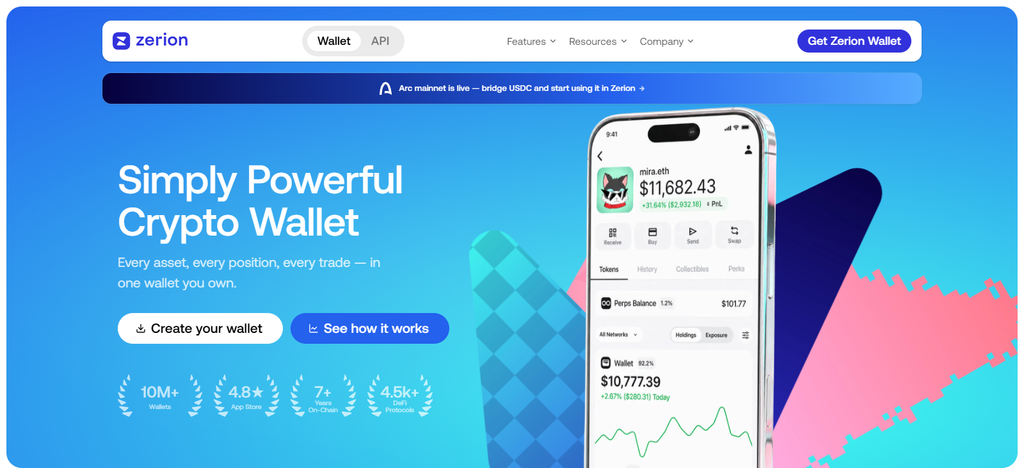
You can connect your wallet or enter public addresses to track cryptocurrency balances, transaction history, NFTs, staking positions and DeFi investments. Zerion supports 40+ networks and tracks thousands of DeFi protocols to offer consolidated portfolio visibility across disparate blockchain ecosystems.
It also offers an API for businesses and fintech developers to include blockchain portfolio information into their own apps. But its consumer tracker is primarily designed for on-chain asset visibility, not corporate accounting, tax filing or multi-entity bookkeeping.
Zerion Key Features, Benefits & Cons
Main Features
- Monitors multi-chain cryptocurrency portfolio using wallet addresses.
- Tracks your tokens, NFTs, staking positions and DeFi investments
- Supports multiple blockchains like Ethereum, Solana and other EVM ecosystems.
- It provides wallet transaction histories, portfolio valuations and asset allocation.
- Provides wallet connection, transaction visibility, and developer API capabilities.
Benefits
- Compatible with several blockchain networks.
- Has built-in DeFi and NFT tracking.
- Features a clean and user-friendly portfolio interface.
- Enables self-custody wallet management.
Basic portfolio monitoring is free and does not require a subscription.
Cons
- Lack of monitoring by centralized exchanges.
- Not a business accounting or tax reporting software.
- Some blockchain networks have limited capabilities.
- Complex portfolio reporting may require additional tools.
9. Rotki
Rotki was created in 2019 and is an open source cryptocurrency portfolio tracker with an emphasis on financial privacy, accounting and investment analytics. There is a free Starter plan, then paid subscriptions Supporter (€9 per month), Basic (€25) and Advanced (€45). Users can connect supported cryptocurrency exchanges and wallets to track balances, transaction history, blockchain activity and DeFi positions.
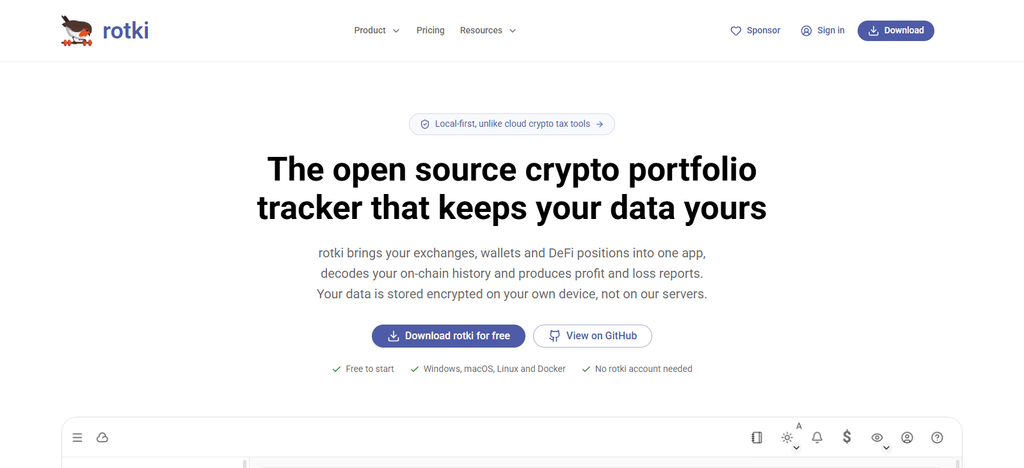
You can also calculate profit and loss, track assets and liabilities, view historical portfolio data and export CSV spreadsheets for further financial analysis. Visibility of blockchain and NFT transactions varies depending on integration supported. The encrypted, locally-stored financial data makes it a good fit for privacy-conscious investors but corporate multi-user accounting and centralized team management are limited.
Rotki Key Features, Benefits & Cons
Key Features
- Open source cryptocurrency portfolio tracking and financial accounting.
- Exchange connection, blockchain wallet and transaction import support.
- Monitors DeFi positions, staking activity and crypto balances.
- Calculates portfolio P&L, asset valuations and historical performance.
- Provides CSV exports, financial reports & encrypted portfolio data stored locally.
Benefits
- Gives you more control over your own financial data.
- Supports accounting and analysis of crypto transactions.
- Provides useful DeFi portfolio tracking.
- Includes a free plan for basic portfolio tracking.
Cons
- Technical knowledge may be required to use interface.
- Some integrations need to be manually set up.
- Paid subscriptions for advanced features.
- NFT tracking based on what integrations are supported.
- Few team collaboration and corporate management features.
10. Nansen Portfolio
Nansen Portfolio is part of Nansen, a blockchain analytics platform founded in 2020. It helps investors to track crypto holdings, on-chain transactions and portfolio performance across supported blockchain networks.
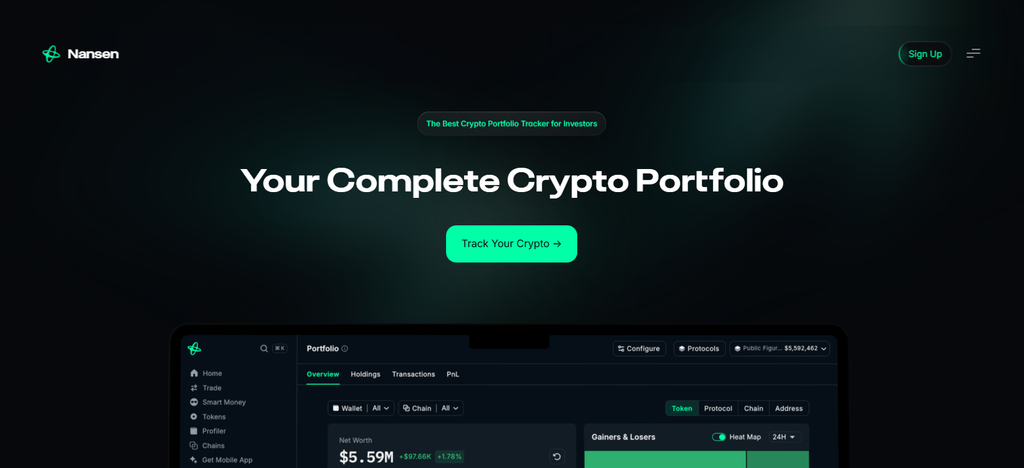
It has a portfolio product that offers basic portfolio tracking, and paid Nansen subscription plans that provide advanced analytics and research tools, with exact pricing varying depending on the tier chosen. Users can track wallet addresses, token balances, transaction history and portfolio profit and loss.
Its blockchain intelligence features offer further insight on Smart Money wallets, token activity and capital flows. Network and assets supported for NFT and DeFi visibility. It’s helpful for individual investors, funds and research teams, but shouldn’t be thought of as a complete corporate accounting solution.
Nansen Portfolio Key Features, Benefits & Cons
Key Features
- Provides on-chain portfolio valuations, transaction histories and asset allocation
- • It monitors cryptocurrency portfolios via the public blockchain wallet addresses it supports.
- insights.
- Features wallet tracking, blockchain intelligence and Smart Money analytics.
- To track DeFi activity, token movements and supported NFT holdings
- Offers additional blockchain research and wallet analysis for a fee through subscription plans.
Benefits
- integrated portfolio tracking and blockchain analytics.
- Gives useful insights of Smart Money wallet.
- Helps to identify investment activity on-chain.
- Allows portfolio tracking across multiple blockchain networks.
- Good for crypto investors and research teams.
Cons
- Subscription is behind advanced analytics.
- On-chain holdings are the main focus.
- Limited tracking of centralized exchanges
- It is not the best at business accounting and tax reporting.
- Beginner investors may feel overwhelmed by advanced research features.
Conclusion
The best crypto portfolio tracker for personal and business use depends on the size of your portfolio, wallet integrations, reporting needs and financial management needs.
Platforms like CoinTracking, CoinStats, CoinTracker and Koinly allow investors to track transactions, calculate profits and keep organized crypto tax records.
Kubera is more focused on wealth and multi-entity tracking, while DeBank, Zerion, Rotki and Nansen Portfolio are more focused on DeFi activity, blockchain analytics and on-chain holdings. Delta is useful to track different types of investments. Find the right solution by comparing pricing, security, NFT support, accounting features, personal vs business portfolio separation, and more for each platform.
FAQ
What is a crypto portfolio tracker?
A crypto portfolio tracker is a tool that monitors cryptocurrency investments across multiple wallets and exchanges. It helps users check asset balances, transaction history, portfolio performance, profits, losses, and investment allocation.
Can I separate personal and business crypto holdings?
Yes. Some portfolio trackers support multiple portfolios, account labels, ownership tags, or separate entities. CoinTracking and Kubera offer useful capabilities for organizing personal and business-related holdings.
Which crypto portfolio tracker is best for business use?
CoinTracking is worth considering for business transaction records, tax reporting, and multi-client management. Kubera is another option for monitoring complex ownership structures and multiple entities.
Do crypto portfolio trackers support DeFi and NFT tracking?
Yes. Platforms such as DeBank, Zerion, Nansen Portfolio, Rotki, and CoinStats provide DeFi or NFT tracking capabilities. Supported networks and available features differ between platforms.