





In this article, I will be discussing the Best Crypto Node Providers for developers and Web3 businesses. We will evaluate top platforms based on blockchain support, node infrastructure, RPC access, pricing, scalability, security, archive data, performance, and developer tools. This guide will assist you to understand the differences between each provider and which infrastructure features are appropriate for various blockchain applications and workloads.
What Is Crypto Node Providers?
Crypto node providers are infrastructure platforms that enable developers to access blockchain nodes in a managed way without having to set up, run and maintain node servers.
They usually provide RPC endpoints, APIs, full nodes, archive nodes, WebSockets, Webhooks and blockchain data services for networks like Ethereum, Bitcoin, Solana and Layer 2 chains. They handle infrastructure, synchronization, updates, monitoring, and scaling so that applications can more efficiently interact with blockchain networks.
Web3 applications like dApps, DeFi platforms, wallets, exchanges, gaming projects, and analytics platforms often use crypto node providers to ensure reliable blockchain connectivity.
Why Choose Crypto Node Providers
Faster Deployment – Managed node providers let developers connect applications to blockchain networks without spending a lot of time setting up and maintaining individual nodes.
Access to Multiple Chains – Many providers offer access to multiple blockchain networks through standardized RPC endpoints, enabling easier development and operation of multi-chain applications.
Scalable Infrastructure – As application traffic and blockchain activity increases, node providers can offer higher request capacity, dedicated resources, load balancing and scaling options.
Less Maintenance – Providers take care of the infrastructure operations like node syncing, updates, monitoring and hardware management, relieving dev teams from the operational burden.
Reliable RPC Access – Managed RPC endpoints are available for production applications, designed for reliable blockchain connectivity. Some providers offer redundancy and failover.
Historical Blockchain Data – Archive-node access can help developers retrieve historical states, transactions, logs, traces, and other blockchain data that are necessary for analytics and data-intensive applications.
Developer-Friendly APIs – Beyond basic node connectivity, additional APIs, WebSockets, Webhooks, SDKs, and indexed data services can ease the blockchain development process.
Enterprise Infrastructure – For larger or more demanding Web3 workloads, businesses may utilize dedicated nodes, higher limits, security controls, monitoring and customized infrastructure.
Key Points
| Crypto Node Provider | Key Point |
|---|---|
| Alchemy | Leading blockchain infrastructure platform offering RPC nodes, developer APIs, webhooks, transaction services, and support for 100+ blockchain networks. |
| QuickNode | Popular multi-chain node provider with support for 80+ chains, real-time Streams, WebSockets, archive data access, and enterprise-grade infrastructure. |
| Infura | Ethereum-focused node infrastructure provider from the Consensys ecosystem, widely used for RPC access, Web3 APIs, and Ethereum-based applications. |
| Ankr | Multi-chain RPC and node platform providing decentralized infrastructure, advanced APIs, staking services, and broad blockchain coverage. |
| Chainstack | Enterprise-ready node provider offering managed RPC endpoints, dedicated nodes, archive access, self-hosted deployments, and support for 70+ networks. |
| Blockdaemon | Institutional-grade blockchain infrastructure platform delivering node management, APIs, staking, custody integrations, and support for 70+ protocols. |
| GetBlock | Infrastructure platform offering shared and dedicated RPC nodes, archive access, compliance APIs, streams, and support for 130+ blockchains. |
| NOWNodes | Multi-chain blockchain API provider known for broad network coverage, shared nodes, dedicated node services, and Web3 infrastructure tools. |
| Helius | Solana-focused infrastructure provider delivering high-performance RPC nodes, indexing APIs, webhooks, and developer tools for Solana applications. |
| Chainnodes | Specialized RPC provider offering blockchain node access, archive data support, Ethereum infrastructure, and developer-friendly pricing models. |
1. Alchemy
Alchemy was founded in 2017 and is based in San Francisco, California. Alchemy provides managed blockchain infrastructure for developers and enterprises. It supports 100+ blockchain networks including Ethereum, Solana, Polygon, Arbitrum, Base, Optimism, BNB Smart Chain, Avalanche, Starknet and zkSync.
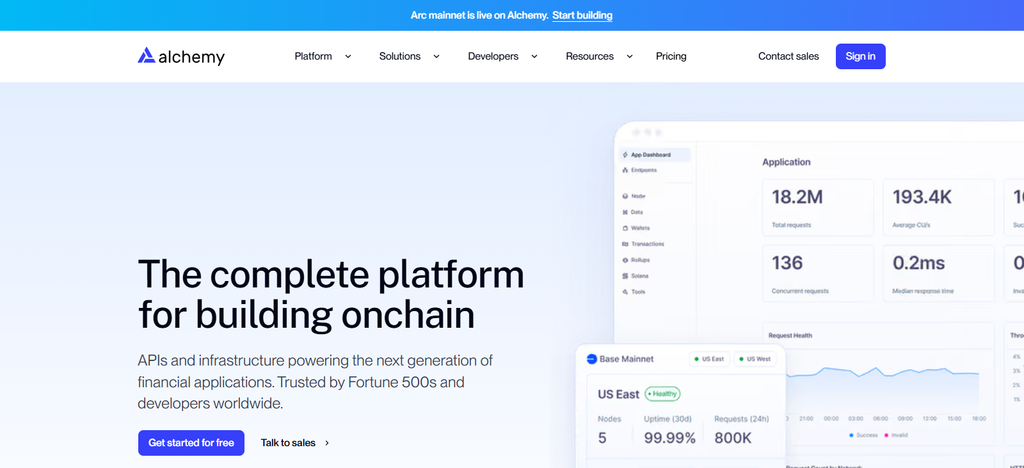
Its infrastructure has RPC nodes, full and archive data, WebSockets, enhanced APIs, transaction simulation, webhooks and developer SDKs. Alchemy’s Free tier offers 30 million Compute Units per month, Pay-As-You-Go starts at $0.525 per million CUs, and enterprise capacity is available for larger workloads. Scalable throughput and security controls support production apps; Full archive data.
Alchemy – Best For
- Multi-Chain dApps – Apps that need access to multiple blockchain networks through managed RPC infrastructure.
- DeFi Applications – DeFi platforms that require reliable RPC, transaction, token, NFT and blockchain data APIs.
NFT Platforms – NFT marketplaces and applications built on top of the indexed NFT and token data APIs.
AI & Web3 Apps – Developers creating AI agents and applications that require access to blockchain data and RPC. - Enterprise Projects – Production applications requiring scalable infrastructure, monitoring and enterprise capabilities.
| Feature | Details |
|---|---|
| Platform Type | Managed blockchain infrastructure and Web3 developer platform |
| Blockchain Coverage | 100+ supported blockchains, with EVM and non-EVM coverage |
| RPC Access | Standard JSON-RPC, chain-specific APIs and WebSockets |
| Node Infrastructure | Full nodes, archive infrastructure, dedicated clusters and specialized infrastructure |
| Data APIs | NFT, Token, Transfers, Prices, Portfolio and other indexed data APIs |
| Archive Data | Historical blockchain state and archive data available for supported networks |
| Real-Time Data | WebSockets and Webhooks for blocks, transactions, logs and wallet activity |
| Developer Tools | SDKs, APIs, CLI, dashboards and development tooling |
| Transaction Tools | Transaction simulation, tracing, debugging and gas-related functionality |
| AI Features | AI Agent Skills, MCP Server and AI-oriented blockchain development tools |
| Scaling | Dedicated clusters and scalable infrastructure for high-volume applications |
| Security | API keys, endpoint controls and enterprise infrastructure capabilities |
| Best For | dApps, wallets, DeFi, data applications and multi-chain developers |
2. QuickNode
Based in Miami, Florida, QuickNode was founded in 2017 and provides developers, startups and enterprises with managed blockchain infrastructure. Its platform supports 70+ blockchain networks including Ethereum, Bitcoin, Solana, Polygon, Arbitrum, Base, Avalanche, BNB Chain and many more newer networks.
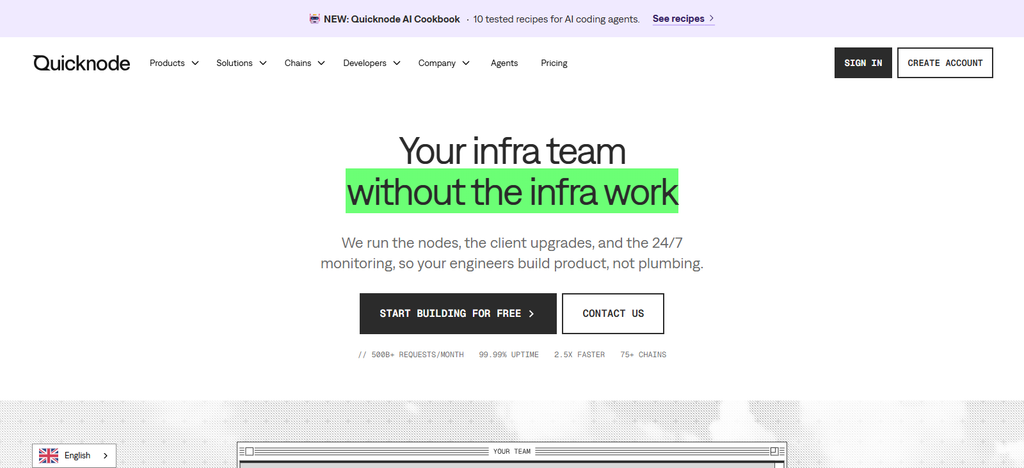
Infrastructure options are full nodes, archive nodes, RPC endpoints, WebSockets and data-streaming tools. QuickNode offers a free trial and paid plans. Flat Rate RPS model has fixed monthly prices for selected endpoints. archive availability is network-specific, so developers should check chain-specific historical-data support before deployment.
QuickNode Best For
- Multi Chain Development – Developers building on Ethereum, Solana, Polygon, Arbitrum, Base and beyond.
- High-Traffic dApps – dApps requiring scalable RPC infrastructure and high request capacity
DeFi & Trading – Projects that require fast access to the blockchain, broadcasting of transactions and real-time data.
Blockchain Data Streaming – Applications that need Streams, WebSockets, or other real-time blockchain data services. - Enterprise Infrastructure – For teams that need dedicated clusters and a more controlled production infrastructure.
| Feature | Details |
|---|---|
| Platform Type | Managed blockchain RPC and Web3 infrastructure platform |
| Blockchain Coverage | 75+ chains and 130+ networks according to its current infrastructure documentation |
| RPC Access | JSON-RPC, REST and WebSocket access |
| Node Infrastructure | Full nodes, archive nodes and dedicated private clusters |
| Archive Data | Full historical data on supported networks |
| Real-Time Data | Streams, WebSockets and Webhooks |
| Streaming | Blockchain Streams and gRPC options for supported networks |
| Dedicated Infrastructure | Private single-tenant Dedicated Clusters |
| Performance | Global edge infrastructure and low-latency RPC |
| Transaction Features | Transaction broadcasting and specialized transaction tools |
| Solana Features | Solana gRPC and specialized real-time infrastructure |
| Scaling | Dedicated clusters with high sustained and burst request capacity |
| Security | Endpoint authentication, enterprise security and compliance capabilities |
| Best For | High-volume dApps, DeFi, trading, analytics and multi-chain applications |
3. Infura
Infura was created in 2016 within ConsenSys to provide managed blockchain infrastructure and RPC access to Web3 applications. Its current platform supports 40+ networks on the Core plan, and its wider network portfolio includes Ethereum and several Layer 2 and other blockchain networks.
Infrastructure includes RPC endpoints, WebSockets, archive data, Gas API, Debug and Trace APIs and enterprise services. Infura’s Core plan is free with 3 million daily credits, Developer is $50 per month and Team is $225 per month. Higher throughput enterprise infrastructure and security controls support larger production applications.
Infura — Best For
- Web3 dApps – Projects that need managed RPC access without maintaining their own blockchain nodes.
- Ethereum Applications – Developers building applications which primarily interact with Ethereum infrastructure.
- Layer 2 Applications – Developers on supported Ethereum Layer 2 networks
- Wallet Infrastructure – Applications that require to connect to the blockchain and access transaction data.
Production Web3 Projects – Teams wanting mature managed infrastructure and scalable API access
| Feature | Details |
|---|---|
| Platform Type | Managed blockchain RPC and Web3 infrastructure |
| Blockchain Coverage | Multi-chain infrastructure covering Ethereum and numerous Layer 2 and other networks |
| RPC Access | JSON-RPC and WebSocket-based blockchain access |
| Node Infrastructure | Managed blockchain nodes and RPC endpoints |
| Archive Data | Archive requests are supported for applicable networks and currently use the documented RPC credit model |
| APIs | Blockchain RPC and developer-focused APIs |
| Data Access | Blocks, transactions, balances, smart-contract state and blockchain events |
| Developer Tools | Documentation, API access and development integrations |
| Pricing Model | Credit-based usage model with plan-specific allowances |
| Request Billing | RPC methods have different credit costs depending on network and method |
| Scaling | Higher usage is supported through paid and enterprise infrastructure |
| Security | Managed infrastructure and API authentication mechanisms |
| Best For | Ethereum developers, Web3 applications and teams requiring managed RPC infrastructure |
4. Ankr
Founded in 2017 Ankr builds blockchain infrastructure as RPC services, APIs, staking infrastructure and application-chain tools. The supported chains are Ethereum, Solana, BNB Smart Chain, Arbitrum, Base, Bitcoin, TRON, TON and Sui, with its documentation currently supporting 80+ chains.
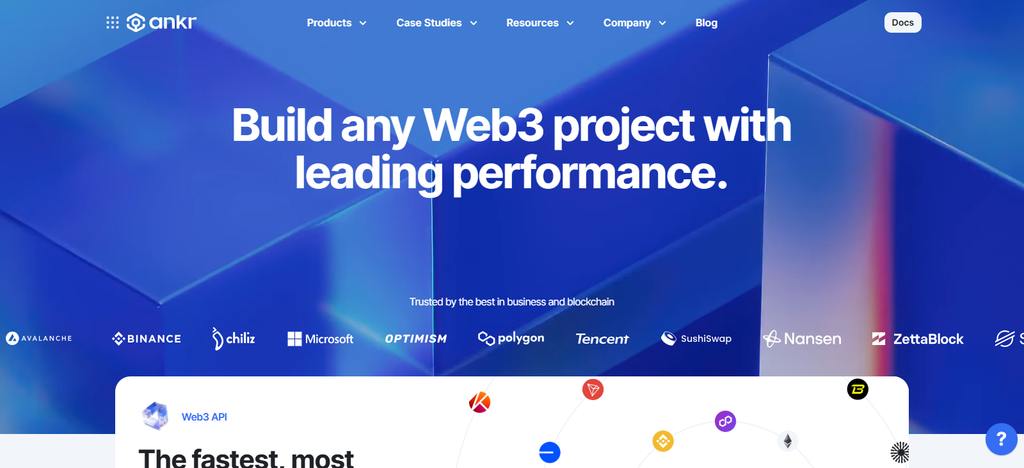
The Node API offers JSON-RPC and WebSocket access, and Advanced APIs offer indexed blockchain data for supported networks. Ankr offers public, freemium and premium service levels with Pay-As-You-Go pricing starting at 0.10 USD per one million API Credits. It supports full and archive data, global node coverage, IP/domain whitelisting, and premium traffic prioritization.
Ankr — Best For
- Multi-Chain dApps – Developers who require RPC access to a wide variety of blockchain networks.
- DeFi Projects – Applications that require blockchain RPC and structured blockchain data APIs.
- AI Agents – Developers creating AI apps that require a connection to a blockchain.
- Blockchain Data Applications – Projects that leverage token, NFT, transaction and other enhanced APIs.
- Web3 Startups – Teams requiring scalable RPC plans with public, freemium and premium infrastructure options.
| Feature | Details |
|---|---|
| Platform Type | Blockchain RPC, API, staking and Web3 infrastructure platform |
| Blockchain Coverage | 80+ chains |
| RPC Access | JSON-RPC and WebSockets |
| Node Infrastructure | Public RPC, premium endpoints and global node infrastructure |
| Archive Data | Full and archive data available across supported plans |
| Advanced APIs | Multichain NFT, token, transaction and query APIs |
| AI Infrastructure | Agentic RPC, MCP server and AI-oriented blockchain access |
| Developer Access | JavaScript/Python SDK support and API documentation |
| Security | Premium plans include IP, domain and smart-contract whitelisting |
| Scaling | Premium infrastructure with higher throughput and prioritized traffic |
| Pricing | Public, Freemium and Premium plans; PAYG and monthly Deal options |
| Specialized Features | Verifiable RPC, AppChains, staking and liquid-staking infrastructure |
| Best For | Multi-chain dApps, DeFi, AI agents and blockchain data applications |
5. Chainstack
Founded in 2017 and headquartered in Singapore, Chainstack provides managed blockchain nodes & RPC endpoints and infrastructure for developers and enterprises. It supports 70+ blockchain networks such as Ethereum, Solana, Polygon, BNB Smart Chain, Arbitrum, Base, Hyperliquid, Linea, Berachain and other ecosystems.
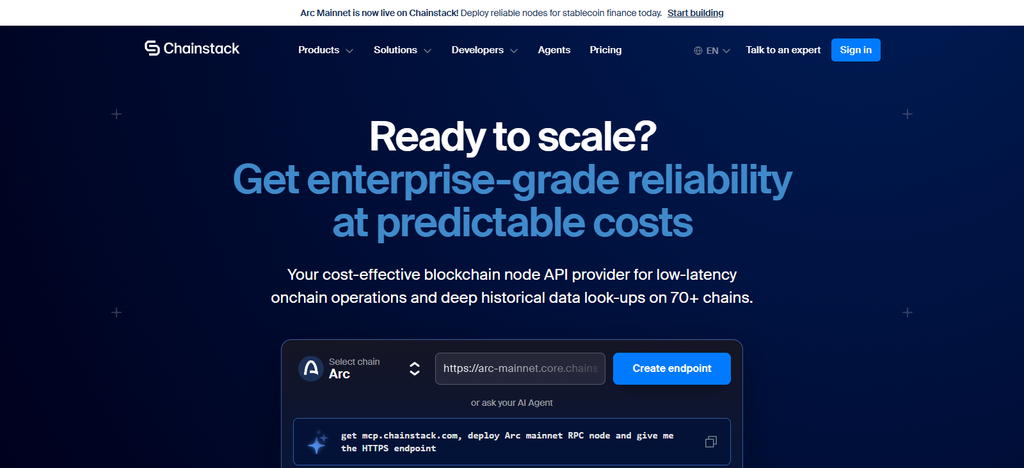
Developers are able to deploy regional, global, full and archive nodes with dedicated infrastructure for increased configuration and isolation. Chainstack’s Developer plan is free with 3 million Request Units monthly while Growth starts at $49/month, Pro at $199 and Business at $499. Security coverage includes ISO 27001, SOC 2 Type II.
Chainstack Best For
- Production dApps – Applications that need managed blockchain nodes and reliable RPC infrastructure.
- Enterprise Web3 – For organizations that require dedicated infrastructure, monitoring, security and scalability.
Archive Data Workloads – Analytics and applications that need to access historical blockchain state. - Multi Region Applications – Applications that can be deployed in multiple regions or globally.
- Infrastructure-focused Teams – Developers that want managed nodes, but more control over deployment and infrastructure.
| Feature | Details |
|---|---|
| Platform Type | Managed blockchain node and RPC infrastructure |
| Blockchain Coverage | 25+ protocols for managed node deployment, with broader network/API coverage |
| Node Types | Full nodes, archive nodes, global nodes and dedicated nodes |
| RPC Access | JSON-RPC and WebSocket support |
| Archive Data | Available from Growth plan and through dedicated/archive infrastructure |
| Dedicated Nodes | Dedicated infrastructure with isolated compute and storage |
| Global Infrastructure | Regional and global node deployment options |
| Monitoring | Node analytics, monitoring and operational alerts |
| Scaling | Cross-region, cross-cloud and dedicated infrastructure options |
| Pricing | Free Developer, $49 Growth, $199 Pro, $499 Business and Enterprise options |
| Security | SOC 2 Type II and ISO 27001 |
| Self-Hosted Option | Chainstack Self-Hosted with automated updates, monitoring and failover |
| Best For | Production dApps, analytics, enterprise workloads and teams needing dedicated nodes |
6. Blockdaemon
Founded in 2017, Blockdaemon is an enterprise blockchain infrastructure provider with a strong focus on institutional and production workloads. Its node infrastructure powers networks such as Ethereum, Bitcoin, Avalanche, Arbitrum, Base, Polkadot, Near, Optimism, Litecoin and more, with its published RPC portfolio spanning 23 blockchains.
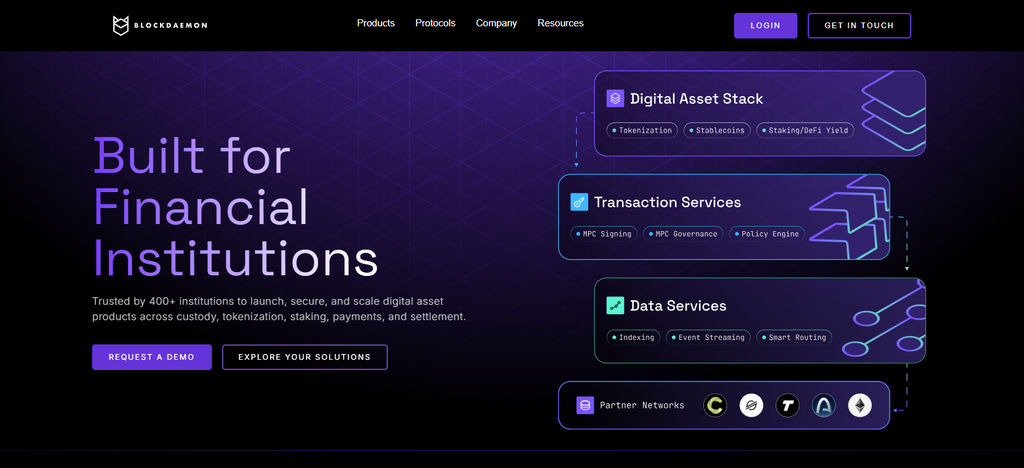
Customers can deploy dedicated nodes on cloud or bare-metal infrastructure across 70+ Points of Presence for more control over capacity and deployment. API offering includes a free tier with up to 3 million Compute Units monthly, and paid and enterprise pricing varies by requirements. Infrastructure security includes SOC 2 and ISO 27001 certification.
Blockdaemon — Best For
- Institutional Web3 – Financial institutions and businesses requiring enterprise blockchain infrastructure.
- Crypto Exchanges – Exchanges needing managed blockchain connectivity and production infrastructure.
- Staking Operations – Organizations operating validators and institutional staking infrastructure.
- Fintech Applications – Financial technology companies integrating blockchain networks into their products.
- Enterprise Blockchain – Large organizations requiring security-focused infrastructure and dedicated blockchain services.
| Feature | Details |
|---|---|
| Platform Type | Institutional blockchain infrastructure and node provider |
| Primary Focus | Enterprise, institutional and production-grade blockchain infrastructure |
| Node Infrastructure | Managed blockchain nodes, dedicated infrastructure and API services |
| Blockchain Coverage | Major networks including Ethereum, Bitcoin, Solana, Avalanche, Polygon and other ecosystems |
| RPC Access | Blockchain APIs and RPC infrastructure |
| Enterprise Infrastructure | Dedicated infrastructure and configurable production deployments |
| Staking | Institutional staking and validator infrastructure |
| Data Access | Blockchain data and transaction infrastructure |
| Scaling | Designed for enterprise-scale blockchain workloads |
| Security | Enterprise security and compliance-oriented infrastructure |
| Deployment | Cloud and dedicated infrastructure options |
| Developer Access | APIs and managed blockchain connectivity |
| Best For | Institutions, exchanges, fintech companies and enterprise Web3 applications |
7. GetBlock
GetBlock has been in business since 2019 and provides shared and dedicated blockchain infrastructure for developers, businesses and enterprises. The platform supports 130+ blockchains such as Ethereum, Solana, Bitcoin, BNB Chain, TRON, XRP Ledger, Polygon, Base, Cardano and NEAR. Infrastructure includes full nodes, archive nodes, JSON-RPC, WebSockets, gRPC, dedicated nodes and MEV-protected endpoints.
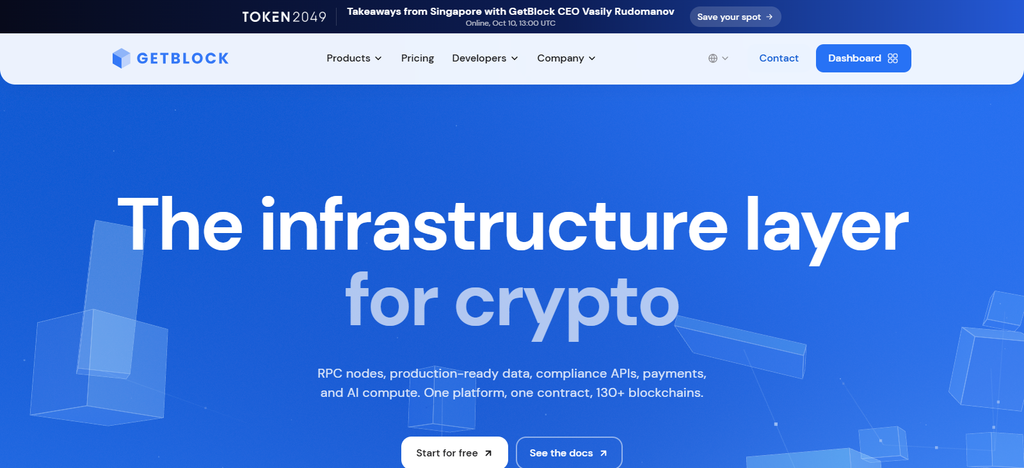
Pricing includes a free tier and paid shared infrastructure starts at $39 per month on annual billing with dedicated nodes available from higher custom configurations. GetBlock has reported SOC 2 Type II attestation in 2026. Archive data is available on selected networks.
GetBlock — Best For
- Multi-Chain Developers – Teams requiring access to a large selection of blockchain networks.
- Crypto Wallets – Wallet applications needing blockchain balances, transactions, and network connectivity.
- Exchange Platforms – Exchanges requiring managed node access across multiple supported networks.
- Blockchain Applications – dApps that need hosted full nodes and RPC endpoints.
- Data-Heavy Projects – Developers requiring archive or historical blockchain data on supported networks.
| Feature | Details |
|---|---|
| Platform Type | Blockchain node and RPC infrastructure provider |
| Blockchain Coverage | 130+ blockchain networks |
| Node Access | Full nodes and archive-node options on supported networks |
| RPC | JSON-RPC and blockchain-specific APIs |
| WebSockets | Available for supported networks and services |
| API Access | Blockchain data and node APIs |
| Dedicated Nodes | Dedicated infrastructure available for selected networks |
| Archive Data | Historical blockchain access available on supported networks |
| Pricing | Freemium and paid infrastructure plans |
| Developer Tools | API documentation, endpoints and blockchain access tools |
| Scaling | Shared infrastructure plus dedicated options |
| Network Variety | Ethereum, Bitcoin, Solana, BNB Chain, TRON, Polygon and many others |
| Best For | Multi-chain developers, dApps, wallets, exchanges and blockchain data applications |
8. NOWNodes
NOWNodes offers blockchain-as-a-service infrastructure, with access to 100+ blockchain full nodes and Blockbook-powered blockchain explorers via APIs. It supports major ecosystems including Bitcoin, Ethereum, BNB Chain, Arbitrum, Avalanche, Base, Polkadot and other networks.
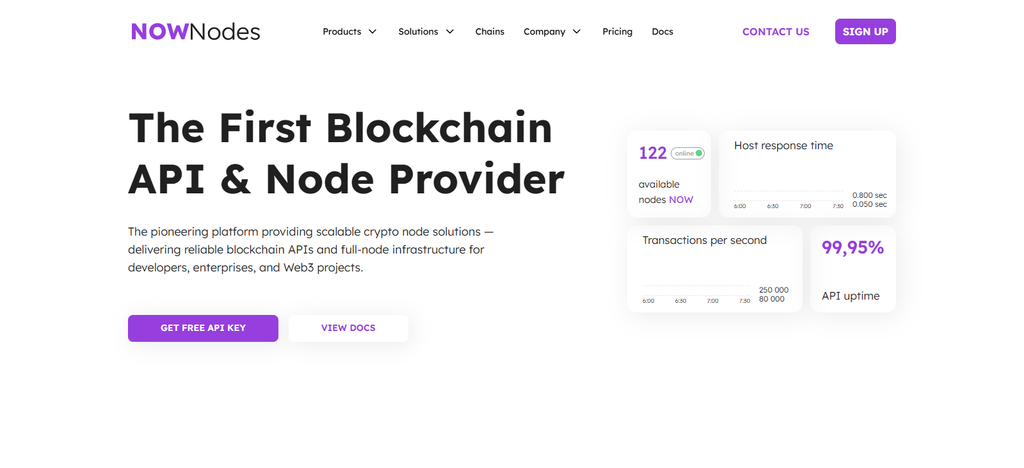
The platform offers full-node access, WebSockets and indexed Blockbook APIs for balance and transaction queries. NOWNodes offers subscription-based pricing with shared plans and dedicated-node options for more extensive requirements.
It’s an infrastructure for developers who want managed node access and don’t want to run their own servers. Dedicated nodes can be configured for specific networks and regional needs.
NOWNodes — Best For
- Crypto Wallets – Wallet providers needing access to multiple blockchain full nodes through APIs.
- Crypto Exchanges – Platforms requiring managed infrastructure for transaction and blockchain data access.
- Payment Applications – Businesses integrating blockchain transactions into payment workflows.
- Multi-Chain Applications – Projects needing hosted access to numerous blockchain networks.
- Blockchain Startups – Smaller teams that want managed nodes without building and maintaining their own infrastructure.
| Feature | Details |
|---|---|
| Platform Type | Blockchain-as-a-Service and hosted full-node provider |
| Blockchain Coverage | 100+ blockchain full nodes |
| Node Infrastructure | Hosted full nodes and blockchain infrastructure |
| API Access | Blockchain APIs and Blockbook Explorer APIs |
| RPC Access | RPC connectivity for supported networks |
| Historical Data | Blockbook-based access provides indexed blockchain information |
| WebSockets | Available for selected supported services |
| Pricing | Freemium and paid subscription options |
| Dedicated Infrastructure | Dedicated-node options for selected networks |
| Monitoring | API and node availability monitoring |
| Uptime | Provider reports 99.95% API uptime |
| Network Coverage | Bitcoin, Ethereum, BNB Chain, Polygon, Avalanche, Arbitrum, Base and others |
| Best For | Wallets, exchanges, blockchain applications and developers needing many hosted nodes |
9. Helius
Helius is predominantly focused on Solana infrastructure, which is what differentiates it from multi-chain providers. The platform provides developers with Solana RPC access, improved APIs, WebSockets, LaserStream streaming, transaction delivery and blockchain data services.
Pricing varies from 1 million credits per month on a free Developer plan to Business for $49, Professional for $499, Enterprise for $999, and custom enterprise pricing. RPC scaling varies from 10 RPS on the free plan to 500 RPS on Professional, with increased capacity for enterprise customers.
Helius also provides archival data, webhooks, transaction subscriptions and dedicated infrastructure, supporting high-volume Solana apps and specialized data workloads.
Helius – Best For
- High-Throughput Apps – Applications that need scalable Solana RPC and streaming infrastructure.
- Solana dApps – Developers building applications on the Solana blockchain.
- DeFi & Trading – Projects that require fast Solana RPC and real-time blockchain data.
- Solana Analytics – Apps that process structured transaction, account, and program data.
- Real-Time Web3 Apps – For developers needing WebSockets, Webhooks, transaction subscriptions and streaming.
| Feature | Details |
|---|---|
| Platform Type | Solana-focused blockchain infrastructure platform |
| Primary Blockchain | Solana |
| RPC Infrastructure | High-performance Solana RPC |
| Data APIs | Enhanced APIs for structured Solana blockchain data |
| Real-Time Data | WebSockets, LaserStream and transaction subscriptions |
| Webhooks | Event-driven Solana transaction and account notifications |
| Streaming | High-throughput real-time Solana data streaming |
| Archive/Historical Data | Historical Solana data and specialized data-access capabilities |
| Developer Tools | APIs, SDK-oriented tooling and developer documentation |
| Scaling | Higher RPS plans and enterprise infrastructure |
| Use Cases | DeFi, trading, wallets, analytics, payments and Solana applications |
| Security | API-key and endpoint controls with production infrastructure |
| Best For | Solana developers requiring specialized RPC and real-time data |
10.Chainnodes
Chainnodes provides blockchain node infrastructure with a focus on low latency RPC access, archival data and developer APIs. It supports networks like Ethereum, Optimism, Polygon, Arbitrum, BNB Chain, Gnosis, Base and Solana and more. Features including archive nodes, WebSocket connections, Debug and Trace APIs, validator-as-a-service, liquid staking, and custom protocol hosting.
The provider describes globally distributed infrastructure to handle high volumes of requests. Its node services are offered on a freemium basis with scalable infrastructure and dedicated capabilities available for larger workloads.
Archive access is especially relevant for analytics, historical blockchain queries and applications requiring more granular chain-state data.
Chainnodes — Best For
- Low-Latency dApps – Applications requiring fast RPC responses to interact with the blockchain.
Archive Data Applications – Projects which need analytics and research access to historical blockchain state. - Ethereum Ecosystem Projects – Developers building on Ethereum and supported Layer 2 networks.
- Staking Infrastructure – Teams seeking validator, staking, or other blockchain infrastructure.
- Advanced Blockchain Developers – Projects involving WebSockets, Debug APIs, Trace APIs or custom protocol hosting
| Feature | Details |
|---|---|
| Platform Type | Blockchain RPC and node infrastructure provider |
| Blockchain Coverage | Ethereum, Optimism, Polygon, Arbitrum, BNB Chain, Gnosis, Base, Solana and other supported networks |
| RPC Access | Low-latency blockchain RPC endpoints |
| Node Infrastructure | Full and archival node infrastructure |
| Archive Data | Archival nodes for historical blockchain-state queries |
| WebSockets | WebSocket connections for real-time blockchain data |
| Debug & Trace | Debug and Trace APIs for supported networks |
| Validator Infrastructure | Validator-as-a-Service and solo staking infrastructure |
| Staking | Liquid staking and validator-related services |
| Custom Hosting | Custom protocol hosting |
| Scaling | Globally distributed infrastructure designed for high request volumes |
| Pricing | Freemium model with paid infrastructure options |
| Best For | dApps, analytics, staking, historical-data applications and developers needing specialized RPC features |
How Much Do Crypto Node Providers Cost?
Crypto node provider pricing is based on coverage of the blockchain, RPC requests, compute usage, type of node, archive data, performance and infrastructure requirements. Most providers provide a free tier with a limited number of requests or monthly credits for testing and small applications.
Paid plans can be subscription, pay-as-you-go, credits or based on the number of requests. Generally, shared RPC services are cheaper than dedicated or archive nodes that need more computing and storage resources.
Enterprise customers may be offered custom pricing based on throughput, dedicated capacity, geographic deployment, support, security requirements and service-level agreements. Premium APIs, historical data, WebSockets, data streaming and higher rate limits may also be subject to additional charges.
Conclusion
Who will be the best crypto node provider in 2026? The answer depends on the blockchain coverage, RPC performance, pricing, scalability, archive data, security, and the developer’s requirements. Alchemy, QuickNode, Infura, Ankr, Chainstack, Blockdaemon, GetBlock, NOWNodes, Helius, Chainnodes provide various infrastructure models for web3 apps.
Multi-chain developers might like the extensive network support, while Solana-focused projects may need specific infrastructure like Helius. Archive access, dedicated nodes, API limits, monitoring and enterprise capacity can also influence the final decision.
Before choosing a provider, compare supported networks, pricing structures, performance capabilities, historical-data access, security features and scaling options to your project’s specific workload.
FAQ
What are crypto node providers?
Crypto node providers offer managed blockchain infrastructure that lets developers access blockchain networks through RPC endpoints, APIs, full nodes, archive nodes, and related data services without maintaining all node infrastructure themselves.
Which blockchain networks do crypto node providers support?
Network coverage varies by provider. Commonly supported networks include Ethereum, Bitcoin, Solana, Polygon, Arbitrum, Base, Optimism, BNB Chain, Avalanche, and other Layer 1 and Layer 2 networks.
What is an archive node?
An archive node stores extensive historical blockchain state and data, allowing applications to perform deeper historical queries. It is commonly used for blockchain analytics, explorers, indexing, research, and data-heavy applications.
How much do crypto node providers cost?
Pricing varies significantly. Some providers offer free tiers or monthly credits, while paid services may use subscription, request-based, compute-unit, or custom enterprise pricing. Dedicated nodes generally cost more.