




The following article examines the best Financial Infrastructure APIs for Crypto and the bridges that link traditional finance and blockchain technology. These APIs provide essential services in the domains of custody, payments, compliance, and scalability and, therefore, are required by crypto exchanges, fintechs, and Web3 developers.
We will look at Plaid, Fireblocks, Circle, MoonPay, Anchorage Digital, Copper, Chainalysis, and Alchemy to determine how their technologies support global crypto adoption and crypto infrastructure with regulatory certainty and trust, as well as secure and scalable crypto ecosystems.
What Are Financial Infrastructure APIs for Crypto?
Financial infrastructure APIs are essential for crypto. Using those APIs, crypto businesses can connect their applications routing money, banking services, custody, trading, compliance, game elements, digital and physical assets, digital cash on and off ramps, and more. Building such systems anew would be long and expensive.
Labor and business hassle saving automation is useful for cryptocurrency exchanges, cryptocurrency wallets, fintech firms and web 3.0 services. With the intention of building at scale, APIs replace code and simplify the complexity of digital financial operations more quickly and less expensively. Financial infrastructure APIs create the building blocks for scalable crypto products for the future.
Why Choose Financial Infrastructure APIs for Crypto
Faster Product Development
APIs decrease the work needed to develop the banking, payment, and compliance systems, as well as wallets, amongst other services.
Easy Crypto-FIAT Integration
The Financial infrastructure APIs can connect crypto applications with payments, bank accounts and other services that convert crypto into fiat currency.
Stablecoin Payment Support
When stablecoins start to become more instrumental in payments and settlements, companies can use APIs to build the capability for stablecoins payments, as well as the support for the conversion of stablecoins.
Global Payments
Financial Infra APIs can assist crypto organizations with payment capabilities and settlement for different currencies in global markets.
Built In Compliance Infrastructure
Financial Infra APIs usually include AML screening, KYC, KYB, Sanctions checking APIs, amongst others, which can simplify compliance for crypto companies.
Improved Developer Experience
Financial Infra APIs make it easy for developers to use the product by standardizing a lot of the work through prebuilt endpoints, webhooks, and documentation.
Scalable Financial Infra
Most financial Infra APIs can manage increased transaction volumes and new financial products, meaning the businesses using the APIs do not have to build their own replicable infra.
Multi-Chain Support
Multi-chain support allows crypto companies to add flexibility to their infrastructure by allowing them to operate across multiple blockchain networks. APIs help abstract the complexity of managing different chains, tokens, and transaction flow.
Benefits Of Financial Infrastructure APIs for Crypto
Rapid Product Development: APIs allow crypto related companies to build banking, payment, custody, trading, and compliance services with very little development.
Reduction in Infrastructure Costs: A company can completely remove the need to build an overly complex financial service by outsourcing to a third party and reduce costs of development and maintenance, as well as operations.
Simple Integration Between Fiat and Crypto: Financial Infrastructure APIs connect crypto based businesses with payment rails in various forms (i.e. bank transfers, card payments), accounts, deposits, and withdrawals.
Improved Compliance: Integration of APIs for KYC, KYB, AML, and transaction monitoring and screening of sanctions can facilitate the necessary regulatory compliance.
Increased Scalability: Financial Infrastructure based on APIs facilitates the increased vertical and horizontal scalability of a business’ operations.
Increased Geographical Scalability: APIs allow businesses to expand operations to new payment methods, currencies, financial offerings, and geographic regions.
Improved User Experience: Services integrated with APIs allow a business to conduct both financial and non-financial related activities without leaving an application.
Real Time Data: APIs provide a seamless and real time flow of financial data.
Enhanced Data Security: Outsourcing to third party service providers allows companies to avoid the costly burden of developing infrastructures themselves.
Financial Automation: APIs facilitate the automation of payments, settlements, reporting, and transaction monitoring.
Key Points
| Platform | Key Features |
|---|---|
| Plaid | Open banking, instant KYC, account linking |
| Fireblocks | Secure MPC wallets, institutional transfers |
| Circle | USDC issuance, programmable payments |
| Wyre | On/off ramps, compliance APIs |
| MoonPay | Fiat‑to‑crypto APIs, NFT checkout |
| Anchorage Digital | SEC‑qualified custodian, APIs for funds |
| Prime Trust | KYC/AML APIs, escrow services |
| Copper | Secure custody, DeFi connectivity |
| Chainalysis | AML/KYC APIs, blockchain analytics |
| Alchemy | NFT minting, smart contract integration |
1. Plaid
Plaid was founded in 2013 as a fintech infrastructure provider which connects financial apps and services with financial institutions. The pricing model is somewhat moderate as API usage attracts a fee. Plaid offers enterprise contracts. Currently, Plaid does not support blockchain networks directly, but offers integrations through its crypto partners to facilitate fiat-to-crypto transactions.
Plaid operates in the U.S., Canada, and the U.K. and the EU. Indirect crypto support is offered through services for KYC and crypto exchange bank account verification. Plaid has strong compliance services and infra-structures with built-in AML/ KYC offerings; it support MSB registration in the U.S. and is PSD2 aligned in the EU. Plaid continues to be the backbone of many fintech and crypto onboarding processes.
Plaid Characteristics
- Started in 2013
- Uses API pricing based on usage, has enterprise contracts
- Focused primarily on bank APIs, has limited direct blockchain support
- Active in the US, Canada, UK and EU
- Indirect crypto support via partners
- Can support 100M+ accounts and 8,000+ applications
- Strong compliance: PSD2, MSB registration, AML/KYC tools
| Pros | Cons |
|---|---|
| Strong fintech API integration | Limited direct blockchain support |
| Scales to 100M+ accounts | Enterprise pricing can be opaque |
| PSD2 and MSB compliance | Crypto support only via partners |
| Widely adopted by fintech apps | Regional focus (US/EU heavy) |
2. Fireblocks
Established in 2018, Fireblocks provides custody and transfer services for digital assets. Although pricing is largely opaque and is more cost efficient for large organizations, its reach is extensive, supporting access to over 150 blockchains for institutional crypto operations. Fireblocks provides its services in over 100 countries and works with banks, exchanges, and fintechs. Fireblocks also offers crypto-related services like custody,
transfers, tokenization, and settlement. The platform has processed over 550 million wallets with a total value of $6 trillion. Fireblocks’ compliance infractructure includes SOC 2 certification, DORA readiness, and innovative custody technology. Fireblocks has established itself as a leader in the crypto space with scalable, secure, and compliant solutions for institutions.
Fireblocks Characteristics
- Started in 2018
- Priced on the enterprise level, expensive for small businesses
- Supports 150+ blockchains
- Active in more than 100 countries
- Crypto custody, transfers, and tokenization
- 550M+ wallets, $6T+ transacted
- SOC 2, DORA compliance, MPC custody
| Pros | Cons |
|---|---|
| Supports 150+ blockchains | Expensive for small firms |
| $6T+ processed securely | Pricing transparency limited |
| Advanced MPC custody | Complex enterprise contracts |
| SOC 2, DORA compliant | Focused mainly on institutions |
3. Circle
Starting in 2013, Circle achieved industry recognition for USDC and EURC stablecoins. Circle earns accolades for its pricing models. Reporting and reserve attestations occur monthly. Scalability is high with over 20 blockchains. Circle operates on the Ethereum, Solana, and Avalanche blockchains. It offers its services in more than 185 countries, which is greater than most other fintech companies.
Circle’s services use a variety of stablecoins like USDC, EURC, and USYC for DeFi and payments. Circle leads its industry in transacting stablecoins as it processes a peak of $73.7B. In terms of digital currency compliance, Circle processed MiCA, the BitLicense in New York, and approval for services in other jurisdictions. Circle has built competitive compliance for transparent and respected issuance of stablecoins.
Circle Characteristics
- Started in 2013
- Has transparent reserve reporting and monthly attestations
- Supports 20+ blockchains (Ethereum, Solana, Avalanche)
- Operates in 185+ countries
- Has stablecoins (USDC, EURC, USYC)
- Circualted over $73.7B of USDC
- Compliant with MiCA, BitLicense, global approvals
| Pros | Cons |
|---|---|
| Transparent reserves & audits | Dependent on regulatory approvals |
| USDC/EURC on 20+ blockchains | Stablecoin competition (USDT) |
| Operates in 185+ countries | Limited product diversity beyond stablecoins |
| MiCA, BitLicense compliant | Market volatility impacts adoption |
4. Wyre
Wyre was a fiat-to-crypto payments interface started in 2013. Transparency with pricing was moderate in that the 0.75% transaction fee was bundled with API-based billing. Wyre facilitated cross border payments using Bitcoin, Ethereum, and fiat rail. Wyre offered services in the US, EU, and Asia and as of 2023, no longer operated.
Wyre offered fiat to crypto API, wallets, and liquidity services and scaled to offer $10B+ in transactions. Wyre also built compliance infrastructure MSB licenses, AML/KYC, and regulatory registries. Wyre faced both liquidity and regulatory issues, and closed. It’s a great case study to see how payments evolved.
Wyre Characteristics
- Started in 2013
- Charges ~0.75% per transaction
- Supported Bitcoin, Ethereum, and fiat rails
- Operated in US, EU, Asia (before shutdown)
- Fiat-to-crypto APIs and wallets
- Processed more than $10B
- Has MSB licenses and AML/KYC (shut down in 2023)
| Pros | Cons |
|---|---|
| Fiat‑to‑crypto APIs | Shut down in 2023 |
| Supported Bitcoin & Ethereum | Liquidity challenges |
| $10B+ processed | Limited blockchain coverage |
| MSB licenses & AML/KYC | Regional restrictions |
5. MoonPay
Established in 2019, MoonPay is an on and off-ramp payment solution for cryptocurrency and NFTs. Pricing includes clearly visible checkout fees. MoonPay supports over 170 cryptocurrencies and has native infrastructure for cross-blockchain transactions. They are in 160+ countries, making them one of the most globally accessible payment processors for cryptocurrency.
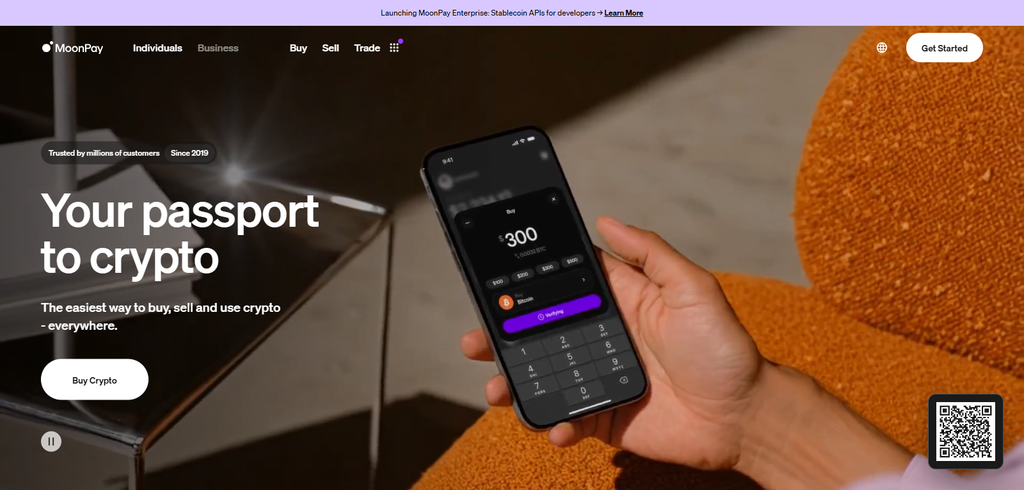
MoonPay supports fiat-to-crypto transactions, NFT checkout, and integrates crypto wallets. Highly-scalable with 30M+ customers and $8B+ insights processed. Compliance includes MSB licenses in the U.S, MiCA in Europe, and other jurisdictions. MoonPay is one of the first mainstream providers to help users transact cryptocurrency in and out of Web3.
MoonPay Characteristics
- Started in 2019
- Has transparent checkout fees
- Supports 170+ crypto assets
- Operates in 160+ countries
- Supports fiat-to-crypto and NFT payments
- Has more than 30M users and more than $8B in transactions
- Is an MSB in the US, MiCA‑aligned, global licenses
| Pros | Cons |
|---|---|
| Transparent checkout fees | High transaction costs for users |
| Supports 170+ crypto assets | Limited institutional focus |
| Operates in 160+ countries | Regulatory hurdles in some regions |
| NFT & fiat‑to‑crypto support | Reliant on third‑party wallets |
6. Anchorage Digital
Anchorage Digital was one of the first companies to provide crypto custody and staking. Despite some competitive offerings in pricing transparency, Anchorage prefers contract-based enterprise pricing. It allows custody, staking, and trading for multiple blockchains.
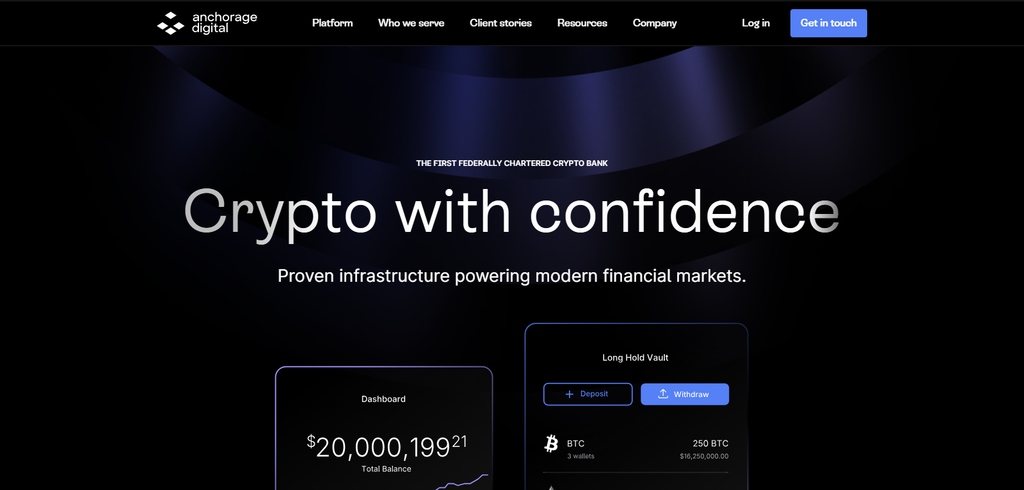
Anchorage Digital has a leading industry presence across the U.S, Singapore, and the EU providing custody to major cryptocurrencies for institutional clients. Anchorage Digital has a proven record of supporting tens of billions of USD worth of digital assets for custody.
The company’s compliance infrastructure is advanced with an OCC charter and BitLicense along with MAS regulation in other countries. Anchorage Digital is an industry leader by combining the key elements for a successful regulated digital asset bank.
Anchorage Digital Characteristics
- Founded 2017
- Enterprise Contract Based Pricing
- Multi Chain Custody Staking
- U.S., Singapore, Europe
- Custody, Staking, Trading
- Tens of billions in assets under custody
- OCC charter, BitLicense, MAS license
| Pros | Cons |
|---|---|
| OCC chartered crypto bank | Pricing not public |
| Custody, staking, trading | Limited retail access |
| Multi‑chain support | Enterprise‑only contracts |
| Strong compliance (US, EU, Singapore) | Narrow geographic footprint |
7. Prime Trust
Prime Trust launched in 2016 to offer crypto custody and payments services out of the United States. Prime Trust offered subscription and transaction-based pricing. Prime Trust offered custody for Bitcoin, Ethereum, and all ERC-20 tokens. Prime Trust’s primary customer base was in the US and consisted of fintech and crypto exchanges.

Prime Trust offered crypto services that included custody, payments, and API offerings. Prime Trust scaled to support 250M+ API calls monthly. Prime Trust’s infrastructure consisted of a Nevada trust charter, AML/KYC frameworks and compliance, and oversight by various agencies. Prime Trust’s strong infrastructure was unable to solve their liquidity and compliance issues and they were forced to file for bankruptcy in 2023.
Prime Trust Characteristics
- Founded in 2016
- Subscription + transaction fees
- Custody for BTC, ETH, ERC‑20 tokens
- US‑focused operations
- Custody, payments, API integrations
- 250M+ API calls monthly
- Nevada trust charter, AML/KYC (bankrupt 2023)
| Pros | Cons |
|---|---|
| Custody for BTC, ETH, ERC‑20 | Bankrupt in 2023 |
| Nevada trust charter | Liquidity & compliance failures |
| 250M+ API calls monthly | US‑only focus |
| Payments & API integrations | Limited blockchain expansion |
8. Copper
Copper was founded 2018 and provides institutional crypto custody and settlement services. Some prices are not disclosed and bespoke enterprise contracts are not public. It is able to provide custody services for 60+ blockchains and thereby offer even more coverage for institutional holdings.
Copper runs its services in the US, the EU, APAC, and the UAE. Crypto services offered include custody, staking, and DeFi. Scalability is impressive as they handle $50B+ in monthly transactions.
For compliance, they have SOC 2 and ISO 27001 certification, as well as state-of-the-art MPC custody. Given the fact that they provide the most secure, compliant, and scalable crypto services, Copper has easily achieved status as a leader in institutional crypto.
Copper Characteristics
- Founded in 2018
- Bespoke enterprise pricing
- Supports 60+ blockchains
- Global presence: US, EU, APAC, UAE
- Custody, staking, DeFi integrations
- $50B+ monthly volumes processed
- SOC 2, ISO 27001, MPC custody
| Pros | Cons |
|---|---|
| Supports 60+ blockchains | Bespoke pricing, not transparent |
| $50B+ monthly volumes | Enterprise‑only focus |
| Custody, staking, DeFi | Complex onboarding |
| SOC 2, ISO 27001 compliant | Limited retail accessibility |
9. Chainalysis
Chainalysis was founded in 2014 to bring blockchain analytics and compliance to market. Pricing is opaque due to the custom nature of enterprise contracts for regulators and institutions. Chainalysis supports over 100 blockchains with a forensic accounting and compliance tool offering.
Chainalysis is active in over 70 countries with a customer base comprised of regulators, exchanges, and law enforcement. Crypto support provides a suite of compliance, analytics and forensic services. Scalability is 2,000+ customers worldwide.
The compliance infrastructure also includes support for the FATF Travel Rule and AML/KYC frameworks, along with forensic services. As a foundation of crypto compliance, Chainalysis has created a degree of transparency and trust in the blockchain ecosystem.
Chainalysis Characteristics
- Founded in 2014
- Enterprise contracts, opaque pricing
- Supports 100+ blockchains
- Operates in 70+ countries
- Compliance, analytics, forensic tools
- 2,000+ institutional clients
- FATF Travel Rule, AML/KYC, forensic standards
| Pros | Cons |
|---|---|
| Supports 100+ blockchains | Pricing opaque |
| 2,000+ institutional clients | Enterprise‑focused only |
| FATF Travel Rule compliance | No direct crypto custody |
| Global regulator adoption | High cost for smaller firms |
10. Alchemy
Alchemy was created in 2017 to provide developer tools for Web3. The API pricing provided by Alchemy is clear and based on compute units. They support 100+ blockchains like Ethereum, Polygon, and Solana.
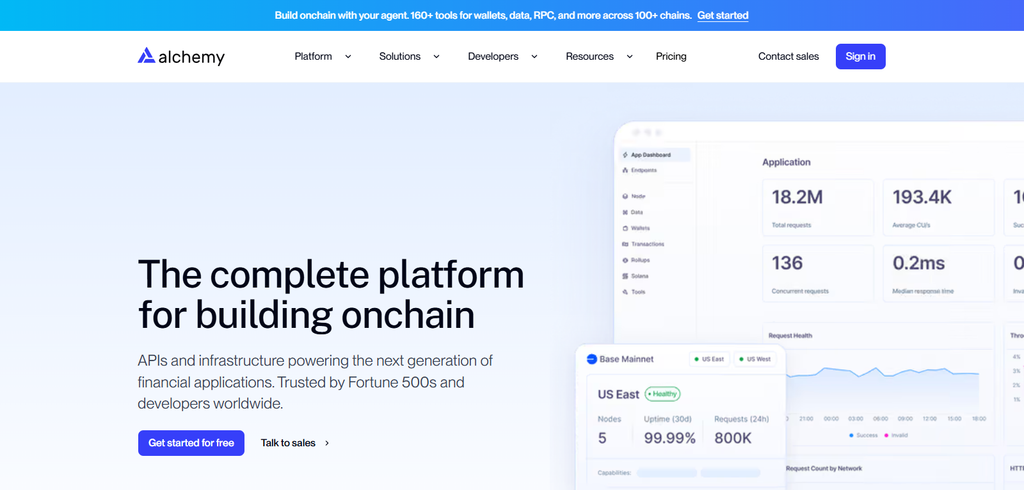
Alchemy works in over 260 countries. Alchemy has no direct custody of crypto. Traditionally, Alchemy provides tools to help build applications and protocols in the blockchain. Their prime products support scaling.
Alchemy supports over $ 4.2 trillion worth of transactions every year. Their compliance infrastructure includes SOC 2 certification, ISO 27001, and enterprise-grade security. For a company built for web3 development, Alchemy provides scalable, compliant, and transparent developer tools for blockchain infrastructure.
Alchemy Characteristics
- Founded in 2017
- Transparent API pricing (compute units)
- Supports 100+ blockchains
- Operates in 260+ countries
- Developer infrastructure, not direct custody
- $4.2T+ annual transaction volume
- SOC 2, ISO 27001, enterprise-grade infra
| Pros | Cons |
|---|---|
| Transparent API pricing | No direct crypto custody |
| Supports 100+ blockchains | Developer‑focused, not consumer‑facing |
| $4.2T+ annual volume | Reliant on blockchain demand |
| SOC 2, ISO 27001 compliant | Competitive developer infra market |
Conclusion
The crypto‑fintech ecosystem has allowed each company to define a distinct segment. For instance, Plaid and MoonPay promote accessibility for fiat currency to crypto transactions. Fireblocks, Anchorage Digital, and Copper provide scalability, compliance, and institutional custody.
In terms of transparent and globally trusted stablecoins, that is Circle’s niche. Chainalysis creates regulatory confidence aimed at blockchain analytics. Alchemy creates scalable Web3 infrastructure and is essential for the innovation of developers.
Wyre and Prime Trust have strong infrastructures, but are cautionary tales of the risks of compliance and liquidity. As a whole, these companies have created a solid foundation of scalable, compliant, and accessible services for the modern digital asset infrastructure thatwill help facilitate global crypto adoption.
FAQ
Which company is best known for stablecoins?
The leader is Circle, founded in 2013, issuer of USDC and EURC, with transparent reserves and compliance across 185+ countries.
Who dominates institutional custody?
Fireblocks (2018), Anchorage Digital (2017), and Copper (2018) are trusted for MPC custody, scalability, and global compliance.
Which firm powers Web3 developers?
Alchemy (2017) provides transparent API pricing, supports 100+ blockchains, and scales apps with $4.2T+ annual volume.
Who ensures compliance and blockchain analytics?
Chainalysis (2014) supports 100+ blockchains, serving regulators in 70+ countries with AML/KYC and forensic tools.
Which platforms focus on fiat‑to‑crypto flows?
Plaid (2013) enables bank connectivity, while MoonPay (2019) offers transparent checkout fees and supports 170+ crypto assets globally.