



In this fidelity, I will talk about AI Tools to Increase PC Gaming Without Hardware Improvement and now modern-day synthetic intelligence technology improve FPS, reduce lag & lower frame drops with optimal graphics settings & device overall performance.
- What are AI tools for PC gaming performance?
- Can AI really improve FPS without upgrading hardware?
- Key Point & AI Tools to Boost PC Gaming Without Hardware Upgrade
- 1. AMD FSR 4.1
- AMD FSR 4.1 – Features
- AMD FSR 4.1 — Pros & Cons
- 2. Nvidia DLSS 4.5
- DLSS 4.5 from Nvidia — Features
- Nvidia DLSS 4.5 — Pros & Cons
- 3. Intel XeSS 2.0
- Intel XeSS 2.0 — features
- Intel XeSS 2.0 — Pros & Cons
- 4. AI Frame Generation (Nvidia/AMD)
- AI Frame Generation (Nvidia / AMD) Feature
- AI Frame Generation (Nvidia / AMD) — Pros & Cons
- 5. AI Thermal & Power Management
- Thermal & Power Management with AI — Features
- AI Thermal & Power Management — Pros & Cons
- 6. ASUS GameFirst VI (Network AI)
- ASUS GameFirst VI (Network AI) – Features
- ASUS GameFirst VI (Network AI) — Pros & Cons
- 7. AI Latency Optimizers (e.g., WTFast, ExitLag)
- Latency Optimizers like AI (WTFast, ExitLag) — Features
- AI Latency Optimizers (WTFast, ExitLag) — Pros & Cons
- 8. AI‑Driven Game Settings Optimizers (GeForce Experience, Radeon Software)
- AI Game Settings Optimizers — Features
- AI-Driven Game Settings Optimizers — Pros & Cons
- Conclusion
- FAQ
These intelligent tools assist gamers in achieving better gameplay experiences with software optimization, allowing for finer gaming performance without paying out big bucks on hardware upgrades.
What are AI tools for PC gaming performance?
PC gaming performance AI tools are intelligent software solutions that leverage artificial intelligence and machine learning to optimize game runs on a PC. They do not require an upgrade of hardware, instead they monitor system resources and graphics workload in real-time along with network conditions and power consumption to provide useful changes that can enhance frame rates, reduce lag as well as improve visual quality.
This includes the kinds of things that companies like Nvidia, AMD and Intel are working on — technologies which tweak graphics settings, throw out extra frames when needed, control temperatures automatically in real time (and maybe sometimes needlessly), manage Internet routing for video gaming.
This in turn translates to seamless gaming experience, increased responsiveness and improved performance without the costs associated with upgrading hardware.
Can AI really improve FPS without upgrading hardware?
The answer is yes, AI can deliver massive frame rate increases without requiring any new hardware by making the most of how games are rendered and whether system resources are adequately allocated. Current generation AI features from hardware makers like Nvidia, AMD and Intel include ai upscaling frame generation smart perf tuning.
Rather than rendering every frame at full resolution, AI synthesizes visuals and reconstructs high-quality images from less intensive workloads to ease GPU stress. It run your games better with an improved frame rate, less stuttering and overall superior gaming performance even on older or mid range PCs without paying for any hardware upgrades.
Key Point & AI Tools to Boost PC Gaming Without Hardware Upgrade
| AI Tool / Technology | Key Points |
|---|---|
| AMD FSR 4.1 | AI-powered upscaling technology that increases FPS by rendering games at lower resolution and intelligently scaling visuals with minimal quality loss. Works on many GPU brands. |
| Nvidia DLSS 4.5 | Deep Learning Super Sampling uses AI neural networks and Tensor Cores to boost performance, improve image clarity, and enable smooth high-resolution gaming with higher frame rates. |
| Intel XeSS 2.0 | AI-based upscaling solution from Intel that enhances performance and sharpness while supporting both Intel Arc GPUs and compatible non-Intel hardware. |
| AI Frame Generation (Nvidia/AMD) | Uses AI prediction models to generate extra frames between rendered frames, significantly increasing FPS and creating smoother gameplay without extra GPU workload. |
| AI Thermal & Power Management | AI monitors CPU/GPU temperature and power usage in real time, dynamically adjusting performance levels to prevent overheating and maintain stable gaming sessions. |
| ASUS GameFirst VI (Network AI) | AI network optimization tool that prioritizes gaming traffic, reduces ping spikes, minimizes packet loss, and improves online gaming stability automatically. |
| AI Latency Optimizers (WTFast, ExitLag) | AI routing systems analyze internet paths and automatically select the fastest servers to reduce lag, latency, and connection instability in online games. |
| AI-Driven Game Settings Optimizers (GeForce Experience, Radeon Software) | AI scans hardware specs and automatically applies optimized graphics settings to balance performance, FPS, and visual quality for each game. |
1. AMD FSR 4.1
New games require high GPU power, and AI upscaling allows gamers to achieve performance without renew hardware. AMD FSR 4.1 takes a game, renders it at lower internal resolutions & upscales using advanced spatial and temporal algorithms rather further into optimization than halfway through. It greatly boosts FPS while keeping the visuals sharp.

Compared with many proprietary technologies, FSR is also extremely accessible because it works on all manner of GPUs. Gamers get smoother gameplay with less instability and a smaller GPU load. This then works exceptionally well when older graphics cards are choke-d by modern titles, allowing for very high settings without noticeably losing performance or clarity.
AMD FSR 4.1 – Features
- Upgrade Images to Higher FPS with AI-based enhancer.
- Does not need to be for AMD hardware, works across multiple GPU brands.
- Increases visual clarity while reducing GPU load.
- High-res gaming including 1440p and even true 4K.
- Activation with the in-game graphics settings.
AMD FSR 4.1 — Pros & Cons
| Pros | Cons |
|---|---|
| Works on multiple GPU brands | Image quality slightly lower than DLSS in some games |
| Large FPS improvement | Requires game developer support |
| Free and easy to enable | Sharpness varies by game |
| Good for older GPUs | May introduce minor visual artifacts |
| Improves high-resolution gaming | Not all games support latest version |
2. Nvidia DLSS 4.5
AI-assisted rendering has changed performance in PC game development radically. Nvidia DLSS 4.5 uses trained neural networks that run on Tensor Cores to intelligently upscale images while gameplay optimization is doing its work.
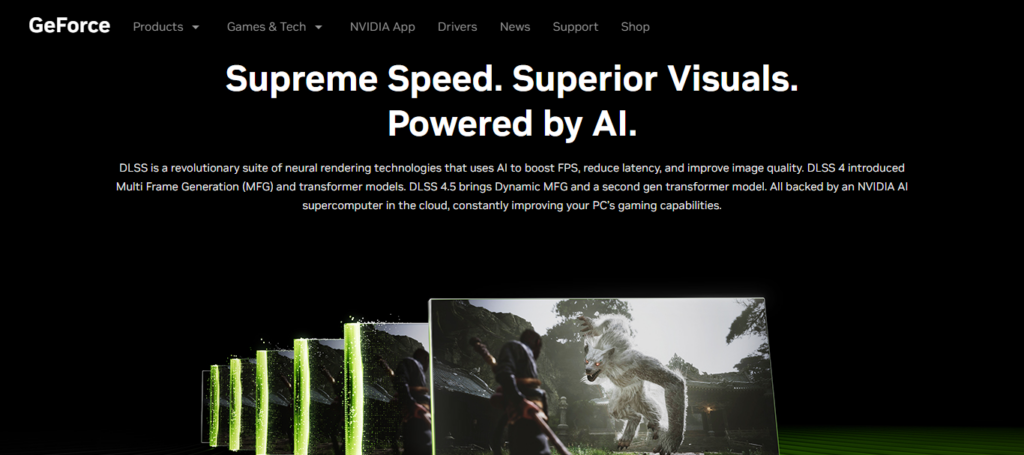
However, rather than brute-force rendering DLSS predicts high-resolution frames from lower resolution inputs and achieves higher FPS. It allows for ray tracing and ultra graphics settings even on mid-tier GPUs — it seemed like magic to many.
Gamers enjoy lower stutter, smoother frame pacing and more responsive input. DLSS learns indefinitely (thanks to periodic AI model updates), so performance improvements can always flow through a good old-fashioned driver update — no new hardware needed.
DLSS 4.5 from Nvidia — Features
- AI Re-Construction — Deep learning AI using Tensor Cores
- High FPS improvement with no major image quality degradation.
- Enhanced ray tracing performance support.
- advance in driver based AI upon inspection of the data to go back and investigate it.
- High End level anti-aliasing and IS techniques.
Nvidia DLSS 4.5 — Pros & Cons
| Pros | Cons |
|---|---|
| Excellent image quality with AI upscaling | Limited to Nvidia RTX GPUs |
| Massive FPS boost | Requires Tensor Core hardware |
| Enhances ray tracing performance | Not supported in all games |
| Continuous AI model improvements | Can add slight input latency |
| Reduces GPU workload | Needs latest drivers |
3. Intel XeSS 2.0
AI gaming optimization is not confined to a singular ecosystem. Intel XeSS 2.0, with its AI-based super sampling, focuses on improving image quality while increasing frame rates in today’s performance tuning workflows for games. Powered by Intel Arc GPU using machine learning acceleration, with the option of compatibility via alternative instruction sets on applicable hardware.
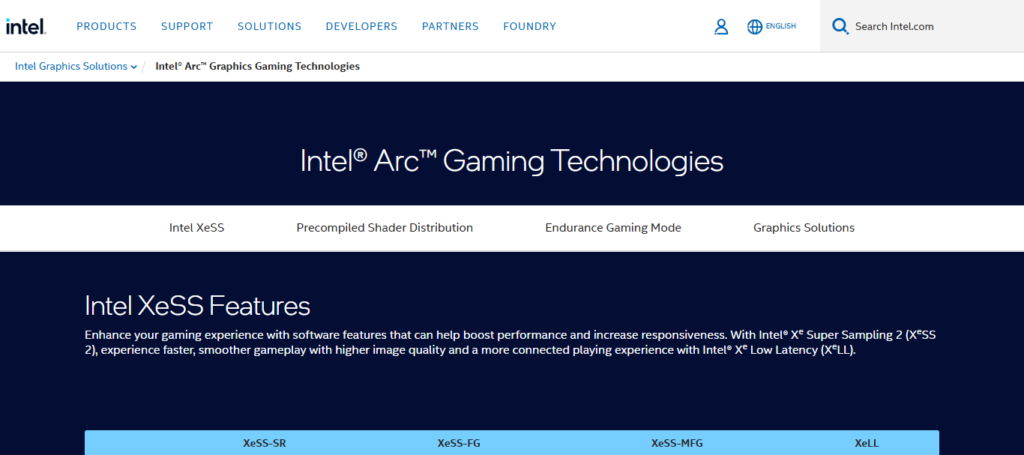
That versatility also means XeSS should be appealing to some gamers with legacy systems or hybrid hardware setups. AI reconstruction minimizes aliasing, enhances texture detail finally stabilizes performance in harsh scenes. Higher resolutions and smoother motion without the need to upgrade a player’s graphics card.
Intel XeSS 2.0 — features
- AI super sampling making for smoother game performance.
- Suitable for Intel Arc GPUs and similar hardware
- Smoothes out sharp edges, increases texture clarity
- High performance optimization for modern AAA titles
- Enhanced Visuals Without Compromising Frame Rate
Intel XeSS 2.0 — Pros & Cons
| Pros | Cons |
|---|---|
| Works on Intel and non-Intel GPUs | Performance varies across hardware |
| Improves visual clarity | Smaller game support compared to DLSS |
| Good balance of quality and FPS | Newer technology still evolving |
| Reduces aliasing effects | Less optimized in older titles |
| Helps mid-range systems run modern games | Requires supported APIs |
4. AI Frame Generation (Nvidia/AMD)
Gauge generation is one of the great AI revolutions for gaming performance. Rather than traditional rendering, AI predicts a motion data and places in-between the synthetic frames where there are real ones. With the help of technologies made by Nvidia and also AMD, movement vectors, player input plus scene transitions are assessed so you could get smoother animation.
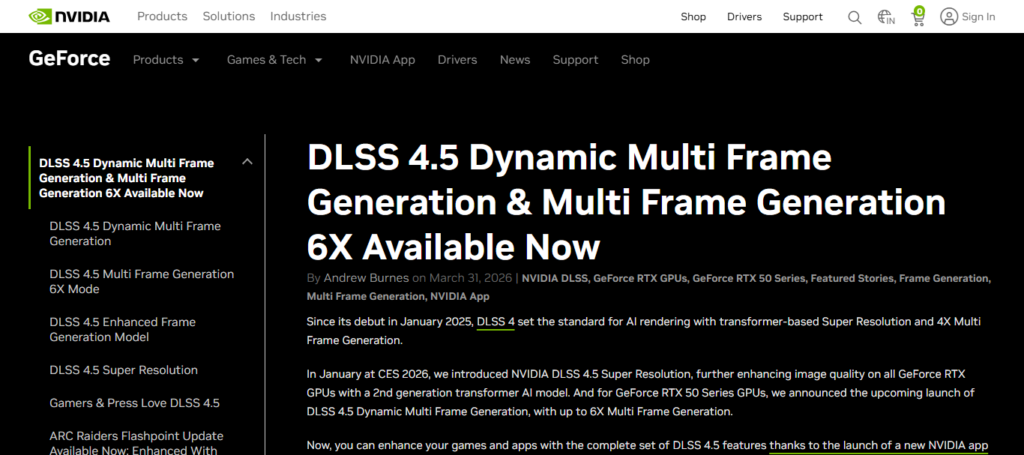
This means perceived FPS is doubled without double the GPU workload. For gamers, this means ultra-smooth gameplay because blurriness caused by motion is greatly reduced and everything becomes more responsive. It becomes especially valuable for systems unable to cope with traditional rendering methods, such as those found in ray-traced environments and open-world games.
AI Frame Generation (Nvidia / AMD) Feature
- An AI method for generating frame between each real frames, specified by the GAN.
- Dramatically increases perceived FPS performance.
- Helps reduce motion stutter in fast-paced games.
- Smoothes out gameplay without needing those extra frames from the GPU.
- Ray tracing and high settings still run like a charm.
AI Frame Generation (Nvidia / AMD) — Pros & Cons
| Pros | Cons |
|---|---|
| Dramatically increases perceived FPS | May introduce slight latency |
| Smooth gameplay experience | Not ideal for competitive esports |
| Enhances ray-traced games | Requires modern GPU support |
| Reduces rendering workload | Limited game compatibility |
| Improves motion fluidity | AI-generated frames aren’t real renders |
5. AI Thermal & Power Management
Primarily graphics power, but also heat and energy management for stable performance. AI thermal systems cover a continuous loop of CPU temperature measurements, GPU load values, fan speeds and power consumption. Dynamic adjustments during usage balance the performance against cooling to avoid thermal throttling.

Smart power distribution above ensures that games get the priority share and background services play a secondary role with lower battery usage. The AI systems learn usage patterns over a period of time, and how they can be predicted when to add cooling (no pun intended) or power optimization.
This helps players have consistent FPS, quieter systems that are guaranteed to be assist with longer hardware lifespan and more stability without needing new components.
Thermal & Power Management with AI — Features
- Monitor CPU and GPU Temperatures in Real time
- Automatic power and fan curve optimisation.
- Restrains thermal throttling during prolonged periods of gameplay.
- Smart Flow Control for Consistent Performances
- Increases hardware longevity by apply cooling control to keep the engine from over heating.
AI Thermal & Power Management — Pros & Cons
| Pros | Cons |
|---|---|
| Prevents overheating | May slightly limit peak performance |
| Extends hardware lifespan | Depends on motherboard/software support |
| Automatic performance balancing | Background monitoring uses resources |
| Reduces thermal throttling | Limited manual customization sometimes |
| Improves system stability | Results vary by cooling setup |
6. ASUS GameFirst VI (Network AI)
The power available in your hardware will usually matter far lesser than the quality of internet connection for online gaming performance. Using AI to analyze traffic, ASUS GameFirst VI gives a gaming packet place in the queue — ahead of streaming packages or downloads or behind-the-scenes apps. The system automatically recognizes gaming data and dynamically assigns bandwidth to decrease ping spikes/drops, and reduce packet loss.
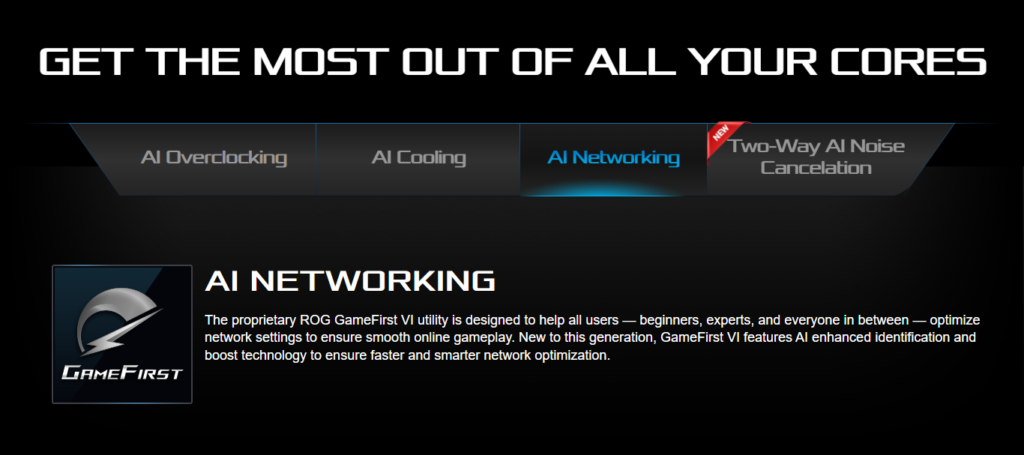
Players can enjoy more consistent connections, reduced matchmaking times and less lag spikes. AI monitoring not only detects network congestion and reroutes automatically instantaneously. This makes a massive improvement to competitive gaming performance, especially with esports titles where milliseconds of latency can mean the difference between victory and defeat.
ASUS GameFirst VI (Network AI) – Features
- Prioritizing and different types of AI network traffic, gaming applications
- Automatic buffer for ping spikes and packet loss
- Dynamic bandwidth allocation depending on the actual usage
- Improves online multiplayer stability.
- Automatic or manual optimization via a simple interface (pitch).
ASUS GameFirst VI (Network AI) — Pros & Cons
| Pros | Cons |
|---|---|
| Reduces ping spikes | Mainly available on ASUS systems |
| Prioritizes gaming traffic automatically | Limited benefit on already stable networks |
| Improves online match stability | Requires configuration for best results |
| Easy user interface | Not useful for offline gaming |
| Optimizes bandwidth usage | Depends on internet quality |
7. AI Latency Optimizers (e.g., WTFast, ExitLag)
Network routing drives competitive multiplayer gaming. Internally, AI latency optimization tools evaluate the ways servers travel worldwide and automatically choose which pathways are best for data. Services such as WTFast and ExitLag actively keep track of how long packets takes to arrive its destination, bypassing congested traffic.

Unlike default ISP routing, where the paths are sub-optimal resulting in lag (buffering) or dropped connections, AI will choose optimized packets and lower latency routes.
This ensures that gamers enjoy minimal ping, smooth gameplay with fewer disconnections. These tools help make real improvements in online gaming reaction times without ongoing hardware upgrades or inefficient and expensive internet changes.
Latency Optimizers like AI (WTFast, ExitLag) — Features
- AI powered routing to accelerate connections for game servers.
- Automatically selects lowest-latency network paths.
- Reduces lag, jitter, and disconnections.
- Improves competitive gaming responsiveness.
- Works with a variety of well-known online multiplayer titles.
AI Latency Optimizers (WTFast, ExitLag) — Pros & Cons
| Pros | Cons |
|---|---|
| Lower ping and reduced lag | Some features require subscription |
| Intelligent server routing | Works mainly for online games |
| Reduces packet loss | Improvement depends on ISP routing |
| Stable multiplayer connections | Not effective for local server issues |
| Easy setup process | Background service required |
8. AI‑Driven Game Settings Optimizers (GeForce Experience, Radeon Software)
The manual configuration of graphics settings is given manually but that can be very confusing and time-consuming. These tools utilize AI to automatically evaluate the computer’s hardware and match it against game requirements, generating optimal performance settings in real time. Software like GeForce Experience and Radeon Software, scans CPU, GPU, RAM & resolution capabilities for applying effectively optimized presets.
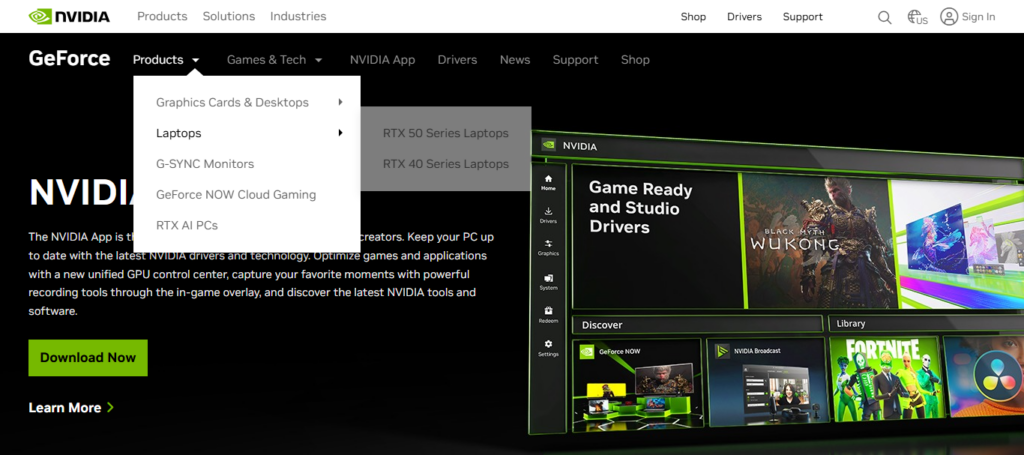
These AI changes strike a balance between visual quality and FPS on the fly, removing trial-and-error configurations. Gamers receive improved performance, reduced game launch time and stability of experience from title to title. They also include automatic updating that adapts settings over time, keeping games optimized as drivers and AI models refine in response to the latest features.
AI Game Settings Optimizers — Features
- Automatic scanning for hardware and optimization related to the game.
- Applies recommended graphics settings instantly.
- It balances FPS performance and visual fidelity.
- Optimizes profiles with driver updates.
- It removes the need to manually configure, and use trial-and-error tuning.
AI-Driven Game Settings Optimizers — Pros & Cons
| Pros | Cons |
|---|---|
| Automatic graphics optimization | AI settings may not match personal preference |
| Saves configuration time | Requires driver software running |
| Balanced FPS and visual quality | Limited customization sometimes |
| Beginner-friendly | Needs regular updates |
| Improves performance instantly | May overwrite manual settings |
Conclusion
I mean, it has totally revolutionized the way gamers optimize performance without actually buying new components. With smart frame rate boosting, automatic graphics optimization and a host of other features that reduce latency for an ultra-compelling online play experience while managing temperatures and unstable connections resulting from local ISR demands, modern tools utilize AI to great benefit. AMD FSR, Nvidia DLSS and Intel XeSS show that often it is smarter software than the hardware of a new generation.
To rewrite the rule, gamers do not have to upgrade their GPUs or CPUs because now they can unleash untapped performance potential using AI-driven optimization. As a kind of virtual performance engineer, AI analyzes data in real time to balance aspects like smoother gameplay and higher FPS with network stability and system demand.
The evolution of AI means that advancements in gaming performance can increasingly be expected to come from intelligent software rather than physical upgrades, still keeping high-quality gaming accessible, affordable and efficient.
FAQ
What are AI tools for PC gaming performance?
AI gaming tools are software technologies that use machine learning and intelligent algorithms to optimize graphics rendering, system performance, internet latency, and power usage. Solutions from companies like Nvidia, AMD, and Intel help increase FPS, reduce lag, and improve overall gameplay without requiring new hardware.
Can AI really improve FPS without upgrading hardware?
Yes. AI technologies such as upscaling and frame generation render games at lower resolutions and reconstruct high-quality images using intelligent prediction models. This reduces GPU workload while increasing frame rates, allowing smoother gameplay even on older systems.
Are AI gaming optimization tools safe to use?
Most AI gaming tools provided by official GPU manufacturers or trusted software platforms are completely safe. They work within driver-level optimizations and do not modify game files illegally, making them secure and widely supported by game developers.
Do AI tools work on low-end PCs?
Absolutely. Many AI optimization solutions are specifically designed to help low-end and mid-range PCs. Features like automatic graphics tuning, thermal management, and AI upscaling allow weaker hardware to run modern games more efficiently.
Which AI feature provides the biggest performance boost?
AI upscaling technologies like DLSS, FSR, and XeSS typically deliver the largest FPS improvements. AI frame generation also provides major performance gains by creating additional frames, making gameplay feel smoother without increasing hardware load.