


I’ll go over Why Cross-Chain Liquidity Is the Next Big DeFi Trend in this post and why it’s becoming crucial for decentralized finance going forward.
- What Is Cross-Chain Liquidity?
- Why Cross-Chain Liquidity Is the Next Big DeFi Trend
- Resolves the Fragmentation of Liquidity
- Increased Capital Effectiveness
- Better Possibilities for Trading
- Expansion of the Multi-Chain DeFi Ecosystem
- Enhanced Accessibility for Users
- Opportunities for Liquidity Providers with Higher Yields
- Quick Advancement in Cross-Chain Technology
- Encourages DeFi Interoperability in the Future
- How Cross-Chain Liquidity Solves the Problem
- Technologies Powering Cross-Chain Liquidity
- Bridges Across Chains
- Protocols for Interoperability
- Tokens that are wrapped
- Pools of Cross-Chain Liquidity
- Intelligent Contracts
- Benefits of Cross-Chain Liquidity in DeFi
- Enhanced Efficiency of Capital
- Availability of Several Blockchain Ecosystems
- Improved Trading Prospects
- Opportunities for Increased Yield for Liquidity Providers
- DeFi Transactions Are Quicker and More Adaptable
- Challenges and Risks of Cross-Chain Liquidity
- Cross-Chain Bridge Security Risks
- Smart Contract Weaknesses
- Complexity and Exorbitant Transaction Fees
- Uncertainty in Regulation
- Future of Cross-Chain Liquidity in DeFi
- Real-World Examples of Cross-Chain Liquidity Platforms
- Pros & Cons
- Conclusion
- FAQ
Cross-chain liquidity helps link networks, enhance trade efficiency, and build a more adaptable, scalable, and integrated DeFi ecosystem as blockchain ecosystems like Ethereum and Solana expand.
What Is Cross-Chain Liquidity?
The capacity to transfer and utilize digital assets between many blockchain networks without being constrained to a single ecosystem is known as cross-chain liquidity. Because blockchains like Bitcoin, Ethereum, and Solana function independently, liquidity in decentralized finance (DeFi) is frequently divided.
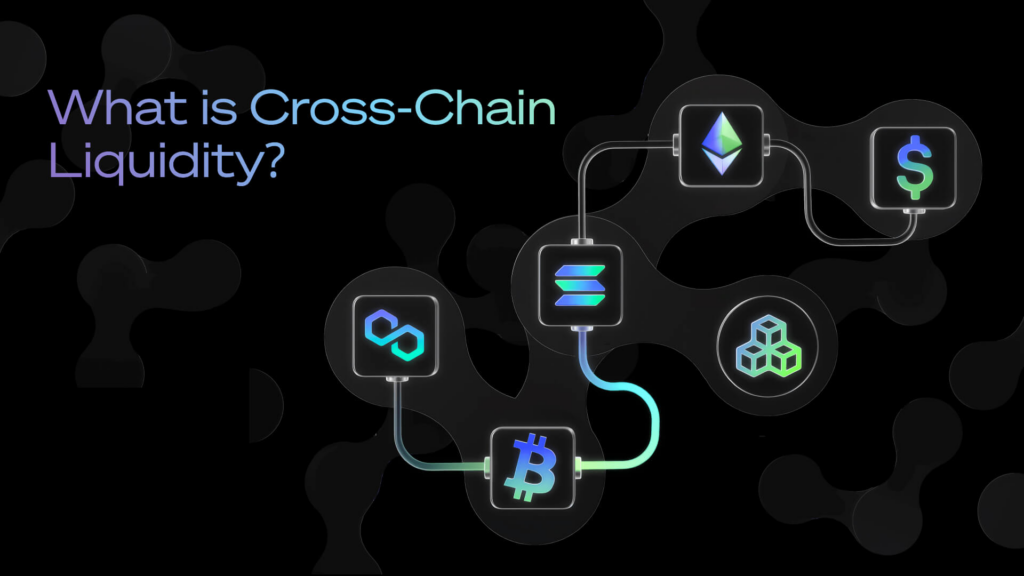
These networks are connected via cross-chain liquidity solutions using technologies like shared liquidity pools, bridges, and interoperability protocols. This makes it easier for consumers to access DeFi services across several chains, trade assets, and transfer tokens.
Cross-chain liquidity enhances capital efficiency, increases trading opportunities, and contributes to the development of a more interconnected and scalable decentralized financial ecosystem by facilitating smooth communication between blockchains.
Why Cross-Chain Liquidity Is the Next Big DeFi Trend

Resolves the Fragmentation of Liquidity
Liquidity fragmentation across several blockchains is one of the main issues in decentralized finance. Asset accessibility is restricted by the autonomous operations of networks like Ethereum, Solana, and BNB. These ecosystems are linked by cross-chain liquidity, which permits assets to flow freely across them and enhances market efficiency overall.
Increased Capital Effectiveness
Instead of being restricted to a single ecosystem, cross-chain liquidity enables money to be utilized across several blockchain networks. This improves capital efficiency and eliminates the need for manual asset movement, enabling traders and liquidity providers to optimize returns.
Better Possibilities for Trading
Cross-chain liquidity allows users to access markets and trade pairings on other blockchains. This enhances price discovery across decentralized exchanges, lowers slippage, and improves arbitrage opportunities.
Expansion of the Multi-Chain DeFi Ecosystem
There is no longer just one blockchain in the DeFi ecosystem. Cross-chain solutions facilitate the development of a fully multi-chain financial environment by connecting various ecosystems when platforms extend beyond a single network.
Enhanced Accessibility for Users
By facilitating smooth asset transfers between chains, cross-chain liquidity streamlines the user experience. Users don’t need to use several wallets or perform complicated manual conversions in order to communicate with various DeFi platforms.
Opportunities for Liquidity Providers with Higher Yields
In contrast to single-chain liquidity pools, liquidity providers can give assets to pools that function over many chains, increasing the likelihood of earning larger rates.
Quick Advancement in Cross-Chain Technology
Cross-chain infrastructure is continuously being improved by new protocols and platforms. Solutions for safe and effective cross-chain liquidity are being developed by initiatives including THORChain, Stargate Finance, and Synapse Protocol.
Encourages DeFi Interoperability in the Future
The long-term viability of decentralized finance depends on interoperability. In order to link blockchain networks and facilitate smooth financial transactions throughout the DeFi ecosystem, cross-chain liquidity is essential.
How Cross-Chain Liquidity Solves the Problem
One of the main issues with decentralized finance is the fragmentation of liquidity over several blockchains, which is addressed by cross-chain liquidity. Assets and liquidity are frequently locked within distinct ecosystems since networks like Ethereum, Solana, and BNB function independently.
These networks are linked via cross-chain liquidity solutions via shared liquidity pools, interoperability protocols, and bridges. This enhances market depth and trade efficiency by enabling users to move tokens between chains with ease.
Traders benefit from reduced slippage, improved price discovery, and quicker transactions as a result. Cross-chain liquidity makes the DeFi ecosystem more cohesive and effective by allowing assets to move freely between blockchains.
Technologies Powering Cross-Chain Liquidity
Bridges Across Chains
Digital assets can be transferred between several blockchain networks thanks to cross-chain bridges. They facilitate smooth transfers between ecosystems like Ethereum and Solana by locking coins on one chain and minting comparable tokens on another. In order to connect disparate blockchain networks, these bridges are essential.
Protocols for Interoperability
Data exchange and communication between various blockchains are made possible by interoperability protocols. Liquidity flow is improved by decentralized applications interacting across different chains thanks to technologies like the Polkadot ecosystem and Chainlink’s cross-chain solutions.
Tokens that are wrapped
Assets from one blockchain are represented by wrapped tokens on another blockchain. For instance, Wrapped Bitcoin makes it possible to use Bitcoin in the Ethereum ecosystem, giving DeFi platforms more liquidity.
Pools of Cross-Chain Liquidity
These liquidity pools enable users to exchange tokens across networks and hold assets from several blockchains. Cross-chain swaps are supported by decentralized liquidity pools offered by platforms such as THORChain and Stargate Finance.
Intelligent Contracts
Cross-chain transactions are automated and secured using smart contracts. They lessen the need for middlemen in decentralized finance systems by ensuring that asset transfers, swaps, and liquidity activities take place automatically if certain requirements are satisfied.
Benefits of Cross-Chain Liquidity in DeFi
Enhanced Efficiency of Capital
Instead of being restricted to a single ecosystem, assets can move freely across several blockchain networks thanks to cross-chain liquidity. By allowing traders and investors can use their money freely across platforms like Ethereum, Solana, and BNB, this enhances capital efficiency.
Availability of Several Blockchain Ecosystems
Cross-chain liquidity solutions allow users to communicate with decentralized applications on several blockchains. This gives consumers access to the distinctive qualities of different networks and increases opportunities in decentralized finance.
Improved Trading Prospects
Access to more trade pairs and bigger liquidity pools is made possible via cross-chain liquidity. This enhances overall market efficiency across decentralized exchanges, lowers slippage, and helps traders obtain better prices.
Opportunities for Increased Yield for Liquidity Providers
Assets can be supplied by liquidity providers to several DeFi platforms in various chains. Compared to single-chain liquidity pools, this offers more chances to earn rewards, transaction fees, and staking incentives.
DeFi Transactions Are Quicker and More Adaptable
Cross-chain liquidity increases transaction speed and flexibility by facilitating smooth asset transfers between blockchains. In the DeFi ecosystem, users can swiftly transfer assets to the most effective network or platform for lending, trading, or staking.
Challenges and Risks of Cross-Chain Liquidity
Cross-Chain Bridge Security Risks
Hackers frequently target cross-chain bridges because they contain substantial sums of locked assets. Attackers may use weaknesses in the bridge’s architecture or smart contracts to steal money. The necessity for more robust security measures has been brought to light by a number of bridge hacks in the DeFi ecosystem.
Smart Contract Weaknesses
Automated smart contracts play a major role in cross-chain liquidity. These contracts may result in monetary losses if they have faults or code flaws. To lower these risks, platforms operating on networks like Ethereum and Solana need to audit their smart contracts on a regular basis.
Fragmentation of Liquidity Throughout Chains
Liquidity can still get dispersed across too many networks and protocols, notwithstanding cross-chain technology’s efforts to address fragmentation. Because of this, traders may find it challenging to effectively tap vast liquidity pools.
Complexity and Exorbitant Transaction Fees
Bridge costs, gas fees, and network fees may be incurred while transferring assets between different blockchains. Particularly during times of severe network congestion, these expenses may lower traders’ and liquidity providers’ earnings.
Uncertainty in Regulation
Cross-chain DeFi systems function worldwide and frequently lack centralized management. Because countries are currently formulating regulations regarding decentralized finance, cryptocurrency assets, and cross-chain transactions, this poses regulatory issues.
Future of Cross-Chain Liquidity in DeFi

As the blockchain ecosystem continues to grow across numerous networks, cross-chain liquidity in decentralized finance appears to have a very bright future.
The demand for smooth asset movement and shared liquidity will only increase as platforms on chains like Ethereum, Solana, and BNB expand. Cross-chain transactions should become safer and faster because to multi-chain decentralized apps, enhanced bridge security, and advanced interoperability protocols.
This advancement will improve trade efficiency, lessen liquidity fragmentation, and give customers more access to DeFi services. Cross-chain liquidity will eventually be crucial to building a decentralized financial environment that is more efficient, scalable, and integrated.
Real-World Examples of Cross-Chain Liquidity Platforms
THORChain
THORChain is a decentralized cross-chain liquidity protocol that eliminates the need for wrapped tokens by enabling users to exchange native assets between several blockchains. For instance, its liquidity pools allow users to directly exchange assets like Ethereum and Bitcoin. The platform maintains decentralized control while facilitating effective cross-chain trade through the use of continuous liquidity pools in conjunction with its native coin.
Finance for Stargate
The LayerZero interoperability protocol serves as the foundation for Stargate Finance, a cross-chain liquidity bridge. Through unified liquidity pools, it enables users to move native assets between more than 40 blockchain networks. It is one of the most popular cross-chain liquidity platforms in DeFi because of its design, which minimizes slippage and guarantees speedier transactions with finality.
The Synapse Protocol
Users can exchange tokens and transfer assets between several blockchain ecosystems using the Synapse Protocol, a cross-chain liquidity network. In order to reduce fees and slippage during cross-chain transfers, it offers optimal routing and supports many blockchains. The platform’s significant contribution to DeFi interoperability is demonstrated by the billions of dollars in cross-chain transactions it has handled.
The Wormhole Protocol
Wormhole is a significant interoperability technology that facilitates liquidity transfers and cross-chain communication between numerous blockchain networks. Users can transfer tokens, NFTs, and other digital assets between ecosystems like Ethereum, Solana, and BNB Chain via its Portal Bridge. It supports dozens of blockchains and has handled cross-chain transactions worth billions of dollars.
Layer Zero
LayerZero is an omnichain interoperability protocol that facilitates cross-blockchain communication for decentralized applications. It gives cross-chain liquidity platforms like Stargate Finance the infrastructure they need to transfer assets and data between networks without the need for centralized middlemen.
Pros & Cons
| Pros | Cons |
|---|---|
| Enables seamless asset transfers between different blockchains like Ethereum and Solana | Cross-chain bridges can be vulnerable to hacking and security exploits |
| Improves capital efficiency by allowing funds to be used across multiple networks | Transactions may involve multiple fees such as bridge fees and gas fees |
| Provides access to more trading pairs and larger liquidity pools | Technical complexity can make it difficult for beginners to understand |
| Reduces liquidity fragmentation across blockchain ecosystems | Smart contract bugs or vulnerabilities can lead to financial losses |
| Opens opportunities for higher yields for liquidity providers | Regulatory uncertainty around cross-chain DeFi platforms |
Conclusion
Because it addresses the significant issue of liquidity dispersion across several blockchain networks, cross-chain liquidity is quickly emerging as a crucial innovation in decentralized finance. It makes the DeFi environment more interconnected and effective by allowing assets to flow between ecosystems like Ethereum, Solana, and BNB.
This technology increases trade opportunities, increases capital efficiency, and gives customers more flexible access to several blockchain platforms. In order to shape DeFi’s future and create a truly multi-chain financial ecosystem, cross-chain liquidity will be essential as interoperability solutions and security measures continue to advance.
FAQ
What is cross-chain liquidity in DeFi?
Cross-chain liquidity refers to the ability to move and use digital assets across multiple blockchain networks. It allows users to transfer tokens and access DeFi services between ecosystems such as Ethereum, Solana, and BNB without being limited to a single blockchain.
Why is cross-chain liquidity important for DeFi?
Cross-chain liquidity helps solve the problem of liquidity fragmentation by connecting different blockchain networks. This improves trading efficiency, increases capital utilization, and allows users to access a wider range of decentralized financial services.
How does cross-chain liquidity work?
Cross-chain liquidity works through technologies like cross-chain bridges, interoperability protocols, and shared liquidity pools. These systems enable assets to be transferred or represented on different blockchains while maintaining their value.
Are cross-chain liquidity solutions safe?
While many platforms focus on improving security, cross-chain systems can still face risks such as smart contract vulnerabilities and bridge attacks. However, ongoing audits and advanced security protocols are helping make these solutions safer.