


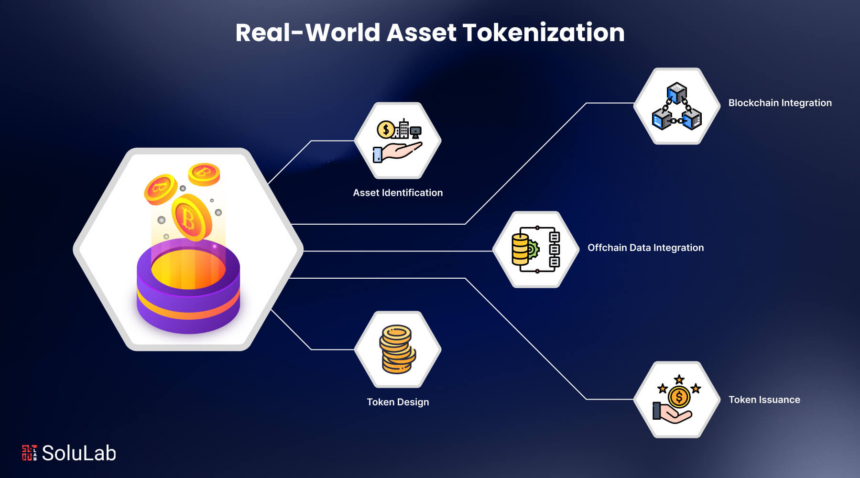
I’ll talk about the Best Prop Firms for Trading Tokenized Real World Assets in this post, emphasizing platforms that connect blockchain technology and conventional banking.
- Why Use Prop Firms for Trading Tokenized Real World Assets
- Key Point & Top Prop Firms for Trading Tokenized Real World Assets
- 1. Ondo Finance Prop DAO
- Ondo Finance Prop DAO Features, Pros & Cons
- 2. Maple Finance Prop Collective
- Maple Finance Prop Collective Features, Pros & Cons
- 3. Centrifuge Prop Program
- Centrifuge Prop Program Features, Pros & Cons
- 4. Goldfinch Prop DAO
- Goldfinch Prop DAO Features, Pros & Cons
- 5. Clearpool Prop Collective
- Clearpool Prop Collective Features, Pros & Cons
- 6. TrueFi Prop Program
- TrueFi Prop Program Features, Pros & Cons
- 7. OpenTrade Prop DAO
- OpenTrade Prop DAO Features, Pros & Cons
- 8. RealT Prop Collective
- RealT Prop Collective Features, Pros & Cons
- 9. Parcl Prop Guild
- Parcl Prop Guild Features, Pros & Cons
- 10. Securitize Prop DAO
- Securitize Prop DAO Features, Pros & Cons
- Conclusion
- FAQ
By providing transparent, on-chain trading, enhanced liquidity, and a variety of yield prospects across international real-world markets, these prop firms give traders access to tokenized real estate, credit, treasuries, and fixed-income assets.
Why Use Prop Firms for Trading Tokenized Real World Assets
Institutional Backing Won’t Cost You Personally: Prop firm capital allows you to gain greater exposure to tokenized real world assets without having to use your own money.
Access to a Variety of RWA Markets: You can access tokenized real estate, credit, treasuries, and fixed-income assets. This allows for a more diversified portfolio.
Less Risk Personally: You can set your own risk parameters and will have less to lose personally when trading assets that are backed by real-world assets.
Better Risk Management Professionally: The firm will have drawdown limits, risk frameworks and other associated controls that are geared toward lower risk RWA markets.
Access to Liquidity is Better: The firm will have better access to RWA markets as they are connected to a number of RWA and DeFi markets which makes trade execution better.
Yield Opportunities are Better: RWA will always have a yield as opposed to trading crypto markets which are very volatile are not good for prop trading.
No Compliance Worries: RWA focused prop trading firms will take care of KYC, compliance, and custodial assets which makes trading in a regulated environment much easier.
Better Trading Tools: You will have access to better trading tools, institutional-level analytics, and the ability to trade with better on-chain transparency.
Profit Sharinking is Scalable: If you perform well, your capital allocation will increase, and you will earn based on the firm’s profit share.
Early Exposure to a Growing Market: The use of prop firms allows traders to stake an early position in the fast-emerging ecosystem of tokenized real world assets.
Key Point & Top Prop Firms for Trading Tokenized Real World Assets
| Platform | Key Point |
|---|---|
| Ondo Finance Prop DAO | Focuses on institutional-grade tokenized RWAs like treasuries, enabling prop traders to access yield-bearing assets with on-chain transparency and regulated exposure. |
| Maple Finance Prop Collective | Offers decentralized credit markets for RWAs, allowing prop traders to participate in structured lending strategies backed by real-world borrowers. |
| Centrifuge Prop Program | Bridges DeFi and RWAs by tokenizing invoices and assets, giving prop traders diversified exposure to real-world cash-flow-backed tokens. |
| Goldfinch Prop DAO | Enables RWA lending without over-collateralization, allowing prop traders to earn yield from real-world credit markets globally. |
| Clearpool Prop Collective | Provides permissionless RWA liquidity pools where prop traders can access short-term lending opportunities with transparent on-chain risk metrics. |
| TrueFi Prop Program | Delivers uncollateralized lending exposure through tokenized credit markets, ideal for prop traders seeking higher RWA yields. |
| OpenTrade Prop DAO | Focuses on tokenized fixed-income and yield products, giving prop traders stable, predictable returns from RWAs. |
| RealT Prop Collective | Specializes in tokenized real estate, allowing prop traders to gain fractional ownership and rental yield exposure via blockchain assets. |
| Parcl Prop Guild | Enables trading of tokenized real estate price indices, allowing prop traders to speculate on property market movements without owning property. |
| Securitize Prop DAO | Provides compliant infrastructure for tokenized securities and RWAs, offering prop traders regulated access to real-world asset markets. |
1. Ondo Finance Prop DAO
Ondo Finance is among the pioneering platforms for the tokenization of real-world assets (RWAs) with institutional-grade U.S. Treasuries and fixed-income funds. Ondo bridges Decentralized Finance (DeFi) and Traditional Finance (TradFi) by allowing traders and investors access to the tokenized versions of high-quality assets.
This enhances liquidity and transparency for the difficult-to-trade assets. As a Top Prop Firm for Trading Tokenized Real World Assets, Ondo specializes in Regulated Tokenized Securities and is expanding to Tokenized Stocks and Treasuries.
Ondo collaborates with custodians and exchanges for balanced compliance and market access. Its ecosystem features advanced trading and governance to meet institutional requirements.
Ondo Finance Prop DAO Features, Pros & Cons
Features
- Institutional asset tokenization (e.g., treasuries, securit ies).
- DAO governance on-chain.
- Real-world yield tokens liquidity pools.
- Issuance standards for compliance-oriented tokens.
- Real-world trading ecosystem DeFi integration.
Pros
- Low volatility with institutional-grade assets.
- High transparency and settling via blockchain.
- On-chain community management via DAO governance.
- Regulatory worries are reduced with strong compliance.
- Real DeFi inaccessible yield RWAs are provided.
Cons
- A speculative trader’s short-term opposition is lower volatility.
- KYC for regulated products may be needed.
- Crypto natives may be delayed.
- Liquidity issues.
- Partnerships with institutional traders are required.
2. Maple Finance Prop Collective
Maple Finance is a decentralized credit market that puts institutional lending and real-world asset financing on-chain. Accredited and institutional lenders can provide liquidity to real-world credit risk- assessed and on-chain collateral backed liquidity pools and access them to select borrowers.
Maple is a prop firm for trading tokenized real-world assets, focusing on optimizing capital to risk ratios, implementing robust risk controls, and remaining compliant with the traditional finance world, allowing participants to earn a yield on structured lending markets. Its ecosystem enables both DeFi and traditional yield and tokenized debt strategies, making Maple a vital player in RWA trading.
Maple Finance Prop Collective Features, Pros & Cons
Features
- Decentralized credit marketplace
- Structured lending pools for RWA
- Risk assessment tools on-chain
- Institutional counterparties are supported
- Tokenized debt instruments
Pros
- Credit exposure diversified beyond crypto
- Open and clear risk metrics
- Real borrower market yields are accessible
- Lending is efficient in capital when pooled
- Appeals to both institutional and DeFi capital
Cons
- Credit risk exists if borrowers default
- Skills in assessing risks are needed
- Retail focus is minimal
- Regulatory scrutiny is possible
- Varying liquidity per pool
3. Centrifuge Prop Program
Centrifuge is a decentralized protocol for the tokenization of real-world assets, including invoices, loans, and other cash-flow-generating assets.
Using the Tinlake securitization framework, these tokenized assets can be pooled and on-chain financed, allowing prop traders and investors to access real-world credit markets with varying risk and return.

Centrifuge is recognized as a Top Prop Firm for Trading Tokenized Real World Assets in enhancing the liquidity of and providing scalable and cost-efficient financing solutions to other DeFi protocols for previously economically unfeasible assets.
This methodology incorporates real business assets into trading strategies, enhancing further transparency and accessibility for participants of the RWA market.
Centrifuge Prop Program Features, Pros & Cons
Features
- Cash-flow producing real world assets are tokenized.
- Utilizes the Tinlake Securitization Framework.
- DeFi assets financing integrated.
- Assets are pooled multiple ways.
- Investors are on-chain.
Pros
- Connects to DeFi Business Assets.
- Provides multiple risk-return variations.
- Increases liquidity in assets.
- Protocols are developer pleasing.
- RWA markets on cross chain.
Cons
- Difficulties arise in the structure of tokens.
- Issues may arise in valuation of assets.
- More Due Diligence is required.
- Demand driven liquidity.
- This is not for the newly initiated.
4. Goldfinch Prop DAO
Goldfinch is a decentralized credit protocol that seeks to improve the accessibility of real-world lending to emerging markets where potential borrowers may be underserved due to the absence of traditional credit histories.
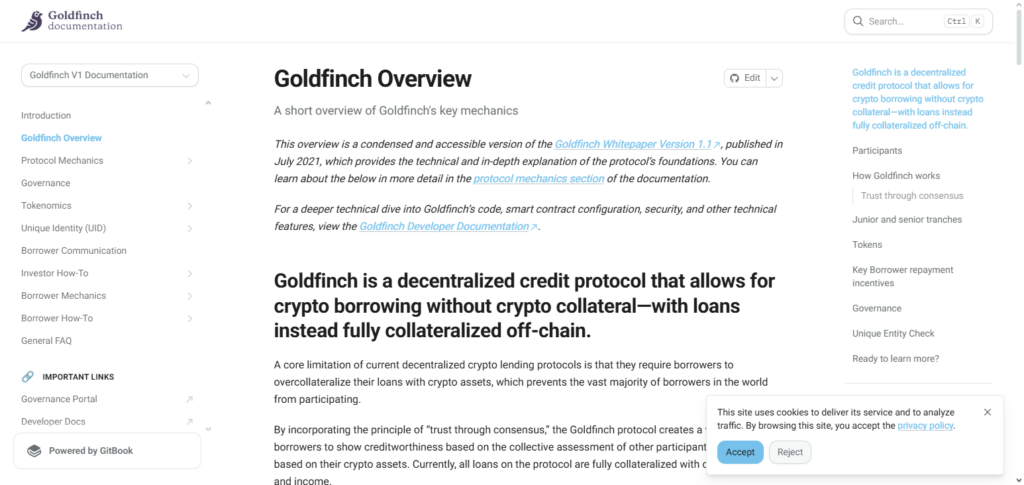
It helps investors and proprietary traders engage with tokenized loan pools that support businesses and individuals, earning them yield opportunities without large collateral demands. As a Top Prop Firm for Trading Tokenized Real World Assets,
Goldfinch integrates decentralized systems and real-world credit risk, providing a wider range of exposure to loans and credit instruments. Its purpose prioritizes providing traders structured yield opportunities, which are economically grounded in activities outside the crypto ecosystem, and focuses on financial inclusion.
Goldfinch Prop DAO Features, Pros & Cons
Features
- Credit protocol that is decentralized.
- Focused on lending that is under-collateralized.
- Credit assessments are community driven.
- Pools of loans that are tokenized.
- DAO elections.
Pros
- Credit exposure increases risk-adjusted returns.
- Emerging markets lending becomes possible.
- Access to real world credit becomes democratized.
- Decisions are decentralized.
- A strong community is involved.
Cons
- Credit risk is high
- Loss potential increases from under-collateralization.
- Complexity of governance is high.
- Limited liquidity is possible.
- Yield fluctuations may be high.
5. Clearpool Prop Collective
Clearpool is a decentralized liquidity marketplace that directly links institutional borrowers with on-chain lenders and proprietary traders. It is mainly concerned with the credit market and offers unregulated instant access to short-term loans that are backed by an institutional counterparty’s credit assessment.

As a Top Prop Firm for Trading Tokenized Real World Assets, Clearpool allows participants to either provide capital or trade in capital that is economically tied to real-world credit, coupled with on-chain risk indicators and governance transparency, which offers an advantage to the marketplace.
This marketplace structure allows prop traders to access lending strategies that are not confined to the traditional capital markets but are combined with the seamless integration of blockchain technology and the unregulated access of the markets.
Clearpool Prop Collective Features, Pros & Cons
Features
- A liquidity marketplace that is permissionless
- Credit markets that are on-chain.
- Access for institutional borrowers.
- Risk dashboards are transparent.
- Issuing Loans via Tokenization
Pros
- They allow lending, and trading flexibility.
- Trust can be built through transparent metrics.
- Real credit yields can be gained.
- They provide liquidity for lending strategies.
- They integrate well with institutions.
Cons
- They can be complicated for retail novices.
- Credit events can negatively impact yields.
- Platforms are gradually being adopted.
- There is regulatory risk with lending.
- There is reliance on borrower’s credit quality.
6. TrueFi Prop Program
TrueFi is an uncollateralized lending decentralized credit protocol that innovates uncollateralized lending by bringing a community-driven credit assessment and governance to on-chain debt markets.
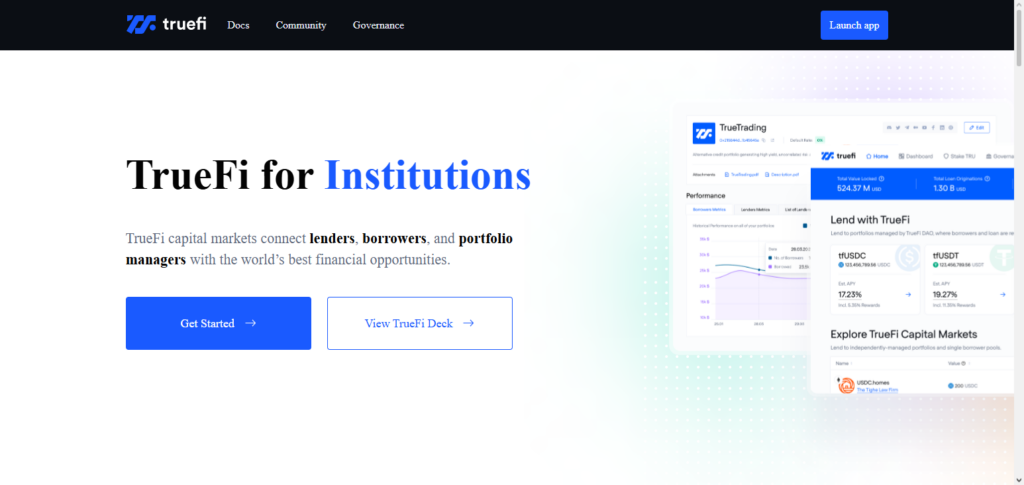
Prop traders can access lending pools where credit decisions are made through decentralized voting. This means that prop traders can earn yields through real-world engagements with borrowers, all without a traditional collateral model. TrueFi is a leading prop trading firm for trading tokenized real-world assets.
TrueFi matches lenders and borrowers across the crypto and real-world divide. This allows traders to access credit markets that are usually not available to them in a fully on-chain ecosystem. TrueFi emphasizes programmable credit and decentralized transparency.
TrueFi Prop Program Features, Pros & Cons
Features
- Unsecured lending
- Credit scoring done on-chain
- Governed by the community
- Lending pools on-chain
- Tokenization of credit
Pros
- Credit markets provide yields that are attractive.
- Evaluation of risk can be done in a decentralized manner.
- Borrowers have greater flexibility.
- Prop traders can access this.
- It is innovative and moves outside the collateralization models of Defi.
Cons
- There is higher risk of default.
- There is a need for a well-developed understanding of credit.
- It is possible for liquidity to be less at times.
- It is strongly governed.
- The trading metrics can be complicated for novices.
7. OpenTrade Prop DAO
Decentralized trading platforms that integrate tokenized fixed-income and real-world instrument goods are commonly represented by OpenTrade, whether it is hypothetical or yet in its infancy.
Such a DAO, which is a Top Prop Firm for Trading Tokenized Real World Assets, will concentrate on giving prop traders access to and the ability to trade tokenized debt, treasury products, and other RWA tokens with decentralized governance and liquidity.
It provides transparent on-chain marketplaces by bridging the gap between TradFi yields and DeFi execution. Platforms in this category offer programmable access to real-world yield instruments customized to prop trading techniques, improving market efficiency and tradability even while individual product characteristics vary.
OpenTrade Prop DAO Features, Pros & Cons
Features
- Decentralized trading of tokenized fixed income
- DAO governance
- On-chain order books/liquidity pools
- Real World Assets (RWA) yield products
- Cross-platform trading
Pros
- Decentralized execution and control
- Diversification of RWA yield
- Transparency on-chain
- Community driven product evolution
- Access to non-crypto asset classes
Cons
- Emerging platform liquidity
- Governance decisions can slow changes
- Necessity of institutional acceptance
- Fixed-income tokens added layers of complexity
- Trading volume increase is necessary, a low volume is a risk
8. RealT Prop Collective
RealT specializes in fractionalized tokenized real estate and allows investors and prop traders to acquire on-chain tokens that represent ownership in a fraction of a residential or commercial property.
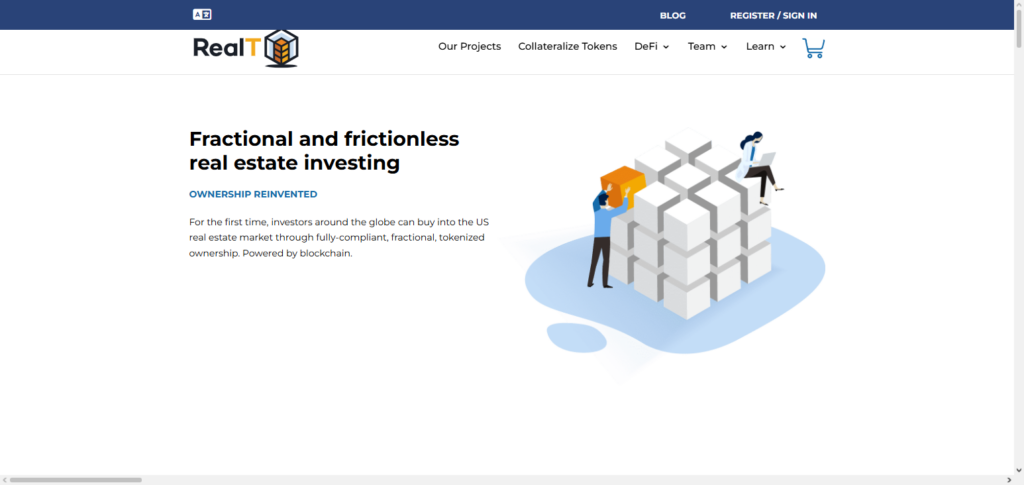
While trading their tokens on DeFi markets, these token holders can earn rental income, benefit from increasing property values, and appreciate the property over time. Securitize is a pioneer of trading tokenized real world assets and democratizes real estate markets by reducing the entry barriers and increasing the liquidity of traditionally illiquid real estate assets.
RealT uses blockchain technology for settlement and fractional ownership, and automated income distribution, offering real estate-linked RWAs for sophisticated trading.
RealT Prop Collective Features, Pros & Cons
Features
- Real estate that is tokenized and made fractionalized
- Distribution of rental income
- Trading integration with DeFi
- Streams of data for property valuations
- Accessibility to global real estate
Pros
- Exposure to real estate on the blockchain
- Yields from rentals passively
- Reduced barriers to entry with fractional investment
- Unlike traditional real estate, there is liquidity
- Ownership records are transparent
Cons
- Rental markets are volatile
- Regulations differ by geography
- There are fluctuating token liquidity
- There are risks associated with property management
- Knowledge of real estate markets is required
9. Parcl Prop Guild
Parcl is a decentralized platform that provides exposure to synthetic products that monitor changes in the real estate market as well as tokenized real estate price indices.
Without actually owning the underlying property, traders and investors can make educated guesses about price patterns in international real estate markets.
Parcl’s guild architecture facilitates active tactics around on-chain derivatives linked to real-world market data, making it a Top Prop Firm for Trading Tokenized Real World Assets.
Prop traders can benefit from insights and risk-managed exposure to larger property sectors thanks to its solutions, which build a bridge between blockchain markets and real estate valuation.
Parcl Prop Guild Features, Pros & Cons
Features
- Indices of prices for synthetic real estate
- Derivatives that are on-chain for property markets
- Access through community guilds
- Tools for speculation across markets
- Risk parameters that are integrated
Pros
- Trade real estate price trends without owning the property
- Diversification from markets that are only crypto
- Derivatives that are efficient on-chain
- Advanced traders find it accessible
- Guild structure provides community information
Cons
- Model risk is carried by synthetic assets
- Dependence on data for the market
- Adoption is what liquidity is tied to
- Casual traders find it complex
- There are challenges to accuracy of the price index
10. Securitize Prop DAO
Offering end-to-end solutions for the issuance and trading of digital securities backed by actual assets, such as funds, treasuries, and private equity, Securitize is a regulated tokenization platform.
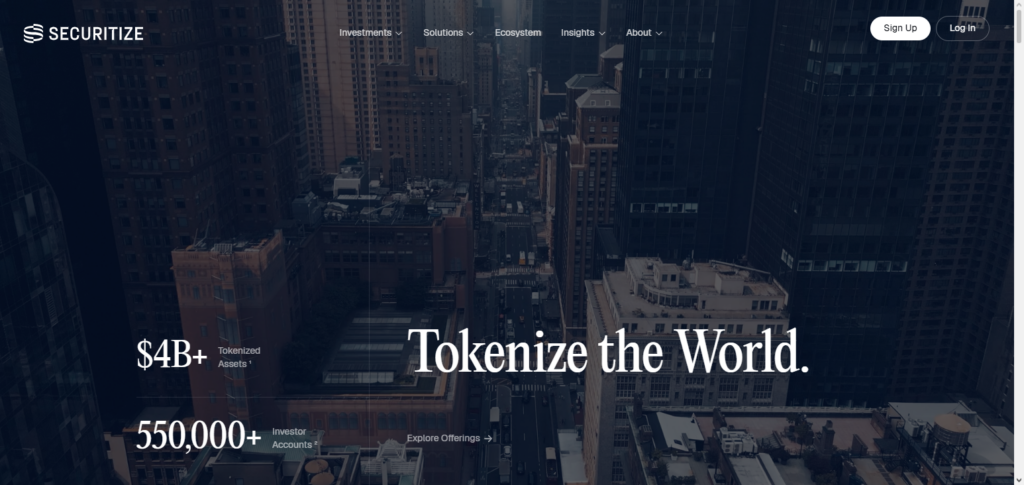
Its infrastructure includes token issuance, compliance, investor onboarding, and secondary trading through regulated platforms, making it a Top Prop Firm for Trading Tokenized Real World Assets.
Securitize is a key supplier for prop traders looking for compliant, premium RWA exposure since it has enabled billions in tokenized U.S. Treasury and other asset offerings handled on several blockchains. Its regulated structure facilitates the alignment of DeFi innovation with TradFi norms.
Securitize Prop DAO Features, Pros & Cons
Features
- Infrastructure of tokenization that is regulated. \r \r
- KYC and compliance are provided.
- Tokenized securities issuance
- Access to secondary markets
- RWAs of institutional quality
Pros
- Legal risk and compliance
- Improved institutional adoption
- Enhanced support for asset tokenization
- Investor registry transparency
- Securities tokenization liquidity
Cons
- KYC/AML compliance on steroids
- Traditional finance speed
- DeFi functionality reduced
- Increased delta onboarding
- Legal compliance on a moving target
Conclusion
By combining the efficiency of blockchain technology with traditional banking, the emergence of tokenized real-world assets is revolutionizing proprietary trading. In a transparent, on-chain setting, traders may now access fixed-income instruments, treasuries, credit, and real estate through leading prop firms like Ondo Finance, Maple Finance, Centrifuge, and Securitize.
These platforms enable worldwide participation in historically illiquid markets, increase liquidity, and lower settlement friction. Prop businesses that concentrate on RWAs will be crucial in determining the direction of decentralized finance in the future as infrastructure, regulation, and institutional adoption all continue to develop. These firms will provide varied, yield-driven, and compliant trading options.
FAQ
What are tokenized real world assets (RWAs)?
Tokenized RWAs are real-world assets like real estate, bonds, credit, or treasuries converted into blockchain-based tokens, enabling easier trading, fractional ownership, and transparent settlement.
What is a prop firm in RWA trading?
A prop firm for RWAs allows traders to use firm capital to trade tokenized real-world assets, earning profits while leveraging structured risk management and on-chain infrastructure.
Why are RWAs attractive for prop traders?
RWAs offer lower volatility, real yield, diversification, and exposure to traditional financial markets while benefiting from blockchain speed, transparency, and global access.
Are RWA prop firms regulated?
Many platforms, such as Ondo Finance and Securitize, follow regulatory frameworks and compliance standards, especially for tokenized securities and institutional-grade assets.
Can traders earn passive income from RWA prop firms?
Yes, through lending, fixed-income products, real estate rentals, and yield-bearing tokens offered by platforms like Maple Finance, RealT, and Goldfinch.