



I’ll go over the Top Algorithmic Trading Platforms for Retail Investors in this post, emphasizing the top resources for market analysis, strategy backtesting, and automatic trading.
- Why Use Algorithmic Trading Platforms for Retail Investors
- Key Point & Top Algorithmic Trading Platforms for Retail Investors
- 1. MetaTrader 5 (MT5)
- MetaTrader 5 (MT5) Features, Pros & Cons
- 2. TradingView + Pine Script
- TradingView + Pine Script Features, Pros & Cons
- 3. QuantConnect
- QuantConnect Features, Pros & Cons
- 4. AlgoTrader
- AlgoTrader Features, Pros & Cons
- 5. Thinkorswim (TD Ameritrade)
- Thinkorswim (TD Ameritrade) Features, Pros & Cons
- 6. NinjaTrader
- NinjaTrader Features, Pros & Cons
- 7. Quantopian (Community Legacy)
- Quantopian (Community Legacy) Features, Pros & Cons
- 8. TradeStation
- TradeStation Features, Pros & Cons
- 9. Amibroker
- Amibroker Features, Pros & Cons
- 10. MultiCharts
- MultiCharts Features, Pros & Cons
- Conclusion
- FAQ
These platforms offer strong features, flexible code, and multi-asset support to assist retail investors maximize trades, reduce risks, and make data-driven decisions effectively, regardless of expertise level.
Why Use Algorithmic Trading Platforms for Retail Investors
Automation of Trading Strategies – Emotions often lead traders to make bad decisions. Algorithmic trading platforms execute trades automatically, allowing for greater emotional detachment.
Faster Trading – Platforms execute trades and close positions almost instantaneously. This is a great advantage over manual trading and helps users avoid missed trading opportunities.
Backtesting and Optimization – There are historical datasets that are used to optimize trading strategies. Retail investors are able to analyze the effectiveness of their strategies prior to putting real money on the line.
Multi-Asset Support – Trading a variety of assets such as stocks, foreign currencies, futures, and coins all on the same platform is a great way to diversify a trading portfolio.
Risk Management Tools – Retail investors can set mechanisms to manage their risk. These include stop losses, take profit orders, and others based on specific parameters of the investor’s portfolio.
Advanced Analytics Accessibility – Investors are able to see a variety of data like charts, statistical models, and technical indicators. This helps investors make better and more informed decisions.
Scalability – Manual traders are limited and can only manage a handful of strategies or assets at a time. Algorithmic trading allows users to manage many more.
The Sense of Community – Many traders enjoy the sense of community that comes with money management software. There are forums and community-created scripts that traders can use in addition to the educational materials that companies with Algorithmic Trading provide.
Key Point & Top Algorithmic Trading Platforms for Retail Investors
| Platform | Key Point / Feature |
|---|---|
| MetaTrader 5 (MT5) | Advanced charting, automated trading, multi-asset support, and backtesting capabilities for retail traders. |
| TradingView + Pine Script | Cloud-based charts, social trading, and customizable algorithms with Pine Script coding. |
| QuantConnect | Open-source algorithmic trading platform supporting multiple asset classes and cloud backtesting. |
| AlgoTrader | Institutional-grade algorithmic trading platform with strategy automation and risk management tools. |
| Thinkorswim (TD Ameritrade) | Professional-level charts, paper trading, and scripting via thinkScript for custom strategies. |
| NinjaTrader | Focused on futures and forex, offering automated trading, backtesting, and advanced charting. |
| Quantopian (Community Legacy) | Python-based algorithmic trading platform for backtesting and community strategy sharing (legacy now). |
| TradeStation | Powerful trading platform with EasyLanguage scripting, strategy testing, and multi-asset support. |
| Amibroker | Technical analysis software with custom indicators, advanced backtesting, and automation capabilities. |
| MultiCharts | Professional trading platform supporting automated trading, extensive backtesting, and multiple data feeds. |
1. MetaTrader 5 (MT5)
MetaTrader 5 (MT5) is a popular platform among retail traders. Multi-asset trading, advanced charting features, and automated trading using Expert Advisors (EAs) are some of the services MT5 offers. Users can backtest trading strategies, view charts in varied time frames, and access an integrated economic calendar.
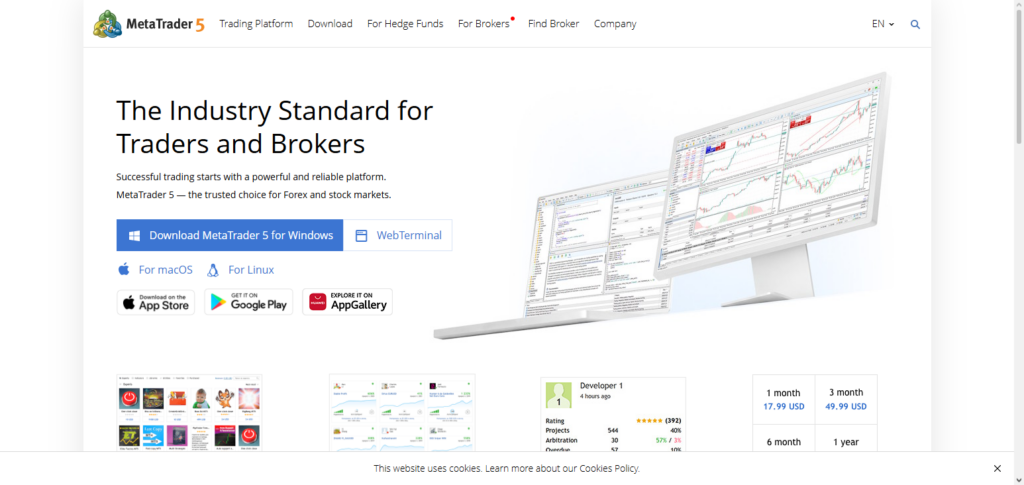
MT5’s easy-to-navigate platform allows both novice and seasoned traders to implement algorithmic strategies. MT5 is a platform that offers consistency, reliability, and robust features in order to facilitate algorithmic trading in the stock and forex markets.
MetaTrader 5 (MT5) Features, Pros & Cons
Features
- Trade multiple assets (Futures, Stocks, Forex)
- Trade using automated systems (Expert Advisors)
- High-end charting and technical analysis tools
- Backtesting and optimization for strategies
- Calendar and news integration for economic events
Pros
- Easy to use for both beginners and advanced users
- Community and broker support are plentiful
- Many brokers offer the platform free of charge
- Highly compatible for automated trading
- Great tools for backtesting
Cons
- MT5 brokers restrict you
- Personalization is very limited
- You need to learn EAs for full automation
- Some classes of assets are not very supportive
- It may be too much for brand new users
2. TradingView + Pine Script
TradingView provides retail investors with a cloud-based platform for technical analysis, charting, and algorithmic strategy development when paired with its scripting language, Pine Script. Custom indicators and automated alarms can be created by users without requiring complicated installations.
The social trading community on TradingView makes it possible to share techniques, which improves learning for novice traders. One of the Best Algorithmic Trading Platforms for Retail Investors, it supports a variety of asset types, such as stocks, FX, and cryptocurrency, and excels in accessibility and versatility.
The platform’s real-time data, backtesting capabilities, and direct strategy deployment via third-party integrations or supported brokers are all advantageous to retail traders.
TradingView + Pine Script Features, Pros & Cons
Features
- Analytics and charts available cloud-based
- Indicators and alerts customizable
- Automation of strategies via Pine Script coding
- Social trading and sharing of strategies
- Supports multiple assets. (Forex, Crypto, Stocks)
Pros
- Interface is friendly to beginners
- The platform is cloud-based, so access is available on multiple devices
- A common resource for strategy and script sharing for the community
- Data is updated in real time
- Supports automation
Cons
- Limited live trading broker integrations
- There is time invested to understand Pine Script
- The free version has feature limitations.
- Some plans impose limits on backtesting.
- Fully reliant on internet connectivity.
3. QuantConnect
QuantConnect is an open-source, cloud-based algorithmic trading platform for Python users. It covers equities, forex, futures, and crypto trading with an emphasis on research, backtesting, and live trading.
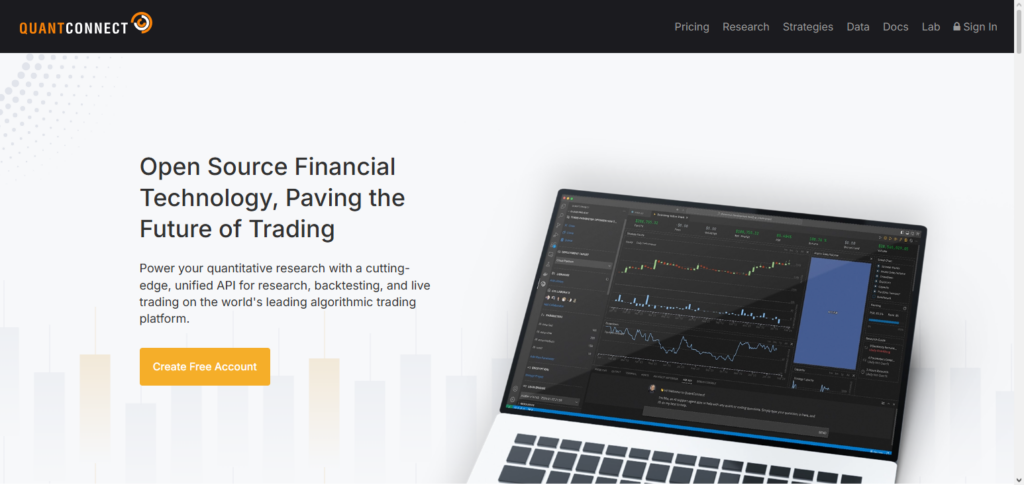
Retail investors can gain access to QuantConnect’s LEAN engine and use it to formulate and test advanced trading strategies against historical data. QuantConnect is among the Top Algorithmic Trading Platforms for Retail Investors and allows users to customize their trading strategies, collaborate through the community, access and utilize various datasets, and connect to different broker APIs.
Its LEAN engine coding access is perfect for differentiated tech-savvy traders from the ceiling retail option to algorithmic trading with professional grade algorithmic trading tools.
QuantConnect Features, Pros & Cons
Features:
- LEAN engine that is open-source
- Coders’ strategies based in Python
- Live deployment and cloud backtesting
- Multi-asset support, including stocks, Forex, and Crypto
- API integration with Broker
Pros:
- Retail traders get the rudimentary version.
- They have a wide range of datasets.
- An excellent community offers support and collaboration.
- Unrestricted strategy design.
- Automated trading that is advanced is supported.
Cons:
- Intermediate coding and advanced coding are required.
- It can be daunting for newcomers.
- Dependent on the cloud.
- Charges for advanced features.
- No GUI for non-coders.
4. AlgoTrader
AlgoTrader is an advanced algorithmic trading platform for professionals and institutions. It offers automation for trading strategies, risk and order management, plus direct market access for streamlined order execution.
The platform is integrated with primary brokers and exchanges for professional backtesting and trading. For strategy optimization and execution analytics, AlgoTrader is among the Best Algorithmic Trading Platforms for Retail Investors.
Retail traders can use the platform’s adaptable and modular infrastructure to create, evaluate, and implement advanced trading strategies like professional traders.
AlgoTrader Features, Pros & Cons
Features:
- Automation of an institutional grade
- Multi-asset trading
- Risk management
- Strategy analytics and backtesting
- Connectivity for multiple brokers and exchanges
Pros:
- Complex strategies that are scalable
- Retail-grade automation that is professional
- Automation that has a high reliability and execution speed
- Management and analytics of risk is supported
- Multiple brokers and exchanges can be integrated
Cons:
- Retail investors find this cost prohibitive
- Requires some coding knowledge
- Little community support when compared to Trading View or MT5
- It is not friendly for a beginner
- It has a large and steep learning curve.
5. Thinkorswim (TD Ameritrade)
TD Ameritrade’s Thinkorswim is an award-winning trading platform that features options analysis, and paper trading, plus advanced charting. Retail traders can create algorithmic strategies and custom indicators using the platform’s proprietary scripting language, thinkScript.
Thinkorswim is considered one of the Best Algorithmic Trading Platforms for Retail Investors because of the fusion of its high-end features with entry-level options.
As a trading strategy, users can backtest, and automate, plus simulate trades to reduce risk. The trading community and educational tools are among the platform’s features that enhance trading activities, especially for retail traders that require algorithmic trading and high-level analytics.
Thinkorswim (TD Ameritrade) Features, Pros & Cons
Features:
- Advanced charting features and analytics2. Simulated testing and paper trading
- Automation and custom indicators via thinkScript
- Trading across multiple assets (stocks, options, futures)
- News feeds and educational materials
Pros:
- Analytics and research at a professional level
- Community and broker support
- For safe testing, paper trading is available
- Excellent for stock and options traders
- Users of TD Ameritrade get it for free
Cons:
- For newcomers, the interface can be convoluted
- Outside TD Ameritrade, support is minimal
- thinkScript is a challenge
- Heavy interface for desktop users
- Smooth operation requires quick connectivity
6. NinjaTrader
NinjaTrader focuses on trading futures, forex, and equities. Retail traders can access advanced charting, automation, and the ability to backtest strategies. The platform has a user-friendly interface with a combination of C# coding for custom algorithmic strategies and drag-and-drop for those who prefer a more simplistic approach.
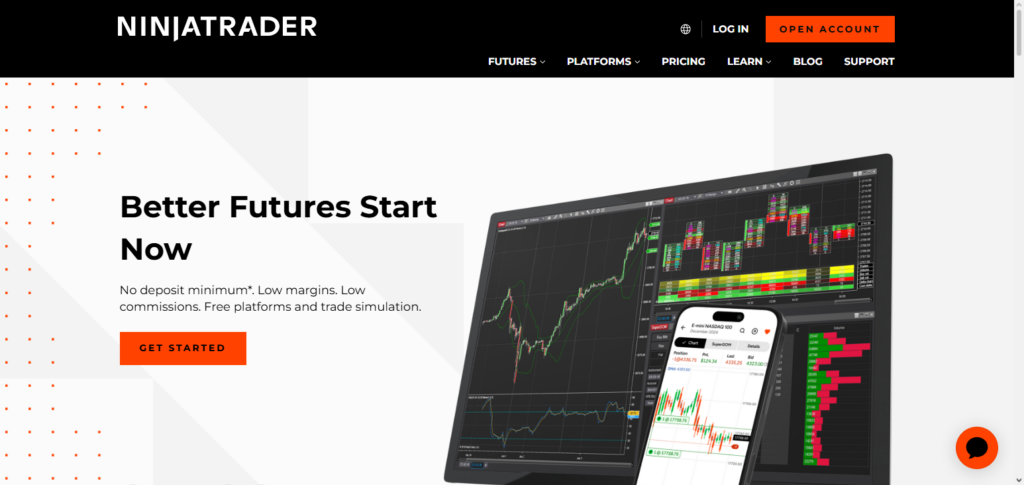
The platform is recognized as one of the Top Algorithmic Trading Platforms for Retail Investors. NinjaTrader has a strong focus on automation and performance tracking, helping retail traders to devise intricate strategies. Its automation features strong risk control. The platform is great for algorithmic traders on control and scalability.
NinjaTrader Features, Pros & Cons
Features:
- Specialization on forex and futures
- Capabilities for automated trading
- Strategy coding in custom C#
- Optimization and backtesting for strategies
- Marketplace for third-party applications
Pros:
- Automation at a professional level
- Connectivity across multiple brokers
- Analytics and charting tools are robust
- Strategy extensions available in the marketplace
- A free demo version is offered
Cons:
- Beginners may face difficulties
- A focus on desktop
- Some advanced options need a paid license
- Limited support for stock trading
- Strategies need coding for custom solutions
7. Quantopian (Community Legacy)
Quantopian, now a part of its community legacy, offered a retail trading platform in the form of a Python-based algorithmic trading platform. Retail traders used Quantopian to formulate, backtest, and implement strategies.
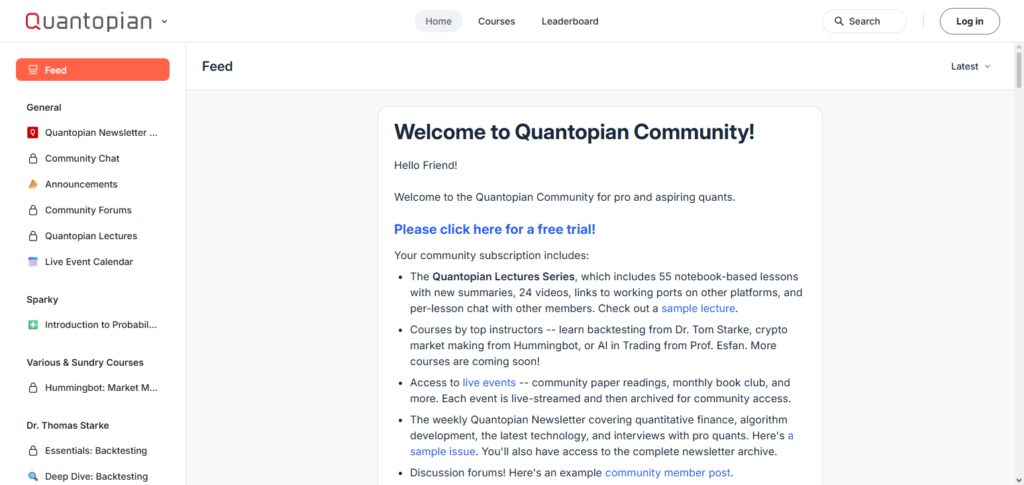
It is one of the only algorithmic trading platforms to have an open source structure, which provided the community with a unique opportunity to collaborate with each other using the same historical data sets. Quantopian is ranked as one of the Top Algorithmic Trading Platforms for Retail Investors for its community focused model.
It remains influential with its educational focus on the coding language Python as the basis of coding for strategy formulation. Retail traders cite Quantopian in reference to algorithmic trading, showcasing its legacy in the automation trading ecosystem.
Quantopian (Community Legacy) Features, Pros & Cons
Features:
- Strategies in coding with Python
- Access to historical data
- A backtesting engine
- Strategies sharing in the community
- An environment for algorithmic trading research
Pros:
- Access to algorithmic trading tools is democratized.
- Unrestricted access to historical data and backtesting
- Heavy emphasis on Python instruction
- Knowledge sharing driven by community
- Best suited for learning coding and strategy creation
Cons:
- Platform is not open for live trading
- Restrained to community legacy features
- Python knowledge is a requirement
- Absence of broker integration at this time
- Some features of a more advanced level are not present
8. TradeStation
TradeStation is a multi-asset trading software with options for equities, options, futures, and forex. The platform is designed with a programming environment, EasyLanguage, that allows retail investors to build, analyze, and automate their own trading strategies.
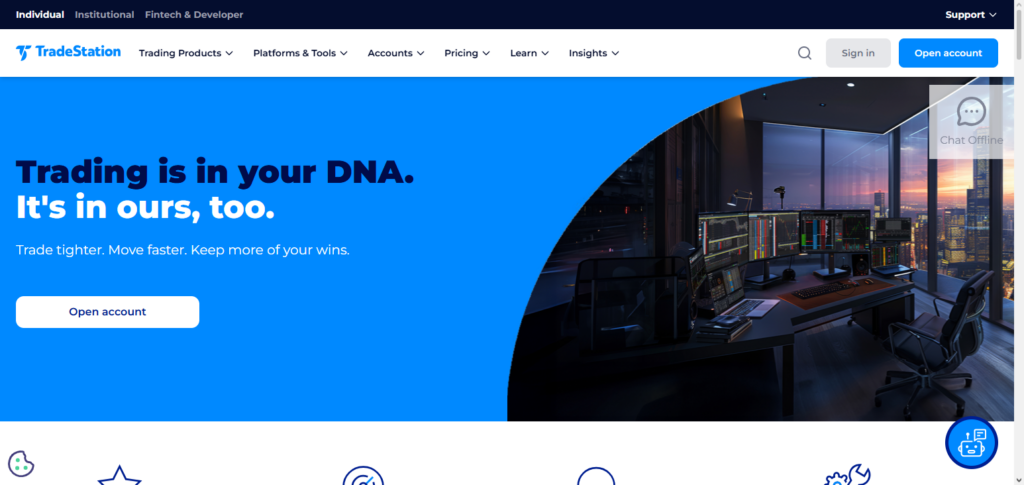
TradeStation is recognized as one of the Top Algorithmic Trading Platforms for Retail Investors due to its charting and risk management capabilities. Additionally, its powerful tools for market scanning and strategy implementation, along with its historical data and integrated brokerage services, are valuable to investors.
This platform is with advanced analytics and strategy modification, making it desirable for novice and seasoned algorithmic traders. Retail investors are equipped with tools and capabilities to rival institutional traders.
TradeStation Features, Pros & Cons
Features:
- Multi-asset trading (stocks, futures, options)
- Automation via EasyLanguage scripting
- Sophisticated analytics and charting
- Optimization and backtesting of strategy
- Live execution and broker integration
Pros:
- Professional-grade tools and analytics
- Automated trading is supported
- Extensove access to historical data
- Scalable for advanced traders
- Outstanding testing capabilities for strategy
Cons:
- EasyLanguage is not quite so easy
- Full-feature access requires payment
- An interface that is focused on the desktop
- Overwhelming to beginning users
- Few features centered on community and social interaction
9. Amibroker
Amibroker is a well-liked algorithmic trading and trend analysis tool for individual investors. Using AFL (Amibroker Formula Language), it enables automation, backtesting, and strategy building. Amibroker, one of the best algorithmic trading platforms for retail investors, offers portfolio-level testing, optimization tools, and quick analysis.
Its ability to connect various data sources and create intricate trading algorithms is advantageous to retail traders. It is perfect for traders who value performance and strategy customisation because of its lightweight yet potent engine. Amibroker is still a great option for individual investors looking for sophisticated algorithmic trading solutions because of its large community support and third-party plugins.
Amibroker Features, Pros & Cons
Features:
- Custom strategies via scripting language AFL
- Analysis at the advanced technical level
- Portfolio and strategy testing backtracking
- Integration of multiple data sources
- Automation and custom indicators
Pros:
- Engine for backtesting that is fast
- Powerful and flexible for custom strategies
- Retail investors find it cost-effective
- Supports the design of a complex system
- Software that is stable and lightweight
Cons:
- Knowledge of coding is necessary (AFL)
- Learning curve for newbies
- Limited broker integrations
- Outdated interface in comparison to competitors
- No default cloud access
10. MultiCharts
MultiCharts is an advanced trading platform that allows automated trading, advanced charting, and strategy backtesting for equities, futures, and forex. It has seamless integration with various brokers and data feeds, giving retail investors execution flexibility.
MultiCharts has one of the Top Algorithmic Trading Platforms for Retail Investors due to the powerful scripting environment provided through EasyLanguage and PowerLanguage.
Users can design strategies and test and optimize them with great analytics and do it all with great efficiency. Precision, risk control, and customization makes MultiCharts one of the best platforms for retail traders that want professional tools without full institutional infrastructure.
MultiCharts Features, Pros & Cons
Features:
- Integration of multiple brokers
- Advanced charting and analytics
- Automated trading with EasyLanguage/PowerLanguage
- Backtesting and optimization of strategies
- Support for multiple assets
Pros:
- Professional grade automation tools
- Advanced customization for high-level traders
- Support for several brokers and data feeds
- Excellent analytics and backtesting
- Great for designing complex strategies
Cons:
- Paid platform
- Scripting knowledge is required
- High learning curve for novices
- Software is only desktop
- Lesser community in comparison to MT5 or TradingView
Conclusion
For retail investors looking to maximize their trading techniques and produce reliable returns, choosing the appropriate algorithmic trading platform is essential.
While systems like Thinkorswim, TradeStation, Amibroker, and MultiCharts offer sophisticated analytics and customisation for more seasoned traders, platforms like MetaTrader 5, TradingView, QuantConnect, and NinjaTrader offer strong capabilities for strategy creation, backtesting, and automation.
Every platform has its own advantages, such as multi-asset support, coding freedom, or ease of use. Retail investors can confidently select the platform that best suits their trading objectives and technical proficiency by assessing features, usability, and integration options.
FAQ
What is an algorithmic trading platform?
An algorithmic trading platform is software that allows traders to create, test, and execute automated trading strategies based on predefined rules, technical indicators, or mathematical models. Retail investors use these platforms to optimize trading efficiency and minimize emotional decisions.
Which platform is best for beginners?
Platforms like MetaTrader 5 (MT5) and TradingView are ideal for beginners due to their intuitive interfaces, community support, and easy-to-use scripting languages for automation.
Can retail investors trade multiple asset classes?
Yes, platforms like QuantConnect, TradeStation, and MultiCharts support equities, forex, futures, and cryptocurrencies, giving retail traders diverse opportunities to diversify and implement multi-asset strategies.
Do I need coding skills to use these platforms?
It depends on the platform. TradingView + Pine Script and Thinkorswim offer beginner-friendly scripting, while platforms like QuantConnect or AlgoTrader require intermediate to advanced programming knowledge.
How do I test my algorithmic strategies?
Most platforms provide backtesting tools to simulate trading strategies using historical data. Platforms like MetaTrader 5, Amibroker, and NinjaTrader allow thorough testing and optimization before live deployment.