


In this post, I’ll go over how cryptocurrency companies monitor on-chain financial reporting by converting unprocessed blockchain data into transparent, verifiable financial records.
- What Is On-Chain Financial Reporting?
- How Crypto Businesses Track On-Chain Financial Reporting
- Example: Daily treasury transaction reporting by a crypto exchange.
- Step 1: Identify business wallets
- Step 2: Link to blockchain data sources
- Step 3: Track transactions in real-time
- Step 4: Classify financial transactions
- Step 5: Reconcile the transactions with the accounting records
- Step 6: Create financial reports
- Why is on-chain reporting important for crypto businesses?
- Transparency
- Regulatory Compliance
- Audit Assessments
- Real-Time Insights
- Risk Management
- Investor Confidence
- Operational Efficiency
- Scalability
- Best Practices for Accurate On-Chain Reporting
- Key Data Crypto Businesses Track On-Chain
- Transaction Volumes
- Wallet Balances
- Token Movements
- Revenue Streams
- Gas and Network Fees
- Smart Contract Activity
- Liquidity Positions
- Customer Liabilities
- Cross-Chain Transfers
- Compliance and Audit Data
- Tools and Technologies Used for Tracking
- Challenges in On-Chain Financial Reporting
- Data Complexity
- Cross-chain Fragmentation
- Wallet Attribution Problems
- Reconciliation Errors
- Regulatory Uncertainty
- Privacy Limitations
- Smart Contract Risks
- Real-Time Volatility
- Scalability Issues
- Audit Readiness
- Real-World Use Cases
- Future Trends in On-Chain Financial Reporting
- Pros & Cons
- Conclusion
- FAQ
This guide describes the tools, procedures, and best practices businesses use to uphold transparency, accuracy, and confidence across decentralized financial ecosystems globally today, from wallet labeling and real-time transaction monitoring to automated analytics and compliance-ready reporting.
What Is On-Chain Financial Reporting?
The method by which cryptocurrency companies gather, examine, and display financial data straight from blockchain networks in order to produce transparent, verifiable records of their operations is known as “on-chain financial reporting.”
It entails monitoring wallet balances, transaction histories, token movements, smart contract interactions, and network fees on both public and private blockchains. Businesses can reconcile on-chain data with conventional financial accounts by utilizing blockchain explorers, analytics platforms, and automated accounting systems.
This strategy facilitates real-time insights into treasury management, revenue flows, and operational performance in decentralized ecosystems while also improving auditability, supporting regulatory compliance, and boosting investor confidence.
How Crypto Businesses Track On-Chain Financial Reporting
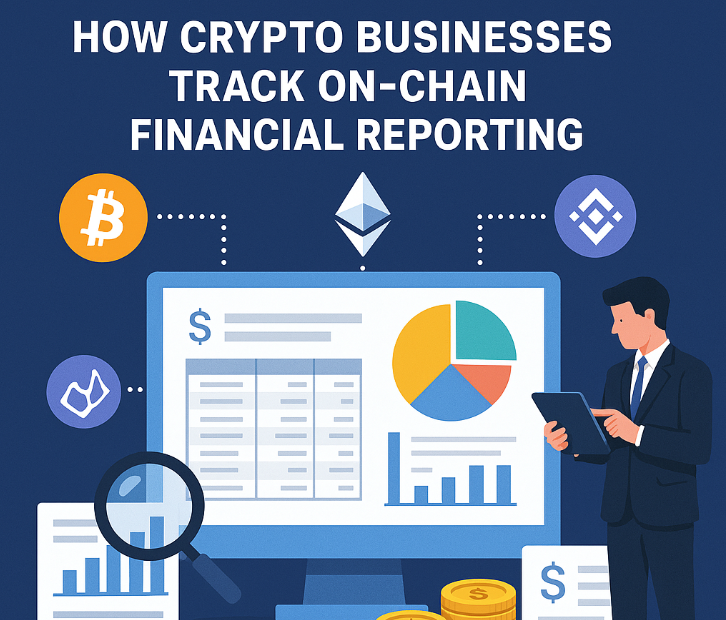
Example: Daily treasury transaction reporting by a crypto exchange.
Step 1: Identify business wallets
The exchange has business wallets marked that handle customer deposits and withdrawals as well as treasury reserves to distinguish business activity from other external wallets.
Step 2: Link to blockchain data sources
The exchange connects these wallets to various blockchain and on-chain activity analytics tools like Etherscan and Dune to obtain real-time activities.
Step 3: Track transactions in real-time
All transactions including incoming and outgoing transfers , gas fees, and smart contracts, are recorded automatically.
Step 4: Classify financial transactions
Transactions are labeled as revenue, operational expenses, customer liabilities, and internal transfers.
Step 5: Reconcile the transactions with the accounting records
The on-chain data is compared with the internal ledgers and the bank records to check if the balances are the same.
Step 6: Create financial reports
The system generates reports on a daily and monthly basis that show treasury balances, total transactions done, and audit trails.
Why is on-chain reporting important for crypto businesses?
Transparency
Fostering trust with users, investors, and regulators by recording every transaction and balance on the blockchain for anyone to see and check.
Regulatory Compliance
Meeting the needed regulations for specific geography Anti-Money Laundering, taxes, and financial reporting, among others.
Audit Assessments
Having securely documented policies that improve the experience of internal and external auditors.
Real-Time Insights
Having the ability to monitor streams of revenue, treasury, and operational cash in real-time.
Risk Management
Identifying, without having to wait for, any smart contract problems, legal issues, or any unusual activities with the funds.
Investor Confidence
Showing good financial practices and management of the funds.
Operational Efficiency
Using automated reporting systems and less manual data entry.
Scalability
Accommodating business growth with the ability to process a high number of transactions on different blockchains.
Best Practices for Accurate On-Chain Reporting
Label and Organize Wallets: Misclassification of wallets can be controlled by labeling and categorizing business, treasury, and operational wallets.
Automate Data Collection: Manually importing data is a potential source of errors, so use blockchain APIs and analytics to automate real-time data retrieval.
Standardize Transaction Categories: Tagging revenues, expenses, transfers, and funds provided by customers, should be governed by the same system for internal consistency.
Reconcile Regularly: On-chain balances and internal ledgers should be matched, along with bank and exchange records, daily or weekly.
Track Gas and Network Fees: In order to report expenses accurately, all transaction costs should be recorded.
Maintain Audit Trails: For the sake of regulatory compliance and external audits, transaction hashes, timestamps, and wallet histories should be preserved.
Monitor Cross-Chain Activity: To obtain the full picture of financial activity, leverage multi-chain compatible block explorers.
Implement Access Controls: To guard against internal errors or manipulation, restrict wallet labeling and financial data editing privileges.
Stay Updated on Regulations: Maintaining compliance with local and international requirements should be at the forefront of reporting.
Run Periodic Reviews: To ensure consistency in reporting and data accuracy, conduct internal audits regularly.
Key Data Crypto Businesses Track On-Chain
Transaction Volumes
A total number and value of all transfers coming in and going out of the company’s wallets.
Wallet Balances
Current treasury, operational, and custodial wallet balances.
Token Movements
Internal token transfers, burning, staking rewards, and other token issuances.
Revenue Streams
Fees on the blockchain, income generated from trading, and income from the protocols.
Gas and Network Fees
Fees for transactions and for the execution of smart contracts.
Smart Contract Activity
Interactions, upgrades, and payments that are done automatically.
Liquidity Positions
Money that is invested in pools in DeFi, lending, and market making.
Customer Liabilities
Custodial wallets which have withdrawal and deposit commitments.
Cross-Chain Transfers
Movement and bridges between other blockchain networks.
Compliance and Audit Data
Data relating to network engagement for regulatory and auditing purposes like timestamps, transaction id’s, and histories of the addresses.
Tools and Technologies Used for Tracking
Blockchain Explorers: Etherscan, Solscan and BscScan allow the user to track and view real-time transactions, balances of wallets, and activities of smart contracts.
On-Chain Analytics Platforms: Dune, Nansen, and Glassnode are used for dashboards, for behavioral analysis, and wallet labeling.
Crypto Accounting Software: CoinTracker, Koinly, and Cryptio software are used to record on-chain data and subsequently integrate them into financial and tax statements.
APIs and Data Aggregators: Services like Alchemy, Infura, and Moralis Enable the integration of raw blockchain data into the internal reporting systems.
Enterprise Data Warehouses: Cloud systems like BigQuery and Snowflake are used for the storage and analysis of massive arrays of blockchain data.
Smart Contract Monitoring Tools: Systems that monitor and track the performance of a contract, upgrades, and automated payments.
Compliance and Risk Tools: Systems that monitor and flag transactions that are considered to be suspicious and assist KYC and AML reporting.
Automation and Integration Tools: Middleware and scripts that enable the connection of on-chain data to ERP, accounting, and compliance systems.
Challenges in On-Chain Financial Reporting

Data Complexity
It isn’t always easy to form structures and interpret large amounts of raw blockchain data.
Cross-chain Fragmentation
Visibility gaps are created by the difficulty of tracking operations spanning numerous blockchain networks and bridges.
Wallet Attribution Problems
pinning down which addresses belong to the business, customers, or a third party’s is not always easy.
Reconciliation Errors
On-chain data conflicting with your internal bookkeeping or your bank statements.
Regulatory Uncertainty
Compliance needs that are different and constantly changing based on the area you’re operating in.
Privacy Limitations
Transaction data is exposed on public blockchains, but there is a lack of clear identity context.
Smart Contract Risks
Bugs or exploits can distort financial data and balances.
Real-Time Volatility
Rapid price changes affect valuation and financial reporting accuracy.
Scalability Issues
When large volumes of transactions are processed, data reporting and processing systems become extremely slow.
Audit Readiness
Having full and traceable records that can be audited at all times in decentralized systems.
Real-World Use Cases
Crypto Exchanges: Record and report deposits, withdrawals, trades, and regulatory trading fees.
DeFi Protocols: Record and report total locked value (TLV), protocol earnings, automated smart contract earnings, and liquidity pools.
Web3 Startups: Report and manage intrepid funds, operational costs, and treasury wallets, cross-chain.
NFT Marketplaces: Report and manage fees per transaction, volumes per transaction, and royalties to creators.
DAOs: On-chain reporting and management of treasury spending, governance, and distributions of grants.
Stablecoin Issuers: On-chain reporting and management of burn, peg, and transaction reserves.
Payment Processors: On-chain reporting and management of payment, time of settlement, and transaction cost for cross-border crypto.
Institutional Investors: On-chain management and auditing of fund flow, custody, and portfolio of real-time performance.
Future Trends in On-Chain Financial Reporting
Increased automation, real-time transparency, and tighter interaction with conventional financial systems will be the main developments in on-chain financial reporting in the future.
Analytics driven by AI will assist in categorizing transactions, identifying irregularities, and forecasting compliance issues across several blockchains. In order to enable real-time financial statements and ongoing audits, businesses will increasingly link blockchain data directly to ERP and accounting systems.
While privacy-preserving technologies like zero-knowledge proofs may enable businesses to demonstrate compliance and solvency without disclosing sensitive transactional data, standardized reporting frameworks and international regulatory requirements are anticipated to increase uniformity.
Pros & Cons
| Pros | Cons |
|---|---|
| High transparency with publicly verifiable data | Complex raw data that requires technical expertise |
| Real-time tracking of transactions and balances | Cross-chain reporting can be difficult |
| Strong audit trails using immutable blockchain records | Regulatory uncertainty across jurisdictions |
| Reduced risk of manual reporting errors through automation | Privacy limitations for sensitive business data |
| Faster compliance and audit processes | Volatility can impact financial valuations |
| Improved investor and stakeholder trust | Dependence on third-party analytics tools |
| Easy detection of suspicious or fraudulent activity | Scalability challenges with high transaction volumes |
Conclusion
To sum up, cryptocurrency companies monitor on-chain financial reporting by fusing transparent blockchain data with sophisticated analytics, accounting software, and robust internal controls.
They convert complicated on-chain activities into transparent, audit-ready financial records through wallet labeling, automatic transaction monitoring, and routine reconciliation.
Accurate on-chain reporting will become even more crucial for fostering trust, guaranteeing compliance, and promoting sustainable growth in the global digital asset ecosystem as laws change and technology develops.
FAQ
What is on-chain financial reporting in crypto?
It is the process of collecting and analyzing blockchain transaction data—such as wallet balances, transfers, and smart contract activity—to create transparent and verifiable financial records.
Why is on-chain reporting important for crypto businesses?
It improves transparency, supports regulatory compliance, simplifies audits, and helps investors and regulators verify financial activity in real time.
What tools are commonly used for on-chain tracking?
Businesses use blockchain explorers, on-chain analytics platforms, crypto accounting software, and APIs to collect and organize transaction data.
How do companies ensure data accuracy?
They label wallets, automate data collection, reconcile on-chain records with internal ledgers, and maintain detailed audit trails.
Can on-chain data be used for tax and regulatory reporting?
Yes, on-chain data can be mapped to tax and compliance reports, though requirements vary by country and jurisdiction.