


In this article, I will look at the Bitcoin L2s Bringing DeFi to BTC Without Wrapped Assets, where I will examine the new solutions that are unlocking new functionality for Bitcoin beyond simple transactions using Bitcoin Layer 2.
- Why Choose Bitcoin L2s Bringing DeFi to BTC Without Wrapped Assets
- Benefits Of Bitcoin L2s Bringing DeFi to BTC Without Wrapped Assets
- Key Features Of Bitcoin L2s Bringing DeFi to BTC Without Wrapped Assets
- Bitcoin L2s Bringing DeFi to BTC Without Wrapped Assets List
- 10 Bitcoin L2s Bringing DeFi to BTC Without Wrapped Assets
- 1. Stacks
- Stacks Traits, Benefits & Drawbacks
- Traits:
- Benefits:
- Drawbacks:
- 2. Rootstock (RSK)
- Rootstock (RSK) Traits, Benefits & Drawbacks
- Traits:
- Benefits:
- Drawbacks:
- 3. Liquid Network
- Liquid Network Traits, Benefits & Drawbacks
- Traits:
- Benefits:
- Drawbacks:
- 4. Lightning Network
- Lightning Network Traits, Benefits & Drawbacks
- Traits:
- Benefits:
- Drawbacks:
- 5. Botanix Labs Spiderchain
- Botanix Labs Spiderchain Traits, Benefits & Drawbacks
- Traits:
- Benefits:
- Drawbacks:
- 6. Babylon
- Babylon Traits, Benefits & Drawbacks
- Traits:
- Benefits:
- Drawbacks:
- 7. Mintlayer
- Mintlayer Traits, Benefits & Drawbacks
- Traits:
- Benefits:
- Drawbacks:
- 8. RGB Protocol
- RGB Protocol Traits, Benefits & Drawbacks
- Traits:
- Benefits:
- Drawbacks:
- 9. Nomic
- Nomic Traits, Benefits & Drawbacks
- Traits:
- Benefits:
- Drawbacks:
- 10. Drivechain
- Drivechain Traits, Benefits & Drawbacks
- Traits:
- Benefits:
- Drawbacks:
- Comparison Table: Bitcoin L2s Bringing DeFi to BTC Without Wrapped Assets
- Conclusion
- FAQ
Using these new networks, you can conduct smart contracts and complex transactions for DeFi, crypto staking, and faster payments, while also providing the same level of security that Bitcoin includes with each of its transactions. Meet the premier Bitcoin L2 platforms that are expanding the use of BTC without using wrapped assets.
Why Choose Bitcoin L2s Bringing DeFi to BTC Without Wrapped Assets
Retain Your Own Bitcoin: Without Bitcoin L2s, individuals looking to use DeFi services are forced to convert their Bitcoin to wrapped assets and relinquish custody to a third-party. L2s allow users to engage and utilize DeFi while retaining their ownership of native Bitcoin.
Increased Usability for Bitcoin: Bitcoin L2s enable many of the financial protocols and services (decentralized exchanges, lending services, staking, smart contracts) that are inaccessible to the base layer of the Bitcoin blockchain.
Faster Transactions with Greater Scalability: Since Bitcoin L2s alleviate congestion on the primary Bitcoin blockchain, users experience faster transaction confirmations with lower transaction costs.
Greater Security with Bitcoin’s Infrastructure: Since many Bitcoin L2s are utilizing cryptographic proofs, Bitcoin’s security and settlement layer, and Bitcoin’s mining layer, L2s can offer greater security when layered on the feature-rich financial offerings.
Less Wrapped Asset Risk: By bringing DeFi to Bitcoin, L2s reduce the risk of wrapped assets due to bridge risks, security concerns, centralized custody, and management of tokens.
DeFi on Bitcoin: With L2s, Bitcoin is the underlying asset at the center of the financial ecosystem and permits extensive trade, liquidity, and DeFi protocol participation.
Encouraging Developers: By L2s providing the capability to build smart contracts, DeFi, and DApps to the protocol, developers are given the means to build financial products without the need to alter the core protocol of Bitcoin.
Enhanced Privacy and Transaction Speed: Bitcoin L2 solutions promote a better user experience with off-chain transaction processing and advanced transaction features, all while remaining Bitcoin compliant.
Bringing Bitcoin to the Future: Bitcoin L2 solutions take the secure and decentralized framework of Bitcoin and integrate the modern features needed for the future of finance and the next generation of financial transactions, thus evolving Bitcoin for ever-growing demands and wider usage.
Benefits Of Bitcoin L2s Bringing DeFi to BTC Without Wrapped Assets
Native BTC DeFi Access: With the development of Bitcoin L2s, users no longer need to wrap BTC to access DeFi solutions. Users retain full control of their BTC while also using Bitcoin-based financial services.
More Use Cases for Bitcoin: Beyond being a digital gold, these Layer 2s give Bitcoin the capability to have DeFi, smart contracts, and other blockchain services such as Staking, Lending, NFTs, and DEXs.
Lower Fees: Bitcoin L2s reduce congestion and resource consumption on the Bitcoin blockchain, allowing users to take advantage of reduced fees compared to standard on-chain transactions.
Quicker Transactions: Users can utilize DeFi services built on Bitcoin even quicker than usual. L2s use things such as payment channels and sidechains to facilitate quicker transaction processing.
Less Wrapped BTC Use: With the advent of Bitcoin L2s, there is less need for Wrapped BTC because BTC now has the ability to seamlessly interact with DeFi protocols.
Increased Bitcoin Scalability: Bitcoin L2s expand the number of possible transactions the Bitcoin network can support while still being linked to the Bitcoin blockchain.
More Secure and Trustless: Because many Bitcoin L2s use Bitcoin for the majority of their processing, they provide a more secure financial service infrastructure.
Additional Yield Opportunities for BTC Holders: Bitcoin L2 ecosystems expand Bitcoin holder’s options for lending, staking, liquidity provision, and other DeFi opportunities that were previously unavailable.
Developer-Centric Innovation: The L2s of Bitcoin offer developers the opportunity to build decentralized applications, financial tools, and Web3 solutions that utilize the broader, developed ecosystem of Bitcoin.
Expansion of the Bitcoin Ecosystem: By enabling DeFi and securing developers, users, and businesses, Bitcoin L2s assist in evolving the Bitcoin system into a more decentralized financial system.
Key Features Of Bitcoin L2s Bringing DeFi to BTC Without Wrapped Assets
| Key Feature | Description |
|---|---|
| Native Bitcoin DeFi Support | Bitcoin L2s enable decentralized finance applications using Bitcoin-based infrastructure without requiring users to convert BTC into wrapped assets. |
| Smart Contract Functionality | Layer 2 networks add programmable smart contracts to Bitcoin, allowing developers to build DeFi platforms, lending systems, exchanges, and Web3 applications. |
| Bitcoin Security Integration | Many L2 solutions leverage Bitcoin’s settlement layer, mining security, or cryptographic verification methods to provide stronger network protection. |
| Faster Transactions | Bitcoin L2s process transactions through secondary layers, enabling quicker confirmations compared to Bitcoin’s main blockchain. |
| Lower Transaction Fees | By reducing congestion on the Bitcoin network, L2 solutions provide more affordable transactions for DeFi activities and everyday payments. |
| Wrapped Asset-Free Approach | These solutions allow BTC users to access decentralized applications without relying heavily on wrapped BTC tokens or centralized custodial systems. |
| Scalable DeFi Infrastructure | Bitcoin L2 networks improve scalability by handling more transactions through sidechains, payment channels, and off-chain execution methods. |
| Smart Contract Compatibility | Platforms like Stacks and Rootstock provide developer environments that support decentralized applications and advanced financial products. |
| Cross-Chain Interoperability | Some Bitcoin L2s connect Bitcoin liquidity with other blockchain ecosystems, enabling broader access to decentralized applications. |
| Privacy Enhancements | Certain L2 technologies offer confidential transactions, client-side validation, and improved privacy features for Bitcoin users. |
| BTC Staking and Yield Opportunities | Protocols like Babylon introduce ways for Bitcoin holders to generate additional utility and potential rewards from their BTC holdings. |
| Tokenization Support | Some Bitcoin L2 solutions allow the creation and management of digital assets, stablecoins, and tokenized financial products. |
| Developer Innovation Platform | Bitcoin L2s provide tools and frameworks for developers to create new financial applications without modifying Bitcoin’s core protocol. |
| Decentralized Financial Ecosystem | These networks help transform Bitcoin into a broader financial platform supporting lending, trading, payments, and Web3 services. |
Bitcoin L2s Bringing DeFi to BTC Without Wrapped Assets List
- Stacks
- Rootstock (RSK)
- Liquid Network
- Lightning Network
- Botanix Labs Spiderchain
- Babylon
- Mintlayer
- RGB Protocol
- Nomic
- Drivechain
10 Bitcoin L2s Bringing DeFi to BTC Without Wrapped Assets
1. Stacks
Stacks aims to enhance the functionality of Bitcoin by taking the lead in most of the smart contracts and DeFi applications as a Bitcoin Layer 2 solution.
Because Stacks is among the major Bitcoin L2s Bringing DeFi to BTC Without Wrapped Assets, Bitcoin serves as the settlement layer and Stacks developers can build decentralized applications using the Clarity smart contract language.
Stacks achieves Bitcoin security doing Proof of Transfer consensus for every transaction. Stacks combines lending, NFTs, DAOs and decentralized exchanges. Its unique approach allows participants to retain ownership of the native Bitcoin instead of relying on synthetic coins.
Stacks Traits, Benefits & Drawbacks
Traits:
- Bitcoin Secured Smart Contracts: Smart contracts and dApps can use Bitcoin as the settlement layer.
- Clarity Programming Language: Smarts contracts are predictable and designed to reduce risks and improve security.
- Proof of Transfer Consensus: Stacks transactions are synced to Bitcoin and secured by Stacks’ custom consensus method.
- DeFi and NFT Support: Web3 dApps, Decentralized Exchanges, Lending, and NFTs are built in Stacks.
- Bitcoin Native Ecosystem: Stacks allows for the building of Apps which use Bitcoin’s liquidity without having to alter Bitcoin’s base layer.
Benefits:
- Stacks allows for Bitcoin-based DeFi.
- Stacks offers more use cases for BTC.
- Layer 2 decreases the burden of the main Bitcoin network while increasing the speed of confirmation for transactions.
- BTC based smart contracts are executed quickly.
Drawbacks:
- Stacks has a smaller ecosystem compared to Ethereum-related DeFi.
- Smart contracts are in the early stages of adoption.
- Compared to other chains, stacks transactions are relatively slow.
- Clarity has a small user base.
- Stacks is reliant on the network of Bitcoin.
2. Rootstock (RSK)
Rootstock (RSK) provides Bitcoin-compatible smart contracts that allow Ethereum-style decentralized applications on Bitcoin.
As one of the Bitcoin L2s Bringing DeFi to BTC Without Wrapped Assets, Rootstock enables Bitcoin-based DeFi and offers smart contract users access to lending and trading as well as yield services.

To ensure Bitcoin security is retained, RSK uses merged mining in a two-way peg system, allowing BTC transfers between Rootstock and Bitcoin.
A developer’s flexibility is further enhanced as Rootstock supports the deployment of Ethereum applications through its EVM. Rootstock creates an ecosystem of services on the layer 2 of Bitcoin with advanced financial services and minimal reliance on wrapped assets.
Rootstock (RSK) Traits, Benefits & Drawbacks
Traits:
- Ethereum-Compatible Smart Contracts: EVM based apps allow Ethereum devs to build on Bitcoin.
- Merged Mining Security: Bitcoin miners secure the Rootstock network.
- Bitcoin-Based DeFi Infrastructure: Enables lending, trading, and decentralized applications using BTC liquidity.
- Two-Way Bitcoin Peg: Allows movement of BTC between Bitcoin and Rootstock.
- Developer-Friendly Platform: Supports existing Ethereum tools and frameworks.
Benefits:
- Ethereum based DeFi on Bitcoin is possible.
- Rootstock provides Bitcoin security.
- Compatible with existing dapps.
- Broadens Bitcoin applications beyond payment options.
- Presents an opportunity for cheaper and quicker transactions.
Drawbacks:
- Requires reliance on some federated systems.
- Less adoption when compared with Ethereum DeFi.
- Security issues create concerns with bridging.
- Limited and smaller developer communities.
- Still a work in progress for complete decentralization.
3. Liquid Network
Liquid Network is an efficient, private Bitcoin sidechain, and layer 2 solution for the issuance of tokenized assets, developed by Blockstream.
In the context of Bitcoin L2s Bringing DeFi to BTC Without Wrapped Assets, Liquid Network enables the transfer of BTC, in the form of Liquid Bitcoin (L-BTC), while users maintain their embedded position in the Bitcoin Network.
As a federated sidechain, which is operated by a select, trusted cohort of the Bitcoin community, Liquid Network is ideal for institutional players who desire a solution for faster settlement and privacy-oriented Bitcoin transactions.
Liquid Network Traits, Benefits & Drawbacks
Traits:
- Bitcoin Sidechain Technology: Offers quicker and more private transactions.
- Confidential Transactions: Conceals the amounts and the assets involved in transactions.
- Asset Issuance Support: Creation of digital assets and tokens is enabled.
- Institution-Focused Infrastructure: Designed with exchanges, traders, and financial institutions in mind.
- Fast Settlement: Quicker transfer of Bitcoin compared to the main chain.
Benefits:
- Provides faster transactions with Bitcoin.
- Increased privacy for transactions.
- Provides tokenized financial assets.
- Supports financial institutions use of Bitcoin.
- Provides less congestion to the Bitcoin network.
Drawbacks:
- Uses a federated governance model.
- Less decentralized than Bitcoin.
- Limited retail adoption.
- Requires trust in federation members.
- Smaller DeFi ecosystem.
4. Lightning Network
Lightning Network is a layer 2 scaling solution for Bitcoin, which facilitates the processing of near-instant and low-cost transactions, by utilizing off-chain payment channels.
Arguably one of the most well-known Bitcoin L2s Bringing DeFi to BTC Without Wrapped Assets, Lightning Network employs technically ingenious methods of enabling near-instantaneous transactions, without the need to make changes to Bitcoin’s base layer.

Although Lightning Network initially focused on payments, the use-cases of the technology have rapidly expanded to include a variety of decentralized finance and micropayment applications, as well as Bitcoin-centric financial services.
Notably, users transact in BTC and do not need to convert their holdings to wrapped tokens. Its scalable design achieves the processing of millions of transactions while upholding Bitcoin’s censorship-resistance, security and decentralization.
Lightning Network Traits, Benefits & Drawbacks
Traits:
- Instant Bitcoin Payments: Payments are almost instantaneous by way of payment channels.
- Low Transaction Fees: Costs are decreased due to an off-chain transaction.
- Bitcoin Native Solution: Uses actual BTC rather than wrapped assets.
- High Scalability: Designed to accommodate millions of small transactions.
- Global Payment Network: Payment is designed to be quick and peer-to-peer.
Benefits:
- Makes Bitcoin practical for transactions on a daily basis.
- Reduces congestion of the blockchain.
- Extremely low cost transactions.
- Upholds the security of the Bitcoin system.
- Introduces new financial services and facilitates micropayments.
Drawbacks:
- Managing liquidity can be difficult.
- The experience is still at an early stage.
- Not constructed for more complex DeFi.
- Channel management is required.
- Route management has a steeper learning curve.
5. Botanix Labs Spiderchain
Botanix Spiderchain, being one of the pioneering Bitcoin L2s, utilizes wrapped assets and employs Spiderchain technology to introduce smart contracts and DeFi on Bitcoin. As part of its mission,
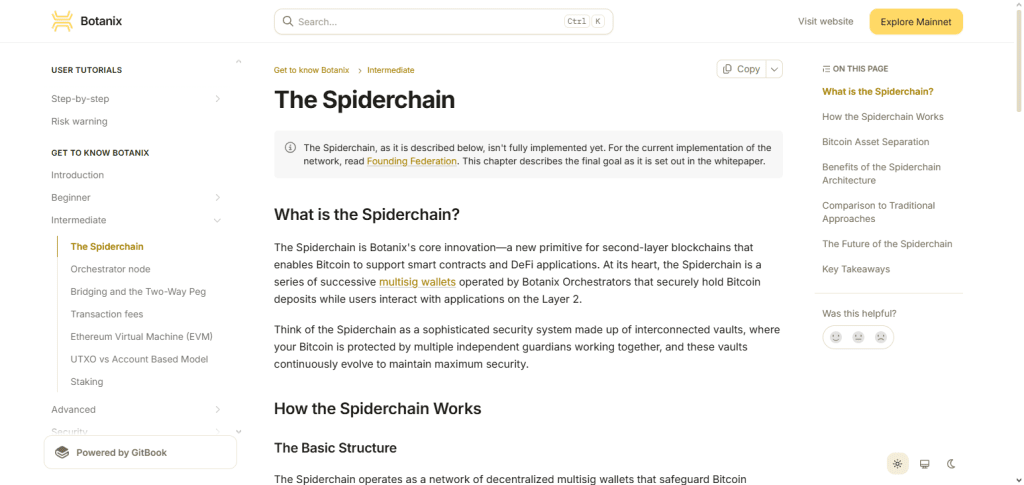
Botanix is building a Bitcoin secure environment that is compatible with Ethereum. Spiderchain employs multisignature technology to connect Bitcoin liquidity with smart contracts and minimize the reliance on wrapped assets.
The platform allows developers to create DeFi and dApps, lending services, and financial instruments based entirely on Bitcoin. Combining security and smart contracts is the focus of Botanix.
Botanix Labs Spiderchain Traits, Benefits & Drawbacks
Traits:
- Bitcoin-Compatible Smart Contracts: Introduces Ethereum functions on Bitcoin.
- Spiderchain Architecture: Employs multi-signature decentralization.
- EVM Compatibility: Ethereum developers can build on top of it.
- Bitcoin Settlement Layer: Transactions settle on Bitcoin.
- DeFi Infrastructure: Network lending and trading focused with integrated Web3.
Benefits:
- Smart contracts on Bitcoin are now possible.
- Bitcoin based DeFi is possible.
- Less reliant on wrapped BTC.
- Developer tools are integrated.
- Programmable features are added to Bitcoin’s security.
Drawbacks:
- New tech.
- Newer ecosystem.
- Security model is untested.
- Less usage than other L2s.
- Unknown future scalability.
6. Babylon
The Babylon Bitcoin Staking Protocol is one of the newest Bitcoin L2s and provides a means by which BTC holders can stake their assets in order to provide security to DeFi networks based on Proof of Stake.
Without the use of wrapped assets, Babylon allows Bitcoin users to use their native BTC. Trustless staking is enabled by the security features of the Bitcoin network, such as time-locks and cryptographic proofs.
Babylon increases the usability of Bitcoin by simultaneously connecting BTC with liquidity in decentralized networks, and users can retain their original holdings of Bitcoin. This creates pathways for yield generation and security.
Babylon Traits, Benefits & Drawbacks
Traits:
- Bitcoin Staking Protocol: BTC can secure other chains.
- Native BTC can be used. No wrapping needed.
- Cryptographic Security Model: Bitcoin stake security.
- Cross-Chain: links Bitcoin liquidity with PoS chains.
- Focused on Yield Generation.
Benefits:
- Staking on other chains is possible.
- BTC no longer needs to be HODL.
- Improves safety of other chains.
- Stays with Bitcoin ownership.
- New DeFi uses.
Drawbacks:
- Staking is difficult.
- Risks involve associated networks.
- Adoption continues to expand.
- Understanding validator economics is crucial.
- Growth may be influenced by regulatory unpredictability.
7. Mintlayer
Mintlayer aims to innovate decentralized finance by building a Bitcoin-inspired blockchain capable of native tokenization and financial applications. Mintlayer is one of the Bitcoin L2s Bringing DeFi to BTC Without Wrapped Assets.
Mintlayer is building Bitcoin-compatible financial infrastructure and does not force users to use wrapped BTC. The network provides token management, decentralized exchanges, token issuance, and atomic swaps within the network.
Mintlayer’s hybrid model combines Proof-of-Stake and security of Bitcoin. Mintlayer aims to accomplish a more effective DeFi ecosystem, allowing users of Bitcoin to use financial services and accomplish this with transparency and with fewer intermediaries.
Mintlayer Traits, Benefits & Drawbacks
Traits:
- Bitcoin-Centric Blockchain: Integrates Devi features while following Bitcoin design.
- Built-in Tokenization: Capable of housing digital assets.
- Supports Atomic Swaps: Facilitates borderless exchange of assets.
- Sustains Financial Apps: Hosts financial application infrastructure.
- Hybrid Consensus Framework: Balances security and efficiency.
Benefits:
- Flexible and modular financial infrastructure.
- Token creation and trading is supported.
- Intermediary dependency is reduced.
- Transaction processing is more efficient.
Drawbacks:
- Limited developer support.
- Smaller Ecosystem.
- Market adoption is limited.
- New technology is inherently risky.
- Lower liquidity is prevalent.
- Traditional DeFi platforms are preferred.
8. RGB Protocol
As a client-side validation protocol, RGB Protocol allows the users of Bitcoin and the Lightning Network to create smart contracts and digital assets while keeping Bitcoin’s base layer unaltered.
RGB is one of the pioneering Bitcoin L2s Bringing DeFi to BTC Without Wrapped Assets. With RGB, the users of Bitcoin may create DApps (decentralized applications) and perform programmable transactions with the majority of data off-chain.
RGB further enhances privacy, scalability, and efficiency. RGB provides Bitcoin users with DeFi applications and services, and digital asset management, while keeping all of the security and decentralized features of Bitcoin intact.
RGB Protocol Traits, Benefits & Drawbacks
Traits:
- Client-Side Validation: Processes transaction data privately outside Bitcoin.
- Bitcoin Native Smart Contracts: Enables programmable assets on Bitcoin.
- Lightning Integration: Supports faster Bitcoin-based applications.
- Privacy-Focused Design: Keeps sensitive data off-chain.
- Asset Issuance Support: Allows creation of digital assets.
Benefits:
- Maintains Bitcoin decentralization.
- Improves privacy and scalability.
- Enables Bitcoin-native tokens.
- Reduces blockchain storage requirements.
- Supports advanced DeFi applications.
Drawbacks:
- Technical complexity for developers.
- Limited user adoption.
- Development is still progressing.
- Requires specialized knowledge.
- Ecosystem tools are still emerging.
9. Nomic
Nomic is a decentralized blockchain that aims to connect Bitcoin with various other blockchains through secure interoperability solutions. As part of “Bitcoin L2s Bringing DeFi to BTC Without Wrapped Assets,” Nomic provides Bitcoin users with cross-chain application access without the use of wrapped assets.

Nomic enables users to send Bitcoin into decentralized ecosystems via secure bridges and interoperability. Nomic’s architecture allows users to send Bitcoin to different blockchains to use Bitcoin in DeFi across multiple blockchain ecosystems. Nomic aims to improve accessibility, safety, and control of financial applications built on top of Bitcoin.
Nomic Traits, Benefits & Drawbacks
Traits:
- Bitcoin Interoperability Network: Integrates other blockchain ecosystems with Bitcoin.
- Cross-Chain Infrastructure: Uses technology that enables movement of BTC across networks.
- De-Centralized Bridge Technology: Prioritizes minimizing dependency on centralized bridges.
- Cosmos Ecosystem Integration: Links Bitcoin liquidity to app solutions built on Cosmos.
- BTC Accessibility Focus: Focuses on the usability of BTC throughout DeFi solutions.
Benefits:
- Facilitates interoperability of Bitcoin.
- Enables participation of BTC to different ecosystems.
- Broadens DeFi options.
- Decreases risks of centralized bridges.
- Creates more liquidity access for Bitcoin.
Drawbacks:
- The use of cross-chain bridges causes security risks.
- Minimal ecosystem adoption.
- Requires a dependency on other networks/blockchains.
- High level of complexity.
- Liquidity may be inadequate.
10. Drivechain
Drivechain is a Bitcoin scaling solution that supports independent sidechains that are directly linked to the Bitcoin Network.
Within the scope of Bitcoin L2s Bringing DeFi to BTC Without Wrapped Assets, Drivechain allows the development of blockchains that support smart contracts and DeFi applications while keeping Bitcoin the settlement layer.

Through mechanisms such as Blind Merged Mining and two-way BTC transfer, Drivechain aims to extend the functionality of Bitcoin while keeping changes to the core protocol to a minimum.
Drivechain creates an environment for the development of different applications and sidechains that run in the Bitcoin ecosystem while keeping BTC liquidity and reducing the reliance on wrapped tokens.
Drivechain Traits, Benefits & Drawbacks
Traits:
- Bitcoin Sidechain Framework: Allows creation of independent blockchains connected to Bitcoin.
- Two-Way BTC Transfers: Enables transfers of BTC between the chains.
- Customized Blockchain Creation: Allows creation of blockchain dedicated to particular apps.
- Blind Merged Mining: Integrates the security of Bitcoin mining.
- Flexible Development Model: Encourages development of ideas and solutions without direct modifications to Bitcoin.
Benefits:
- Provides additional functionality to Bitcoin.
- Supports the creation of customized DeFi.
- Supports innovations that do not modify Bitcoin’s protocols.
- Refers to the liquidity of Bitcoin.
- Provides an avenue for application development.
Drawbacks:
- Presents an inherent change to the Bitcoin protocol.
- Security issues related to control of the sidechain.
- Currently low adoption.
- Ongoing debates about governance.
- High implementation cost.
Comparison Table: Bitcoin L2s Bringing DeFi to BTC Without Wrapped Assets
| Bitcoin L2 | Main Purpose | Key Technology | DeFi Capability | Wrapped Asset Dependency | Best For |
|---|---|---|---|---|---|
| Stacks | Smart contracts and Bitcoin-based applications | Proof of Transfer + Clarity Smart Contracts | Lending, NFTs, DeFi apps, Web3 platforms | Low dependency | Developers building Bitcoin DeFi applications |
| Rootstock (RSK) | Ethereum-compatible smart contracts on Bitcoin | EVM Compatibility + Merged Mining | DEXs, lending, yield platforms | Reduced dependency | Ethereum developers entering Bitcoin ecosystem |
| Liquid Network | Fast and private Bitcoin transactions | Federated Sidechain + Confidential Transactions | Asset issuance, tokenized finance | Uses L-BTC model | Institutions and financial markets |
| Lightning Network | Instant Bitcoin payments | Off-chain Payment Channels | Payments, micropayments, emerging DeFi use cases | No wrapped assets | Fast BTC transactions and payments |
| Botanix Spiderchain | Bitcoin-native smart contract ecosystem | Spiderchain Architecture + EVM Support | DeFi apps, trading, lending | Designed to avoid wrapped BTC reliance | Bitcoin smart contract innovation |
| Babylon | Bitcoin staking and security services | Bitcoin Cryptographic Staking | BTC staking, blockchain security, yield opportunities | No wrapped BTC required | BTC holders seeking staking utility |
| Mintlayer | Bitcoin-focused DeFi infrastructure | Hybrid Consensus + Tokenization | DEXs, token trading, financial applications | Low dependency | Tokenization and decentralized finance |
| RGB Protocol | Bitcoin-native smart contracts and assets | Client-Side Validation + Lightning Integration | Tokens, smart contracts, private DeFi applications | No wrapped assets | Privacy-focused Bitcoin applications |
| Nomic | Bitcoin interoperability | Cross-Chain Bridge Technology | Cross-chain DeFi access and BTC liquidity | Reduces wrapped asset dependence | Connecting Bitcoin with other ecosystems |
| Drivechain | Custom Bitcoin sidechain framework | Two-Way Peg + Blind Merged Mining | Custom DeFi chains and applications | Designed for native BTC usage | Experimental Bitcoin scaling solutions |
Quick Comparison Summary
| Category | Leading Bitcoin L2 Examples |
|---|---|
| Best for Smart Contracts | Stacks, Rootstock, Botanix Spiderchain |
| Best for Fast Payments | Lightning Network |
| Best for Bitcoin Staking | Babylon |
| Best for Privacy Features | RGB Protocol, Liquid Network |
| Best for Institutional Use | Liquid Network |
| Best for Cross-Chain Access | Nomic |
| Best for Experimental Scaling | Drivechain |
| Best for Bitcoin DeFi Growth | Stacks, Rootstock, Babylon |
Conclusion
Bitcoin L2s Bringing DeFi to BTC Without Wrapped Assets, are major building blocks to evolving Bitcoin’s perception. Rather than only storing value, Bitcoin can now become a means of building a highly functional and versatile financial system.
This is facilitated through Stacks, Rootstock, the Lightning Network, Babylon, RGB and more. The aforementioned networks and many more, like Bitcoin itself, supply users with the tools of smart contracts and DeFi while prioritizing token security.
L2 innovations are rapidly improving Bitcoin’s ease of use and fleibility by providing better existing technologies, privacy options , and higher transactional ceilings.
The flexibility provided by the increase in L2 networks is better establishing and diversifying the use of Bitcoin in our financial system. It is providing a more secure, efficient and decentralized means of using exchange-value for the near future.
FAQ
What Are Bitcoin L2s Bringing DeFi to BTC Without Wrapped Assets?
Bitcoin L2s Bringing DeFi to BTC Without Wrapped Assets are Layer 2 networks and protocols that expand Bitcoin’s functionality by enabling decentralized finance applications without requiring users to convert BTC into wrapped tokens. These solutions use technologies such as smart contracts, sidechains, payment channels, and interoperability protocols to allow Bitcoin holders to access lending, trading, staking, and other DeFi services while maintaining a direct connection with native Bitcoin.
Why Are Bitcoin L2s Important for Bitcoin DeFi?
Bitcoin L2s are important because Bitcoin’s original blockchain was designed mainly for secure transactions and value storage rather than complex financial applications. Layer 2 solutions add smart contract capabilities, faster transactions, lower fees, and improved scalability. By enabling DeFi services directly around Bitcoin, these networks help unlock BTC liquidity while preserving Bitcoin’s security and decentralized nature.
How Do Bitcoin L2s Work Without Wrapped Assets?
Bitcoin L2s avoid wrapped assets by using technologies such as sidechains, smart contract layers, payment channels, and cryptographic verification systems. Instead of creating synthetic versions of BTC on other networks, these solutions allow Bitcoin to interact with decentralized applications through native infrastructure. This approach reduces dependency on custodial bridges and improves transparency for users participating in Bitcoin-based DeFi.