



I’ll compare which option pays more in 2026 in this post by talking about Binance Earn vs. Staking.
- What Is Binance Earn?
- What Is Crypto Staking?
- Key Differences Between Binance Earn vs Staking
- How Returns Are Calculated in 2026
- APY and APR Differentiation
- Frequency of Compounding
- Inflation Rate with Token Supply
- Lending Rates and Market Demand
- Premium for Lock-Up Periods
- Campaigns and Promotional Boosts
- Commission by Validators & Fees by Platforms
- Who Should Choose Binance Earn vs Staking?
- Advantages Of Binance Earn vs Staking
- Liquidity & Flexibility
- Risk Comparison
- Fees & Hidden Costs
- Pros & Cons
- Conclusion
- FAQ
You will discover how both strategies provide passive income as well as their risks, costs, returns, and variations in liquidity. By the end, it will be evident to you which approach best fits your risk tolerance and investing objectives.
What Is Binance Earn?
Users can earn interest on their cryptocurrency holdings without actively trading with Binance Earn, a mechanism that Binance offers for passive income. Staking, Launchpool, Dual Investment, Locked Savings, Flexible Savings, and other structured products are all combined into a single dashboard.
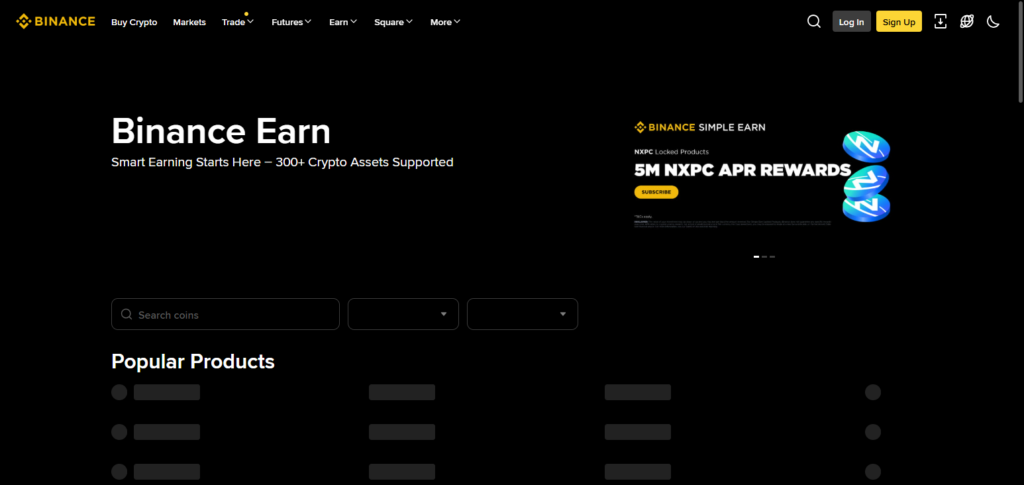
Depending on the product they choose, users can deposit cryptocurrencies like Bitcoin, Ethereum, stablecoins, and other altcoins to receive interest or prizes. While locked products offer higher APYs in exchange for set lock-up periods, flexible products permit withdrawals at any time with variable yields.
Lending, staking, provisioning for liquidity, and advertising efforts all produce returns. For both novice and experienced investors looking for easy, automated methods to increase idle cryptocurrency assets while controlling risk and liquidity preferences in 2026, Binance Earn was created.
What Is Crypto Staking?
The process of locking bitcoin in a blockchain network to support its operations and generate rewards is known as crypto staking. It is mostly utilized in consensus systems like Proof-of-Stake (PoS), in which validators add new blocks and validate transactions to protect the network. PoS networks choose validators based on the quantity of coins they stake, as opposed to mining like Bitcoin.
Participants earn staking benefits in exchange, which are often paid out in the same cryptocurrency. BNB, Cardano, Solana, and Ethereum are well-liked staking assets.
By operating a validator node, users can stake directly on the chain or assign their tokens via wallets and exchanges. Staking may include lock-up periods, unbonding delays, price volatility, and hazards such slicing penalties, even though it offers compounding potential and passive income.
Key Differences Between Binance Earn vs Staking
| Feature | Binance Earn | Crypto Staking |
|---|---|---|
| Definition | A collection of yield-generating products offered by Binance. | Locking crypto in a Proof-of-Stake blockchain to earn rewards. |
| How Returns Are Generated | Through lending, staking, liquidity provisioning, and structured products. | Through validating transactions or delegating tokens to validators. |
| Supported Assets | Wide range including BTC, ETH, stablecoins, and altcoins. | Only Proof-of-Stake cryptocurrencies. |
| Flexibility | Flexible and locked options available. | Often requires lock-up or unbonding period. |
| Liquidity | Flexible products allow instant redemption. | Funds may be locked with delayed withdrawals. |
| Risk Level | Platform and product-based risk. | Network, validator, and slashing risk. |
| Return Stability | Can vary based on product type and promotions. | Depends on network inflation and staking demand. |
| Technical Knowledge Required | Beginner-friendly interface. | May require understanding of validators and blockc |
How Returns Are Calculated in 2026
APY and APR Differentiation
The Automatic Percentage Yield (APY) and Automatic Percentage Rate (APR) are two formats used to display returns. While APR only calculates interest for the year (alongside the principal) as simple interest,APY calculates interest for the year (across the principal) as compound interest. In 2026, more platforms are more likely to show APY, as it APY is more transparent to user earnings, as it is more accurate to user earnings and expense when they have their rewards reinvested automatically.
Frequency of Compounding
The more frequently the rewards are able to compound, to the point where it may compound daily, the more effective the yield will be. Daily is more often seen with flexible products, while staking products may hold and require a manual restake to have the rewards become restaking rewards to lose the staking rewards.
Inflation Rate with Token Supply
With staking with a blockchain, you are guaranteed returns based on the inflation of the blockchain with the total amount of tokens staked. If the amount of users staking the tokens increases, it is common for the individual reward rate to decrease as the total reward gets distributed.
Lending Rates and Market Demand
The products designed for earning money are effective products that pay users more money to borrow than they themselves have to pay to borrow. The more the people want to trade and to use leverage, the more likely they are to trade and to use leverage, which increases the money the products pay their users more than the products themselves.
Premium for Lock-Up Periods
The products that are flexible to be locked up for a flexible amount of time before they can become inaccessible offer more rewards than the products that are more often than not to be more flexible in their rewards. The more flexible they are in this way, the more likely they are to be locked up for a longer period of time to be flexible.
Campaigns and Promotional Boosts
From 2026 and beyond, it is expected that more and more exchanges will be seen to have time-limited boosted yields of up to 100% APR pay to use as a way to bring users to them. In the case of time-limited boosted yield rewards, it is often the case that such yields will be applied only to a total amount that is limited as well as time-limited only to a period of time that has a limit to it.
Commission by Validators & Fees by Platforms
Potential rewards from staking are affected by commissions from validators or fees from exchanges. Your returns are affected by the fee percentage taken.
Who Should Choose Binance Earn vs Staking?
Who Should Choose Binance Earn
- Crypto Newbies. No need for much knowledge to operate and understand it.
- Investors with a Short-Time Horizon. Flexible access to funds is a must.
- Stablecoin Holders. Earn consistent interest on assets that don’t fluctuate.
- Users Who Want Little Structure. They want hands-off income without having to set up nodes or become validators.
- Investors Who Want to Take Less Risk. Products with lower volatility and more predictable returns are preferred.
- Investors Who Want Easily Flexible Options. Simply earn on various products without much of a structure.
Who Should Choose Staking
- Investors Who Want to Hold Assets Long.
- Investors Who Want to Support a Blockchain. Those who want to keep the network and consensus active.
- Investors Who Want to Lock Their Tokens for a Chance at Higher Returns. Those who want to gain the most on a set amount of time.
- Users Who Understand the Validators. Those who understand selection and unbonding of a validator.
- Investors Who Want to Focus Solely on a Certain Proof of Stake Token.
- Users Who Want to Wait Longer for Better Returns. Those who do not mind the liquidity of a token becoming better after time.
Advantages Of Binance Earn vs Staking
Advantages of Binance Earn
- User-friendly Dashboard – Earning on Binance Earn is as simple as a click of a button.
- Locked vs Flexible – Users select which method they prefer and which aligns with their liquidity needs.
- Different Types of Approval – Binance Earn includes both popular coins, as well as various altcoins and stablecoins.
- Compound Earnings – Users can select products that automatically reinvest their earnings to increase the the earnings.
- APY Promotions – Users can earn more by taking advantage of boosted APY rates.
- Flexible Instant Access – Users can withdraw their earnings on select products, at any time.
- Risk Diversification – Users can earn in more ways than one (i.e. savings, dual investments, etc.) using the same platform.
Advantages of Staking
- Protocol Incentives – Users earn incentives directly from the chains.
- Community health – Staking assists with securing and decentralizing the chain.
- Stream Yield – Given the economics of the chain, the yield will remain somewhat the same.
- Compound Potential – Users can maximize their reinvestment return by holding the incentives for a longer period.
- Reduce Centralized Risk – Staking is better for the community if it is done on chain and independently.
- Strategy Alignment – Genuinely the focus is on the long term of holding the incentives of the retained tokens.
Liquidity & Flexibility
Liquidity for Binance Earn
- Flexible Redemption – Many products provide opportunities for users to withdraw funds without major penalties.
- Daily Interest Payouts – Revenue is usually computed and distributed daily and thus interest is paid daily.
- No Unbonding Delay (Flexible Products) – Products are usually accessible without and no more than a few minutes.
- Locked Options Available – Users can earn more by agreeing to extended lock-up periods.
- Early Redemption Feature – Some locked products can be withdrawn early but you may lose the interest earned.
Liquidity for Crypto Staking
- Mandatory lock-up – periods – most proof-of-stake networks have a lock-up periods for staked tokens to be remain locked.
- Unbonding period – After the periods of staking, users must (wait for a set ) days or weeks before they can move unstaked funds.
- No instant access – funds are usually are illiquid staked for the duration of the staking period and the unbonding period.
- Locked Slashing Risk – tokens are always at the mercy of the validators performance for the duration of the lock.
- Liquid Staking Options (Optional) – Staking derivatives are offered by some protocols for more freedom.
Risk Comparison
Risks In Binance Earn
- Platform Risk — Funds are held on an exchange like Binance, so investors rely on the platform to keep things secure and to work.
- Counterparty Risk — Lending, and, structured products have an outcome based on the borrowers and other market participants.
- Variable Yield Risk — Interest goes up and down based on the market’s demand and availability.
- Market Lock-Up Risk — Locked products will prevent access to money until the time has run out.
- Market Conditions — The return will be negatively affected if the token drops in value, even if the interest earned will be positive.
Risks In Staking
- Slashing Risk — If validators are misbehaving, or if they go quiet, they can be penalized and some of the money that was staked will be taken.
- Unbonding Risk — When you are unstaking, if you are in a waiting period to sell your funds, you are stuck and cannot sell even if the prices drop.
- Network Risk — The blockchain is having issues, or is even being attacked, so the rewards may be affected.
- Validator Risk — Not picking a good validator can lead to lowered returns, or even increased penalties.
- Token Price Risk — The market may go down, making the returns from staking worthless or making it even worse than before.
Fees & Hidden Costs
| Fee / Cost Type | Binance Earn | Crypto Staking |
|---|---|---|
| Platform Service Fees | May charge management or service fees on certain products. | Some platforms may charge fees for delegation or custodial staking. |
| Validator/Commission Fees | Not typically applicable; fees are included in APY. | Validator commission is deducted from staking rewards. |
| Network/Gas Fees | Users may incur network fees when withdrawing or transferring tokens. | Gas fees for staking and unstaking transactions on-chain. |
| Early Withdrawal Penalties | Locked products may forfeit part of earnings if withdrawn early. | Unbonding period applies; no penalty but delayed access. |
| Reward Distribution Timing | Some products compound automatically, others require manual action. | Rewards may require claiming and re-staking to compound. |
| Opportunity Cost | Locked funds miss out on market moves or better yields elsewhere. | Long lock-up/unbonding can miss trading opportunities. |
| Promotional Limit Caps | High APY offers may apply only to limited amounts or durations. | Generally no promotional caps, but base yields fluctuate with network conditions. |
| Service Suspension Risk | If product gets paused, funds may be temporarily inaccessible. | Validators may get slashed, impacting actual net yield. |
Pros & Cons
Pros & Cons Binance Earn
Pros
- User-Friendly Platform – Interface designed for simple use by beginner and passive investors.
- Flexible & Locked Options – Options between instant liquidity or fixed higher returns.
- Wide Asset Support – Includes BTC, ETH, stablecoins and other altcoins.
- Promotional High APYs – Short-term profit boosts from temporarily promoted rates.
- Automated Compounding – Some products reinvest the rewards automatically.
Cons
- Platform Risk – Risks of loss through storing funds on a centralized exchange like Binance.
- Variable Returns – Depending on demand, yields may be lower.
- Locked Fund Restrictions – Unlocked funds will have lowered earnings.
- Limited Transparency – More complex structured products may be opaque for beginners.
Pros & Cons Crypto Staking
Pros
- Supports Blockchain Networks – Directly supports the security and validation of the network.
- Protocol-Based Rewards – Earnings from the network’s inflation model.
- Long-Term Compounding – Great for investors planning to hold their assets for a long time.
- No Centralized Lending Risk – On-chain staking means less reliance on lending from the exchange.
- Potentially Stable Yields – Yields are stable based on network parameters.
Cons
- Lock-Up & Unbonding Periods – Your funds will be inaccessible for a number of days to weeks.
- Slashing Risk – You may receive fewer rewards due to a validator’s poor performance.
- Technical Complexity – You need to grasp a solid understanding of winding up, winding down, validators, and staking.
- Token Price Volatility – Staking rewards may be outweighed by decreases in market price.
Conclusion
In 2026, the best Binance Earn and crypto staking will depend on individual investment strategies, risk, and liquidity. Binance Earn is better for flexibility and ease of use. With investment earning options and passive income opportunities for both stablecoins and other assets, it is a great place for Binance Earn Users. There is always the opportunity for a flexible withdrawal return on the investment or a locked return option.
In contrast, crypto staking is favored by those with a long-term strategy and a desire to earn protocol-based rewards for supporting the respective blockchains. Staking does present the risk of withdrawal lock-up periods and validator risks, but it does allow for compounding and consistent yield on the invested “coins”.
And so, the balance of liquidity versus returns and risk is achieved when an Investor combines multiple strategies. The flexibility and added convenience of Binance Earn paired with the depth of participation in the blockchain through Staking is often favored. Many crypto staking users and Binance Earn users combine the two strategies.
FAQ
What’s the main difference between Binance Earn and staking?
Binance Earn offers a variety of yield products on a centralized platform, while staking locks crypto directly in a blockchain network to earn on-chain rewards.
Which pays more in 2026 — Earn or staking?
Returns vary with market conditions. Staking often offers stable protocol-based rewards, while Binance Earn can sometimes provide higher promotional APYs on select assets.
Can I withdraw my funds anytime?
With flexible Binance Earn products, yes. Staked assets usually require an unbonding period before you regain access.
Is my crypto safe in Binance Earn?
Funds on Binance are held on a centralized exchange, exposing users to platform risk, though security measures are in place. On-chain staking has different risks tied to validators and network performance.