

This article examines the Best Intent-Based DEXs for Zero-Slippage Swaps and their innovation of next-generation decentralized exchanges with solver networks, liquidity consolidation, MEV mitigation, and complex settlement frameworks.
- How Intent-Based DEXs Achieve Near Zero-Slippage Swaps?
- Solver Competition for Best Execution
- Aggregated Liquidity From Multiple Sources
- RFQ (Request for Quote) Liquidity Mechanism
- Batch Auctions and Order Matching
- MEV Protection and Private Execution
- Smart Order Routing Technology
- Off-Chain Order Processing With On-Chain Settlement
- Deep Liquidity Networks
- Evaluation Criteria for Ranking Top Intent-Based DEXs (Unique Table)
- Best Intent-Based DEXs for Zero-Slippage Swaps (Main List)
- 10 Best Intent-Based DEXs for Zero-Slippage Swaps
- 1. 1inch Fusion
- Key Features:
- 2. CoW Protocol
- Key Features:
- 3. Curve
- Key Features:
- 4. Jupiter
- Key Features:
- 5. Hyperliquid
- Key Features:
- 6. dYdX v4
- Key Features:
- 7. GMX v2
- Key Features:
- 8. Aerodrome
- Key Features:
- 9. PancakeSwap v4
- Key Features:
- 10. Matcha (0x)
- Key Features:
- Conclusion
- FAQ
We will examine the core elements, linked networks, advantages, and assistance provided to traders in realizing the best achievable swap prices and least amount of slippage in 2026.
How Intent-Based DEXs Achieve Near Zero-Slippage Swaps?
Solver Competition for Best Execution
Intent Based DEXs implement a competitive solver network, where as a result of competition among the network’s professional participants, each solver searches for the optimal execution path among liquidity, market makers and DEXs. Competition eventually drives each solver to more efficient execution. The solver that executes a trade at the best outcome wins the order. This approach reduces price impact and helps achieve near zero-slippage swaps compared to AMM execution.
Aggregated Liquidity From Multiple Sources
Unlike other DEXs that depend on a single liquidity pool, Intent Based DEXs combine liquidity across AMMs, order books, and private liquidity as well as professional market makers. Aggregated liquidity enables large trades to avoid moving the price of tokens. Advanced routing technologies implemented by 1inch Fusion, Matcha (0x), and Jupiter help identify the optimal liquidity path and improve trade efficiency and reduce slippage in volatile market conditions.
RFQ (Request for Quote) Liquidity Mechanism
Most Intent-Based DEXs employ RFQ mechanisms that enable professional market makers to provide user order quotes. Contrary to pools, traders receive quotes from liquidity providers in this case. This approach is well suited to large trades because marketmakers can provide quotes at fixed prices with limited execution slippage. From the perspective of a user, the RFQ mechanism combines performance of a centralized exchange with the transparent nature of decentralized trading.
Batch Auctions and Order Matching
Leveraging mechanisms of batch auctions, the CoW protocol groups traded intent to be finalized simultaneously. By doing so, the protocol evaluates the orders which can be executed against internal orders, and in turn, eliminates the need for external liquidity. As a result, the market impact and execution costs – both of which are inevitable – are decreased. Batch auctions ensure fair competition among solvers while MEV opportunities are significantly reduced.
MEV Protection and Private Execution
Other DEXs use Intents to prevent slippage caused by MEV attacks (e.g. front-running and sandwich attacks). Typically DEX trades are broadcast to the public memepools and, therefore, are transparent to trading bots. In contrast, Intent-Based systems employ private execution channels or hide user Intent until execution, both of which prevent malicious traders from the exploitation of unsatisfied Intent. This Improve Intent-Based Systems the price that users receive when they complete a swap.
Smart Order Routing Technology
Advanced routing algorithms evaluate multiple trading paths and streams to determine the optimal execution path. Compared with conventional smart routing that takes a single swap route, Intent-Based DEXs compare all trading paths and select the route that will have the least adverse effect on the market and will incur the lowest execution cost. Smart order routing provides the best market rate, even for highly fragmented market liquidity.
Off-Chain Order Processing With On-Chain Settlement
A majority of Intent-Based DEXs use a trade discovery + blockchain settlement model. In such a model, user intents are processed off-chain. Solvers, which are a part of off-chain processing, evaluate execution strategies, while finality is ensured through on-chain settlement using smart contracts. This limits on-chain overhead, enhances speed, and allows trade optimization post confirmation.
Deep Liquidity Networks
Intent-Based DEXs improve access to deep liquidity networks. They connect multiple liquidity pools, decentralized exchanges, and market makers, thus ameliorating the impact of large orders. Deep liquidity is particularly important to high-frequency traders and institutions, who demand consistent order fill without significant price impact. Offering near zero-slippage swaps requires sufficient liquidity.
Evaluation Criteria for Ranking Top Intent-Based DEXs (Unique Table)
| Evaluation Factor | Why It Matters |
|---|---|
| Intent Execution Model | Determines swap efficiency |
| Solver Network Quality | Better competition = better prices |
| Slippage Reduction Technology | Measures execution accuracy |
| Liquidity Depth | Supports large swaps |
| MEV Protection | Prevents value extraction |
| Supported Chains | Multi-chain usability |
| Settlement Speed | Faster trade completion |
| Token Coverage | Trading flexibility |
| Security Architecture | Smart contract safety |
| User Experience | Adoption potential |
Best Intent-Based DEXs for Zero-Slippage Swaps (Main List)
- 1inch Fusion
- CoW Protocol
- Curve
- Jupiter
- Hyperliquid
- dYdX v4
- GMX v2
- Aerodrome
- PancakeSwap v4
- Matcha (0x)
10 Best Intent-Based DEXs for Zero-Slippage Swaps
1. 1inch Fusion
1inch Fusion Fusion is an intent-based swap mechanism designed to boost DEX execution and replace transaction-based swapping. In intent-based swapping, users do not interact with Liquidity pools, but instead, users create swap requests, and resolvers compete to fulfill those requests.
1INCH’s Fusion system implements a method similar to a Dutch auction, where resolvers bid to execute a trade and helps in minimizing price impact and eliminating slippage. Moreover, Fusion guarantees gasless swaps, resolvers eliminate execution cost, and prevents front-running attacks to protect from MEV.
Supported Networks: Ethereum, Arbitrum, Optimism, Polygon, Base, BNB Chain, Avalanche, Gnosis, Linea, zkSync Era, Sonic, Unichain, Solana and other supported ecosystems
Key Features:
- A resistance MEV order settlement
- A resolver-based execution network
- Cross-chain swap
- Aggregated liquidity routing
- Gasless trading experience
Best For: Users and traders that require an optimized trading experience with large swaps while being able to keep their assets custodied.
2. CoW Protocol
CoW Protocol’s intent-based trading allows users to post trade intentions, avoiding the need to conduct swaps through automated market makers. Professional solvers have the ability to compete and propose the best settlement through batch auctions.

As a result of this methodology, Coincidence of Wants (CoWs) can be achieved, whichc enables traders to be directly aligned without dependence on external liquidity pools. This significantly decreases cost exposure, and slippage.
CoW Protocol has a strong user base because of its MEV protection, as orders are never posted to the public mempool. The solver competition model ensures prices are competitively low and execution is improved when compared to traditional AMM swaps.
Supported Networks: Ethereum, Gnosis Chain, Arbitrum, Base, Polygon and other EVM-compatible networks.
Key Features:
- Batch auction settlement
- Solver competition
- MEV protection
- Gas-efficient trading
- P2P order matching
Best For: Professionals, DAOs, Institutions, Secure Execution Focused Users.
3. Curve
Curve Finance is a DEX that focuses on liquidity. However, Curve uses a sophisticated trading and liquidity routing mechanism that makes intent-based trading possible. Curve has built a proprietary automated market making (AMM) algorithm to lower the price impact of swaps that predominantly involves stablecoins.
Large swaps can be done with low slippage because of Curve’s deep liquidity pools. Intent-based trading systems and aggregators rely on Curve because it offers the best settlement possible. The infrastructure and design of Curve are geared towards capital efficiency. This makes Curve an attractive protocol for solving networks that need optimized swap executions.
Supported Networks: Ethereum, Arbitrum, Optimism, Polygon, Avalanche, Fantom, Gnosis, Base, and other EVM networks.
Key Features:
- Stablecoin liquidity
- Slippage trading
- Efficient AMM curves
- Multiple liquidity pools
- Liquidity of an institutional grade
Best For: Stablecoin traders, DeFi protocols, and large-volume swaps.
4. Jupiter
Jupiter is renowned for DEX aggregation in the Solana ecosystem. When swapping on Jupiter, users designate endpoints to the protocol in the form of expected swap outcomes, while Jupiter figures out the most optimal path to execution for the given outcomes.

Jupiter fundamentally reduces slippage by comparing liquidity on various markets on the Solana blockchain and automatically choosing the best route.
Amongst other advanced features, Jupiter offers trading limit orders, automatically execute trades through DCA, and smart routing. These advanced features make Jupiter a crucial player in the world of decentralized trading.
Supported Networks: Primarily Solana ecosystem with integrations across Solana-based liquidity protocols.
Key Features:
- Smart liquidity routing
- Solana native execution
- Limit orders
- DCA automation
- Low transaction fees
Best For: Solana traders, retail users, and high-frequency swap users.
5. Hyperliquid
Hyperliquid offers a high-quality trading API for perpetual futures. Unlike most DEXs, Hyperliquid uses an order-book model which is more conducive to the placement of limit orders and execution of orders.
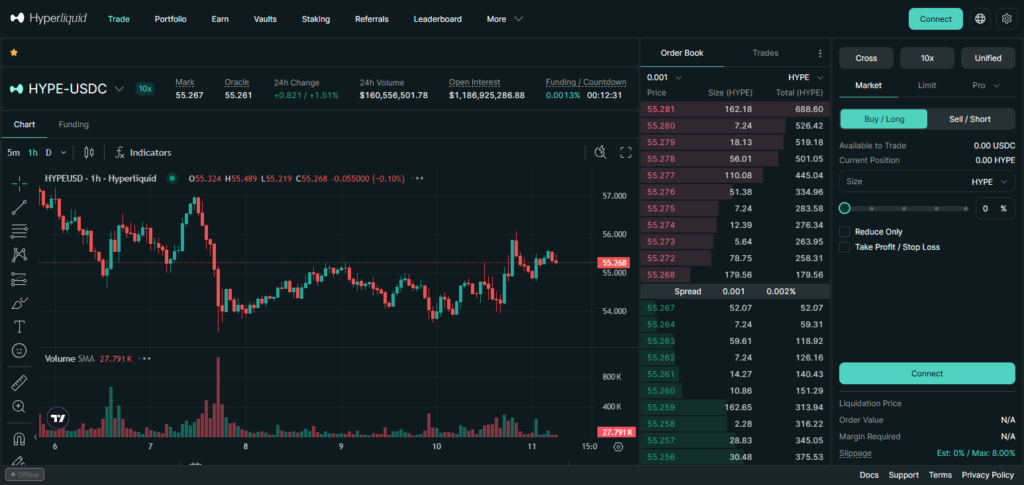
Through its high-performance blockchain technology, Hyperliquid strives to provide fast execution, low costs, and low friction. Hyperliquid is primarily focused on traders who require the performance of centralized exchanges while still retaining ownership of a decentralized exchange.
The platform strives to reduce the execution gaps of active traders by offering a very efficient trading match and the deepest perpetual liquidity.
Supported Networks: Hyperliquid’s L1 blockchain.
Key Features:
- Order Book on chain
- High speed settlement
- Low trading costs
- Professional trading interfaces
- Extreme perpetual liquidity
Best For: Professional
6. dYdX v4
dYdX v4 introduces decentralized order-book trading on its own blockchain. Users can submit trading intents in the form of limit orders, and the execution is handled by validators and matching systems.

Compared to automated market maker (AMM) based perpetual trading, dYdX provides an order-book trading system that is efficient and has improved capital utilization. The design of dYdX v4 combines Decentralized Finance (DeFi) principles with advanced order-book trading systems that normally rely on Centralized Finance (CeFi) and are used extensively by professional traders.
This combination is suitable for traders who need to use advanced tools to execute complex orders that require low slippage.
Supported Networks: dYdX’s own blockchain built using Cosmos SDK.
Key Features:
- Decentralized order books
- Perpetual contracts
- Fast matching system
- Professional trading systems
- Validator Systems
Best For: Professional traders and institutions.
7. GMX v2
Perpetual trading on GMX v2 is possible with improved liquidity systems and better execution mechanisms. GMX v2 leverage liquidity contracts based on multi-asset to provide order-book based liquidity and allow traders to open positions.

The focus of GMX v2 is managing price impact using various strategies and mechanisms such as pricing based on Oracle, varying and optimizing trading fees, and optimizing liquidity.
GMX v2 is designed for efficient swaps and trading of perpetual contracts, especially large positions, which normally have high slippage. As a result, it has become one of the most popular DeFi options for traders seeking alternatives to centralized derivatives exchanges.
Supported Networks: Avalanche, Arbitrum.
Key Features:
- Oracle based pricing
- Dynamic trading fees
- Deep liquidity pools
- Perpetual trading
- Execution impact reduced
Best For: DeFi derivatives traders and large position holders.
8. Aerodrome
Aerodrome Finance is a liquidity marketplace in the Base blockchain providing token swaps and liquidity optimization. Built on a decentralized exchange model, Aerodrome also offers intent-based trading with advanced routing systems and concentrated liquidity. It creates a liquidity ecosystem that links traders with deep liquidity pools, and helps protocols efficiently derive liquid assets.

Through the ve(3,3) incentive structure, Aerodrome improves the distribution of liquidity and provides an ideal swap execution environment for secondary markets. Base’s low transaction costs and ecosystem are added benefits.
Supported Networks: Base blockchain.
Key Features:
- Concentrated liquidity
- Base ecosystem liquidity structures
- Improved token swaps
- Governance based liquidity
- Liquidity incentives
Best For: DeFi users and projects on the Base blockchain.
9. PancakeSwap v4
PancakeSwap v4 features a new advanced build of trading systems focused on liquidity and user experience flexibility. This build focuses on better pool management and hooks, as well as efficient execution. PancakeSwap’s large multi-chain ecosystem provides liquidity that can readily support intent-routing systems.
The protocol aims to lower swap costs, boost capital efficiency, and improve execution for users across various blockchain networks. It has a large user base and ample liquidity making it critical infrastructures for decentralized trading.
Network Supported: BNB Chain, Ethereum, Arbitrum, Base, Polygon zkEVM, zkSync Era and other compatible chains.
Key Features:
- Unique liquidity hooks
- Cross-chain trades
- Extensive liquidity
- Minimized trade costs
- Complicated pool design
Best For: Regular traders and multi-chain DeFi users.
10. Matcha (0x)
Matcha (0x) implements smart order routing and professional liquidity aggregation. Matcha will comb through multiple decentralized liquidity resources to provide the best price execution and less slippage. Matcha integrates the 0x infrastructure to link liquidity providers and market makers to a unified trading system.
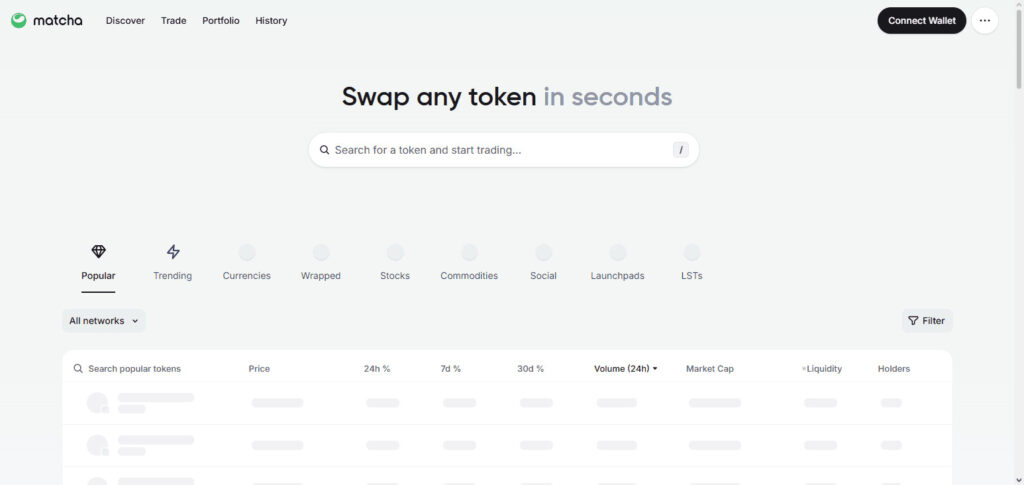
Matcha implements an RFQ-based trading model, allowing professional market makers to compete for trades, therefore improving the execution for the end users. It is simple and easy to use for liquidity optimization.
Supported Networks: Ethereum, POL, BNB Chain, Avalanche, Optimism, Arbitrum, Base and other EVM networks.
Key Features:
- Smart order routing
- RFQ liquidity
- Aggregated DEX liquidity
- Competitive pricing
- Developer-friendly infrastructure
Best For: Retail traders, developers, and users seeking optimized swaps.
Conclusion
Intent-Based DEXs are offering better execution and slippage while providing users more protection from MEV. 1inch Fusion, CoW Protocol, Jupiter, Matcha, and others are using solver networks, liquidity aggregation, and advanced settlement to offer swaps with improved efficiency.
With the volatility of markets and liquidity, complete no-slippage swaps aren’t possible, but Intent-Based DEXs provide users with better results than traditional AMMs. For the next phase of DeFi in 2026, fewer friction, faster, and more automated trading with improved UI will place Intent-Based DEXs at the forefront of trading.
FAQ
What are Intent-Based DEXs?
Intent-Based DEXs are decentralized exchanges that allow users to specify their desired trading outcome instead of manually selecting liquidity pools, routes, and transaction execution methods. In this model, users submit a trade intent, and specialized solvers compete to execute the swap at the best available price. This approach improves execution efficiency by combining multiple liquidity sources, reducing unnecessary price impact, and minimizing risks such as failed transactions and MEV attacks. Protocols like 1inch Fusion and CoW Protocol use solver-based systems where competing executors search for optimal settlement opportunities.
Can Intent-Based DEXs provide completely zero-slippage swaps?
No decentralized exchange can guarantee absolute zero slippage in every market condition because prices depend on liquidity depth, volatility, and asset demand. However, Intent-Based DEXs can achieve near-zero-slippage execution by using solver competition, RFQ systems, batch auctions, and aggregated liquidity sources. Instead of relying on a single AMM pool, these platforms allow multiple liquidity providers or solvers to compete, helping users receive better execution prices with lower price impact compared with traditional swaps.
How do Intent-Based DEXs reduce slippage?
Intent-Based DEXs reduce slippage through advanced execution mechanisms such as solver auctions, liquidity aggregation, and off-chain order matching. When a user submits an intent, multiple solvers analyze available liquidity from different sources and compete to provide the best settlement price. This competition creates a more efficient market environment where traders are not limited to a single liquidity pool. For large transactions, this model can significantly reduce price impact compared with traditional AMM-based swaps.
What is a solver in an Intent-Based DEX?
A solver is a specialized market participant responsible for fulfilling user trade intents. Instead of users directly interacting with blockchain liquidity pools, solvers search for the most efficient execution route using their own liquidity, decentralized exchanges, market makers, or arbitrage strategies. Multiple solvers may compete through auctions to provide the best price, and the winning solver executes the transaction. This competitive system converts potential execution advantages into better pricing for users.