


I’ll go over the Top Forex Brokers for High-Frequency Trading in this post. Brokers with extremely quick execution, narrow spreads, and dependable platforms are needed for high-frequency trading (HFT) in order to manage quick trades.
- What is High-Frequency Forex Trading?
- Key Features to Look for in a High-Frequency Forex Broker
- Key Point & Best Forex Brokers for High-Frequency Forex Trading List
- 1. Eightcap
- Eightcap – Features
- Pros & Cons Eightcap
- 2. Pepperstone
- Pepperstone — Features
- Pros & Cons Pepperstone
- 3. Tickmill
- Tickmill — Features
- Pros & Cons Tickmill
- 4. Darwinex
- Darwinex — Features
- Pros & Cons Darwinex
- 5. OANDA
- OANDA — Features
- Pros & Cons OANDA
- 6. Exness
- Exness — Features
- Pros & Cons Exness
- 7. eToro
- eToro — Features
- Pros & Cons eToro
- 8. XM
- XM — Features
- Pros & Cons XM
- 9. XTB
- XTB — Features
- Pros & Cons XTB
- 10. RoboForex
- RoboForex — Features
- Pros & Cons RoboForex
- Benefits of Choosing the Right Broker for HFT
- Conclusion
- FAQ
Selecting the appropriate broker is essential for cutting expenses, decreasing slippage, and increasing profits. The best brokers for active and algorithmic traders are reviewed here.
What is High-Frequency Forex Trading?
A form of algorithmic trading known as “High-Frequency Forex Trading” (HFT) involves traders executing several orders in minuscule amounts of time—typically milliseconds. To profit from tiny price changes between currency pairs, HFT uses cutting-edge technology, low-latency execution, and direct market access.
With the goal of making modest, steady profits over time, traders execute hundreds or thousands of deals per day using sophisticated software, automated systems, and trading algorithms. Success in high-frequency forex trading depends on speed, accuracy, and having access to trustworthy brokers with narrow spreads and substantial liquidity.
Key Features to Look for in a High-Frequency Forex Broker
Low Spreads and Commissions“: Minimal commissions and tight spreads are necessary to lower trading costs when executing hundreds or thousands of trades.
Ultra-Fast Order Execution: In fast moving markets, orders need to be filled quickly and at the intended price to avoid slippage. Low latency orders achieve this.
ECN/STP Accounts: Transparent and quicker trading is made possible by brokers that offer direct liquidity access via Electronic Communication Networks (ECN) or Straight Through Processing (STP) accounts.
Advanced Trading Platforms: for HFT, it is necessary to use platforms that incorporate algorithmic trading, and automated strategies, and allow for one-click trading. MetaTrader 4/5 and cTrader are a couple of platforms that meet this.
Reliable Regulation and Safety.For active and high frequency traders, it is important to not only be regulated, but also to be tier-1 regulated (FCA, ASIC, CySEC) for fund security, practice transparency, and operational reliability.
API and Automated Trading Support: Automated trading, and the ability to customize algorithms for rapid decision making and execution is made possible by trading bots and access to APIs.
Deep Liquidity and Market Access: Larger liquidity pools that a broker holds minimize price gaps and slippage, and therefore for high speed trading strategies, ensure smoother execution.
Key Point & Best Forex Brokers for High-Frequency Forex Trading List
| Broker | Key Points / Features |
|---|---|
| Eightcap | Low spreads, fast execution, MetaTrader 4 & 5 support, ASIC regulation, ECN accounts |
| Pepperstone | Ultra-low latency, tight spreads, multiple platforms, strong research, FCA regulated |
| Tickmill | Low commissions, fast order execution, STP/ECN accounts, educational resources |
| Darwinex | Unique DARWIN investment platform, copy trading, FCA regulated, algorithmic trading |
| OANDA | Trusted broker, extensive market research, no minimum deposit, flexible lot sizes |
| Exness | High leverage options, instant withdrawals, MT4/MT5, global regulation |
| eToro | Social & copy trading, user-friendly interface, multiple assets, strong community |
| XM | Wide range of instruments, low spreads, free educational tools, strong support |
| XTB | Proprietary xStation platform, competitive spreads, educational webinars, regulated |
| RoboForex | ECN/STP accounts, low commissions, wide asset selection, automated trading supported |
1. Eightcap
Eightcap is an Australian-broker established in 2009. They have high-frequency trading services and algorithmic trading services with fast execution and minimal commissions. Customers can trade on the MetaTrader 4, MetaTrader 5, TradingView, and Eightcap’s own WebTrader. They have a minimum deposit of $100 and leverage of 1:500.
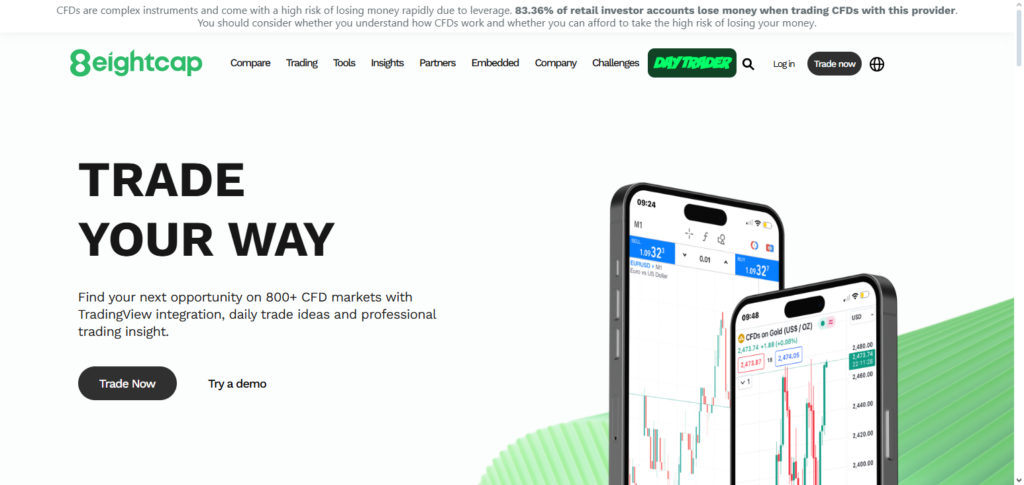
They have spreads of 0.1 pips with commissions. Their Australian brokers are ASIC accredited, and their European brokers are FCA, SCB, and CySEC accredited. They have low fees and a wide selection to trade which helps to prove their reliability to the consumer.
Eightcap – Features
| Feature | Explanation |
|---|---|
| Low Spreads | Eightcap offers competitive raw spreads (often from ~0.1 pips), reducing trading cost per trade — ideal for HFT where frequent entries/exits matter. |
| Fast Execution | Advanced pricing and deep liquidity hubs help deliver quick order execution with minimal latency, crucial for high‑frequency strategies. |
| Trading Platforms | Supports MetaTrader 4, MetaTrader 5 & TradingView integration, enabling automated EAs and scripts for algorithmic trading. |
| Strong Regulation | Regulated by ASIC, FCA, CySEC & SCB, which supports fund safety and execution transparency — an important trust factor for active traders. |
| Global Liquidity | Access to large tier‑1 liquidity providers reduces slippage and improves price consistency during volatile, high‑speed trading. |
Pros & Cons Eightcap
Pros
- Low Spread and Fast Execution – Fast execution with low raw spread HFT cost.
- Multiple Platforms – Algorithmic trading on MT4, MT5, and TradingView.
- Strong Regulation – ASIC, FCA, CySEC, and SCB regulation.
- Good Liquidity Providers – Quick order flow with little slippage.
- User‐Friendly Accounts – Accounts are easy to open and scale.
Cons
- Limited Research Tools – Less in-platform research options.
- Minimum Deposit – Live ECN accounts require a mid-level deposit.
- Market Depth Info – Some ECN brokers have a better market depth.
- Fees Can Rise – High trading volume increases commissions.
- Regional Restrictions – Features differ based on user location.
2. Pepperstone
Pepperstone was founded in 2010 and is based in Melbourne, Australia. They are still considered newer brokers. They have Tier 1 (new forex trading brokers) brokers from ASIC, FCA, and CySEC, and SCB from the Bahamas.
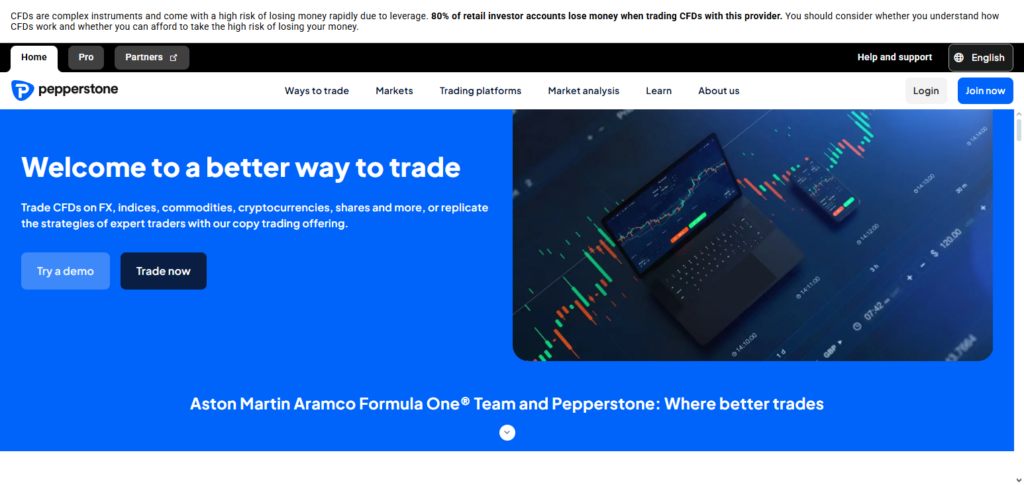
They have razor accounts which provides them with spreads of 0 pips and their execution time is 0. They have MetaTrader 4 and 5 and cTrader. They offer low fees which is an incentive to forex trading scalpers.Thanks to their tech infrastructure and global regulations, they can offer rapid executions and dependability for pricing for active strategies.
Pepperstone — Features
| Feature | Explanation |
|---|---|
| Ultra‑Tight Spreads | Pepperstone raw spreads begin near 0.0 pips, lowering the overall cost for high‑frequency strategies. |
| Low Latency Execution | Powered by robust server infrastructure and connectivity, supporting fast trade fills. |
| Multi‑Platform Support | MT4/MT5 and cTrader support, giving algo traders multiple execution environments and advanced order types. |
| Tier‑1 Regulation | Overseen by ASIC, FCA, CySEC & others, ensuring reliable operational standards for fast trading. |
| Deep Liquidity Pools | Strong access to institutional liquidity helps reduce slippage for rapid order flow. |
Pros & Cons Pepperstone
Pros
- Very Tight Spreads – Ideal for HFT and scalping.
- Low Latency Execution – Excellent for trading algorithms.
- Multiple Platforms – Advanced features on MT4, MT5, and cTrader.
- Global Regulation – Regulation under FCA, ASIC and CySEC.
- Deep Liquidity Pools – Ensures less slippage
Cons
- Commission Fees – With Razor accounts, there’s fees for every lot.
- Lack of Proprietary Tools – Tools come from third parties.
- Withdrawal Processing – Is slower compared to competitors.
- Restricted Education – More challenging for new traders.
- Account Tiering** – Different pricing depending on country of residence.
3. Tickmill
Founded in 2014, Tickmill has spread its operations worldwide, obtaining regulations from the FCA (UK), CySEC (Cyprus), FSCA (South Africa), DFSA (Dubai), and FSA-Seychelles, among others. On MetaTrader 4 and 5, he offers fast execution and at very low costs:

spread from 0.0 pips on the Pro accounts and commission per side per lot, which is very competitive for high-frequency and scalping strategies. Tickmill has a minimum deposit of $100, and offers leverage of 1:500, depending on the region. His regulatory credentials and low prices make him a good option for traders who value low cost and high speed in their trading.
Tickmill — Features
| Feature | Explanation |
|---|---|
| Very Low Spreads | Tickmill Pro accounts often start at 0.0 pips — excellent for high‑frequency and scalping systems. |
| Fast Order Handling | Efficient STP/ECN execution with low latency supports rapid trades. |
| Low Commissions | Competitive commission per lot makes frequent trading more cost‑efficient. |
| Global Regulation | Regulated by FCA, CySEC, FSCA & DFSA, providing strong oversight on execution fairness. |
| Education Tools | Free webinars and market insights help traders refine HFT strategies. |
Pros & Cons Tickmill
Pros
- Ultra-Low Spreads – Starting at zero pips on the Pro account.
- Quick Execution Speeds – Ideal for scalping and high-frequency trading.
- Competitive Commissions – Affordable pricing model.
- Worldwide Regulation** – FCA, CySEC, FSCA, DFSA registered.
- Regulated Education – Webinars and courses at no charge.
Cons
- Fewer Platforms – Only MT4 and MT5 available.
- Market Options – Not as many financial instruments offered as some brokers.
- Lack of Social Trading – Strategies can’t be copied easily.
- Limited Deposit Methods – Not many options available per country.
- Variable Customer Service – Customer support response time is inconsistent.
4. Darwinex
Darwinex is one of the UK’s most recent brokerage companies, established in 2012. It is regulated by the Financial Conduct Authority (FCA) and offers direct trading for its clients on forex, CFDs, stocks, and other assets. What is unique with Darwinex is the internally managed proprietary “DARWIN” assets, which enables clients to have access to capital from investors based on the performance of their respective trading strategies.
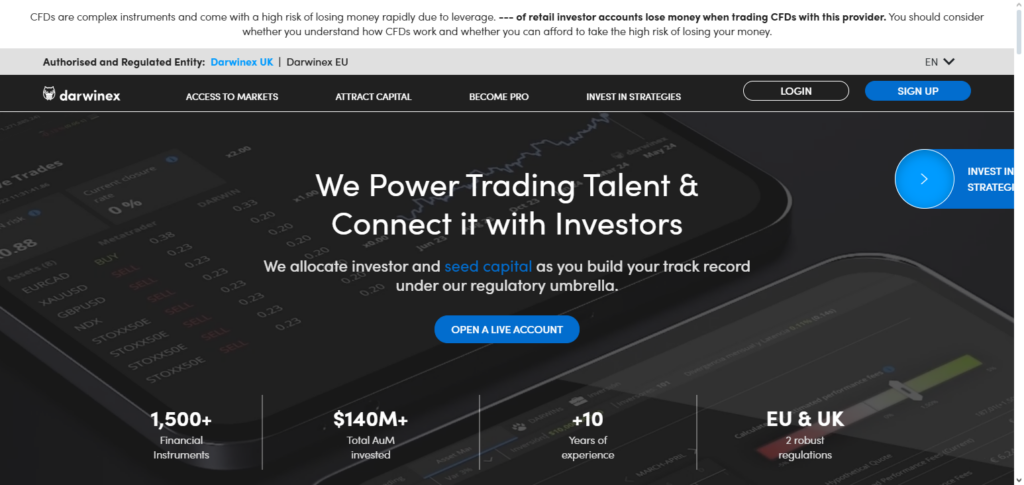
Darwinex has access to Meta Trader 4/5 for high-frequency traders and has competitive commission structures and spreads while having high quality execution. They also offer compensation plans such as UK FSCS protection for eligible clients. The pricing transparency, innovative trading ecosystem and FCA protection from the UK provides high quality execution and strategic performance.
Darwinex — Features
| Feature | Explanation |
|---|---|
| DARWIN Model Access | Allows traders to turn strategies into investable assets, benefiting high‑frequency traders beyond execution returns. |
| FCA Regulation | UK oversight gives strong investor protection and transparent operations. |
| MT4/MT5 Execution | Supports established platforms with low latency capabilities for algorithmic systems. |
| Risk Analytics | Built‑in metrics help optimize and monitor HFT performance across strategies. |
| Performance Tracking | Detailed historical stats assist in evaluating HFT strategy viability. |
Pros & Cons Darwinex
Pros
- The Unique DARWIN Model – Investable assets for every trading strategy.
- FCA Regulated – Investor protection at its highest standards.
- HFT with MT4/5 – High speed execution for algorithmic trading.
- Integrated Risk Management – Advanced tools for portfolio analytics.
- Detailed Performance – Metrics for strategies and performance tracking.
Cons
- Commission Structure – Performance Fees Apply.
- Complex for Beginners – Model may confuse new traders.
- Smaller Liquidity Pools – Less deep than major ECN brokers.
- Platform Limitations – No cTrader or proprietary alternatives.
- Fees Can Add Up – Costs higher for frequent rebalancing.
5. OANDA
Started in 1996, OANDA is one of oldest forex brokers and has regulations with multiple Tier-1 authorities such as ASIC (Australia), MAS (Singapore), and many more.
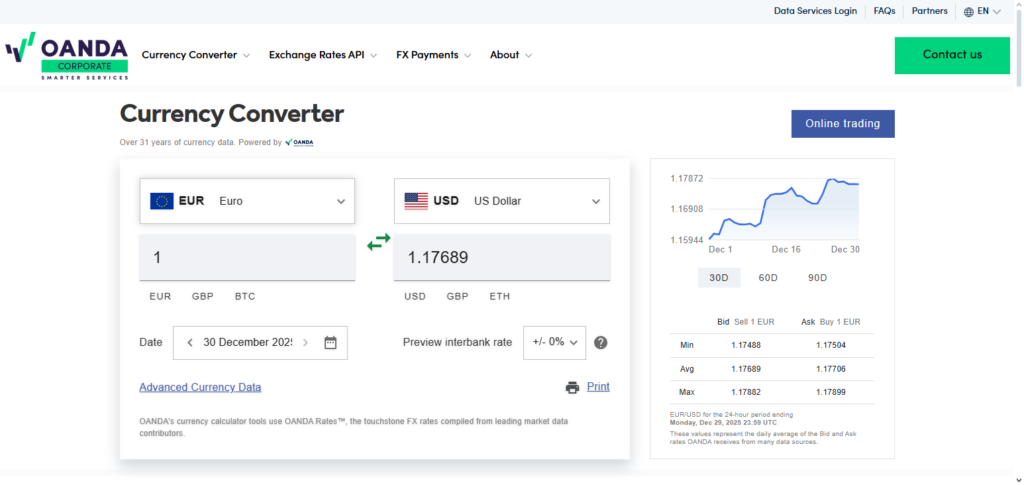
They provide forex and CFD trading, and are known for their competitive spreads which are as low as 1.0 pips on some accounts, however spreads tend to get wider on some standard accounts. The overall fees from OANDA consist of an inactivity charge after 12 months, some withdrawal fees, and no deposit fees. They provide a good platform for automated trading and high-frequency trading.
OANDA — Features
| Feature | Explanation |
|---|---|
| Long‑Term Market Presence | Established in 1996 with deep forex market integration, supporting reliable connectivity. |
| Transparent Pricing | Clear spreads and no hidden costs enhance predictability in frequent trades. |
| API Trading Support | Direct API access allows automated HFT logic to connect for rapid order routing. |
| Strong Regulation | Regulated by FCA, CFTC/NFA (US), ASIC & MAS for global compliance. |
| No Minimum Deposit | Flexible start for developing and testing high‑frequency algorithms. |
Pros & Cons OANDA
Pros
- Long عEstablished Broker – Trusted since 1996.
- Wide Regulation – FCA, CFTC, ASIC, MAS oversight.
- Transparent Pricing – Clear spreads and no hidden fees.
- API Access – automata. trading systems.
- No Minimum Deposit – Flexible account start.
Cons
- Spreads Wider – Standard pricing less competitive for HFT.
- Execution Speed – No the fastest compared to pure ECNs.
- Limited Platform Choice – Own platform + MT4.
- Fewer Instruments – Smaller asset range than some peers.
- Inactive Fees – Charges after dormancy.
6. Exness
Exness provides Meta Trader 4, Meta Trader 5, and their own proprietary trading tool, Exness Terminal. With Exness you can get started with a minimum deposit of $1 and in some areas you can receive 1:2000 leverage. Exness has regulatory licenses from multiple places which include the UK (FCA), Cyprus (CySEC), South Africa (FSCA), Kenya (CMA), and Seychelles (FSA).
Exness offers highly competitive spread pricing with zero spreads on Raw and Zero accounts and low commissions. Fast execution and algorithmic strategy focused traders appreciate Exness’ popularity due to lightweight fee structure and deep liquidity, although traders must check regional regulation.
Exness — Features
| Feature | Explanation |
|---|---|
| Zero/Raw Spreads Available | Very low spreads on Raw accounts reduce friction for frequent trade execution. |
| High Leverage Options | Allows amplified exposure (varies by region), which can support HFT capital efficiency. |
| Fast Withdrawals | Quick withdrawal processes often appreciated by active traders. |
| MT4, MT5 & Proprietary Terminal | Multiple environment options for automated strategies. |
| Deep Liquidity | Quality liquidity connections help maintain tight pricing during rapid execution. |
Pros & Cons Exness
Pros
- Very High Leverage – Can boost capital efficiency.
- Zero/Raw Spreads – Excellent for low‑cost HFT.
- Fast Withdrawals – Quick processing in many regions.
- Multiple Platforms – MT4, MT5, and proprietary terminal.
- Small Minimum Deposits – Accessible for new traders.
Cons
- Independent Oversight – Varies depending on the entity.
- Leverage Risk – Losses can be magnified in high-frequency trading.
- Support – Reported inconsistencies in response time.
- Research – Advanced analytics are sparse.
- Pricing – In a liquidity void, spreads can be dynamically worse.
7. eToro
Founded in 2007 in Tel Aviv, eToro has become a globally licensed multi-asset broker with FCA (UK), CySEC (EU), ASIC (Australia), and registered with FinCEN in the USA. While best known for its social and copy trading, eToro also has a competitive forex trading offering with spreads often around 0.9 pips on the majors, and a nice, easy to use platform.
Cost structure includes currency conversion fees, potential inactivity fees, and standard spread-only pricing. While eToro is not typically focused on ultra-low latency execution relative to pure ECN brokers, the eToro platform lends itself to social trading, strategy diversification, and high-activity trading.
eToro — Features
| Feature | Explanation |
|---|---|
| Social/Copy Trading | Offers unique ability to follow successful traders, different from pure HFT but supportive of strategy insights. |
| User‑Friendly Platform | An easy‑to‑navigate interface with quick trade entry/exit, helpful for active traders. |
| Regulated Globally | FCA, CySEC, ASIC & FinCEN (US) oversight for reliable operations across regions. |
| Spread‑Only Pricing | No direct forex commissions — cost determined mainly by spreads. |
| Multi‑Asset Access | Forex, stocks, crypto & more help diversify frequent trading strategies. |
Pros & Cons eToro
Pros
- Social and Copy/Strategy trading – One of the few platforms allowing the replication of trades.
- Intuitive Platform – Offers a simple and clear interface, which is best for active traders.
- Access to Multiple Assets – Offers access to forex, stocks, and crypto.
- Global Regulation – eToro is regulated by the FCA, CySEC, ASIC, and FinCEN (US).
- No Forex Commission – Pricing is calculated by spread only.
Cons
- Wider Spread – Not the best option for high-frequency trading.
- Optimized Execution Speed – Trades are not optimized for access to ultra rapid algorithms.
- Limited MT Integration – eToro does not support MT4 or MT5.
- Currency Conversion Costs – There are increased costs on accounts that are not USD based.
- Inactive Fees – eToro charges account holders for account inactivity.
8. XM
XM was established in 2009 and has regulations from ASIC (Australia), CySEC (Cyprus), DFSA (Dubai), and FSC (multiple jurisdictions). Trade forex and CFDs on MetaTrader 4/5 with no fees for deposits or withdrawals. XM does have variable spreads that can be competitive on the major currency pairs.
XM’s accessibility to traders is partially due to its low minimum deposit requirements, which can be as low as $5. Even though XM’s average spreads are a bit higher than ultra-low-latency ECN brokers, their far-reaching market accessibility, reliable execution, and multilingual support make them a good fit for traders who want to frequent the market and require an extensive range of instruments.
XM — Features
| Feature | Explanation |
|---|---|
| Low Minimum Deposit | Accessible entry point for testing and scaling frequent strategies. |
| MT4 & MT5 Support | Provides automation and strategy execution tools. |
| Reliable Execution | Generally stable trade processing for frequent entries and exits. |
| Multi‑Regulated | ASIC, CySEC & DFSA oversight maintain operational standards. |
| Free Educational Resources | Market analysis and webinars help traders optimize HFT approaches. |
Pros & Cons XM
Pros
- Low Minimum Deposit – Great for beginners.
- Reliable Execution – XM has a fine reputation of stable and reliable execution.
- Support for MT4 & MT5 – Good for users looking for strong algorithmic trading support.
- Multiple Regulatory Bodies – XM is regulated by ASIC, CySEC, and DFSA.
- No Cost Research Tools – Users have access to free webinars, market news, and trading analysis.
Cons
- Wider Spread – XM is not the best option for high frequency trading.
- Commission-Free Accounts – Some accounts are higher cost but commission free.
- Execution Tech – Falling behind in latency.
- Asset Depth – Less liquidity than purely ECN.
- Service limits.– Less advanced APIs.
9. XTB
XTB is headquartered in Warsaw, Poland, and began its operations in 2002. Due to the firm being regulated by major institutions such as the FCA (UK), CySEC (Cyprus), and the Polish KNF, along with having licenses in other countries, they are able to offer their clients Forex and CFD trading at very competitive prices via their proprietary and MetaTrader platforms.
XTB’s spreads vary by account type, and they have no commission trading; however, some of the markets have small commission fees which affects the overall pricing. Because of XTB being well-regulated in the countries that they are based in, along with their solid platform capabilities, fast execution, and reliable pricing, they are highly recommended for FX and CFD traders.
XTB — Features
| Feature | Explanation |
|---|---|
| xStation Platform | Fast, custom platform with responsive trade execution and advanced tools. |
| FCA & CySEC Regulation | Tier‑1 oversight ensures fund safety and regulated pricing. |
| Competitive Spreads | Reasonable pricing benefits high activity levels. |
| Low Commission Models | Many instruments tradable with minimal extra fees. |
| Strong Research & Tools | Built‑in analysis enhances strategy optimization. |
Pros & Cons XTB
Pros
- Proprietary xStation Platform – Fast and easy to use with many features.
- FCA & CySEC Regulation – Strong investor protection.
- Low Spread – Competitive spreads suitable for active traders.
- Low Commission in Many Markets – Cost-efficient for HFT.
- Education and Research – Good analytics and helpful webinars.
Cons
- Moderate Execution Speed – Not pure ECN.
- Fewer APIs – No systematic trading.
- Regional Restrictions – Feature limitations by region.
- Withdrawal and Deposit Fees – Applicable to some regions.
- Platform Complexity – It takes time to learn and use xStation.
10. RoboForex
RoboForex has been operational since 2009, and with the Belize Financial Services Commission (FSC) being the only regulator of the firm, they provide Forex and CFD trading along with a variety of platforms such as MetaTrader 4, MetaTrader 5, and R-Trader.
The trading conditions on their website seem to show spreads starting from 0.0 pips on ECN account types. Their website also shows commission from $2 to $4. RoboForex has minimum account deposits starting from 10 dollars and offers leverage as high as 1:2000, depending on the jurisdiction.
RoboForex’s structures and flexible trading platforms can support automated trading and high frequency trading strategies. However, traders should also understand that their Belize regulation is considered offshore and does not offer the same protection is tier one jurisdiction regulations.
RoboForex — Features
| Feature | Explanation |
|---|---|
| ECN‑Type Accounts | Tight pricing with raw spreads useful for frequent trading. |
| Multiple Platforms | MT4, MT5 & R‑Trader support algorithmic systems. |
| High Leverage | Up to 1:2000 in some regions (trader must manage risk). |
| Wide Asset Selection | Forex plus CFDs and other instruments for diversified strategies. |
| Low Start Requirement | Small minimum deposit makes strategy testing accessible. |
Pros & Cons RoboForex
Pros
- Low Spreads & ECN – Good for frequent trading.
- Multiple Platforms – MT4, MT5, and R-Trader for algo trading.
- High Leverage – Good for HFT.
- Wide Asset Selection – Forex + CFDs + crypto.
- Low Minimum Start – Good for accessibility.
Cons
- Offshore Regulation – Less regulated FSC Belize.
- Increasing Slippage – In volatile market.
- Execution Quality is Mixed – Varies by server region.
- Support Response – More Inconsistency
- Fee Complexity – Varied pricing tiers can create confusion.
Benefits of Choosing the Right Broker for HFT
Quicker Trade Execution: The ideal broker offers the least amount of latency, and the quickest order processing. In HFT, the time interval of processing orders is in milliseconds, and the order processing time can determine if you make a profit or loss.
Reduced Cost of Trading: The less a broker charges on commission and the tighter their spreads, the less a trader pays to trade, and closing the trade often makes high-frequency traders profit.
More Dependable Trading Interfaces: MT4, MT5, and cTrader are more advanced and stable trading interfaces which make rapid trading less of a slippage risk.
More Sophisticated HFT APIs and Add-ons: Algorithms, An advanced broker is more likely to provide support for automated trading, and trading APIs that help support the strategies of HFT traders.
Regulatory Safety and the Security of Your Funds: Trading in high frequency means operational risks also increase. More Tier-1 regulated brokers means less fund segregation, less investor protection, and less regulatory compliance.
Conclusion
For high-frequency forex trading, where speed, low latency, and narrow spreads directly affect profitability, selecting the correct broker is essential.
For active and algorithmic traders, brokers such as Eightcap, Pepperstone, Tickmill, Darwinex, OANDA, Exness, eToro, XM, XTB, and RoboForex provide a combination of cutting-edge platforms, competitive pricing, and robust regulation.
High-frequency traders should put execution speed, dependability, and cheap fees first, even though every broker has different characteristics, such as social trading or ECN execution. In the end, trading performance will be smoother, quicker, and more effective if you choose a broker who shares your trading style.
FAQ
What is high-frequency forex trading?
High-frequency trading (HFT) in forex involves executing a large number of trades in very short time frames using advanced algorithms. It relies on speed, low latency, and tight spreads to maximize profit opportunities in milliseconds.
Which brokers are best for high-frequency forex trading?
Top brokers for HFT include Eightcap, Pepperstone, Tickmill, Darwinex, OANDA, Exness, eToro, XM, XTB, and RoboForex. These brokers offer fast execution, low spreads, robust platforms, and strong regulation suitable for active traders.
What features should I look for in a high-frequency forex broker?
Look for tight spreads, ECN/STP execution, low commissions, fast order execution, reliable platforms like MT4/MT5 or cTrader, and Tier-1 regulation for security.
Are there risks in high-frequency forex trading?
Yes. HFT is highly technical and can lead to significant losses if strategies or algorithms fail. It requires strong risk management and a broker with stable execution infrastructure.