


I’ll go over the Top Crypto Exchanges With Portfolio Margin in this post, emphasizing sites that provide sophisticated risk management, capital efficiency, and expert trading tools. By allowing traders to maximize leverage across a variety of assets, portfolio margin lowers the total amount of margin needed.
- Key Point & Best Crypto Exchanges With Portfolio Margin
- Bitget Pros & Cons
- MEXC Global Pros & Cons
- 3. Gate.io
- Gate.io — Features
- Gate.io Pros & Cons
- 4. BitMEX
- BitMEX — Features
- BitMEX Pros & Cons
- 5. Huobi (HTX)
- Huobi (HTX) — Features
- Huobi (HTX) Pros & Cons
- 6. Binance
- Binance — Features
- Binance Pros & Cons
- 7. Coinbase Advanced
- Coinbase Advanced — Features
- Coinbase Advanced Pros & Cons
- 8. OKX
- OKX — Features
- OKX Pros & Cons
- 9. KuCoin
- KuCoin — Features
- KuCoin Pros & Cons
- 10. Crypto.com App
- Crypto.com App — Features
- Crypto.com App Pros & Cons
- Conclusion
- FAQ
Leading exchanges in this area include OKX, while others offer strong margin and derivatives trading to enable intermediate and seasoned traders make the most of their tactics.
Key Point & Best Crypto Exchanges With Portfolio Margin
| Platform | Key Points |
|---|---|
| Bitget | Strong in futures trading, copy trading features, beginner-friendly interface, moderate fees, global presence. |
| MEXC Global | Wide altcoin selection, high liquidity, leveraged trading, frequent token listings, competitive fees. |
| Gate.io | Extensive crypto variety, advanced trading tools, DeFi integration, staking options, beginner interface can be complex. |
| BitMEX | Popular for margin trading, high leverage (up to 100x), robust security, complex interface, limited fiat options. |
| Huobi (HTX) | Large global user base, futures & spot trading, advanced analytics, strong security, customer support response time varies. |
| Binance | Massive coin selection, low fees, futures & options trading, staking & earning products, regulatory scrutiny in some regions. |
| Coinbase Advanced | User-friendly for US users, regulated & secure, advanced trading charts, higher fees than other platforms, limited altcoin range. |
| OKX | Futures & spot markets, low trading fees, options & DeFi products, occasional interface complexity for beginners. |
| KuCoin | Large altcoin library, staking & lending features, futures trading, competitive fees, occasional withdrawal delays reported. |
| Crypto.com App | Mobile-focused, simple UI, crypto card rewards, staking & earn programs, smaller selection of advanced trading tools. |
1. Bitget
Bitget was established in 2018 and has since expanded to become a significant global cryptocurrency exchange with over 100 million users and support for hundreds of coins with both spot and futures trading.
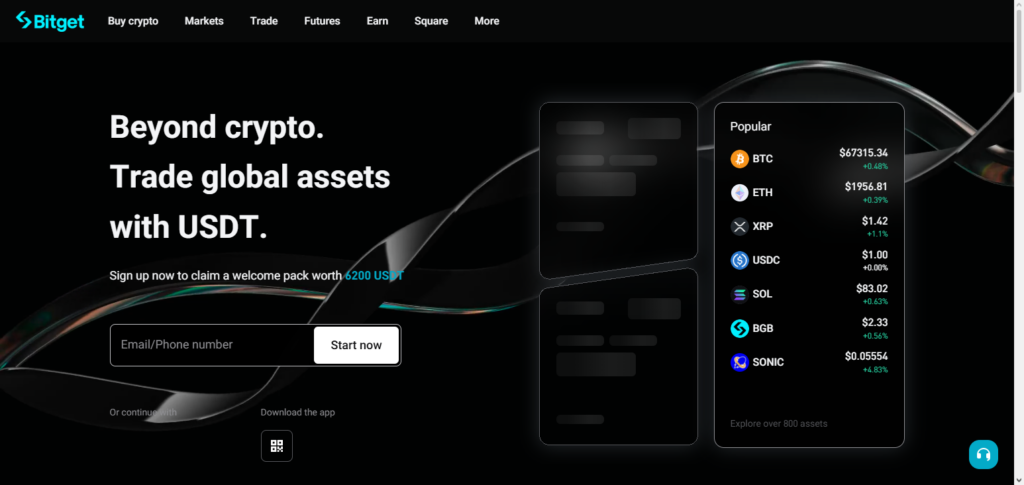
It is renowned for its competitive trading charges, which are approximately 0.10 percent maker/taker on spot and 0.02 percent maker/taker on futures, as well as for features like copy trading that let consumers imitate experienced traders.
Although Bitget does not widely promote portfolio margin as a normal account type, it does offer margin and cross/isolated options for leveraged situations. With proof-of-reserves and protection funds, the platform prioritizes security.
Bitget — Features
| Feature | Description |
|---|---|
| Spot Trading | Buy/sell crypto instantly. |
| Futures Trading | Perpetual & quarterly contracts. |
| Margin Trading | Cross & isolated margin options. |
| Copy Trading | Follow professional traders. |
| Mobile & Web App | Easy, intuitive trading platforms. |
Bitget Pros & Cons
Pros:
- User‑friendly interface suitable for beginners
- Innovative copy trading & copy portfolio tools
- Competitive futures fees
- Strong global presence with high liquidity
- Enhanced security features (proof‑of‑reserves)
Cons:
- Limited fiat on‑ramp options in some regions
- Portfolio margin not widely supported
- Altcoin liquidity can vary by token
- Customer support response time fluctuates
- Advanced trading tools not as deep as some competitors
2. MEXC Global
Founded in 2018, MEXC Global is a rapidly expanding cryptocurrency exchange with one of the biggest token catalogs in the market (3000+ assets) and incredibly low prices; many spot pairs have maker fees of 0% and taker fees of ~0.02% on futures.
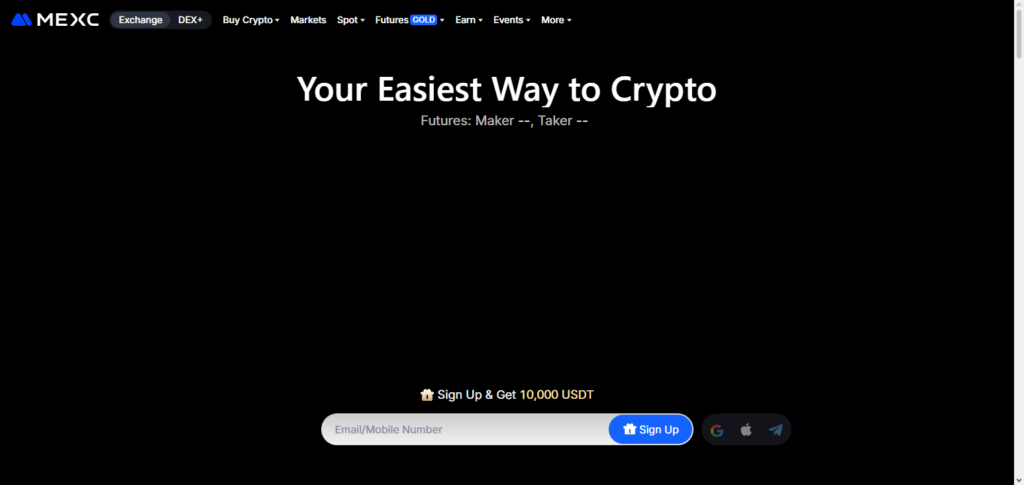
It draws traders interested in new tokens and specialty markets with its spot and leveraged markets, isolated and cross-margin options, and very high leverage (up to ~200×) on some perpetual futures. However, margin tools are often standard isolated/cross modes; actual portfolio margin is not widely available. Fiat support is not emphasized by MEXC.
MEXC Global — Features
| Feature | Description |
|---|---|
| Spot Trading | Wide token selection for spot trades. |
| Futures & Leverage | High‑leverage derivatives available. |
| Token Launchpad | Early access token launches. |
| Staking | Earn rewards on supported assets. |
| Incentive Programs | Trading rewards & bonuses. |
MEXC Global Pros & Cons
Pros:
- Massive coin selection (thousands of tokens)
- High leverage options (up to ~200×)
- Low trading fees
- Frequent new token listings and incentives
- Strong liquidity on many altcoins
Cons:
- Portfolio margin not supported
- Interface can be overwhelming for beginners
- Limited fiat payment options
- Regulatory clarity limited in some regions
- Occasional wallet withdrawal delays reported
3. Gate.io
One of the oldest centralized exchanges, Gate.io was established in 2013 and is well-known for its vast selection of altcoins (thousands of tokens) and full range of trading services, which include spot, futures, and margin trading. On-spot fees for makers and takers are usually approximately 0.1%, with comparable derivatives charges.
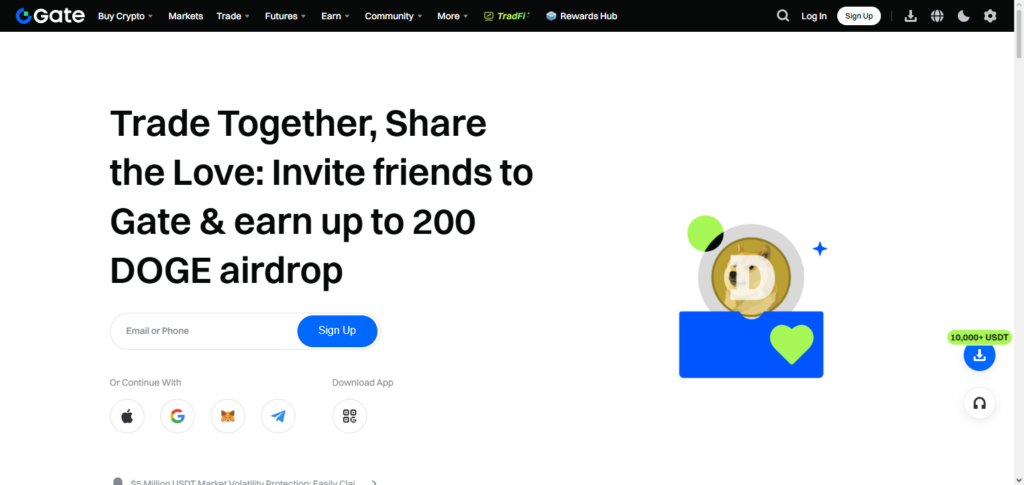
Although it provides isolated/cross margin, it does not actively promote a specialized portfolio margin system, unlike several of the platforms on this list. Diverse traders and those looking for early token access find Gate.io appealing because to its wide selection of assets and solid proof-of-reserves commitment.
Gate.io — Features
| Feature | Description |
|---|---|
| Spot Trading | Extensive altcoin support. |
| Margin Trading | Cross & isolated leverage. |
| Futures Trading | Derivatives markets available. |
| DeFi Integration | Bridge to decentralized finance. |
| Staking & Lending | Earn on idle crypto. |
Gate.io Pros & Cons
Pros:
- Extensive altcoin inventory
- Comprehensive trading tools
- Available margin and futures trading
- DeFi staking and lending
- Established, high uptime exchange
Cons:
- UI is not beginner friendly
- No portfolio margin
- Liquidity for some tokens is low
- Limited fiat support compared to global peers
- Greater fees on some assets
4. BitMEX
Launched in 2014, BitMEX gained notoriety as a derivatives-focused exchange that invented high-leverage Bitcoin perpetual and futures contracts, frequently with leverage of up to 100×. Its fee structure, which rewards liquidity providers and is designed for experienced traders rather than novices, typically consists of a taker fee and occasionally a negative maker fee.
BitMEX’s product revolves around margin trading, including cross and isolated positions. However, portfolio margin as a single risk model isn’t widely positioned here; instead, it concentrates on sophisticated derivative risk instruments. Professional traders of margins and derivatives continue to use BitMEX.
BitMEX — Features
| Feature | Description |
|---|---|
| Futures Trading | High leverage on perpetuals. |
| Margin Trading | Up to 100× leverage on BTC/ETH. |
| Advanced Order Tools | Stop, take‑profit orders, etc. |
| Professional UI | Designed for experienced traders. |
| Deep Liquidity | High volumes in derivatives. |
BitMEX Pros & Cons
Pros:
- Strong focus on derivatives with great liquidity
- Higher leverage is available to seasoned traders
- Advanced risk management available
- Maker fees are low compared to others
- API is available for developers
Cons:
- Not beginner-friendly
- Portfolio margin not available
- Limited choices for spot trading
- Restrictions for U.S. traders
- The trading environment is dangerous for untrained traders
5. Huobi (HTX)
Since its founding in 2013, Huobi Global (now known as HTX) has expanded to become one of the biggest exchanges globally, offering a wide range of goods such as financial services, futures, margin, staking, and spot. Spot trading fees usually begin around 0.2%, and derivatives pricing is competitive.
Like many large exchanges, Huobi/HTX does not place much emphasis on a portfolio margin approach, although it does offer normal margin trading capabilities. It is appropriate for intermediate to advanced traders due to its robust liquidity across major pairings and regional variations in its global regulatory and compliance standing.
Huobi (HTX) — Features
| Feature | Description |
|---|---|
| Spot Trading | Major & emerging token support. |
| Margin Trading | Cross & isolated options. |
| Futures & Derivatives | Perpetual and futures markets. |
| Staking | Earn yields on assets. |
| Analytics | Trading and market insights. |
Huobi (HTX) Pros & Cons
Pros:
- Established history and large clientele
- Margin & derivatives options
- Wide variety of crypto assets
- Strong liquidity for large tokens
- Protection from losses via security and insurance fund
Cons:
- No portfolio margin
- User regulatory limits by region
- New traders may find UI overwhelming
- Some competitors have lower fees
- Support may take longer to respond
6. Binance
With hundreds of coins, derivatives, savings products, staking, and its own BNB ecosystem, Binance, which was founded in 2017, is the biggest cryptocurrency exchange globally in terms of trading volume. Futures fees can be as low as 0.02 % or 0.04 %, while spot trading fees are normally about 0.10 % maker/taker, with even lower rates possible with BNB discounts.
Although Binance provides sophisticated margin tools and adaptable risk management, its margin system—which enables cross and isolated margin as well as sophisticated risk engines—is not commonly referred to as portfolio margin. Binance is a market mainstay due to its extensive liquidity and global presence.
Binance — Features
| Feature | Description |
|---|---|
| Spot Trading | One of the largest coin libraries. |
| Futures & Options | Derivatives with advanced tools. |
| Margin Trading | Cross & isolated leverage. |
| Savings & Staking | Passive income options. |
| BNB Ecosystem | Reduced fees with native token. |
Binance Pros & Cons
Pros:
- Greatest exchange by liquidity & volume
- Wide range of coins & products
- Low fees, BNB discount available
- Good charts and tools for trading
- Great participation from institutions
Cons:
- Portfolio margin not fully developed
- Regulatory concerns in many regions
- New users might find interface overwhelming
- Some regions have restrictions for fiat deposits/withdrawals
- Delays in processing withdrawals can occur
7. Coinbase Advanced
The professional trading division of Coinbase, a U.S.-based exchange that was established in 2012 and is listed on the NASDAQ, is called Coinbase Advanced. With more trading pairs, deeper order books, and richer charting than the normal Coinbase interface, it is intended for advanced and higher-volume traders.
In the past, fees were greater than those of many international exchanges, but for active traders, more recent membership choices can significantly lower them. Coinbase is especially well-liked in regulated areas since it prioritizes regulatory compliance and custodial security with insured wallets, while offering fewer margin services than specialized margin experts and without having a key feature of portfolio margin.
Coinbase Advanced — Features
| Feature | Description |
|---|---|
| Spot Trading | Regulated trading pairs. |
| Advanced Charts | Pro charting and tools. |
| Order Types | Limit, stop, market orders. |
| Insured Custody | Secure, insured wallet holding. |
| Regulatory Compliance | Fully compliant in many regions. |
Coinbase Advanced Pros & Cons
Pros:
- Good regulations in U.S.
- Security and custodial wallet insurance
- Order book depth and advanced charting
- Simple use in the Coinbase system
- Professional UI that’s clean and intutive
Cons:
- Trade fees higher than many worldwide competitors
- Smaller selection of cryptocurrencies
- No portfolio margin offered
- Trading margin tools are limited
- Certain features are not available globally
8. OKX
Launched in 2017, OKX provides a variety of cryptocurrency products, such as complex margin types, options, perpetual swaps, futures, and spot. A characteristic that sets OKX apart from other major exchanges is the introduction of Portfolio Margin and Multi-Currency Margin solutions for qualified traders, which enable optimal capital efficiency and risk aggregation across products.
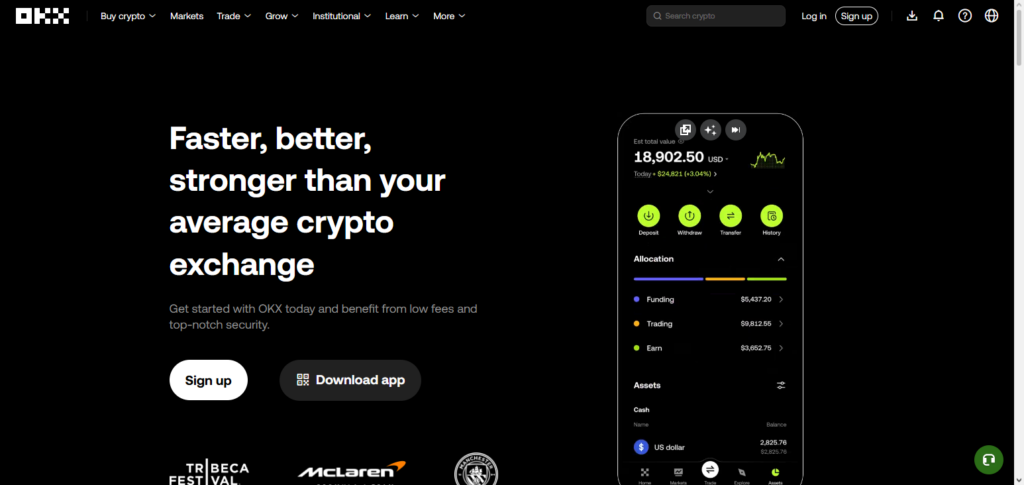
Trading expenses are competitive and vary by market (for example, futures makers may charge roughly 0.02 percent and takers approximately 0.05 percent). Both experts and experienced retail traders find OKX appealing because it incorporates wallet/DeFi services and powerful charting tools.
OKX — Features
| Feature | Description |
|---|---|
| Spot Trading | Large selection of coins. |
| Futures & Options | Professional derivatives. |
| Portfolio Margin | Unified risk across assets. |
| Multi‑Currency Margin | Cross‑asset margin support. |
| DeFi Tools | Integrated DeFi access. |
OKX Pros & Cons
Pros:
- True portfolio margin for qualified clients
- Low trading costs, high liquidity
- Risk management goes above & beyond
- Options, derivatives and spot trading
- Support for multiple devices and API
Cons:
- More complex UI than other platforms
- Some options are regionally limited
- Advanced features require KYC
- Portfolio margin has learning curve
- Performance issues are not unheard of
9. KuCoin
Since its founding in 2017, KuCoin has gained recognition for its extensive asset listing, affordable fees (~0.1% maker/taker on spot), and services including lending, staking, futures, and margin.

Although KuCoin provides standard margin modes (isolated and cross) for leveraged trading, its leverage tools are more conventional and it does not place much emphasis on a formal portfolio margin structure.
The native KCS token, which is part of KuCoin’s ecosystem and offers incentive programs and fee refunds, draws traders seeking lower barriers to entry and a variety of coin availability.
KuCoin — Features
| Feature | Description |
|---|---|
| Spot Trading | Wide token listings. |
| Margin Trading | Cross & isolated modes. |
| Futures | Perpetual contracts available. |
| KCS Rewards | Benefits with native token. |
| Staking & Lending | Earn interest on holdings. |
KuCoin Pros & Cons
Pros:
- Huge selection of altcoins
- Low trading fees (base)
- Some tokens have margin and futures
- Incentives for staking tokens and revenue sharing
- Active community and growth programs
Cons:
- No portfolio margin
- Support provided is inconsistent
- UI could use improvement
- Tokens have varying degrees of liquidity
10. Crypto.com App
Founded in 2016, Crypto.com offers exchange services together with a consumer-focused mobile app. In its ecosystem, it provides basic margin trading, earn/staking products, a cryptocurrency debit card, and spot trading over a moderate range of assets (with varying trading costs depending on volume and CRO token stakes).
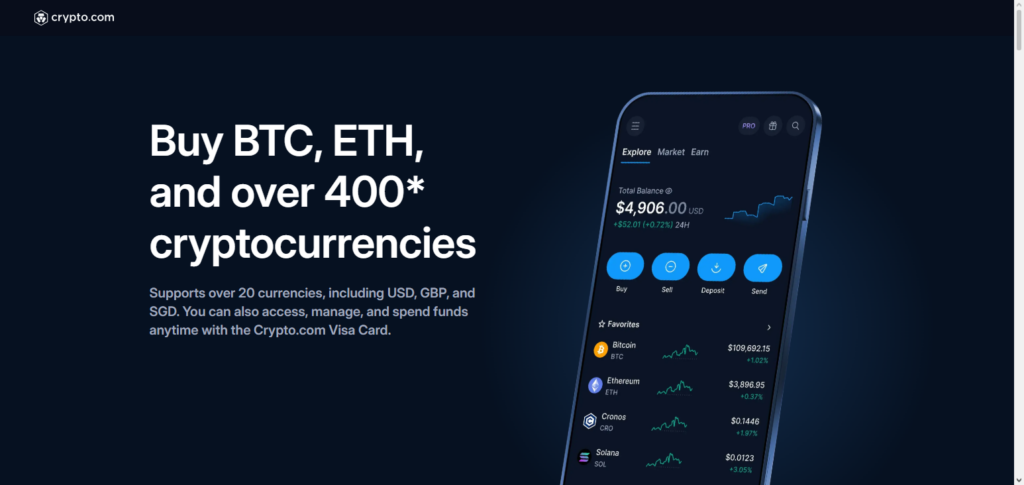
Although fees can differ greatly—they are frequently lower with native token incentives—advanced margin kinds, such as portfolio margin, are not essential to the mobile app experience. The integrated mobile finance, user benefits, and convenience of use for regular cryptocurrency holders are the main advantages of Crypto.com.
Crypto.com App — Features
| Feature | Description |
|---|---|
| Mobile Trading | App‑first experience. |
| Spot Trading | Popular tokens supported. |
| Crypto Card | Pay with crypto card rewards. |
| Earn & Staking | Interest‑earning options. |
| Fiat Wallet | Easy fiat to crypto entry. |
Crypto.com App Pros & Cons
Pros:
- Mobile experience is easy to understand
- Competitive pricing with CRO staking
- Rewards with crypto debit card
- Earn & staking programs integrated
- Easy fiat‑to‑crypto onramps in multiple regions
Cons:
- No portfolio margin
- Only basic margin
- Less trading tools
- Limited cryptocurrency options compared to big exchanges
- Features limited due to location
Conclusion
A few platforms stand out when assessing cryptocurrency exchanges for capital efficiency, superior risk management, and portfolio margin trading. The industry leader, OKX, provides genuine portfolio margin, which combines risk across various assets and derivatives to enable traders to maximize leverage with lower margin needs. Although powerful spot and futures trading with isolated and cross-margin modes is offered by exchanges like as Binance, Bitget, and MEXC Global, portfolio margin is typically not used extensively. While other major exchanges continue to be excellent choices for flexible leverage and a variety of assets, OKX offers traders the most advanced framework for professional-grade margin capabilities, security, and liquidity.
FAQ
What is portfolio margin in crypto trading?
Portfolio margin is an advanced risk-based margin system that calculates margin requirements across multiple positions and assets. It allows traders to reduce overall margin needs by offsetting correlated risks, increasing capital efficiency compared to traditional isolated or cross margin.
Which crypto exchanges offer portfolio margin?
Among major exchanges, OKX is known for offering true portfolio margin, allowing traders to manage multiple assets and derivatives under a single margin account. Most other exchanges provide isolated or cross-margin modes but do not yet offer full portfolio margin.
Are portfolio margin accounts risky?
Yes, portfolio margin can amplify both gains and losses. While it reduces required margin for diversified portfolios, it exposes traders to larger liquidation risks if markets move sharply. Advanced risk management is essential.
Can beginners use portfolio margin?
Portfolio margin is generally designed for experienced traders. Beginners are better off using spot trading or standard isolated/cross-margin accounts until they understand leverage and risk management.