




In this article, I will be reviewing the Best Node-as-a-Service Platforms for developers, Web3 startups and enterprises. We’ll evaluate the top providers across supported networks, node types, pricing, RPC performance, rate limits, scalability, APIs, security, archive access, and developer tools.
This guide will assist you to understand the key differences and help you figure out the right blockchain infrastructure options for different project requirements.
How to Choose a Node-as-a-Service Platform
Verify Supported Networks: Choose a provider that supports the blockchains, L2s, mainnets and testnets your app needs. also considering future network needs so that you don’t need to switch out infrastructure later
Compare Node Types: See if the platform offers full, archive, dedicated, validator or specialized nodes. Archive nodes are useful if your application requires historical blockchain state or data.
Evaluate RPC Performance: Compare latency, throughput, consistency of response, requests per second capacity. The provider should be able to handle your normal traffic, as well as spikes in demand.
Review Rate Limits: Examine RPS limits, monthly or daily quotas, burst capacity, and throttling rules. A provider with insufficient limits can block your app during traffic spikes.
Check for WebSocket Support: If your application needs real-time blockchain events, transactions or contract activity, look for WebSocket support, connection limits and subscription capabilities.
Compare Prices: Don’t just compare the starting price. Compare free credits, RPC requests, compute units, overage charges, archive access, dedicated-node costs and enterprise pricing to see true infrastructure cost.
Ensure Scalability: Choose a platform that can grow with your application, increasing throughput, upgrading plans, adding nodes or moving to dedicated infrastructure.
How We Selected These NaaS Platforms
| Selection Factor | What We Evaluated |
|---|---|
| Supported Networks | We considered the range of blockchain networks, L1s, L2s, and ecosystems supported by each platform. |
| Node Infrastructure | We checked the availability of full nodes, archive nodes, dedicated nodes, validator infrastructure, and other node options. |
| RPC Performance | We evaluated RPC access, response performance, throughput, reliability, and infrastructure designed for production workloads. |
| Rate Limits | We compared requests-per-second limits, monthly quotas, compute units, API credits, and available capacity across plans. |
| Pricing | We reviewed free tiers, subscription plans, usage-based pricing, dedicated-node costs, and enterprise pricing models. |
| Scalability | We considered whether platforms can accommodate increasing traffic through higher limits, dedicated infrastructure, additional nodes, or custom capacity. |
| API & Developer Tools | We examined RPC APIs, WebSockets, SDKs, dashboards, webhooks, debugging tools, data APIs, and other developer resources. |
| Archive & Historical Data | We checked whether providers offer archive access and historical blockchain data for analytics, indexing, and advanced applications. |
| Reliability | We considered uptime commitments, redundancy, failover capabilities, monitoring, and infrastructure designed for continuous availability. |
| Security | We reviewed access controls, API authentication, infrastructure isolation, monitoring, and other security-related capabilities. |
| Geographic Coverage | We considered regional infrastructure and multi-region availability where providers publicly disclose these capabilities. |
| Enterprise Support | We evaluated dedicated support, SLAs, custom infrastructure, account management, and enterprise deployment options. |
| Use-Case Coverage | We included platforms serving different requirements, including dApps, DeFi, wallets, exchanges, gaming, analytics, and enterprise Web3 applications. |
| Platform Differentiation | We looked for distinctive capabilities such as Solana-focused infrastructure, decentralized RPC, intelligent routing, dedicated nodes, or integrated development tools. |
| Overall NaaS Utility | The final selection focused on the breadth of infrastructure capabilities and how effectively each platform addresses practical blockchain node-access requirements. |
Node-as-a-Service Pricing: What Actually Drives Cost?
Node-as-a-Service pricing is not just based on the advertized monthly plan. The main cost drivers are RPC requests, requests per second, compute-unit consumption, supported blockchain networks, node type, storage, bandwidth, archive data, WebSocket connections, and dedicated infrastructure.
Shared nodes are usually cheaper, while dedicated and archive nodes require more resources and are more expensive.
Providers may also charge for higher API limits, additional regions, premium support, or enterprise service level agreements. Free plans may work for testing and small projects, but larger applications may need paid capacity. By comparing total usage requirements, it helps to determine the actual NaaS cost for a project.
Key Points
| Platform | Key Point 1 | Key Point 2 |
|---|---|---|
| Helius | Solana-focused infrastructure | High-performance RPC |
| Tenderly Node | EVM-focused RPC infrastructure | Virtual TestNets support |
| Moralis | Multi-chain infrastructure | Blockchain data APIs |
| Tatum | Multi-chain node access | RPC and blockchain APIs |
| InfStones | Multi-chain node infrastructure | Full and validator nodes |
| Gateway.fm | Managed blockchain infrastructure | RPC and node services |
| All That Node | Multi-chain RPC provider | JSON-RPC and WebSocket |
| Lava Network | Decentralized RPC network | Multi-chain data access |
| NOWNodes | Multi-chain full-node access | Dedicated node options |
| Allnodes | Multi-chain node hosting | Validator infrastructure |
1. Helius
Year Founded: 2022. Created by Mert Mumtaz, Nicolas Pennie and Liam Vovk, Helius is heavily focused on Solana infrastructure. Supported networks It is Solana and SVM focused on its fundamental infrastructure, not a general multi-chain NaaS.

Node Types: We provide high-performance RPC nodes, dedicated nodes, archival access, LaserStream WebSockets/gRPC, and transaction infrastructure. Pricing: Plans start free, then Developer at $49/month, Business at $499, and Professional at $999; dedicated nodes start at around $2,900/month.
Performance: Published RPC limits vary from 10 to 500 RPS. Scalability: Higher tiers offer more throughput and custom enterprise infrastructure. Rate Limits: 10, 50, 200 and 500 RPS based on the plan.
Key Strengths of Helius
- Solana-native infrastructure: Infrastructure purpose-built for Solana applications and high-performance workloads.
Low-Latency RPC: Globally-distributed RPC infrastructure for quick reads and writes. - Live Data Streaming: LaserStream delivers live Solana data via gRPC and WebSockets.
- Transaction Delivery: Sender is designed for fast transaction landing on Solana infrastructure.
- Enterprise Reliability: Helius comes with 99.99% RPC success rate and enterprise-grade infrastructure.
| Feature | Details |
|---|---|
| Solana RPC Infrastructure | High-performance RPC infrastructure designed specifically for Solana applications. |
| LaserStream | Provides low-latency Solana streaming through WebSockets and gRPC, including real-time transaction and account data. |
| Transaction Infrastructure | Sender and related transaction services are designed to improve transaction delivery and landing performance. |
| Archival Data | Provides access to historical Solana blockchain data for applications requiring older on-chain information. |
| Preprocessed Transactions | Developers can access processed transaction data without handling all raw blockchain processing themselves. |
| Dedicated Nodes | Dedicated Solana nodes are available for applications requiring specialized infrastructure and higher control. |
| Scalability | Plans scale from 10 RPS on the free tier to 500 RPS on Professional, with custom enterprise limits. |
| Developer Tools | APIs, webhooks, RPC, data streaming, transaction tools, and other Solana-focused developer services. |
| Enterprise Features | Enterprise plans include custom rate limits, advanced geographic coverage, optimized infrastructure, and latency/uptime SLAs. |
| Pricing | Free, Developer ($49/month), Business ($499/month), Professional ($999/month), and custom Enterprise options. ( |
2.tenderly node
Founded: Tenderly began as a blockchain development infrastructure company, later expanding to offer its Node RPC. Supported Networks: Tenderly Node supports many EVM networks including Ethereum, Arbitrum, Base, Polygon, Optimism, Linea, Blast, BOB, Mode and more.
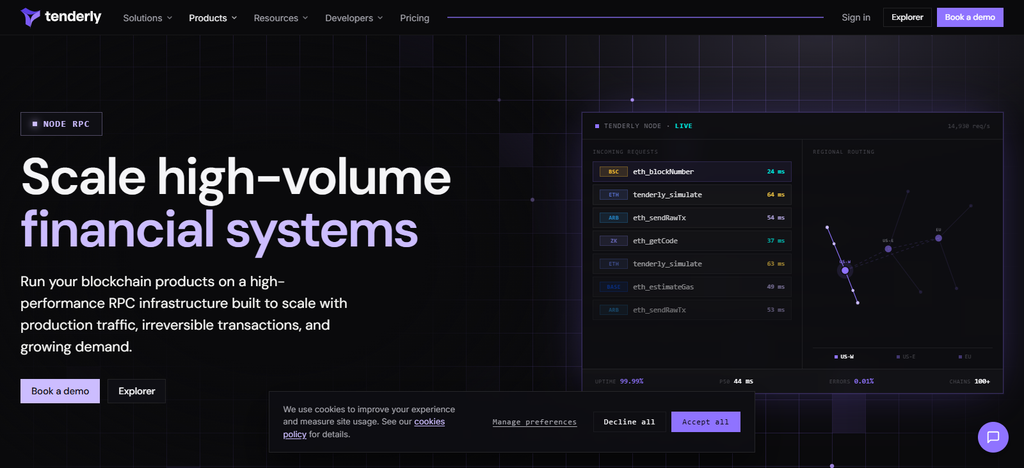
Node Types Main offerings are managed node RPC endpoints with simulation, debugging, tracing and Virtual TestNets. Pricing: Tenderly has a usage-based pricing model on its platform, measured in Tenderly Units (previously documented at 350 million TUs per month for Pro).
Performance: it emphasizes low-latency, production-grade RPC and multiregional routing. Scalability: Multiple RPCs can be created per network and traffic can be controlled with access controls that are standard. Rate Limits The published Pro documentation lists 300 TU/second with soft limits for usage spikes.
Key Strengths of Tenderly Node Provider
- Production-Grade RPC: Managed JSON-RPC endpoints for production applications, so you never need to self-host nodes.
EVM Development Integration: Node infrastructure integrates directly with Tenderly’s debugging, simulation and testing tools. - Consistent Data Access: Built to serve application workloads with consistent reads from the blockchain.
Custom RPC: Developers are able to configure custom RPC endpoints and control which methods are supported.
Developer-Friendly Monitoring: See request activity, usage, and operational behavior in the Tenderly environment.
| Feature | Details |
|---|---|
| Managed RPC Nodes | Provides managed blockchain RPC access for applications without requiring teams to operate their own nodes. |
| EVM Infrastructure | Primarily designed around Ethereum and EVM-compatible development environments. |
| RPC Endpoints | Developers can create and use RPC endpoints for application and smart-contract interactions. |
| Simulation Integration | Node infrastructure works alongside Tenderly’s transaction simulation and debugging environment. |
| Debugging Tools | Developers can inspect transactions, traces, contracts, and execution behavior within the broader Tenderly platform. |
| Virtual TestNets | Provides development environments that allow teams to test blockchain applications with controlled network states. |
| Development Workflow | Combines RPC infrastructure with testing, simulation, debugging, and monitoring tools. |
| Production Support | Designed for applications requiring managed blockchain infrastructure rather than self-hosted nodes. |
| Custom Infrastructure | Enterprise-oriented requirements can be handled through customized infrastructure and support arrangements. |
| EVM Focus | Particularly useful for teams building and testing smart-contract applications across EVM networks. |
3. Moralis
Founded: Moralis is a Web3 development infrastructure company focused on simplifying blockchain application development. Supported Networks: It supports major networks such as Ethereum, Base, Solana, BNB Smart Chain, Polygon, Avalanche, Arbitrum, Optimism, Linea, Gnosis and more.

Node Types: The NaaS-style infrastructure includes managed RPC nodes in addition to blockchain data APIs and Streams. Pricing: The current paid plans are published as: Starter $149/month, Pro $249 and Business $749 billed annually, and Enterprise custom pricing.
Performance: Throughput is 40 RPS on Starter and 200 RPS on Business. Scalability: Business offers unlimited RPC nodes and increased API capacity. Rate Limits: Published plans are 40, 80 and 200 RPS respectively.
Key Strengths of Moralis
- Broad Chain Coverage: Nodes available on major networks including Ethereum, Base, Solana, Polygon, Arbitrum and more.
- Fast RPC Response: Moralis claims to have response times of 70 ms for its infrastructure.
RPC + Data APIs: Developers are able to access direct node access combined with token, NFT, wallet, and blockchain data APIs.
Scalable Infrastructure: The node infrastructure is architected for application scalability. - Enterprise Security: Moralis touts its SOC 2 Type II certification and managed infrastructure.
| Feature | Details |
|---|---|
| Multi-Chain RPC | Provides RPC access across supported EVM and Solana networks. |
| Blockchain APIs | Includes APIs for wallets, tokens, NFTs, prices, DeFi, and broader blockchain data. |
| Supported Networks | Includes Ethereum, Base, Solana, BNB Smart Chain, Polygon, Avalanche, Arbitrum, Optimism, Linea, Gnosis, and other networks. |
| RPC Nodes | Starter includes RPC access, Pro provides 20 RPC nodes, and Business provides unlimited RPC nodes. |
| Streams | Moralis Streams enables applications to receive blockchain events and transaction-related data. |
| Archive Data | Full archive data is included across the published plans. |
| Scalability | Published throughput increases from 40 RPS on Starter to 80 RPS on Pro and 200 RPS on Business. |
| Enterprise Infrastructure | Enterprise customers can receive custom throughput, engineering access, monitoring, and support. |
| Developer APIs | Unified APIs reduce the need to build separate blockchain data infrastructure for different networks. |
| Pricing | Current published pricing lists Starter at $149/month billed annually, Pro at $249, Business at $749, and Enterprise custom pricing. |
4. Tatum
Year Established: 2018. Tatum was built as a blockchain development platform to make it easier to build infrastructure and applications. Supported Networks: Its RPC service now supports over 100 networks including Ethereum, Bitcoin, Base, Arbitrum and BNB Smart Chain.

Node Types: Tatum offers managed RPC endpoints, removing the need for users to run infrastructure, with geo-balancing, failover, caching and blockchain APIs. Price: There is a free plan of 100,000 credits, paid plans scale with larger credit allocations, dedicated API keys start at $99/month for 10 RPS.
** Performance: 200 RPS for standard paid RPC access. Scalability: Geo-balanced gateways & failover support production workloads. ** Rate Limits:** Free 3 RPS, paid up to 200 RPS.
Key Strengths of Tatum
- Multi-Chain Connectivity: Tatum provides multi-chain connectivity with APIs and developer tooling.
Smart RPC Routing: Its Gateway intelligently routes requests based on the health, performance and data freshness of the endpoints. - Archive Data: Access to historical blockchain data for supported networks.
Traffic Handling: The gateway architecture is built to perform reliably during periods of heavy traffic. - Developer Integration: Tatum brings together node access and wallets, transactions, tokens, and other blockchain development functions.
| Feature | Details |
|---|---|
| RPC Nodes | Provides direct access to more than 100 blockchain nodes without requiring customers to manage infrastructure. |
| Full Nodes | Users can access managed full-node infrastructure for supported networks. |
| Archive Nodes | Archive infrastructure is available for applications requiring historical blockchain data. |
| Intelligent RPC Routing | Routes RPC traffic through a global node network using performance-aware routing, caching, and automatic failover. |
| Low Latency | Tatum states that its Intelligent RPC Routing can provide sub-30ms latency. |
| Data APIs | Provides standardized APIs for reading and writing blockchain data. |
| Blockchain Notifications | Webhooks allow applications to receive notifications for on-chain events with retry functionality. |
| Multi-Chain Development | Provides a unified framework across 100+ blockchain protocols. |
| Scalability | Designed to handle growing application workloads through managed infrastructure and RPC orchestration. |
| Developer Ecosystem | Also includes wallets, transaction tools, token functionality, crypto price APIs, and other Web3 development services. |
5. InfStones
Established: 2018. InfStones was founded by Dr. Zhenwu Shi to provide blockchain infrastructure, node management, staking and Web3 development services. Supported Networks: It supports many blockchain protocols, making it a great option for organizations that require a multi-chain infrastructure.

Node Types: Infrastructure: Full nodes, validator nodes, RPC endpoints, staking infrastructure, managed blockchain nodes Pricing: InfStones typically does not publish a single public rate card for NaaS, but uses customized or enterprise pricing. Performance : Infrastructure for production blockchain workloads with managed node operations.
Scalability: Users can provision and control infrastructure across multiple networks from a single, unified control plane. ** Rate Limits Public RPS limits are different based on network, service, and deployment. Enterprise workloads should be confirmed directly with InfStones.
Key Strengths of InfStones
- Dedicated Nodes: Users have access to dedicated full node infrastructure for production workloads.
- Quick Implementation: Managed infrastructure reduces the operational efforts to deploy blockchain nodes.
- Scalable Architecture: InfStones is architected to scale with your application and infrastructure scale.
- Operations Management: Node operations are simplified by dashboard, analytics, automated infrastructure management and support.
| Feature | Details |
|---|---|
| Multi-Chain Infrastructure | Provides blockchain infrastructure across multiple blockchain ecosystems. |
| Full Nodes | Managed full-node deployment helps teams avoid handling infrastructure directly. |
| Validator Infrastructure | Supports validator infrastructure for networks using proof-of-stake and related consensus mechanisms. |
| RPC Services | Provides blockchain connectivity for applications requiring RPC access. |
| Node Deployment | Infrastructure can be deployed and managed through a dedicated Web3 infrastructure environment. |
| Staking Infrastructure | Provides infrastructure services for blockchain staking and validator operations. |
| Node Monitoring | Infrastructure management and monitoring tools help track node health and operational status. |
| Enterprise Infrastructure | Designed to support institutional and production blockchain workloads. |
| Scalability | Multi-chain infrastructure allows organizations to expand node deployments across additional networks. |
| Custom Pricing | Enterprise and infrastructure requirements can be handled through customized commercial arrangements rather than one universal public NaaS price. |
6. Gateway.fm
Founded: Norway-based Gateway.fm was founded in 2021 and initially focused on managing open blockchain networks, before expanding into more general managed infrastructure. Networks Supported: Particularly focused on Ethereum-lineage networks and institutional blockchain needs.

Network availability is dependent on the deployed service. Node Types: Gateway provides managed blockchain infrastructure, node deployments, RPC connectivity, data services, and production operations. Pricing: Public standardized NaaS pricing is not clearly disclosed and institutions and custom deployments generally need to contact the company.
Performance: Its infrastructure is built for production reliability, connectivity, and operational management. Scalability: Gateway is designed to support institutional workloads that require customized deployment and operational support. Rate Limits: Fixed public RPS limits are not well-documented and are likely influenced by infrastructure setup, network, and customer needs.
Key Strengths of Gateway.
- Managed Blockchain Infrastructure: Infrastructure services that lower the operational burden of operating blockchain nodes.
- Enterprise Focus: Infrastructure for organizations that need managed, customized blockchain deployments.
- Node Operations: Offers node deployment and ongoing infrastructure management instead of teams having to do everything on their own.
Custom Infrastructure: Enterprise customers can set up their own infrastructure.
Operational Reliability: The platform’s focus on managed infrastructure means that operational reliability and blockchain connectivity are paramount.
| Feature | Details |
|---|---|
| Web3 Infrastructure | Provides infrastructure focused on blockchain networks and application deployments. |
| L2 Infrastructure | Gateway emphasizes infrastructure for Layer-2 solutions and high-performance blockchain deployments. |
| CDK-Erigon | Its high-performance Erigon-based node implementation is designed for Polygon CDK networks and RPC/sequencer workloads. |
| RPC Nodes | Provides node infrastructure for blockchain connectivity and application RPC requirements. |
| High Performance | Gateway documents 250ms block times for its CDK-Erigon-based implementation. |
| Sequencer Support | Its node implementation can serve as infrastructure for sequencer workloads in supported L2 deployments. |
| Managed Infrastructure | Reduces the operational requirements involved in deploying and maintaining blockchain infrastructure. |
| Custom Deployments | Infrastructure can be adapted for specific blockchain and institutional requirements. |
| Developer Infrastructure | Designed to support Web3 builders requiring specialized blockchain infrastructure. |
| Enterprise Orientation | Particularly focused on production infrastructure and organizations building or operating blockchain networks. |
7. All That Node
Founded: All That Node is a multi-chain Web3 infrastructure provider that offers managed blockchain node access and developer APIs. Supported Networks: It supports Ethereum, Arbitrum, Aptos, Astar and many other networks, with different capabilities per chain.

Node Types: Core node APIs, archive data, WebSockets, debug and trace APIs, and dedicated nodes for business customers. Pricing: Free plan with 500,000 compute units per day; Starter, Scale and Business plans with higher capacities; Business uses custom pricing. Performance: Higher tiers include published plans for throughput controls and auto-scaling.
Scalability: Scale and Business plans are for heavier dApp workloads. Rate Limits: Rate limits are based on the plan and protocol and customized request and throughput limits are available for our enterprise customers.
Key Strengths of All That Node
- Multiple types of API: Offers JSON-RPC, REST and WebSocket connectivity for a variety of development needs.
- Archive Access: Provides access to blockchain archives for supported networks.
Developer Friendly Free Tier: Free tier includes 50K requests per day.
Advanced Node APIs: Build out its infrastructure capabilities with trace and debug APIs, automated updates, unlimited endpoint access and technical support.
| Feature | Details |
|---|---|
| Multi-Chain Infrastructure | Provides managed access to multiple blockchain protocols through a unified infrastructure platform. |
| RPC Access | Supports blockchain RPC connectivity for decentralized applications and Web3 projects. |
| WebSockets | WebSocket support enables applications to receive real-time blockchain events and data. |
| Archive Data | Provides archival blockchain data for supported networks and use cases. |
| Debug & Trace APIs | Debug and trace namespaces are available for supported infrastructure and plans. |
| Dedicated Nodes | Business customers can order dedicated nodes for higher traffic, security, and customized configurations. |
| Auto-Scaling | The platform provides an auto-scaling option for projects requiring additional quota as usage increases. ( |
| Team Plans | Free, Starter, Scale, and Business plans target different project and team sizes. |
| Enterprise Support | Business/enterprise customers can receive customized limits and SLA arrangements. |
| Free Tier | Current pricing lists a free plan with 500,000 compute units per day and a 150-CU throughput limit. |
8. Lava Network
Founded: Lava Network is not your average centralized node provider, but a decentralized RPC and blockchain data-access protocol. Supported Networks Its ecosystem consists of many chains like Ethereum, Arbitrum, Base, Polygon, Solana, Cosmos, Avalanche, Starknet, NEAR, Bitcoin, and more.
Node Types: Lava connects applications to decentralized RPC providers via a relay marketplace and provider network. Pricing Usage is based on compute units and provider economics within the protocol rather than a traditional monthly NaaS subscription.
Performance: Requests can be handled by multiple RPC providers, providing redundancy and a competitive infrastructure.
Scalability: The decentralized provider model increases infrastructure capacity across networks. Rate Limits: There is no one RPS number, it is determined by the chain specs, the provider capacity, the API interfaces and the consumer configuration.
Key Strengths of Lava Network
- Decentralized RPC Model: Lava connects apps to autonomous infrastructure providers, not a one-stop shop node operator.
Provider Redundancy: Multiple providers can increase infrastructure redundancy and reduce single endpoint dependency. - Multi-Chain Connectivity: Allows for multi-blockchain connectivity support.
- Open Source Architecture: Lava’s infrastructure and SDK approach is open ecosystem.
- Data integrity Its network has protocol-level features designed to provide reliable access to blockchain data.
| Feature | Details |
|---|---|
| Decentralized RPC | Uses a decentralized provider network rather than relying exclusively on one centralized infrastructure operator. |
| Multi-Chain Access | Connects applications with RPC and data providers across multiple blockchain ecosystems. |
| Provider Marketplace | Infrastructure providers participate in the network and serve blockchain data requests. |
| RPC Routing | Requests can be routed through participating providers according to network and service requirements. |
| Redundancy | Multiple infrastructure providers can reduce dependence on a single node operator. |
| Blockchain Data Access | Provides developers with RPC-based access to supported blockchain networks. |
| Open Infrastructure | Lava’s protocol-based model enables independent providers to participate in the infrastructure ecosystem. |
| Provider Economics | The network uses protocol-level mechanisms for relationships between consumers and infrastructure providers. |
| Scalability | Capacity can expand as additional infrastructure providers and supported chains participate. |
| Different NaaS Model | Unlike conventional centralized NaaS providers, Lava focuses on decentralized RPC infrastructure and provider coordination. |
9. NOWNodes
Founded: 2019 as a department of ChangeNOW (launched in 2017) Supported Networks: NOWNodes gives you access to 110+ full nodes and supports major networks like Bitcoin, Ethereum, BSC, Polygon, Cardano, Solana and many more.
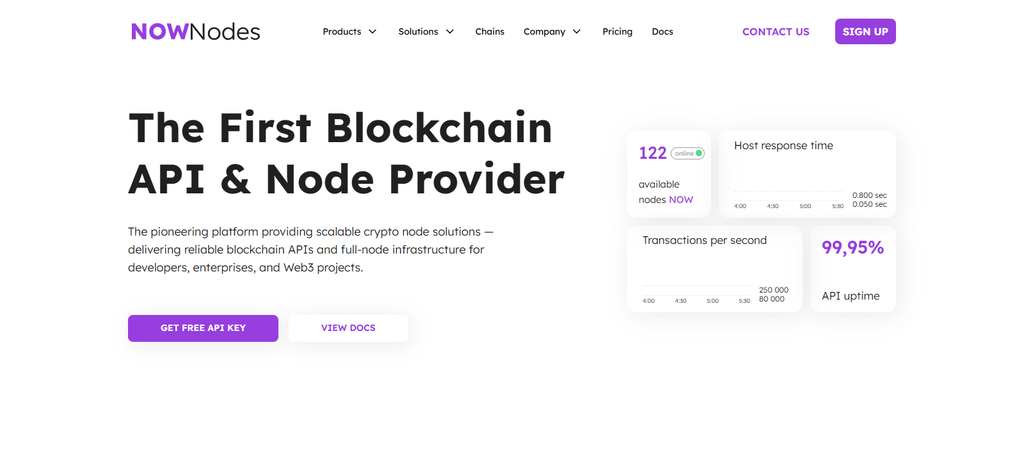
Node Types: It offers managed full-node infrastructure, RPC access, WebSockets, and Blockbook explorers. Pricing: Free Start, Pro €20/month, Pro Plus €90, Business €200, Business Plus €300, Enterprise €500 (current published prices); custom plans available.
**Performance: Plans begin at 15 RPS on the free trial, increasing to larger monthly request allocations. Scalability: more requests, API keys, support, enterprise capacity in higher tiers.
Key Strengths of NOWNodes
- Extensive Network Access: More than 50 blockchain nodes available, supporting many top networks.
- Multiple Node Options: Shared, archive, backup and dedicated node infrastructure.
- Fast API Access: NOWNodes says that its API responds in about one second.
- Block Explorer Integration: Block explorer functionality is embedded into the node and API infrastructure.
- Managed Support: Customers receive access to account management services and 24/7 technical support.
| Feature | Details |
|---|---|
| Multi-Chain Node Access | Provides managed access to a large range of blockchain networks through its infrastructure. |
| Full Nodes | Provides full-node access for supported blockchains. |
| Dedicated Nodes | Dedicated infrastructure is available for customers requiring higher performance and isolation. |
| Archive Nodes | Archive infrastructure supports applications requiring historical blockchain information. |
| API Access | Provides APIs for interacting with supported blockchain networks. |
| Webhooks | Webhook functionality allows applications to receive blockchain-related notifications. |
| Market Data | Higher-tier plans include market-data functionality alongside node infrastructure. |
| Regional Infrastructure | Custom plans can include selected regions and dedicated infrastructure. |
| Enterprise Support | Custom plans include priority support, a dedicated account manager, dedicated nodes, and selected regions. |
| Usage Scaling | Published plans range from 100,000 to 100 million requests per month, with custom options available. |
10. Allnodes
Founded: 2018 Allnodes began as a staking platform and expanded into wider Web3 infrastructure including validator nodes, full nodes, archive nodes, RPC endpoints and monitoring.
Networks Supported: It now manages infrastructure across 90+ networks, including ecosystems such as Bitcoin, Ethereum-related chains, Cosmos-based networks, and several more. Node Types Full node services Validator node services Archive node services RPC endpoints Dedicated infrastructure Pricing: Prices are network-specific. Published full node examples include Bitcoin ($100/month and up) and several EVM networks ($160/month and up). Heavy networks can be more costly.
Performance Plans can feature dedicated nodes, bandwidth from 1 to 10 Gbit/s, and uptime SLAs. Scalability: Enterprise options such as dedicated servers and failover nodes Rate Limits: The advertized node plans have no limit to number of requests, limited only by service terms and infrastructure configuration.
Key Strengths of Allnodes (Allnodes)
- Comprehensive Blockchain Support: Node infrastructure for more than 90 blockchains with dedicated and archive solutions.
- Dedicated Nodes: Dedicated nodes are available on supported networks with no rate limits.
- Archive Infrastructure: Dedicated archive nodes to support applications requiring historical blockchain data.
Global Availability: Infrastructure deployed in US, European and Asian regions. - Node Monitoring: Allows you to monitor full nodes, validators, and masternodes and receive operational alerts.
| Feature | Details |
|---|---|
| Full Nodes | Provides managed full-node hosting with infrastructure designed for high uptime and simplified deployment. |
| Validator Nodes | Supports validator-node hosting for eligible proof-of-stake networks. |
| Masternodes | Provides managed masternode infrastructure and monitoring. |
| Archive Nodes | Dedicated archive nodes are available for supported blockchains. |
| RPC Endpoints | Dedicated nodes can provide RPC access, including PublicNode infrastructure for many networks. |
| Global Regions | Full-node infrastructure is available across multiple global locations. |
| Node Monitoring | Multilayer monitoring helps track node availability and performance. |
| Notifications | Allnodes Bot can send node-performance updates through Telegram, Discord, and Slack. |
| Staking | Provides staking services alongside node infrastructure and hosting. |
| Pricing Flexibility | Full-node pricing varies by blockchain, with published examples starting at $100/month for Bitcoin and $160/month for several EVM networks. |
How much does Node-as-a-Service cost?
Node-as-a-Service (NaaS) pricing is highly variable and depends on the blockchain network, type of node, RPC usage, throughput, storage, archive access, and shared or dedicated infrastructure.
Some have free tiers to tinker with, while production plans are usually monthly subscriptions, usage-based credits, request-based billing, or custom enterprise pricing. For instance, Helius has a free plan, a Developer plan for $49/month, a Business plan at $499/month, and a Professional plan at $999/month, with dedicated nodes starting from $2,900/month.
Main NaaS Pricing Models
Free Plans: Free tiers are primarily designed for developers, testing, prototypes, and low-traffic applications. They typically include limited requests, credits, supported networks, or throughput.
Usage-Based Pricing: Some providers charge according to RPC requests, compute units, API credits, bandwidth, or data consumed. This model can be economical for applications with variable traffic but requires monitoring usage carefully.
Monthly Subscription: Fixed monthly plans provide a predetermined number of requests or compute credits and generally offer higher limits, better support, and additional infrastructure features.
Dedicated Node Pricing: Dedicated nodes cost substantially more because the customer receives isolated infrastructure and predictable resources. For example, Helius lists dedicated nodes from $2,900/month.
Enterprise Pricing: Large exchanges, wallets, protocols, and institutions may require custom rate limits, dedicated infrastructure, SLAs, regional deployment, security requirements, or high-volume discounts. These packages are commonly priced through sales negotiations.
Example Pricing Across NaaS Providers
| Provider | Pricing Approach | Example Published Pricing |
|---|---|---|
| Helius | Subscription + usage | Free, $49, $499, $999/month; dedicated nodes from $2,900/month |
| Tenderly Node | Tenderly Units / custom | Paid Node RPC is currently sales-led; usage is measured in Tenderly Units |
| Moralis | Monthly subscription | Paid plans scale according to API/RPC usage and infrastructure requirements |
| Tatum | Credits / usage | Pricing varies according to credits, API usage, and infrastructure requirements |
| InfStones | Custom infrastructure | Primarily customized according to networks and infrastructure requirements |
| Gateway.fm | Custom | Pricing depends on deployment and infrastructure requirements |
| All That Node | Subscription / compute units | Free and paid plans with different compute-unit and throughput allocations |
| Lava Network | Decentralized usage model | Costs depend on network/provider economics and usage |
| NOWNodes | Monthly + overage | Start is free; published paid tiers range from €20 to €500/month, with custom plans available |
| Allnodes | Pay-per-hour/month | Pricing varies by blockchain; examples include Bitcoin from $100/month and several networks from $160/month |
Conclusion
Node-as-a-Service platforms make blockchain infrastructure easy, offering managed nodes, RPC endpoints, APIs, and scalable access, all without teams having to manage their own hardware. The platforms in this list cover a wide range of needs, from Helius’s Solana infrastructure and Tenderly’s EVM dev tools to Moralis and Tatum’s multi-chain APIs, and Lava Network’s decentralized approach to RPC access.
Before you choose a provider, compare things like supported networks, node types, pricing, performance, scalability, rate limits, reliability, and enterprise requirements. Understanding these differences can help developers, startups, protocols and enterprises choose infrastructure that fits their technical workload and growth needs.
FAQ
What is Node-as-a-Service (NaaS)?
Node-as-a-Service is a managed blockchain infrastructure model that provides access to blockchain nodes, RPC endpoints, APIs, and related services without requiring users to operate and maintain the underlying node infrastructure themselves.
What are the benefits of using a NaaS platform?
NaaS platforms can reduce infrastructure management work, simplify node deployment, provide scalable RPC access, and offer features such as monitoring, backups, API access, and technical support.
Which blockchain networks can NaaS platforms support?
Network coverage varies by provider. Depending on the platform, users may access Ethereum, Bitcoin, Solana, Polygon, Arbitrum, Base, BNB Chain, Avalanche, Cosmos ecosystems, and many other blockchain networks.
How much does Node-as-a-Service cost?
Pricing varies significantly. Some providers offer free tiers, while others use monthly subscriptions, usage-based credits, request-based pricing, or customized enterprise pricing. Dedicated nodes generally cost more than shared infrastructure.