





In this article I will cover the Best Bitcoin Node Providers for developers building wallets, exchanges, payment applications, explorers and Web3 projects. We will compare leading providers on Bitcoin network support, RPC and API access, indexing, performance, pricing, security, reliability, developer tools, transaction broadcasting and scalability. This will help developers understand the infrastructure options available for different Bitcoin applications.
What Is Bitcoin Node Providers?
Bitcoin node providers are infrastructure platforms that provide developers with managed access to Bitcoin nodes via APIs, RPC endpoints and blockchain data services. Developers don’t have to run, synchronize, secure and maintain Bitcoin Core infrastructure themselves.
Instead, they can simply connect their wallets, exchanges, payment applications, explorers and Web3 projects to provider-managed nodes. They can provide access to blocks, transactions, utxos, mempool data, fee estimates and transaction broadcasting.
Other features may include blockchain indexing, WebSockets, dedicated nodes, monitoring, scalability, authentication, and enterprise support, depending on the provider. Pricing varies by request, compute units, throughput, infrastructure type or dedicated capacity.
Why Choose Bitcoin Node Providers
Faster Development – Developers are able to access blockchain data via APIs with managed Bitcoin nodes, so they don’t have to spend time setting up and syncing node infrastructure.
Lower Infrastructure Work: Providers handle node deployment, synchronization, upgrades, monitoring, maintenance and much of the underlying infrastructure management.
Reliable RPC Access Developers are able to connect applications to managed RPC endpoints to fetch blocks, transactions, UTXOs, mempool info and blockchain status.
Simple Transaction Broadcasting: Many providers support transaction submission, enabling applications to broadcast signed Bitcoin transactions without the need to run their own public-facing node.
Scalable Infrastructure: Node Providers can provide increased request capacity, dedicated endpoints, load balancing, and infrastructure designed for scaling application traffic.
Indexing blockchain Some platforms include support for indexed addresses, transactions, balances, UTXOs, and historical data, which can save you the time and effort of building an indexing system yourself.
Better developer experience: Documentation, SDKs, WebSockets, Webhooks, dashboards, monitoring and API management tools can make it easier to build applications for Bitcoin.
Security and Reliability: Managed providers can provide API authentication, control of access, infrastructure monitoring, redundancy and published uptime commitments for production applications.
Several Network Choices: Developers are able to access Bitcoin Mainnet and testing networks like Testnet, Testnet4, or Signet depending on the provider.
Cost Flexibility: Developers are able to start with minimal infrastructure costs and scale up their capacity as their application’s needs grow, thanks to free tiers and usage-based plans.
Key Points
| Bitcoin Node Provider | Best For | Key Strength |
|---|---|---|
| QuickNode | High-performance applications | Fast Bitcoin RPC endpoints with enterprise-grade uptime |
| Alchemy | Developer experience | Bitcoin RPC plus extensive developer tools and analytics |
| Chainstack | Multi-chain teams | Managed Bitcoin nodes with transparent pricing |
| Blockdaemon | Enterprise infrastructure | Institutional-grade node hosting and compliance features |
| GetBlock | Affordable Bitcoin RPC | Dedicated and shared node access with flexible plans |
| NOWNodes | Broad blockchain coverage | Bitcoin support alongside 100+ blockchain networks |
| dRPC | Decentralized RPC access | Distributed infrastructure with intelligent routing |
| Ankr | Scalable applications | Large RPC network with pay-as-you-go usage |
| Tatum | Blockchain development platforms | Bitcoin APIs combined with wallet infrastructure |
| InfStones | Enterprise node operations | Managed blockchain infrastructure for large-scale deployments |
1. QuickNode
QuickNode is a 2017 founded provider of managed Bitcoin infrastructure with Bitcoin Core JSON-RPC access over HTTPS and WSS. It supports Bitcoin Mainnet and Testnet4 with blockchain, UTXO, transaction and mempool operations. Its Bitcoin stack features Blockbook indexing, Streams, Webhooks, and Ordinals & Runes APIs.
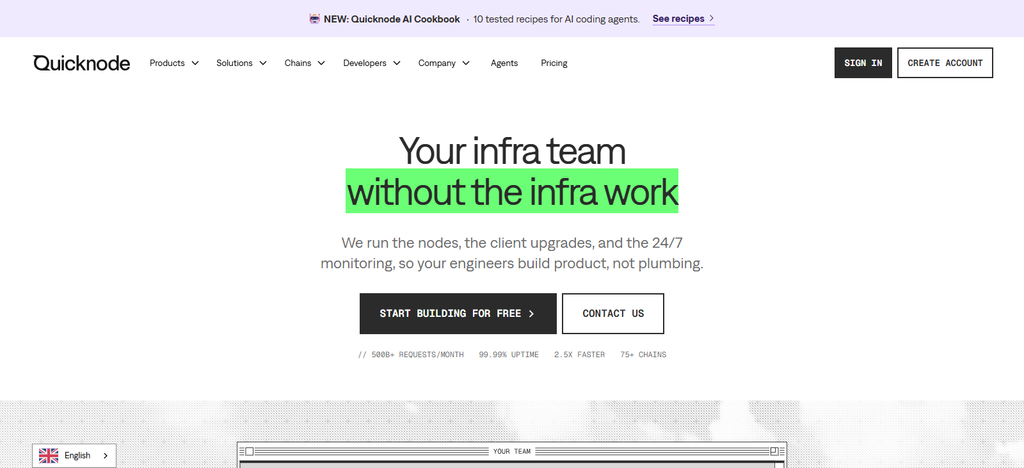
17+ global regions, 99.99% uptime SLA. It works in 17+ global regions, 99.99% uptime SLA. It is free to start, and paid plans include more API credits and rate limits. Security features token authentication, JWT and whitelist. The developer tools include SDKs, documentation, cURL samples and sample apps.
QuickNode Features, Pros & Cons
Features
| Feature | Details |
|---|---|
| Bitcoin RPC | Bitcoin JSON-RPC for blockchain, UTXO, transaction and mempool operations |
| Networks | Bitcoin Mainnet and Testnet4 |
| APIs | JSON-RPC, Blockbook, Ordinals and REST APIs |
| Indexing | Blockbook indexed data for balances, transactions and UTXOs |
| Developer Tools | Streams, Webhooks, OpenRPC/OpenAPI specifications and documentation |
| Performance | Global infrastructure with scalable API capacity |
| Pricing | Free tier available; paid Bitcoin plans start around $49/month |
| Reliability | Published 99.99% uptime SLA |
| Best For | Wallets, payment applications, explorers and production dApps |
Pros
| Pros |
|---|
| Broad Bitcoin RPC method coverage |
| Supports both Mainnet and Testnet4 |
| Combines raw RPC with indexed blockchain data |
| Streams and Webhooks support event-driven applications |
| Strong documentation and developer tooling |
| Suitable for production workloads |
Cons
| Cons |
|---|
| Pricing can increase with higher API usage |
| Advanced infrastructure can be more complex for beginners |
| Some specialized capabilities require additional products |
| Bitcoin network coverage is narrower than its overall multichain coverage |
2. Alchemistry
Alchemy Alchemy launched its Bitcoin infrastructure in 2026, adding Bitcoin to its multichain developer platform in 2017. Its Bitcoin API offers standard JSON-RPC access for blocks, transactions, mempool inspection and transaction broadcasting.

Its indexed APIs offer address balances, UTXOs and transaction history. Alchemy also supports Bitcoin family networks like Litecoin, Dogecoin, and Bitcoin Cash. Pricing begins with 30M free Compute Units monthly.
Pay-As-You-Go begins at $0.525 per 1M CUs. Developer tools include APIs, dashboard analytics, SDK-friendly workflows and documentation. Higher throughput plans and SLA options are provided for security and enterprise reliability.
Alchemy Features, Pros & Cons
Features
| Feature | Details |
|---|---|
| Bitcoin RPC | Standard JSON-RPC for blocks, transactions and blockchain queries |
| Mempool | Supports mempool inspection |
| Transactions | Raw and decoded transaction retrieval and transaction submission |
| Networks | Bitcoin Mainnet and supported Bitcoin test networks |
| Pricing | 30M Compute Units/month free; usage-based paid pricing |
| Performance | Scalable RPC infrastructure with configurable capacity |
| Developer Tools | Dashboard, API documentation and standard developer workflows |
| Indexing | Provides indexed APIs alongside node-level access where supported |
| Best For | Developers already using Alchemy’s multichain infrastructure |
Alchemy’s Bitcoin API specifically supports block and transaction retrieval, mempool monitoring and raw transaction submission.
Pros
| Pros |
|---|
| Familiar JSON-RPC interface |
| Strong developer documentation |
| Generous free Compute Unit allocation |
| Useful for teams building across multiple blockchain networks |
| Supports transaction and mempool operations |
| Scalable infrastructure for production applications |
Cons
| Cons |
|---|
| Compute Unit pricing requires usage monitoring |
| Bitcoin-specific functionality is newer than its EVM ecosystem |
| Some advanced capacity options may require additional configuration |
| Developers need to understand Bitcoin’s UTXO model rather than treating it like an EVM chain |
3. Chainstack
Chainstack is a managed blockchain infrastructure platform founded in 2018 that provides node deployment, RPC access and dedicated infrastructure for developers and enterprises.
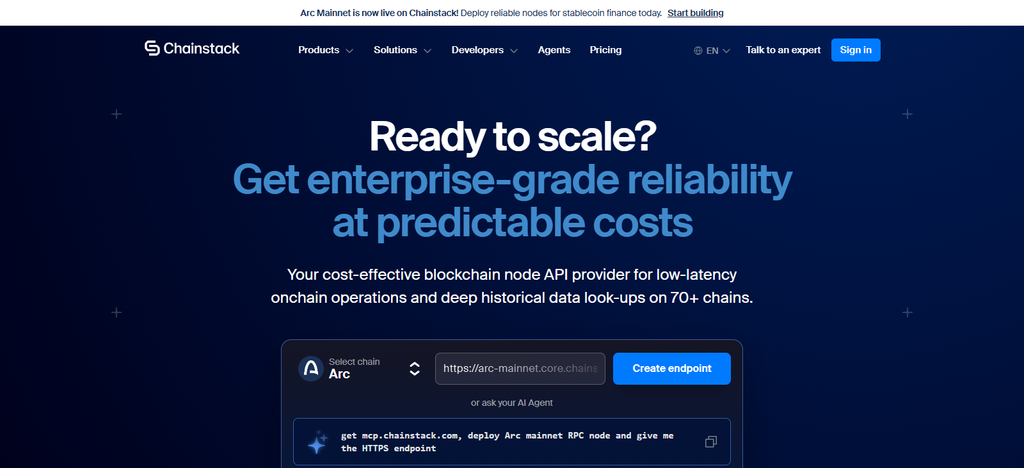
It uses a Request Units pricing model with a Developer plan that provides 3M units per month and paid plans with increasing request limits; dedicated infrastructure options are available.
Chainstack’s network coverage is protocol-dependent so developers should check the available Bitcoin network and API configuration when deploying to Bitcoin workloads. Its larger platform provides regional, global, archive and dedicated-node infrastructure, with 25 to 600 RPS on standard plans and enterprise options with custom RPS and uptime SLA.
Chainstack Features, Pros & Cons
Features
| Feature | Details |
|---|---|
| Infrastructure | Managed blockchain nodes and RPC endpoints |
| Bitcoin Access | Managed Bitcoin infrastructure where supported |
| Pricing | Free Developer plan; paid plans from approximately $49/month |
| Billing | Request Unit-based pricing |
| Performance | Plans provide defined RPS capacity with higher tiers for production |
| Deployment | Shared, dedicated and enterprise infrastructure options |
| Developer Tools | RPC endpoints, dashboards, documentation and node management |
| Enterprise | Custom RPS, infrastructure and SLA options |
| Best For | Teams needing managed infrastructure and deployment flexibility |
Chainstack’s current comparison data lists 3M Request Units/month on its free tier and a $49/month Growth plan, while its infrastructure can scale substantially beyond entry-level RPS.
Pros
| Pros |
|---|
| Flexible managed-node infrastructure |
| Request Unit pricing provides usage-based scaling |
| Dedicated infrastructure available |
| Strong enterprise-oriented controls |
| Broad multichain coverage |
| Suitable for teams that need more infrastructure control |
Cons
| Cons |
|---|
| Request Unit billing can be harder to estimate |
| Higher-capacity infrastructure can become expensive |
| Bitcoin-specific functionality should be checked against the current network configuration |
| More infrastructure options can increase setup complexity |
4. Blockdaemon
Blockdaemon was founded in 2017 and is very focused on institutional blockchain infrastructure, they provide managed nodes and RPC APIs, no need for teams to run their own infrastructure.
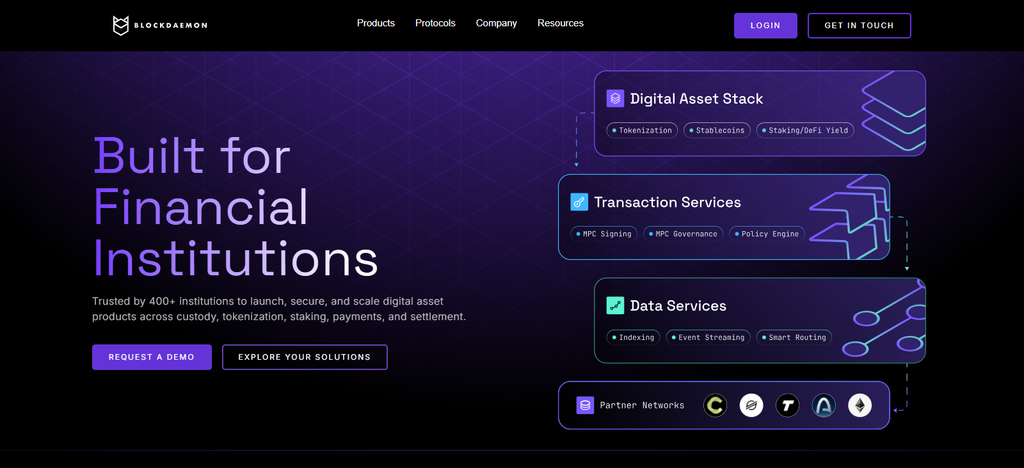
It’s Bitcoin service exposes JSON-RPC access to authenticated endpoints and supports Bitcoin Mainnet, Testnet and Testnet4. Developers are able to pull blockchain data and submit transactions using supported RPC methods and Blockdaemon also offers broader APIs and institutional infrastructure services.
Security and reliability are at the core of its offering, with SOC 2 compliance, ISO 27001 certification and cloud-based deployment options. Mostly pricing is geared toward production and enterprise workloads with custom infrastructure and service arrangements available to larger customers.
Blockdaemon Features, Pros & Cons
Features
| Feature | Details |
|---|---|
| Infrastructure | Institutional-grade blockchain infrastructure |
| Bitcoin Networks | Mainnet, Testnet and Testnet4 |
| APIs | RPC, Data API and Transaction API |
| Transactions | Creation, decoding, verification, fee estimation and broadcasting |
| Security | Enterprise authentication and compliance controls |
| Pricing | Multiple API tiers; enterprise pricing can be customized |
| Performance | Scalable infrastructure designed for institutional workloads |
| Developer Tools | API documentation, standard endpoints and transaction tooling |
| Best For | Exchanges, institutions, custodians and enterprise applications |
Pros
| Pros |
|---|
| Strong institutional focus |
| Bitcoin Mainnet and multiple test networks |
| Broad transaction API functionality |
| Enterprise security and compliance capabilities |
| Supports multiple blockchain protocols |
| Useful for large production infrastructure |
Cons
| Cons |
|---|
| Pricing is less transparent for some enterprise services |
| Enterprise-oriented features may be excessive for small projects |
| Institutional onboarding can require more configuration |
| Some API write operations are subject to compliance screening |
5. GetBlock.
GetBlock was founded in 2019 and provides shared, dedicated and archive blockchain nodes via API-based infrastructure. Its Bitcoin service supports Mainnet and Testnet and exposes dozens of Bitcoin RPC methods including block, transaction, PSBT and UTXO functionality.
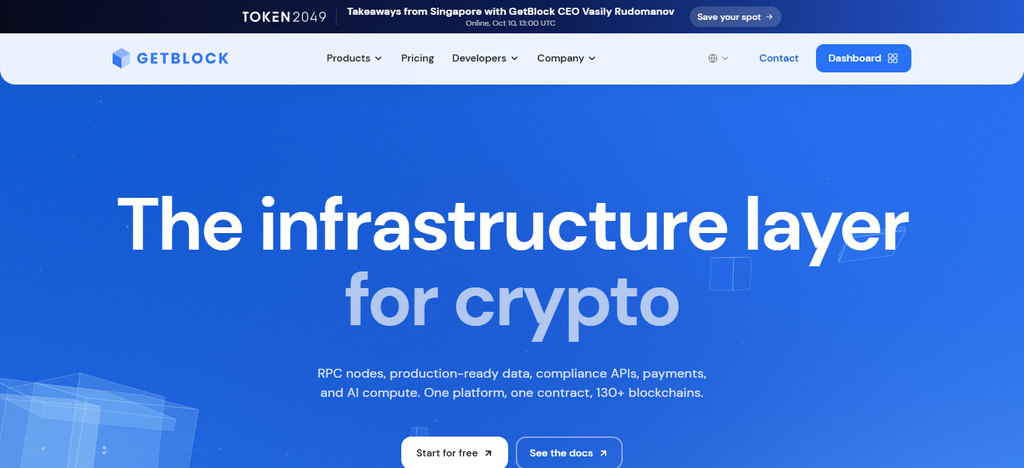
Developers are able to access archive data and WebSocket on eligible plans via JSON-RPC and other supported interfaces The platform.
Existing shared pricing starts with a free tier and then paid plans at $39 per month and higher tiers increasing compute units, endpoints and RPS. GetBlock has 99.99% uptime, SOC 2 Type II and ISO certifications and dashboards and documentation for development and monitoring.
GetBlock Features, Pros & Cons
Features
| Feature | Details |
|---|---|
| Bitcoin RPC | JSON-RPC access to Bitcoin infrastructure |
| Indexing | Blockbook-based indexed blockchain data |
| Networks | Bitcoin Mainnet and Testnet |
| APIs | JSON-RPC, REST and Blockbook APIs |
| Pricing | Free tier plus paid shared and dedicated options |
| Performance | Shared plans offer increasing RPS; dedicated nodes provide isolated capacity |
| Developer Tools | API dashboard, documentation and endpoint management |
| Security | API authentication and enterprise security options |
| Best For | Developers needing both raw RPC and indexed Bitcoin data |
Pros
| Pros |
|---|
| Bitcoin-focused RPC capabilities |
| Blockbook indexing is useful for wallet and explorer applications |
| Shared and dedicated node options |
| Public pricing makes capacity comparison easier |
| Supports a broad range of blockchain networks |
| Suitable for applications requiring indexed data |
Cons
| Cons |
|---|
| Compute Unit pricing requires usage planning |
| Dedicated infrastructure costs substantially more |
| Free-tier capacity is limited |
| Advanced workloads may require higher-priced plans |
6. NOWNodes
NOWNodes: a unified API that provides access to 100+ blockchain nodes. Founded in 2019, it supports Bitcoin and other networks. Its Bitcoin infrastructure provides JSON-RPC, WebSocket, Blockbook indexing and archive capabilities for developers to retrieve blocks, transactions, balances, addresses and historical blockchain data. Pricing is based on API access and usage . Developers are able to create an API key and start with free access , scaling to paid capacity .
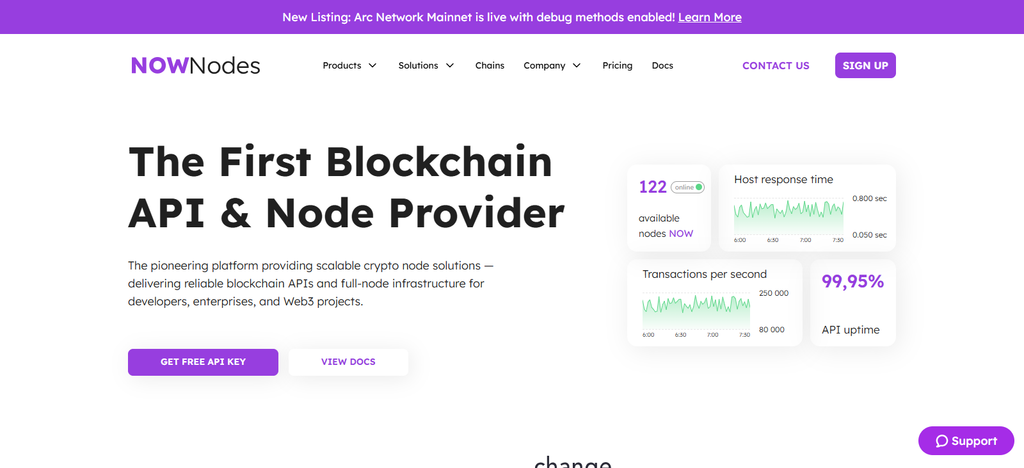
Developer tools include documentation, API end points, explorer style data and integration examples. It is managed infrastructure that does not require direct maintenance of Bitcoin nodes and is well suited for wallets, exchanges, payment applications and blockchain analytics.
NOWNodes Features, Pros & Cons
Features
| Feature | Details |
|---|---|
| Bitcoin Access | Managed Bitcoin node infrastructure |
| RPC | Bitcoin JSON-RPC access |
| Indexing | Blockbook-based indexed data |
| APIs | JSON-RPC, REST and WebSocket options |
| Pricing | Free 100K-request trial; paid plans from approximately €20/month |
| Performance | Paid plans provide substantially higher request capacity |
| Networks | Bitcoin Mainnet and supported Bitcoin test environments |
| Developer Tools | API keys, documentation and blockchain data APIs |
| Best For | Wallets, exchanges, payment apps and multichain applications |
Pros
| Pros |
|---|
| Simple request-based pricing |
| Bitcoin-specific API support |
| Blockbook provides indexed blockchain information |
| WebSocket support is useful for real-time applications |
| Broad multichain coverage |
| Relatively low-cost entry-level paid plan |
Cons
| Cons |
|---|
| Free access is primarily a trial rather than an unlimited permanent tier |
| Higher-volume applications may require larger plans |
| Some advanced infrastructure is quote-based |
| Developers should verify exact network and method availability before production deployment |
7. dRPC
dRPC was founded in 2022 and is built on a decentralized RPC architecture that shares requests among independent infrastructure providers and public nodes. Its Bitcoin API consists of block information, transactions, UTXOs, fee estimation and transaction broadcasting via send raw transaction.
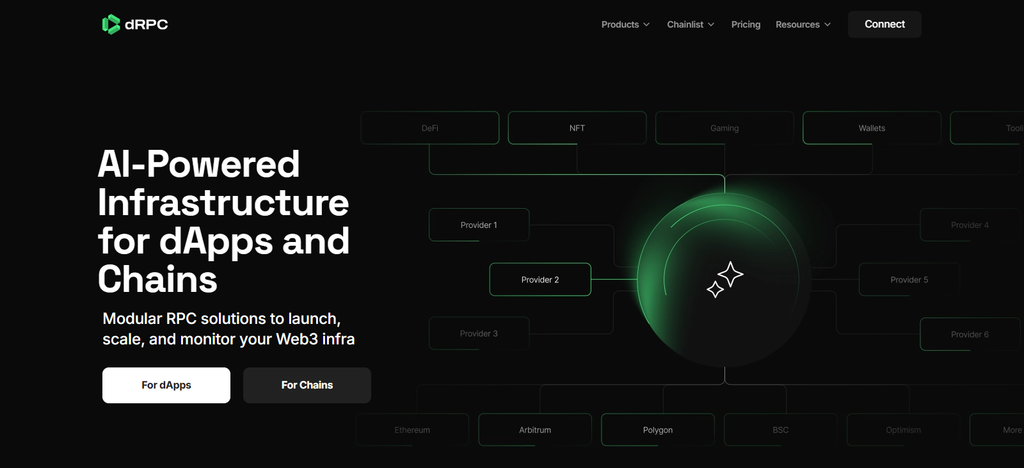
dRPC uses a compute-unit model, with most Bitcoin RPC methods costing 20 CUs and charging $0.30 per 1M CUs . Performance is built around routing and failover across multiple providers, not a single node.
Developer tools: JSON-RPC endpoints, statistics APIs, key management, configurable rate limits & documentation. Security features include API Key, JWT support, IP whitelisting and provider controls.
dRPC Features, Pros & Cons
Features
| Feature | Details |
|---|---|
| Architecture | Decentralized RPC infrastructure |
| Routing | Routes requests across multiple infrastructure providers |
| Bitcoin RPC | Bitcoin blockchain and transaction RPC access |
| Pricing | Usage-based Compute Unit model |
| Free Tier | Large monthly Compute Unit allocation |
| Performance | Multi-provider routing, retries and geographic infrastructure |
| Security | API keys, JWT and access controls |
| Developer Tools | RPC endpoints, statistics and API management |
| Best For | Developers seeking redundancy and multichain RPC access |
Pros
| Pros |
|---|
| Distributed RPC architecture |
| Provider-level redundancy |
| Automatic routing and failover capabilities |
| Large free Compute Unit allocation |
| Broad blockchain coverage |
| Useful for applications concerned with RPC availability |
Cons
| Cons |
|---|
| Decentralized architecture can be harder to understand |
| Compute Unit billing requires monitoring |
| Performance can depend on underlying providers |
| Not necessarily the best fit when direct dedicated-node control is required |
8 Ankr
Ankr – Launched in 2017, Ankr offers multichain node infrastructure via its Web3 API platform, including Bitcoin access via native Bitcoin JSON-RPC and Blockbook indexed APIs. The Bitcoin support now includes Mainnet and Signet Testnet.
Developers are able to query blockchain information, transactions and other supported methods through the API. Ankr’s Premium pricing is based on API Credits with published PAYG pricing of $0.10 per 1M API Credits and higher volume subscription options.
Performance is up to ~1,500 requests/second/endpoint on Premium Node API infrastructure. Developer tools such as JavaScript and Python SDKs, React Hooks, API testing, and usage analytics are available. Security-oriented infrastructure also includes authenticated endpoints and newer verifiable RPC capabilities.
Ankr Features, Pros & Cons
Features
| Feature | Details |
|---|---|
| Bitcoin API | Native Bitcoin RPC and indexed API options |
| Networks | Bitcoin Mainnet and supported test environments |
| Pricing | Pay-as-you-go and credit-based options |
| Free Tier | Large monthly API Credit allocation |
| Performance | High-throughput API infrastructure |
| Developer Tools | APIs, SDKs, documentation and monitoring tools |
| Security | Authenticated endpoints and advanced RPC security capabilities |
| Multichain | Broad blockchain network coverage |
| Best For | Multichain applications and developers needing scalable APIs |
Pros
| Pros |
|---|
| Large free API Credit allocation |
| Competitive usage-based pricing |
| Broad multichain ecosystem |
| High-throughput infrastructure |
| Developer-friendly APIs and tools |
| Useful for teams building across several networks |
Cons
| Cons |
|---|
| Credit-based pricing requires understanding API consumption |
| Bitcoin-specific functionality is only one part of a much broader platform |
| Advanced infrastructure options can increase complexity |
| Developers with Bitcoin-only workloads may prefer a specialized provider |
9. Tatum
Tatum, an API-first blockchain development platform, was founded in 2018 and makes it easy to build applications across multiple networks including Bitcoin. Its Bitcoin infrastructure exposes blockchain, transaction and address related APIs and dedicated API keys can give guarantyd RPS capacity for production workloads.
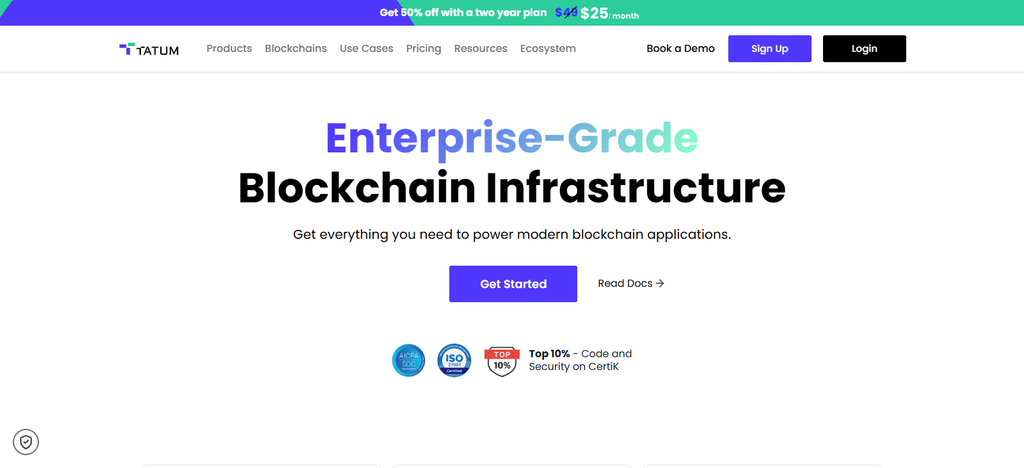
The current dedicated throughput options are 10 RPS for $99/month, 25 RPS for $249/month, 50 RPS for $509/month and 100 RPS for $1,049/month. Developers are able to access Tatum APIs and development tools for wallet, transaction workflows, address histories and blockchain applications. Abstraction rather than direct node management characterizes the platform and the API-based integration is the main development model.
Tatum Features, Pros & Cons
Features
| Feature | Details |
|---|---|
| Platform | API-first blockchain development platform |
| Bitcoin Access | Blockchain and transaction APIs |
| API Model | Managed APIs rather than direct node administration |
| Pricing | Free/developer access plus usage-based and dedicated API options |
| Performance | Dedicated RPS options for production |
| Developer Tools | APIs, SDKs, documentation and application development tools |
| Wallet Support | APIs for blockchain and wallet-related development |
| Multichain | Supports numerous blockchain networks |
| Best For | Developers wanting abstraction from node infrastructure |
Pros
| Pros |
|---|
| API-first developer experience |
| Simplifies blockchain application development |
| SDKs and development tooling |
| Dedicated RPS options |
| Useful for multichain applications |
| Reduces the need for direct node management |
Cons
| Cons |
|---|
| Less focused on raw Bitcoin node administration |
| Advanced throughput can require paid dedicated capacity |
| API abstraction may not expose every Bitcoin Core capability |
| Pricing can become significant for high-throughput production workloads |
10. InfStones
Founded in 2018, InfStones provides blockchain infrastructure for node deployment, API access, staking and Web3 application development. It uses a self-service infrastructure model for its platform, allowing developers and organizations to deploy and manage blockchain nodes through a centralized interface.

Pricing for Fast API is based on Request Cost where different RPC methods will cost differently depending on the resource needs. There is a free service plan. Developers working on Bitcoin projects should check current Bitcoin API availability and supported network configuration before deploying to production.
InfStones’ public documentation is oriented toward general protocol infrastructure and does not have a Bitcoin-specific service page. The focus of developer tooling is APIs, node management and infrastructure automation.
InfStones Features, Pros & Cons
Features
| Feature | Details |
|---|---|
| Infrastructure | Managed blockchain node infrastructure |
| Deployment | Node deployment and infrastructure management |
| API | Fast API access with request-based billing |
| Pricing | Free service option plus usage-based capacity |
| Performance | Request-cost model varies according to API operations |
| Developer Tools | API access, node management and infrastructure automation |
| Multichain | Broad protocol and network support |
| Enterprise | Infrastructure services for larger blockchain applications |
| Best For | Teams seeking managed blockchain infrastructure |
Pros
| Pros |
|---|
| Managed node infrastructure |
| Supports multiple blockchain ecosystems |
| API-based developer workflow |
| Infrastructure automation capabilities |
| Useful for teams managing several blockchain networks |
| Reduces operational burden compared with self-hosting |
Cons
| Cons |
|---|
| Bitcoin-specific public documentation is less extensive than some dedicated RPC providers |
| Request-cost pricing requires usage planning |
| Advanced infrastructure may require enterprise engagement |
| Developers should verify current Bitcoin network availability before production use |
Conclusion
The best Bitcoin node provider to choose in 2026 depends on your application’s RPC needs, indexing needs, performance expectations, pricing model, and infrastructure preferences.
Bitcoin infrastructure and developer access is provided by providers such as QuickNode, Alchemy, Chainstack, Blockdaemon, GetBlock, NOWNodes, dRPC, Ankr, Tatum, and InfStones. Look at supported bitcoin networks, API methods, transaction broadcasting, mempool access, rate limits, security features, uptime commitments and developer tools when choosing a provider.
Developers should also think about whether they need shared RPC access, dedicated infrastructure, indexed blockchain data, or enterprise-grade node management for their specific Bitcoin application and expected workload.
FAQ
What is a Bitcoin node provider?
A Bitcoin node provider offers managed access to Bitcoin blockchain infrastructure through APIs or RPC endpoints. Developers can access blockchain data, transactions, blocks, mempool information, and other node functions without operating and maintaining a Bitcoin node themselves.
Why do developers use Bitcoin node providers?
Developers use Bitcoin node providers to avoid the infrastructure, storage, synchronization, monitoring, maintenance, and security work required to run Bitcoin nodes. Managed providers can offer scalable RPC access, APIs, indexing, monitoring, and production infrastructure.
What should I look for in a Bitcoin node provider?
Important factors include Bitcoin network support, RPC and API coverage, transaction broadcasting, mempool access, indexing capabilities, rate limits, performance, pricing, uptime, security, documentation, SDKs, and deployment options.
Do Bitcoin node providers support Bitcoin Testnet?
Many providers support Bitcoin Mainnet and one or more testing environments. However, support for Testnet4, Signet, or other Bitcoin networks varies, so developers should verify the provider’s current network availability before integrating.
What is Bitcoin RPC access?
Bitcoin RPC, or Remote Procedure Call, allows an application to communicate with a Bitcoin node programmatically. Developers can use RPC methods to retrieve blocks and transactions, inspect blockchain status, estimate fees, access mempool information, and broadcast transactions.