



In this article, I will focus on the Best Geopolitical Prediction Market Platforms for 2026. Some of these platforms help predict world events with far more precision than they could in the past. These squarely centralized marketplaces like Kalshi and decentralized marketplaces like Polymarket, contain areas in which they excel in liquidity, fees, and accessibility. When combined, they reflect the rapidly increasing interest around the world in predictive markets and geopolitics more generally.
What Are Geopolitical Prediction Market Platforms?
Geopolitical prediction market platforms enable users to trade outcome-related contracts for political, economic and world events. These platforms are built similarly to financial markets in that contract prices reflect the market belief for the probability of an event occurring.
As an example, a contract priced at $0.65 positions a likely outcome of something occurring in a 65% likely case. Platforms cover a variety of events such as elections and policies, international conflicts, and macroeconomic trends.
Some platforms are fully—Kalshi—or partially—Polymarket—regulated. When combined, these prediction market platforms offer comprehensive tools for researchers and traders to add geopolitical business intelligence to their operations.
Why Geopolitical Prediction Markets Matter in 2026
Accurate Predictions: Frequently, prediction markets outperform polls in predicting election outcomes, policy outcomes, and war outcomes.
Institutional Adoption: Firms such as hedge funds and government agencies utilize platforms like Kalshi and Polymarket to make real-time assessments of geopolitical risks.
Increase in Liquidity: Volumes in the vicinity of billions of dollars give these markets the robustness of sentiment and probability indicators.
Use in Policy and Research: Political science and economics scholarly research find PredictIt and IEM to be highly valuable.
Main Stream Investment: Integrating geopolitical prediction markets into Robinhood and Crypto.com makes these markets availabile to all retail users.
How We Ranked the 10 Platforms
| Ranking Factor | Suggested Weight |
|---|---|
| Geopolitical Market Coverage | 20% |
| Market Liquidity & Trading Depth | 15% |
| Event & Contract Variety | 15% |
| Market Resolution Transparency | 10% |
| Real-Time Pricing & Market Responsiveness | 10% |
| Fees & Trading Costs | 8% |
| Regulatory Status & Market Access | 8% |
| Platform Transparency & Data Quality | 5% |
| User Accessibility & Trading Experience | 5% |
| Market Integrity & Risk Controls | 4% |
| Total | 100% |
1. Kalshi
Kalshi launched in 2021 as America’s first official CFTC prediction market exchange after founding in 2018. It centers on binary contracts for event outcomes for $0.01 – $0.99, paying out $1 or $0. Like all exchange markets, Kalshi has focused its liquidity on key event outcomes for U.S. politics, macro, weather & sports markets.
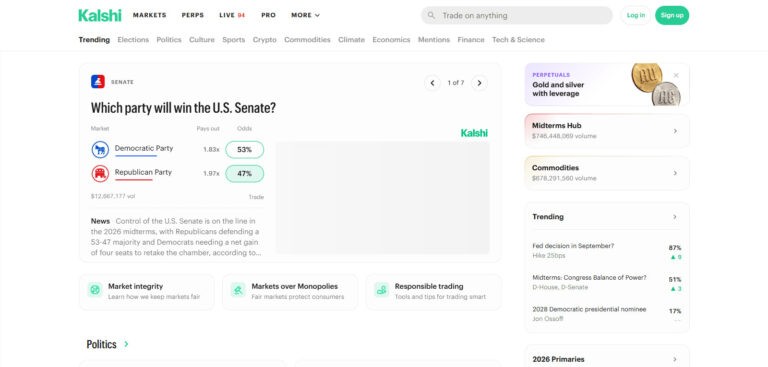
By 2026, it is projected to achieve institutional SP of over $30B. Trading has been low cost since 2024, including zero fees on winning trades. As an official regulated market, Kalshi has attracted international patrons from all tiers of the trading market, including institutional and retail.
| Characteristic | Details |
|---|---|
| Founded | 2018, launched 2021 |
| Regulation | CFTC-regulated U.S. exchange |
| Market Focus | U.S. politics, macroeconomics, weather, sports |
| Contract Design | Binary event contracts ($0.01–$0.99) |
| Liquidity | Institutional + retail, $30B+ volume |
| Fees | No fees on winning trades |
| Accessibility | U.S. residents, institutional investors |
| Settlement | Cash-settled, regulated clearing |
| Strength | Safest regulated geopolitical market |
Kalshi Pros & Cons
Pros:
- Regulated by CFTC (legal and safe)
- High liquidity with institutional participation
- No fees on winning trades
- Wide range of U.S. political and economic markets
- Strong hedge fund credibility
Cons:
- U.S.-only access limits global reach
- Limited to binary contracts
- KYC verification is required
- Less gamified than crypto-native platforms
- Smaller retail user base versus Robinhood
2. Polymarket
Launched in 2020, Polymarket is the leading prediction market built on Polygon and dominates over $12B monthly volume in 2026. Polymarket provides the deepest global markets for geopolitical, economic, and cultural predictions. Fees are between 0.30% and 1.80%, in stark comparison to sportsbooks.
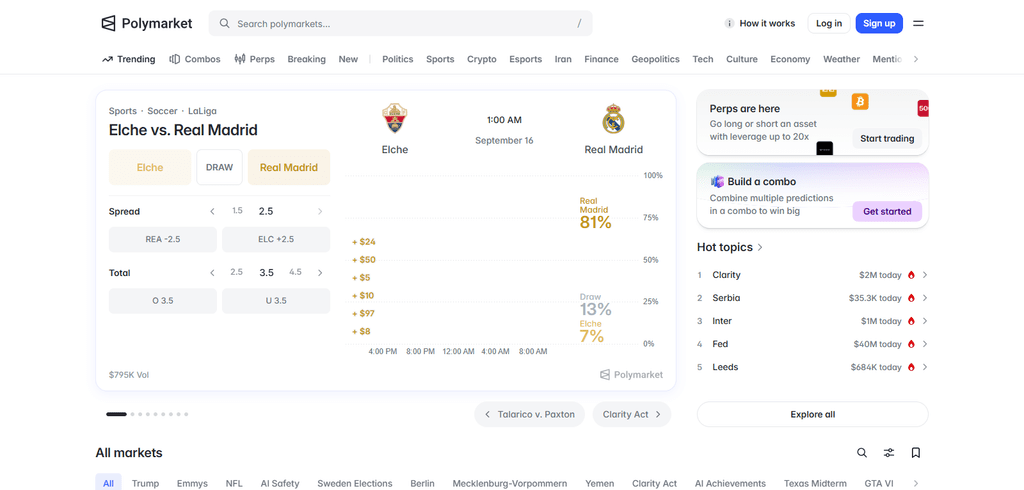
All of Polymarket’s contracts are fully transparent and settled through the UMA Optimistic Oracle in USDC. Polymarket has developed dual platforms that are both crypto native and regulated fiat-based to serve the United States. As a result, Polymarket is truly global.
| Characteristic | Details |
|---|---|
| Founded | 2020 |
| Regulation | Dual: crypto-native + U.S. fiat-regulated |
| Market Focus | Global politics, economics, culture |
| Contract Design | On-chain binary contracts |
| Liquidity | $12B+ monthly volume |
| Fees | 0.3%–1.8% |
| Accessibility | Global, USDC-based |
| Settlement | UMA Optimistic Oracle |
| Strength | Largest decentralized geopolitical market |
Polymarket Pros & Cons
Pros:
- The largest decentralized prediction market
- Global access via USDC
- Transparent blockchain settlement
- Diverse geopolitical and cultural markets
- High liquidity ($12B+ monthly volume)
Cons:
- Regulatory uncertainty in some regions
- Requires familiarity with crypto
- Fees are higher than Kalshi (0.3%–1.8%)
- Risk of oracle disputes
- Not integrated with fiat systems
3. PredictIt
PredictIt is a political market that launched in 2014 with a CFTC no-action letter and is designed for research. It focuses on U.S. elections and the outcome of U.S. policies. The price of contracts is between $0.09-$0.99 and have a cap of $3500 for each trader.
Staking profit nets a 10% fee. Traders also incur a 5% withdrawal fee. Even with these fees in place, PredictIt enjoys great status as an academic resource for political science and crowd forecasting.
| Characteristic | Details |
|---|---|
| Founded | 2014 |
| Regulation | Academic exemption (CFTC no-action letter) |
| Market Focus | U.S. elections & policy |
| Contract Design | Binary contracts ($0.01–$0.99) |
| Liquidity | Limited, capped at $3,500 per trader |
| Fees | 10% profit fee + 5% withdrawal fee |
| Accessibility | U.S. academic users |
| Settlement | Cash-settled |
| Strength | Political science research credibility |
PredictIt Pros & Cons
Pros:
- Earns academic credibility for research
- Long-standing U.S. political market
- Simple binary contracts
- Strong forecasting community
- Good for political science
Cons:
- $3,500 trading cap for each market
- High fees (10% profit + 5% withdrawal)
- Poor liquidity in comparison to Polymarket/Kalshi
- Restricted to U.S. elections and policies
- Outdated compared to the rest
4. Metaculus
Metaculus was launched in 2015 as an AI forecasting marketplace. It has over 1,000 questions in areas like geopolitics, health, economics, and AI. Unlike typical marketplaces, instead of trading contracts, users answer questions by providing answer probability estimates and reputation points are earned.
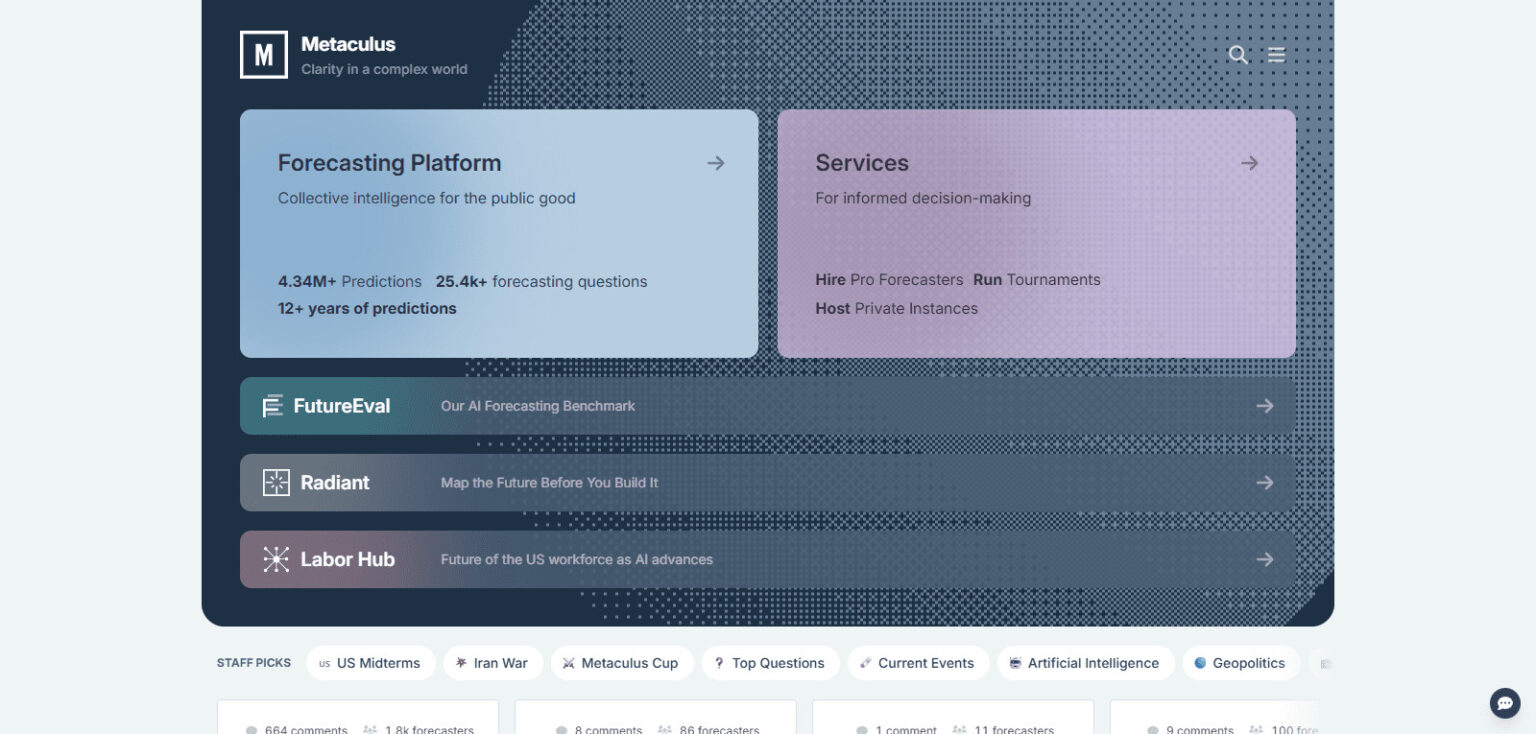
The service is free, so forecasters and researchers can use it to build records without any financial commitments. In 2026, Metaculus launched FutureEval, which benchmarks the AI forecasting bots against human experts.
| Characteristic | Details |
|---|---|
| Founded | 2015 |
| Regulation | Non-monetary forecasting |
| Market Focus | Geopolitics, AI, health, economics |
| Contract Design | Probability estimates, not trades |
| Liquidity | Reputation-based, no money |
| Fees | Free |
| Accessibility | Global researchers & forecasters |
| Settlement | Accuracy scoring |
| Strength | Benchmark for expert forecasting |
Metaculus Pros & Cons
Pros:
- Free to use
- Users gain a reputation based on the accuracy of their forecasts
- Covers Geopolitics, AI, health, economics
- Large expert community
- Benchmark for long term forecasting
Cons:
- No monetary value rewards are available
- Limited attractiveness for trading
- Settlement via scoring instead of contracts.
- Less engagement from retail users.
- Less liquidity than crypto-native exchanges.
5. Manifold Markets
Manifold’s 2022 founding saw ex-Google engineers create a play-money “Mana” trading system. It provides permissionless market creation for topics of the participants’ choosing, including geopolitics. In 2026, Manifold added sweepstakes mode for real USD prizes.
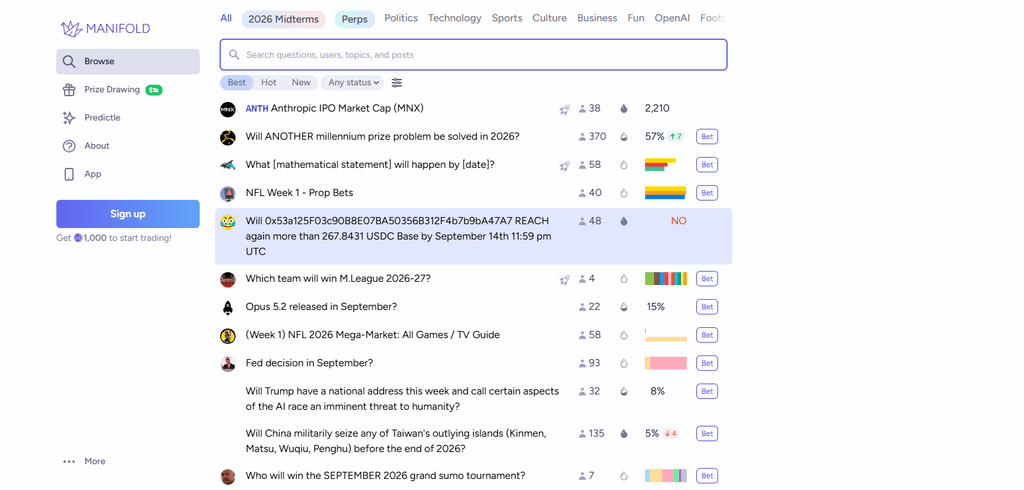
Creators have the option of using contracts that are binary or multiple-choice, as well as contracts that are numeric and are resolved by the creators. In play money mode, there are no fees. However, play money mode suffers from low liquidity when compared to either Polymarket or Kalshi. Manifold’s success is derived from the focus on building an accessible platform and a strong community for forecasting.
| Characteristic | Details |
|---|---|
| Founded | 2022 |
| Regulation | Play-money, sweepstakes mode |
| Market Focus | Geopolitics, niche topics |
| Contract Design | Binary, multiple-choice, numeric |
| Liquidity | Lower than Polymarket/Kalshi |
| Fees | None in play-money mode |
| Accessibility | Global, gamified |
| Settlement | Manual resolution by creators |
| Strength | Community-driven forecasting |
Manifold Markets Pros & Cons
Pros
- Play-money system
- Free entry via currency “Mana”
- Flexible contract design (binary, numeric, multiple choice)
- Intense community forecasting
- Real USD prizes in Sweepstakes mode
Cons
- Less liquidity than Polymarket/Kalshi
- Bias, potential for manual resolution
- Minimal real-world institutional participation
- Currency system lowers seriousness of participants
- Not regulated for real-money trading.
6. Myriad
In 2025, Farokh Sarmad started Myriad, a crypto-focused platform on the Layer-1 blockchain D.Energy. Myriad uses Chainlink oracles for settlement and targets global sports and geopolitical events. In 2026, Myriad ran a $100K FIFA World Cup contest with zero transaction costs and multi-binary contracts.
Myriad’s platform aims for community engagement and decentralized accuracy with a focus on Polymarket. Myriad’s platform is expected to grow further and be a direct competitor to Polymarket.
| Characteristic | Details |
|---|---|
| Founded | 2025 |
| Regulation | Crypto-native, decentralized |
| Market Focus | Sports + geopolitics |
| Contract Design | Multi-binary contracts |
| Liquidity | Growing, $100K+ contests |
| Fees | Zero fees in major events |
| Accessibility | Global blockchain users |
| Settlement | Chainlink oracles |
| Strength | Rising competitor in crypto markets |
Myriad Pros & Cons
Pros
- Focused on sports + geopolitics
- Crypto-native decentralised design
- Zero-fees in major contests
- Chainlink oracle settlement
- Innovative multi-binary contracts
Cons
- Less proven
- Less liquidity than Polymarket
- Minimal institutional participation
- Regulatory uncertainty
- Less global user base
7. Iowa Electronic Markets
Founded in 1988, IEM is the first of its kind: a real-money prediction market run by the University of Iowa that focuses on forecasting U.S. political elections. Accounts are capped at $500, and there are no trading fees.
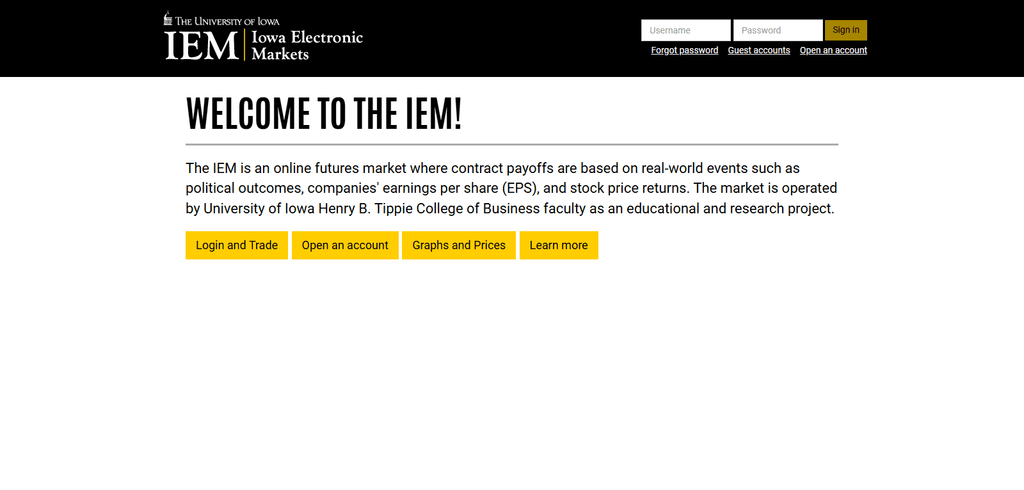
Contracts pay out $1 if the stated event is correct, which makes the market somewhat cost-effective for academia, but has limited value for the commercial market. In terms of accuracy compared to polling, IEM is the best market research benchmark in the market.
| Characteristic | Details |
|---|---|
| Founded | 1988 |
| Regulation | Academic, university-run |
| Market Focus | U.S. elections |
| Contract Design | Binary contracts ($1 payout) |
| Liquidity | Limited, $500 cap per account |
| Fees | None |
| Accessibility | Academic participants |
| Settlement | University clearing |
| Strength | Historic accuracy benchmark |
Iowa Electronic Markets Pros & Cons
Pros
- Oldest running Prediction Market
- Strong academic support
- High level of accuracy vs polls
- No trading fees
- Simple binary contracts
Cons
- $500 cap on accounts limits trading
- US election markets only
- Poor liquidity compared to other markets
- Inaccessible for global retail
- Outdated interface
8. Robinhood Predictions
In 2025, Robinhood incorporated event contracts into its retail brokerage app and ventured into prediction markets. By 2026, it added political and economic markets to its stock and crypto markets. Contracts are binary with prices quoted in cents or American odds.
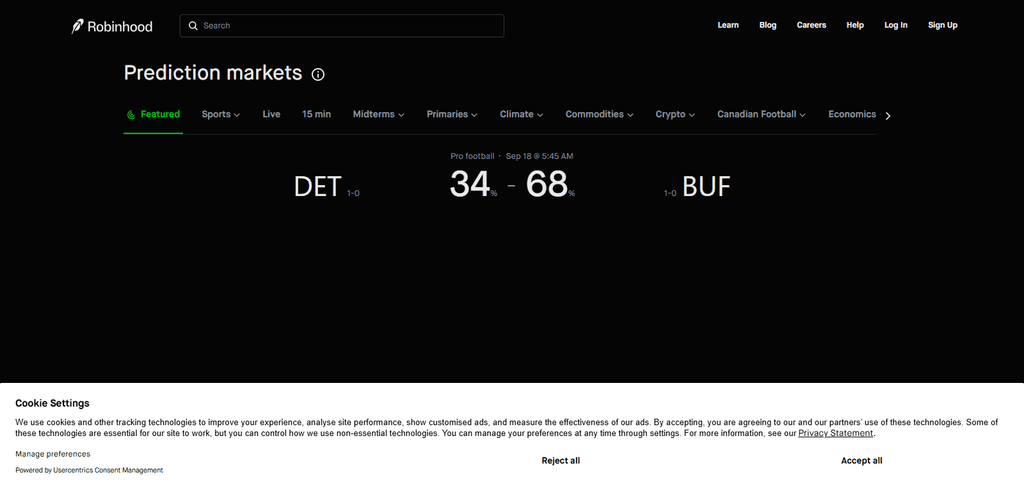
Robinhood’s product appeals to retail traders. Fees are competitive. Mass adoption is attributable to Robinhood’s 30 million plus users. Institutional partnerships and subscription services help them reach more users.
| Characteristic | Details |
|---|---|
| Founded | 2025 |
| Regulation | Retail brokerage extension |
| Market Focus | Politics + economics |
| Contract Design | Binary contracts, American odds |
| Liquidity | Mass retail adoption |
| Fees | Competitive, low |
| Accessibility | 30M+ retail traders |
| Settlement | Cash-settled |
| Strength | Mainstream retail gateway |
Robinhood Predictions Pros & Cons
Pros
- Over 30M users from integration with Robinhood
- Easy access for retail along with stocks and crypto
- Low competition fees
- Cash settlement contracts
- Possible mass adoption
Cons
- Retail focused markets
- Less institutional credibility compared to Kalshi
- Binary contracts only
- Regulation is still developing
- Potential for entertainment over accuracy
9. DraftKings Predictions
DraftKings Predictions was launched in 2025 as a part of the regulated DKeX exchange that is operated by DraftKings. This exchange offers binary options for sports, politics and economics.
DraftKings have a clear advantage over other binary options providers because their fees per contract are significantly simpler, at $0.01 to $0.02, compared to Kalshi’s percentage model. Since serving 30 million sportsbook users, DraftKings grew to servicing $11 billion in annualized trading volume in just 2026. DraftKings strong suit is in synthesizing sports with geopolitics and their user experience design.
| Characteristic | Details |
|---|---|
| Founded | 2025 |
| Regulation | CFTC-regulated via DKeX |
| Market Focus | Sports + politics |
| Contract Design | Binary contracts |
| Liquidity | $11B annualized volume |
| Fees | Flat $0.01–$0.02 per contract |
| Accessibility | 30M sportsbook users |
| Settlement | Exchange clearing |
| Strength | Sports-geopolitics crossover |
DraftKings Predictions Pros & Cons
Pros:
- CFTC-regulated via DKeX exchange
- Strong crossover with sports betting
- Flat low fees ($0.01–$0.02 per contract)
- Large sportsbook user base (30M+)
- High liquidity ($11B annualized volume)
Cons:
- Focused heavily on sports-geopolitics crossover
- Less academic credibility
- Binary-only contract design
- New entrant, still scaling
- Retail-heavy, limited institutional adoption
10. Crypto.com Predictions
Crypto.com launched its first prediction market offering in 2025. Using its market position with over 80 million cryptocurrency users, it built prediction markets around geopolitics and economics. It offers a competitive trading fee structure and often waives fees for promotions.
Blockchain-based contracts provide users with options for settlement in fiat and crypto currency. Furthermore, Crypto.com has the regulatory partnerships and scale necessary to be a trusted entry point for mainstream prediction trading.
| Characteristic | Details |
|---|---|
| Founded | 2025–26 |
| Regulation | Exchange-integrated |
| Market Focus | Global politics + economics |
| Contract Design | Blockchain-settled contracts |
| Liquidity | Large crypto user base |
| Fees | Competitive, often waived |
| Accessibility | 80M+ global users |
| Settlement | Crypto + fiat |
| Strength | Mainstream crypto gateway |
Crypto.com Predictions Pros & Cons
Pros:
- Integrated with Crypto.com’s 80M+ users
- Global fiat + crypto access
- Competitive fees, often waived
- Blockchain-settled contracts
- Strong mainstream crypto gateway
Cons:
- Regulatory uncertainty in some regions
- New platform, still building credibility
- Limited institutional adoption compared to Kalshi
- Focused more on retail than research
- Dependent on Crypto.com ecosystem
Conclusion
In 2026, Kalshi, Polymarket, PredictIt, Metaculus, Manifold Markets, Myriad, Iowa Electronic Markets, Robinhood Predictions, DraftKings Predictions, and Crypto.com Predictions will be the top 10 geopolitical prediction market platforms.
This group showcases the range of sanctioned exchanges along with crypto-native platforms and academic forecasting portals. Prediction markets have evolved enough to be major players in the understanding of global politics, economics, and policy end results. This is what makes 2026 a huge year for predictive trading and forecasting geopolitical events.
FAQ
What is a geopolitical prediction market?
A geopolitical prediction market is a platform where users trade contracts based on the outcome of political, economic, or global events. Prices reflect the probability of an event occurring, making them useful forecasting tools.
Which platform is fully regulated?
Kalshi is the only CFTC-regulated exchange in the U.S., offering legally compliant event contracts. DraftKings Predictions also operates under CFTC oversight.
Which platform has the highest liquidity?
Polymarket leads globally with billions in monthly trading volume, thanks to its crypto-native design and international accessibility.
Which platform is best for academic research?
PredictIt and Iowa Electronic Markets are primarily used for political science research, offering capped accounts and academic exemptions.
Which platform is free to use?
Metaculus and Manifold Markets allow free participation, focusing on forecasting accuracy rather than monetary trading.