





This article reviews the Best Virtual Data Room Providers for M&A in 2026 including security measures, compliance certifications, AI and pricing for various deal size tiers. These services help reduce the friction for due diligence, maintain confidentiality, and assist in the intricate transactions of multiple jurisdictions.
An appropriate VDR can make a big difference to efficiency and costs, while increasing the chance of deal completion success in mergers and acquisitions.
What Is a Virtual Data Room for M&A?
A Virtual Data Room (VDR) is an online resource where documentation for a merger and acquisition (M&A) deal can be shared securely. Different parties involved in the deal may include buyers, sellers, and consultants. VDRs provide the ability to control document access and audit logs. Ultimate deal protection is important.
Therefore, VDRs are constructed with top enterprise security and compliance standards such as SOC 2, ISO 27001, and GDPR. Document AI capabilities include auto indexing, redaction, and document Q&A-based due diligence workflows.
Finally, VDRs reduce risks through transparency and deal efficiency with controlled access. VDRs are essential for complex M&A transactions because of the Doc protection, transparency, and the intellectual property safeguards and regulatory compliance they provide throughout different jurisdictions.
How We Selected the 10 Best VDR Providers
| Provider | Security & Compliance | Key M&A Features | M&A Fit | Best Use Case | Best For | Weight (%) |
|---|---|---|---|---|---|---|
| Intralinks | SOC 2, ISO 27001, GDPR, HIPAA | AI redaction, predictive analytics | Bulge‑bracket ($50M+ deals) | Complex cross‑border M&A | Global banks, Fortune 500 | 25 |
| Datasite | SOC 2, ISO 27001, GDPR | AI tagging, smart redaction, analytics | Mid‑cap ($20M–200M) | Investment bank workflows | Law firms, PE mid‑market | 20 |
| Firmex | SOC 2 Type II, GDPR | Automated indexing, permission management | Lower‑middle market ($5M–50M) | SMB diligence | Advisors, boutique firms | 15 |
| iDeals | ISO 27001, GDPR, MFA | Smart search, multilingual Q&A | Fast onboarding, global M&A | Cross‑border transactions | Startups, SMBs | 12 |
| DealRoom | SOC 2 Type II, GDPR | Workflow + VDR hybrid, Q&A automation | Serial acquirers, PE firms | Parallel deal management | Corporate development teams | 12 |
| Ansarada | ISO 27001, SOC 2, ESG modules | Readiness scoring, ESG diligence | ESG‑heavy or IPO prep | Compliance‑driven M&A | ESG‑focused firms | 10 |
| FirmRoom | SOC 2 Type II, GDPR | Smart search, workflow tracking | SMB & search‑fund deals | Affordable acquisitions | Small acquirers | 8 |
| Onehub | SOC 2, role‑based permissions | Drag‑and‑drop uploads, activity tracking | Budget sub‑$5M deals | Quick SMB diligence | Small businesses | 6 |
| Caplinked | SOC 2 Type II, GDPR | Workflow templates, permission management | Small‑mid deals | Startup fundraising | Mid‑sized firms | 6 |
| Box M&A Workflow | SOC 2, HIPAA, ISO 27001 | AI search, secure sharing | Enterprises using Box | Cloud collaboration | Large corporates | 8 |
1. Intralinks
Intralinks was founded in 1996 and has since then worked primarily with Bulge Bracket Banks on deals of a billion dollars or more. The platform is SOC 2 Type II and ISO 27001 certified and thus compliant with enterprise-level demands.

The platform uses AI for automated document redaction, along with document sorting and analytics. Ease of use and cost means that Intralinks is considered the “gold standard” for deals of higher risks and complexity. Intralinks can be too costly and complex for less serious deals and is therefore not an ideal option for smaller deals.
Security & Compliance: SOC 2 Type II, ISO 27001, GDPR, HIPAA certified.
Key M&A Features: AI redaction, predictive analytics, deep audit trails.
M&A Fit: Bulge‑bracket ($50M+ deals).
Best Use Case: Complex cross‑border transactions.
Best For: Global banks, Fortune 500 corporations.
Intralinks Pros & Cons
| Pros | Cons |
|---|---|
| Industry gold standard for large M&A | Very expensive ($15K–$150K/year) |
| SOC 2 Type II & ISO 27001 certified | Complex interface, steep learning curve |
| Trusted by bulge‑bracket banks | Overkill for small deals |
| Advanced AI redaction & analytics | Limited flexibility for SMBs |
| Global compliance coverage (GDPR, HIPAA) | High onboarding time |
| Deep audit trails for regulators | Requires IT support |
| Handles billion‑dollar transactions | Not budget‑friendly |
| Strong brand reputation | Less agile vs newer platforms |
| 24/7 global support | Customization limited |
2. Datasite
Datasite was founded in 1968 as Merrill Corporation and rebranded in 2020. It is a leader for mid-market M&A deals. The platform is SOC 2, GDPR, and ISO 27001 certified. Provided is a secure access control and advanced audit trails. Datasite’s AI consists of auto tagging, deal analytics, and smart redaction.

The technology of Datasite processes 13,000+ deals in a given year. Like the other providers, pricing is dependent on the desired features and size of the deal and falls in the range of $10k to $100k a year. Law firms and investment banks use Datasite because of the strong workflow and platform functionality, but smaller clients may deem it too expensive and complex.
Security & Compliance: SOC 2, ISO 27001, GDPR compliant.
Key M&A Features: AI tagging, smart redaction, deal analytics.
M&A Fit: Mid‑cap deals ($20M–200M).
Best Use Case: Investment bank workflows.
Best For: Law firms, PE mid‑market funds.
Datasite Pros & Cons
| Pros | Cons |
|---|---|
| SOC 2, ISO 27001, GDPR compliant | Pricing $10K–$100K/year |
| AI tagging & smart redaction | Complex workflows |
| Used in 13K+ deals annually | Overkill for <$20M deals |
| Strong law firm adoption | UI less intuitive |
| Deep analytics & reporting | Limited SMB appeal |
| Global support & multilingual | Requires training |
| Trusted by PE & banks | Higher cost vs Firmex |
| Workflow depth unmatched | Slower setup |
| Strong brand credibility | Niche for mid‑cap |
3. Firmex
Firmex is a virtual data room (VDR) provider based in Toronto, Canada. With a focus on affordability, Firmex offers transparent pricing and has a strong presence in smaller to lower middle market transactions. Firmex pricing is in the $5K – $30K range, making it a good option for a majority of SMB and mid-market advisory firms.

Currently over 5000 transactions use Firmex, which points to a good value proposition, even with a lack of deep AI, when compared to the likes of Datasite and Ansarada. SOC 2 Type II certification and GDPR compliance provide Firmex with an edge in the market. Simplicity is key for Firmex with focus on the reliable basics.
Firmex products offer automated permissions and AI based indexing, however stop short of providing full predictive AI analytics. This focus on simplicity is what gives Firmex a leg up against the competition.
Security & Compliance: SOC 2 Type II, GDPR certified.
Key M&A Features: Automated indexing, permission management.
M&A Fit: Lower‑middle market ($5M–50M).
Best Use Case: SMB diligence and boutique advisory.
Best For: Advisors, boutique firms, SMB acquirers.
Firmex Pros & Cons
| Pros | Cons |
|---|---|
| Transparent pricing ($5K–$30K/year) | Limited AI sophistication |
| SOC 2 Type II certified | Less suited for large deals |
| Easy to use, reliable | Fewer advanced modules |
| Popular in 5K+ deals/year | Not ideal for ESG diligence |
| Strong SMB adoption | Less predictive analytics |
| GDPR compliant | Limited global brand |
| Affordable for advisors | Smaller feature set |
| Quick onboarding | Less innovation |
| Strong reputation in mid‑market | Not enterprise‑focused |
4. iDeals
Since 2008, iDeals has been a global VDR provider with a reputation of fast onboarding and support for multiple languages. iDeals has an AI offering for smart search and workflow optimization, along with automated Q&A.

iDeals helps customers execute deals quickly with its focus on speed and ease of use. As a global VDR provider, iDeals has the same ISO 27001 and GDPR compliance certifications that focus on the secure sharing of documents.
Pricing starts at $3K and goes up to $15K, making iDeals an affordable option for startups and SMBs involved in cross border transactions. As with Firmex, the ease of use and speed of iDeals is appreciated, however most legacy providers like Intralinks and Datasite have more sheer brand presence, even if their technology is outdated.
Security & Compliance: ISO 27001, GDPR, multi‑factor authentication.
Key M&A Features: Smart search, multilingual Q&A automation.
M&A Fit: Fast onboarding, global M&A.
Best Use Case: Cross‑border transactions requiring speed.
Best For: Startups, SMBs, international deals.
iDeals Pros & Cons
| Pros | Cons |
|---|---|
| Affordable ($3K–$15K/year) | Less brand recognition |
| ISO 27001 & GDPR compliant | Limited enterprise adoption |
| Fast onboarding (30 min) | Fewer advanced AI tools |
| Multilingual support | Smaller market share |
| Granular permissions | Not ideal for billion‑dollar deals |
| Smart search & Q&A automation | Limited compliance modules |
| User‑friendly interface | Less suited for regulated industries |
| Strong SMB adoption | Less depth vs Datasite |
| Global reach | Niche positioning |
5. DealRoom
Built in 2012, DealRoom is a project management and VDR technology fusion. Its services earn the Sofia Compliance and Trust Mark (SOC) 2 Type II and are GDPR-compliant, enhancing secure collaboration.

DealRoom has workflow Q&A and task tracking, as well as predictive deal analytics, making it a strong offering for serial acquirers. Deals range from $8K to $50K annually, depending on deal volume and modules.
Although DealRoom has integrated technology, it can be more complicated to use as compared to simpler VDRs such as Firmex or iDeals, for which deal teams like PE and corporate development deal teams like.
Security & Compliance: SOC 2 Type II, GDPR compliant.
Key M&A Features: Hybrid VDR + project management, Q&A automation.
M&A Fit: Serial acquirers, PE firms.
Best Use Case: Parallel deal management.
Best For: Corporate development teams, PE firms.
DealRoom Pros & Cons
| Pros | Cons |
|---|---|
| SOC 2 Type II & GDPR compliant | Steeper learning curve |
| Hybrid VDR + project management | Pricing $8K–$50K/year |
| AI task tracking & Q&A | Not ideal for small deals |
| Workflow automation | Requires training |
| Popular with PE firms | Less brand recognition |
| Parallel deal management | Overkill for <$10M deals |
| Strong analytics | Limited SMB appeal |
| Integrated collaboration | Higher cost vs FirmRoom |
| Modern interface | Niche positioning |
6. Ansarada
Founded in 2005, in Australia, Ansarada offers AI as a readiness platform, which is ISO 27001 certified and SOC 2 compliant, with very robust ESG due diligence modules.
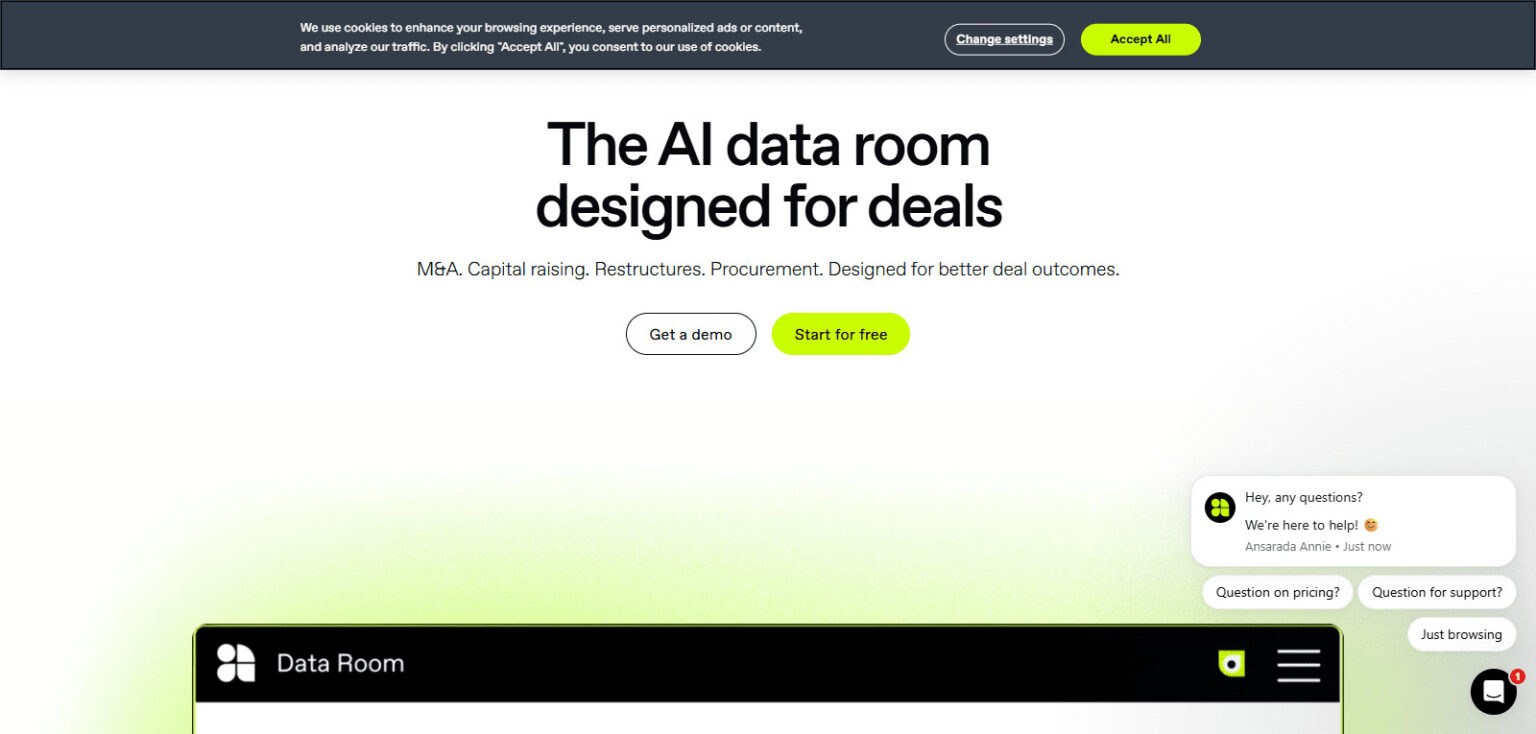
Ansarada has workflow automation and predictive analytics, as well as scoring readiness to help companies prepare for M&A, IPOs, and audits. Deals costs range from $8K to $50K annually. Ansarada excels in ESG and compliance-intensive deals, but has less deal market share than Intralinks and Datasite.
Security & Compliance: ISO 27001, SOC 2, ESG modules.
Key M&A Features: Readiness scoring, ESG diligence, AI workflows.
M&A Fit: ESG-Heavy or IPO Prep Deals.
Best Use Case: Compliance-Focused M&A and IPO Readiness.
Best For: ESG-Focused Firms, IPO Candidates.
Ansarada Pros & Cons
| Pros | Cons |
|---|---|
| ISO 27001 & SOC 2 certified | Pricing $8K–$50K/year |
| ESG diligence modules | Niche positioning |
| AI readiness scoring | Less mainstream |
| IPO prep workflows | Overkill for SMBs |
| Predictive analytics | Limited adoption outside ESG |
| Strong compliance focus | Higher cost |
| Trusted in ESG‑heavy deals | Smaller global footprint |
| Workflow automation | Less intuitive UI |
| Global reach | Specialized use case |
7. FirmRoom
Secure document sharing is what makes FirmRoom stand out as a modern, approachable VDR for SMBs and Search funds. FirmRoom was founded in 2016 and features SOC 2 Type 2 certification and GDPR.
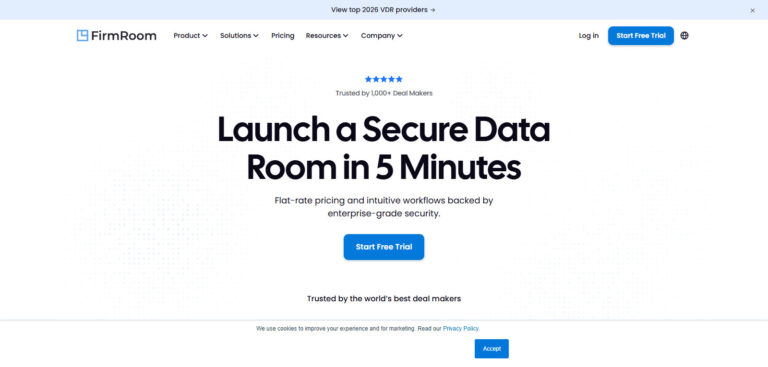
FirmRoom uses AI for all document sharing, permissions, and workflows, but in comparison to enterprise AI, this is on the lighter end.
FirmRoom is considerably more budget friendly, ranging from $2K to $15K. This is ideal for smaller deals. FirmRoom has an extremely clean UI with great prices. FirmRoom lacks advanced compliance modules that are required in industries with heavy regulation.
Security & Compliance: SOC 2 Type II, GDPR Certified.
Key M&A Features: Smart Search, Workflow Tracking.
M&A Fit: SMB and Search Fund Acquisitions.
Best Use Case: Affordable Small-Scale Acquisitions.
Best For: Small Acquirers and Search Funds.
FirmRoom Pros & Cons
| Pros | Cons |
|---|---|
| Affordable ($2K–$15K/year) | Limited enterprise compliance |
| SOC 2 Type II & GDPR compliant | Not suited for large deals |
| Modern UI | Fewer advanced AI tools |
| Smart search & permissions | Smaller adoption |
| Workflow tracking | Limited ESG modules |
| Quick onboarding | Less brand recognition |
| Ideal for SMBs & search funds | Not for Fortune 500 |
| Easy to use | Limited analytics |
| Cost‑effective | Narrow focus |
8. Onehub
Onehub takes a similar approach to FirmRoom, targeting SMBs with a simple VDR offering secure role-based permissions, plus SOC 2 compliance. Onehub’s certifications are also less extensive than those offered by enterprise vendors.
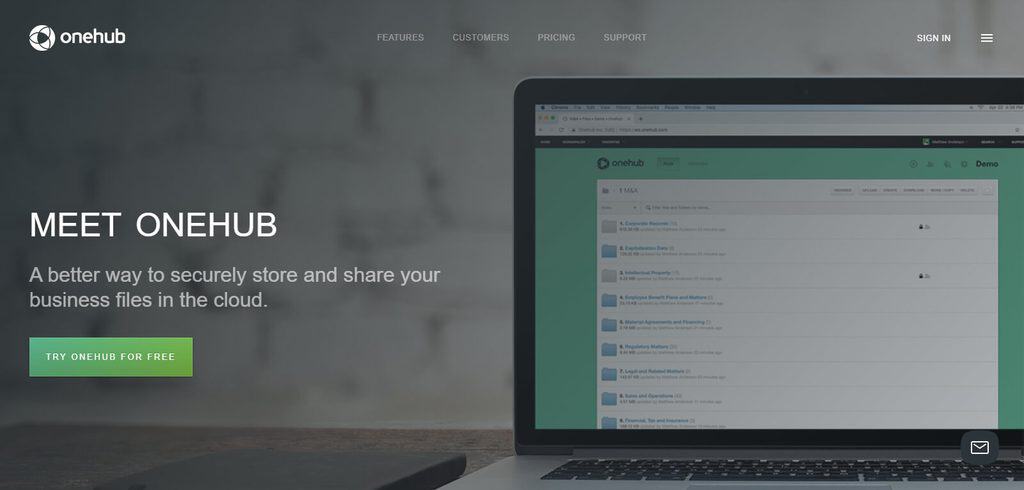
Onehub also has automation for their VDR including permission templates, drag and drop uploads, and activity tracking, however this automation is also lacking in comparison to enterprise VDRs. Onehub’s prices start from $1K and go up to $10K, making them a good budget-friendly option, particularly for deals under $5M.
Onehub’s ease of use and deployment speed are other advantages of their product. Unfortunately, Onehub is not a good option for more complex or regulated M&A transactions.
Security & Compliance: SOC 2, Role-Based Permissions.
Key M&A Features: Drag & Drop Uploads, Activity Tracking.
M&A Fit: Budget Sub-$5M Deals.
Best Use Case: Quick SMB Diligence.
Best For: Small Businesses, Startups.
Onehub Pros & Cons
| Pros | Cons |
|---|---|
| Affordable ($1K–$10K/year) | Limited certifications |
| SOC 2 compliant | Not ISO 27001 |
| Simple drag‑and‑drop uploads | Weak AI |
| Role‑based permissions | Not suited for large M&A |
| Easy setup | Limited compliance |
| SMB‑friendly | Not for regulated industries |
| Quick deployment | Few advanced features |
| Budget‑friendly | Smaller adoption |
| User‑friendly | Limited scalability |
9. Caplinked
Built in 2010, Caplinked provides flexible VDR (Virtual Data Room) services for small to mid-sized deals in the US. Caplinked receives a SOC 2 Type II certification and complies with GDPR and so provides secure collaborating services. Features like permission management, activity logging, workflow automation, and templates are available, but Caplinked lags behind Datasite or Ansarada.

Costs range between $2k – $15k, making it attractive to startups and smaller firms. Caplinked prides itself on usability and cost effectiveness, but has limited market penetration in large deals of the M&A market.
Security & Compliance: SOC 2 Type II, GDPR Compliant.
Key M&A Features: Workflow Templates, Permission Management.
M&A Fit: Small-Mid Market Deals.
Best Use Case: Startup Fundraising and Mid-Market Acquisitions.
Best For: Mid-Sized Firms and Startups.
Caplinked Pros & Cons
| Pros | Cons |
|---|---|
| Affordable ($2K–$15K/year) | Limited AI |
| SOC 2 Type II & GDPR compliant | Smaller adoption |
| Workflow templates | Not suited for large deals |
| Permission management | Limited compliance depth |
| Easy collaboration | Less brand recognition |
| SMB‑friendly | Not enterprise‑focused |
| Startup fundraising fit | Limited analytics |
| Quick onboarding | Narrow feature set |
| US‑based support | Less global reach |
10. Box M&A Workflow
Box delivers a M&A workflow solution constructed on its enterprise cloud platform. It has strong compliance with SOC 2 and HIPAA certifications, and ISO 27001, making it compliant across a range of industries.

Box uses AI to enable smart search, auto-label, auto-classify, and collaborate on tasks, but is not a full service VDR. Prices will be custom, based on the modules and licenses of the enterprise level agreement.
Box M&A Workflow is a solid option for workflow integrations for clients using Box, but for M&A tasks and features lags behind provider specific systems such as Intralinks or Datasite.
Security & Compliance: SOC 2, HIPAA, ISO 27001 Certified.
Key M&A Features: AI Search, Secure Sharing, Cloud Collaboration.
M&A Fit: Enterprises Using Box.
Best Use Case: Integration within the Box Ecosystem.
Best For: Large Corporates and Enterprise Teams.
Box M&A Workflow Pros & Cons
| Pros | Cons |
|---|---|
| SOC 2, HIPAA, ISO 27001 certified | Not a full VDR |
| AI search & tagging | Limited M&A features |
| Secure sharing | Custom pricing |
| Seamless Box integration | Requires Box ecosystem |
| Enterprise‑ready | Not SMB‑friendly |
| Cloud collaboration | Limited Q&A modules |
| Strong compliance | Less specialized |
| Trusted brand | Not tailored for M&A |
| Global enterprise adoption | Overkill for small deals |
Conclusion
In closing, in 2026 the Virtual Data Room (VDR) segmentation by deal size, compliance, and workflow complexity is apparent. In large and mid-cap transactions, Intralinks and Datasite continue to dominate with enterprise level security and AI automation. For lower middle market transactions, Firmex and iDeals provide secure solutions with reasonable pricing.
For workflow integration and ESG compliance, DealRoom and Ansarada are prominent. For workflow integration with ESG, relative ease, and compliance balancing at the lower end, FirmRoom, Onehub, and Caplinked provide VDR solutions to SMBs and smaller acquisitions.
For enterprises using Box, the Box M&A Workflow provides integration for seamless workflows. The combination of deal complexity, compliance requirements, and adhering to a budget helps practitioners select the appropriate VDR.
FAQ
What is a Virtual Data Room?
A Virtual Data Room (VDR) is a secure online platform used during M&A transactions to store, share, and manage confidential documents. It ensures compliance, provides audit trails, and enables controlled access for buyers, sellers, and advisors.
Which VDR is best for large M&A deals?
Intralinks and Datasite are the most trusted for large and mid‑cap transactions. They offer enterprise‑grade compliance (SOC 2, ISO 27001) and advanced AI features like automated redaction and predictive analytics, making them ideal for billion‑dollar deals.
Which VDR is most affordable for SMBs?
FirmRoom, Onehub, and Caplinked are budget‑friendly options, with pricing starting as low as $1K annually. They provide secure sharing and basic automation, suitable for deals under $10M.
Do all providers offer AI automation?
Not all. Datasite, Ansarada, and DealRoom lead in AI automation with smart tagging, readiness scoring, and workflow analytics. Budget providers like Onehub and Caplinked focus more on simplicity than advanced AI.